
Open data, citation and reuse
Use, cite and scrutinize the tracker.
Explore 172 source-linked records in dataset version 2026-10-25.1. The canonical JSON preserves stable record IDs, evidence labels, source URLs and correction histories.
JSON is canonical; CSV omits some nested fields. The /v1/ URLs remain the live exports. For a fixed, version-addressable snapshot, use the Zenodo release published August 2, 2026.
Cite this tracker
For articles, papers and datasets, cite the version DOI below. It resolves to the exact archived files for dataset version 2026-08-01.1.
Kingy AI. “Mathematics & Science Breakthrough Tracker.” Dataset version 2026-08-01.1, schema version 1.0.0. Zenodo, 2026. https://doi.org/10.5281/zenodo.21753206 (accessed October 25, 2026).
Reuse and attribution
The files in the fixed Zenodo release are licensed under Creative Commons Attribution 4.0 International. Credit Kingy AI, cite the version DOI and identify dataset version 2026-08-01.1.
Linked papers, images, websites and other third-party source materials are not part of the deposit and are not relicensed. Their original terms continue to apply.
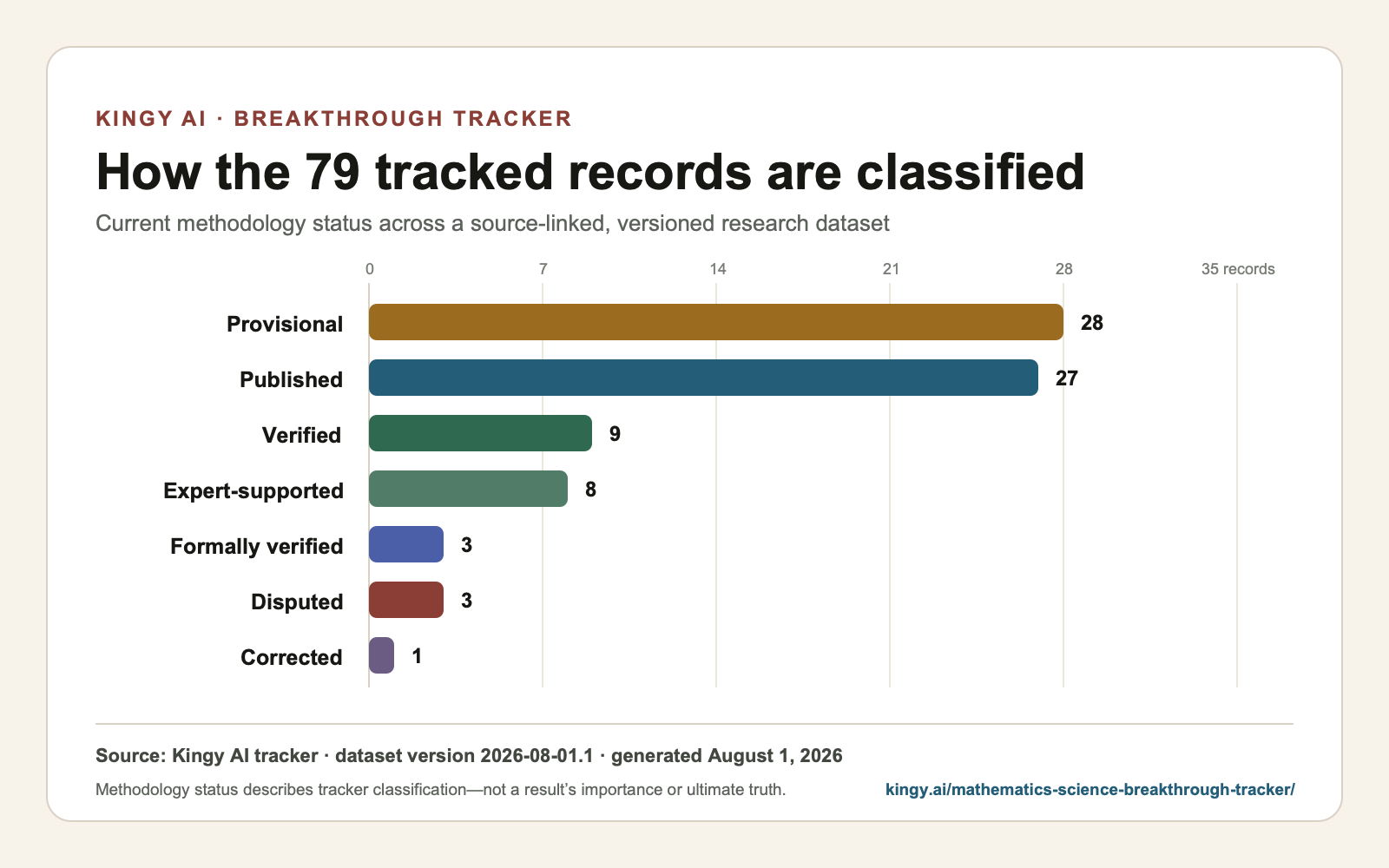
| Methodology status | Records |
|---|---|
| Provisional | 28 |
| Published | 27 |
| Verified | 9 |
| Expert-supported | 8 |
| Formally verified | 3 |
| Disputed | 3 |
| Corrected | 1 |
A continuously maintained, source-linked index of notable claimed and confirmed advances in mathematics and science. Mathematics receives the deepest coverage, with explicit labels for peer review, formal verification, early evidence, disputes and corrections.
Coverage promise: This tracker aims for broad, systematic coverage; it is not a claim of literal completeness. Reporting delays and omissions are possible. A posted manuscript establishes that a result has been claimed, not that the field has accepted it.
Last checked: 25 October 2026 · mathematics-first 72-hour evidence and integrity refresh
Update cadence: Every 72 hours. Qualifying evidence is added when available, and no-change passes are logged without manufacturing a quota.
Dataset and archive note: The current dataset contains 172 distinct current records represented by 208 append-only revision rows. The cited Zenodo release, chart and accessible table remain the fixed 79-record version 2026-08-01.1; they are a permanent archive, not the current live count.
New and updated in this maintenance cycle
This refresh adds three evidence-qualified provisional mathematics records and materially revises one formal-proof record. It preserves the distinction between a primary claim, a parallel preprint and independent specialist validation.
- An AI-assisted preprint claims a counterexample to Simon’s multidimensional L2 conjectureAdded · Mathematics
- Parallel preprints claim the corrected Cheng–Murray deep-hole classificationAdded · Mathematics and theoretical computer science
- An AI-assisted preprint constructs a critical two-dimensional KPZ processAdded · Mathematics and mathematical physics
- A Lean-checked construction disproves Vaught’s conjecture for infinitary logicMaterially revised · Mathematics
Search and filter the tracker
91 tracked records
Mathematics breakthroughs
An AI-assisted preprint claims a counterexample to Simon's multidimensional L2 conjecture
Becker and Yang construct, for every dimension at least two and every weight exponent below one third, smooth bounded nonnegative potentials with arbitrarily small weighted L2 size whose Schrödinger operators have pure point spectrum throughout the positive axis. If correct, the construction disproves Barry Simon's Problem 8.
- Problem or result
- Barry Simon's multidimensional weighted-L2 conjecture for preservation of absolutely continuous spectrum
- Authors
- Simon Becker and Mengxuan Yang
- Institutions
- Bocconi University; Texas A&M University
- Result date
- First-version preprint submitted October 22, 2026
Why it matters: The conjecture sought a broad integrability condition guaranteeing that multidimensional Schrödinger operators retain continuous spectrum. A valid counterexample would rule out that program even under a stronger positive spatial weight and with arbitrarily small bounded potentials.
Limits: This is a new unrefereed preprint with no independent specialist correctness assessment located in this cycle. The construction is highly parameter-sensitive, and the tracker has not reproduced its spectral-averaging argument. The record therefore says claimed counterexample, not proved theorem.
Sources and record details
Stable ID: math-simon-l2-conjecture-counterexample-2026 · Permanent record URL
AI involvement: The authors say the first construction emerged in discussions with ChatGPT, which later supplied the parameter adjustment leading to point spectrum and the extension to the full positive spectrum. They rewrote the argument and take responsibility for the manuscript; the model version is not disclosed.
Change history
- 2026-10-25 — Added after primary-source, scope, status, AI-role and limitation review.
Parallel preprints claim the corrected Cheng–Murray deep-hole classification
Fang claims to settle the remaining low-dimensional cases and, with earlier high-dimensional results, prove the corrected Cheng–Murray conjecture for full-length Reed–Solomon codes in every nonexceptional dimension. Chen and Huang independently cover every dimension for fields larger than 19,683, while Fan supplies exact classifications for several interpolation-degree ranges and reproducible finite certificates.
- Problem or result
- Corrected Cheng–Murray conjecture on deep holes of full-length Reed–Solomon codes
- Authors
- Weijun Fang; Bocong Chen and Jing Huang; Xiang Fan
- Institutions
- Shandong University; South China University of Technology; Guangzhou University; Sun Yat-sen University
- Result date
- Parallel first-version preprints submitted October 21 and 22, 2026
Why it matters: Deep holes describe received words at maximum distance from a code and connect decoding theory to arcs and maximum-distance-separable extensions in finite geometry. A correct full classification would close a problem posed in 2007 while isolating the known characteristic-two exceptions.
Limits: All three manuscripts are recent and unrefereed. Their scopes overlap without being identical: Fang's full claim relies on earlier high-dimensional classification, Chen and Huang impose a field-size threshold, and Fan proves degree-specific and bounded classifications rather than the whole conjecture. The tracker found no external specialist verdict and does not merge those scopes into stronger evidence than the papers supply.
Sources and record details
Stable ID: math-cheng-murray-reed-solomon-deep-holes-2026 · Permanent record URL
- Primary Fang, The Cheng–Murray Conjecture on Deep Holes of Full-Length Reed–Solomon Codes
- Independent parallel preprint Chen and Huang, Deep holes of full-length Reed–Solomon codes
- Independent parallel preprint Fan, Uniform bounds and exact classifications for Reed–Solomon deep holes
AI involvement: Fang reports using GPT-6 to polish the exposition and check some main proofs. Fan reports GPT-5.6 Sol and GPT-6 Astra assistance with exploratory proof development, computation, literature searches and polishing. Chen and Huang disclose no substantive AI role in the inspected manuscript. Each author group retains responsibility.
Change history
- 2026-10-25 — Added after primary-source, scope, status, AI-role and limitation review.
An AI-assisted preprint constructs a critical two-dimensional KPZ process
Berger, Caravenna, Clark and collaborators construct a non-Gaussian distribution-valued process as the critical limit of centred log partition functions for two-dimensional Gaussian directed polymers and as a renormalized Cole–Hopf functional of the critical stochastic heat flow.
- Problem or result
- Construction and characterization of a critical two-dimensional KPZ process
- Authors
- Quentin Berger, Francesco Caravenna, Jeremy Clark, Alexander Dunlap, Yu Gu, Ziyang Liu, Shuta Nakajima, Rongfeng Sun, Li-Cheng Tsai, Zuodi Xie and Nikos Zygouras
- Institutions
- Université Sorbonne Paris Nord; University of Milano-Bicocca; University of Mississippi; Duke University; University of Maryland; Hong Kong University of Science and Technology; Keio University; National University of Singapore; University of Utah; University of Warwick
- Result date
- First-version preprint submitted October 22, 2026
Why it matters: The two-dimensional KPZ equation is ill-defined at criticality without renormalization. The proposed process supplies a nontrivial critical object, connects it to the previously constructed stochastic heat flow and identifies non-Gaussian local behavior at the marginal dimension.
Limits: This is an 84-page unrefereed preprint and no independent specialist correctness assessment was located. The result is a mathematically constructed scaling limit, not an experimental demonstration or a claim that every two-dimensional KPZ model has been solved. Its extensive AI contribution makes author checking important but is not independent validation.
Sources and record details
Stable ID: math-critical-two-dimensional-kpz-process-2026 · Permanent record URL
- Primary Berger and collaborators, The Critical 2D KPZ Process
- Foundational context Caravenna, Sun and Zygouras, The critical 2D stochastic heat flow
AI involvement: The eleven authors report extensive work with ChatGPT 5.5, 5.6 and 6. They attribute contributions to tightness, convergence to a unique limit and non-Gaussianity, describe discarded AI-generated approaches, and state that they checked and revised the arguments and take responsibility for the final manuscript.
Change history
- 2026-10-25 — Added after primary-source, scope, status, AI-role and limitation review.
Independent rewrites support OpenAI's quasi-Riemann and Landau–Siegel claims
OpenAI manuscripts claim a zero-free half-plane Re(s) greater than 11/12 for every Dirichlet L-function and a uniform exclusion of Landau–Siegel zeros. Independent preprints by William D. Banks and Bryce Kerr reconstruct the Landau–Siegel argument, with Banks supplying explicit constants.
- Problem or result
- Quasi-Riemann hypothesis for Dirichlet L-functions and exclusion of Landau–Siegel zeros
- Authors
- OpenAI; independent proofs by William D. Banks and Bryce Kerr
- Institutions
- OpenAI; University of Missouri (William D. Banks); School of Science, UNSW Canberra (Bryce Kerr). Banks also acknowledges support from the Max Planck Institute for Mathematics in Bonn.
- Result date
- OpenAI manuscripts dated October 1 and 5; independent preprints submitted October 11 and 15; specialist assessment published October 19, 2026
Why it matters: A fixed zero-free half-plane would materially strengthen control of primes in arithmetic progressions and settle the Landau–Siegel exceptional-zero problem. Independently authored, AI-assisted expositions make the argument more inspectable, while their authors retain responsibility for checking it.
Limits: None of the papers is peer reviewed. Specialists quoted by Quanta largely judged the 11/12 argument correct, but Peter Sarnak declined to call it a theorem until every detail is checked, and experts set aside a separate stronger 7/8 manuscript because its exposition was too difficult to audit. The tracker therefore does not mark either claim as an unqualified proved theorem.
Sources and record details
Stable ID: math-quasi-riemann-landau-siegel-2026 · Permanent record URL
- Primary OpenAI quasi-Riemann hypothesis manuscript
- Primary OpenAI Landau–Siegel zero exclusion manuscript
- Independent proof Banks direct proof with explicit constants
- Independent proof Kerr simplified Landau–Siegel proof
- Independent specialist assessment Quanta assessment of the quasi-Riemann proof
AI involvement: OpenAI attributes the originating manuscripts to an internal frontier model with human assistance. Banks reports using Claude to expand and revise the proof, work out explicit constants, check arguments and references, and prepare text and figures. He states that he checked every line and takes full responsibility. Kerr credits ChatGPT with assistance in the mathematical development and preparation of his paper. These are independently authored, AI-assisted expositions; the authors remain responsible for their arguments.
Change history
- 2026-10-22 — Added after primary-source, scope, status, AI-role and limitation review.
- 2026-10-22 — Corrected the scope of Banks's Claude assistance, added Kerr's ChatGPT disclosure and verified both university affiliations. Proof claims, evidence tier, peer-review state and provisional status are unchanged.
Three proof routes and a Lean artifact strengthen the KLS resolution claim
Song and Zhang, Bizeul, Klartag and Lehec, and Balasubramanian and Kasiviswanathan give three proof routes to a dimension-free KLS bound. A separate public Lean project checks a Poincaré constant at most 500 for an encoded statement.
- Problem or result
- Kannan–Lovász–Simonovits conjecture for isotropic log-concave measures
- Authors
- Zhao Song and Xinzhi Zhang; Pierre Bizeul, Boaz Klartag and Joseph Lehec; Krishnakumar Balasubramanian and Shiva Kasiviswanathan; Lean artifact by Hongru Zhao
- Institutions
- Song: independent researcher; Zhang: Microsoft Research. The inspected Bizeul–Klartag–Lehec manuscript did not list affiliations in its author block.
- Result date
- Three proof preprints posted October 4; public Lean artifact and synthesis documented by October 21, 2026
Why it matters: KLS has guided high-dimensional convex geometry since 1995 and controls concentration, random-walk mixing, sampling and volume computation. Three mathematical routes plus a kernel-checked quantitative statement provide materially stronger evidence than a single manuscript.
Limits: The papers and Lean repository remain recent and unrefereed. The formalization's own evidence says Comparator and Nanoda were not run, and kernel checking validates the encoded theorem rather than every prose-to-formal correspondence or historical claim. Microsoft is an author-affiliated source, so its synthesis is context rather than independent peer review.
Sources and record details
Stable ID: math-kls-dimension-free-proof-claims-2026 · Permanent record URL
- Primary Bizeul, Klartag and Lehec KLS proof preprint
- Parallel primary Song and Zhang dimension-free KLS bound
- Specialist context PIMS seminar on the surrounding high-dimensional geometry programme
- Third proof Balasubramanian and Kasiviswanathan KLS proof
- Formal proof KLS500 Lean formalization
- Author-affiliated context Microsoft Research synthesis of the KLS proof routes
AI involvement: Bizeul, Klartag and Lehec attribute most proofs and mathematical ideas to ChatGPT while retaining human understanding and exposition. Song and Zhang report collaborative use of GPT-6 Astra, GPT-5.6 Sol and Claude Fable models, with the authors choosing directions and checking the proofs.
Change history
- 2026-10-19 — Added after primary-source, scope, status, AI-role and limitation review.
- 2026-10-22 — Added a third proof route, the KLS500 Lean artifact and author-affiliated synthesis; upgraded the methodology label to formalization-backed while retaining provisional status pending peer review and independent semantic audit.
A Lean-checked construction disproves Vaught's conjecture for infinitary logic
Ackerman, Freer and Knight construct an L-omega-one-omega sentence with exactly aleph-one countable models up to isomorphism and no perfect set of non-isomorphic models, giving a counterexample to the infinitary version of Vaught's conjecture.
- Problem or result
- Vaught's conjecture for sentences of infinitary logic L-omega-one-omega
- Authors
- Nathanael L. Ackerman, Cameron E. Freer and Robin W. Knight
- Institutions
- Harvard University; Massachusetts Institute of Technology; University of Oxford
- Result date
- Preprint submitted October 10; Lean correspondence work extended through October 25, 2026
Why it matters: The infinitary statement is one of the oldest open problems connecting model theory and descriptive set theory. The public Lean theorem now proves the manuscript's Theorem 4.36 spectrum statement for the repository's template sentence on models coded by the natural numbers, adding unusually strong artifact evidence to the unrefereed paper.
Limits: The result concerns infinitary logic, not the still-open first-order Vaught conjecture. The repository proves exactly aleph-one isomorphism classes and no perfect set for its template sentence on models coded by the natural numbers, but explicitly does not identify that sentence with its density sentence or transfer the repository's main theorem. The prose paper remains unrefereed and the definitions still require semantic specialist review.
Sources and record details
Stable ID: math-vaught-infinitary-counterexample-2026 · Permanent record URL
- Primary Ackerman, Freer and Knight counterexample preprint
- Formal proof Lean proof development
- Independent mechanical check Palomar Comparator registry entry
AI involvement: Freer worked with Claude Code, Codex and related models to formalize and repair Knight's construction. The authors report substantial human mathematical direction, AI-assisted exploration and three propositions requiring extensive guided AI work.
Change history
- 2026-10-19 — Added after primary-source, scope, status, AI-role and limitation review.
- 2026-10-22 — Recorded post-publication Lean work formalizing counterparts of Propositions 4.32, 4.34 and 4.35, while preserving the repository's explicit sentence-identification and spectrum-transfer caveats.
- 2026-10-25 — Recorded the merged Lean proof of Theorem 4.36 for the repository's template sentence and the published-text audit, while retaining the explicit sentence-identification, spectrum-transfer and semantic-review caveats.
AlphaProof Nexus receives peer-reviewed publication for broad formal proof search
The Science paper reports that AlphaProof Nexus produced Lean-checked resolutions for 9 of 353 selected open Erdős problems and proofs for 44 of 492 selected OEIS conjectures, with public formal and human-readable proof materials.
- Problem or result
- Large-scale Lean-verified proof search across selected Erdős and OEIS conjectures
- Authors
- George Tsoukalas, Anton Kovsharov, Sergey Shirobokov and collaborators
- Institutions
- Google DeepMind, Aarhus University and Google
- Result date
- Science publication October 8, 2026; underlying preprint first posted May 21, 2026
Why it matters: Peer review and public formal artifacts turn an earlier system announcement into a reproducible, broad demonstration of AI-guided formal proof search across a curated open-problem set.
Limits: The October event is peer review of the system and reported result set, not the first discovery date for every included proof. Problem selection, statement encoding, novelty and mathematical significance vary, and formal checking does not independently validate every natural-language interpretation.
Sources and record details
Stable ID: math-alphaproof-nexus-peer-reviewed-2026 · Permanent record URL
- Primary Science paper on AlphaProof Nexus
- Preprint AlphaProof Nexus preprint
- Formal proof AlphaProof Nexus public result repository
- Independent commentary Science commentary on AI-assisted formal mathematics
AI involvement: The proof-search agent is central. Human researchers selected and encoded problems, curated the evaluation and released proof artifacts; Lean checked the formal statements supplied to it.
Change history
- 2026-10-19 — Added after primary-source, scope, status, AI-role and limitation review.
Specialists give a concise preprint proof of Brennan's conjecture
Binder, Ivrii, Prause and Smirnov prove the universal integral-means bound B_b(t) at most t squared over 4 for t between minus 2 and 2, which yields Brennan's integrability range 4/3 less than p less than 4.
- Problem or result
- Brennan's conjecture via the universal integral means spectrum
- Authors
- Ilia Binder, Oleg Ivrii, István Prause and Stanislav Smirnov
- Institutions
- University of Toronto; Tel Aviv University; Åbo Akademi University; University of Geneva
- Result date
- Preprint submitted October 16, 2026
Why it matters: Brennan's conjecture is a long-standing problem in geometric function theory. Four specialists independently reconstructed a short mathematical route instead of merely repeating an institutional claim.
Limits: The note is not peer reviewed. It announces a stricter interior inequality but defers those details to a later paper, so the tracker does not treat that stronger statement as established here or generalize this validation to the rest of the OpenAI catalogue.
Sources and record details
Stable ID: math-brennan-conjecture-proof-2026 · Permanent record URL
- Primary Binder, Ivrii, Prause and Smirnov Brennan preprint
- Related artifact OpenAI mathematics repository
AI involvement: The authors developed the concise proof while checking OpenAI manuscripts on Brennan's and Kraetzer's conjectures. The published argument is a human-authored specialist validation of an AI-originated route.
Change history
- 2026-10-19 — Added after primary-source, scope, status, AI-role and limitation review.
A preprint proves the Erdős–Gallai cycle-decomposition conjecture
Kim proves that the edges of every n-vertex graph can be decomposed into O(n) cycles and single edges, equivalently that every Eulerian n-vertex graph decomposes into O(n) cycles.
- Problem or result
- Erdős–Gallai cycle decomposition of graph edges
- Authors
- Jaehoon Kim
- Institutions
- Korea Advanced Institute of Science and Technology
- Result date
- First submitted October 6 and revised October 9, 2026
Why it matters: The result settles the asymptotic cycle-decomposition conjecture and supplies a second proof route separate from the formalized OpenAI announcement.
Limits: This does not prove the sharp Hajós bound; it establishes the required linear-order decomposition. Both proof routes are recent preprints, and formal verification of one encoding is not peer review of either mathematical exposition.
Sources and record details
Stable ID: math-erdos-gallai-cycle-decomposition-2026 · Permanent record URL
- Primary Kim proof of the Erdős–Gallai conjecture, version 2
- Independent formal route OpenAI mathematics repository
AI involvement: Kim reports extensive assistance from ChatGPT and Claude while retaining responsibility for the proof. A separately developed OpenAI route is AI-generated and Lean-formalized.
Change history
- 2026-10-19 — Added after primary-source, scope, status, AI-role and limitation review.
The Erdős–Ulam artifact sharpens bounds and narrows its claimed scope
Bhattacharjee, Mandal and Bhattacharya claim answers to the two questions recorded as Erdős Problem 1183. The maintained artifact now reports 11n/20 as a stronger finite lower bound and preserves a subexponential upper construction, while explicitly leaving the exact orders of the associated functions open.
- Problem or result
- Erdős–Ulam monochromatic union-closed-family problem, Erdős Problem 1183
- Authors
- Deep Bhattacharjee, Priyabrata Mandal and Ushashi Bhattacharya
- Institutions
- Formerly EGSPL, Bhubaneswar; Maulana Azad National Institute of Technology Bhopal; formerly National Taiwan University
- Result date
- Preprint and first artifact published October 2; corrected and sharpened artifact releases October 6–10, 2026
Why it matters: The maintained artifact materially improves a quantitative bound, clarifies which two Erdős questions are answered and exposes a layered verification boundary instead of overstating complete formalization.
Limits: This remains unrefereed. Chojecki had independently proved the subexponential side in March 2026, so that part is not novel to this artifact. Four conventional checkers cover the finite list and Lean checks the colourings-by-size component, but the mixed-level reduction is not formalized; the exact asymptotics remain open. A footnote error was corrected without changing the stated conclusion.
Sources and record details
Stable ID: math-erdos-ulam-union-closed-families-2026 · Permanent record URL
- Primary Bhattacharjee, Mandal and Bhattacharya, Erdős–Ulam union-closed families
- Proof artifact Paper, source and Lean artifact at Zenodo
- Formal proof Erdős Problem 1183 Lean repository
- Corrected release Erdős 1183 artifact release v2.1.1
- Sharpened artifact Pinned 11n/20 verification-boundary update
AI involvement: The paper and artifact say Claude assisted with formal coding; they do not attribute the mathematical argument to AI.
Change history
- 2026-10-05 — Added after primary-source, scope, status, AI-role and limitation review.
- 2026-10-19 — Recorded the v2.1 correction, the sharper 11n/20 bound, Chojecki's earlier subexponential proof and the remaining unformalized mixed-level reduction; retained provisional status.
A formalization-backed preprint claims Lehmer’s permutation conjecture
Verhoeff claims that every multiset-permutation neighbor-swap graph admits Lehmer’s imperfect Hamiltonian traversal, proving the equivalent non-stutter Hamiltonicity formulation and identifying the exact path-only exceptions.
- Problem or result
- Lehmer’s 1965 permutation conjecture for neighbor-swap graphs
- Authors
- Tom Verhoeff
- Institutions
- Department of Mathematics and Computer Science, Eindhoven University of Technology
- Result date
- Manuscript dated September 30; first-version preprint submitted October 1, 2026
Why it matters: The claim resolves a 1965 permutation-generation conjecture recorded as an unsolved Knuth problem and provides executable and kernel-checked artifacts.
Limits: This reconciliation addition predates the prior cutoff but was absent from the dataset. The paper is not peer reviewed, the large formal package lacks an outside semantic audit, and its port from Lean and Mathlib 4.28.0 to a stable toolchain was still in progress.
Sources and record details
Stable ID: math-lehmer-neighbor-swap-conjecture-2026 · Permanent record URL
- Primary and artifacts Verhoeff, proof and ancillary Lean and Python files
- Institutional metadata Eindhoven University of Technology research record
AI involvement: The manuscript attributes the hypercube representation and spanning-matching-tree proof to Claude Opus 5.5, major Lean packages to Aristotle, and project-side integration to DeepSeek V41 Flash. The human author reports directing and checking the work.
Change history
- 2026-10-05 — Added after primary-source, scope, status, AI-role and limitation review.
A preprint claims Simpson’s closedness conjecture in arbitrary rank
Hu claims that the attracting fiber associated with every stable degree-zero graded Higgs bundle is Zariski closed in the de Rham moduli space, extending the known rank-two case to arbitrary rank through determinant-of-cohomology and Quillen geometry.
- Problem or result
- Simpson’s closedness conjecture for attracting fibers of stable graded Higgs bundles
- Authors
- Tianzhi Hu
- Institutions
- School of Mathematics and Statistics, Wuhan University
- Result date
- Preprint submitted October 2; version 2 posted October 5, 2026
Why it matters: The claimed theorem would establish a strong algebraic separatedness property for Simpson filtrations throughout arbitrary-rank de Rham moduli, closing the gap beyond the established rank-two case.
Limits: The proof is an unrefereed first version. No independent specialist assessment, formal proof or journal acceptance was located, and the disclosed AI role includes intermediate mathematical work.
Sources and record details
Stable ID: math-simpson-closedness-arbitrary-rank-2026 · Permanent record URL
AI involvement: The author reports using ChatGPT for calculations, intermediate proofs and writing, and states that all mathematical claims were independently checked by the author.
Change history
- 2026-10-05 — Added after primary-source, scope, status, AI-role and limitation review.
- 2026-10-19 — Corrected the primary-source pin to arXiv version 2; the abstract-level claim and provisional status are unchanged.
A preprint claims Mond’s conjecture for corank-one maps from C³ to C⁴
Rimányi claims that every Aₑ-finite corank-one map germ from C³ to C⁴ satisfies the Mond inequality between Aₑ-codimension and image Milnor number, with equality for quasihomogeneous germs.
- Problem or result
- The corank-one C³-to-C⁴ case of Mond’s conjecture
- Authors
- Richárd Rimányi
- Institutions
- No institution was stated in the inspected manuscript author block
- Result date
- First-version preprint submitted October 2, 2026
Why it matters: The paper claims the first broad three-dimensional corank-one case after more than thirty years of partial results.
Limits: This is a primary-only, unrefereed first version without a formal artifact or independent proof assessment. It covers the corank-one C³-to-C⁴ case, not the full conjecture in higher dimensions, and reduces further cases to another inequality.
Sources and record details
Stable ID: math-mond-corank-one-three-four-2026 · Permanent record URL
AI involvement: The manuscript reports that Claude and ChatGPT materially assisted computer experiments, first drafts of several proofs and internal audits; the author retains responsibility.
Change history
- 2026-10-05 — Added after primary-source, scope, status, AI-role and limitation review.
A human exposition and Lean artifact support a claimed full proof of the Erdős–Sós conjecture
Riordan and Scott claim that every graph of average degree greater than k−2 contains every k-vertex tree, including a classification of equality cases and an antidirected-tree analogue. Their mathematical exposition builds on a GPT-6 Astra proof, and a separate Lean 4 artifact checks the formal statement.
- Problem or result
- The full Erdős–Sós conjecture for embedding every k-vertex tree
- Authors
- Oliver Riordan and Alex Scott; underlying proof credited to GPT-6 Astra; Lean artifact maintained by Tamás C. Adamczewski
- Institutions
- University of Oxford
- Result date
- Preprint first submitted September 14; v3 posted October 8, 2026
Why it matters: This is the full 1960s conjecture rather than the dense-regime theorem already tracked. The short human exposition and separate formal artifact materially improve checkability.
Limits: The v3 manuscript remains unrefereed. Its authors describe minor corrections in Section 5 and add an Eulerian-graph result; these changes do not independently validate the claimed full proof or alter the formal artifact's semantic-review caveat.
Sources and record details
Stable ID: math-erdos-sos-full-proof-formalization-2026 · Permanent record URL
- Primary Riordan and Scott, full Erdős–Sós conjecture
- Proof artifact GPT-6 Astra proof artifact for Erdős problem 548
- Formal proof Lean 4 repository for Erdős problem 548
- Expert exposition Thomas Bloom, proof exposition for Erdős problem 548
- Revised primary Erdős–Sós full-proof preprint v3
AI involvement: The underlying full proof is attributed to GPT-6 Astra. Riordan and Scott supplied a conventional human-authored exposition; a separate Lean 4 repository provides machine checking of the encoded statement.
Change history
- 2026-10-02 — Added after primary-source, scope, status, AI-role and limitation review.
- 2026-10-19 — Recorded arXiv v3's minor Section 5 corrections and added Eulerian-graph result; retained formalized provisional-proof status.
A preprint claims the remaining case of Sylvester’s rational-cubes conjecture
Burungale and Tian claim that every prime congruent to 4, 7 or 8 modulo 9 is a sum of two rational cubes, closing the previously open residue-8 case through an analytic-rank-one result for an associated elliptic curve.
- Problem or result
- Sylvester’s rational-cubes conjecture for primes in the 4, 7 and 8 residue classes modulo 9
- Authors
- Ashay A. Burungale and Ye Tian
- Institutions
- University of Texas at Austin; Morningside Center of Mathematics, Chinese Academy of Sciences
- Result date
- Submitted September 14 and revised September 15, 2026
Why it matters: The result would close the last residue class in a rational-cube problem rooted in Sylvester’s 1879 work and connects it with Heegner points and Gross–Zagier methods.
Limits: The long technical preprint is not peer reviewed. No formalization or independent proof-level assessment was located, and its historical formulation is modern rather than a verbatim 1879 statement.
Sources and record details
Stable ID: math-sylvester-rational-cubes-conjecture-2026 · Permanent record URL
AI involvement: No substantive AI role was disclosed in the inspected manuscript.
Change history
- 2026-10-02 — Added after primary-source, scope, status, AI-role and limitation review.
Two internal proof routes claim the Cassels–Swinnerton-Dyer criterion for cubic surfaces
Alexeev and Schreieder claim that a cubic surface over any field has a rational point exactly when it has a point of degree coprime to three, equivalently a zero-cycle of degree one. Their paper gives two proofs of the missing degree-four case and smooth and singular extensions.
- Problem or result
- The rational-point criterion for cubic surfaces
- Authors
- Valery Alexeev and Stefan Schreieder
- Institutions
- University of Georgia; Leibniz University Hannover
- Result date
- Submitted September 14; current v3 September 25, 2026
Why it matters: It would close the cubic-surface case of a longstanding rational-point criterion across characteristics and singularity cases.
Limits: The two routes are within one coauthored paper, not independent external verification. Expert comments are acknowledged, but the preprint is not peer reviewed.
Sources and record details
Stable ID: math-cassels-swinnerton-dyer-cubic-surfaces-2026 · Permanent record URL
AI involvement: The authors describe independently GPT-assisted proof development: GPT-6 Astra supplied a rational-section idea and extensions for one route, while GPT assistance contributed to the second. The authors synthesized and checked the arguments.
Change history
- 2026-10-02 — Added after primary-source, scope, status, AI-role and limitation review.
A Lean development claims to formalize the Hamilton–Perelman proof of 3D Poincaré
Qin and collaborators released a Lean 4 development claiming to formalize the smooth three-dimensional Poincaré theorem, Moise smoothing and the topological endpoint through Ricci flow with surgery and finite-time extinction.
- Problem or result
- Lean formalization of the Hamilton–Perelman proof of the three-dimensional Poincaré theorem
- Authors
- Ziyang Qin, Yuan Liao, Bennett Chow and Ayush Khaitan
- Institutions
- Cornell University; University of California, San Diego; Princeton University and Princeton Language and Intelligence
- Result date
- Paper submitted September 27; reviewed stable release v0.1.4 on October 5; development preview v0.1.5 on October 9, 2026
Why it matters: If its definitions and interfaces withstand expert audit, this is an unusually large formal-verification milestone for modern geometric analysis.
Limits: Poincaré was not newly proved. Stable v0.1.4 remains the last tracker-reviewed source. The newer v0.1.5 development preview adds claimed geometrization and Mostow–Prasad work but explicitly awaits later integration and build caches. A successful kernel build does not establish that every formal definition matches the intended geometry; independent semantic review remains pending.
Sources and record details
Stable ID: math-poincare-lean-formalization-2026 · Permanent record URL
- Primary Qin et al., formalization of the 3D Poincaré theorem
- Formal proof Stable v0.1.4 Lean source release
- Formal endpoint Pinned v0.1.4 topological Poincaré endpoint
- Release record DifferentialGeometry stable release v0.1.4
- Development preview DifferentialGeometry v0.1.5 preview release
- Independent formalization claim Zhang and collaborators Poincaré formalization preprint
- Independent artifact Second-team Poincaré Lean repository
AI involvement: The paper reports automated assistance for proofs and prose without quantifying it; the named authors retain responsibility.
Change history
- 2026-10-02 — Added after primary-source, scope, status, AI-role and limitation review.
- 2026-10-05 — Replaced the v0.1.3 preview pins with stable v0.1.4 and retained the formalization-claim status pending independent semantic review.
- 2026-10-19 — Added the v0.1.5 development preview and a separately assembled Lean project without replacing the reviewed v0.1.4 stable pin or upgrading the semantic-validation claim.
An explicit Heisenberg-group element is claimed to refute determinant approximation
Kammeyer gives the element 1−2a+2b in the integral group ring of the discrete Heisenberg group, with infinite Fuglede–Kadison determinant 2 while finite-quotient determinants have limsup at most the cube root of 5.
- Problem or result
- Determinant approximation for finite quotients of residually finite groups
- Authors
- Holger Kammeyer
- Institutions
- Heinrich Heine University Düsseldorf
- Result date
- First-version preprint submitted September 14, 2026
Why it matters: The example would refute a standing approximation conjecture in a simple class-two nilpotent setting and block a proposed L²-torsion approximation route.
Limits: This is a primary-only, non-peer-reviewed preprint. No independent correctness assessment was located.
Sources and record details
Stable ID: math-determinant-approximation-counterexample-2026 · Permanent record URL
AI involvement: ChatGPT 6 Astra Pro recognized the relevance of Jan Boschheidgen’s theorem after a detailed prompt. Kammeyer says he wrote and verified the paper and credits Boschheidgen for the underlying input.
Change history
- 2026-10-02 — Added after primary-source, scope, status, AI-role and limitation review.
OpenAI releases a formalized finite-time Navier–Stokes blowup construction
OpenAI claims an analytical proof of finite-time blowup for the three-dimensional incompressible Navier–Stokes equations, starting from rest with smooth compactly supported forcing and uniformly bounded kinetic energy. The paper says this establishes alternatives C and D in the Clay formulation. Independent PDE papers now explain part of the construction and use it downstream, without completing an outside proof check.
- Problem or result
- Navier–Stokes existence and smoothness, Clay alternatives C and D
- Authors
- OpenAI
- Institutions
- OpenAI
- Result date
- OpenAI release September 8; independent technical papers through September 2026
Why it matters: Navier–Stokes regularity is one of the seven Millennium Prize Problems. If the analytical statement, formal specification and proof all withstand expert review, the work settles the problem by exhibiting smooth forced data whose velocity becomes unbounded in finite time.
Limits: This remains an institutional preprint rather than a peer-reviewed or Clay-accepted solution. Bastounis, Circelli and Hansen specifically dispute that the Lean theorem corresponds to the natural-language blow-up argument. Their critique is not a counterproof to every analytical step, and the promised Lei–Ren Part II correction was not located, so the record is disputed rather than disproved or retracted.
Sources and record details
Stable ID: math-navier-stokes-forced-blowup-openai-2026 · Permanent record URL
- Primary OpenAI, Navier–Stokes research announcement
- Primary OpenAI, Finite Time Blowup for Navier–Stokes
- Artifacts Lean certificates for the Navier–Stokes and Euler results
- Independent context Nature, OpenAI claims a Millennium Problem breakthrough
- Expert context Lei and Ren, exposition of the profile-construction portion
- Downstream result Cao, Chi and Nie, density consequences of forced blowup
- Independent context Petrillo and Glimm, forced singularity context
- Independent critique Bastounis, Circelli and Hansen, Navier–Stokes lost in translation
AI involvement: OpenAI says an internal model more capable than GPT-6 Astra produced the analytical proof through a large coordinated-agent run; GPT-6 Astra was then used for the Lean formalization.
Change history
- 2026-09-10 — Added after primary-source, scope, status, AI-role and limitation review.
- 2026-10-02 — Added substantial independent PDE engagement and downstream use; retained provisional status because a complete outside proof check is still absent.
- 2026-10-19 — Added an independent critique alleging a semantic mismatch between the Lean theorem and the natural-language blow-up argument; reclassified the claim as disputed without marking it disproved.
OpenAI claims a formalized finite-time blowup for the unforced 3D Euler equations
A companion OpenAI paper constructs smooth, compactly supported, divergence-free initial velocity on three-dimensional space whose unforced incompressible Euler evolution develops a finite-time singularity, with unbounded C1 norm and divergent time-integrated maximum vorticity.
- Problem or result
- Finite-time singularity for the unforced three-dimensional incompressible Euler equations
- Authors
- OpenAI
- Institutions
- OpenAI
- Result date
- Publicly released September 8, 2026
Why it matters: The unforced Euler regularity problem is a central open question in mathematical fluid dynamics. The claimed construction is distinct from concurrent forced-Euler work because no external forcing drives it.
Limits: The 57-page paper and Lean artifact have not yet received located independent semantic review or peer review. Machine checking does not by itself establish that the formalized definitions capture every analytic condition intended by the paper.
Sources and record details
Stable ID: math-unforced-euler-finite-time-blowup-openai-2026 · Permanent record URL
- Primary OpenAI, Finite Time Blowup for the Euler Equation
- Primary OpenAI, Navier–Stokes and Euler announcement
- Artifacts Lean certificates for the Navier–Stokes and Euler results
AI involvement: OpenAI says about 100 internal-model agents worked for roughly 50 hours on the result, followed by a GPT-6 Astra Lean formalization.
Change history
- 2026-09-10 — Added after primary-source, scope, status, AI-role and limitation review.
Pierce–Birkhoff now has a hand-checkable R30 example and a claimed formal R4 counterexample
Lai, Lim and Ren’s paper gives a continuous piecewise-quadratic function on R30 that cannot be expressed by finite polynomial min/max combinations. Their repository now also claims a four-variable construction with degree-232 partition tests, degree-40 pieces and a Lean endpoint excluding every finite min/max representation.
- Problem or result
- Pierce–Birkhoff representation of continuous piecewise-polynomial functions
- Authors
- Zehua Lai, Lek-Heng Lim and Junyu Ren
- Institutions
- Chinese Academy of Sciences; University of Chicago
- Result date
- Paper submitted September 9; four-variable artifact added October 4, 2026
Why it matters: The paper’s short R30 construction refutes the 1956 conjecture, while the new R4 artifact would greatly reduce the dimension and supplies machine-checkable evidence for its encoded endpoint.
Limits: The paper is unrefereed and still presents the hand-checkable R30 construction. The repository reports a clean build and kernel replay for R4, but this maintenance pass did not reproduce the large build; human expert review of the four-dimensional argument remains pending.
Sources and record details
Stable ID: math-pierce-birkhoff-counterexample-2026 · Permanent record URL
- Primary Lai, Lim and Ren, Pierce–Birkhoff counterexample
- Artifacts Lean formalizations of Pierce–Birkhoff counterexamples
- Formal artifact Four-variable Pierce–Birkhoff formalization checkpoint
AI involvement: The authors used a custom multi-agent harness spanning GPT-5.6, GPT-6, Claude Opus 5 and Claude Fable 5.1 for construction and review. They report that ChatGPT helped reduce the example to dimension 30.
Change history
- 2026-09-10 — Added after primary-source, scope, status, AI-role and limitation review.
- 2026-10-05 — Added the repository’s four-variable formal counterexample claim while preserving the R30 paper claim and provisional status.
A preprint claims a counterexample to Köthe's 90-year-old ring-theory conjecture
Tom Adamczewski, Bernhard Böhmler and René Marczinzik construct, over every countable field, a nil algebra whose 2-by-2 matrix ring is not nil. This yields two nil left ideals with a nonnil sum and therefore a counterexample to Köthe's conjecture, while also answering a question of Rowen negatively.
- Problem or result
- Köthe's conjecture that the sum of two nil left ideals is nil
- Authors
- Tom Adamczewski, Bernhard Böhmler and René Marczinzik
- Institutions
- Epoch AI; Leibniz University Hannover; University of Bonn
- Result date
- Preprint submitted September 7, 2026
Why it matters: Köthe's conjecture has resisted resolution since 1930 and is a foundational question about nil ideals and matrix rings in noncommutative algebra.
Limits: The construction is an unreviewed first-version preprint and applies over countable fields. No independent specialist verification or published version was located in this cycle.
Sources and record details
Stable ID: math-kothe-conjecture-counterexample-2026 · Permanent record URL
AI involvement: No substantive AI role is disclosed in the inspected manuscript.
Change history
- 2026-09-10 — Added after primary-source, scope, status, AI-role and limitation review.
An AI-assisted explicit ideal is claimed to disprove the general Huneke–Wiegand conjecture
Son Pham constructs a one-dimensional Gorenstein local domain and a nonprincipal two-generated ideal whose tensor product with its dual is torsion-free, giving a counterexample to the conjecture's general Gorenstein formulation over every field.
- Problem or result
- The general one-dimensional Gorenstein Huneke–Wiegand tensor-product conjecture
- Authors
- Son Pham
- Institutions
- Independent researcher
- Result date
- Preprint submitted September 7, 2026
Why it matters: The conjecture has shaped rigidity questions in commutative algebra since the 1990s. The explicit numerical-semigroup example supports both algebraic proofs and small exact certificates.
Limits: The manuscript has not been peer reviewed. Craig Huneke is reported to have independently recomputed the semigroup and colon-ideal data and verified rigidity, but the tracker has not independently run the two supplied Python verifiers. The counterexample does not cover complete-intersection restrictions.
Sources and record details
Stable ID: math-huneke-wiegand-counterexample-2026 · Permanent record URL
- Primary Pham, Huneke–Wiegand counterexample
- Independent context Christensen, Gerko and Iyengar, related rigid-ideal construction
AI involvement: The author says GPT-5.6 Pro assisted the search, early drafting and initial verification code, and that ChatGPT assisted the exact checks and preparation of the submitted version.
Change history
- 2026-09-10 — Added after primary-source, scope, status, AI-role and limitation review.
Two independent preprints claim uniform Turán density one half for the tetrahedron
Kielak and collaborators and, independently, Matija Bucić claim that the uniform Turán density of the complete 3-uniform tetrahedron equals one half. The papers use distinct combinatorial and Fourier-analytic routes.
- Problem or result
- Uniform Turán density of the complete 3-uniform tetrahedron
- Authors
- Bartłomiej Kielak, Daniel Král’, Ander Lamaison, Hong Liu, Xichao Shu and Zhuo Wu; independently, Matija Bucić
- Institutions
- Leipzig University; MPI MiS; Public University of Navarre; Institute for Basic Science; UPC
- Result date
- Independent preprints revised through September 24, 2026
Why it matters: The uniform problem is a long-open extremal-hypergraph question and fixes its exact density. It must not be confused with the original unrestricted 1941 Turán tetrahedron problem, which remains open.
Limits: Both proof routes use supplied exact or computer-checkable certificates and neither is peer reviewed. Independent convergence is strong support but not journal acceptance or a complete outside audit; the unrestricted 1941 Turán problem remains open.
Sources and record details
Stable ID: math-uniform-turan-tetrahedron-density-2026 · Permanent record URL
- Primary Kielak et al., uniform Turán tetrahedron solution
- Independent preprint Bucić, Fourier-analytic proof of the uniform Turán density
AI involvement: Kielak et al. say no presented argument came from AI and that an earlier AI suggestion was superseded. Bucić discloses a substantive ChatGPT 6 Pro contribution to the key identity and certificate.
Change history
- 2026-09-10 — Added after primary-source, scope, status, AI-role and limitation review.
- 2026-10-02 — Added Bucić’s independent Fourier-analytic preprint and the v3/v2 histories; provisional status retained.
A ChatGPT-generated construction is claimed to refute Yau's scalar-curvature integral bound
Tianze Hao and Jintian Zhu construct a complete one-ended three-manifold, diffeomorphic to R3 and with strictly positive Ricci curvature, for which the scalar-curvature integral over radius-R balls divided by R has infinite limsup. This would refute Yau's unrestricted asymptotic scalar-curvature bound.
- Problem or result
- Yau's asymptotic scalar-curvature integral bound under nonnegative Ricci curvature
- Authors
- Tianze Hao and Jintian Zhu
- Institutions
- Peking University; Westlake University
- Result date
- Submitted September 6 and announced September 9, 2026
Why it matters: The construction targets a remaining unrestricted scalar-curvature case after positive results under stronger geometric assumptions and would also defeat a related one-ended conjecture.
Limits: This is a long first-version preprint with no external review or formal proof artifact. The authors say they checked the mathematics and take responsibility, but that is not independent validation.
Sources and record details
Stable ID: math-yau-scalar-curvature-integral-counterexample-2026 · Permanent record URL
AI involvement: The authors state that GPT-5.6 Pro generated the main theorems, proofs and entire construction after they supplied the target and suggested an iterative method from earlier work.
Change history
- 2026-09-10 — Added after primary-source, scope, status, AI-role and limitation review.
Independent preprints claim a dimension-free Komlós discrepancy bound
Guo, Fang and Lu claim a universal 3√(2π) discrepancy bound for unit-norm columns; Karingula and Lovett give a separate elementary proof with constant 36; and an algorithmic follow-up claims polynomial-time constant discrepancy.
- Problem or result
- The dimension-free Komlós discrepancy conjecture and an algorithmic construction
- Authors
- Shengtao Guo, Ethan X. Fang and Junwei Lu; Sankeerth Rao Karingula and Shachar Lovett
- Institutions
- Harvard T.H. Chan School of Public Health; Agentin AI; University of California, San Diego
- Result date
- Preprints submitted September 10–20 and revised through September 22, 2026
Why it matters: A universal constant is the conjectured threshold. The separate elementary proof provides meaningful technical corroboration, and the spectral follow-up claims a polynomial-time construction.
Limits: All three papers are unrefereed preprints. The reproof simplifies the original rather than peer-reviewing it, and the algorithm’s stated polynomial is very large rather than a practical benchmark. Ercan’s earlier log-quarter result remains valid historical progress.
Sources and record details
Stable ID: math-komlos-log-quarter-bound-2026 · Permanent record URL
- Primary Ercan, a log-quarter bound for the Komlós problem
- Primary Guo, Fang and Lu, a constant Komlós bound
- Independent preprint Karingula and Lovett, an elementary Komlós proof
- Primary Guo, Fang and Lu, algorithmic Komlós follow-up
AI involvement: The first constant-bound proof is attributed to the Odin Automatic AI Research Agent. Karingula and Lovett disclose ChatGPT 6 Astra assistance in refining the proof and writing. The algorithmic follow-up is by the original team.
Change history
- 2026-09-10 — Added after primary-source, scope, status, AI-role and limitation review.
- 2026-10-02 — Reclassified from best-bound progress to a provisional full-proof claim after a dimension-free bound, separate elementary reproof and algorithmic follow-up appeared.
A revised preprint claims all three de Bruijn–Erdős consecutive-gap conjectures
Samuel Korsky proves quantitative lower bounds for the largest and smallest r-spans formed by inserting points on a circle and a matching-order bound for their ratio, resolving the three asymptotic conjectures posed by de Bruijn and Erdős in 1949.
- Problem or result
- The three 1949 de Bruijn–Erdős asymptotic consecutive-gap conjectures
- Authors
- Samuel Korsky
- Institutions
- No affiliation stated in the manuscript
- Result date
- Version 2 submitted September 9, 2026
Why it matters: The revision expands a one-part result into a claimed resolution of the full 77-year-old problem and determines the ratio's order up to an absolute constant.
Limits: Version 1 resolved only one of the three limits; the broader version 2 is a fresh, non-peer-reviewed claim with no located external specialist assessment.
Sources and record details
Stable ID: math-de-bruijn-erdos-consecutive-gap-resolution-2026 · Permanent record URL
AI involvement: No substantive AI role is disclosed in the inspected manuscript.
Change history
- 2026-09-10 — Added after primary-source, scope, status, AI-role and limitation review.
An Astra-assisted preprint claims the remaining case of Erdős Problem 1040
Ioannis Tzachristas proves that every compact plane set of logarithmic capacity one admits monic polynomials with zeros in the set whose unit lemniscates have arbitrarily small area. Combined with prior work and an unbounded-set argument, this answers the vanishing question for every closed infinite set of transfinite diameter at least one.
- Problem or result
- Vanishing unit-lemniscate area in Erdős Problem 1040
- Authors
- Ioannis Tzachristas
- Institutions
- No affiliation stated in the manuscript
- Result date
- Submitted September 5 and announced September 9, 2026
Why it matters: The capacity-one case was the boundary left open by earlier results; the preprint would complete the affirmative vanishing classification at and above the sharp capacity threshold.
Limits: The author explicitly labels this an AI-assisted proposed result. It has no proof-assistant artifact, independent human verification or peer review, and it does not give degree bounds or explicit root sets.
Sources and record details
Stable ID: math-erdos-problem-1040-capacity-one-2026 · Permanent record URL
AI involvement: The author says GPT-6 Astra, used through Codex, assisted proof exploration, mathematical reasoning, literature checks, drafting and parallel internal reviews.
Change history
- 2026-09-10 — Added after primary-source, scope, status, AI-role and limitation review.
An Astra-attributed preprint lowers the bounded prime-gap record to 186
An OpenAI preprint proves DHL[40,2] and concludes that infinitely many pairs of consecutive primes differ by at most 186, improving the long-standing published bound of 246 and a concurrent 240 result.
- Problem or result
- The best unconditional upper bound for the limit inferior of consecutive-prime gaps
- Authors
- OpenAI; proof attributed to GPT-6 Astra
- Institutions
- OpenAI
- Result date
- Paper dated August 30, 2026; publicly announced September 3, 2026
Why it matters: Bounded prime gaps are a central post-Zhang problem in analytic number theory. A correct 186 bound would be the first improvement below 246 in more than a decade and a striking AI-assisted advance.
Limits: The result is an unreviewed preprint. Its Lean derivation remains conditional on three explicit input axioms, including cited finite-field estimates and numerical integral/cap bounds; the numerical certificate does not discharge those axioms. The twin-prime gap of two remains unproved.
Sources and record details
Stable ID: math-prime-gap-186-bound-2026 · Permanent record URL
- Primary OpenAI, GPT-6 Astra research announcement
- Primary OpenAI, Improved Short Gaps Between Primes
- Artifacts Conditional Lean development and numerical certificate
AI involvement: The paper attributes the proof to GPT-6 Astra. OpenAI supplied a conditional Lean development and a Python-FLINT numerical certificate; no independent human semantic review was located.
Change history
- 2026-09-07 — Added after primary-source, scope, status, AI-role and limitation review.
An Astra-attributed proof improves the classic lower bound for large prime gaps
An OpenAI preprint proves that the largest prime gap below X is bounded below, up to a constant, by log X times (log₂ X)² times log₄ X divided by (log₃ X)², improving Rankin's classical expression by a factor of log₂ X.
- Problem or result
- Asymptotic lower bounds for unusually large gaps between consecutive primes
- Authors
- OpenAI; proof attributed to GPT-6 Astra
- Institutions
- OpenAI
- Result date
- Publicly announced September 3, 2026
Why it matters: The improved iterated-log factor changes a term in the classical large-gap scale that OpenAI says had resisted improvement for more than 80 years, while supplying a machine-checkable proof artifact.
Limits: This is an unreviewed institutional preprint, and the tracker did not independently rebuild the Lean repository. The theorem is asymptotic and hides an unspecified positive constant; it is not an explicit new largest numerical prime gap.
Sources and record details
Stable ID: math-long-prime-gaps-iterated-log-bound-2026 · Permanent record URL
- Primary OpenAI, GPT-6 Astra research announcement
- Primary OpenAI, Improved Long Gaps Between Primes
- Artifacts Lean 4 formalization of the large-gap bound
AI involvement: The paper attributes the proof to GPT-6 Astra. OpenAI published a complete Lean 4 development and independent kernel-checking instructions, but no external specialist correctness assessment was located.
Change history
- 2026-09-07 — Added after primary-source, scope, status, AI-role and limitation review.
A 146-page preprint claims a complete classification of Forsythe's conjecture
Matthew Colbrook, George Stepaniants and Alex Townsend prove that Forsythe's restarted-conjugate-gradient conclusion holds exactly for restart lengths one, two and three, while diagonal positive-definite counterexamples exist for every restart length at least four.
- Problem or result
- Forsythe's 1968 asymptotic-direction conjecture for restarted conjugate gradients
- Authors
- Matthew J. Colbrook, George Stepaniants and Alex Townsend
- Institutions
- University of Cambridge; California Institute of Technology; Cornell University
- Result date
- Preprint submitted September 4, 2026
Why it matters: The work gives a sharp restart-length boundary for a nearly six-decade-old numerical-linear-algebra problem and combines analytic dynamics with exact rational interval and Sturm-sequence certification.
Limits: The 146-page first-version preprint has not been peer reviewed. Exact programs certify the finite restart-four premises, while the general higher-length construction is analytic; no independent specialist correctness assessment was located.
Sources and record details
Stable ID: math-forsythe-restarted-cg-classification-2026 · Permanent record URL
AI involvement: The authors describe several weeks of iterative work with GPT-5.6, including discovery of the route for lengths two and three and the oscillatory obstruction at length four. They checked and developed the final mathematics and accept responsibility.
Change history
- 2026-09-07 — Added after primary-source, scope, status, AI-role and limitation review.
Dense-graph Erdős–Sós progress also resolves an Erdős–Graham Ramsey problem
Bruce Reed and Maya Stein prove the Erdős–Sós conjecture for sufficiently large host graphs when the tree size is at least a fixed positive fraction of the host size. As a corollary, they report a solution to a 51-year-old Erdős–Graham problem on multicolor Ramsey numbers of trees.
- Problem or result
- Dense-regime Erdős–Sós theorem and a 51-year-old Erdős–Graham tree-Ramsey problem
- Authors
- Bruce Reed and Maya Stein
- Institutions
- Academia Sinica; Universidad de Chile and Centro de Modelamiento Matemático
- Result date
- Companion preprints submitted September 4, 2026
Why it matters: Erdős–Sós is a central tree-embedding conjecture from the 1960s. The exact dense-regime theorem removes maximum-degree restrictions and yields a separate long-open Ramsey-theory consequence.
Limits: This does not prove the full Erdős–Sós conjecture: it assumes sufficiently large n and k at least a fixed positive fraction of n. Both papers are first-version preprints without located peer review.
Sources and record details
Stable ID: math-erdos-sos-dense-graphs-erdos-graham-2026 · Permanent record URL
- Primary Reed and Stein, the Erdős–Sós conjecture in dense graphs
- Companion Reed and Stein, extremal cases of the Erdős–Sós conjecture
AI involvement: No substantive AI role was disclosed in the inspected manuscripts.
Change history
- 2026-09-07 — Added after primary-source, scope, status, AI-role and limitation review.
A Lean-certified counterexample answers Pommerenke's convexity question negatively
Yuankai Guo and Xiaozhe Hu construct explicit convex functions in the exterior-disk class Σ whose convex linear combination remains univalent but is not convex, answering Pommerenke's 1962 question in the negative.
- Problem or result
- Pommerenke's Problem 6.10 on convex combinations in the exterior-disk class Σ
- Authors
- Yuankai Guo and Xiaozhe Hu
- Institutions
- No current institutional affiliations stated in the manuscript
- Result date
- Preprint submitted September 3, 2026
Why it matters: The explicit algebraic construction closes a question carried in Hayman's problem collection and pairs a short human-readable argument with a substantial formal proof artifact.
Limits: This is a six-page, non-peer-reviewed first version. The authors report 32 Lean files with no custom axioms or unfinished placeholders, but this maintenance cycle did not independently rebuild the repository.
Sources and record details
Stable ID: math-pommerenke-convex-combination-counterexample-2026 · Permanent record URL
- Primary Guo and Hu, Pommerenke counterexample
- Artifacts Lean 4 formalization of the Pommerenke counterexample
AI involvement: No substantive AI role was disclosed in the inspected manuscript or repository description.
Change history
- 2026-09-07 — Added after primary-source, scope, status, AI-role and limitation review.
An AI-generated graph is claimed to disprove Teschner's bondage-number conjecture
Yousof Yavari gives a connected 18-vertex cubic bipartite graph with domination number six and bondage number five, contradicting Teschner's proposed bound b(G) ≤ 3Δ(G)/2.
- Problem or result
- Teschner's upper-bound conjecture for graph bondage numbers
- Authors
- Yousof Yavari
- Institutions
- University of British Columbia
- Result date
- Preprint submitted September 1 and announced September 7, 2026
Why it matters: A small explicit graph would settle a three-decade-old universal bound negatively, and the complete standard-library verifier makes every finite enumeration independently reproducible.
Limits: The nine-page manuscript is not peer reviewed. The exact verifier checks the stated graph and all four-edge deletion sets, but the tracker did not independently rerun it in this cycle.
Sources and record details
Stable ID: math-teschner-bondage-number-counterexample-2026 · Permanent record URL
AI involvement: The author states that GPT-5.6 Sol Max generated the counterexample after being prompted to solve the problem. Yavari revised and expanded the proof and accepts responsibility; Eric Hou is thanked for independent verification.
Change history
- 2026-09-07 — Added after primary-source, scope, status, AI-role and limitation review.
A counterexample breaks the Chung–Graham–Spiro gap-set conjecture at step four
Mohsen Aliabadi proves that the four-step gap sets of the up- and down-integers from slow Fibonacci walks differ, specifically with 9 in U₄ but not D₄, disproving equality for every step length.
- Problem or result
- The Chung–Graham–Spiro conjecture equating all up/down slow-Fibonacci gap sets
- Authors
- Mohsen Aliabadi
- Institutions
- Clayton State University
- Result date
- Preprint submitted September 3, 2026; journal acceptance reported
Why it matters: The result pinpoints the first stated failure of a structural conjecture about the local spacing of the integer partition generated by slow Fibonacci walks.
Limits: The arXiv record says the paper is to appear in the International Journal of Number Theory, but a final journal DOI or version of record was not located. The theorem is narrow and concerns step four.
Sources and record details
Stable ID: math-chung-graham-spiro-gap-set-counterexample-2026 · Permanent record URL
AI involvement: No substantive AI role was disclosed in the inspected manuscript.
Change history
- 2026-09-07 — Added after primary-source, scope, status, AI-role and limitation review.
RSA-260 has been factored, setting a public general-purpose record
Eric Lu published a 130-digit divisor of RSA-260. Dividing the 260-digit, 862-bit challenge number produces a second 130-digit factor, and multiplying the pair exactly reconstructs RSA-260.
- Problem or result
- Factorization of the 260-decimal-digit, 862-bit RSA challenge number
- Authors
- Eric Lu
- Institutions
- Cognition (employer reported by Scientific American)
- Result date
- Factor announced September 3, 2026
Why it matters: RSA-260 is larger than the previously factored RSA-250 and is readily checkable once a factor is known, making it a clear computational-number-theory milestone.
Limits: The primary post supplies a factor but no algorithm, runtime, hardware, cost or reproducibility record. The result does not threaten modern 2048-bit RSA, and exact multiplication verifies the factorization without explaining how it was found.
Sources and record details
Stable ID: math-rsa-260-factorization-2026 · Permanent record URL
- Primary Eric Lu's RSA-260 divisor announcement
- Independent context Scientific American, RSA-260 factorization analysis
- Independent verification John D. Cook, new RSA number factored
AI involvement: The primary announcement does not disclose a method. Public reports conflict on whether AI assisted, so the tracker records the AI role as unknown rather than inferring one.
Change history
- 2026-09-07 — Added after primary-source, scope, status, AI-role and limitation review.
A short preprint claims the Daykin–Frankl width conjecture
Kada Kálmán Williams presents a proof that every convex subset of the Boolean cube contains an antichain of at least its cardinality times the central-binomial density, confirming a conjecture of Daykin and Frankl from 1983.
- Problem or result
- Daykin and Frankl’s 1983 lower bound on the width of convex subsets of the Boolean cube
- Authors
- Kada Kálmán Williams
- Institutions
- Independent author in Szeged, Hungary
- Result date
- First-version preprint submitted September 2, 2026
Why it matters: The inequality gives the conjectured sharp-scale antichain guarantee for every convex family in the Boolean lattice, resolving a four-decade-old extremal-combinatorics question if the proof holds.
Limits: The argument is a four-page first-version preprint generated by an LLM and communicated after author verification. No peer review, independent proof, formal artifact or specialist correctness assessment was located.
Sources and record details
Stable ID: math-daykin-frankl-conjecture-proof-2026 · Permanent record URL
AI involvement: The note explicitly says it verifies and communicates an LLM-generated proof and credits GPT-5.6 Sol Pro with generating the proof content. The author presents the argument and assumes responsibility for it.
Change history
- 2026-09-04 — Added after primary-source, scope, status, AI-role and limitation review.
A preprint gives a counterexample to McKean’s conjecture for Landau–Coulomb dynamics
Jonathan Junné, Raphael Winter and Havva Yoldaş construct smooth radial perturbations arbitrarily close to Maxwellian equilibrium for which entropy dissipation initially increases in the spatially homogeneous Landau–Coulomb equation. Their argument also transfers to a grazing-collision Boltzmann regime.
- Problem or result
- McKean’s proposed monotonic entropy-dissipation hierarchy for kinetic equations
- Authors
- Jonathan Junné, Raphael Winter and Havva Yoldaş
- Institutions
- University of Rennes–Inria–CNRS; Cardiff University; Delft University of Technology
- Result date
- First-version preprint submitted September 3, 2026
Why it matters: McKean’s conjecture is a proposed strengthening of Boltzmann’s H-theorem. A counterexample near equilibrium delineates exactly which higher-order monotonicity principles fail in physically important models.
Limits: This is a first-version, non-peer-reviewed preprint. The result concerns the homogeneous Landau–Coulomb equation and a grazing-collision Boltzmann regime; it does not invalidate the ordinary H-theorem, which only asserts monotonic entropy.
Sources and record details
Stable ID: math-mckean-landau-coulomb-counterexample-2026 · Permanent record URL
- Primary Junné, Winter and Yoldaş, Landau–Coulomb counterexample
- Independent context Silvestre, hard-sphere and Maxwell-molecule counterexamples
AI involvement: The authors state that AI found the specific counterexample sequence. They rewrote the model’s convoluted proof and take responsibility for the mathematical arguments.
Change history
- 2026-09-04 — Added after primary-source, scope, status, AI-role and limitation review.
A preprint claims a full proof of Fraenkel’s Beatty-sequence conjecture
Hu Tan and Ying Zhang claim that every exact partition of the integers into at least three Beatty sequences with distinct moduli has Fraenkel’s binary density pattern. Their proof reduces the problem to a dimension-free one-third density theorem, exact finite checks and a deletion induction.
- Problem or result
- Fraenkel’s 1973 classification of exact partitions by distinct Beatty sequences
- Authors
- Hu Tan and Ying Zhang
- Institutions
- Academy of Mathematics and Systems Science, Chinese Academy of Sciences; Soochow University
- Result date
- Preprint v2 submitted October 2, 2026; Lean artifact uploaded the same day
Why it matters: The conjecture links exact integer coverings to a rigid binary pattern and had previously been proved only through seven components. A correct general proof would close the remaining cases uniformly.
Limits: The 38-page v2 remains unrefereed. Its Lean package contains no sorry or admit tokens but declares 13 explicit axioms, including three imported certificate assertions, so it is useful partial formalization evidence rather than an end-to-end derivation from Lean’s foundational axioms.
Sources and record details
Stable ID: math-fraenkel-beatty-sequence-conjecture-proof-2026 · Permanent record URL
- Primary Tan and Zhang, claimed proof of Fraenkel’s conjecture
- Artifacts Finite-case verification repository
- Formal artifact Pinned Fraenkel Lean artifact upload
AI involvement: The authors report that GPT-5.6 Sol resolved the cases with 8–11 components and inspired key proof ideas; OpenAI Codex designed, implemented and ran the finite-case verification code; and Ziv supported exploration and checking. They state that the authors determined and verified the mathematics.
Change history
- 2026-09-04 — Added after primary-source, scope, status, AI-role and limitation review.
- 2026-10-05 — Reviewed arXiv v2 and the uploaded Lean package; documented its explicit axiomatic boundary and retained provisional status.
A preprint claims the truncated octahedron is the unique least-area parallelohedron
Thomas Hales and Lark Song claim that, among three-dimensional parallelohedra of fixed volume, the Archimedean truncated octahedron uniquely minimizes surface area. The final scalar inequality is supported by an exact computer-assisted certificate.
- Problem or result
- Károly Bezdek’s 2006 fixed-volume surface-area conjecture for three-dimensional parallelohedra
- Authors
- Thomas Hales and Lark Song
- Institutions
- University of Pittsburgh; University of Wisconsin–Madison
- Result date
- Current v2 revised September 11, 2026
Why it matters: The result would give a sharp global isoperimetric classification across all five three-dimensional parallelohedron types and settle a geometric problem tied to space-filling cells.
Limits: The simplified 23-page v2 remains unrefereed. Its exact Bernstein certificate was introduced earlier in the argument, but this maintenance cycle did not independently replay the full computation; the theorem concerns translative polyhedral tilings, not unrestricted Kelvin foams.
Sources and record details
Stable ID: math-truncated-octahedral-conjecture-proof-2026 · Permanent record URL
AI involvement: The authors state that GPT-5.6 Sol in ChatGPT was used substantially at every stage. They take responsibility for the proof, code and certificate; Song’s local-minimality result was obtained without machine assistance.
Change history
- 2026-09-04 — Added after primary-source, scope, status, AI-role and limitation review.
- 2026-10-02 — Reviewed the shortened v2, which introduces the exact Bernstein certificate earlier; no independent replay or status upgrade located.
A preprint gives a counterexample to the stable forking conjecture
James Freitag and Scott Mutchnik construct a simple theory whose forking is not always witnessed by a stable formula, contradicting the stable forking conjecture posed by Hart, Kim and Pillay in 1996.
- Problem or result
- The 1996 stable forking conjecture in simple theories
- Authors
- James Freitag and Scott Mutchnik
- Institutions
- University of Illinois Chicago
- Result date
- First submitted August 31; substantially revised October 19, 2026
Why it matters: Stable forking is a prominent proposed bridge between stable and simple model theory. A valid counterexample would settle the general conjecture negatively and sharpen the boundary between the two.
Limits: This remains a non-peer-reviewed preprint without an independent specialist correctness assessment, formal proof or separate construction. Version 2 corrects an algebraic sign in the Ore-condition argument, expands the manuscript from 21 to 26 pages and adds a claimed negative answer to Ziegler's one-variable reduction question without changing the headline counterexample.
Sources and record details
Stable ID: math-stable-forking-conjecture-counterexample-2026 · Permanent record URL
AI involvement: The authors describe the result as AI-generated: guided prompts to GPT-5.6 Sol produced the counterexample and supporting proof route. The authors wrote and checked the final arguments and accept responsibility for them.
Change history
- 2026-09-04 — Added after primary-source, scope, status, AI-role and limitation review.
- 2026-10-22 — Recorded arXiv version 2's corrected Ore-condition sign, expanded motivation and additional Ziegler-question result; retained provisional status because no independent mathematical validation was located.
A preprint claims a complete, Lean-formalized solution to Colombo’s determinant problem
Qianli Ma proves a necessary-and-sufficient condition for the determinant of the matrix with entries (x_j−x_i)^D to be nonzero for distinct real nodes, completing Colombo’s 1928 problem. The new odd-exponent branch is accompanied by a Lean 4 formalization.
- Problem or result
- Colombo’s 1928 determinant nonvanishing classification for powers of pairwise differences
- Authors
- Qianli Ma
- Institutions
- Zhejiang University; WuJie AI
- Result date
- First-version preprint submitted August 31, 2026
Why it matters: The result supplies the missing odd-exponent classification for a problem originating in hyperbolic partial differential equations. The independent odd-branch preprint and Lean artifact provide stronger corroboration than an isolated informal claim.
Limits: The complete classification remains a non-peer-reviewed preprint. The repository reports a pinned Lean 4.30/mathlib build with 2,817 jobs and no sorry/admit declarations, but this cycle reviewed the artifact metadata and source rather than independently rebuilding the full formalization.
Sources and record details
Stable ID: math-colombo-determinant-problem-solution-2026 · Permanent record URL
- Primary Ma, claimed solution to Colombo’s determinant problem
- Artifacts Lean 4 formalization of the odd-exponent branch
- Independent Independent proof of the odd-exponent branch
AI involvement: The author reports substantial use of WuJie and other AI agents plus DeepSeek, Qwen, Kimi and GPT to identify the strategy and draft the proof. The author checked and revised the argument, formalized it in Lean 4 and accepts responsibility.
Change history
- 2026-09-04 — Added after primary-source, scope, status, AI-role and limitation review.
A preprint claims a full proof of the Arnold–Givental conjecture
Shaoyun Bai, Egor Shelukhin, Yi Wang and Guangbo Xu claim the full Arnold–Givental intersection bound over F₂ for fixed loci of anti-symplectic involutions in closed symplectic manifolds. Their argument combines integral Floer theory, an equivariant PSS map and global Kuranishi-chart techniques.
- Problem or result
- The Arnold–Givental lower bound for intersections of a real Lagrangian fixed locus with its Hamiltonian image
- Authors
- Shaoyun Bai, Egor Shelukhin, Yi Wang and Guangbo Xu
- Institutions
- MIT; Université de Montréal; Hetao Institute of Mathematics and Interdisciplinary Sciences; Rutgers University
- Result date
- First-version preprint submitted August 27, 2026
Why it matters: The 1989 conjecture is a central symplectic-rigidity statement. The claimed proof gives the full mod-two intersection bound without the restrictions that limited earlier cases.
Limits: This is a first-version, non-peer-reviewed preprint. Amanda Hirschi separately announced joint work in progress with Noah Porcelli on August 26, but no manuscript was available, so that announcement is context rather than independent verification.
Sources and record details
Stable ID: math-arnold-givental-conjecture-proof-2026 · Permanent record URL
- Primary Bai, Shelukhin, Wang and Xu, full Arnold–Givental proof claim
- Independent context University of Augsburg programme noting a separate proof announcement
AI involvement: The manuscript does not disclose a substantive AI role in the proof or writing.
Change history
- 2026-09-01 — Added after primary-source, scope, status, AI-role and limitation review.
Matrix Spencer now has explicit constants, algorithms and a separate exposition
Akbas and Sra’s O(√n) proof claim now has a separate exposition by Bansal and Kook, while Song and Zhang claim existence below 8√n, a randomized algorithm below 12√n in n^(3+o(1)) real-arithmetic operations for dense input, and a (2−o(1))√n lower bound.
- Problem or result
- The Matrix Spencer conjecture for operator-norm discrepancy of symmetric matrices
- Authors
- Emrullah Akbas and Suvrit Sra; Zhao Song and Lichen Zhang; Nikhil Bansal and Yunbum Kook
- Institutions
- Technical University of Munich; MIT; Song lists no institution in the inspected preprint
- Result date
- Original August 28; technical follow-ups submitted September 14 and revised through September 21, 2026
Why it matters: Matrix Spencer extends classical vector discrepancy to noncommuting matrices. The O(√n) scale matches the conjectured order and would close the general form left open by structured and moderate-rank results.
Limits: All sources remain preprints. The exposition improves checkability but is not peer review. Song–Zhang runtime is stated in a real-arithmetic model, not as a practical benchmark.
Sources and record details
Stable ID: math-matrix-spencer-conjecture-proof-2026 · Permanent record URL
- Primary Akbas and Sra, claimed proof of the Matrix Spencer conjecture
- Primary context Akbas and Sra, earlier structured Matrix Spencer theorem
- Primary Song and Zhang, explicit Matrix Spencer constants and algorithm
- Independent exposition Bansal and Kook, a simple proof of Matrix Spencer
AI involvement: The authors report extensive GPT-5.6 Sol Pro use. They attribute most calculations and the hereditary small-ball lemma to the model after human-directed exploration, and state that they simplified and verified the proof and accept responsibility for it. Song and Zhang disclose several LLMs and attribute substantial proof, complexity and lower-bound development to them before human rewriting and verification.
Change history
- 2026-09-01 — Added after primary-source, scope, status, AI-role and limitation review.
- 2026-10-02 — Added explicit constants, a lower bound, a near-input-linear algorithm and a separate exposition; provisional status retained.
A preprint gives a counterexample to Nevanlinna’s century-old half-plane problem
Yixin He and Teng Zhang construct a nonconstant meromorphic function on the complex plane whose zeros, one-points and poles all lie on the real axis but whose restriction to the upper half-plane is not of bounded type. This would answer Nevanlinna’s unrestricted 1925 question negatively.
- Problem or result
- Nevanlinna’s 1925 half-plane bounded-type problem for entire-plane meromorphic functions
- Authors
- Yixin He and Teng Zhang
- Institutions
- Fudan University; Xi’an Jiaotong University
- Result date
- First-version preprint submitted August 25, 2026
Why it matters: The problem had survived a century of positive results under finite-order and related growth conditions. The construction would show that those hypotheses cannot be removed.
Limits: The manuscript is not peer reviewed and no independent proof or specialist assessment was located. The counterexample concerns the unrestricted problem and does not overturn Nevanlinna’s finite-order theorem or later positive results under explicit growth conditions.
Sources and record details
Stable ID: math-nevanlinna-half-plane-counterexample-2026 · Permanent record URL
- Primary He and Zhang, half-plane counterexample manuscript
- Primary context Eremenko, Kulikov and Sodin, sharp bounded-type criteria
AI involvement: The authors state that AI-assisted exploration helped obtain the counterexample under their mathematical supervision. They do not name a model and accept responsibility for the final arguments.
Change history
- 2026-09-01 — Added after primary-source, scope, status, AI-role and limitation review.
A preprint claims the planar Khavinson–Shapiro conjecture
Feng Shao and Weicheng Zhan claim that a bounded planar domain whose boundary is a finite union of disjoint Jordan curves has polynomial Dirichlet solutions for every polynomial boundary datum only when its boundary is an ellipse and the domain is the ellipse’s interior.
- Problem or result
- The planar Khavinson–Shapiro classification of domains with polynomial solutions to polynomial Dirichlet data
- Authors
- Feng Shao and Weicheng Zhan
- Institutions
- Xiamen University
- Result date
- First-version preprint submitted August 30, 2026
Why it matters: The conjecture asks whether exact polynomial solvability forces a domain’s geometry to be quadratic. The claimed theorem settles the planar case without assuming a smooth or connected boundary.
Limits: This is a first-version, non-peer-reviewed preprint with no located independent correctness assessment. Its scope is two-dimensional bounded domains with finitely many Jordan boundary components; it does not settle the higher-dimensional conjecture.
Sources and record details
Stable ID: math-planar-khavinson-shapiro-conjecture-proof-2026 · Permanent record URL
- Primary Shao and Zhan, planar Khavinson–Shapiro proof claim
- Problem context Tikaradze, planar polynomial Dirichlet formulation
AI involvement: The manuscript does not disclose a substantive AI role in the proof or writing.
Change history
- 2026-09-01 — Added after primary-source, scope, status, AI-role and limitation review.
A formally verified bound puts more than two thirds of zeta zeros on the critical line and simple
The manuscript proves unconditionally that at least two thirds of the nontrivial Riemann-zeta zeros, counted with multiplicity, are simple and on the critical line and that at least five sixths are distinct. An optimized window raises the constants to 0.6725 and 0.8362, and the results extend to primitive Dirichlet L-functions.
- Problem or result
- Unconditional lower bounds for simple and distinct nontrivial zeros of the Riemann zeta function
- Authors
- Levent Alpöge and Ralph Furman; argument credited to Claude
- Institutions
- Anthropic hosted the project; the manuscript does not print formal author affiliations
- Result date
- Submitted August 13; manuscript dated August 17, 2026
Why it matters: The result raises the previous unconditional simple-on-line bound from 5/12 to above two thirds and supplies a formal artifact for a major analytic-number-theory advance without assuming the Riemann hypothesis.
Limits: This does not prove the Riemann hypothesis, simplicity of every zero, or any statement about the remaining fraction. It is a very recent preprint rather than a refereed article; formal verification establishes the encoded theorems, while specialists must still assess encoding, novelty and mathematical significance.
Sources and record details
Stable ID: math-zeta-two-thirds-simple-critical-line-2026 · Permanent record URL
- Primary Alpöge and Furman, zeta-zero lower-bound manuscript
- Formal proof Anthropic Zeta23 Lean 4 formalization and audit
AI involvement: The paper states that Claude autonomously discovered and wrote the mathematical argument. Levent Alpöge and Ralph Furman independently studied and checked it, and a companion Lean 4 repository gives kernel-checkable statements and an audit trail.
Change history
- 2026-08-22 — Added after primary-source, scope, status, AI-role and limitation review.
Two preprints claim to settle Banach’s isometric conjecture over real, complex and quaternionic spaces
Xinbao Lu and Kaiwen Yang claim the remaining real odd-dimensional cases, while Antonio Acuaviva and Tomasz Kania claim the remaining complex cases and a quaternionic counterpart. Together with earlier results, the two first-version preprints would settle the classical finite-dimensional real and complex isometric-subspace conjectures.
- Problem or result
- Banach’s 1932 isometric-subspace conjecture over real and complex scalars, plus a quaternionic analogue
- Authors
- Xinbao Lu and Kaiwen Yang; Antonio Acuaviva and Tomasz Kania
- Institutions
- Tongji University; Lancaster University; Czech Academy of Sciences and Jagiellonian University
- Result date
- Real-case preprint submitted August 13 and revised August 31; complex/quaternionic preprint submitted August 18, 2026
Why it matters: If both arguments hold, they close the remaining finite-dimensional cases of a 94-year-old problem connecting normed spaces, ellipsoids, bundle topology and Brouwer degree theory, and extend the mechanism to quaternionic spaces.
Limits: The real-case manuscript is now version 2, with a substantially expanded and restructured proof but an unchanged theorem claim. Both manuscripts remain non-peer-reviewed preprints. No independent specialist correctness assessment or formal proof was located, and the complex/quaternionic paper adapts the real-case mechanism rather than independently confirming it.
Sources and record details
Stable ID: math-banach-isometric-conjecture-real-case-2026 · Permanent record URL
- Primary Xinbao Lu and Kaiwen Yang, A solution to Banach’s isometric conjecture
- Primary Antonio Acuaviva and Tomasz Kania, Banach’s Isometric Conjecture over the Complex Field
AI involvement: Lu and Yang report extensive interactions with ChatGPT 5.5 Pro and 5.6 Pro after reducing the problem to a key theorem. Acuaviva and Kania report using ChatGPT 5.6 Sol for technical details and extensions. Both groups state that the human authors checked and own the results.
Change history
- 2026-08-22 — Added after primary-source, scope, status, AI-role and limitation review.
- 2026-09-01 — Rechecked real-case version 2, which expands and restructures the proof while retaining the same theorem claim; provisional status retained.
Six-author analysis tightens the Petersen Coloring counterexample to 40–52 vertices
Putman’s 112-vertex disproof remains independently supported. Goedgebeur, Jooken, Máčajová, Mattiolo, Mazzuoccolo and Ulyanov now give two 52-vertex counterexamples, a purely theoretical proof, an infinite family for every even order at least 60 and a computational lower bound of 40 vertices.
- Problem or result
- Jaeger’s Petersen Coloring Conjecture for bridgeless cubic graphs
- Authors
- Bryce Putman; Jan Goedgebeur, Jorik Jooken, Edita Máčajová, Davide Mattiolo, Giuseppe Mazzuoccolo and Nikolay Ulyanov
- Institutions
- Leiden University; KU Leuven; Ghent University; Comenius University; University of Modena and Reggio Emilia
- Result date
- 112-vertex manuscripts August 8–14; six-author v4 revised September 30, 2026
Why it matters: The original construction refuted the conjecture. The later theoretical analysis narrows the possible minimum to 40–52 vertices and supplies counterexamples at every even order from 60 onward.
Limits: The current six-author analysis is not peer reviewed. Its theoretical proof and computational lower bound materially strengthen the record, but the exact minimum between 40 and 52 vertices remains unknown.
Sources and record details
Stable ID: math-petersen-coloring-counterexample-2026 · Permanent record URL
- Primary Bryce Putman, 112-vertex Petersen-coloring counterexample
- Artifacts Frozen graph, SAT, DRAT and verification artifacts
- Independent Goedgebeur et al., theoretical analysis, two 52-vertex examples and lower bound
- Primary Goedgebeur et al., 52-vertex counterexample and infinite family
AI involvement: Putman reports extensive OpenAI-model use in discovery, computational search, verification and preparation. Jooken reports GPT-5.6 Sol assistance with presentation and proof rewriting while stating that he independently verified every mathematical statement and proof. The 52-vertex follow-up does not disclose a substantive AI role.
Change history
- 2026-08-22 — Added after primary-source, scope, status, AI-role and limitation review.
- 2026-09-01 — Added the presented 52-vertex counterexample and infinite cyclically four-edge-connected family; the smaller graph remains independently unchecked.
- 2026-10-02 — Updated the evolving arXiv source to six-author v4, added the theoretical proof and infinite family, and narrowed the minimum interval to 40–52 vertices.
A preprint claims a fivefold counterexample to the cscK Yau–Tian–Donaldson conjecture
Jihao Liu constructs a smooth polarized projective fivefold claimed to be K-polystable but to admit no constant-scalar-curvature Kähler metric. If correct, it disproves the broad cscK form of the Yau–Tian–Donaldson conjecture in dimension five.
- Problem or result
- The cscK Yau–Tian–Donaldson conjecture for smooth polarized projective varieties
- Authors
- Jihao Liu
- Institutions
- Beijing International Center for Mathematical Research, Peking University
- Result date
- Preprint submitted August 19; manuscript dated August 21, 2026
Why it matters: The conjecture is a central bridge between algebro-geometric stability and canonical Kähler metrics. A valid counterexample would show that K-polystability alone is insufficient for the general cscK problem.
Limits: This is a 79-page first-version preprint with no located peer review, formal verification or independent correctness assessment. Its scope is the broad cscK formulation; it does not undo established Yau–Tian–Donaldson theorems in more restricted Fano or Kähler–Einstein settings.
Sources and record details
Stable ID: math-yau-tian-donaldson-csck-counterexample-2026 · Permanent record URL
AI involvement: The manuscript discloses heavy use of GPT-5.6 Sol, Fable 5 and Danus for calculations, proof development and exposition. The author states that he independently verified the output and takes full responsibility for the mathematics.
Change history
- 2026-08-22 — Added after primary-source, scope, status, AI-role and limitation review.
Independent preprints claim Pólya’s Neumann bound for every Euclidean ball
Two independently developed preprints claim Pólya’s lower bound for the Neumann eigenvalue-counting function of every Euclidean ball. Together with the published Dirichlet result and Neumann-disk case, the claims would settle both Pólya inequalities for balls in every dimension at least two.
- Problem or result
- Pólya’s conjectured lower bound for the Neumann Laplacian on Euclidean balls
- Authors
- Yutian Li; independently, Nikolay Filonov, Michael Levitin, Iosif Polterovich and David A. Sher
- Institutions
- Nanfang College, Guangzhou; Steklov Institute of Mathematics; University of Reading; Université de Montréal; DePaul University
- Result date
- Li v3; independent branch v2 revised September 23, 2026
Why it matters: Pólya’s 1954 spectral bound is known for tiling domains and selected non-tiling domains, but higher-dimensional Neumann balls resisted the methods that settled the disk. Two groups now report different dimension-uniform arguments, including exact or computer-assisted finite checks.
Limits: Both manuscripts remain unrefereed. Li is at v3; the independent Filonov–Levitin–Polterovich–Sher branch is at v2 with minor revisions and 42 pages. Concurrent proofs improve confidence but do not replace specialist assessment.
Sources and record details
Stable ID: math-polya-neumann-euclidean-balls-2026 · Permanent record URL
- Primary Yutian Li, Pólya’s Conjecture for the Neumann Eigenvalues on Euclidean Balls
- Independent preprint Filonov, Levitin, Polterovich and Sher, Pólya’s conjecture for higher-dimensional Neumann balls
- Published context Filonov, Levitin, Polterovich and Sher, published Dirichlet-ball and Neumann-disk proof
AI involvement: Li discloses no AI role in the inspected manuscript. Filonov, Levitin, Polterovich and Sher say ChatGPT and Claude contributed to several technical lemmas and the design and implementation of their computational algorithm; they independently checked the work and accept responsibility.
Change history
- 2026-07-29 — Added as a provisional claimed proof after full-text review; the ball-only scope, first-version status and unreviewed finite calculations are explicit.
- 2026-08-08 — Reviewed Li’s substantially revised v3 and added a concurrent independent preprint by Filonov, Levitin, Polterovich and Sher. The active record now discloses the second group’s substantive AI contribution; status remains provisional.
- 2026-10-02 — Reviewed the independent branch’s minor v2 revision; no theorem or status change found.
Two preprints claim a proof of Crouzeix’s conjecture
Two preprints give independent arguments for the sharp constant two in Crouzeix’s inequality: for a matrix or bounded operator A and an appropriate function f, the operator norm of f(A) is at most twice the maximum of |f| on A’s numerical range.
- Problem or result
- Crouzeix’s conjectured optimal constant two for functions of matrices and operators
- Authors
- Emiel Lorist and Felix Schwenninger; independently, Shanmu Jin
- Institutions
- Delft University of Technology and University of Twente; Jin’s affiliation was not verified from the inspected source
- Result date
- Lorist–Schwenninger preprint submitted August 4; Jin manuscript revised through August 7, 2026
Why it matters: The conjecture has been a central sharp-bound problem connecting non-normal matrices, spectral sets and numerical analysis. The factor two is known to be optimal, so a correct proof would close the remaining gap from the published 1 + square-root-of-two bound.
Limits: Both manuscripts are unreviewed. Lorist and Schwenninger’s arXiv posting is a five-page first version, and Jin’s posting is a Preprints.org manuscript rather than an independent specialist assessment. Concurrent arguments strengthen the signal but do not substitute for peer review.
Sources and record details
Stable ID: math-crouzeix-conjecture-proof-2026 · Permanent record URL
- Primary Lorist and Schwenninger, A solution to Crouzeix’s conjecture
- Independent preprint Shanmu Jin, The Crouzeix Conjecture
- Published context Crouzeix and Palencia, the earlier 1 + square-root-of-two bound
AI involvement: Lorist and Schwenninger disclose using ChatGPT 5.6 Pro to explore proof strategies; they wrote the note and accept responsibility. No AI disclosure was located on the inspected public page for Jin’s concurrent manuscript.
Change history
- 2026-08-08 — Added after primary-source review as a provisional claim; the scope, evidence level and material limitations are stated explicitly.
Independent preprints give planar counterexamples to the Schiffer and Pompeiu conjectures
Two independent preprints construct noncircular bounded simply connected planar domains with a Neumann eigenfunction constant on the boundary, contradicting Schiffer’s conjecture and yielding counterexamples to the associated planar Pompeiu conjecture.
- Problem or result
- The planar Schiffer conjecture and the equivalent rigidity direction of the Pompeiu problem
- Authors
- Matthew J. Colbrook and George Stepaniants; independently, Gonzalo Cao-Labora and Jaume de Dios Pont
- Institutions
- University of Cambridge; California Institute of Technology; École Polytechnique Fédérale de Lausanne; New York University
- Result date
- Preprints submitted August 3 and August 5, 2026
Why it matters: The Pompeiu problem dates to 1929, and Schiffer’s spectral formulation became a prominent rigidity conjecture. The two groups reach the same negative conclusion using different constructions: an exact computer-assisted certificate and an analytic bifurcation family with Lean verification.
Limits: Neither manuscript has been peer reviewed. One argument depends on a rigorous computational certificate and the other on a new bifurcation analysis plus a claimed Lean check; both require specialist scrutiny. The stated counterexamples concern planar simply connected domains.
Sources and record details
Stable ID: math-schiffer-pompeiu-counterexamples-2026 · Permanent record URL
- Primary Colbrook and Stepaniants, A computer-assisted counterexample to the planar Pompeiu and Schiffer conjectures
- Independent preprint Cao-Labora and de Dios Pont, Counterexamples to Schiffer’s Conjecture
- Open data Validated computational certificate for the Colbrook–Stepaniants construction
AI involvement: Colbrook and Stepaniants used ChatGPT 5.5 Codex to debug early certificate code. Cao-Labora and de Dios Pont disclose GPT 5.5/5.6 and Claude models for numerical checks, proof drafts and exposition; GPT 5.6 wrote their Lean 4 verification. The authors state that outputs were checked and accept responsibility.
Change history
- 2026-08-08 — Added after primary-source review as a provisional claim; the scope, evidence level and material limitations are stated explicitly.
A preprint claims the period–index conjecture is false in dimension three and higher
Alexander Perry constructs period-two Brauer classes of index 2^d on smooth projective d-folds, violating the proposed period–index bound in every dimension at least three. Version 2 extends the construction to positive characteristic and adds a corrected small-prime formulation with a proved Hodge-theoretic counterpart.
- Problem or result
- The period–index conjecture for Brauer classes on algebraic varieties
- Authors
- Alexander Perry
- Institutions
- University of Michigan
- Result date
- Preprint submitted August 4 and revised September 3, 2026
Why it matters: Period and index measure different obstructions carried by a Brauer class. A valid Hodge-theoretic counterexample would overturn the proposed general bound in every dimension at least three while leaving the established surface case intact.
Limits: The expanded 41-page version 2 remains a non-peer-reviewed preprint with no located independent correctness assessment. Its positive-characteristic scope excludes characteristic two and depends on specified transcendence-degree hypotheses; the established surface theorem remains intact.
Sources and record details
Stable ID: math-period-index-conjecture-counterexample-2026 · Permanent record URL
AI involvement: The author says a flawed example produced in an interaction with ChatGPT supplied features of the eventual construction, and further discussion led to the theorem. The author wrote the paper and accepts responsibility for correctness.
Change history
- 2026-08-08 — Added after primary-source review as a provisional claim; the scope, evidence level and material limitations are stated explicitly.
- 2026-09-04 — Version 2 expanded the construction to positive characteristic, corrected the proposed small-prime formulation and added a Hodge-theoretic counterpart; provisional status retained.
A preprint gives real-valued counterexamples to Landis’s conjecture in dimensions three and higher
Frank and Ivanisvili construct, in every dimension at least three, a nonzero solution of the stationary Schrödinger equation with bounded real-valued potential that decays like exp(−c|x|^(4/3)), giving the claimed negative answer to Landis’s conjecture in those dimensions.
- Problem or result
- Landis’s unique-continuation conjecture for real-valued Schrödinger potentials
- Authors
- Rupert L. Frank and Paata Ivanisvili
- Institutions
- LMU Munich and Munich Center for Quantum Science and Technology; University of California, Irvine
- Result date
- Preprint submitted August 1, 2026
Why it matters: The exponent four-thirds is the sharp complex-valued decay scale from Meshkov’s construction. Producing the same scale with a real potential resolves the higher-dimensional form of a long-standing unique-continuation question.
Limits: This is a 34-page first-version preprint without located independent specialist assessment or peer review. The construction applies in dimensions three and higher; the real-valued two-dimensional problem remains open.
Sources and record details
Stable ID: math-landis-conjecture-real-counterexamples-2026 · Permanent record URL
- Primary Frank and Ivanisvili, Counterexamples to the Landis conjecture in dimensions three and higher
AI involvement: The authors acknowledge using AI tools but state that they checked and wrote every mathematical argument and proof in the final manuscript. The disclosure does not specify the tools or individual contributions.
Change history
- 2026-08-08 — Added after primary-source review as a provisional claim; the scope, evidence level and material limitations are stated explicitly.
Claimed counterexamples to matroid Kazhdan–Lusztig real-rootedness and log-concavity
The authors construct representable matroids over every finite field whose Kazhdan–Lusztig polynomials are not even unimodal. The examples therefore refute the stronger conjectures that all such polynomials are log-concave or real-rooted.
- Problem or result
- Real-rootedness and log-concavity conjectures for Kazhdan–Lusztig polynomials of matroids
- Authors
- Ronnie Cheng and Shurui Liu
- Institutions
- Stanford University; the disclosed Rethlas research team
- Result date
- Preprint submitted July 27, 2026
Why it matters: The conjectures had survived extensive computation and proofs for many important matroid families. The projective-deletion construction gives counterexamples over every finite field and makes the failure stronger than non-real roots alone.
Limits: The manuscript is a first-version preprint and has not been conventionally peer reviewed. A specialist MathOverflow assessment reports that an independent counterexample was announced at ICM 2026 and verified, which supports the negative conclusion but does not review every argument in this paper.
Sources and record details
Stable ID: math-matroid-kazhdan-lusztig-nonunimodal-2026 · Permanent record URL
- Primary Cheng and Liu, Kazhdan–Lusztig polynomials of matroids need not be unimodal
- Independent specialist assessment Luis Ferroni’s MathOverflow note on the paper and independently verified ICM counterexample
AI involvement: The authors say the Rethlas agent, using GPT-5.6 Sol at max reasoning effort, found the motivating real-rootedness counterexample. The paper records the prompt, accepted output, discovery trajectory, human proofs and a repair after the agent’s verifier rejected an earlier step.
Change history
- 2026-07-29 — Added as a provisional claimed disproof after manuscript review and an independent specialist report of a separately verified counterexample with the same negative implication.
A claimed smooth-projective counterexample to the Bondal–Polishchuk conjecture
A preprint gives a weak Fano threefold whose bounded derived category has two full exceptional collections in different braid-group orbits, claimed as the first smooth-projective counterexample to the Bondal–Polishchuk conjecture. Its expanded second version also reports infinitely many connected components in the threefold’s Bridgeland stability space.
- Problem or result
- Bondal and Polishchuk’s 1993 transitivity conjecture for full exceptional collections
- Authors
- Anya Nordskova
- Institutions
- Kavli Institute for the Physics and Mathematics of the Universe, University of Tokyo
- Result date
- Preprint submitted July 28; substantially expanded second version posted August 3, 2026
Why it matters: Earlier published counterexamples lived in partially wrapped Fukaya categories. The construction targets the smooth-projective setting that motivated the original conjecture, and the added stability-space result would give the first known disconnected Bridgeland stability space for a smooth projective variety.
Limits: This is an 18-page second-version preprint without located independent correctness assessment or peer review. The expanded manuscript retains the same core counterexample and adds refinements and stability-condition results; the broader conjecture had already failed in other triangulated categories.
Sources and record details
Stable ID: math-bondal-polishchuk-smooth-projective-counterexample-2026 · Permanent record URL
- Primary Anya Nordskova, A smooth projective counterexample to Bondal–Polishchuk’s conjecture
- Published context Chang, Haiden and Schroll, published counterexamples in other triangulated categories
AI involvement: The author says ChatGPT 5.6 found mistakes in earlier constructions and a mistaken reference, but did not produce the counterexample or generate the manuscript text.
Change history
- 2026-07-29 — Added as a provisional claimed counterexample with the smooth-projective scope and disclosed error-checking role of AI stated precisely.
- 2026-08-08 — Reviewed the substantially expanded v2, including new Bridgeland-stability results; the core counterexample and provisional status are unchanged.
A claimed complete proof of the Erdős–Gyárfás monochromatic path-cover conjecture
The authors claim that, for every positive integer n, every red–blue edge-colouring of the complete graph K n has a same-colour collection of at most √n paths covering every vertex. This removes the finite-size gap left by the published large-n theorem.
- Problem or result
- The 1995 Erdős–Gyárfás monochromatic path-cover conjecture
- Authors
- Hangdi Chen and Yaojun Chen
- Institutions
- Putian University; Nanjing University
- Result date
- Preprint submitted July 24, 2026
Why it matters: The conjecture asks for the sharp √n cover bound in every finite red–blue complete graph, a natural extremal question open since 1995. A 2026 Journal of Combinatorial Theory, Series B paper had proved it only for n greater than 20 40 .
Limits: This is a first-version preprint without located independent correctness assessment or peer review. The covering paths may intersect; the statement is not a vertex-disjoint path partition.
Sources and record details
Stable ID: math-erdos-gyarfas-monochromatic-path-covers-2026 · Permanent record URL
- Primary Hangdi Chen and Yaojun Chen, On monochromatic path covers conjecture of Erdős–Gyárfás
- Published context Pokrovskiy, Versteegen and Williams, published proof for all sufficiently large n
AI involvement: No AI role was disclosed in the inspected manuscript.
Change history
- 2026-07-27 — Added as a provisional claimed proof after full-text review; the finite-n scope, intersecting-path convention and lack of independent review are stated explicitly.
A claimed five-variable counterexample to the Hessian conjecture
The preprint gives an explicit degree-14 integer polynomial in five variables with constant Hessian determinant 128 and two distinct rational points having the same gradient. If the identities and bridge arguments stand, the Hessian conjecture is false in every dimension at least five.
- Problem or result
- The Hessian conjecture in dimension five and its stabilization to higher dimensions
- Authors
- Guowu Meng and Liang Yang
- Institutions
- Hong Kong University of Science and Technology; Sichuan University
- Result date
- Version one dated July 23 and submitted July 24, 2026
Why it matters: Together with known results in dimensions one through three, the construction would leave only the four-variable Hessian conjecture open; that case is linked to the still-open two-variable Jacobian conjecture.
Limits: The draft appeared only days after the Jacobian counterexample on which it builds. It is not peer reviewed, and the authors explicitly request independent computer-algebra checking and expert review. The four-variable Hessian and two-variable Jacobian cases remain open.
Sources and record details
Stable ID: math-hessian-conjecture-five-variable-counterexample-2026 · Permanent record URL
AI involvement: The authors say Liang Yang found the Schur-descent step with ChatGPT Pro assistance and that exact-arithmetic checks used Claude. The authors wrote the paper and accept responsibility for its claims.
Change history
- 2026-07-27 — Added as a provisional claimed counterexample with the explicit polynomial test, AI contribution, unsettled low-dimensional cases and authors’ call for independent checking preserved.
Claimed counterexamples to Rota’s matroid-flat unimodality conjecture
The authors construct matroids whose numbers of flats by rank fall and then rise, contradicting the unimodality conjecture attributed to Rota in 1970. Their mechanism applies q-lifts to matroids with sufficiently strong failures of flat-count log-concavity.
- Problem or result
- Rota’s conjecture that the Whitney numbers of the second kind are unimodal for every matroid
- Authors
- Alexander Divoux, Chayim Lowen and Shouda Wang
- Institutions
- Princeton University
- Result date
- Preprint submitted July 24, 2026
Why it matters: The conjecture is a long-standing structural prediction about matroids. The construction also clarifies how a failure of the stronger Mason log-concavity conjecture can be amplified into a failure of unimodality itself.
Limits: This remains a first-version preprint without conventional peer review. A specialist MathOverflow assessment now describes the result as a disproof of Rota’s conjecture; that is meaningful independent reception, but it is not a line-by-line review of the manuscript’s infinite construction.
Sources and record details
Stable ID: math-rota-matroid-flat-unimodality-counterexample-2026 · Permanent record URL
- Primary Divoux, Lowen and Wang, Matroid flat counts are not unimodal
- Independent specialist assessment Luis Ferroni’s MathOverflow assessment of the matroid-flat counterexamples
AI involvement: The authors say ChatGPT 5.6 Pro suggested a q-lift example during a search for a weaker non-convexity counterexample. They generalized that idea into the proof and state that the paper was written entirely by the authors.
Change history
- 2026-07-27 — Added as a provisional claimed disproof after full-text review, with the construction, AI discovery role and absent independent assessment recorded.
- 2026-07-29 — Added an independent specialist assessment that treats the construction as a disproof; conventional peer review is still absent, so provisional status is retained.
The Jacobian conjecture is false in dimension 3
An explicit polynomial map from C³ to C³ has constant Jacobian determinant −2 but is not injective. The example disproves the unrestricted Jacobian conjecture in dimension 3.
- Problem or result
- Jacobian conjecture
- Authors
- Levent Alpöge; example credited to Claude Fable after a question from Akhil Mathew
- Institutions
- Affiliation not stated in the inspected announcement
- Result date
- Announced July 19, 2026
Why it matters: The conjecture had been open since 1939 and is a central problem in affine algebraic geometry.
Limits: The two-dimensional conjecture remains open. The exact determinant and collision have been checked independently, but no conventional paper or refereed publication by the announcer was located.
Sources and record details
Stable ID: math-jacobian-conjecture-dimension-3-2026 · Permanent record URL
- Primary Levent Alpöge’s original announcement and explicit map
- Independent T. Shaska, Graded Keller maps and the Jacobian Conjecture
- Independent Terence Tao, A digestion of the Jacobian conjecture counterexample
- Independent Wolfram MathWorld, Jacobian Conjecture
- Independent Oliver Knill, exact Mathematica verification
- Independent Independent symbolic check and explainer
- Independent Christopher D. Long, Small Counterexamples to the Gaussian Moments Conjecture
AI involvement: Claude Fable reportedly found the example; humans posed the question, checked the algebra and announced the result.
Change history
- 2026-07-22 — Added as an announced, directly checkable counterexample with conventional peer review still pending.
- 2026-07-22 — Added a new independent scholarly preprint analyzing the grading of the announced counterexample; this does not change the entry's peer-review status.
A formally verified proof package for the Cycle Double Cover Conjecture
The proof package establishes that every finite loopless bridgeless undirected multigraph has a multiset of cycles covering every edge exactly twice. A Lean formalization and two independent specialist expositions are public.
- Problem or result
- Cycle Double Cover Conjecture
- Authors
- OpenAI proof system; independent expositions by Jim Geelen and Sang-il Oum
- Institutions
- OpenAI; University of Waterloo; Institute for Basic Science
- Result date
- Announced July 9–10, 2026; expert expositions July 16–17, 2026
Why it matters: The Szekeres–Seymour conjecture is a foundational, decades-old problem in graph theory and a prominent test of AI-generated research mathematics.
Limits: No peer-reviewed journal publication was located. Formal verification checks the encoded theorem and proof, while specialists must still assess exact correspondence with the accepted conjecture and the surrounding mathematical exposition.
Sources and record details
Stable ID: math-cycle-double-cover-2026 · Permanent record URL
- Primary OpenAI proof PDF
- Primary Original problem prompt
- Primary Lean formalization repository
- Independent Jim Geelen, OpenAI's proof of the Cycle Double Cover Theorem
- Independent Sang-il Oum, An exposition of OpenAI's proof
- Independent IBS seminar by Sang-il Oum
- Independent Wolfram MathWorld status summary
AI involvement: The originating package credits GPT-5.6 Sol Ultra for proof generation and Codex for assistance with the write-up.
Change history
- Added on 2026-07-22 with formal-verification and independent-exposition signals, while retaining a non-peer-reviewed status.
Correlated two-sided Gaussian tests can defeat the Benjamini–Hochberg guarantee
An explicit correlated Gaussian factor model, backed by an interval-arithmetic certificate, has asymptotic false discovery rate above 0.0104 when Benjamini–Hochberg is run at nominal level 0.01. A follow-on paper extends the negative result.
- Problem or result
- False-discovery-rate control for Benjamini–Hochberg under unrestricted Gaussian correlation
- Authors
- Edgar Dobriban
- Institutions
- University of Pennsylvania
- Result date
- Preprint submitted July 13, 2026
Why it matters: The primary counterexamples delimit a standard multiple-testing guarantee under unrestricted Gaussian dependence, while an independent v4 analysis now gives a sharper two-sided upper bound with a matching leading constant for a class of correlations.
Limits: The result does not invalidate Benjamini–Hochberg under independence or its established positive-dependence conditions. Both the primary and follow-on analyses remain unrefereed preprints, and the matching leading constant is proved only for specified correlation classes rather than every dependence structure.
Sources and record details
Stable ID: math-benjamini-hochberg-correlated-gaussian-2026 · Permanent record URL
- Primary Edgar Dobriban, The Benjamini--Hochberg Procedure Can Fail to Control the FDR for Correlated Two-Sided Gaussian Tests
- Independent Independent v4 analysis with sharper two-sided bound
- Independent Independent technical explainer with scope caveats
AI involvement: The paper states that GPT-5.6 Pro produced the proof and that Dobriban carefully checked it.
Change history
- Added on 2026-07-22 with the dependence assumptions and small numerical excess made explicit to prevent overstatement.
- 2026-10-19 — Updated the independent follow-on to v4, which sharpens the two-sided upper bound and matches the leading constant for a class of correlations; retained expert-supported, unrefereed status.
A near-quadratic lower bound in derivative-free convex optimization
The paper proves an Ω(d²/log(d+1)) lower bound for a specified deterministic exact-value-oracle problem at accuracy on the order of d⁻¹ᐟ². This nearly matches the known upper bound up to polylogarithmic factors.
- Problem or result
- Oracle-complexity gap for deterministic derivative-free convex optimization
- Authors
- Phillip Kerger
- Institutions
- Affiliation not stated on the inspected arXiv record
- Result date
- Preprint submitted July 14, 2026
Why it matters: It sharply narrows a complexity gap dating to the 1990s and limits what derivative-free methods can achieve in the stated oracle model.
Limits: The theorem concerns a specific deterministic oracle model and accuracy regime. Lean verification supports deductive correctness, but independent specialists still need to assess statement correspondence, novelty and the surrounding literature.
Sources and record details
Stable ID: math-derivative-free-convex-lower-bound-2026 · Permanent record URL
- Primary Phillip Kerger, Closing the Oracle-Complexity Gap in Derivative-Free Convex Optimization
- Primary Author disclosure and discussion
- Independent Cautious secondary explainer
AI involvement: Kerger reports that GPT-5.6 Sol Pro generated the main argument, which he checked and formalized in Lean.
Change history
- Added on 2026-07-22 as a formally checked but very recent preprint whose novelty and scope still need specialist review.
Erdős Problem #90: the planar unit-distance conjecture is false
Arbitrarily large planar point sets can determine at least n^(1+c) unit-distance pairs for an absolute c greater than zero, contradicting the proposed n^(1+o(1)) growth. A companion paper gives an explicit exponent greater than 1.014.
- Problem or result
- Erdős Problem #90, the planar unit-distance conjecture
- Authors
- Noga Alon, Thomas F. Bloom, W. T. Gowers, Daniel Litt, Will Sawin, Arul Shankar, Jacob Tsimerman, Victor Wang and Melanie Matchett Wood
- Institutions
- Multi-institution collaboration
- Result date
- Announced and submitted May 20, 2026
Why it matters: The disproved near-linear-growth conjecture had guided the unit-distance problem for decades.
Limits: The extremal unit-distance problem remains open. A large gap persists between the new lower bound and the classical O(n^(4/3)) upper bound.
Sources and record details
Stable ID: math-erdos-90-unit-distance-2026 · Permanent record URL
- Primary OpenAI research announcement
- Primary Original proof PDF
- Primary Alon et al., Remarks on the disproof of the unit distance conjecture
- Primary Will Sawin, An explicit lower bound for the unit distance problem
- Independent Erdős Problems #90
- Independent Nature news coverage
AI involvement: An OpenAI model generated the construction and proof; a group of mathematicians produced a shorter human-verified account.
Change history
- Added on 2026-07-22 as a human-verified disproof while preserving that the broader extremal problem remains unsolved.
Erdős Problems #1196 and #1217: primitive sets and divisibility chains
The authors resolve 1966 Erdős–Sárközy–Szemerédi conjectures concerning dense primitive subsets of sufficiently large integers and long divisibility chains. They develop a Markov-chain and von Mangoldt framework for the proofs.
- Problem or result
- Erdős Problems #1196 and #1217
- Authors
- Boris Alexeev, Kevin Barreto, Yanyang Li, Jared Duker Lichtman, Liam Price, Jibran Iqbal Shah, Quanyu Tang and Terence Tao
- Institutions
- Multi-institution collaboration
- Result date
- Preprint submitted May 1, 2026
Why it matters: The work settles two named Erdős problems and introduces machinery that may apply beyond them.
Limits: The paper also gives a short proof related to the already resolved Erdős primitive-set conjecture #164. That result must not be presented as a third newly solved problem.
Sources and record details
Stable ID: math-erdos-1196-1217-primitive-sets-2026 · Permanent record URL
- Primary Alexeev et al., Primitive sets and von Mangoldt chains
- Primary Terence Tao's technical discussion
AI involvement: The paper credits GPT-5.4 Pro with suggesting the Markov-chain idea; the human authors developed and checked the proofs.
Change history
- Added on 2026-07-22 with #1196 and #1217 separated from the paper's alternate treatment of already resolved #164.
Erdős Problem #728: a Lean-formalized resolution of the reconstructed intended statement
The proof establishes an infinite family of middle-range factorial-divisibility triples whose logarithmic gap lies between any prescribed positive constant multiples of log n. A Lean proof is translated into conventional mathematical prose.
- Problem or result
- Erdős Problem #728
- Authors
- Nat Sothanaphan; GPT-5.2 Pro and Aristotle operated by Kevin Barreto
- Institutions
- Harmonic for Aristotle; see the paper for author affiliation
- Result date
- Submitted January 12, 2026; revised through January 26, 2026
Why it matters: The authors describe it as the first problem in the Erdős Problems database regarded as fully resolved autonomously by an AI system.
Limits: The historical wording of #728 was ambiguous, so the project formalized a reconstructed intended statement. Related older literature also complicates an unqualified novelty claim.
Sources and record details
Stable ID: math-erdos-728-factorial-divisibility-2026 · Permanent record URL
- Primary Nat Sothanaphan, Resolution of Erdős Problem #728
- Independent Erdős Problems project blog
- Independent Problem #728 discussion and formulation notes
AI involvement: GPT-5.2 Pro and Harmonic's Aristotle performed the formal proof search, with Kevin Barreto operating the system and Sothanaphan writing the exposition.
Change history
- Added on 2026-07-22 with an explicit formulation and prior-literature warning rather than an unqualified autonomous-solution claim.
Near-diagonal Ramsey lower bounds improve exponentially
For every fixed C greater than 1, the authors improve the exponential base in the classical Erdős lower bound for r(ℓ,Cℓ). This is the first exponential improvement over the 1947 bound in that near-diagonal regime.
- Problem or result
- Classical lower bounds for near-diagonal Ramsey numbers
- Authors
- Jie Ma, Wujie Shen and Shengjie Xie
- Institutions
- University of Science and Technology of China; Tsinghua University
- Result date
- Submitted July 17, 2025; revised April 26, 2026
Why it matters: The work breaks decades of stasis and introduces a geometric random-coloring method that has already produced follow-on results.
Limits: The numerical improvement can be extremely small and does not determine Ramsey numbers. It does not improve the equal-size diagonal case C=1.
Sources and record details
Stable ID: math-near-diagonal-ramsey-lower-bounds-2025 · Permanent record URL
- Primary Ma, Shen and Xie, An exponential improvement for Ramsey lower bounds
- Independent Quanta, After 80 Years, Mathematicians Give Famed 'Erdős Method' an Upgrade
- Independent Follow-on paper, Gaussian random graphs and Ramsey numbers
AI involvement: No generative-AI role was disclosed.
Change history
- Added on 2026-07-22 as a major bound improvement, not as a solved Ramsey-number problem.
The Kakeya set conjecture in three dimensions
Every Kakeya set in R³, meaning a set containing a unit line segment in every direction, has both Hausdorff and Minkowski dimension 3.
- Problem or result
- Three-dimensional Kakeya set conjecture
- Authors
- Hong Wang and Joshua Zahl
- Institutions
- NYU Courant and University of British Columbia at announcement
- Result date
- Preprint submitted February 24, 2025
Why it matters: The theorem resolves the three-dimensional case of a central problem linking harmonic analysis, geometric measure theory, partial differential equations and number theory.
Limits: Higher-dimensional cases remain open. No peer-reviewed publication was located for the long and technically demanding preprint.
Sources and record details
Stable ID: math-kakeya-three-dimensions-2025 · Permanent record URL
- Primary Hong Wang and Joshua Zahl, Volume estimates for unions of convex sets, and the Kakeya set conjecture in three dimensions
- Independent Quanta, Once-in-a-Century Proof Settles Math's Kakeya Conjecture
AI involvement: No generative-AI role was disclosed.
Change history
- Added on 2026-07-22 with the result confined to three dimensions and higher dimensions explicitly left open.
Hilbert's tenth problem for rings of integers of number fields
Two independent teams prove that no algorithm can always decide whether an arbitrary polynomial equation has a solution in the ring of integers of a given number field.
- Problem or result
- Hilbert's tenth problem over rings of integers of number fields
- Authors
- Peter Koymans and Carlo Pagano; independently Levent Alpöge, Manjul Bhargava, Wei Ho and Ari Shnidman
- Institutions
- Utrecht University and Concordia University for the first team; see the second manuscript for its exact affiliations
- Result date
- One proof published online December 1, 2025, in a March 2026 volume; independent proof forthcoming in JAMS
Why it matters: The work extends the negative solution of Hilbert's tenth problem from ordinary integers to the rings of integers of all number fields.
Limits: The quantified domain is rings of integers of number fields. It should not be broadened casually to every ring described as involving algebraic integers.
Sources and record details
Stable ID: math-hilbert-tenth-number-fields-2024 · Permanent record URL
- Primary Koymans and Pagano, Hilbert's tenth problem via additive combinatorics
- Primary Alpöge, Bhargava, Ho and Shnidman, Rank stability in quadratic extensions and Hilbert's tenth problem
- Primary Published Inventiones Mathematicae article
- Independent Quanta, New Proofs Probe the Limits of Mathematical Truth
- Independent Princeton publication record
- Independent Peter Koymans publication list
- Independent Carlo Pagano publication list
AI involvement: No generative-AI role was disclosed.
Change history
- 2026-07-22 — Added as two independent proof routes with the ring-of-integers domain stated precisely.
- 2026-07-22 — Corrected the review status: the Alpöge–Bhargava–Ho–Shnidman proof is published in Inventiones Mathematicae, and both authors list the independent Koymans–Pagano proof as forthcoming in JAMS.
Erdős's large sum-free subset conjecture
Every n-element set of integers contains a sum-free subset of size at least n/3 + c log log n for an absolute positive c. The guaranteed excess over n/3 therefore tends to infinity.
- Problem or result
- Erdős's 1965 large sum-free subset conjecture
- Authors
- Benjamin Bedert
- Institutions
- University of Oxford at the time of the work
- Result date
- Preprint submitted February 12, 2025
Why it matters: The result settles a simple-to-state, 60-year-old problem connecting additive combinatorics and harmonic analysis.
Limits: The theorem proves an unbounded improvement of the stated order. It does not determine the optimal excess term.
Sources and record details
Stable ID: math-erdos-large-sum-free-subsets-2025 · Permanent record URL
- Primary Benjamin Bedert, Large sum-free subsets of sets of integers
- Independent Quanta, Graduate Student Solves Classic Problem About the Limits of Addition
AI involvement: No generative-AI role was disclosed.
Change history
- Added on 2026-07-22 with the unbounded-excess theorem distinguished from determination of the optimal term.
The bunkbed conjecture is false
The authors construct an explicit finite planar graph with 7,222 vertices that violates the bunkbed percolation inequality.
- Problem or result
- Bunkbed conjecture in percolation
- Authors
- Nikita Gladkov, Igor Pak and Aleksandr Zimin
- Institutions
- University of California, Los Angeles and Massachusetts Institute of Technology at publication
- Result date
- Preprint October 3, 2024; published June 13, 2025
Why it matters: The peer-reviewed counterexample overturns an intuitively compelling conjecture studied for roughly four decades.
Limits: The disproof does not show that every bunkbed-type inequality fails. Restricted graph classes and related variants may remain true.
Sources and record details
Stable ID: math-bunkbed-conjecture-disproof-2025 · Permanent record URL
- Primary Gladkov, Pak and Zimin, The bunkbed conjecture is false
- Primary Peer-reviewed PNAS article
- Independent Quanta, Math's 'Bunkbed Conjecture' Has Been Debunked
AI involvement: No generative-AI role was disclosed; computation and search aided discovery, while the final proof is mathematical.
Change history
- Added on 2026-07-22 as the only peer-reviewed published disproof in the initial 16-card mathematics set.
A counterexample to the Mizohata–Takeuchi conjecture
The paper constructs counterexamples for hypersurfaces not contained in a hyperplane, disproving the Mizohata–Takeuchi conjecture in its stated generality and the related formulation of Stein's conjecture discussed in the paper.
- Problem or result
- Mizohata–Takeuchi conjecture
- Authors
- Hannah Mira Cairo
- Institutions
- Work developed while studying mathematics at UC Berkeley
- Result date
- Preprint submitted February 10, 2025
Why it matters: The result changes which weighted estimates researchers can plausibly pursue in Fourier restriction theory.
Limits: Stronger or more restricted replacement statements may survive. The counterexample should not be described as ending the wider restriction-theory research program.
Sources and record details
Stable ID: math-mizohata-takeuchi-counterexample-2025 · Permanent record URL
- Primary Hannah Mira Cairo, A Counterexample to the Mizohata–Takeuchi Conjecture
- Independent Quanta profile and expert context
AI involvement: No generative-AI role was disclosed.
Change history
- Added on 2026-07-22 as a counterexample to the conjecture as stated, with restricted successor statements left open.
The Friedlander–Iwaniec Gaussian-primes conjecture
For each n congruent to 0 or 4 modulo 6, the authors obtain an asymptotic count of primes of the form p² + nq² with p and q prime. The case n=4 settles the Friedlander–Iwaniec Gaussian-primes conjecture.
- Problem or result
- Friedlander–Iwaniec Gaussian-primes conjecture
- Authors
- Ben Green and Mehtaab Sawhney
- Institutions
- University of Oxford and Columbia University at announcement
- Result date
- Preprint submitted October 5, 2024; accepted July 22, 2025
Why it matters: The proof overcomes a long-standing parity barrier for simultaneous prime-variable constraints in sieve theory.
Limits: The theorem applies to specified congruence classes of n. It is not a complete classification of all quadratic forms that take prime values. Version three corrected a partial-summation error in Section 8.3 and a minor inaccuracy in Section 8.7. Acta Mathematica lists the paper as accepted and awaiting publication; no final issue or DOI was located.
Sources and record details
Stable ID: math-friedlander-iwaniec-gaussian-primes-2024 · Permanent record URL
- Primary Acta Mathematica, accepted papers awaiting publication
- Primary Ben Green and Mehtaab Sawhney, Primes of the form p²+nq²
- Independent Quanta, Mathematicians Uncover a New Way to Count Prime Numbers
- Independent Mehtaab Sawhney publication list
AI involvement: No generative-AI role was disclosed.
Change history
- 2026-07-22 — Added with the n modulo 6 restriction and the special n=4 conjecture case stated explicitly.
- 2026-07-22 — Corrected the review status after the journal's accepted-paper list and the author's publication list showed that the paper was accepted by Acta Mathematica on July 22, 2025; final publication is still pending. Also disclosed the partial-summation error and minor inaccuracy corrected in arXiv version three.
Modularity theorems for a positive proportion of abelian surfaces
Under specified local, image and ordinary or distinguished hypotheses, the paper proves modularity for a positive proportion of abelian surfaces over the rational numbers.
- Problem or result
- Modularity of abelian surfaces over the rational numbers
- Authors
- George Boxer, Frank Calegari, Toby Gee and Vincent Pilloni
- Institutions
- Imperial College London, University of Chicago and CNRS/Université Paris-Saclay affiliations are represented
- Result date
- Preprint submitted February 28, 2025
Why it matters: The work extends modularity machinery central to the proof of Fermat's Last Theorem from elliptic curves toward two-dimensional abelian varieties.
Limits: This is not a theorem that every abelian surface over the rational numbers is modular. The positive-proportion and hypothesis restrictions are essential.
Sources and record details
Stable ID: math-modularity-abelian-surfaces-2025 · Permanent record URL
- Primary Boxer, Calegari, Gee and Pilloni, Modularity theorems for abelian surfaces
- Independent Quanta, The Core of Fermat's Last Theorem Just Got Superpowered
AI involvement: No generative-AI role was disclosed.
Change history
- Added on 2026-07-22 with positive-proportion and technical hypotheses preserved against broader headline claims.
The moving sofa problem: a claimed optimality proof
The paper claims that Gerver's 18-section shape has the largest possible area, approximately 2.2195, among planar sofas that can move around a right-angled unit-width hallway corner.
- Problem or result
- Moving sofa problem
- Authors
- Jineon Baek
- Institutions
- Yonsei University at announcement
- Result date
- Preprint submitted November 29, 2024
Why it matters: If accepted, the proof resolves a famous geometric optimization problem posed in 1966.
Limits: No journal publication was located, and arXiv still showed the original version at the last check. The result should remain labeled as a claimed proof while the long, technical argument is reviewed.
Sources and record details
Stable ID: math-moving-sofa-gerver-optimality-2024 · Permanent record URL
- Primary Jineon Baek, Optimality of Gerver's Sofa
- Independent Quanta, The Largest Sofa You Can Move Around a Corner
AI involvement: No generative-AI role was disclosed.
Change history
- Added on 2026-07-22 as a provisional claimed proof rather than a confirmed solution.
A claimed proof of Godbersen's mixed-volume conjecture
The authors claim the sharp Godbersen bound for the mixed volume of a convex body and its reflection, confirming the conjectured simplex value. They also prove an Lp Rogers–Shephard inequality and classify the equality cases among convex polytopes.
- Problem or result
- Godbersen's 1938 conjecture on mixed volumes of a convex body and its reflection
- Authors
- Jan Kotrbatý and Mohamed A. Mouamine
- Institutions
- Mathematical Institute of Charles University
- Result date
- Current v2 revised September 14, 2026
Why it matters: The conjecture has stood since 1938 and sits inside the Brunn–Minkowski theory of convex bodies and mixed volumes.
Limits: The current v2 remains unrefereed. It simplifies the main proof and adds a symmetric-body proposition, but no independent specialist assessment, journal acceptance or formal verification was located.
Sources and record details
Stable ID: math-godbersen-conjecture-2026 · Permanent record URL
AI involvement: No substantive AI role was disclosed in the inspected manuscript.
Change history
- 2026-07-22 — Added as a version-one preprint claim pending independent specialist review.
- 2026-10-02 — Reviewed v2, which simplifies the main proof and adds a symmetric-body Lp Rogers–Shephard proposition; classification unchanged.
Claimed counterexamples to the Duval–Reiner majorization conjecture
Huang reports strict counterexamples to the majorization assertion for every index r at least 5 in some uniformity and for every uniformity q at least 3 at some index. The paper separately proves the universal second partial-sum inequality and classifies its equality cases.
- Problem or result
- Duval–Reiner majorization assertion for simplicial up-Laplacian spectra
- Authors
- Jing Huang
- Institutions
- Guangzhou University
- Result date
- Preprint submitted July 22, 2026
Why it matters: The result would delimit how far graph Laplacian majorization extends to higher-dimensional uniform simplicial families.
Limits: The counterexamples appear in a same-day version-one preprint. No independent recomputation, specialist assessment or journal review was located by the maintenance cutoff.
Sources and record details
Stable ID: math-duval-reiner-counterexamples-2026 · Permanent record URL
- Primary Jing Huang, The Duval–Reiner Conjecture: Counterexamples and the Second Partial-Sum Inequality
- Independent Earlier partial result on the second partial-sum case
AI involvement: No substantive AI role was disclosed in the inspected manuscript.
Change history
- 2026-07-22 — Added as a version-one preprint disproof claim pending independent verification.
A counterexample to Thakur's conjecture on Carlitz–Wieferich primes
The paper gives an explicit degree-five Carlitz–Wieferich prime over the field with 19 cubed elements. Because 19 does not divide five, the example contradicts the conjectured degree-divisibility condition.
- Problem or result
- Thakur's conjectural degree-divisibility condition for Carlitz–Wieferich primes in odd characteristic
- Authors
- David Niedbala Giraudin
- Institutions
- Independent researcher, Meaux, France
- Result date
- Version 2 submitted July 22, 2026
Why it matters: It overturns a conjectural pattern in function-field arithmetic that had survived earlier proofs in small degrees and extensive computations.
Limits: Version 2 corrected an unrelated exactness theorem to a conjecture. The counterexample remains in the manuscript, and the author reports an independent Magma check by Dinesh Thakur, but no separate verification artifact or journal review was located.
Sources and record details
Stable ID: math-thakur-carlitz-wieferich-counterexample-2026 · Permanent record URL
AI involvement: No substantive AI role was disclosed in the inspected manuscript.
Change history
- 2026-07-22 — Added from version 2. The entry discloses that former Theorem 4.2 was corrected from an exactness statement to a conjecture; the counterexample itself remains.
Both directions of Fuglede’s conjecture fail in dimension two
The paper gives two explicit 60-point constructions in a finite abelian group and transfers them to bounded subsets of the plane. One planar set tiles by translations but is not spectral; the other is spectral but does not tile.
- Problem or result
- Fuglede’s conjecture in the two-dimensional unrestricted measurable setting
- Authors
- Tao Zhang
- Institutions
- Xidian University
- Result date
- Preprint submitted July 17, 2026
Why it matters: Counterexamples were already known in dimensions three and higher, while the unrestricted two-dimensional case had remained unresolved.
Limits: This is a first-version preprint without located independent specialist assessment or peer review. The result concerns unrestricted measurable sets in the plane; narrower versions of Fuglede’s problem can remain open.
Sources and record details
Stable ID: math-fuglede-dimension-two-counterexamples-2026 · Permanent record URL
AI involvement: No AI role was disclosed in the inspected manuscript.
Change history
- 2026-07-23 — Prepared as a provisional tracker addition after checking the explicit constructions and the stated finite-to-infinite transfer; independent assessment remains pending.
The remaining strict off-diagonal cases of Weissler’s conjecture
The authors give a self-contained proof of Weissler’s two-point inequality for 2 < p ≤ q < infinity and, by duality, 1 < p ≤ q < 2, including the previously known diagonal cases and resolving the missing strict off-diagonal ranges.
- Problem or result
- The two-point inequality underlying Weissler’s characterization of complex hypercontractivity
- Authors
- Yi C. Huang and Paata Ivanisvili
- Institutions
- Nanjing Normal University and University of California, Irvine
- Result date
- Current v2 revised September 18, 2026
Why it matters: The result claims to complete the open off-diagonal part of a long-studied characterization in complex hypercontractivity.
Limits: The current v2 remains an unrefereed preprint without located independent specialist assessment. Its new self-contained framing includes prior diagonal cases; novelty is the previously missing strict off-diagonal range.
Sources and record details
Stable ID: math-weissler-two-point-inequality-2026 · Permanent record URL
AI involvement: The manuscript acknowledges AI tools. The authors state that they checked and wrote the final mathematical arguments and proofs.
Change history
- 2026-07-23 — Prepared as a provisional tracker addition with the strict parameter ranges and the authors’ AI disclosure made explicit.
- 2026-10-02 — Reviewed the self-contained v2, now covering 2 < p ≤ q and the dual range including known diagonal cases; provisional status retained.
A claimed proof of Fajtlowicz’s graph-energy conjecture
The paper claims a proof that the sum of the absolute adjacency eigenvalues of every graph is at least twice the difference between its order and independence number.
- Problem or result
- Whether every graph of order n satisfies energy at least 2(n minus its independence number)
- Authors
- Hitesh Kumar and Shivaramakrishna Pragada
- Institutions
- Simon Fraser University
- Result date
- Preprint submitted July 22, 2026
Why it matters: Fajtlowicz’s inequality has been an open spectral graph theory conjecture since the 1980s.
Limits: This is a first-version preprint without located independent specialist assessment or peer review. No formal proof artifact or independently rerun computation accompanies the claim.
Sources and record details
Stable ID: math-fajtlowicz-energy-conjecture-2026 · Permanent record URL
AI involvement: The authors disclose AI-tool use during ideation and state that the manuscript text was not AI-generated.
Change history
- 2026-07-23 — Prepared as a provisional tracker addition; the universal quantifier, preprint status and limited disclosed AI role are retained.
A characteristic-two counterexample to Wehlau’s Noether-number conjecture
For the dihedral group D8 in characteristic two, the paper constructs a five-dimensional submodule U of a six-dimensional module V with Noether number 6 for U but 5 for V. Inflation extends the construction to groups admitting D8 as a quotient.
- Problem or result
- Monotonicity of Noether numbers when a group submodule is included in a larger module
- Authors
- Muhammad Fazeel Anwar
- Institutions
- Sukkur IBA University
- Result date
- Preprint submitted July 20, 2026
Why it matters: The explicit example reverses the inequality proposed by Wehlau in a concrete modular invariant-theory setting.
Limits: This is a first-version preprint without located independent specialist assessment or peer review. The result is characteristic-specific, and the accompanying Magma calculations were not independently rerun in this cycle.
Sources and record details
Stable ID: math-wehlau-noether-number-counterexample-2026 · Permanent record URL
AI involvement: No AI role was disclosed in the inspected manuscript. The paper includes Magma code for its computations.
Change history
- 2026-07-23 — Prepared as a provisional tracker addition with the characteristic-two and computational-verification limits stated explicitly.
A claimed universal residue formula for Witten zeta functions
The paper claims a universal formula for the leading residue of a normalized Witten zeta function and says this establishes Au’s gamma-product-shape conjecture, including the A4 prediction.
- Problem or result
- Au’s gamma-product-shape conjecture for irreducible crystallographic root systems
- Authors
- Jonas Matuzas
- Institutions
- No institutional affiliation stated in the manuscript
- Result date
- Preprint submitted July 14; third version posted August 3, 2026
Why it matters: A uniform formula across all irreducible crystallographic root systems would connect representation growth with Coxeter and special-function identities.
Limits: This is a third-version but unreviewed preprint whose mathematical content was generated in an AI workflow. The manuscript now reports independent numerical corroboration of selected identities, but describes those checks as partial, non-rigorous evidence rather than proof. No independent specialist assessment or formal verification was located.
Sources and record details
Stable ID: math-witten-zeta-au-conjecture-2026 · Permanent record URL
AI involvement: The manuscript states that Codex GPT-5.6 Sol Ultra generated the derivations, proofs, exposition, code and publication materials; ChatGPT Pro and Mathematica were used in the same workflow. The named human reports independent checking and accepts responsibility.
Change history
- 2026-07-23 — Prepared as a provisional tracker addition with the unusually extensive AI authorship and absence of independent assessment prominently disclosed.
- 2026-08-08 — Reviewed v3 and recorded its partial independent numerical corroboration without treating that evidence as proof; status remains provisional.
A counterexample to Batyrev’s non-negativity conjecture for stringy Hodge numbers
Satriano and Usatine give a projective variety with a negative stringy Hodge number, refuting Batyrev’s general non-negativity conjecture. A separate Huang–Satriano preprint now claims the exact dimensional threshold: non-negativity through dimension four and counterexamples in every dimension from five onward.
- Problem or result
- Batyrev’s conjecture that polynomial stringy E-functions of projective varieties with Gorenstein canonical singularities have non-negative stringy Hodge numbers
- Authors
- Matthew Satriano and Jeremy Usatine
- Institutions
- University of Waterloo and Florida State University
- Result date
- Classification source v2 revised October 1, 2026
Why it matters: The counterexample rules out non-negativity in full generality; the newer result, if confirmed, draws the boundary sharply by preserving the conjecture through dimension four and disproving it from dimension five onward.
Limits: Both controlling results remain unrefereed. The classification source is now v2 and still claims non-negativity through dimension four and failure from dimension five, but it shares an author with the original counterexample and is not independent validation.
Sources and record details
Stable ID: math-batyrev-stringy-hodge-counterexample-2026 · Permanent record URL
- Primary Matthew Satriano and Jeremy Usatine, A counter-example to Batyrev’s conjecture on the non-negativity of stringy Hodge numbers
- Primary Huang and Satriano, dimension threshold for Batyrev’s conjecture
AI involvement: The authors state that the counterexample was discovered with assistance from OpenAI’s ChatGPT. They present and take responsibility for the proof.
Change history
- 2026-07-23 — Added as a provisional first-version counterexample after checking the four-page proof, its cited prerequisites and the authors’ AI disclosure.
- 2026-08-08 — Reviewed v2 and replaced the obsolete first-version caveat; no material change to the claimed counterexample or provisional status was found.
- 2026-08-22 — Added the separate dimension-threshold claim: non-negativity through dimension four and counterexamples from dimension five; provisional status retained.
- 2026-10-02 — Reviewed classification v2; the dimension threshold is unchanged and remains non-independent of the original counterexample.
The minimal-distance problem has sharp exponent two-thirds
Pohoata constructs arbitrarily large point–line configurations whose off-diagonal distances are all at least n^(−2/3−ε). Combined with the published Cohen–Pohoata–Zakharov upper bound, this gives Δ_PL(n) = n^(−2/3+o(1)). The second version also derives finite-field matchings that disprove a related conjecture of Hunter, Pohoata, Verstraëte and Zhang.
- Problem or result
- Determine the asymptotic exponent of the greatest possible off-diagonal distance in an n-pair point–line incidence configuration in the unit square
- Authors
- Cosmin Pohoata
- Institutions
- Emory University
- Result date
- Preprint submitted July 22; second version posted July 30, 2026
Why it matters: The result determines the exponent of a discrete-geometry problem introduced in connection with the Heilbronn triangle problem. Its added finite-field consequence also overturns a conjectured upper bound for induced point–line matchings.
Limits: The matching lower bound is a 14-page second-version preprint without located independent specialist assessment or peer review. It determines the exponent, not a leading constant, and it does not settle the Heilbronn triangle problem.
Sources and record details
Stable ID: math-minimal-distance-sharp-exponent-2026 · Permanent record URL
- Primary Cosmin Pohoata, The sharp exponent for the minimal distance problem
- Independent Cohen, Pohoata and Zakharov, published upper bound in Inventiones Mathematicae
AI involvement: The author credits GPT-5.6 Sol Pro with manuscript assistance and with the decisive trace-zero-lattice idea that improved the construction to the sharp exponent. The author presents and takes responsibility for the proof.
Change history
- 2026-07-23 — Added as a provisional first-version solution after checking the complete proof, the published matching upper bound, the exact asymptotic scope and the disclosed AI contribution.
- 2026-08-08 — Reviewed v2, added its finite-field consequence and removed the obsolete first-version caveat; status remains provisional.
Erdős Problem #793: the second-order constant for strongly 2-primitive sets
The preprint claims that the maximum size F(n) is π(n) + (27/2 + o(1))n^(2/3)/(log n)^2. It gives matching upper and lower bounds, and a public Lean package encodes the same constant and allows the two factors in the divisibility condition to coincide.
- Problem or result
- Erdős Problem #793, asking whether the extremal size of a strongly 2-primitive subset of {1,…,n} has a constant second-order term
- Authors
- Przemek Chojecki (sole listed author); GPT-5.6 Sol credited in the project record
- Institutions
- Ulam AI
- Result date
- Preprint and Lean artifact posted July 14, 2026
Why it matters: The formula identifies the exact second-order constant in an Erdős extremal-number-theory problem whose order of growth was known but whose asymptotic constant was not.
Limits: This is a first-version, non-peer-reviewed proof without located independent specialist assessment. Erdős Problems marks it PROVED (LEAN) while its external metadata still says the statement is not formalized. The self-published Star Fleet Math bundle contains the proof sources and build logs, but omits the pinned external dependency directories referenced by its verifier, so the exact build could not be replayed locally from the ZIP alone. The archive operator reports a clean rebuild; this tracker therefore records a Lean-checked claim, not field acceptance.
Sources and record details
Stable ID: math-erdos-793-strongly-two-primitive-2026 · Permanent record URL
- Primary Przemek Chojecki, The Second Term for Strongly 2-Primitive Sets
- Primary Erdős Problems #793 record and status history
- Primary Star Fleet Math self-published verification report
- Primary Star Fleet Math public Lean solution bundle
AI involvement: Chojecki's paper discloses AI assistance in exploring the argument and writing the text. The Erdős Problems record credits GPT-5.6 Sol, prompted by Chojecki, with the solution; the separate Lean archive describes an AI-generated formal proof and a human-operated audit.
Change history
- 2026-07-23 — Added after the human-proof preprint, exact Lean statement, public proof sources and archive audit became inspectable; retained as provisional because specialist review and an independently reproducible complete dependency bundle were not located.
Erdős Problem #421: a claimed density-one distinct-products construction
Chojecki gives a prime-gap greedy construction that claims to retain a density-one set while preventing equal products on distinct consecutive blocks. Sneiderman’s separate nine-page reconstruction fills in the cancellation, curve-counting and forest-summation steps and sharpens one rejected-gap estimate.
- Problem or result
- Erdős Problem #421, asking for a density-one increasing sequence in which all products over distinct consecutive index intervals are different
- Authors
- Przemek Chojecki; expanded audit and reconstruction by Rob Sneiderman
- Institutions
- Ulam AI; independent public GitHub repository
- Result date
- Proof preprint dated July 13; independent audit posted July 20, 2026
Why it matters: A correct construction would answer an Erdős–Graham question by improving the previously recorded density lower bound to natural density one.
Limits: Erdős Problems still labels the problem OPEN and explicitly says its proof-claim listing is not a correctness review. The proof and audit are self-published, not peer reviewed or on arXiv, and no specialist assessment was located. The audit repository is complete and its TeX rebuilt successfully in this maintenance cycle, but that establishes reproducibility of the document, not correctness of the mathematical argument.
Sources and record details
Stable ID: math-erdos-421-distinct-consecutive-products-2026 · Permanent record URL
- Primary Przemek Chojecki, Distinct Consecutive Products
- Primary Erdős Problems #421 status and proof-claim record
- Independent Rob Sneiderman, pinned audit and reconstruction PDF
- Independent Pinned source repository for the audit
AI involvement: Chojecki’s preprint says GPT-5.6 Sol found the proof while iterating on the author’s earlier attempts. The audit discloses OpenAI Codex use for literature searches, exploratory work, exact computation, proof checking and drafting.
Change history
- 2026-07-23 — Added provisionally after the complete five-page proof, a separate expanded audit, pinned TeX source and a successful local document rebuild became inspectable; no specialist acceptance is implied.
A finite counterexample claim for the Dinitz–Garg–Goemans cost conjecture
The claim gives a seven-vertex acyclic network with three demands. Its fractional flow has cost 58, while exhaustive enumeration of all eight unsplittable routings leaves every load-feasible routing with cost at least 60.
- Problem or result
- Goemans’ conjecture that a fractional single-source flow can always be rounded to an unsplittable flow of no greater cost while increasing every arc load by at most the maximum demand
- Authors
- GPT-5.6 Pro output shared by Dmitry Rybin
- Institutions
- Public ChatGPT shared conversation
- Result date
- Public claim shared July 22, 2026
Why it matters: If confirmed, the example disproves a nearly three-decade-old conjecture in single-source unsplittable flow using a small certificate that can be checked entirely with integer arithmetic.
Limits: No paper, arXiv record, DOI, versioned author repository or independent specialist assessment was located. The public shared conversation exposes the full numerical certificate, but its linked sandbox attachments are not independently downloadable from the public page. Kingy independently reconstructed the graph, enumerated all six source–terminal paths and all eight routings, and reproduced the 58-versus-60 separation; the tracker therefore records a provisional exact counterexample claim, not field acceptance.
Sources and record details
Stable ID: math-dinitz-garg-goemans-counterexample-2026 · Permanent record URL
- Primary Public ChatGPT conversation containing the complete finite certificate
- Primary Dmitry Rybin’s public announcement thread
- Independent Dinitz, Garg and Goemans, original 1999 problem paper
- Independent Swamy, Traub, Vargas Koch and Zenklusen, 2025 statement of the still-open conjecture
AI involvement: The complete instance and certificate were generated in a public GPT-5.6 Pro conversation after repeated prompts to find an unconditional counterexample. Rybin shared the result and had previously worked on the problem.
Change history
- 2026-07-23 — Added provisionally after the complete public numerical certificate was extracted and independently reproduced with exact integer arithmetic; stable scholarly publication and specialist assessment remain outstanding.
A deterministic NP-hardness claim for the Euclidean shortest-vector problem
Wan claims a deterministic polynomial-time reduction proving that γ-GapSVP in the ℓp norm is NP-hard for every finite p and every approximation factor γ below 2^(1/p). At p = 2, this includes exact Euclidean SVP and approximation factors below √2, removing the randomness used in earlier hardness reductions.
- Problem or result
- Van Emde Boas’s 1981 conjecture on deterministic NP-hardness of the shortest-vector problem in Euclidean space
- Authors
- Daqing Wan
- Institutions
- Center for Discrete Mathematics and College of Mathematics and Statistics, Chongqing University
- Result date
- First submitted March 28, 2026; expanded version 3 submitted July 22, 2026
Why it matters: The Euclidean shortest-vector problem is a foundational lattice problem. Deterministic NP-hardness had remained open since van Emde Boas posed it in 1981, despite Ajtai’s 1998 randomized reduction and later randomized approximation-hardness results.
Limits: This is an expanded version-three preprint, not a peer-reviewed or independently validated theorem. No specialist correctness assessment or journal record was located. The result concerns worst-case computational hardness under the paper’s reductions; it is not a polynomial-time algorithm, a proof that P differs from NP, or evidence that deployed lattice cryptosystems are broken.
Sources and record details
Stable ID: math-svp-euclidean-deterministic-np-hardness-2026 · Permanent record URL
- Primary Daqing Wan, NP-hardness of SVP in Euclidean Space, arXiv:2603.27398v3
- Independent Bennett and Peikert, 2023 randomized hardness construction and derandomization barrier
- Independent Simons Institute Lattices '22 open-problems context
AI involvement: No substantive AI role was disclosed in the inspected arXiv metadata or version-three manuscript.
Change history
- 2026-07-23 — Added as a provisional claim after the expanded version-three manuscript exposed the exact deterministic reduction, theorem range and relationship to the 1981 conjecture; no independent correctness assessment was located.
Two explicit 64-rectangle counterexamples to Wegner’s packing–piercing conjecture
Two current manuscripts give explicit triangle-free families of 64 axis-parallel rectangles with packing number ν = 16 and piercing number τ at least 32, contradicting Wegner’s bound τ ≤ 2ν − 1. Both also construct recursive families whose packing–piercing ratios and standard clique-LP gaps approach 5/2.
- Problem or result
- Wegner’s 1965 conjecture that every finite family of axis-parallel rectangles satisfies τ ≤ 2ν − 1
- Authors
- Deepak Ajwani, Rishikesh Gajjala, Rajiv Raman and Saurabh Ray; independently, Aranya Kumar Bal
- Institutions
- University College Dublin, NYU Abu Dhabi, IIIT Delhi and Indian Statistical Institute Kolkata
- Result date
- First preprint submitted June 16, 2026; current companion preprints revised July 9 and July 14, 2026
Why it matters: The conjecture had guided geometric transversal theory since 1965. Besides the compact finite counterexample, the recursive constructions raise the known lower bound for the standard LP relaxation used in maximum-independent-set-of-rectangles algorithms.
Limits: Both sources are revised preprints, not peer-reviewed publications, and no independent specialist correctness assessment was located. Their bibliographic narratives are not yet synchronized: Bal describes an earlier, much larger Ajwani–Gajjala–Raman–Ray construction, while the current Ajwani et al. version now states the same 64-rectangle scale and a 5/2 − ε family. The mathematical claims and priority history should therefore be checked again at formal publication.
Sources and record details
Stable ID: math-wegner-rectangle-packing-piercing-counterexample-2026 · Permanent record URL
- Primary Ajwani, Gajjala, Raman and Ray, Counterexamples to Wegner’s Conjecture for Rectangles, arXiv:2606.17854v2
- Primary Bal, A 64-Rectangle Counterexample to Wegner’s Conjecture and LP Gaps up to 5/2, arXiv:2607.11318v2
- Independent Caoduro, Cslovjecsek, Pilipczuk and Węgrzycki, prior sharp segment-case context, Journal of Computational Geometry (2023)
AI involvement: Bal discloses using OpenAI Codex to format parts of the text and generate figures, followed by author review; no substantive AI role in the mathematical construction is disclosed. The Ajwani et al. manuscript discloses no substantive AI role.
Change history
- 2026-07-23 — Added provisionally after full-text review of both current preprints confirmed the same compact 64-rectangle witness scale and stronger recursive 5/2-limit claims; the absent peer review and inconsistent version/priority narrative are disclosed.
15 tracked records
Computer science breakthroughs
Polynomial improvements refute the standard 3SUM and APSP hypotheses
Alman and Vassilevska Williams give deterministic O(n^1.9992) time for polynomial-size integer 3SUM and O(n^2.9995) time for directed APSP with polynomially bounded integer weights, yielding the first fixed-polynomial exponent improvements over the textbook bounds in those models.
- Problem or result
- Truly subquadratic 3SUM and truly subcubic all-pairs shortest paths
- Authors
- Josh Alman and Virginia Vassilevska Williams
- Institutions
- Columbia University; Massachusetts Institute of Technology
- Result date
- First-version preprint submitted October 5, 2026; independent follow-ups submitted later in October
Why it matters: The result overturns two central fine-grained hardness hypotheses in their standard polynomially bounded integer models and transfers through established reductions to a broad family of graph and geometric problems.
Limits: The exponent gains are small and asymptotic, with restrictions on input size and weight models; they are not evidence of practical speedups at ordinary input sizes. The preprint and supplied Lean artifact are not peer review, although independent follow-up manuscripts reproduce and simplify the route.
Sources and record details
Stable ID: cs-3sum-apsp-polynomial-improvements-2026 · Permanent record URL
- Primary Alman and Vassilevska Williams 3SUM and APSP algorithms
- Formal proof Anthropic formalization of the headline claims
- Independent follow-up Karingula and Lovett simplified proof
- Independent extension Follow-up improvement for thin selected-entry matrix products
AI involvement: The paper says an Anthropic Claude model discovered the core algorithm. The human authors understood, simplified, strengthened and extended it, derived consequences and took responsibility. Claude also produced a Lean certification of the headline results.
Change history
- 2026-10-19 — Added after primary-source, scope, status, AI-role and limitation review.
An AI-generated preprint claims matrix multiplication exponent at most 9/4
An OpenAI preprint proves an asymptotic arithmetic upper bound omega at most 9/4 over the complex numbers. A later independent manuscript improves a shared-leg step and extends the 9/4 conclusion over algebraic closures in every characteristic.
- Problem or result
- Upper bound for the square matrix-multiplication exponent
- Authors
- OpenAI; independent extension by Houxi Lü
- Institutions
- OpenAI; Lü's affiliation was not stated in the inspected arXiv author block
- Result date
- Preprint dated October 2; announced October 6; independent extension submitted October 12, 2026
Why it matters: The claimed 9/4 bound would be a major simplification and improvement in algebraic-complexity theory, with a separate manuscript already probing and strengthening one of its central constructions.
Limits: This is an asymptotic arithmetic-operation result, not a practical implementation, bit-complexity bound or claim that ordinary matrix multiplication now runs near n^2. The manuscripts are unrefereed; formal checking certifies encoded statements and does not replace semantic or historical-priority review.
Sources and record details
Stable ID: cs-matrix-multiplication-exponent-nine-quarters-2026 · Permanent record URL
- Primary OpenAI 9/4 matrix-multiplication preprint
- Author announcement OpenAI mathematics release and methodology note
- Independent follow-up Lü arbitrary-characteristic extension
- Independent formal extension Lean formalization for the arbitrary-field extension
AI involvement: OpenAI attributes the released mathematics catalogue, including this result, to an internal frontier model. The public paper is collectively authored as OpenAI; humans remain responsible for release and evaluation.
Change history
- 2026-10-19 — Added after primary-source, scope, status, AI-role and limitation review.
An explicit construction disproves the undirected multiple-unicast conjecture
Braverman and He construct an undirected network with 157 independent sessions whose linear network-coding rate is at least 1 while fractional multicommodity flow is at most 147/157, and use amplification to obtain a polylogarithmic coding gap.
- Problem or result
- Undirected multiple-unicast network-coding conjecture
- Authors
- Mark Braverman and Zhongtian He
- Institutions
- Princeton University
- Result date
- Preprint submitted October 7, 2026
Why it matters: The paper supplies a finite explicit witness against a long-standing network-coding conjecture rather than only an existential separation.
Limits: The executable checker is author-supplied rather than an independent replication, the amplified family depends on the cited theorem, and the large construction has not been peer reviewed or independently replayed in the sources checked.
Sources and record details
Stable ID: cs-undirected-multiple-unicast-counterexample-2026 · Permanent record URL
- Primary Braverman and He multiple-unicast counterexample
- Verification artifact Counterexample symbolic verifier and simulator
AI involvement: The authors report that GPT-6 found a nondeterministic design. They converted it into a causal construction, applied orientation and local search, and supplied an exact symbolic verifier and simulator.
Change history
- 2026-10-19 — Added after primary-source, scope, status, AI-role and limitation review.
A formalized lower bound rules out 21-multiplication recursive integer 3×3 schemes
Rudich and Rousseau prove that recursive 3×3 block-matrix multiplication algorithms using integer constants require at least 22 multiplications. Within that restricted model, no 3×3 scheme can beat Strassen’s recursive exponent.
- Problem or result
- Minimum multiplication count for recursive 3×3 block algorithms with integer constants
- Authors
- Isaac Rudich and Louis-Martin Rousseau
- Institutions
- Polytechnique Montréal; Carnegie Mellon University
- Result date
- Deposits September 30; first-version preprint submitted October 1, 2026
Why it matters: The result closes the possibility that an integer-constant recursive 3×3 scheme with 21 multiplications can improve on Strassen and materially raises a long-stagnant restricted lower bound.
Limits: This reconciliation addition predates the prior cutoff but was absent from the dataset. It does not determine unrestricted 3×3 tensor rank, rule out non-integer constants or improve the general matrix-multiplication exponent; the author-supplied formalization has no independent semantic audit.
Sources and record details
Stable ID: cs-matrix-multiplication-recursive-3x3-lower-bound-2026 · Permanent record URL
- Primary Rudich and Rousseau, recursive 3×3 matrix-multiplication lower bound
- Formal proof Lean proof deposit
- Primary archive Paper deposit
AI involvement: The authors report that Claude agents wrote search code and Lean proofs outside a roughly 1,000-line human audit surface; humans designed and reviewed that surface.
Change history
- 2026-10-05 — Added after primary-source, scope, status, AI-role and limitation review.
A preprint claims the optimal deterministic k-server bound
Coester, Koutsoupias and Zbysiński claim that the work-function algorithm is k-competitive on every metric space, matching the general lower bound and resolving the deterministic k-server conjecture.
- Problem or result
- The deterministic k-server conjecture for online algorithms
- Authors
- Christian Coester, Elias Koutsoupias and Marek Zbysiński
- Institutions
- University of Oxford
- Result date
- First-version preprint submitted September 14, 2026
Why it matters: The conjecture has been central to competitive analysis since the late 1980s. The claimed k ratio improves the longstanding general 2k−1 work-function bound to the conjectured optimum.
Limits: This is a first-version preprint. No peer review, formal proof or independent semantic correctness assessment was located; author-page repetition and machine-generated reviews are not independent validation.
Sources and record details
Stable ID: cs-k-server-conjecture-work-function-2026 · Permanent record URL
AI involvement: The authors report that ChatGPT 6 Astra derived the arbitrary-k algebraic proof from a human k=3 potential and adapted it to their representation; the authors revised and checked the proof. Other models and Oxford ARC were used in exploration and checking.
Change history
- 2026-10-02 — Added after primary-source, scope, status, AI-role and limitation review.
A preprint claims the optimal strong matroid secretary guarantee
Huang claims an expected-polynomial-time ordinal algorithm that is 1/e-probability-competitive for every matroid using only comparison and independence oracles on arrived elements.
- Problem or result
- The strong matroid secretary conjecture in the ordinal oracle model
- Authors
- Zhiyi Huang; contextual results by Sahil Singla, Abdi and collaborators, and Bérczi and collaborators
- Institutions
- University of Hong Kong and collaborating institutions
- Result date
- Primary preprint submitted September 24, 2026
Why it matters: The claim upgrades a nearly two-decade-old constant-factor conjecture to the optimal classical secretary constant in the strongest common information model.
Limits: The surrounding papers establish important weaker or linear-matroid results but do not verify the all-matroid 1/e theorem. No peer review or formal artifact was located.
Sources and record details
Stable ID: cs-strong-matroid-secretary-conjecture-2026 · Permanent record URL
- Primary Huang, strong matroid secretary conjecture
- Context Singla, a 1/4 result for general matroids
- Context Abdi et al., a 1/e result for linear matroids
- Context Bérczi et al., concurrent linear-matroid result
AI involvement: Huang reports extensive ChatGPT 6 Astra interaction with human guidance and verification. The contemporaneous contextual papers also disclose substantive AI assistance.
Change history
- 2026-10-02 — Added after primary-source, scope, status, AI-role and limitation review.
A scaffolded DNA computer runs programmable calculations at equilibrium
Stérin and collaborators demonstrated a programmable DNA computer whose intended products are favoured at thermodynamic equilibrium. Ten programs and more than 700 experimental computations included 25-bit addition, a 100-bit molecular computation.
- Problem or result
- Programmable molecular computation favoured by thermodynamic equilibrium
- Authors
- Tristan Stérin, Abeer Eshra, Constantine Glen Evans, Janet Adio and Damien Woods
- Institutions
- Maynooth University; Foundation for Molecular Medicine; PRGM DEV
- Result date
- Published September 16, 2026
Why it matters: The architecture encodes computation into an energy landscape rather than relying only on staged kinetic reactions, showing that useful molecular calculations can reliably settle toward their answer and be cycled again.
Limits: This is a laboratory proof of principle, not an electronic-computer replacement. Synthesis, thermal cycling and runtimes up to about 14 hours are real costs; no end-to-end energy advantage was established, and patent-related interests are disclosed.
Sources and record details
Stable ID: cs-chemistry-equilibrium-scaffolded-dna-computer-2026 · Permanent record URL
- Primary Nature, thermodynamically driven scaffolded DNA computing
- Specialist context Physics World assessment of the equilibrium DNA computer
- Research briefing Nature Research Briefing on the DNA computer
- Institutional Maynooth University release distributed by EurekAlert
AI involvement: No substantive AI role was disclosed in the inspected primary article or supporting accounts.
Change history
- 2026-10-02 — Added after primary-source, scope, status, AI-role and limitation review.
An AI-assisted proof yields a new iterative-rounding route for Feedback Vertex Set
Karthekeyan Chandrasekaran, Chandra Chekuri and Shubhang Kulkarni prove a 2021 extreme-point conjecture for strong-density polyhedra and derive polynomial-time iterative-rounding 2-approximation algorithms for Feedback Vertex Set.
- Problem or result
- Fiorini's extreme-point conjecture and iterative rounding for Feedback Vertex Set
- Authors
- Karthekeyan Chandrasekaran, Chandra Chekuri and Shubhang Kulkarni
- Institutions
- University of Illinois Urbana-Champaign
- Result date
- Preprint submitted September 3, 2026
Why it matters: The factor-two approximation ratio is already optimal under standard assumptions, but this proves a previously open polyhedral property and supplies the first stated iterative-rounding route to that ratio.
Limits: This is a first-version preprint without located peer review. The approximation factor itself is not new, and the paper does not yet identify the AI tools or provide a detailed interaction record.
Sources and record details
Stable ID: cs-feedback-vertex-set-extreme-point-proof-2026 · Permanent record URL
AI involvement: The paper states that AI tools suggested key ideas in the proof of the extreme-point property. The authors provide the final proof and algorithmic analysis.
Change history
- 2026-09-07 — Added after primary-source, scope, status, AI-role and limitation review.
A preprint disproves the greedy superstring 2-approximation conjecture
Hiroki Shibata constructs instances for which the standard greedy shortest-common-superstring algorithm has approximation ratio approaching 9/4. This refutes the nearly four-decade conjecture that the ratio is at most 2.
- Problem or result
- The conjectured factor-2 guarantee for the greedy shortest-common-superstring algorithm
- Authors
- Hiroki Shibata
- Institutions
- Joint Graduate School of Mathematics for Innovation, Kyushu University
- Result date
- First-version preprint submitted September 1, 2026
Why it matters: Shortest common superstring is a foundational approximation problem with applications in sequence assembly and compression. The construction raises the greedy algorithm’s known worst-case lower bound from 2 to 9/4.
Limits: The result is a first-version preprint with no located peer review or independent verification. It establishes a lower bound approaching 9/4; it does not determine the exact worst-case ratio, whose known upper bound remains 3.
Sources and record details
Stable ID: cs-greedy-superstring-conjecture-counterexample-2026 · Permanent record URL
AI involvement: The author reports that GPT-5.6 Sol, used through a custom harness, first discovered the counterexample and proof strategies. The author examined, simplified and verified the proof and takes responsibility for it.
Change history
- 2026-09-04 — Added after primary-source, scope, status, AI-role and limitation review.
Separating QMA from QCMA with a classical oracle
The authors constructed a classical-oracle setting in which QMA, the class with quantum witnesses, is strictly larger than QCMA, whose witnesses are classical. The proof uses a decision problem called spectral Forrelation.
- Problem or result
- Whether quantum proofs can be strictly more powerful than classical proofs checked by a quantum verifier
- Authors
- John Bostanci, Jonas Haferkamp, Chinmay Nirkhe and Mark Zhandry
- Institutions
- Columbia, Saarland/Harvard, University of Washington, Stanford and NTT Research
- Result date
- November 12, 2025; published at STOC 2026 on June 9, 2026
Why it matters: It supplies the oracle separation quantum-complexity researchers had sought for roughly two decades and introduces techniques that may be useful beyond this problem.
Limits: This is a relativized oracle separation, not an unconditional proof that QMA differs from QCMA in the ordinary unrelativized setting. It is not a demonstrated hardware advantage.
Sources and record details
Stable ID: qma-qcma-classical-oracle-2026 · Permanent record URL
- Primary Final ACM STOC 2026 proceedings record
- Primary Primary paper on arXiv
- Primary Author publication record confirming STOC 2026 Best Paper
- Independent Quanta Magazine explanation
- Independent Ruhr University report on the STOC Best Paper Award
AI involvement: No AI assistance was disclosed in the paper or linked reporting.
Change history
- July 22, 2026 — Added the final ACM STOC 2026 proceedings record and changed “accepted” to “published.” The theorem statement and verification status are unchanged.
Simulating Time With Square-Root Space
Williams proved that every multitape Turing-machine computation running in time t can be simulated in O(sqrt(t log t)) space. This substantially improves the previous O(t/log t) universal bound.
- Problem or result
- The general relationship between computation time and memory, including the 50-year-old Hopcroft–Paul–Valiant simulation bound
- Authors
- R. Ryan Williams
- Institutions
- Massachusetts Institute of Technology
- Result date
- February 25, 2025; published at STOC 2025
Why it matters: The theorem is the first major improvement in half a century on a foundational time-versus-space simulation.
Limits: It does not prove P is different from PSPACE. Its formal scope is multitape Turing machines and related models, not immediate memory savings for production software.
Sources and record details
Stable ID: square-root-space-simulation-2025 · Permanent record URL
- Primary Final ACM STOC 2025 proceedings record
- Primary Primary paper on arXiv
- Independent Quanta Magazine explanation
AI involvement: No AI assistance was disclosed in the paper or linked reporting.
Change history
- July 22, 2026 — Added the ACM STOC 2025 version of record; result and status unchanged.
Breaking the Sorting Barrier for Directed Single-Source Shortest Paths
The authors gave a deterministic O(m log^(2/3) n)-time algorithm for directed single-source shortest paths in the comparison-addition model. It is the first to beat Dijkstra's O(m + n log n) bound on sparse directed graphs in that model.
- Problem or result
- Single-source shortest paths in directed graphs with non-negative real edge weights
- Authors
- Ran Duan, Jiayi Mao, Xiao Mao, Xinkai Shu and Longhui Yin
- Institutions
- Tsinghua University, Stanford University and Max Planck Institute for Informatics
- Result date
- April 23, 2025; published at STOC 2025
Why it matters: The result shows that the sorting-like overhead in Dijkstra's method is not an unavoidable barrier for this foundational graph problem.
Limits: The improvement is asymptotic and model-specific to non-negative real weights in the comparison-addition model. It does not establish faster performance on current routing workloads or small-integer-weight graphs.
Sources and record details
Stable ID: directed-sssp-sorting-barrier-2025 · Permanent record URL
- Primary Open proceedings record
- Primary Primary preprint on arXiv
- Independent Quanta Magazine explanation
AI involvement: No AI assistance was disclosed in the paper or linked reporting.
Change history
- Initial entry.
Optimal Bounds for Open Addressing Without Reordering
The authors constructed open-addressed hash tables with better-than-expected search bounds, disproving the central conjecture in Andrew Yao's “Uniform Hashing Is Optimal.” They also proved matching lower bounds for the models studied.
- Problem or result
- Expected search and insertion costs in open-addressed hash tables without reordering
- Authors
- Martín Farach-Colton, Andrew Krapivin and William Kuszmaul
- Institutions
- New York University, University of Cambridge and Carnegie Mellon University
- Result date
- FOCS 2024; arXiv version January 4, 2025
Why it matters: The paper replaces a presumed 40-year-old barrier for one of computer science's most basic data structures with optimal bounds.
Limits: The result concerns a defined open-addressing model without reordering. It does not show that every real-world hash-table implementation should be replaced, and immediate engineering performance was not demonstrated.
Sources and record details
Stable ID: open-addressing-yao-counterexample-2024 · Permanent record URL
- Primary Primary paper on arXiv
- Primary IEEE FOCS 2024 proceedings record
- Independent Quanta Magazine explanation
AI involvement: No AI assistance was disclosed in the paper or linked reporting.
Change history
- Initial entry.
A claimed proof of the complex Permanent Anticoncentration Conjecture
The paper bounds the density and small-ball probability of normalized permanents in real, complex and quaternionic Ginibre ensembles. In the complex case, the authors state that this resolves the Permanent Anticoncentration Conjecture.
- Problem or result
- Aaronson–Arkhipov Permanent Anticoncentration Conjecture for complex Gaussian matrices
- Authors
- Frederic Koehler and Pui Kuen Leung
- Institutions
- University of Chicago for Koehler; Leung’s affiliation was not stated in the manuscript
- Result date
- Preprint submitted July 22, 2026
Why it matters: Permanent anticoncentration is a central assumption in arguments about the classical hardness of approximate boson sampling.
Limits: This remains a first-version preprint without located independent specialist assessment or peer review. A separate QCE 2026-accepted manuscript submitted July 24 proves only a weaker super-exponential bound and says that an inverse-polynomial Permanent Anticoncentration Conjecture remains open, but it does not cite or evaluate the Koehler–Leung manuscript posted two days earlier. The chronology and formulations require reconciliation; the parallel paper is not evidence that the claimed proof has been accepted or refuted.
Sources and record details
Stable ID: permanent-anticoncentration-conjecture-2026 · Permanent record URL
- Primary Frederic Koehler and Pui Kuen Leung, Anticoncentration of the Permanent in Ginibre Ensembles
- Parallel work Meng, Cheng, Li and Yung, Weak Permanent Anti-Concentration and its Applications in Quantum Complexity
AI involvement: The authors disclose discussions with ChatGPT, Codex assistance with writing and a Claude-suggested reference; they accept responsibility for the paper.
Change history
- 2026-07-23 — Prepared as a provisional tracker addition with the complex-case scope and downstream complexity limits stated explicitly.
- 2026-07-27 — Added a parallel QCE 2026-accepted manuscript whose weaker theorem and “open” wording do not yet reconcile with this newer claimed proof; status remains provisional.
A counterexample to the polynomial-time low-degree conjecture
The paper constructs permutation-invariant graph distributions whose low-degree advantage vanishes through polylogarithmic degree, yet a deterministic rank test distinguishes the noisy planted model from the uniform null model in polynomial time.
- Problem or result
- The standard binary polynomial-time low-degree conjecture after independent noise
- Authors
- Songtao Mao
- Institutions
- Johns Hopkins University
- Result date
- Preprint submitted July 22, 2026
Why it matters: The low-degree method is widely used as evidence of average-case computational hardness. A valid counterexample would identify a missing condition in the standard conjecture.
Limits: This is a first-version preprint without located independent specialist assessment or peer review. The construction refutes the specific formulation stated in the paper; it does not invalidate every low-degree heuristic or lower bound.
Sources and record details
Stable ID: polynomial-time-low-degree-conjecture-counterexample-2026 · Permanent record URL
AI involvement: The author discloses substantial proof assistance from ChatGPT 5.4, 5.5 and 5.6, including development of the rank argument, and states that the proofs were independently checked, simplified and organized by the author.
Change history
- 2026-07-23 — Prepared as a provisional tracker addition with the exact formulation, rank-test mechanism and disclosed AI role stated explicitly.
16 tracked records
Physics breakthroughs
A nonlinear fluorescence measurement confirms attosecond hard-X-ray pulses
Inoue, Robles, Halavanau and collaborators report the first direct experimental confirmation of hard-X-ray attosecond pulse generation at a free-electron laser, inferring shot-to-shot durations of about 100 to 400 attoseconds from amplified spontaneous emission in transition-metal foils.
- Problem or result
- Direct confirmation and duration measurement of hard-X-ray attosecond pulses
- Authors
- Ichiro Inoue, River Robles, Aliaksei Halavanau, Veronica Guo, Takahiro Sato, Agostino Marinelli and collaborators
- Institutions
- University of Tokyo; RIKEN SPring-8 Center; SLAC National Accelerator Laboratory; Stanford University; DESY and University of Hamburg; Osaka University; University of Wisconsin–Madison
- Result date
- Nature Photonics version of record published October 20, 2026; underlying preprint submitted June 9, 2025
Why it matters: The measurement extends directly confirmed attosecond operation to roughly 9-keV hard X-rays, combining electron-timescale resolution with atomic-scale wavelengths and establishing a diagnostic route for future ultrafast scattering experiments.
Limits: Pulse duration was inferred from collective fluorescence yield with simulations and statistical modelling rather than read from a general-purpose pulse meter. The reported 100-attosecond case was nearly transform limited, but routine user operation, damage-free structural imaging and broad experimental access remain future goals.
Sources and record details
Stable ID: physics-attosecond-hard-xray-direct-demonstration-2026 · Permanent record URL
- Primary Nature Photonics attosecond hard-X-ray study
- Open preprint Inoue and collaborators experimental preprint
AI involvement: No substantive AI role was disclosed in the inspected paper or publication metadata. Beam-dynamics and Maxwell–Bloch simulations were treated as conventional computational methods.
Change history
- 2026-10-22 — Added after primary-source, scope, status, AI-role and limitation review.
Two independent teams operated thorium-229 nuclear-clock prototypes
Vienna- and Tsinghua-led teams independently stabilized continuous-wave lasers to the thorium-229 nuclear transition in calcium-fluoride crystals, making the nuclear resonance the feedback reference in operational prototype clocks.
- Problem or result
- Closed-loop operation of solid-state thorium-229 nuclear clocks
- Authors
- L. Toscani De Col, T. Riebner, I. Morawetz and collaborators; Beichen Huang, Gaowei Yan, Qi Xiao and collaborators
- Institutions
- TU Wien-led European collaboration; Tsinghua University-led Chinese collaboration
- Result date
- Both Nature papers published October 7, 2026
Why it matters: The paired demonstrations turn a long-standing nuclear-clock proposal into a reproducible clock architecture and create a new platform for precision tests of changing constants and ultralight dark matter.
Limits: Neither prototype is yet more precise than the best optical atomic clocks. Proposed orders-of-magnitude gains, compact deployment and stronger new-physics limits are future prospects rather than demonstrated capabilities.
Sources and record details
Stable ID: physics-thorium-229-operational-nuclear-clocks-2026 · Permanent record URL
- Primary Vienna-led thorium-229 nuclear clock
- Independent primary Tsinghua-led thorium-229 nuclear clock
- Independent specialist assessment APS Physics on the two operational nuclear clocks
- Independent specialist assessment Chemical & Engineering News on the first nuclear clocks
AI involvement: No substantive AI role was disclosed in the inspected primary papers or specialist assessments.
Change history
- 2026-10-19 — Added after primary-source, scope, status, AI-role and limitation review.
BASE-STEP transported 92 trapped antiprotons by road without particle loss
The BASE-STEP collaboration transported 92 trapped antiprotons 7.5 kilometres across CERN in 24 minutes without losing particles or measurably degrading the trap vacuum. Monitoring for 33 days set a 7.27-year storage-lifetime lower bound at 68% confidence.
- Problem or result
- Portable confinement and transport of trapped antiprotons
- Authors
- M. Leonhardt, J. Morgner, F. Abbass and the BASE-STEP collaboration
- Institutions
- CERN BASE-STEP; Heinrich Heine University Düsseldorf; CERN; Mainz; GSI; MPIK; RIKEN; University of Tokyo; Leibniz University Hannover
- Result date
- Transport March 24; published September 16, 2026
Why it matters: Portable antiproton traps can move precision experiments away from accelerator noise; the collaboration estimates that off-site CPT comparisons could eventually improve by at least two orders of magnitude.
Limits: This was a proof-of-feasibility trip within CERN, not intercity delivery or a new CPT measurement. The demonstrated autonomous interval was 2.72 hours, and the projected precision gain has not yet been achieved.
Sources and record details
Stable ID: physics-antiproton-road-transport-base-step-2026 · Permanent record URL
- Primary Nature, lossless road transport of trapped antiprotons
- Collaboration CERN BASE-STEP experiment report
- Specialist context Nature News & Views on portable antiprotons
AI involvement: No substantive AI role was disclosed in the inspected article or collaboration report.
Change history
- 2026-10-02 — Added after primary-source, scope, status, AI-role and limitation review.
LZ reports one unexplained high-energy nuclear-recoil candidate, below discovery significance
The LUX-ZEPLIN collaboration reports one event consistent with a 248±23(stat)±23(sys) keV nuclear recoil in 2.84 tonne-years of exposure. Across the tested dark-matter models, the background-only tension is 2.6σ globally after look-elsewhere effects, with a maximum local significance of 3.4σ.
- Problem or result
- Search for high-energy nuclear recoils from effective-field-theory and inelastic dark-matter models
- Authors
- LUX-ZEPLIN Collaboration
- Institutions
- About 250 researchers across 39 institutions; detector at Sanford Underground Research Facility
- Result date
- Result presented September 1 and preprint submitted September 2, 2026
Why it matters: The extended recoil window opens dark-matter parameter space that standard low-energy analyses sample poorly. The event is unusual enough to motivate scrutiny and additional exposure without constituting a detection.
Limits: This is one event in a non-peer-reviewed analysis. Its 2.6σ global significance is far below the usual 5σ discovery threshold, the analysis was not blind above 55 keV, and no particle identity can be inferred from a single unexplained recoil candidate.
Sources and record details
Stable ID: physics-lz-high-energy-recoil-event-2026 · Permanent record URL
- Primary LZ extended nuclear-recoil-window analysis
- Collaboration LZ collaboration result announcement
- Data LZ supporting data release
AI involvement: The collaboration paper does not disclose a substantive AI role in the analysis or writing.
Change history
- 2026-09-04 — Added after primary-source, scope, status, AI-role and limitation review.
A cavity vacuum field measurably enhances superconductivity in thin NbSe₂
Experiments with thin niobium diselenide inside a split-ring cavity report increases in the superconducting transition temperature, critical current and critical magnetic field. The authors’ model attributes the effect to hybridization with the cavity’s vacuum electromagnetic mode.
- Problem or result
- Vacuum-field modification of superconducting properties in layered NbSe₂
- Authors
- Zheyan Wang and collaborators
- Institutions
- University of Science and Technology of China and an international collaboration
- Result date
- Published online August 19, 2026
Why it matters: The work supplies direct experimental evidence that an unpopulated cavity mode can tune a material’s equilibrium superconducting state, advancing cavity control of quantum materials.
Limits: This is a proof-of-principle in one layered material and a specific split-ring cavity, not a general route to room-temperature superconductivity. The institutional release reports a 5.4% transition-temperature increase in a six-layer sample; the full Nature text is access-limited.
Sources and record details
Stable ID: physics-vacuum-enhanced-superconductivity-nbse2-2026 · Permanent record URL
- Primary Nature, Evidence for vacuum-enhanced superconductivity in NbSe₂
- Institutional University of Science and Technology of China report on cavity-enhanced superconductivity
AI involvement: No substantive AI role was disclosed in the inspected journal record or institutional release.
Change history
- 2026-08-22 — Added after primary-source, scope, status, AI-role and limitation review.
A Rydberg quantum simulator directly resolves conformal-field-theory spectra
A programmable chain of Rydberg atoms directly measures the low-energy spectra and scaling dimensions associated with the Ising and tricritical Ising conformal field theories. The experiment identifies both primary fields and descendants from finite-system spectroscopy.
- Problem or result
- Direct spectroscopy of Ising and tricritical Ising conformal-field-theory operator content
- Authors
- Jingxiang Sun, Martin Le and collaborators
- Institutions
- Caltech, Paris-Saclay and CNRS, Technical University of Munich and collaborators
- Result date
- Published online August 19, 2026
Why it matters: Conformal field theory organizes universal critical behaviour across many systems. Reading its operator spectrum directly from a controllable quantum device turns an abstract classification tool into an experimental observable.
Limits: The demonstration uses one-dimensional Rydberg chains of up to 35 atoms and two well-understood universality classes. It is not a generic solver for arbitrary conformal field theories and does not by itself test quantum-gravity models.
Sources and record details
Stable ID: physics-conformal-field-theory-spectra-quantum-simulator-2026 · Permanent record URL
- Primary Nature, Observation of conformal field theory spectra in a quantum simulator
- Institutional Caltech, Universal pattern revealed in quantum matter
AI involvement: No substantive AI role was disclosed in the inspected open-access article or institutional account.
Change history
- 2026-08-22 — Added after primary-source, scope, status, AI-role and limitation review.
Magnetar X-ray polarization gave strong evidence for vacuum birefringence
A coordinated IXPE, NICER and Parkes analysis of the radio magnetar 1E 1547.0−5408 measured very high X-ray polarization whose energy-dependent behaviour is naturally explained by quantum-electrodynamic vacuum birefringence in the star’s extreme magnetic field.
- Problem or result
- Astrophysical evidence for QED vacuum birefringence in an ultrastrong magnetic field
- Authors
- Rachael E. Stewart, Hoa Dinh Thi, George Younes, Marcus E. Lower, Matthew G. Baring, Michela Negro, Fernando Camilo, Joel B. Coley, Teruaki Enoto, Alice K. Harding, Wynn C. G. Ho, Chin-Ping Hu, Philip Kaaret, Paul Scholz, Alex Van Kooten and Zorawar Wadiasingh
- Institutions
- George Washington University, Rice University, NASA Goddard Space Flight Center, Swinburne University of Technology and collaborating institutions
- Result date
- Published in Nature on August 5, 2026
Why it matters: Vacuum birefringence is a non-linear prediction of quantum electrodynamics that has remained difficult to measure directly. Magnetars provide magnetic fields far beyond laboratory reach, and the combined polarization signal sharply constrains models of photon propagation there.
Limits: This is model-dependent astrophysical evidence, not a controlled laboratory detection or an exclusive proof of vacuum birefringence. Earlier magnetar and neutron-star observations supplied suggestive evidence, so the result should not be described as the first confirmation.
Sources and record details
Stable ID: physics-magnetar-vacuum-birefringence-2026 · Permanent record URL
- Primary Stewart and colleagues, Vacuum birefringence and the polarized X-ray emission from a radio magnetar
AI involvement: No AI role was disclosed in the inspected peer-reviewed article.
Change history
- 2026-08-08 — Added after primary-source review as a peer-reviewed result; the scope, evidence level and material limitations are stated explicitly.
A cold-atom quantum simulator mapped the Hubbard-model pseudogap
A two-dimensional ultracold-atom implementation of the repulsive Fermi–Hubbard model observed the crossover from a normal metal to a pseudogapped metal and mapped the pseudogap across interaction, temperature and doping using single- and two-particle response measurements.
- Problem or result
- Experimental phase mapping of the pseudogap in the two-dimensional Fermi–Hubbard model
- Authors
- Lev Haldar Kendrick, Anant Kale, Youqi Gang, Alexander Dennisovich Deters, Martin Lebrat, Aaron W. Young and Markus Greiner
- Institutions
- Harvard University and JILA, University of Colorado Boulder
- Result date
- Published in Nature on August 5, 2026
Why it matters: The Hubbard model is a central minimal model for strongly correlated electrons, but its doped two-dimensional regime is hard to calculate. A controlled quantum simulator provides a direct experimental map of the pseudogap and a benchmark for theories connected to high-temperature superconductivity.
Limits: This is an analogue quantum simulation of the two-dimensional Hubbard model, not a direct observation in a cuprate material. Mapping the normal-state pseudogap does not by itself establish the mechanism of high-temperature superconductivity.
Sources and record details
Stable ID: physics-fermi-hubbard-quantum-simulator-pseudogap-2026 · Permanent record URL
- Primary Kendrick and colleagues, Pseudogap in a Fermi–Hubbard quantum simulator
- Open data and code Data and analysis code for the Fermi–Hubbard pseudogap experiment
AI involvement: No AI role was disclosed in the inspected peer-reviewed article.
Change history
- 2026-08-08 — Added after primary-source review as a peer-reviewed result; the scope, evidence level and material limitations are stated explicitly.
A discrete time quasicrystal was observed in a driven Rydberg-atom ensemble
A quasiperiodically driven, dissipative ensemble of strongly interacting Rydberg atoms produced robust subharmonic responses at multiple incommensurate frequencies. The experiment mapped the resulting discrete-time-quasicrystal phase and tested its rigidity against changes in radio-frequency intensity and laser detuning.
- Problem or result
- Experimental realization and phase mapping of discrete time-quasicrystalline order in a Rydberg-atom platform
- Authors
- Dong-Yang Zhu, Zheng-Yuan Zhang, Qi-Feng Wang, Yu Ma, Tian-Yu Han, Chao Yu, Qiao-Qiao Fang, Shi-Yao Shao, Qing Li, Ya-Jun Wang, Jun Zhang, Han-Chao Chen, Xin Liu, Jia-Dou Nan, Yi-Ming Yin, Li-Hua Zhang, Guang-Can Guo, Bang Liu, Dong-Sheng Ding and Bao-Sen Shi
- Institutions
- Laboratory of Quantum Information and Anhui Province Key Laboratory of Quantum Network, University of Science and Technology of China
- Result date
- Published July 29, 2026; preprint first posted September 25, 2025
Why it matters: The controlled atomic platform connects quasiperiodic driving, finite Abelian symmetry and rigidity in a directly mapped non-equilibrium phase, expanding the experimental toolkit for studying time-translation symmetry breaking.
Limits: This is not the first reported time quasicrystal, nor an equilibrium ground-state crystal. It is a platform-specific driven-dissipative result, and the journal currently labels the article an unedited early-access version that may still receive copy-editing corrections.
Sources and record details
Stable ID: physics-discrete-time-quasicrystal-rydberg-gas-2026 · Permanent record URL
- Primary Zhu and colleagues, Observation of discrete time quasicrystal in Rydberg atomic gases
- Preprint Author manuscript and version history for the Rydberg time-quasicrystal experiment
- Open data Zenodo repository for the experiment’s source data
AI involvement: No AI role was disclosed in the inspected article.
Change history
- 2026-07-29 — Added after peer-reviewed publication, with the Rydberg-platform novelty separated from earlier time-quasicrystal observations and the journal’s early-access notice retained.
Phonon focusing observed at room temperature
Tip-enhanced Raman temperature maps revealed ray-like heat propagation in boron arsenide at room temperature. The patterns, their time evolution and their orientation-dependent symmetry matched first-principles Boltzmann-transport calculations across multiple samples.
- Problem or result
- Experimental observation of phonon focusing at room temperature
- Authors
- Man Li, Huan Wu, Zihao Qin, Chuanjin Su, Huu Duy Nguyen and Yongjie Hu
- Institutions
- University of California, Los Angeles, including Mechanical and Aerospace Engineering and the California NanoSystems Institute
- Result date
- Published July 23, 2026
Why it matters: Phonon focusing had previously been observed only at cryogenic temperatures. Room-temperature directional heat flow creates a new experimental regime for nanoscale thermal transport and possible future thermal or quantum devices.
Limits: The demonstration is in high-thermal-conductivity boron arsenide and the device applications are prospective. The extended data show three principal experimental samples; the article states that data and code are available from the corresponding author on reasonable request rather than through an open repository.
Sources and record details
Stable ID: physics-phonon-focusing-room-temperature-2026 · Permanent record URL
- Primary Li and colleagues, Phonon focusing at room temperature, Nature Physics
- Institutional context UCLA research announcement and experimental overview
AI involvement: No AI role was disclosed in the inspected article.
Change history
- 2026-07-27 — Added after reviewing the peer-reviewed article, experimental figures, sample-reproducibility data, institutional context and data-availability statement.
Hybrid calculation of hadronic vacuum polarization in muon g − 2 to 0.48%
A hybrid lattice-QCD and experimental calculation determined the leading hadronic-vacuum-polarization contribution to 0.48% precision. With other Standard Model terms included, the prediction differs from the final experimental value by only 0.5 standard deviations.
- Problem or result
- The discrepancy between measured and predicted values of the muon's anomalous magnetic moment
- Authors
- A. Boccaletti, Sz. Borsanyi, A. Cotellucci, M. Davier, Z. Fodor and collaborators
- Institutions
- University of Wuppertal, Forschungszentrum Jülich, Université Paris-Saclay/CNRS, Aix-Marseille University/CNRS and partners
- Result date
- April 22, 2026
Why it matters: The calculation strongly weakens the former interpretation of muon g − 2 as evidence for undiscovered particles.
Limits: It does not remove every theory-level disagreement: tensions remain among some electron–positron datasets and between certain dispersive and lattice determinations. The careful conclusion is that the former anomaly is largely reconciled under the updated lattice-led prediction.
Sources and record details
Stable ID: muon-g-minus-2-hvp-2026 · Permanent record URL
- Primary Hybrid theory calculation in Nature
- Independent Muon g − 2 experimental measurement in Physical Review Letters
- Independent Forschungszentrum Jülich technical context
AI involvement: No AI assistance was disclosed in the paper or linked reporting.
Change history
- Initial entry; the 2026 theory result materially changed the interpretation of the June 2025 experimental precision update.
Direct observation of the Migdal effect induced by neutron bombardment
A purpose-built detector recorded six correlated nuclear-recoil and electron-track candidates among almost one million events, producing a reported significance above 5σ. The measured cross-section ratio agrees within uncertainty with theory.
- Problem or result
- Direct laboratory validation of the Migdal effect in neutral-particle collisions
- Authors
- Difan Yi, Qian Liu, Shi Chen and collaborators
- Institutions
- University of Chinese Academy of Sciences, Guangxi University, Central China Normal University, Lanzhou University and partners
- Result date
- January 14, 2026
Why it matters: The observation supplies an empirical anchor for light-dark-matter searches that use the Migdal effect to extend their sensitivity.
Limits: This was a controlled neutron–nucleus experiment, not a dark-matter detection. The signal rests on six candidate events, so replication in other target materials and recoil regimes remains important.
Sources and record details
Stable ID: migdal-effect-direct-observation-2026 · Permanent record URL
- Primary Primary paper in Nature
- Independent Nature Physics specialist commentary
AI involvement: No AI assistance was disclosed in the paper or linked reporting.
Change history
- Initial entry.
Observation of charge–parity symmetry breaking in baryon decays
LHCb measured significant asymmetries between a beauty baryon's decay rate and that of its antibaryon. This is the first observation of CP violation in baryon decay.
- Problem or result
- Whether CP violation, previously observed in mesons, can be observed in baryon decays
- Authors
- LHCb Collaboration
- Institutions
- International LHCb collaboration at CERN
- Result date
- March 25, 2025; published July 16, 2025
Why it matters: The result opens a new class of matter–antimatter asymmetry measurements and a new test bed for the Standard Model.
Limits: CP violation is already part of the Standard Model, and this result alone does not explain the universe's matter excess. It is not by itself evidence for a new force or particle.
Sources and record details
Stable ID: cp-violation-baryon-decays-2025 · Permanent record URL
- Primary LHCb paper in Nature
- Independent CERN result explanation
AI involvement: No AI assistance was disclosed in the paper or linked reporting.
Change history
- Initial entry; preliminary reporting was followed by the peer-reviewed Nature publication.
Direct observation of coherent elastic antineutrino–nucleus scattering
CONUS+ inferred 395 ± 106 reactor-antineutrino signal events, consistent with the Standard Model expectation of 347 ± 59. The reported significance was 3.7σ.
- Problem or result
- Detecting coherent elastic neutrino–nucleus scattering with low-energy reactor antineutrinos
- Authors
- N. Ackermann, H. Bonet, A. Bonhomme, C. Buck and the CONUS Collaboration
- Institutions
- Max Planck Institute for Nuclear Physics and the Brokdorf and Leibstadt nuclear plants
- Result date
- Preprint April 1, 2025; published July 30, 2025
Why it matters: Reactor CEνNS enables compact neutrino detectors and a clean low-energy test of the Standard Model.
Limits: CEνNS was first observed by COHERENT in 2017 with higher-energy accelerator neutrinos; the novelty is the reactor-antineutrino signal in the fully coherent regime. Its 3.7σ strength is below the conventional 5σ particle-physics discovery threshold.
Sources and record details
Stable ID: reactor-antineutrino-cevns-2025 · Permanent record URL
- Primary CONUS+ paper in Nature
- Independent Max Planck Institute technical explanation
AI involvement: No AI assistance was disclosed in the paper or linked reporting.
Change history
- Initial entry.
Observation of a B_c*+ meson with the ATLAS detector
ATLAS reported a new state above 8σ significance with a mass and mass gap matching expectations for the long-predicted B_c*+ meson. The collaboration submitted the result to Physical Review Letters.
- Problem or result
- Completing the lowest-lying spectrum of the meson made from a bottom antiquark and a charm quark
- Authors
- ATLAS Collaboration
- Institutions
- International ATLAS collaboration at CERN
- Result date
- May 15, 2026
Why it matters: The state fills a basic gap in the heavy-meson spectrum and tests calculations of how the strong force binds two different heavy quark flavours.
Limits: This is a new composite hadron, not a new elementary particle or evidence beyond the Standard Model. At the cutoff date it remained an official collaboration preprint submitted to a journal.
Sources and record details
Stable ID: bc-star-plus-atlas-2026 · Permanent record URL
- Primary ATLAS collaboration preprint
- Independent CERN result explanation
AI involvement: No AI assistance was disclosed in the paper or linked reporting.
Change history
- July 22, 2026 — Rechecked arXiv and INSPIRE. No refereed version or journal DOI was found; provisional/preprint-only status retained.
11 tracked records
Astronomy and astrophysics
An M31 superbubble census finds clustered supernovae can sustain galactic turbulence
A combined FAST and Jansky VLA survey identified 118 superbubbles across M31. Their inferred kinetic-energy injection rates match independently estimated turbulence-dissipation rates in magnitude and spatial distribution.
- Problem or result
- Whether clustered supernova feedback can sustain turbulence across a spiral-galaxy disk
- Authors
- Fanyi Meng, Chao-Wei Tsai, Jingwen Wu, Sihan Jiao and collaborators
- Institutions
- Tsinghua University; Chinese Academy of Sciences; Beijing Normal University; Max Planck institutes; AMNH; Nanjing University; KASI; Peking University
- Result date
- Published September 17, 2026
Why it matters: Galactic turbulence regulates gas structure and star formation. This galaxy-wide census provides unusually direct observational energy accounting across a nearby spiral galaxy.
Limits: This is one galaxy, and bubble properties are inferred. Matching injection and dissipation establishes energetic sufficiency, not that supernovae are the unique driver; gravity, magnetic effects and other processes may contribute.
Sources and record details
Stable ID: astronomy-m31-supernova-galactic-turbulence-2026 · Permanent record URL
- Primary Nature Astronomy, M31 superbubbles and galactic turbulence
- Artifacts Public M31 bubble catalogue and analysis code
- Primary manuscript Meng et al., M31 superbubble census
- Institutional NAOC report on the M31 turbulence study
AI involvement: No substantive AI role was disclosed in the inspected article, manuscript or public code record.
Change history
- 2026-10-02 — Added after primary-source, scope, status, AI-role and limitation review.
Chandra observations reveal a class of 84 hypersoft extragalactic X-ray sources
Mustafa Muhibullah, Jimmy Irwin and Rosanne Di Stefano identify 84 luminous, non-nuclear point sources across six galaxies that appear mainly or only below 0.3 keV, defining a previously missed hypersoft X-ray-source class whose spectra peak in the extreme ultraviolet.
- Problem or result
- A low-energy class of luminous compact extragalactic X-ray emitters
- Authors
- Mustafa Muhibullah, Jimmy A. Irwin and Rosanne Di Stefano
- Institutions
- University of Alabama; Center for Astrophysics | Harvard & Smithsonian
- Result date
- Published September 9, 2026
Why it matters: The objects occupy an observational blind spot and may expose previously hidden compact binaries. Some could be Type Ia supernova progenitors or important sources of ionizing radiation in galaxies.
Limits: The class is observational; the physical systems behind it are not yet identified. White dwarfs, post-nova systems, neutron stars and black-hole binaries remain candidate explanations, so the proposed links to supernova progenitors and galactic ionization are hypotheses rather than established functions.
Sources and record details
Stable ID: astronomy-hypersoft-xray-source-class-2026 · Permanent record URL
- Primary Nature Astronomy, hypersoft X-ray sources
- Institutional NASA Chandra release on hypersoft X-ray sources
AI involvement: No substantive AI role is disclosed in the journal article or NASA release.
Change history
- 2026-09-10 — Added after primary-source, scope, status, AI-role and limitation review.
JWST timing variations point to a possible third planet around LP 890-9
Kevin Stevenson and collaborators report statistically significant timing variations across 20 JWST/NIRSpec transits of LP 890-9 b and c. The known two-planet model cannot reproduce the signal, while three-planet models fit substantially better and favor a possible interior planet near 4.4 days.
- Problem or result
- Evidence for an additional non-transiting planet in the LP 890-9 system
- Authors
- Kevin B. Stevenson and twelve collaborators
- Institutions
- Johns Hopkins APL and University; University of Bristol; UNLV; University of Washington; Space Telescope Science Institute
- Result date
- Preprint submitted September 4, 2026; submitted to ApJ Letters
Why it matters: A third rocky-system companion would revise the architecture of a nearby temperate M-dwarf system and demonstrates that repeated atmospheric-transit programs can also reveal unseen planets dynamically.
Limits: No transit of LP 890-9 d was detected. The present data do not uniquely determine the architecture, periods from 4.0 to 6.9 days remain plausible, and more high-precision transit times are required.
Sources and record details
Stable ID: astronomy-lp-890-9d-ttv-evidence-2026 · Permanent record URL
AI involvement: The authors report using ChatGPT to assist with Python code, tables, figures and clarity. They do not credit it with originating the planet interpretation.
Change history
- 2026-09-07 — Added after primary-source, scope, status, AI-role and limitation review.
Zhurong observations support a primary gypsum evaporite on geologically recent Mars
Zhurong rover imagery and spectroscopy of a 5–10-centimetre surface layer in southern Utopia Planitia revealed decimetre-scale platy crystal forms and hydrous-mineral signatures that the authors interpret as euhedral selenite gypsum formed as a primary evaporite about 760 million years ago.
- Problem or result
- Evidence for surface-water evaporation and primary gypsum formation in Amazonian-aged southern Utopia Planitia
- Authors
- Jiacheng Liu, Bo Wu, Wenyuan Gao, James W. Head III, Joseph R. Michalski, Mei-Fu Zhou, Anthony E. Williams-Jones, Xingao Hou, Zongcheng Ling, Zhongchen Wu, Changqing Liu, Yuqi Qian, Honglei Lin, Sen Hu, Yu Sun, Wei Tan, Xiao Wang and Guochun Zhao
- Institutions
- The University of Hong Kong and NWU–HKU Joint Centre of Earth and Planetary Sciences; Hong Kong Polytechnic University; Brown University; Northeastern University, China; Chinese University of Hong Kong; McGill University; Shandong University; Chinese Academy of Sciences; Northwest University; collaborating institutions
- Result date
- Published July 29, 2026
Why it matters: If the mineral and depositional interpretation holds, it records much more recent surface-associated aqueous activity than Mars’s ancient valley networks and would constrain late groundwater, brine and ice-covered water environments.
Limits: The mineral identity and formation history are remote interpretations from rover imagery and spectroscopic measurements, not confirmation by a returned sample or in-situ X-ray diffraction. The estimated 6.25–25-metre water-equivalent column is cumulative over time; the authors estimate an actual liquid layer of about one metre or less at any moment.
Sources and record details
Stable ID: astronomy-zhurong-utopia-primary-evaporite-2026 · Permanent record URL
- Primary Liu and colleagues, Primary evaporite in southern Utopia Planitia on Mars from Zhurong rover observations
- Conference record Lunar and Planetary Science Conference abstract describing the Zhurong evaporite analysis
AI involvement: No AI role was disclosed in the inspected article.
Change history
- 2026-07-29 — Added as a peer-reviewed planetary interpretation; remote mineral identification, cumulative-water meaning and the absence of sample confirmation are explicit.
XRISM measured unusually vigorous gas motions around a radio-quiet quasar
XRISM spectroscopy of the H1821+643 cluster measured iron-line broadening corresponding to gas motions of about 300 kilometres per second, mostly 20–100 kiloparsecs from its central radio-quiet quasar. Under the authors’ shock-driven interpretation, the quasar coupled at least roughly 1–10% of its radiative energy into the surrounding intracluster medium.
- Problem or result
- Direct constraints on the reach and efficiency of quasar-mode feedback in a galaxy-cluster core
- Authors
- Satoshi Yamada, Shutaro Ueda, Hirofumi Noda, Yutaka Fujita, Misaki Mizumoto, Kentaro Nagamine, Claudio Ricci, Shoji Ogawa, Taiki Kawamuro, Shinya Yamada, Yuichi Terashima and Yoshihiro Ueda
- Institutions
- Tohoku University; University of Geneva; RIKEN; Kanazawa University; The University of Osaka; ISAS/JAXA; Kyoto University; collaborating institutions
- Result date
- Published July 28, 2026
Why it matters: Cosmological simulations require powerful black holes to inject substantial energy beyond their host galaxies, but direct constraints on quasar-mode coupling at cluster scales have been sparse. The measurement reaches the efficiency range used in leading simulations.
Limits: The large line width is directly measured, but its division among turbulence, velocity shear, sloshing and radial flows is not unique. The 1–10% feedback efficiency depends strongly on a quasar-driven-shock interpretation and assumed shock radius; it is not a model-independent measurement.
Sources and record details
Stable ID: astronomy-xrism-quasar-feedback-cluster-turbulence-2026 · Permanent record URL
- Primary Yamada and colleagues, Vigorous turbulence driven by quasar-mode feedback in a cluster core
- Official observation record ISAS/JAXA record for XRISM observation 201030010
AI involvement: No AI role was disclosed in the inspected article.
Change history
- 2026-07-29 — Added as a peer-reviewed measurement with the direct linewidth result separated from the model-dependent feedback-efficiency interpretation.
Discovery of an Exterior Third Planet Orbiting β Pictoris
JWST spectroscopy revealed the carbon-monoxide fingerprint, position and motion of a third giant planet in the Beta Pictoris system. A separate VLT/JWST imaging team independently confirmed the object.
- Problem or result
- Finding planets hidden within the bright debris disk around the young star Beta Pictoris
- Authors
- Aidan Gibbs, Jean-Baptiste Ruffio, Alexis Bidot and collaborators
- Institutions
- University of California San Diego, Space Telescope Science Institute and partners
- Result date
- July 15, 2026
Why it matters: The discovery demonstrates a way to find planets amid bright circumstellar dust and creates only the second known system with at least three directly imaged planets.
Limits: The planet's mass, orbit, temperature and atmospheric abundances remain model dependent. It is a young giant planet, not an Earth analogue or a biosignature result.
Sources and record details
Stable ID: beta-pictoris-d-2026 · Permanent record URL
- Primary Discovery paper in The Astrophysical Journal Letters
- Independent NASA Webb mission explanation
- Independent ESO independent confirmation
AI involvement: No generative-AI research assistance was disclosed; standard data-processing and modelling software were used.
Change history
- Initial entry; qualifies for New and updated this week.
Water D/H in 3I/ATLAS as a probe of formation conditions in another planetary system
ALMA constrained the water deuterium-to-hydrogen ratio in interstellar comet 3I/ATLAS to more than 6.6 × 10^-3. That lower bound is over 40 times Earth's ocean value and over 30 times typical Solar System comet values.
- Problem or result
- Measuring an isotopic formation tracer in material from outside the Solar System
- Authors
- Luis E. Salazar Manzano, Teresa Paneque-Carreño, Martin A. Cordiner and collaborators
- Institutions
- University of Michigan, NASA Goddard, JPL/Caltech, UC Berkeley, Observatoire de Paris/CNRS, NRAO and partners
- Result date
- April 23, 2026
Why it matters: The result provides a direct chemical constraint on planetary material formed around another star and points to unusually cold or weakly processed formation conditions.
Limits: The result is a lower bound derived from HDO detection and H2O non-detection, not a precise ratio. The birth-environment inference depends on chemical and excitation modelling and does not identify the comet's home star.
Sources and record details
Stable ID: 3i-atlas-water-deuterium-2026 · Permanent record URL
- Primary Primary paper in Nature Astronomy
- Independent Le Monde specialist reporting
AI involvement: No AI assistance was disclosed in the paper or linked reporting.
Change history
- Initial entry.
Observation of an ultra-high-energy cosmic neutrino with KM3NeT
KM3NeT detected KM3-230213A, a through-going muon event consistent with a cosmic neutrino whose estimated energy is about 220 PeV. It is the highest-energy cosmic neutrino observed to date.
- Problem or result
- Extending neutrino observations into the ultra-high-energy regime and identifying their cosmic sources
- Authors
- KM3NeT Collaboration
- Institutions
- International KM3NeT collaboration
- Result date
- Observed February 13, 2023; published February 12, 2025
Why it matters: The event opens an observational window in which cosmogenic neutrinos and extreme cosmic accelerators may become distinguishable.
Limits: This is one event, its source has not been identified and origin scenarios remain speculative. A March 2025 author correction fixed a surname only and did not alter the scientific result.
Sources and record details
Stable ID: km3net-ultra-high-energy-neutrino-2025 · Permanent record URL
- Primary KM3NeT paper in Nature
- Primary Nature author correction
- Independent Le Monde specialist reporting
AI involvement: No AI assistance was disclosed in the paper or linked reporting.
Change history
- Initial entry; the non-substantive author-name correction is recorded explicitly.
GW231123: a Binary Black Hole Merger with Total Mass 190–265 M⊙
The collaboration interpreted GW231123 as a black-hole merger with a total source-frame mass of 190–265 solar masses, the most massive such merger it had reported. Later peer-reviewed analyses found that component masses and spins depend strongly on waveform and possible signal-overlap assumptions.
- Problem or result
- Characterizing a short, high-mass gravitational-wave signal with strongly model-dependent source properties
- Authors
- LIGO Scientific, Virgo and KAGRA Collaborations
- Institutions
- International LIGO–Virgo–KAGRA network
- Result date
- Primary preprint July 10, 2025; interpretation updated May 26, 2026
Why it matters: A secure characterization would probe how very massive black holes form and grow through hierarchical mergers or other channels.
Limits: The detection is secure, but the event is extremely short and its exact source properties remain model dependent. A two-signal model is favoured in one likelihood comparison but has low prior probability and only modest background significance, while other studies attribute the discrepancies to waveform systematics.
Sources and record details
Stable ID: gw231123-massive-black-hole-merger-2025 · Permanent record URL
- Primary Peer-reviewed Astrophysical Journal Letters version of record
- Primary LIGO–Virgo–KAGRA primary analysis
- Independent Peer-reviewed overlapping-signal analysis
- Independent Peer-reviewed waveform-systematics analysis
- Independent LIGO Lab result context
AI involvement: No generative-AI assistance was disclosed for the primary merger claim; a separate lensing analysis used deep-learning inference.
Change history
- July 22, 2026 — Added the peer-reviewed ApJ Letters version of record. A new formation-channel preprint was reviewed but does not alter the entry’s model-dependent interpretation caveat.
A planetary-mass exosatellite candidate around CD-35 2722 B
High-resolution radial-velocity monitoring with VLT/CRIRES+ found an approximately 170-day wobble in the young brown dwarf CD-35 2722 B. The preferred interpretation includes an orbiting companion with a minimum mass of about 0.9 Jupiter masses.
- Problem or result
- Detecting a natural satellite outside the Solar System
- Authors
- Kevin Hoy, Alice Zurlo, P. A. Peña R. et al.
- Institutions
- European Southern Observatory; Universidad Diego Portales; Millennium Nucleus on Young Exoplanets and their Moons; collaborating observatories
- Result date
- Published July 22, 2026
Why it matters: The result is strong peer-reviewed evidence for a planetary-mass satellite around an extrasolar substellar object and demonstrates a radial-velocity route to satellite systems beyond the Solar System.
Limits: The host is a brown dwarf orbiting a star, not a planet, so calling the object an exomoon is partly definitional. The satellite interpretation still needs independent or astrometric confirmation, and radial velocity supplies a minimum rather than a true mass.
Sources and record details
Stable ID: cd-35-2722-b-exosatellite-2026 · Permanent record URL
- Primary Nature, Planetary-mass exosatellite detected around the substellar companion of a star
- Primary Initial pre-peer-review manuscript
- Independent European Southern Observatory research summary
- Independent Physics World analysis
AI involvement: No substantive AI role was disclosed in the inspected paper or official research summary.
Change history
- July 22, 2026 — Added from the final peer-reviewed Nature paper. Values follow the published article rather than the earlier preprint; the satellite interpretation remains provisional pending independent confirmation.
The first true sugar detected in interstellar space
Broadband spectral surveys with the Yebes 40 m and IRAM 30 m telescopes identified 17 transitions consistent with erythrulose in the Galactic-centre molecular cloud G+0.693−0.027. Erythrulose is a chiral four-carbon ketose and the first chemically defined sugar reported in the interstellar medium.
- Problem or result
- Detecting chemically defined sugars in interstellar space and testing whether complex prebiotic feedstocks can form before planets
- Authors
- Izaskun Jiménez-Serra, Juan García de la Concepción, Herma M. Cuppen and collaborators
- Institutions
- CAB/CSIC-INTA, University of Extremadura, Radboud University, Complutense University of Madrid, Max Planck Institute for Extraterrestrial Physics, ESO, Towson University, Yebes Observatory, University of the Basque Country and partners
- Result date
- Published July 13, 2026
Why it matters: Sugars are central to metabolism and nucleic-acid chemistry. The peer-reviewed detection shows that a comparatively complex sugar can form before planets, strengthening the empirical basis for studying interstellar contributions to prebiotic chemistry.
Limits: The detection does not establish life, a biosignature or delivery of erythrulose to early Earth. Some transitions occur in a line-rich source where blending is a challenge, and the proposed grain-surface formation pathway and early-Earth contribution rely on chemical models and later delivery scenarios.
Sources and record details
Stable ID: astronomy-interstellar-erythrulose-2026 · Permanent record URL
- Primary Jiménez-Serra et al., Detection of a four-carbon sugar in interstellar space, Nature Astronomy (2026)
- Primary Observed spectra and LTE fits, Zenodo
- Independent Nature specialist reporting and independent astrochemist context
- Independent ABC Science interview with independent molecular spectroscopist Evan Bieske
- Independent Towson University co-author announcement
AI involvement: No generative-AI research assistance was disclosed in the inspected article. The analysis used established spectroscopy, quantum-chemistry and astrochemistry software.
Change history
- 2026-07-23 — Added after the peer-reviewed article, open data record and independent specialist context cleared the evidence threshold; limits distinguish molecular detection from claims about life or delivery to early Earth.
- 2026-07-23 — Added an independent molecular-spectroscopy assessment from University of Melbourne professor Evan Bieske, who judged the laboratory-to-astronomical spectral match conclusive while explicitly rejecting a biological interpretation; status unchanged.
13 tracked records
Medicine and public health
Disease-specific human tau folds were copied by endogenous mouse tau
Lövestam and collaborators seeded wild-type mouse brains with human Alzheimer’s-disease or corticobasal-degeneration tau. Later cryo-electron microscopy found that endogenous mouse tau retained the seed-specific folds, providing direct structural evidence for prion-like templated transmission in a mouse model.
- Problem or result
- Structural retention of disease-specific tau folds after templated propagation in vivo
- Authors
- Sofia Lövestam, Aki Shimozawa, Airi Tarutani, Reiko Ohtani and collaborators
- Institutions
- MRC Laboratory of Molecular Biology; Tokyo Metropolitan Institute of Medical Science; collaborating neuropathology centres
- Result date
- Published online September 30, 2026
Why it matters: The work directly links disease-specific tau conformations with templated propagation in an intact brain and strengthens the mechanistic basis for treating distinct tau folds as biologically meaningful strains.
Limits: The mice did not develop the corresponding human clinical diseases. Seeds were injected directly into the brain, adult mouse tau differs from human tau, pooled material was used for structural preparations, and the result does not imply person-to-person contagiousness, prevention or treatment.
Sources and record details
Stable ID: medicine-tau-fold-transmission-mouse-2026 · Permanent record URL
- Primary Nature, prion-like transmission of human tau strains in mouse brain
- Specialist context Nature News & Views on copied tau-fold structures
- Institutional record University of Manchester publication record
AI involvement: No substantive AI role was disclosed in the inspected article records.
Change history
- 2026-10-05 — Added after primary-source, scope, status, AI-role and limitation review.
Human pituitary organoids produced transient hormone responses in a primate model
Kondo and collaborators transplanted human pluripotent-stem-cell-derived pituitary–hypothalamus organoids into mice and one cynomolgus monkey. The primate showed increased ACTH and cortisol for about six weeks before function waned as inflammatory rejection emerged.
- Problem or result
- Functional pituitary-cell replacement beyond rodents
- Authors
- Tatsuma Kondo, Hidetaka Suga, Kenji Watari, Shiori Taga and collaborators
- Institutions
- Nagoya University with collaborating academic and industry researchers
- Result date
- Published October 2, 2026
Why it matters: The study moves pituitary replacement from rodents to a functional large-animal feasibility test and shows that the graft can temporarily engage an intact adrenal axis.
Limits: The primate evidence is one uncontrolled xenograft with short follow-up, intensive immunosuppression and eventual rejection. It establishes neither human safety nor durable efficacy, dosing, tumour safety or a clinical treatment.
Sources and record details
Stable ID: medicine-pituitary-organoid-primate-2026 · Permanent record URL
- Primary Stem Cell Research & Therapy, pituitary-organoid transplantation
- Institutional Nagoya University release on the pituitary-organoid study
AI involvement: No substantive AI role was disclosed in the inspected primary article or institutional account.
Change history
- 2026-10-05 — Added after primary-source, scope, status, AI-role and limitation review.
One anomalous trial materially distorted meta-analytic support for paediatric fluoxetine
Lyus and collaborators trace conflicting network meta-analyses to a 40-participant active-comparator trial with an implausibly large, unusually orderly effect and missing methodological details. Reanalysis without it removed the outsized fluoxetine advantage.
- Problem or result
- Integrity and sensitivity of evidence for fluoxetine in paediatric depression
- Authors
- Richard Lyus, Florian Naudet, Gert van Valkenhoef and Martin Plöderl
- Institutions
- Affiliations in the version of record span UK child and adolescent psychiatry, University of Rennes, University of Groningen and Paracelsus Medical Private University
- Result date
- Peer-reviewed online article and independent specialist reporting in October 2026
Why it matters: The analysis shows how one small, apparently unreliable trial can materially change a high-level evidence network used in paediatric treatment discussions, separating data-integrity risk from an ordinary statistical disagreement.
Limits: This is not a retraction, regulator decision, proof that fluoxetine is ineffective or advice to stop treatment. The questioned trial remained published at the cutoff, earlier reviews had already rated confidence very low, and total benefit–risk decisions require the full evidence base and individualized clinical care.
Sources and record details
Stable ID: medicine-fluoxetine-trial-meta-analysis-reappraisal-2026 · Permanent record URL
- Primary Cochrane Evidence Synthesis and Methods, fluoxetine evidence reappraisal
- Preprint Public preprint and analysis trail
- Independent context Nature report on the anomalous trial and meta-analyses
AI involvement: No substantive AI role was disclosed in the inspected article, preprint or independent reporting.
Change history
- 2026-10-05 — Added after primary-source, scope, status, AI-role and limitation review.
FDA approves the first direct muscle-targeted add-on therapy for spinal muscular atrophy
FDA approved apitegromab for adults and children aged two years or older with spinal muscular atrophy who already receive an SMN2-targeted treatment. The pivotal 52-week trial found a 1.8-point adjusted motor-scale benefit at the approved dose.
- Problem or result
- Add-on muscle-targeted treatment for spinal muscular atrophy
- Authors
- Thomas O. Crawford, Laurent Servais, Eugenio Mercuri and the SAPPHIRE Study Group
- Institutions
- International SAPPHIRE trial sites; Scholar Rock; neuromuscular centres in the United States and Europe
- Result date
- FDA approval September 11, 2026
Why it matters: Existing disease-modifying SMA therapies increase survival motor neuron protein. Apitegromab is the first approval to complement them by directly inhibiting latent myostatin in muscle.
Limits: It is an add-on, not a cure or replacement for SMN-directed therapy. The mean gain was modest, the pivotal primary population was non-ambulatory children aged 2–12, and longer-term functional durability remains uncertain.
Sources and record details
Stable ID: medicine-apitegromab-sma-fda-approval-2026 · Permanent record URL
- Regulator FDA approval announcement for apitegromab
- Primary SAPPHIRE phase 3 PubMed record
- Primary Lancet Neurology SAPPHIRE trial article
AI involvement: No substantive AI role was disclosed in the regulator decision or inspected trial records.
Change history
- 2026-10-02 — Added after primary-source, scope, status, AI-role and limitation review.
FDA approves the first treatment for ataxia in ataxia-telangiectasia
FDA approved levacetylleucine for ataxia in people with ataxia-telangiectasia weighing at least 15 kilograms. In a 73-participant randomized crossover trial, 12 weeks of treatment improved SARA scores by an estimated 1.88 points versus placebo.
- Problem or result
- Symptomatic treatment of ataxia in ataxia-telangiectasia
- Authors
- Kyriakos Martakis, Tatiana Bremova-Ertl, Clare Bolton and the multinational phase 3 investigators
- Institutions
- Ten multinational trial hospitals; University of Cologne; Bern; UCLA; Massachusetts General Hospital; UTHealth Houston; IntraBio
- Result date
- FDA approval September 18, 2026
Why it matters: Ataxia-telangiectasia causes progressive childhood-onset coordination loss, immune defects and cancer susceptibility. This is the first FDA-approved treatment for its disabling ataxia.
Limits: The rare-disease trial was small, sponsor-funded and limited to 12 weeks per period. The approval concerns symptomatic improvement; long-term neuroprotection or disease modification is unproven.
Sources and record details
Stable ID: medicine-levacetylleucine-ataxia-telangiectasia-fda-2026 · Permanent record URL
- Regulator FDA approval announcement for levacetylleucine
- Regulator FDA orphan-drug approval record
- Primary Peer-reviewed phase 3 PubMed record
- Specialist context National Ataxia Foundation evidence summary
AI involvement: No substantive AI role was disclosed in the regulator decision or inspected trial records.
Change history
- 2026-10-02 — Added after primary-source, scope, status, AI-role and limitation review.
FDA approves the first disease-modifying treatment for Alexander disease
The U.S. Food and Drug Administration approved intrathecal zilganersen (Zanvastro) for pediatric and adult Alexander disease. The antisense drug reduces production of abnormal GFAP and is the first approved treatment to target the disease’s underlying protein accumulation.
- Problem or result
- First approved treatment for the ultra-rare GFAP-driven neurological disorder Alexander disease
- Authors
- FDA review; pivotal study led by Amy Waldman and collaborators
- Institutions
- U.S. Food and Drug Administration; Ionis Pharmaceuticals; international trial sites
- Result date
- FDA approval announced September 3, 2026
Why it matters: Patients previously had only supportive care. In the 49-person randomized study, the 50-mg group met the walking-speed primary endpoint at week 61, and the approval extends from infancy through adulthood.
Limits: Alexander disease affects fewer than one person per million, so the evidence base is small. The randomized study enrolled 49 patients aged two or older; the under-two indication relies on four open-label patients plus pharmacokinetic extrapolation. Aseptic meningitis has been reported, and the pivotal results located for this cycle were a conference-supplement abstract rather than a full article.
Sources and record details
Stable ID: medicine-zilganersen-alexander-disease-approval-2026 · Permanent record URL
- Regulatory FDA approval announcement for Zanvastro
- Trial registry NCT04849741 study record
- Clinical abstract Pivotal zilganersen efficacy and safety results
AI involvement: The regulatory announcement and pivotal-study abstract do not disclose a substantive AI role.
Change history
- 2026-09-04 — Added after primary-source, scope, status, AI-role and limitation review.
The FDA approved the first treatment that directly restores orexin signaling in narcolepsy type 1
The FDA approved Orzeyful (oveporexton) for adults with narcolepsy type 1 after two randomized, double-blind, placebo-controlled 12-week studies enrolling 273 adults. It is the first approved medicine to act directly on the lost orexin-signaling pathway and address the disorder’s full symptom range.
- Problem or result
- Disease-mechanism-directed treatment for adult narcolepsy type 1
- Authors
- FDA review teams; FirstLight and RadiantLight investigators
- Institutions
- U.S. Food and Drug Administration; Takeda; multinational phase 3 sites
- Result date
- FDA approval August 5, 2026
Why it matters: Existing medicines treated separate symptoms. Oveporexton is the first approved oral orexin-2 receptor agonist intended to restore the missing wakefulness signal underlying narcolepsy type 1.
Limits: Approval is for adults with narcolepsy type 1, not narcolepsy type 2 or a cure. The pivotal studies lasted 12 weeks; insomnia and urinary effects were common, strong CYP3A inhibitors are contraindicated, pediatric safety is unestablished, and marketing awaits DEA scheduling.
Sources and record details
Stable ID: medicine-orzeyful-orexin-narcolepsy-approval-2026 · Permanent record URL
- Regulator FDA approval announcement for Orzeyful
- Regulator FDA 2026 novel-drug approvals register
- Primary CHEST phase 3 FirstLight and RadiantLight trial abstract
- Independent ICER evidence review of oveporexton for narcolepsy
AI involvement: No substantive AI role was disclosed in the FDA decision or inspected trial records.
Change history
- 2026-08-22 — Added after primary-source, scope, status, AI-role and limitation review.
Mitochondrial plaques were described in Alzheimer’s models and postmortem human brains
Researchers found large accumulations of acidic and neutral mitochondria inside neuronal processes in two Alzheimer’s mouse models and in postmortem human tissue. They named the structures mitochondrial plaques and linked their persistence to delayed lysosomal recruitment and incomplete mitochondrial degradation.
- Problem or result
- A newly described mitochondrial-rich pathological structure associated with impaired mitophagy and lysosomal function in Alzheimer’s disease
- Authors
- Xiuli Dan, Deborah L. Croteau, Wenlong Liu, Xixia Chu, Ross A. McDevitt, Paul D. Robbins and Vilhelm A. Bohr
- Institutions
- National Institute on Aging, NIH; National Cancer Institute, NIH; University of Minnesota; University of Copenhagen
- Result date
- Published July 29, 2026
Why it matters: The structures sometimes appeared before or apart from amyloid plaques in the mouse models, offering a concrete tissue-level feature through which mitochondrial and lysosomal dysfunction can be studied alongside established Alzheimer’s pathology.
Limits: Most mechanistic evidence comes from transgenic mouse models. Human validation used postmortem tissue from four Alzheimer’s cases and four controls, so independent replication, disease-specificity and clinical relevance remain unresolved. The study does not show that the structures cause cognitive decline or provide a validated diagnostic or treatment target.
Sources and record details
Stable ID: medicine-alzheimer-mitochondrial-plaques-2026 · Permanent record URL
- Primary Dan and colleagues, Mitochondrial accumulation and lysosomal dysfunction result in mitochondrial plaques in Alzheimer’s disease
- Open data record NCBI Gene Expression Omnibus record GSE245929 cited by the study
AI involvement: No AI role was disclosed in the inspected article.
Change history
- 2026-07-29 — Added after peer-reviewed publication, with the mouse-model dependence, eight-person postmortem comparison and unproved clinical relevance stated explicitly.
A one-time in-vivo CRISPR treatment cut hereditary-angioedema attacks by 87% in a phase 3 trial
In the randomized phase 3 HAELO trial, 80 participants received one 50-mg intravenous dose of lonvoguran ziclumeran or placebo. From weeks 5 through 28, mean monthly attack rates were 0.26 versus 2.10, an estimated 87% relative reduction.
- Problem or result
- Hereditary angioedema causes unpredictable, potentially life-threatening swelling attacks and usually requires continuing preventive treatment.
- Authors
- Danny M. Cohn et al.; HAELO Investigators
- Institutions
- International HAELO clinical sites; Intellia Therapeutics
- Result date
- June 13, 2026
Why it matters: It is the first placebo-controlled phase 3 result to show a large clinical benefit from a single systemic CRISPR treatment that edits cells inside the body.
Limits: The treatment remains investigational, the rare-disease cohort was small, and median follow-up was about 7.5 months. Long-term durability, off-target editing, late adverse effects and permanent kallikrein-suppression risks remain unresolved; Intellia funded the study.
Sources and record details
Stable ID: science-2026-hae-in-vivo-crispr-phase-3 · Permanent record URL
- Primary NEJM primary paper
- Primary ClinicalTrials.gov HAELO record
AI involvement: No substantive AI role was reported.
Change history
- 2026-06-13 — Phase 3 results published online in the New England Journal of Medicine.
The first bespoke in-vivo base-editing medicine was designed and given to one infant
Researchers created a lipid-nanoparticle-delivered adenine base editor for one infant's pathogenic CPS1 variant. After two infusions, the child tolerated more dietary protein and required about half the baseline nitrogen-scavenger dose during the short observation reported in the paper.
- Problem or result
- Carbamoyl-phosphate synthetase 1 deficiency is an ultra-rare genetic disorder that can cause dangerous ammonia accumulation, brain injury and death.
- Authors
- Kiran Musunuru, Rebecca C. Ahrens-Nicklas et al.
- Institutions
- Children's Hospital of Philadelphia; University of Pennsylvania; Innovative Genomics Institute; Broad Institute and collaborators
- Result date
- May 15, 2025
Why it matters: The case proves that an n-of-1 programmable genetic medicine can be designed, manufactured, reviewed and delivered on a clinically meaningful timescale.
Limits: This was one infant with no control group and only seven weeks of reported post-treatment observation. The fraction of liver cells edited was not directly measured, so the result does not establish a cure, durable efficacy, scalability or long-term safety.
Sources and record details
Stable ID: science-2025-patient-specific-base-editing-cps1 · Permanent record URL
- Primary NEJM primary case report
- Primary Open full text
- Independent Nature specialist reporting
AI involvement: No substantive AI role was reported.
Change history
- 2025-05-15 — Peer-reviewed n-of-1 treatment report published online.
The first gene therapy for OTOF-related genetic hearing loss won accelerated FDA approval
The peer-reviewed CHORD report found that nine of 12 children met the week-24 auditory endpoint, six could hear soft speech without assistive devices and three reached average normal hearing sensitivity. The FDA later reviewed an ongoing single-arm study with 24 treated children, 20 of whom were efficacy-evaluable, and granted accelerated approval to Otarmeni after 80% of evaluable participants improved.
- Problem or result
- People with biallelic OTOF variants can have severe-to-profound congenital hearing loss because inner hair cells cannot transmit auditory signals normally.
- Authors
- Vassili Valayannopoulos et al.; CHORD Study Group
- Institutions
- Multicentre CHORD trial sites in North America and Europe; Regeneron Pharmaceuticals
- Result date
- April 23, 2026
Why it matters: Otarmeni is the first approved disease-modifying treatment for OTOF-related deafness and the first FDA-approved dual-AAV gene therapy.
Limits: Accelerated approval rests on a single-arm rare-disease trial and a hearing-sensitivity surrogate; continued approval may depend on durability and confirmation of speech-development and quality-of-life benefits. The indication is limited to molecularly confirmed biallelic OTOF variants with preserved outer hair-cell function and no prior implant in the treated ear.
Sources and record details
Stable ID: science-2026-otarmeni-otof-hearing-gene-therapy · Permanent record URL
- Primary NEJM CHORD primary paper
- Primary FDA approval announcement
- Primary FDA product and review documents
- Independent International expert consensus on hereditary-hearing-loss gene therapy
AI involvement: No substantive AI role was reported.
Change history
- 2025-10-12 — CHORD results published online in the New England Journal of Medicine.
- 2026-04-23 — FDA granted accelerated approval to Otarmeni, formerly DB-OTO.
Twice-yearly lenacapavir prevented nearly all HIV infections in two phase 3 trials and became a WHO-recommended PrEP option
PURPOSE 1 recorded zero HIV infections among 2,134 participants assigned twice-yearly lenacapavir, compared with infections in both daily-oral-PrEP groups; PURPOSE 2 showed similarly high prevention efficacy in a broader gender population. The FDA approved injectable lenacapavir for prevention in June 2025, and WHO recommended it as an additional PrEP choice in July 2025.
- Problem or result
- Daily oral HIV pre-exposure prophylaxis is highly effective when taken consistently, but adherence and access barriers reduce its real-world impact.
- Authors
- Linda-Gail Bekker et al., PURPOSE 1 Study Team; Colleen F. Kelley et al., PURPOSE 2 Study Team
- Institutions
- Multicountry PURPOSE trial networks; Gilead Sciences
- Result date
- July 14, 2025
Why it matters: A six-month injection can remove much of the day-to-day adherence burden that limits oral PrEP.
Limits: Public-health impact depends on price, equitable access, clinic capacity and timely HIV testing. Injection-site reactions occur, infection during the long pharmacologic tail can select resistance, and both phase 3 trials were manufacturer-sponsored.
Sources and record details
Stable ID: science-2025-lenacapavir-twice-yearly-hiv-prep · Permanent record URL
- Primary PURPOSE 1 primary paper
- Primary PURPOSE 2 primary paper
- Primary WHO guideline
- Independent Nature specialist reporting on PURPOSE 1
AI involvement: No substantive AI role was reported.
Change history
- 2024-07-24 — PURPOSE 1 efficacy result reported.
- 2024-11-27 — PURPOSE 2 result published.
- 2025-06-18 — FDA approval reported by WHO.
- 2025-07-14 — WHO recommended twice-yearly injectable lenacapavir as an additional PrEP choice.
Gene-edited donor islet cells survived and secreted insulin without immunosuppression for 14 months in one patient
Gene-edited allogeneic pancreatic islets transplanted into the forearm muscle of one man with longstanding type 1 diabetes continued to show beta-cell function through 14 months without systemic immunosuppression. The investigators reported no detected immune response against the allograft.
- Problem or result
- Donor islet replacement can restore insulin production, but immune rejection normally requires chronic immunosuppression.
- Authors
- Per-Ola Carlsson, Xiaomeng Hu, Hanne Scholz et al.
- Institutions
- Uppsala University; UCSF; University of Oslo and Oslo University Hospital; Karolinska Institutet; Sana Biotechnology
- Result date
- Initial report August 4, 2025; follow-up July 10, 2026
Why it matters: Functional donor-cell survival without immunosuppressive drugs addresses the central barrier to off-the-shelf islet replacement.
Limits: This remains a one-person, uncontrolled early-phase result using a low cell dose; the participant did not become insulin-independent. Fourteen months does not establish population-level efficacy, lifetime immune evasion, malignancy or infection safety, or performance at a therapeutic dose. The registry still lists two planned participants and has stale completion dates.
Sources and record details
Stable ID: science-2025-gene-edited-donor-islets · Permanent record URL
- Primary NEJM primary case report
- Primary NEJM 14-month follow-up
- Primary ClinicalTrials.gov study record
- Independent Independent research commentary record
AI involvement: No substantive AI role was reported.
Change history
- 2025-08-04 — First-in-human result published online in the New England Journal of Medicine.
- 2026-07-10 — Peer-reviewed NEJM follow-up reported beta-cell function and no detected graft-directed immune response through 14 months; status and evidence tier remain unchanged because the evidence still concerns one low-dose participant.
14 tracked records
Biology and biotechnology
Natural-language protein designs show four intended functions in laboratory tests
Dai, You, Yuan and collaborators report that Pinal, a 16-billion-parameter text-to-protein model, generated candidates with experimentally observed function in four tasks: fluorescence, PET hydrolysis, alcohol dehydrogenation and metabolic H-protein activity.
- Problem or result
- Functional protein candidate generation from natural-language specifications
- Authors
- Fengyuan Dai, Shiyang You, Yudian Zhu, Fajie Yuan and collaborators
- Institutions
- Westlake University-led multi-institution collaboration; complete affiliations are listed in the Nature record
- Result date
- Nature publication October 21, 2026; underlying preprint revised before publication
Why it matters: The work moves text-conditioned protein design beyond predicted structure by testing distinct functions in the laboratory. A designed H-protein increased product titre 1.7-fold over the native Escherichia coli H-protein in a multi-enzyme carbon-fixation pathway without iterative experimental optimization.
Limits: Four successful task classes do not establish general prompt-to-protein reliability, safety or superiority to specialist design pipelines. Most candidate screening remained computational, and the reported H-protein gain is a pathway-specific laboratory result rather than an organism-level or industrial production result.
Sources and record details
Stable ID: biology-pinal-natural-language-protein-design-2026 · Permanent record URL
- Primary Nature Pinal protein-design study
- Code and model artifact Pinal public implementation and model links
- Preprint Pinal bioRxiv preprint, version 2
AI involvement: Pinal is the central generative system. It was trained on 1.7 billion synthetically annotated protein–text pairs and maps functional descriptions through structure to sequence; wet-lab assays, rather than model scores alone, supply the decisive evidence.
Change history
- 2026-10-22 — Added after primary-source, scope, status, AI-role and limitation review.
Designed proteins cleaved peptide bonds through two catalytic strategies
Two related Nature studies report wet-lab-validated de novo cysteine proteases and zinc metalloproteases, including sequence-selective cleavage, high rate enhancements and crystal structures close to the intended designs.
- Problem or result
- De novo design of sequence-selective cysteine proteases and zinc metalloproteases
- Authors
- Hojae Choi, Magnus S. Bauer, Samuel J. Pellock, Donald Hilvert, David Baker and collaborators; Anqi Chen, Kejia Wu, Hojae Choi and collaborators
- Institutions
- University of Washington Institute for Protein Design with ETH Zurich, HHMI, LBNL and international collaborators
- Result date
- Both Nature papers published October 14, 2026
Why it matters: Cleaving unactivated peptide bonds has been a difficult de novo enzyme-design target. The paired studies demonstrate two experimentally and structurally tested catalytic routes rather than only binding predictions or activated-substrate chemistry.
Limits: These are laboratory and cultured-cell results, not therapies. The designs remain less efficient than the best natural proteases, and delivery, off-target cleavage, immunogenicity, organism-level efficacy and safety are untested. The two papers substantially share a research ecosystem and are not independent replication.
Sources and record details
Stable ID: biology-de-novo-cysteine-metalloproteases-2026 · Permanent record URL
- Primary Nature de novo cysteine-protease study
- Companion primary Nature computational metalloprotease study
- Data archive Metalloprotease design and assay archive
AI involvement: RFdiffusion-family generation, sequence design and AlphaFold filtering were central to proposing the proteins; biochemical assays, cellular experiments and structures supplied the decisive evidence.
Change history
- 2026-10-19 — Added after primary-source, scope, status, AI-role and limitation review.
A Jurassic avialan broadens the earliest known flight ecology
Xu and collaborators describe Yuezhuornis yangyuanensis from a partial Upper Jurassic skeleton and infer from its short forelimbs, long hindlimbs and related anatomy that it was a terrestrial, non-volant early-diverging avialan.
- Problem or result
- Ecological diversity and loss or absence of flight in early avialans
- Authors
- Liming Xu, Min Wang, Ganmin Lin, Liping Dong, Ke Deng, Xing Xu, Zhonghe Zhou and collaborators
- Institutions
- Institute of Vertebrate Paleontology and Paleoanthropology, Chinese Academy of Sciences; Fujian Institute of Geological Sciences; collaborators
- Result date
- Published October 14, 2026
Why it matters: A non-volant avialan contemporary with Archaeopteryx expands the known ecological range near the origin of birds and argues against a simple progression toward steadily improved flight.
Limits: The taxon is known from one incomplete specimen. Flight ability and phylogenetic position are anatomical and model-based inferences that further fossils may revise; the result does not imply multiple origins of modern birds.
Sources and record details
Stable ID: biology-yuezhuornis-jurassic-flightless-avialan-2026 · Permanent record URL
- Primary Nature description of Yuezhuornis
- Independent specialist context Nature News & Views on Jurassic flightless avialans
AI involvement: No substantive AI role was disclosed in the inspected primary paper or specialist commentary.
Change history
- 2026-10-19 — Added after primary-source, scope, status, AI-role and limitation review.
Norellraptor supports convergent assembly of flight-related anatomy
Wang and collaborators describe Norellraptor barsboldi and infer that microraptorines and early birds acquired a similar flight apparatus through different evolutionary sequences, supporting convergence rather than inheritance of one fully assembled package.
- Problem or result
- Whether microraptorine and avialan flight apparatuses were assembled in the same evolutionary sequence
- Authors
- Wang Xuri and collaborators
- Institutions
- Chinese Academy of Geological Sciences; Hebei GEO University; OPHIS Museo Paleontologico; collaborating institutions
- Result date
- Published September 29; specialist coverage October 2, 2026
Why it matters: The unusually complete fossil provides a stronger basis for separating convergence from shared inheritance and complicates linear accounts of how the avian flight package accumulated.
Limits: The inference rests on one fossil and model-dependent anatomical coding and phylogeny. Flight-related anatomy and plumage do not by themselves demonstrate sustained powered flight, multiple origins of modern birds or repeated evolution of every flight component.
Sources and record details
Stable ID: biology-norellraptor-flight-convergence-2026 · Permanent record URL
- Primary Nature Communications, Norellraptor and flight-apparatus evolution
- Specialist context Nature report on Norellraptor
- Journal summary Nature Portfolio press summary
AI involvement: No substantive AI role was disclosed in the inspected paper and journal records.
Change history
- 2026-10-05 — Added after primary-source, scope, status, AI-role and limitation review.
Human cortical organoids integrate extensively into a developing mouse brain
After genetically depleting glutamatergic neurons in mouse cortex and hippocampus, Stanford researchers transplanted human cortical organoids into neonatal mice. Human-derived tissue expanded through the vacant niche, formed several cell types, integrated anatomically and showed organized developing activity.
- Problem or result
- Extensive developmental integration of human cortical organoid tissue in vivo
- Authors
- Konstantin Kaganovsky, Kevin W. Kelley, Tilo Gschwind and collaborators led by Sergiu P. Pașca
- Institutions
- Stanford University and Stanford Medicine
- Result date
- Published September 16, 2026
Why it matters: Earlier organoid grafts remained relatively localized. This method creates a broader in-vivo platform for studying human cortical development, injury and disease than an isolated organoid dish can provide.
Limits: This artificial chimera is not a human brain in a mouse. The cells remained immature and lacked normal cortical lamination, areal organization and full interneuron diversity; connectivity and activity do not establish human-like cognition. Ethical oversight and long-term safety remain central.
Sources and record details
Stable ID: biology-developmental-xenocortication-human-organoid-mouse-2026 · Permanent record URL
- Primary Nature, developmental xenocortication with human cortical organoids
- Institutional Stanford Medicine description of the organoid model
- Independent experts Science Media Centre expert reactions
- Ethics context Nature editorial on neural-chimera oversight
AI involvement: No substantive AI role was disclosed in the inspected article or institutional description.
Change history
- 2026-10-02 — Added after primary-source, scope, status, AI-role and limitation review.
A functional atlas maps human-specific skeletal gene regulation
Researchers assayed 561,410 human-derived substitutions in candidate regulatory elements in cartilage-forming cells and identified 15,077 loci with human-specific activity, revealing broad rewiring of extracellular-matrix and skeletal-development programs.
- Problem or result
- Genome-scale functional mapping of human-specific skeletal regulatory substitutions
- Authors
- Yizhi Yan, Nadav Mishol, Katharina Lange, Zicong Zhang and collaborators led by David Gokhman
- Institutions
- Kyoto University; McGill University; Weizmann Institute; Technion; EMBL Barcelona; Pompeu Fabra; CRG; CNAG and collaborators
- Result date
- Published September 23, 2026
Why it matters: The study links large-scale regulatory change with the evolution of human skeletal traits and supplies a reusable functional map rather than relying only on comparative sequence annotation.
Limits: The trait and disease connections are associations, not proof that any one regulatory substitution caused a human anatomical feature or osteoarthritis. Hybrid-cell and in-vitro systems do not reproduce whole-organism development.
Sources and record details
Stable ID: biology-human-skeletal-regulatory-evolution-atlas-2026 · Permanent record URL
- Primary Nature, human skeletal regulatory evolution atlas
- Primary PubMed record for the skeletal regulatory atlas
- Institutional Institutional release distributed by EurekAlert
AI involvement: No substantive AI role was disclosed in the inspected journal and PubMed records.
Change history
- 2026-10-02 — Added after primary-source, scope, status, AI-role and limitation review.
Bianfu Cave fossils and artefacts expand the Denisovan body and behavioural record
Two coordinated Nature studies identify five Denisovan fossils from Bianfu Cave in southwestern China, including the first attributed radius from the group, and reconstruct a roughly 190,000-to-70,000-year cultural sequence with specialized hunting, stone tools and bone-tool use.
- Problem or result
- Denisovan anatomy, geographic range and material culture at Bianfu Cave
- Authors
- Qiaomei Fu, Qianjun Ruan and collaborating teams
- Institutions
- Chinese Academy of Sciences and collaborating Chinese research institutes
- Result date
- Published September 9, 2026
Why it matters: Bianfu is now the richest molecularly identified Denisovan site outside Siberia, fills a major southwest-China geographic gap and adds rare postcranial evidence alongside an unusually long associated cultural record.
Limits: The five fossil assignments rest primarily on palaeoproteomic markers rather than recovered ancient DNA. The broader 190,000-to-70,000-year cultural sequence is attributed parsimoniously to Denisovans but does not prove that every artefact or occupation layer was made by the same population.
Sources and record details
Stable ID: anthropology-bianfu-denisovan-remains-behaviour-2026 · Permanent record URL
- Primary Nature, ancient proteins identify Denisovan remains
- Primary Nature, Bianfu Denisovans and subsistence strategies
- Independent context Nature News, the Bianfu Denisovan fossil and tool record
AI involvement: No substantive AI role is disclosed in the two journal records.
Change history
- 2026-09-10 — Added after primary-source, scope, status, AI-role and limitation review.
Glud1 suppression supports roughly 500-fold functional mouse stem-cell expansion
Michihiro Hashimoto and collaborators report that inhibiting glutamate dehydrogenase 1 preserves self-renewing hematopoietic stem cells during division and produces approximately 500-fold expansion of functional mouse HSCs over 30 days under conventional culture conditions.
- Problem or result
- Metabolic control of ex vivo hematopoietic stem-cell self-renewal during division
- Authors
- Michihiro Hashimoto, Michie Uchikawa, Yuichiro Arima and collaborators
- Institutions
- Kumamoto University; University of Tokyo; Tokyo Women's Medical University; Chinese Academy of Medical Sciences; KAKETSUKEN
- Result date
- Published September 5, 2026
Why it matters: Sustaining functional HSC self-renewal during culture is a major regenerative-medicine bottleneck. The study identifies a metabolic lever linked to robust JAK2–STAT signaling rather than only another growth-factor cocktail.
Limits: The experiments are murine and ex vivo, not a demonstrated human therapy. Other HSC-expansion methods predate this work, so the novelty is the Glud1-linked mechanism and culture result, not first-ever expansion. Related patent applications and KAKETSUKEN-linked funding/employment are disclosed.
Sources and record details
Stable ID: biology-glud1-mouse-hsc-expansion-2026 · Permanent record URL
AI involvement: No substantive AI role was disclosed in the inspected journal record.
Change history
- 2026-09-07 — Added after primary-source, scope, status, AI-role and limitation review.
Engineered bacterial ribosomes translated proteins encoded in their own RNA
Kasra Alizadeh and colleagues fused a protein-coding sequence to 16S ribosomal RNA, creating Ribo-M and tethered Ribo-TM systems that translated proteins encoded on the same RNA scaffold in cells and in vitro.
- Problem or result
- Whether a ribosome can synthesize a protein encoded within its own ribosomal RNA
- Authors
- Kasra Alizadeh, Dorota Klepacki, Nora Vázquez-Laslop and Alexander S. Mankin
- Institutions
- University of Illinois Chicago, Department of Pharmaceutical Sciences and Center for Biomolecular Sciences
- Result date
- Published in Nature September 2, 2026
Why it matters: Self-encoding translation provides a route to ribosomes committed to a chosen product, supporting orthogonal protein manufacturing and experimentally grounding a possible bridge in RNA-world models.
Limits: The work used engineered bacterial systems, not a fully self-replicating ribosome or autonomous cell. Production performance and generality remain to be established, and three authors are named on a pending patent covering the Ribo-M and Ribo-TM designs.
Sources and record details
Stable ID: biology-ribosome-self-translation-engineering-2026 · Permanent record URL
AI involvement: The article does not disclose a substantive AI role in the research or writing.
Change history
- 2026-09-04 — Added after primary-source, scope, status, AI-role and limitation review.
AI plus evolutionary constraints produced compact, active RNA-guided genome editors
Researchers combined machine-learning inverse folding with evolutionary and structural constraints to design synthetic TnpB nucleases. Experimentally screened variants matched or exceeded natural TnpB activity in bacterial, plant and human cells, and cryo-EM revealed stabilizing contacts created by the designs.
- Problem or result
- Many powerful genome editors are difficult to package and deliver, while unconstrained AI protein designs often fail when tested experimentally.
- Authors
- Petr Skopintsev, Isabel Esain-Garcia, Evan C. DeTurk et al.
- Institutions
- Innovative Genomics Institute; University of California, Berkeley; University of California, Los Angeles
- Result date
- July 16, 2026
Why it matters: The study closes a credible loop from AI sequence generation to cell activity and structural explanation while producing editors smaller than commonly used Cas9 proteins.
Limits: This is laboratory and cell evidence, not a therapeutic result. Editing activity does not establish genome-wide specificity, delivery, immunogenicity or safety, and only a small fraction of generated candidates passed experimental screening.
Sources and record details
Stable ID: science-2026-ai-designed-tnpb-nucleases · Permanent record URL
- Primary Science primary paper
- Primary Preprint and methods context
- Primary Cryo-EM structure record
- Independent Nature specialist reporting
AI involvement: Machine-learning inverse folding was a core sequence-design method, combined with evolutionary and structural constraints.
Change history
- 2025-12-08 — Preprint posted.
- 2026-07-16 — Peer-reviewed version published in Science.
A Streptomyces megacluster encodes a naturally coordinated multi-drug antibiotic system
A conserved Streptomyces biosynthetic megacluster was shown to produce four natural-product families plus streptavidin that converge on bacterial biotin metabolism through complementary mechanisms. Stravidin S2 and alpha-Me-KAPA acted synergistically and improved efficacy in a mouse model of multidrug-resistant E. coli infection.
- Problem or result
- Conventional antibiotic discovery often isolates one molecule at a time and may miss naturally co-evolved combinations that attack a pathway at several points.
- Authors
- R. Gordzevich, M. Xu, W. Wang et al.
- Institutions
- McMaster University Institute of Infectious Disease Research; Biochemistry and Biomedical Sciences; David Braley Centre for Antibiotic Discovery
- Result date
- June 24, 2026
Why it matters: The work reveals naturally encoded combination therapy as an underexplored antibiotic-discovery strategy.
Limits: The efficacy evidence is preclinical; pharmacokinetics, toxicity, dosing, manufacturing and resistance evolution in humans are unknown. These compounds are not an approved treatment.
Sources and record details
Stable ID: science-2026-streptomyces-antibiotic-megacluster · Permanent record URL
- Primary Nature primary paper
- Primary Code archive
- Independent Nature editorial reporting
AI involvement: No substantive AI role was reported.
Change history
- 2026-06-24 — Mechanistic and mouse-efficacy study published in Nature.
KNIT editing inserts kilobase-scale DNA without double-strand breaks
The peer-reviewed KNIT system couples a Cas9 nickase to donor-DNA recruitment. Across tested loci and cell types it inserted 0.7-kb to greater-than-10-kb payloads, reached up to 89% efficiency in selected experiments and reduced indels, translocations and off-target editing relative to double-strand-break approaches.
- Problem or result
- Efficient, programmable insertion of large DNA payloads into mammalian genomes without the rearrangement risks associated with double-strand DNA cleavage
- Authors
- Yanmin Gao, Yu Ma, Kexin Yu, Yintian Liu, Haifeng Wang et al.
- Institutions
- Tsinghua University and collaborators
- Result date
- Published July 22, 2026
Why it matters: Large, targeted DNA insertion is a central obstacle in genome engineering. A single-nick method could broaden research, gene-replacement and engineered-cell applications while avoiding some double-strand-break damage.
Limits: This is a preclinical platform result, not a human treatment. Performance varied by experiment; therapeutic-gene rescue was shown in cells, and antitumour activity was tested in vitro and in mouse models. Clinical delivery, durability, immune effects and rare genomic outcomes remain unresolved.
Sources and record details
Stable ID: science-2026-knit-programmable-dna-knock-in · Permanent record URL
- Primary Nature, Efficient and precise programmable DNA knock-in without double-strand breaks
- Primary Primary KNIT data and project resources
- Independent Tsinghua University research summary
AI involvement: No substantive AI role was reported in the inspected article.
Change history
- 2026-07-23 — Added after the final Nature publication, methods, source data, peer-review record and preclinical limits were checked.
ContactSeek uses AlphaFold3 contact predictions to improve base-editor specificity
ContactSeek combines experimentally mapped off-target sites with AlphaFold3 contact probabilities to identify specificity-determining residues. The authors engineered adenine and cytosine base-editor variants and validated improved specificity with targeted sequencing, genome-wide profiling, R-loop assays and RNA sequencing.
- Problem or result
- Finding mutations that reduce CRISPR base-editor off-target activity without sacrificing useful on-target editing
- Authors
- Haowei Meng, Zhixin Lei, Yongchang Yan, Liren Wang, Chengqi Yi et al.
- Institutions
- Peking University, East China Normal University, AI for Science Institute and collaborators
- Result date
- Published July 22, 2026
Why it matters: The work turns a structure-prediction model into an experimentally tested guide for engineering more selective genome editors, addressing a central safety constraint in base editing.
Limits: The reported editors were evaluated in laboratory systems, including human cells, rather than in a clinical trial. AlphaFold3 ranked candidate contact changes, but experiments established the editing outcomes. Generality beyond the tested Cas9, Cas12a and deaminase systems remains to be shown.
Sources and record details
Stable ID: science-2026-contactseek-base-editor-specificity · Permanent record URL
- Primary Nature, Precise DNA base editing using AlphaFold3-based contact modelling
- Primary ContactSeek v1.0.0 archived code
AI involvement: AlphaFold3 predictions are a substantive part of the ContactSeek method. The authors combined those predictions with experimentally measured off-target signals and laboratory validation; the article does not present model output alone as proof.
Change history
- 2026-07-23 — Added after checking the final Nature article, peer-review record, released code, experimental validation and nonclinical scope.
AI-redesigned enzymes proved better starting points for directed evolution
Researchers used ProteinMPNN to redesign three botulinum-neurotoxin proteases, then compared evolution campaigns starting from redesigned or natural enzymes. Redesigned starting points repeatedly accessed higher-activity variants; an evolved BoNT/E protease achieved more than 79-fold greater selected specificity for ataxin-2 than the best comparator evolved from the natural enzyme.
- Problem or result
- Natural proteins often lose stability or activity while accumulating mutations needed for a new laboratory-evolved function
- Authors
- Nicholas A. Krasnow, Joy A. Xu, Emily Zhang, Gandhar K. Mahadeshwar, David R. Liu et al.
- Institutions
- Broad Institute, Harvard University, Howard Hughes Medical Institute and collaborators
- Result date
- Published July 22, 2026
Why it matters: Combining model-guided sequence redesign with continuous laboratory evolution expands the mutation space that enzymes can tolerate and offers a general route to proteins with new functions.
Limits: This is a protein-engineering demonstration, not a therapy. The ataxin-2-cleaving proteases were characterized in biochemical assays and transfected cells; delivery, organism-level efficacy, immunogenicity, safety and unintended substrates were not established.
Sources and record details
Stable ID: science-2026-ai-redesign-protein-evolution · Permanent record URL
- Primary Nature, AI-redesigned starting points and outcomes enhance protein evolution
- Independent Howard Hughes Medical Institute profile and PACE research context
AI involvement: ProteinMPNN supplied substantive sequence redesigns that were then built, evolved and tested experimentally. The study also compared a physics-based PROSS redesign, so its conclusions do not rest on model predictions alone.
Change history
- 2026-07-23 — Added after checking the final open-access Nature article, side-by-side evolution design, reported specificity result and preclinical limits.
3 tracked records
Chemistry and materials
Microplastic-water interfaces generated reactive species in controlled experiments
Qian and collaborators detected spontaneous reactive-oxygen-species generation at six commodity-polymer microplastic interfaces under ambient dark conditions and linked stronger activity to surface hydrophobicity and interfacial electrostatics.
- Problem or result
- Intrinsic reactive chemistry at microplastic-water interfaces
- Authors
- Naixin Qian, Ruoqi Zhao, Kwing Yeung Chan, Teresa Head-Gordon, Wei Min and collaborators
- Institutions
- Columbia University- and University of California, Berkeley-led collaboration
- Result date
- Published October 14, 2026
Why it matters: The work supplies a testable chemical mechanism by which fragmented plastics can differ from inert bulk material and connects interfacial-water chemistry to biomolecular effects in model systems.
Limits: This controlled mechanistic study does not show that the pathway causes human disease or population-level ecological harm. It used model microplastics and cells rather than nanoplastics, epidemiology or intact organisms, and correlation with biological readouts does not establish dominance in real-world toxicity.
Sources and record details
Stable ID: chemistry-microplastic-water-interfacial-ros-2026 · Permanent record URL
- Primary Nature microplastic-water interfacial chemistry study
- Independent expert reaction Science Media Centre Spain assessment and environmental limits
AI involvement: No substantive AI role was disclosed. Computational chemistry and molecular simulation were not categorized as AI contributions.
Change history
- 2026-10-19 — Added after primary-source, scope, status, AI-role and limitation review.
Ball milling destroyed diverse PFAS classes while recovering reusable fluoride
Potassium phosphate salts and solvent-free mechanochemical milling mineralized several PFAS classes, including PTFE, PVDF, PFOA and PFOS. The process recovered fluorine as KF and K2PO3F for reuse and also treated consumer materials and PFAS-loaded activated carbon.
- Problem or result
- Many PFAS remediation methods transfer contamination, consume large amounts of energy or work on only a narrow subset of persistent fluorochemicals.
- Authors
- Long Yang, Zijun Chen, Christopher A. Goult et al.
- Institutions
- University of Oxford; Colorado State University
- Result date
- March 26, 2025
Why it matters: The method couples broad fluorochemical destruction to recovery of useful fluorine rather than merely concentrating or transferring the waste.
Limits: The work is laboratory scale, and energy demand, reactor wear, lifecycle emissions, cost, heterogeneous waste handling and residue management need independent scale-up testing. A patent has been filed, and the result does not mean the global PFAS problem is solved.
Sources and record details
Stable ID: science-2025-pfas-mechanochemical-fluoride-recovery · Permanent record URL
- Primary Nature primary paper
- Independent Nature Research Briefing
AI involvement: No substantive AI role was reported.
Change history
- 2025-03-26 — Laboratory destruction and fluoride-recovery method published in Nature.
A hybrid chemical-biological process converted lignin to adipic acid at a record reported single-product yield
Reductive processing of poplar lignin produced alkyl-aromatic mixtures that catalytic oxidation converted to aromatic carboxylic acids at up to 73 wt%. Engineered Pseudomonas putida funnelled the mixture toward muconolactone and then adipic acid at up to 26 wt% relative to starting lignin.
- Problem or result
- Lignin is abundant but chemically heterogeneous, making it difficult to convert into one high-value product rather than low-value heat or a complex mixture.
- Authors
- Kathryn M. Mains, Chad T. Palumbo, Davide Rigo et al.
- Institutions
- National Laboratory of the Rockies; Oak Ridge National Laboratory; MIT; University of Wisconsin-Madison
- Result date
- June 10, 2026
Why it matters: Combining refinery-like redox chemistry with microbial funnelling offers a plausible route from lignin to one high-volume nylon precursor.
Limits: This is not a commercial refinery: feedstock variability, catalyst recovery, solvent and hydrogen demand, fermentation economics, purification, lifecycle carbon and scale remain open. The demonstrated yield is below the paper's 57 wt% theoretical maximum, and several authors filed a patent application.
Sources and record details
Stable ID: science-2026-lignin-to-adipic-acid · Permanent record URL
- Primary Nature primary paper
- Primary NCBI BioProject PRJNA1289884 query record
- Independent Nature News and Views
AI involvement: No substantive AI role was reported.
Change history
- 2026-06-10 — Hybrid chemical-biological lignin-conversion study published in Nature.
- 2026-10-19 — Replaced a deterministic 404 direct BioProject route with the working NCBI query route cited by the primary paper; claim and status are unchanged.
3 tracked records
Earth science
A geophysical model points to gravity as the main multidecadal core–mantle torque
Zhang and Dumberry combined inner-core rotation and geomagnetic core-flow reconstructions. Their angular-momentum model indicates that gravitational coupling between mantle and inner-core density structures dominates multidecadal length-of-day changes, opposed by electromagnetic and topographic torques.
- Problem or result
- Mechanism of multidecadal angular-momentum exchange between Earth’s mantle and core
- Authors
- Huifeng Zhang and Mathieu Dumberry
- Institutions
- University of Alberta
- Result date
- Published September 23, 2026
Why it matters: The result narrows the physical mechanism behind slow changes in Earth’s rotation and constrains otherwise inaccessible structures near the core–mantle boundary and inner core.
Limits: This is a model-based physical inference, not direct measurement of deep-Earth torque. It depends on seismic and geomagnetic reconstructions and uncertain torque parameters, and it does not explain every shorter-period fluctuation.
Sources and record details
Stable ID: earth-core-mantle-gravitational-torque-length-of-day-2026 · Permanent record URL
- Primary Nature, gravitational coupling and multidecadal Earth rotation
- Primary PubMed record for the core–mantle torque study
- Independent context Nature analysis of the Earth-rotation result
AI involvement: No substantive AI role was disclosed in the inspected article or PubMed record.
Change history
- 2026-10-02 — Added after primary-source, scope, status, AI-role and limitation review.
Natural basalt watersheds lose part of their weathering-generated alkalinity before export
A peer-reviewed Nature synthesis of natural volcanic watersheds finds that subsurface and river processes can remove weathering-generated alkalinity through secondary clay and carbonate formation. The result supplies an empirical watershed-scale constraint for enhanced-rock-weathering carbon removal.
- Problem or result
- How much alkalinity produced by basalt weathering survives transport from soil through watersheds to rivers and the ocean
- Authors
- L. A. Derry, K. Maher and O. A. Chadwick
- Institutions
- Cornell University; Institut de Physique du Globe de Paris; Stanford University; University of California, Santa Barbara
- Result date
- Published August 26, 2026
Why it matters: Enhanced weathering removes atmospheric carbon only if generated alkalinity persists and is exported. The synthesis identifies a missing watershed-scale loss term that deployment models and field trials must measure.
Limits: The study synthesizes natural basaltic catchments rather than controlled engineered deployments, so it does not establish a single global efficiency penalty. Direct field measurements remain sparse, and site hydrology, mineralogy and secondary precipitation can change the outcome.
Sources and record details
Stable ID: earth-basalt-weathering-alkalinity-export-2026 · Permanent record URL
- Primary Derry, Maher and Chadwick, Nature watershed synthesis
- Data Stanford repository for the compiled data and calculations
AI involvement: The article does not disclose a substantive AI role in the analysis or writing.
Change history
- 2026-09-01 — Added after primary-source, scope, status, AI-role and limitation review.
Antarctic ice extended direct greenhouse-gas measurements to three million years ago
Discontinuous Allan Hills ice snapshots spanning about 3.1 to 0.5 million years ago showed no marked mean methane change and an approximately 20-ppm carbon-dioxide decline from 2.9 to 1.2 million years ago, followed by values stable within about 10 ppm across the mid-Pleistocene transition. Corrected 2.8- to 3.1-million-year samples yielded mean CO2 of 250 plus or minus 10 ppm.
- Problem or result
- Direct measurements of ancient atmospheric gases from ice had not previously reached far enough into the late Pliocene to constrain greenhouse-gas history over three million years.
- Authors
- Julia Marks-Peterson, Sarah Shackleton, John Higgins et al.
- Institutions
- Oregon State University-led COLDEX collaboration with Woods Hole, Princeton, Scripps/UC San Diego, Tongji, Maine, UC Santa Barbara and Shanghai Jiao Tong
- Result date
- March 18, 2026
Why it matters: Ancient air trapped in ice provides a more direct atmospheric measurement than many proxies and opens a new observational window on long-term climate evolution.
Limits: These are discontinuous blue-ice snapshots, not a continuous three-million-year core. Post-depositional effects and accumulation assumptions complicate interpretation, and the findings do not imply that today's rapid anthropogenic CO2 rise is harmless.
Sources and record details
Stable ID: science-2026-three-million-year-ice-greenhouse-gases · Permanent record URL
- Primary Nature primary paper
- Primary Author correction
- Primary Public data
- Independent Nature News and Views
AI involvement: No substantive AI role was reported.
Change history
- 2026-03-18 — Greenhouse-gas snapshot record published in Nature.
- 2026-04-29 — Author correction published and incorporated into the tracker summary.
1 tracked record
Human evolution
Proteins and mitochondrial DNA identified the Harbin cranium as Denisovan
Mitochondrial DNA recovered from dental calculus clustered with early Denisovan lineages, while protein sequences from the cranium independently supported Denisovan affinity. Together the studies provide the first direct molecular link between a near-complete Middle Pleistocene skull and Denisovans.
- Problem or result
- Denisovans were known mainly from genomes and a small number of fragmentary fossils, leaving their cranial anatomy and the identity of several Asian fossils unresolved.
- Authors
- Qiaomei Fu, Peng Cao, Qingyan Dai et al.
- Institutions
- Chinese Academy of Sciences; University of the Chinese Academy of Sciences; University of Richmond; Max Planck Institute for Evolutionary Anthropology; Hebei GEO University
- Result date
- June 18, 2025
Why it matters: A substantially complete cranium gives researchers a far richer anatomical candidate for Denisovans and connects Asian fossils to molecular lineages.
Limits: Mitochondrial DNA follows only the maternal lineage and is not a nuclear genome; species labels such as Homo longi remain debated. The skull's discovery history, possible population mixing and the limits of molecular affinity mean the result does not settle every morphological or taxonomic question.
Sources and record details
Stable ID: science-2025-harbin-cranium-denisovan · Permanent record URL
- Primary Cell mitochondrial-DNA paper
- Primary Science proteome paper
- Independent Nature specialist reporting
- Independent Nature Ecology and Evolution commentary
AI involvement: No substantive AI role was reported.
Change history
- 2025-06-18 — Companion palaeoproteomic and mitochondrial-DNA identifications published.
5 tracked records
Claims to watch, corrections and disputes
Dark oxygen at the deep seafloor is formally disputed and under editorial review
The original paper reported rising oxygen concentrations in 25 benthic-chamber incubations over polymetallic-nodule fields and proposed a nodule-associated electrochemical source. A peer-reviewed critique raised replication, sensor, entrained-air and thermodynamic objections, and Nature Geoscience added an Editor's Note stating that concerns were under consideration.
- Problem or result
- The original study reported oxygen production in dark abyssal incubations, a result that would challenge assumptions about deep-ocean chemistry if it were real.
- Authors
- Andrew K. Sweetman, Alycia J. Smith, Danielle S. W. de Jonge et al.
- Institutions
- International deep-sea research collaboration in the Clarion-Clipperton Zone
- Result date
- July 22, 2024; disputed April 8, 2026
Why it matters: If independently reproduced, oxygen production without light in abyssal ecosystems would have major implications for deep-ocean chemistry and early-life environments.
Limits: The claim is not established and must remain outside the confirmed-breakthrough feed while editorial review and independent tests continue. Several critique authors disclosed affiliations or interests connected to deep-sea-mining companies or projects, so that conflict must be shown alongside the methodological objections.
Sources and record details
Stable ID: science-dispute-2024-dark-oxygen-abyssal-seafloor · Permanent record URL
- Primary Original Nature Geoscience paper and Editor's Note
- Primary Original data
- Independent Peer-reviewed methodological critique
- Independent Nature reporting on new robotic tests
AI involvement: No substantive AI role was reported.
Change history
- 2024-07-22 — Original dark-oxygen claim published in Nature Geoscience.
- 2025-12-19 — Peer-reviewed critique published in Frontiers in Marine Science.
- 2026-04-08 — Nature Geoscience added an Editor's Note stating that concerns were under consideration.
- 2026-07-22 — Rechecked the article, Editor's Note and critique. No correction, retraction or resolved editorial response was found; disputed status retained.
The autonomous A-Lab paper was corrected after its novelty claims were challenged
The corrected record says the A-Lab successfully synthesized 36 of 57 targeted compounds and clarifies that the targets were new to the laboratory, not necessarily new to science. Previous experimental reports existed for many of the same or closely related compositions.
- Problem or result
- The original public story presented an autonomous laboratory as rapidly realizing novel inorganic materials, making the novelty and identification of its targets central to the claimed advance.
- Authors
- Nathan J. Szymanski, Bernardus Rendy, Yuxing Fei et al.
- Institutions
- Lawrence Berkeley National Laboratory; University of California, Berkeley; Google DeepMind
- Result date
- Correction published January 19, 2026
Why it matters: The autonomous platform remains important, but the correction materially narrows the novelty framing that drove the original breakthrough coverage.
Limits: The paper was corrected, not retracted. Independent chemistry reporting says some critics still consider the treatment of structural disorder insufficiently addressed, so the tracker should preserve the correction history rather than repeat the original novelty claim.
Sources and record details
Stable ID: science-correction-2026-a-lab-autonomous-materials · Permanent record URL
- Primary Original Nature article, updated
- Primary Formal Nature correction
- Independent Chemical and Engineering News integrity reporting
AI involvement: Machine learning, language models, active learning and autonomous experiment planning were core components of the A-Lab platform.
Change history
- 2023-11-29 — Original A-Lab article published in Nature.
- 2026-01-19 — Nature published an author correction and updated the article's target-novelty framing and synthesis accounting.
- 2026-07-22 — Rechecked the correction record. No retraction or later formal amendment was found; corrected, not retracted, status retained.
Microsoft Majorana 1 topological-qubit interpretation
The peer-reviewed Microsoft paper demonstrated a single-shot interferometric fermion-parity measurement in an InAs–Al hybrid device. It did not unequivocally distinguish topological Majorana zero modes from trivial low-energy Andreev states.
- Problem or result
- Whether Microsoft's InAs–Al device data demonstrate a topological superconducting regime or Majorana zero modes
- Authors
- Microsoft Azure Quantum; critique by Henry F. Legg
- Institutions
- Microsoft Azure Quantum, University of St Andrews and University of Basel
- Result date
- Original paper February 19, 2025; critique and reply June 24, 2026
Why it matters: A verified topological regime would be important for fault-tolerant quantum computing, but the published evidence does not yet establish one.
Limits: A 2026 peer-reviewed critique argues that the selected transport regime appears disordered and gapless, suggesting trivial mechanisms; Microsoft published a simultaneous reply disputing that conclusion. Required wording: peer-reviewed device measurement; claimed topological/Majorana interpretation unverified and actively contested.
Sources and record details
Stable ID: microsoft-majorana-1-topological-claim · Permanent record URL
- Primary Original Microsoft paper in Nature
- Primary Peer-reviewed Nature critique
- Primary Microsoft peer-reviewed reply
- Independent APS Physics analysis
AI involvement: No AI assistance was disclosed for the scientific experiment or analysis in the linked papers.
Change history
- July 22, 2026 — Rechecked the published critique and reply. A separate Majorana 2 preprint was reviewed but does not resolve the Majorana 1 interpretation dispute; status unchanged.
DESI evidence for evolving dark energy
DESI’s three-year data combined with CMB and supernova datasets initially produced a 2.8σ–4.2σ preference for time-varying dark energy, depending on dataset and model. A sequential reanalysis finds the signal specification dependent, while DESI’s newer full-shape Lyman-α measurement shifts its high-redshift central value toward ΛCDM and updates the combined preference to 2.7σ–3.2σ.
- Problem or result
- Whether dark energy changes over cosmic time rather than behaving as a cosmological constant
- Authors
- DESI Collaboration and independent cosmology teams
- Institutions
- Dark Energy Spectroscopic Instrument collaboration and partner institutions
- Result date
- DESI DR2 March 19, 2025; full-shape Lyman-alpha update July 29, 2026
Why it matters: Confirmed evolving dark energy would require a major revision of the standard cosmological model.
Limits: No combination establishes a discovery, and the inference changes with dataset, calibration, redshift probe, parameterization and statistical specification. The official Lyman-alpha update is consistent with ΛCDM and could mean the earlier hint will fade, while its combined fits still modestly prefer an evolving model. Required wording remains evidence suggesting evolving dark energy, model- and dataset-dependent.
Sources and record details
Stable ID: desi-evolving-dark-energy-2025 · Permanent record URL
- Primary DESI collaboration’s official Data Release 2 results guide
- Primary DESI official interpretation
- Independent Model-independent reconstruction in JCAP
- Independent Revised-supernova analysis in European Physical Journal C
- Independent Dark Energy Survey Year 6 cosmology results
- Independent DES Year 6 multi-probe analysis
- Independent Sequentially valid DESI dynamical-dark-energy reanalysis
- Primary DESI full-shape Lyman-alpha results guide
- Primary DESI DR2 full-shape Lyman-alpha analysis
AI involvement: No AI assistance was disclosed as a contributor to the core cosmological result.
Change history
- 2026-07-29 — Replaced the retired DR2 data-documentation path, which now returns 404, with the DESI collaboration’s live official results guide; the scientific status is unchanged.
- 2026-08-22 — Added the e-process reanalysis showing a fragile, single-bin, specification-dependent signal; provisional status retained.
- 2026-09-04 — Added DESI’s full-shape Lyman-alpha analysis, whose central value shifts toward ΛCDM and reduces the combined evolving-dark-energy preference; provisional status retained.
K2-18 b DMS/DMDS molecular and biosignature claim
A 2025 JWST analysis reported about 3σ evidence for dimethyl sulfide and/or dimethyl disulfide in K2-18 b's atmosphere. Independent reductions found the MIRI result sensitive to binning and instrumental systematics and did not recover statistically significant DMS/DMDS evidence.
- Problem or result
- Whether JWST spectra establish dimethyl sulfide or dimethyl disulfide in K2-18 b's atmosphere
- Authors
- Nikku Madhusudhan and collaborators; independent reanalyses by Rafael Luque and collaborators
- Institutions
- University of Cambridge and independent JWST-analysis teams
- Result date
- Original analysis April 16, 2025; independent reanalyses from May 2025
Why it matters: A well-verified atmospheric biosignature on a temperate exoplanet would be a landmark result, which makes strict molecular and instrumental verification essential.
Limits: The molecules were degenerate, the significance was below the usual discovery threshold and plausible atmospheric or instrumental alternatives remain. Required wording: tentative and disputed molecular retrieval; not a biosignature detection and not evidence that life has been found.
Sources and record details
Stable ID: k2-18b-dms-dmds-2025 · Permanent record URL
- Primary Original DMS/DMDS analysis
- Primary Independent reanalysis finding insufficient evidence
- Primary Final Astrophysical Journal Letters paper for the original claim
- Primary Final Astronomy & Astrophysics version of the reanalysis
- Independent Subsequent peer-reviewed systematic analysis in The Astronomical Journal
AI involvement: No AI assistance was disclosed as a contributor to the linked spectral-retrieval studies.
Change history
- July 22, 2026 — Rechecked the original claim, independent reanalysis and systematic study. Added final journal links where available; the disputed/insufficient-evidence status is unchanged.
Methodology and evidence standards
Every record links to its strongest available primary evidence. Independent interpretation is added when it clarifies scope or verification. Institutional announcements can establish what an organization says, but they do not independently confirm that organization’s claim.
| Tier | Meaning | How it is used |
|---|---|---|
| 1 | Primary paper, formal artifact, regulator decision, dataset or official collaboration report | The controlling evidence for the result actually reported |
| 2 | Strong independent specialist interpretation or credible early peer-reviewed evidence | Scope, significance and unresolved questions |
| 3 | Institutional announcement, preprint-only claim or incomplete evidence | Provisional records and follow-up triggers |
| 4 | Materially disputed, corrected, under editorial review or retracted | Displayed separately; never presented as an established breakthrough |
Mathematical wording: “Proved,” “disproved,” “solved” and “settled” are used only when the exact statement, dimensional scope, proof artifact and review state justify them. A machine-checked proof verifies the encoded theorem and proof; specialists must still check that the encoding matches the intended problem.
Medical wording: A laboratory result, single patient, phase 3 trial, regulatory approval and public-health recommendation are different milestones. The tracker states which one occurred.
72-hour update log
25 October 2026 — three additions and one formal-proof revision
Added provisional records for the claimed Simon L2 counterexample, the parallel Cheng–Murray deep-hole classifications and the proposed critical two-dimensional KPZ process. Recorded the Vaught repository’s merged Lean proof of Theorem 4.36 for its template sentence without erasing the repository’s remaining identification and transfer caveats. Rechecked every provisional, disputed, corrected, AI-assisted and access-limited record; no removal or retraction was supported. The live dataset now has 172 current records and 208 append-only revision rows; the fixed 79-record Zenodo archive is unchanged.
22 October 2026 — AI disclosures and affiliations corrected
Corrected the quasi-Riemann/Landau–Siegel record’s account of Banks’s Claude assistance, added Kerr’s ChatGPT disclosure and supplied their verified university affiliations. This follow-up reviewed that record’s provenance only; its proof claims and provisional, non-peer-reviewed status are unchanged. The dataset now contains 169 current records and 204 append-only revision rows. The earlier 72-hour review and fixed archive dates are preserved.
22 October 2026 — three additions and three evidence-history revisions
Added one independently unpacked but still provisional number-theory claim, one peer-reviewed hard-X-ray experiment and one peer-reviewed laboratory protein-design result. Recorded the stable-forking preprint’s corrected second version, new KLS proof and formalization evidence, and continued Vaught formalization work without erasing their caveats. Rechecked all provisional, disputed, corrected, AI-assisted and access-limited records; no removal or retraction was supported. The live dataset now has 169 current records and 203 append-only revision rows; the fixed 79-record Zenodo archive is unchanged.
19 October 2026 — twelve evidence-qualified additions and seven source-history revisions
Added eight primary-source mathematics or theoretical-computer-science records and four peer-reviewed science records. Updated Erdős–Ulam, Poincaré, Erdős–Sós and Benjamini–Hochberg artifacts; reclassified the OpenAI Navier–Stokes claim as disputed after an independent theorem-to-argument critique; corrected the Simpson source pin; and repaired one deterministic NCBI source-link failure without changing its claim. Rechecked all provisional, disputed, corrected, AI-assisted and access-limited records; no removal, retraction or status promotion was supported. The live dataset now has 166 current records and 197 append-only revision rows; the fixed 79-record Zenodo archive is unchanged.
5 October 2026 — nine evidence-qualified additions and three source-history revisions
Added five primary-source mathematics or theoretical-computer-science records and four peer-reviewed science or evidence-integrity records. Updated Fraenkel for v2 and its axiom-bounded Lean package; added the formal four-variable Pierce–Birkhoff development without replacing the hand-checkable R30 paper claim; and repinned the Poincaré artifact to stable v0.1.4 without upgrading its status. Rechecked all provisional, disputed, corrected, AI-assisted and access-limited records; no removal, retraction or status upgrade was supported. The live dataset now has 154 current records and 178 append-only revision rows; the fixed 79-record Zenodo archive is unchanged.
2 October 2026 — fifteen evidence-qualified additions and ten scoped record revisions
Added seven provisional mathematics or theoretical-computer-science records and eight peer-reviewed or regulator-backed science records. Reclassified the Komlós record to a provisional full-proof claim with a separate reproof; added technical follow-ups to Matrix Spencer; added independent corroboration to uniform Turán; recorded serious but incomplete external engagement with the forced Navier–Stokes claim; and repaired the Petersen record for six-author v4 and a 40–52 vertex interval. Logged five additional version reviews without status upgrades. Rechecked disputed, corrected, AI-assisted and access-limited records; no removal, retraction or further reclassification was supported. The live dataset now has 145 current records and 166 append-only revision rows; the fixed 79-record Zenodo archive is unchanged.
10 September 2026 — twelve evidence-qualified additions
Added the OpenAI Navier–Stokes and unforced-Euler blowup claims with Lean-artifact and external-review limits made explicit. Added claimed resolutions or counterexamples for Pierce–Birkhoff, uniform Turán tetrahedron, Köthe, Huneke–Wiegand, de Bruijn–Erdős consecutive gaps, Erdős Problem 1040 and Yau’s scalar-curvature bound, plus the improved Komlós discrepancy bound. Added peer-reviewed discoveries of a hypersoft X-ray-source class and Bianfu Denisovan fossils and material culture. A version check found only minimal acknowledgement changes to the two tracked Reed–Stein Erdős–Sós preprints, with no theorem or status change. All 306 previously cited source URLs remained reachable, access-limited or transiently recoverable; none was a deterministic blocker.
7 September 2026 — eleven evidence-qualified additions
Added provisional prime-gap records for the 186 short-gap bound and the improved large-gap asymptotic, both attributed to GPT-6 Astra with their formalization limits stated. Added the Forsythe classification, dense Erdős–Sós and Erdős–Graham result, Pommerenke, Teschner and Chung–Graham–Spiro counterexamples, and the exactly verified RSA-260 factorization. Added the AI-assisted Feedback Vertex Set theorem, provisional LP 890-9 d timing candidate and peer-reviewed Glud1 mouse-HSC result. A 7 September arXiv replacement-list cross-check found no new version among 90 active tracked IDs, and named correction searches found no status change for Arnold–Givental, Matrix Spencer, Nevanlinna, Khavinson–Shapiro, dark oxygen, Majorana, K2-18 b or DESI.
4 September 2026 — ten evidence-qualified additions and two material revisions
Added provisional mathematics records for Fraenkel’s conjecture, the truncated-octahedral conjecture, stable forking, Daykin–Frankl, Colombo’s determinant problem and McKean’s conjecture; added the greedy-superstring counterexample in computer science. Added FDA’s first Alexander-disease treatment, the peer-reviewed self-translating ribosome result and LZ’s below-discovery single-event anomaly. Rechecked all 79 tracked arXiv manuscripts: only the period–index manuscript changed, and version 2 materially expands its scope while remaining provisional. Added DESI’s July full-shape Lyman-alpha update. No correction, retraction or status-changing evidence was found for Banach, Petersen coloring, Arnold–Givental, Matrix Spencer, Nevanlinna, Khavinson–Shapiro, dark oxygen, Majorana or K2-18 b.
1 September 2026 — four mathematics additions, a basalt-weathering constraint and two revisions
Added provisional records for the claimed Arnold–Givental, Matrix Spencer and planar Khavinson–Shapiro proofs and the claimed Nevanlinna half-plane counterexample. Added the peer-reviewed Nature synthesis showing watershed-scale loss of weathering-generated alkalinity. Rechecked all 72 tracked arXiv manuscripts: only the real Banach paper changed, and version 2 retains the theorem while expanding and restructuring its proof. Updated the Petersen record with the explicit 52-vertex construction and kept its independent-verification caveat. No correction, retraction or status-changing evidence was found for dark oxygen, Majorana, K2-18 b, DESI or the other flagged records.
22 August 2026 — four mathematics additions, two physics results, orexin approval and provenance reconciliation
Added the Lean-verified two-thirds zeta-zero bound, the provisional claimed real, complex and quaternionic completion of Banach’s isometric conjecture, the independently corroborated 112-vertex Petersen-coloring counterexample, a provisional fivefold counterexample to the broad cscK Yau–Tian–Donaldson conjecture, two peer-reviewed physics results, and FDA approval of the first orexin-signaling treatment for adult narcolepsy type 1. Updated the Batyrev record with the claimed dimension threshold and the DESI record with a sequentially valid reanalysis; both remain provisional. Rechecked every flagged, AI-assisted and access-limited record without another status change or any removal. Reconciled 92 current records with 99 append-only revision rows while preserving the fixed 79-record Zenodo 2026-08-01.1 archive. The maintenance cadence is now every 72 hours.
8 August 2026 — mathematics catch-up, two peer-reviewed physics results and revision audit
Added four provisional mathematics records: concurrent claimed proofs of Crouzeix’s conjecture; two independent planar Schiffer and Pompeiu counterexample constructions; a claimed period–index counterexample; and real-valued Landis counterexamples in dimensions three and higher. Added peer-reviewed Nature reports of strong magnetar vacuum-birefringence evidence and a mapped Fermi–Hubbard pseudogap. Revised the Pólya record after Li’s third version and an independent Filonov–Levitin–Polterovich–Sher proof; updated the Bondal–Polishchuk, Batyrev, Witten-zeta and minimal-distance records for new manuscript versions without changing their provisional status. Rechecked all 58 tracked arXiv identifiers; Oum’s Cycle Double Cover exposition also advanced to version three without altering that record’s formal and expert-supported classification. No record was removed. The ongoing maintenance cadence is now every 48 hours.
29 July 2026 — additional same-day evidence refresh
Added three peer-reviewed records published after the earlier 29 July pass: a driven-dissipative Rydberg-atom discrete time quasicrystal, Zhurong rover evidence interpreted as a primary gypsum evaporite in southern Utopia Planitia, and mitochondrial plaques reported in two Alzheimer’s mouse models and a small postmortem human comparison. Re-ran the mathematics-first discovery pass across 2,205 arXiv new, cross-listed and replacement entries; the listing set was unchanged and no tracked mathematics manuscript had a new version. Rechecked provisional, disputed, corrected, AI-assisted and access-limited records and searched for corrections and retractions; no existing record warranted a status change. No records were removed.
29 July 2026 — three mathematics claims, two peer-reviewed science results and source maintenance
Added provisional records for a claimed completion of Pólya’s Neumann bound on every Euclidean ball, claimed non-unimodal Kazhdan–Lusztig matroid polynomials that refute real-rootedness and log-concavity, and a claimed smooth-projective counterexample to the Bondal–Polishchuk conjecture. Added peer-reviewed reports of room-temperature hidden spin-valley locking in two-dimensional perovskites and unusually vigorous XRISM-measured gas motions around the H1821+643 quasar. Added an independent specialist assessment to the existing matroid-flat counterexample while retaining provisional status. Replaced a retired DESI DR2 source path with the collaboration’s live official results guide. Screened 2,205 arXiv new and replacement listings; none of the tracker’s 54 existing arXiv identifiers had a new version in the inspected feeds. Rechecked every provisional, disputed, corrected, AI-assisted and access-limited record without another status change. No records were removed.
27 July 2026 — math-first evidence refresh and room-temperature phonon focusing
Added three provisional mathematics records after full-text review: a claimed completion of the Erdős–Gyárfás monochromatic path-cover conjecture for every finite n; a claimed five-variable Hessian-conjecture counterexample with AI-assisted discovery and exact-arithmetic checking; and claimed counterexamples to Rota’s matroid-flat unimodality conjecture, also with a disclosed AI discovery role. Added the peer-reviewed Nature Physics observation of phonon focusing in boron arsenide at room temperature. Updated the Permanent Anticoncentration Conjecture record with a parallel QCE 2026-accepted manuscript whose weaker result and “open” wording do not yet reconcile with the newer claim. Checked 953 relevant arXiv new and replacement listings without finding a revision to any of the tracker’s 50 existing arXiv-linked records; rechecked every provisional, disputed, corrected, AI-assisted and access-limited record without changing its status. No records were removed.
23 July 2026 — independent erythrulose spectroscopy assessment
Added an independent ABC Science interview with University of Melbourne molecular spectroscopist Evan Bieske, who judged the laboratory-to-astronomical spectral match for erythrulose conclusive while explicitly stating that the detection is abiotic chemistry rather than evidence of life. The peer-reviewed status is unchanged. Rechecked the two Wegner counterexample manuscripts and Wan’s shortest-vector claim for revisions, peer review, specialist assessment and priority reconciliation without changing their provisional statuses. Erdős Problem #421, the Dinitz–Garg–Goemans certificate, Pohoata, Batyrev, Gromov–Ros, quartic SYK, Majorana 2 and every intended reading of Erdős #415 also remained unchanged. No new self-contained #793 bundle was located, so the conditional clean rebuild was not attempted.
23 July 2026 — first true interstellar sugar detection
Added the peer-reviewed detection of erythrulose in the Galactic-centre cloud G+0.693−0.027 after checking the Nature Astronomy article, its open spectra and LTE-fit record, independent specialist context and the authors’ institutional account. The entry reports the 17 spectral transitions and line-blending caveat while explicitly separating a molecular detection from evidence of life, a biosignature or delivery to early Earth. Rechecked the two Wegner counterexample manuscripts and Wan’s shortest-vector claim for revisions, peer review, specialist assessment and priority reconciliation without changing their provisional statuses. Erdős Problem #421, the Dinitz–Garg–Goemans certificate, Pohoata, Batyrev, Gromov–Ros, quartic SYK, Majorana 2 and every intended reading of Erdős #415 also remained unchanged. The current #793 ZIP was byte-identical to the previously audited incomplete archive, so the conditional clean rebuild was not attempted.
23 July 2026 — Wegner rectangle-conjecture counterexamples
Added a provisional mathematics record after full-text review of two current manuscripts found explicit triangle-free 64-rectangle families with packing number 16 and piercing number at least 32, contradicting Wegner’s proposed bound, plus recursive packing–piercing and clique-LP gaps approaching 5/2. The entry does not treat the claims as field-accepted: neither paper is peer reviewed, no independent specialist correctness assessment was located, and the manuscripts’ descriptions of the earlier construction are not yet synchronized. Rechecked Wan’s shortest-vector claim, Erdős Problems #421, #793 and all readings of #415, the Dinitz–Garg–Goemans certificate, Pohoata, Batyrev, Gromov–Ros, quartic SYK and Majorana 2 without changing their statuses. The #793 ZIP remained byte-identical and incomplete, so the conditional clean rebuild was not attempted.
23 July 2026 — deterministic shortest-vector hardness claim
Added Daqing Wan’s expanded version-three shortest-vector preprint as a provisional mathematics record. The paper claims deterministic NP-hardness of γ-GapSVP in every finite ℓp norm for approximation factors below 2^(1/p), including exact Euclidean SVP, and therefore claims to settle van Emde Boas’s 1981 deterministic-hardness conjecture. The entry states that no peer review or independent specialist correctness assessment was located and distinguishes worst-case hardness from a practical cryptographic break. Rechecked Erdős Problems #421, #793 and every reading of #415, the Dinitz–Garg–Goemans certificate, Pohoata, Batyrev, Gromov–Ros, quartic SYK and Majorana 2 without changing their statuses. The #793 archive was byte-identical and still omitted its path-pinned external dependency tree, so no rebuild was attempted.
23 July 2026 — #421 audit and Dinitz–Garg–Goemans certificate
Added two provisional mathematics records. For Erdős Problem #421, checked Chojecki’s complete gap-greedy proof, the site’s OPEN and unreviewed proof-claim labels, Sneiderman’s separate audit, its pinned repository and a successful local TeX rebuild. For Dinitz–Garg–Goemans, extracted the complete seven-vertex certificate from the public shared conversation and independently reproduced all paths, routings, load violations and the 58-versus-60 cost gap. Neither result is presented as accepted: #421 lacks specialist review, while Dinitz–Garg–Goemans still lacks a stable scholarly manuscript and public downloadable attachments. Rechecked every existing provisional, disputed and corrected record; no existing status changed.
23 July 2026 — Erdős #793 formal-artifact follow-up
Added the claimed exact second-order asymptotic for strongly 2-primitive sets after checking Chojecki’s version-one proof, the Erdős Problems status record and a public Lean package encoding the same statement and constant. The entry remains provisional: the formal archive is self-published, no independent specialist assessment was located, the Erdős Problems formalization metadata is internally inconsistent and the downloadable bundle omits external dependency directories needed to replay its exact build locally. Rechecked Pohoata, Batyrev, Dinitz–Garg–Goemans, Gromov–Ros, quartic SYK, Majorana 2 and Erdős Problems #421 and #415 without changing their status or admitting the held claims.
23 July 2026 — late-release mathematics and biotechnology pass
Added Pohoata’s sharp two-thirds exponent for the minimal-distance problem as a provisional first-version claim, with the published matching upper bound and the paper’s GPT-5.6 contribution disclosed. Added three peer-reviewed Nature results after their publication timing and final records cleared the previous freeze: KNIT large-payload DNA insertion without double-strand breaks, ContactSeek’s AlphaFold3-guided base-editor engineering and ProteinMPNN-redesigned starting points for directed protein evolution. Rechecked all 20 provisional, disputed or corrected tracker records without changing status. Erdős #793 remains held because its page says the proof was verified in Lean while also listing no formalized statement or public Lean artifact; #421 and #415 remain open. Dinitz–Garg–Goemans remains held without a stable scholarly artifact despite new media coverage.
23 July 2026 — Batyrev counterexample follow-up
Added the Satriano–Usatine counterexample to Batyrev’s non-negativity conjecture as a provisional mathematics record after checking the complete four-page preprint, its scope, cited prerequisites and disclosed ChatGPT assistance. No existing status changed. Rechecks found no new revision or independent assessment for the seven provisional additions from the previous catch-up cycle, Godbersen, Duval–Reiner, Thakur, Gromov–Ros, quartic SYK, Majorana 2, moving sofa or Erdős Problems #421, #415 and #793. The circulating Dinitz–Garg–Goemans and WOWII #91 counterexamples remain off the tracker pending a stable scholarly artifact, independent verification and, for WOWII #91, a clearer field-level significance threshold.
23 July 2026 — evidence-qualified catch-up cycle
Prepared seven provisional additions after full-paper review: two-dimensional Fuglede counterexamples; the remaining strict off-diagonal Weissler inequality; a claimed proof of Fajtlowicz’s graph-energy conjecture; a characteristic-two counterexample to Wehlau’s Noether-number conjecture; an AI-generated Witten-zeta residue formula; permanent anticoncentration in the complex Ginibre setting; and a counterexample to the standard binary polynomial-time low-degree conjecture. Each entry states its exact scope, first-version or revised-preprint status, absent independent assessment and disclosed AI role. Rechecked every existing provisional, disputed, claimed-proof and preprint-only record without changing status. The Gromov–Ros claim, quartic-SYK spectral-edge result, Majorana-device claim and ambiguous Erdős #421, #415 and #793 community claims remain held for independent assessment.
22 July 2026 — follow-up source correction
Corrected the Friedlander–Iwaniec Gaussian-primes entry after the official Acta Mathematica accepted-paper list and Mehtaab Sawhney’s publication list showed that the paper was accepted on 22 July 2025. The tracker now marks it as accepted and awaiting final publication, rather than as an unreviewed preprint, and discloses the partial-summation error and minor inaccuracy corrected in arXiv version three. No new record was added in this follow-up pass.
22 July 2026 — weekly maintenance pass
Added three mathematics records as provisional claims: a claimed proof of Godbersen’s conjecture, counterexamples to the Duval–Reiner majorization assertion, and a counterexample to Thakur’s Carlitz–Wieferich-prime conjecture whose version-two correction is disclosed. Added the peer-reviewed CD-35 2722 B planetary-mass exosatellite candidate with its interpretation still marked provisional. Corrected the Hilbert’s tenth record to show one published proof and an independent proof forthcoming in JAMS; added a new scholarly analysis of the Jacobian counterexample without calling it peer review; updated the QMA-versus-QCMA oracle separation to its final STOC 2026 publication record; and extended the UP421 donor-islet record to its peer-reviewed 14-month follow-up. Rechecked every provisional, disputed, claimed-proof and preprint-only entry. The broad new Gromov–Ros proof claim remains off the tracker pending independent assessment. Source links were refreshed for several conference, astronomy and dispute records.
22 July 2026 — inaugural edition
Created the permanent tracker, established the evidence-tier system and added the first 24-month foundation. Mathematics received the broadest pass, including Erdős problems, conjecture disproofs, formal proofs and AI-assisted work. Physics, computer science, astronomy, medicine, biology, chemistry, Earth science and human evolution were added only where primary evidence supported a field-level advance. Disputed and corrected claims were separated from ordinary results.
Suggest a result or correction
Send the exact theorem, paper, preprint, dataset, regulator record or correction notice through the Kingy.ai contact page. Include a primary-source link and explain whether the item is published, preprint-only, formally verified, disputed or corrected.