Kingy AI research
Evidence you can inspect, reuse, and cite.
Explore source-linked research on AI prices, citations, distribution, and creative-tool funding. Releases state their cohorts, coverage, methods, and source trails; pilot studies are clearly marked.
The API lookup shows its latest price-observation date. The two downloadable pricing studies preserve their stated coverage periods and are not live provider price feeds.
Published products
Start with the question you need answered.
Each focused release explains its evidence and limitations and links available source records and data files. DOI-backed releases are identified individually; pilots may not have DOIs.
Scope at a glance
These are focused studies, not a census of AI providers, models, prices, products, or the market. The counts below describe different evidence units and should not be compared as though they measure the same thing.
| Study | Providers | Unique models | Offerings or series | Primary evidence count | Coverage date |
|---|---|---|---|---|---|
| OpenAI and Anthropic API Price Index | 2: OpenAI and Anthropic | 7 model lines | 9 offerings, including 2 tool/platform offerings | 212 price-component records | 2026-08-24 |
| AI Model Price Stability | 3: Anthropic, Google, and OpenAI | 54 models | 134 eligible price series | 25,046 eligible observations; 6,900 held | 2024-06-20–2026-08-02 |
| State of AI Distribution | Not measured as a provider census | Not measured | Not measured | 25 product records in the retained cohort | Through 2026-08-20 |
| AI Video and Creative-tool Funding Pilot | 11 selected companies | Not a model study | 11 announced funding rounds | 40 product, access, capability, and pricing observations | 2025 rounds; source dates through 2026-09-21 (observed 2026-09-23) |
| KACI Wave One | 3: OpenAI, Anthropic and Google | 3 exact model IDs | Native search via official APIs | 7,200 completed answers; 1,200 designed questions, two runs per provider | 2026-10-04 |
Excluded scope: the price index excludes providers including Google, Mistral, DeepSeek, xAI, Cohere, and Amazon, plus models outside its nine-offering refresh. The stability study excludes providers beyond Anthropic, Google, and OpenAI and does not claim complete model, component, or date coverage. The distribution study excludes every product outside its checksum-bound 25-record cohort. The funding pilot retains only 11 selected companies and does not exhaustively establish company outcomes. Exclusion does not imply absence, inferiority, or lack of market importance.
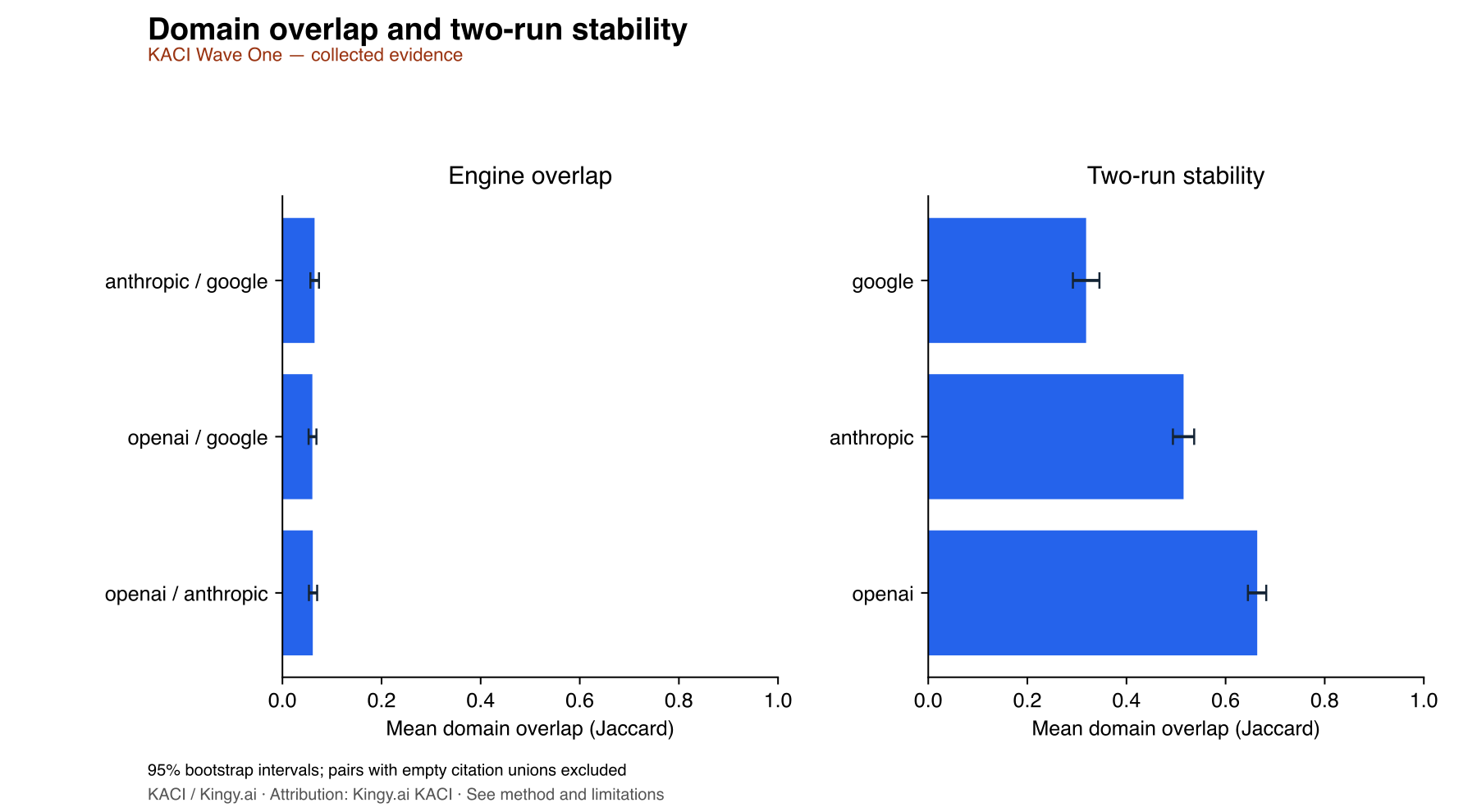
Official API citation study
Which websites do AI APIs cite?
KACI compared 7,200 completed official API answers to 1,200 designed English questions, asked twice through OpenAI, Claude and Gemini.
What it shows: average cited-domain overlap between providers was about 6% among eligible pairs. This measures citation patterns, not answer accuracy.
The selected top 100 of 4,631 domains were human reviewed; 4,531 remain provisional. Category comparisons describe the reviewed subset. YouTube metadata is a later snapshot; citations do not establish video watching.

Historical API price dataset
OpenAI and Anthropic API Price Index
Inspect price records observed on 24 August 2026, with exact model and billing details. Use the API price lookup and linked provider sources for a new cost decision.
What it shows: 212 normalized records: 127 OpenAI and 85 Anthropic.
Verify: Price index GitHub repository · Price index Hugging Face dataset · Price index Zenodo record

Track price changes
AI Model Price Stability
See what repeated archive captures can—and cannot—say about changes in publicly posted model prices.
What it shows: 31,946 retained observations across 1,861 archive captures; 23 are machine-detected candidates, not automatically verified changes.
Verify: Price stability GitHub repository · Price stability Hugging Face dataset · Price stability Zenodo record
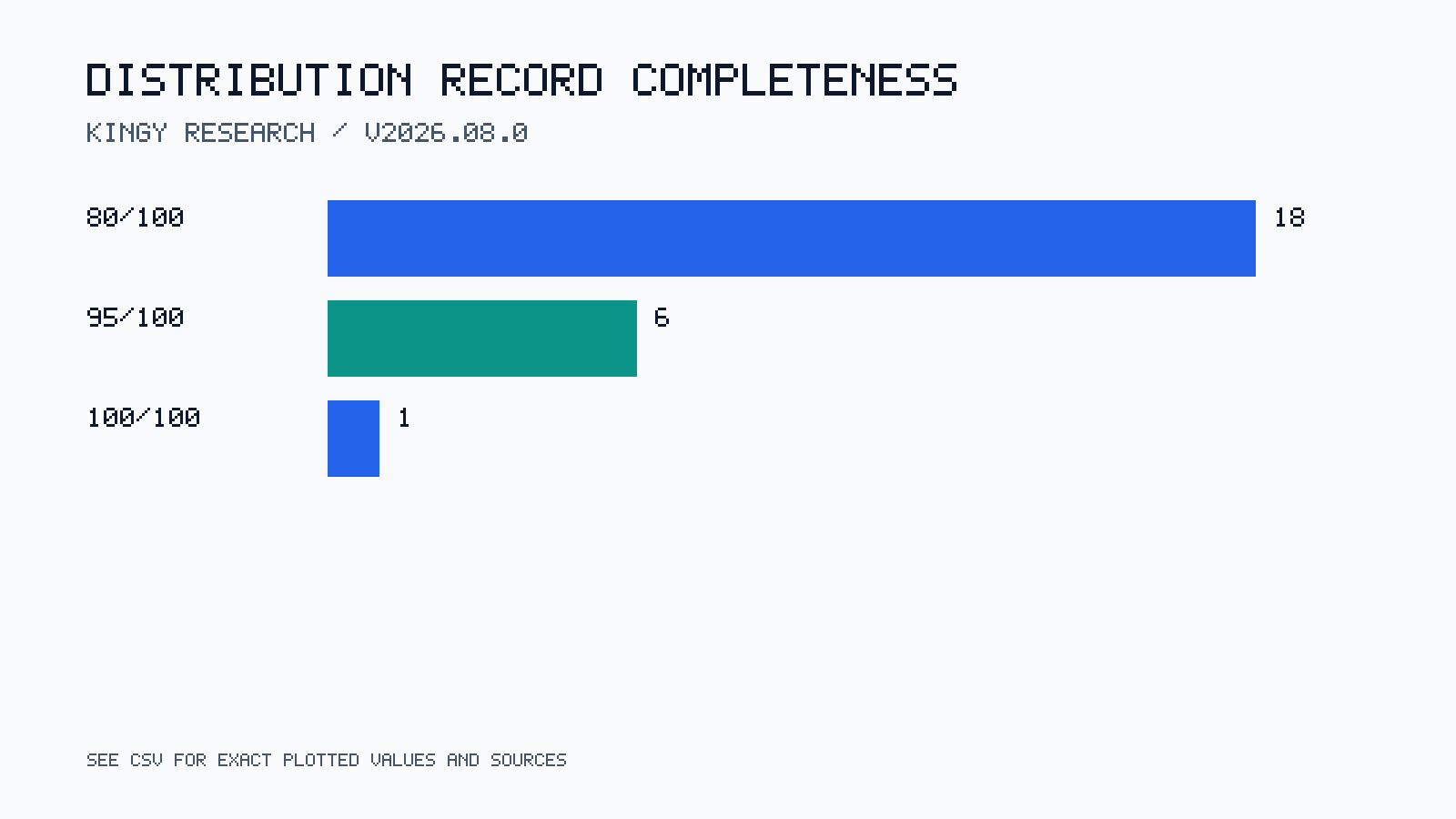
Understand distribution evidence
State of AI Distribution
Learn what a retained evidence cohort can verify about identity, access, documentation, and unknown outcomes.
What it shows: a 25-record first cohort, with completeness tracked separately from quality or commercial outcome.
Verify: Distribution report GitHub repository · Distribution report Zenodo record
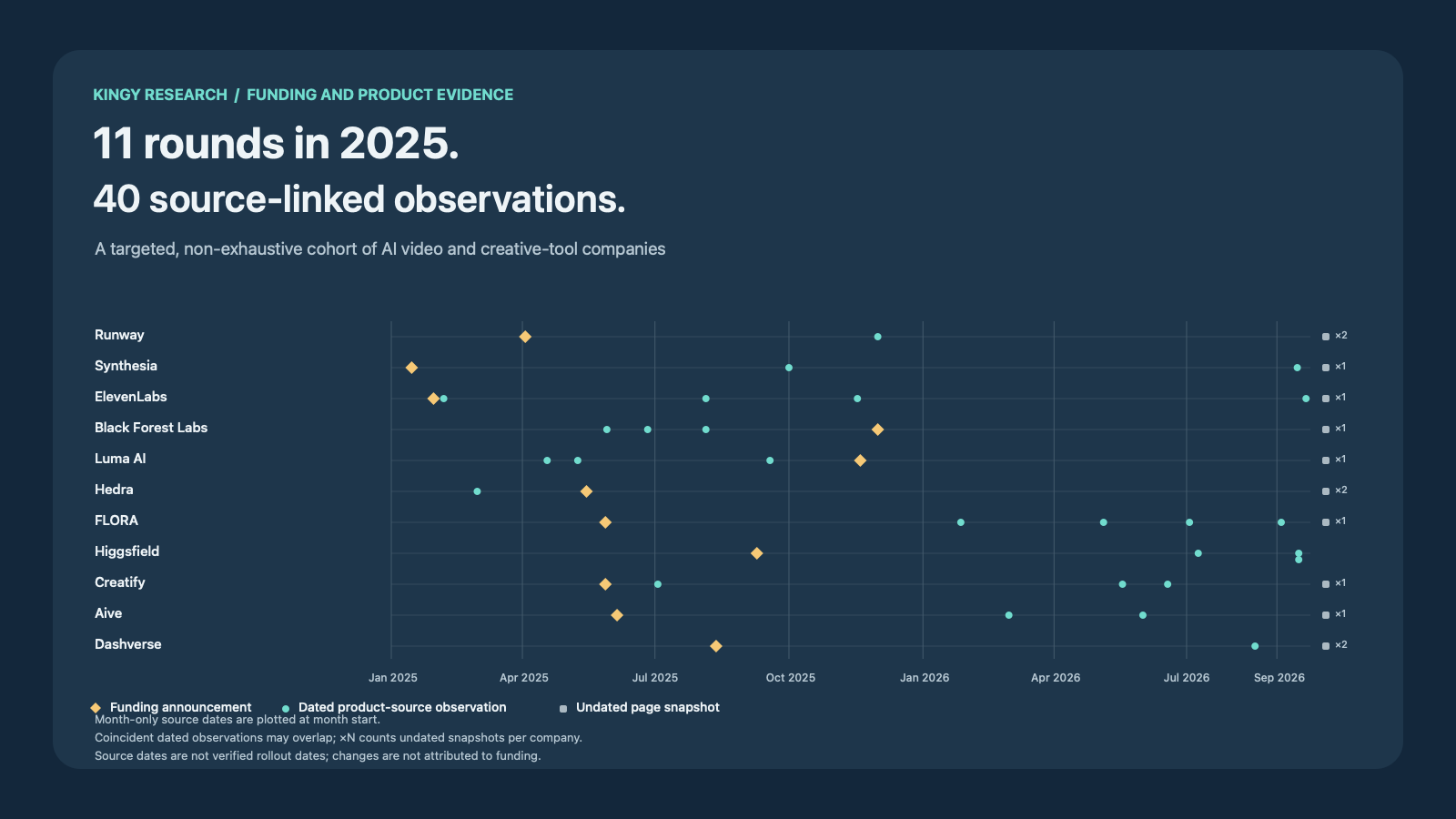
Funding and product evidence · pilot
AI video and creative-tool funding in 2025
Inspect product, access, capability, and pricing sources around funding announcements for 11 selected companies. Product-source dates may come before or after a round.
What it shows: 11 announced rounds and 40 source-linked observations. Company outcomes and account-level access remain unknown; this is not a market census or causal study.
Use and reuse
Choose the format that fits your job.
Making a decision
Read the plain-language report first. The methodology and limitations tell you what the figures do not prove.
Doing analysis
Download the CSV or JSON, use the data dictionary, and keep the release version with your work.
Citing or sharing
Use a version DOI when a release provides one. Otherwise, cite the published page and its as-of date; use a concept DOI only when that product provides one.
Checking the work
Follow the source records, data files, checksums, and external repositories linked from that specific release.
Research standards
Transparent about evidence, uncertainty, and independence.
Who made this
Research lead: Curtis Pyke, Kingy AI. Kingy AI controlled the questions, methods, analysis, conclusions, wording, and publication decisions. The work was independently funded: no covered vendor provided cash, in-kind consideration, prepublication review, or veto rights. Curtis Pyke declared no relevant financial or personal conflicts. AI systems assisted with packaging, code generation, and validation; Curtis Pyke reviewed the release decisions and accepts accountability.
Methodology, limitations, reuse terms, correction routes, and identifiers vary by product; consult the specific release before reusing its data or relying on its results. No product is a market census, a product endorsement, or a guarantee of future price or business outcomes.