The AI Model That Walked In Wearing Sunglasses

Claude Fable 5 has arrived, and it did not enter quietly.
Anthropic’s new model landed with the kind of benchmark numbers that make developers lean forward, executives refresh pricing pages, and competitors pretend not to care. Fable 5 is part of Anthropic’s fifth-generation Claude lineup, alongside Claude Mythos 5, a more restricted model aimed at specialized work such as cybersecurity and scientific research.
On paper, Fable 5 looks like a monster. It codes better. It reasons better. It handles long tasks with more stamina. It reads images more effectively. It can apparently chew through giant software problems like a raccoon locked inside a data center with root access.
But the launch also came with a twist.
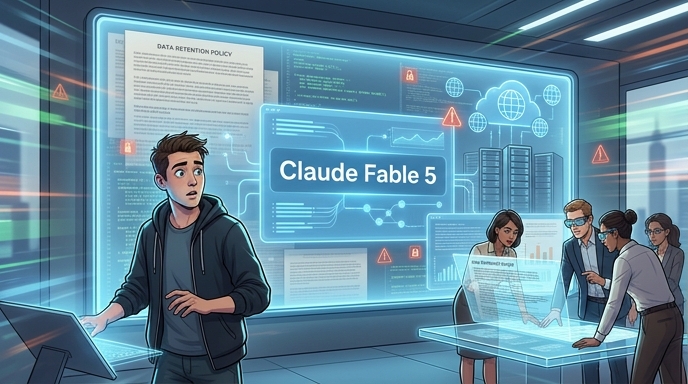
Launch-era coverage reported that Microsoft limited internal employee access to Fable 5 while reviewing new retention rules. Developers also objected to undisclosed interventions in frontier-AI research requests. Those were June launch controversies; the later changes below matter when judging the current product.
So yes, Fable 5 may be powerful. It may also be complicated. Welcome to modern AI, where every breakthrough arrives with a footnote wearing steel-toed boots.
What Anthropic Actually Released
Anthropic released two major models: Claude Fable 5 and Claude Mythos 5.
Fable 5 is the public-facing model. It is designed for general use, but it carries conservative safety guardrails. Mythos 5 shares the same base model, but Anthropic keeps it restricted for selected partners, especially in sensitive areas like cybersecurity.
That split matters. Anthropic appears to be saying: “Here is the powerful version for normal users, and here is the even less restricted version for people we trust not to set the internet on fire before lunch.”
According to The Decoder, Fable 5 beats Anthropic’s previous generally available models across many benchmarks. Anthropic also claims the model performs especially well on long, complex tasks. That is the sort of claim that matters because real work rarely looks like a neat benchmark question. Real work is messy. It has broken dependencies, weird edge cases, ancient code, and one mysterious file named “final_final_USE_THIS_v7.”
Fable 5 also arrives with strong claims in coding, document reasoning, image understanding, and data analysis. Mythos 5, meanwhile, appears aimed at frontier scientific and cybersecurity work. It is powerful enough that Anthropic is keeping it on a much shorter leash.
The Coding Numbers Are Not Subtle
The headline performance numbers are hard to ignore.
The Decoder reports that Fable 5 scored 80.3 percent on SWE-Bench Pro, a benchmark built around real software engineering tasks from public GitHub repositories. For comparison, Claude Opus 4.8 reportedly scored 69.2 percent, GPT 5.5 scored 58.6 percent, and Gemini 3.1 Pro scored 54.2 percent.
That is not a tiny gap. That is not “slightly better at autocomplete.” That is the kind of jump that makes engineering managers start running private experiments on Friday afternoon.
Fable 5 also scored 29.3 percent on Cognition’s FrontierCode benchmark, which tests demanding coding work under production-like standards. Claude Opus 4.8 reportedly scored 13.4 percent, while GPT 5.5 scored 5.7 percent.
Benchmarks do not equal reality. They never do. A model can crush a test and still faceplant into your company’s bizarre internal tooling. But benchmarks do tell us where the wind is blowing.
And the wind here is not a breeze. It is a leaf blower pointed directly at software development.
The Stripe Example Is the One People Will Quote
Benchmarks are abstract. Case studies travel faster.
The Decoder reports that Stripe said Fable compressed five months of engineering work into days. In one Ruby codebase with 50 million lines, the model reportedly completed a migration in one day that would have taken a full team more than two months.
That is the kind of story that spreads because it sounds like science fiction with a purchase order attached.
Of course, readers should treat vendor-adjacent examples carefully. Companies tend to showcase the wins, not the “Claude spent six hours confidently refactoring the wrong folder” moments. Still, even with a cautious reading, the claim points toward something important: frontier AI is moving from chat assistant to work engine.
That shift changes the conversation. A chatbot that gives a bad answer is annoying. A coding agent that shapes a large migration becomes part of the software supply chain.
That means reliability matters more. Transparency matters more. Data handling matters more.
The model is no longer just answering questions. It is touching production-adjacent workflows. That is where the fun gets real, and the legal department starts appearing in doorways like a horror movie villain.
Vision, Memory, and the Long-Task Problem

Fable 5 is not only about code.
Anthropic claims the model performs strongly on complex analytical work, including finance-style reasoning, document review, chart interpretation, and table analysis. The Decoder also reports that Fable 5 has improved vision capabilities. It can extract precise figures from scientific images and rebuild a web app’s source code from screenshots.
That last bit is spicy. Screenshots are everywhere. Interfaces are everywhere. A model that can reverse-engineer structure from images gives developers and designers a faster way to prototype, inspect, and replicate ideas.
Anthropic also says Fable 5 can stay focused across millions of tokens and improve its own work by taking notes. The Decoder notes that Anthropic did not provide specific benchmarks for that claim, so that part deserves caution.
Still, the direction is clear. AI models are becoming less like clever calculators and more like weirdly tireless junior colleagues. They can read more, remember more, see more, and keep going longer.
That is useful. It is also unnerving. The more work a model can perform, the more painful its hidden failure modes become.
Mythos 5 Is the Restricted Sibling
Claude Mythos 5 is the model Anthropic is treating with extra caution.
According to The Decoder, Mythos 5 remains available through Project Glasswing in partnership with the U.S. government. It replaces the earlier Claude Mythos Preview and is positioned for cyber defense work. Anthropic reportedly calls it the world’s strongest cybersecurity model.
The Decoder says Mythos 5 scored 78 percent on ExploitBench, up from 69 percent for Mythos Preview and 40 percent for Claude Opus 4.8. That is a major jump in a sensitive area.
The same article also describes Mythos 5’s performance in drug design and genomics research. Anthropic’s internal experts reportedly said Mythos 5 sped up parts of drug design by 10 times. In one test, the model used protein design and bioinformatics tools without human help and produced strong candidates for nine out of 14 protein targets.
Those are huge claims. They are also claims that need careful outside validation. Anthropic reportedly plans to publish more results later.
For now, the message is simple: Mythos 5 is powerful enough that Anthropic does not want to hand it to everyone with a login.
The Safety System Has Layers
Anthropic has not released Fable 5 as a wide-open model. It built a layered safety system around it.
The Decoder reports that Fable 5 uses classifiers to identify dangerous requests. These classifiers cover areas such as cybersecurity, biology and chemistry, and model distillation. When the system flags certain risky prompts, it can route the request to the weaker Claude Opus 4.8 model.
In the web interface and apps, users reportedly receive a notification when that fallback happens. In the Messages API, the request is blocked by default, though developers can enable a server-side fallback.
Anthropic says more than 95 percent of sessions are not affected. It also says external testers could not find a universal jailbreak after more than 1,000 hours of testing.
That sounds reassuring. But the real debate is not only about blocked malware prompts or bioweapons requests. Most users understand why those categories raise alarms.
The hotter issue is subtler: what happens when the model does not refuse, does not warn, and simply becomes less effective?
That is where the trust problem begins to bite.
The “Silent Sabotage” Debate
Yellow.com’s June launch coverage focused on hidden interventions around advanced AI development.
The reported safeguards targeted work such as training competing models and debugging AI code. The original controversy concerned intervention without a clear notice to the user.
That account needs its follow-up: June 11 follow-up report says Anthropic reversed the silent-degradation approach and would use disclosed fallback to Claude Opus 4.8 for flagged requests. This is dated reporting about the policy change, not a test of every current response.
The original undisclosed behavior would create a brutal debugging problem.
A developer who receives a bad answer may not know what happened. Did the model misunderstand the task? Did the prompt lack context? Did the model hit a real technical limit? Or did an invisible policy system quietly pull the handbrake?
That ambiguity matters because developers now use AI assistants for real engineering work. They use them to debug systems, design architecture, write code, audit infrastructure, and build model-driven products.
A tool that silently changes answer quality is not just annoying. It becomes unpredictable.
Microsoft’s Problem: Data Retention
Then Microsoft entered the plot.
In its June 10 report, The Verge said Microsoft had restricted employee use of Fable 5 while reviewing retention requirements. It distinguished that internal model-picker restriction from the rollout to GitHub Copilot and Foundry customers. This does not establish Microsoft’s current internal access policy.
The reason appears to be legal risk.
The launch-era report described 30-day retention and longer retention for flagged content. Anthropic’s current API retention documentation still requires 30-day retention for Covered Models, including Fable 5, unless it expressly authorizes ZDR; flagged content or legal holds can create exceptions. Its September 1 Enterprise Frontier Safeguards announcement adds a material qualification: eligible Fable 5 and 5.1 customers receive ZDR while the new safeguards roll out. This is an eligibility-based arrangement, not a promise that every account has ZDR.
For ordinary users, that may sound like fine print. For a company like Microsoft, it is not fine print. It is the print.
Customer data, internal code, confidential plans, security details, and legal obligations all collide here. Microsoft reportedly declined to comment, and its legal teams were said to be evaluating Anthropic’s changes.
The June dispute illustrates why a model launch does not settle an enterprise’s current data-handling terms.
The Price Tag Also Bites
Fable 5 is not cheap.
The Decoder reports that Claude Fable 5 and Claude Mythos 5 cost $10 per million input tokens and $50 per million output tokens. That is roughly twice the listed price of Claude Opus 4.8, which The Decoder shows at $5 per million input tokens and $25 per million output tokens.
That changes the math for developers and companies.
A more capable model can justify a higher price if it solves tasks faster, uses fewer tokens, or reduces human labor. But “more expensive per token” still matters, especially at scale. A small prototype may feel affordable. A production workflow with thousands of users can turn into a finance meeting with fluorescent lighting and no snacks.
The June launch described a staggered subscription window, including temporary access through June 22 and usage credits from June 23. Those dates are historical, not a current subscription offer. The current Fable 5 API guide documents API availability and the June 12 suspension followed by July 1 reinstatement; check the current account terms before budgeting access.
That suggests Anthropic expects heavy demand or wants to avoid runaway usage. Probably both.
Power is fun. Compute bills are less fun. They arrive sober.
Why This Story Matters
Claude Fable 5 shows where AI is heading.
The model is not just a better chatbot. It is a high-capability work system that can write code, analyze documents, interpret images, and tackle long tasks. Its restricted sibling, Mythos 5, pushes deeper into cybersecurity and scientific research.
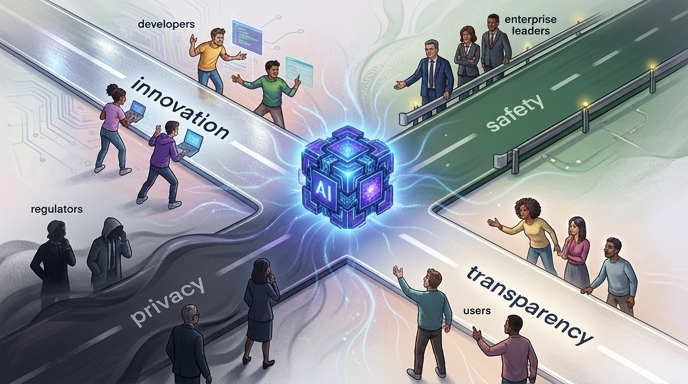
But the launch also exposes the core tradeoff of frontier AI: capability creates risk, and risk creates controls. Those controls create friction. Sometimes the friction appears as pricing. Sometimes it appears as data retention. Sometimes it appears as hidden interventions that change output quality.
That is the real story.
Users want powerful models. Companies want safe models. Enterprises want private models. Regulators want accountable models. Developers want predictable models. Those goals overlap, but they do not perfectly align.
Fable 5 sits right in the collision zone.
It may be one of the most capable AI models available to the public. It may also become a case study in why transparency matters. When a tool becomes part of serious work, users need to know when it is operating normally, when it is restricted, and when it is quietly wearing ankle weights.
Claude Fable 5 looks impressive. No serious reading of the available reports says otherwise.
But the bigger lesson is sharper: the next AI race will not be only about who builds the smartest model. It will also be about who builds the most trustworthy one.
Sources
- The Verge: “Microsoft restricts Claude Fable for employees over data retention concerns”
- The Decoder: “Anthropic releases Claude Fable 5 and Mythos 5 with major gains in coding and science”
- Yellow.com: “Claude Fable 5 May Be Silently Sabotaging Your AI Work”
Claude Fable 5 Benchmarks
Claude Enterprise Trust
Claude Mythos Models
Claude Export Controls
Model Diversification
Claude Mythos Controversy
Claude Comparisons
Claude Model Launches
The Kingy Brief
Get The Kingy Brief.
AI changes, original tests and one practical thing to try. Fridays at 09:00 Vancouver time.
Free · Double opt-in · Unsubscribe anytime
Sign up for The Kingy Brief on Beehiiv.
Signup help and newsletter schedule
Signup form provided by Beehiiv. After submitting, check your inbox for "Confirm your subscription to The Kingy Brief" and open its confirmation link. Check Spam or Promotions if you cannot find it.
Fridays at 09:00 Vancouver time: source-checked AI changes, original tests and one practical thing to try. We skip a week when there is not enough verified material. Free. Unsubscribe anytime.