
The Playlist Police Have Entered the Chat
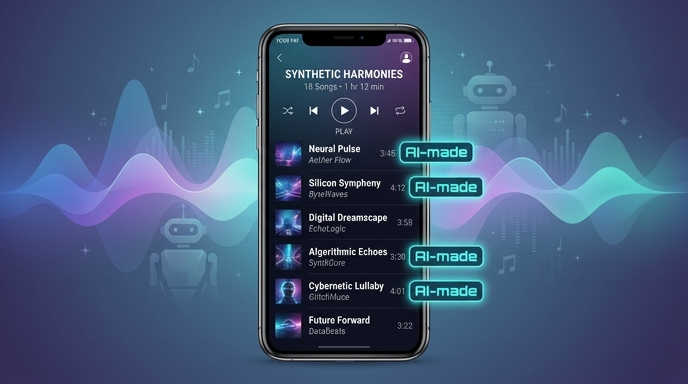
Your playlist may look harmless. A little gym music. A little sad-girl piano. A suspiciously smooth lo-fi track called “Midnight Coding Rain Vol. 9.” Nothing to see here.
Deezer disagrees.
The music streaming company has launched a free AI music detector that lets people scan playlists from other streaming services, not just Deezer. That means Spotify users, Apple Music users, YouTube Music users, SoundCloud users, and listeners on other platforms can now ask a slightly spooky question: “How much of this was made by a machine?”
According to The Verge, the tool works across 20 streaming platforms. Users visit Deezer’s AI music detector site, pick their service, grant access, and let the system check their playlists for synthetic tracks.
That is the simple version.
The bigger story is messier, stranger, and much more interesting. AI-generated music has moved from novelty to flood. Streaming platforms now face a new kind of clutter: songs that can be created quickly, uploaded endlessly, and sometimes used to game royalty systems. Deezer has decided to make that problem visible.
Not subtle. Not buried in policy language. Visible.
Why Deezer Is Doing This Now
Deezer has been louder than most major streaming companies about AI music. It has already labeled AI-generated tracks on its own platform and offered its detection technology to others in the industry.
The response, apparently, was not a stampede.
As The Verge reported, Deezer CEO Alexis Lanternier said that no other company had followed Deezer’s lead, so the company decided to let users check playlists themselves, no matter which streaming service they use.
That is a sharp little move.
Instead of waiting for competitors to license the technology, Deezer is taking the tool directly to listeners. It is also putting pressure on other platforms. Quiet pressure, but pressure all the same.
If users start finding AI-generated music inside their favorite playlists, they may start asking awkward questions. Who uploaded it? Was it labeled? Did the platform know? Did anyone care?
That is where this launch gets interesting. Deezer is not only releasing a tool. It is changing the conversation from “What should platforms do?” to “What will users find when they look?”
That is a much less comfortable question.
How the Detector Works for Regular Listeners
The process sounds fairly simple. Users go to Deezer’s AI music detector website, choose their streaming platform, and authorize access to their playlists. Deezer then imports the playlists and scans the tracks.
The Verge reported that the tool appears to use Tune My Music, a service Deezer already uses to help people transfer libraries when switching from a rival service.
Once Deezer scans the playlist, it flags tracks it identifies as AI-generated. Users can then view the results and share them.
That last part matters.
A private tool helps one listener. A shareable result creates social pressure. Nobody wants to be the person confidently posting “real underground vibes” only to discover half the playlist was apparently assembled by the silicon goblin orchestra.
The tool currently supports 20 platforms, including Spotify, Apple Music, SoundCloud, and YouTube Music, according to The Verge. That makes the launch broader than a Deezer-only feature. It becomes a cross-platform inspection tool.
That is clever. It lets Deezer act like the responsible adult in the room while its rivals decide how public they want this issue to become.
The AI Music Flood Is Not Hypothetical
The reason this tool matters is simple: AI music is not some distant future problem. It is already here, and it is arriving in bulk.
In April 2026, Deezer said it was receiving almost 75,000 fully AI-generated tracks every day. The company said those tracks represented roughly 44 percent of daily music uploads to its platform. Deezer also said that amounted to more than 2 million AI-generated tracks per month, according to its own newsroom.
That is not a trickle. That is a busted fire hydrant.
To be clear, Deezer was talking about music uploaded to its own service, not the entire global music internet. But the number still shows the scale of the problem.
AI tools have made music production faster and cheaper. That can be exciting for experimentation. It can also turn streaming services into audio landfills.
When anyone can generate huge volumes of plausible music, platforms need better ways to sort, label, recommend, and monetize it. Otherwise, listeners drown in pleasant mush.
And pleasant mush is still mush.
The Royalty Problem Lurking Under the Beat
AI-generated music creates a listening problem, but it also creates a money problem.
Streaming royalties depend on plays. That system already attracts fraud. Bad actors can upload tracks, use bots or suspicious listening schemes, and try to siphon payouts. AI makes that easier because it can generate large catalogs quickly.
Deezer has connected AI music with fraud concerns before. In April 2026, it said consumption of AI-generated music on its platform remained low, between 1 and 3 percent of total streams. But it also said a majority of those streams, 85 percent, were detected as fraudulent and demonetized.
That is the rotten little engine under this story.
The threat is not merely that listeners might accidentally enjoy a synthetic jazz noodle. The threat is that streaming systems can be manipulated at scale. If bad actors can mass-produce songs and drive fake plays, money can move away from real artists, labels, songwriters, and rights holders.
The detector does not solve that entire problem. A playlist scanner is not a royalty reform bill. But it does shine a flashlight into the room.
Sometimes that is how the cockroaches start running.
What Other Platforms Are Doing
Deezer’s approach differs from some of its competitors.
According to The Verge, Qobuz launched its own detection technology. Spotify and Apple, meanwhile, have opted for voluntary tagging systems.
Voluntary tagging sounds polite. It also sounds weak.
The obvious problem is that bad actors do not usually volunteer useful evidence against themselves. A creator using AI responsibly may tag a song. A spammer chasing royalties probably will not. That does not make voluntary labels useless, but it does make them incomplete.
Deezer’s strategy is more aggressive. It uses detection, labels synthetic music, and removes AI-generated music from some recommendation surfaces on its own platform. Now it is giving listeners a way to scan playlists from rival services.
That is not neutral. It is a statement.
Deezer is effectively saying: “If platforms will not label this clearly, we will help users check for themselves.”
That may annoy competitors. It may also appeal to artists and listeners who want more transparency. In tech, those two things often arrive in the same box.
Heise and Music Ally Frame It as a User Tool
The framing from the supplied sources points in the same direction. Heise describes Deezer’s launch as a free tool that checks playlists for AI-generated music. Music Ally frames it as an AI music detector for playlists across DSPs, or digital service providers.
That framing matters.
This is not just an internal moderation dashboard. It is not a label-side analytics product hiding in a corporate portal. Deezer is packaging AI detection as something ordinary listeners can use.
That makes the issue feel personal.
People may not care about platform policy until it touches their own playlists. But once they can scan the playlist they use for workouts, road trips, studying, or crying into cereal, the issue becomes less abstract.
That is smart product design. It turns a giant industry problem into a simple user action: click, connect, scan.
The whole thing has the energy of checking your fridge and discovering that three of your “organic” snacks were engineered in a lab by a bored raccoon with venture funding.
Transparency Is the Real Product
The detector’s most important feature may not be detection. It may be transparency.
Listeners do not all hate AI music. Some people enjoy it. Some do not care. Some only care when AI-made tracks pretend to be human-made. The real problem is the fog.
People want to know what they are hearing.
Deezer has argued for clearer labeling, and its new tool fits that philosophy. The company is not banning listeners from playing AI-generated tracks. It is telling them what it believes those tracks are.
That distinction matters.
The strongest argument for this kind of tool is not that AI music must disappear. It is that synthetic content should not sneak through the door wearing a fake mustache and calling itself “Dave from Nashville.”
Music has always used technology. Drum machines, samplers, Auto-Tune, digital audio workstations, and bedroom production all changed the sound of pop. AI is different because it can generate complete tracks at scale and blur the identity of the creator.
That does not make every AI track worthless. It does make disclosure more important.
A label lets listeners choose. No label makes the choice for them.
The Detector Will Not End the Debate
Deezer’s tool raises an obvious question: how accurate is it?
The supplied reports focus on the launch and availability of the detector, not a full independent audit of its performance. That means listeners should treat results as useful signals, not divine judgment from Mount Algorithm.
Detection is hard. AI music models change. Generators improve. Audio gets edited, remixed, compressed, and re-uploaded. Some human-made music may sound machine-like. Some machine-made music may sound human enough to slip through.
So yes, false positives and false negatives are possible.
That does not make detection useless. Spam filters are imperfect too. People still use them because the alternative is inbox soup.
The key issue is how Deezer presents results and how users interpret them. A good detector should encourage transparency without turning every bedroom producer into a suspect. Nobody needs a witch hunt because someone used a shiny synth preset and wrote lyrics with the emotional range of a toaster.
Still, the direction is clear. Streaming platforms need tools that can identify synthetic music at scale. Manual review cannot handle this volume. The machines created the flood; now machines have to help build the drainage system.
Artists Have the Most at Stake
For artists, AI music detection is not a cute feature. It is a labor issue, a royalties issue, and a visibility issue.
Streaming already makes discovery difficult. Millions of tracks compete for attention. If AI-generated uploads keep rising, human artists face even more noise. The marketplace does not become fairer when the supply of tracks becomes functionally endless.
That does not mean every AI-assisted creator is a villain. Many musicians use technology in creative ways. Some may use AI as a sketchpad, a collaborator, or a production tool. The blunt category “AI music” can hide a lot of nuance.
But fully AI-generated tracks uploaded at massive scale create a different problem. They can clog catalogs, distort recommendation systems, and invite fraud. Deezer’s public numbers suggest the company sees that threat as real and growing.
The detector gives listeners a role in spotting synthetic music. It also gives artists a talking point. They can ask platforms to explain their own policies. They can ask whether AI-generated content gets labeled, recommended, monetized, or filtered.
That pressure may matter more than the tool itself.
Listeners Now Get a New Kind of Control
For listeners, the new detector adds a strange but useful layer of control.
Until now, most people had no easy way to check whether tracks in their playlists were AI-generated. They could guess. They could inspect artist pages. They could look for weird names, generic cover art, suspicious release patterns, or songs that sound like royalty-free music escaped from a dentist’s office.
But guessing is not much of a strategy.
Deezer’s tool gives users something more direct. It lets them scan actual playlists. It works across major streaming platforms. It gives results that users can review and share.
Some listeners may use it once for curiosity. Others may use it to clean up playlists. Music fans, playlist curators, journalists, labels, and artists may use it more seriously.
The fun part is the uncertainty. People may discover nothing. They may discover one odd track. Or they may discover that their “deep focus” playlist contains enough synthetic audio to power a robot yoga retreat.
Either way, the listener knows more than before.
And in streaming, where everything is wrapped in recommendations, metadata, and black-box systems, knowing more is not a small thing.
Deezer Just Made AI Music Everyone’s Problem
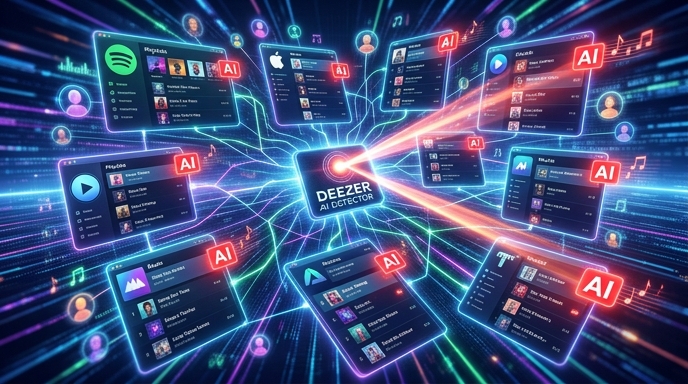
The smartest part of Deezer’s move is that it exports the AI music debate beyond Deezer.
If this tool only scanned Deezer playlists, it would be a platform feature. By supporting playlists from other services, Deezer turns it into a public test. Spotify users can check. Apple Music users can check. YouTube Music users can check. SoundCloud users can check.
That gives Deezer a bigger role in the industry conversation.
It also creates a neat competitive jab. Deezer can say it is protecting transparency while other services move more slowly or rely on voluntary systems. That does not automatically make Deezer the hero. Companies like being seen as heroes when it also helps their market position. Shocking, I know. Corporate altruism has a loyalty program.
But the move still matters.
AI music will not disappear. The incentives are too strong. The tools are too accessible. The upload pipes are too open. So the realistic fight is not “AI music or no AI music.” It is labeling, detection, recommendation, fraud control, and user choice.
Deezer has placed its bet on visibility. Let people see what is in their playlists. Let them decide what they want to keep. Let the platforms explain the rest.
That is not the end of the AI music story. It is the part where someone finally turns on the lights.
Sources
- The Verge: “Deezer launches an AI music detector for other streaming services”
- Heise: “Deezer: Free tool checks playlists for AI-generated music”
- Music Ally: “Deezer debuts AI music detector for playlists on all DSPs”
- Deezer Newsroom: “AI-generated tracks now represent 44% of all new uploaded music”
AI Music Labeling
AI Music Policy
AI Music Debate
AI Music Rights
AI Music Tools
AI Music Guides
The Kingy Brief
Get The Kingy Brief.
AI changes, original tests and one practical thing to try. Fridays at 09:00 Vancouver time.
Free · Double opt-in · Unsubscribe anytime
Sign up for The Kingy Brief on Beehiiv.
Signup help and newsletter schedule
Signup form provided by Beehiiv. After submitting, check your inbox for "Confirm your subscription to The Kingy Brief" and open its confirmation link. Check Spam or Promotions if you cannot find it.
Fridays at 09:00 Vancouver time: source-checked AI changes, original tests and one practical thing to try. We skip a week when there is not enough verified material. Free. Unsubscribe anytime.