
Last updated: June 16, 2026. Editor note: This is an AI strategy and policy explainer, not legal advice. The full government directive was not public in the sources reviewed for this article, so claims about the directive’s legal mechanics are attributed to Anthropic and reputable reporting.
The Fable 5 incident changes the AI adoption conversation.
For the last two years, most teams have asked a simple question: which AI model is smartest? The better question now is harsher and more useful: how fragile is our AI stack if one provider, one model, one cloud marketplace, or one national policy environment changes overnight?
According to Anthropic’s June 12 statement, the U.S. government issued an export-control directive requiring Anthropic to suspend access to Claude Fable 5 and Claude Mythos 5 by foreign nationals, including foreign-national Anthropic employees. Anthropic said the practical result was that it had to abruptly disable Fable 5 and Mythos 5 for all customers while it worked to comply. AP reported that the move marked the U.S. government’s most significant step so far to restrict access to advanced AI models.
That is a policy story. It is also a business continuity story.
If your product, support operation, research workflow, coding agent, internal knowledge system, compliance workflow, or customer-facing SaaS feature depends on one frontier model, you do not just have a model choice. You have a supply-chain dependency.
Image note: AI-generated editorial image: the Fable 5 shock turns model access into a business continuity question.
Key Takeaways
- The Fable 5 and Mythos 5 shutdown is still a developing story, but the public record is enough to show that model access can become a policy-sensitive dependency.
- The lesson is not “stop using frontier models.” The lesson is “do not hard-wire your business to one model.”
- Companies should separate the application layer from the model layer, add fallbacks, keep prompts and evals portable, and measure quality across providers.
- Open-weight and open-source models can reduce lock-in and support private deployment, but they bring licensing, operations, hardware, security, and evaluation work.
- Local models are not necessary for every workload, but they are useful for privacy-sensitive, offline, repetitive, internal, and fallback workflows.
- The winning AI stack is likely a hybrid: frontier APIs, cheaper hosted models, open-weight models, local inference, retrieval, tools, evals, and human review.
Table of Contents
- What happened with Fable 5 and Mythos 5
- Why this is bigger than Anthropic
- The single-model trap
- The better strategy: multi-model AI architecture
- Model routing is the new AI moat
- Where open-source and open-weight models fit
- Local AI and sovereign AI
- Closed frontier models still matter
- A practical AI diversification checklist
- What this means for startups and enterprises
What Happened With Anthropic’s Fable 5 and Mythos 5
Anthropic introduced Claude Fable 5 and Claude Mythos 5 in June 2026. Its Claude API documentation described Fable 5 as Anthropic’s most capable widely released model for demanding reasoning and long-horizon agentic work. The same documentation described Mythos 5 as sharing Fable 5’s capabilities, but available only in limited release through Project Glasswing.
The launch was not just another model card update. Fable 5 was positioned as a broadly available, high-capability Claude model across the API and major cloud channels. Mythos 5 sat closer to the restricted frontier edge. In other words: one model was meant for wide adoption, and the other was a more tightly controlled capability tier.
Then came the shock.
Anthropic said it received a U.S. government directive at 5:21 p.m. ET on June 12, 2026. The company’s statement says the directive required suspension of all access to Fable 5 and Mythos 5 by foreign nationals, whether inside or outside the United States, including foreign-national Anthropic employees. Anthropic also said the directive did not provide specific details of the national security concern, and that access to other Anthropic models was not supposed to be affected.
Anthropic’s explanation should be read carefully. The company said its understanding was that the government believed it had become aware of a way to bypass or jailbreak Fable 5. Anthropic disputed the severity of the issue and said it believed the action did not follow the kind of transparent, fair, technically grounded process it has advocated for. That is Anthropic’s position, not an independently verified conclusion.
AP and other outlets covered the directive as an escalation in government treatment of frontier AI models as national security assets. Kingy AI’s earlier coverage of the Fable 5 and Mythos 5 export-control ban goes deeper on the immediate policy event, while the launch analysis and launch tracker record explain why the model release had attracted so much attention in the first place.
The important business lesson is simpler than the legal question: model access can change for reasons outside your engineering team’s control.
Why This Is Bigger Than Anthropic
This should not be framed as “Anthropic bad” or “closed AI bad.” That is too lazy and too small. Anthropic is one frontier lab inside a much larger shift: the most capable AI systems are starting to look like strategic infrastructure.
Any frontier model can become policy-sensitive. Access can be affected by export controls, sanctions, national security reviews, cloud platform rules, pricing shifts, model deprecations, capacity shortages, safety incidents, contractual changes, data-retention requirements, abuse controls, and geopolitical pressure. Some of those are ordinary platform risks. Some are legal risks. Some are strategic risks.
Companies already understand this in other parts of the stack. They treat cloud access, payment processing, semiconductor supply, identity providers, app stores, mapping APIs, email deliverability, and data residency as serious operational dependencies. AI model access now belongs in the same category.
A model is not just a tool you call. It may be the reasoning layer in your product. It may be the analyst in your workflow. It may be the thing turning raw documents into structured records, answering support questions, writing code, screening claims, summarizing legal material, or coordinating agents. If that layer disappears, the product may not merely degrade. It may stop.
That is why the Fable 5 event matters even to teams that never planned to use Fable 5. It exposes a hidden assumption in a lot of AI roadmaps: that the best model will remain available, affordable, policy-compatible, and technically stable whenever the business needs it.
That assumption is no longer good enough.
The Single-Model Trap
The single-model trap is easy to fall into because it starts as good engineering.
A team wants to ship quickly. One model performs best in early tests. The SDK is clean. The docs are good. The vendor has strong brand trust. The model handles long context, tool calling, code, retrieval, and messy user requests better than the alternatives. So the team builds around it.
At first, that is rational. Later, it can become a hidden dependency.
The trap appears when the application assumes one provider’s behavior is permanent. Prompts are tuned for one model’s quirks. Tool schemas depend on one response format. Retrieval chunks are sized around one context window. Evals are written against one model’s style. Safety behavior is treated as product logic. Billing forecasts assume one price curve. Customer commitments assume one access regime. Internal operators learn one dashboard. The product becomes less an AI application and more a wrapper around a specific vendor state.
That creates risk across several fronts:
- API shutdowns: access can be paused, throttled, restricted, or blocked.
- Model deprecations: the model that behaves best today may disappear or change.
- Price changes: a workflow that looked profitable can become expensive fast.
- Region and nationality restrictions: access rules can depend on where users are, who they are, or which entity they represent.
- Safety throttling: a model may decline classes of work that another model handles differently.
- Data-retention changes: a model may require retention terms that some customers cannot accept.
- Marketplace limitations: access through one cloud may not match access through another.
- Latency and capacity issues: the best model may not be the fastest or most available model.
- Compliance gaps: regulated workflows may need audit trails, data residency, or human review that the default provider path does not supply.
- Vendor lock-in: each model-specific assumption makes switching slower and more expensive.
The point is not that every startup needs five providers on day one. The point is that critical workflows should be designed so a second provider, open-weight model, local model, or human review lane can be added without rewriting the product from the floorboards up.
The Better Strategy: Multi-Model AI Architecture
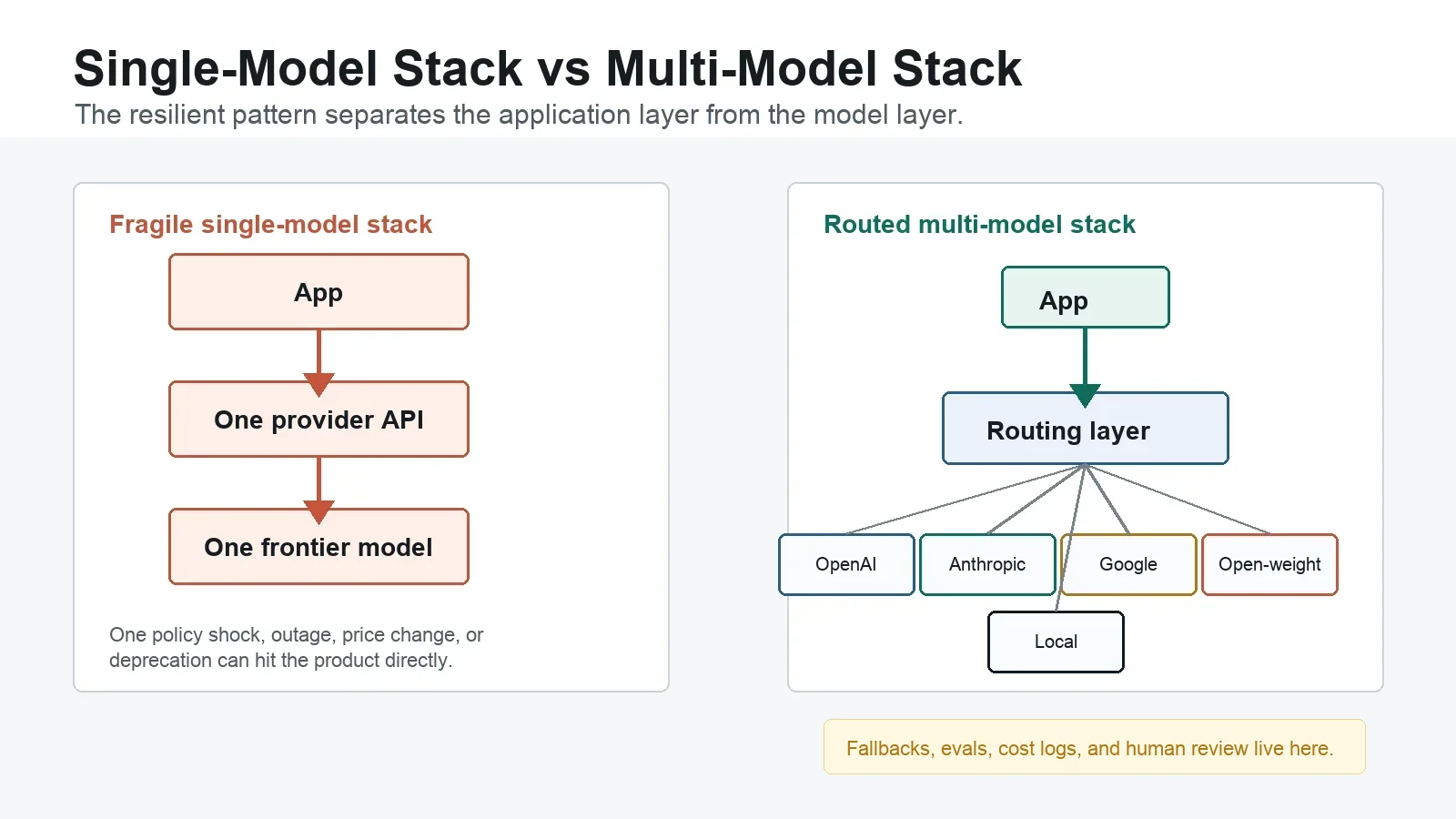
The better architecture separates the application layer from the model layer.
Your app should know what job needs to be done. The routing layer should decide which model, tool, retrieval source, memory, guardrail, or human reviewer should handle it. That sounds more complex than a single API call, but it is the pattern that turns AI from a vendor habit into an operating capability.
A multi-model architecture does not require every company to build a giant internal AI platform. It starts with a few practical habits:
- Keep prompts, evals, retrieval settings, and output schemas outside vendor-specific dashboards where possible.
- Use provider abstraction for critical workflows, even if the first version routes 90 percent of traffic to one provider.
- Maintain at least one fallback for workflows that customers or employees depend on daily.
- Measure output quality across models instead of trusting vibes from a launch demo.
- Track cost per completed task, not just cost per token.
- Preserve logs, test sets, and human corrections so model comparisons get better over time.
- Document what happens if a model is unavailable for 24 hours, 7 days, or permanently.
Kingy AI’s right-model-for-the-right-job guide covers the tactical side of this decision. The Fable 5 episode raises the stakes: routing is not just about saving tokens. It is about resilience.
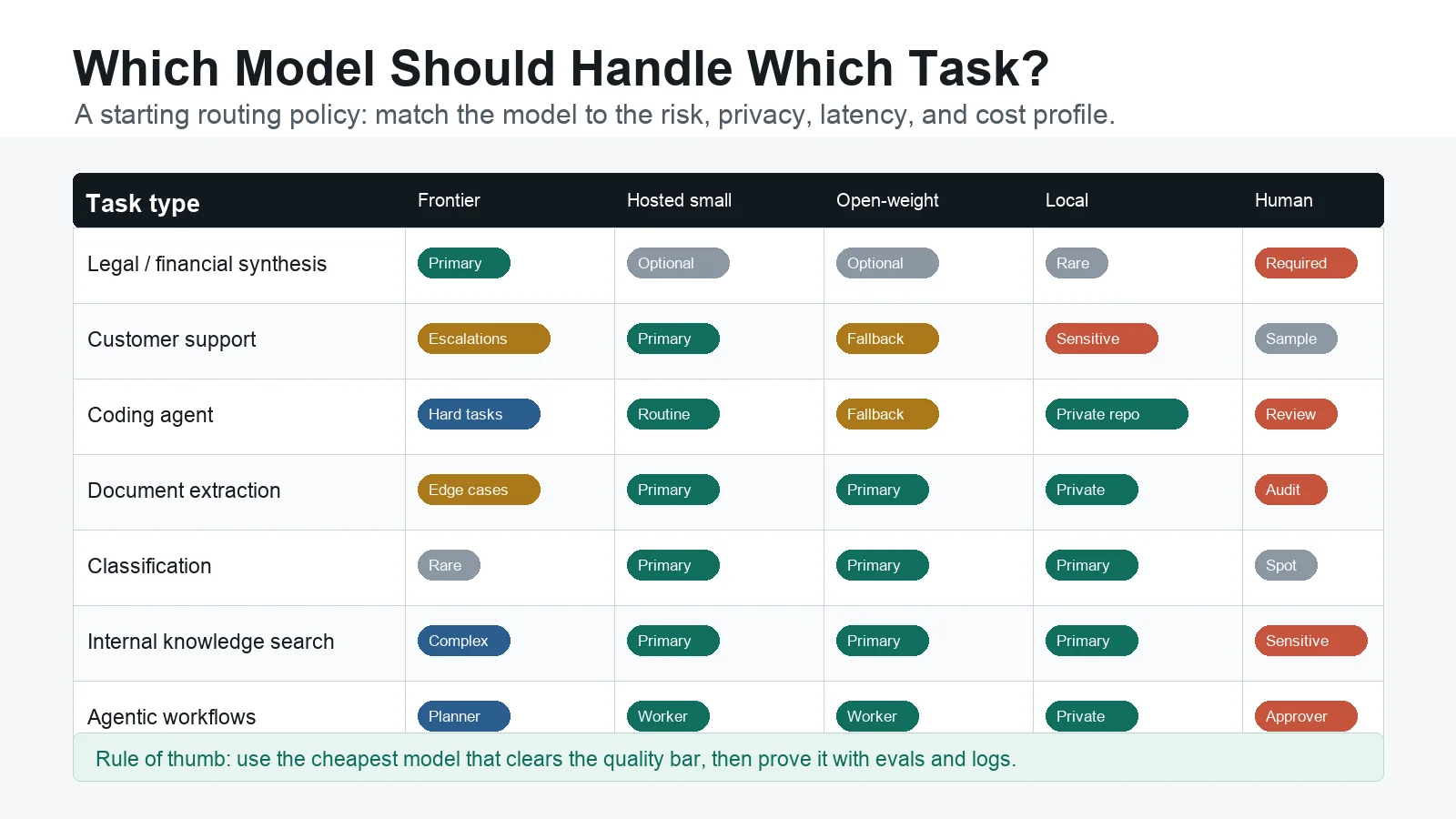
A Practical Task Routing Pattern
| Task type | Likely routing policy | Human review? |
|---|---|---|
| Legal or financial synthesis | Frontier model for synthesis, retrieval-grounded sources, smaller model for formatting | Yes, for advice, filings, financial decisions, or regulated outputs |
| Customer support | Cheaper hosted model for routine answers, frontier model for complex escalations, fallback provider for incidents | Sample review plus mandatory escalation paths |
| Coding | Frontier or specialized coding model for difficult work, smaller model for tests, docs, refactors, and boilerplate | Yes, through code review and security checks |
| Document extraction | Smaller hosted or open-weight model for volume, frontier model for messy edge cases | Spot checks and audit review for high-value records |
| Classification | Small model, fine-tuned model, rules, or local model after evaluation | Only where labels drive consequential decisions |
| Embeddings and internal search | Portable embedding model where possible, with retrieval settings independent from the chat model | For sensitive or high-impact answers |
| Agentic workflows | Frontier planner, cheaper worker models, tool permissions, logs, and approval gates | Yes, for irreversible actions |
| Sensitive or private workloads | Local, private cloud, or open-weight hosted model where data-control requirements justify it | Yes, depending on risk and regulation |
Model Routing Is the New AI Moat
The question is no longer “what is the best model?”
The serious question is: which model is best for this task, this risk level, this budget, this privacy requirement, this latency target, this customer contract, and this failure mode?
That is routing. It is not just a technical convenience. It is a business capability.
A routing layer can choose among OpenAI, Anthropic, Google, Mistral, xAI, Meta/Llama, Qwen, DeepSeek, open-weight hosted models, local models, smaller specialized models, retrieval systems, deterministic tools, and human reviewers. It can route by difficulty, privacy, geography, cost, latency, context length, multimodal need, customer tier, compliance policy, or confidence score.
This connects directly to Kingy AI’s argument that the future of the firm is the routing layer. AI-native companies will not win merely because they chose a good model early. They will win because they learn how to route work, measure outcomes, capture corrections, and improve the next run.
Routing also protects the business from false provider absolutism. No provider is always best. No open model is always enough. No local model is always safer. No frontier model is always worth the cost. The right answer depends on the workflow.
Where Open-Source and Open-Weight Models Fit
Open models matter here, but precision matters even more.
Not every model with downloadable weights is open source. The Open Source Initiative’s Open Source AI Definition focuses on the freedoms to use, study, modify, and share an AI system, including access to the preferred form for making modifications. Many models commonly described as “open” are more accurately called open-weight: users can download or deploy weights, but may not receive full training data, training code, unrestricted use rights, or everything needed to reproduce the system.
That distinction is not pedantry. It affects licensing, portability, auditability, commercial use, modification rights, safety responsibility, and long-term independence.
Open-weight models can still be extremely valuable. They can provide:
- Portability: the same model can run across multiple clouds, inference providers, or private infrastructure.
- Cost control: high-volume tasks can be moved away from expensive frontier APIs if quality is good enough.
- Private deployment: sensitive workflows can run in environments the company controls.
- Fallback capacity: if a closed provider changes access, an evaluated open-weight option can keep core workflows alive.
- Customization: some teams can fine-tune, quantize, distill, or specialize models for narrow tasks.
The ecosystem is broad. Meta describes Llama 4 Scout and Maverick as open-weight multimodal models. Mistral maintains model documentation across its commercial and open-weight lineup. Qwen’s official blog describes Qwen3 as including open-weight models. DeepSeek distributes major model assets through official repositories such as DeepSeek-V3 on GitHub. Google DeepMind describes Gemma as its family of open models.
But open-weight is not a free lunch. It can introduce maintenance burden, weaker performance on some frontier tasks, license complexity, hardware costs, security work, safety governance, and the need for serious evals. A company that self-hosts a model also inherits more responsibility for uptime, patching, prompt injection defenses, abuse monitoring, red-team testing, and customer support.
The better frame is not “open beats closed.” It is “open-weight options give teams more control over parts of the stack where portability matters.” Kingy AI’s open-source AI escape-hatch analysis and local LLM and AI sovereignty guide go deeper on that tradeoff.
Local AI and Sovereign AI
Local AI is not required for every business. A small ecommerce shop does not need to turn into an inference infrastructure company just to summarize product reviews. A SaaS startup does not need to self-host everything before finding product-market fit. An agency does not need local GPUs for every brainstorming task.
But local AI matters for specific use cases:
- privacy-sensitive document review
- offline access and continuity planning
- regulated internal search
- batch processing of repetitive tasks
- low-latency workflows near the user or device
- cost-sensitive internal automation
- fallback planning for provider incidents
- an “own your stack” strategy for sovereign AI buyers
Tools and runtimes such as Ollama, LM Studio, llama.cpp, vLLM, and Apple’s MLX can help teams run or serve models in local, private, or self-managed environments. They do not remove the need for evaluation. They also do not magically make a small model equivalent to the strongest frontier model.
Local models are best understood as a control surface. They give you more say over where data goes, how inference is served, what happens during a provider outage, and which repetitive workflows can be handled without sending every token to a premium model.
That matters more as AI becomes a supply-chain issue. Companies that operate across jurisdictions may increasingly need to explain which models they use, where they run, what data they retain, which providers can access prompts and outputs, and what happens if access changes.
Closed Frontier Models Still Matter
The wrong lesson from the Fable 5 shock would be to declare closed frontier AI obsolete.
Frontier closed models still matter enormously. They are often the best option for high-stakes reasoning support, complex coding, long-context analysis, multimodal interpretation, agentic planning, top-tier synthesis, hard debugging, and messy work where better judgment changes the outcome.
They also come with mature APIs, safety systems, enterprise contracts, managed infrastructure, documentation, cloud integrations, monitoring, and support. For many companies, that is worth paying for. A model you can reliably call today is often more valuable than a theoretical self-hosted model you never operationalize.
The lesson is not to stop using frontier models. The lesson is to avoid total dependence on them.
The winning stack likely combines frontier APIs, open-weight hosted models, local models, retrieval, deterministic tools, workflow software, human review, and evals. The frontier model becomes the high-judgment lane, not the only lane.
A Practical AI Diversification Checklist
Use this as a starting audit for your AI stack.
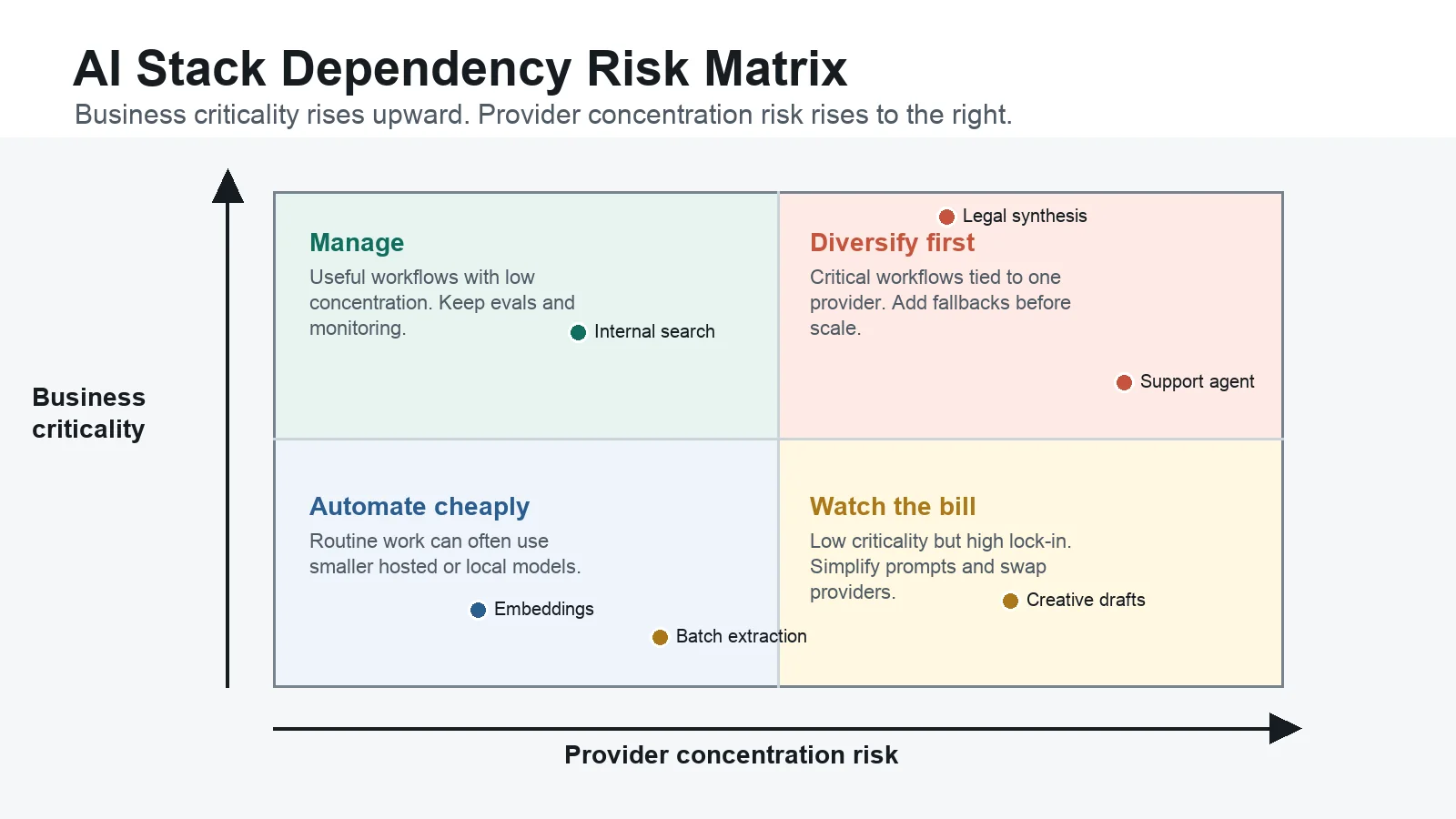
- Identify every workflow that depends on one model or one provider.
- Rank each workflow by business criticality and failure cost.
- Add at least one fallback provider for critical workflows.
- Build a model abstraction layer, even if the first version is simple.
- Store prompts, evals, retrieval settings, and output schemas outside provider-specific dashboards where possible.
- Maintain test suites for output quality, refusal behavior, hallucination risk, and latency.
- Track cost per completed task, not just cost per token.
- Use smaller hosted models for routine work when quality holds.
- Reserve frontier models for high-value reasoning, planning, and complex synthesis.
- Use open-weight models for portable, internal, private, or high-volume tasks where they pass evals.
- Use local models when privacy, offline access, cost, or jurisdictional control justifies the operational burden.
- Keep human review for regulated, irreversible, financial, legal, medical, security, or customer-impacting decisions.
- Monitor provider policy, pricing, access rules, retention requirements, deprecations, and cloud availability.
- Document what happens if a provider disappears for 24 hours, 7 days, or permanently.
If that feels like too much, start with the workflows that would hurt customers if they failed tomorrow. That is where diversification has the clearest return.
What This Means for AI Startups
AI startups should be careful about pitching “powered by one model” as the moat.
Model access is not a moat if the same provider sells access to everyone else and can change the rules. The stronger moat is workflow, data, UX, distribution, evals, memory, integrations, domain-specific feedback loops, customer trust, and the ability to route work across models without breaking the product.
A startup that can swap providers gracefully is more resilient. It can negotiate better. It can serve customers with different privacy requirements. It can lower cost as routine tasks move to smaller models. It can keep operating during a provider incident. It can explain its architecture to enterprise buyers who now have a very good reason to ask about model dependency risk.
Investors may increasingly ask a simple question: what happens if your primary model provider changes pricing, deprecates the model, loses availability, tightens safety behavior, or becomes subject to a policy restriction? A vague answer will not age well.
What This Means for Enterprises
Enterprise buyers should ask their vendors direct questions. The right answer is not always “we self-host everything.” The right answer is evidence that the vendor knows its dependency chain and has a plan.
Buyer Questions Box
- Which models and providers do you use for each major workflow?
- Can you switch providers without rewriting the product?
- What happens if Anthropic, OpenAI, Google, or another provider changes access?
- Do you support private deployment, open-weight models, or local inference for sensitive use cases?
- How do you evaluate model quality across providers?
- Where are prompts, outputs, logs, and embeddings stored?
- What are your data-retention terms for each model path?
- Which workflows require human review?
- What is your fallback plan for 24-hour, 7-day, and permanent provider loss?
- How do you monitor policy, pricing, deprecation, and access changes?
For teams still choosing models, the Kingy AI model selection guide and the AI models hub are good starting points. The core rule is not to choose the trendiest model. Choose the architecture that can keep working when the trend changes.
Final Verdict
The Fable 5 export-control shock is a warning shot.
It does not prove that Anthropic is uniquely risky. It does not prove that open-source AI solves everything. It does not prove that every company needs local GPUs or a five-provider routing platform tomorrow.
It proves something more practical: AI model access is now a business dependency, and business dependencies need resilience.
The future does not belong to companies that worship one model. It belongs to companies that build AI systems that are routed, portable, source-backed, cost-aware, privacy-aware, and capable of surviving political, technical, and market shocks.
Use frontier models where they are worth it. Use cheaper models where they are enough. Use open-weight and local models where control matters. Keep humans in the loop where accountability matters. Above all, do not confuse access to one powerful model with ownership of an AI strategy.
The Kingy Brief
Get The Kingy Brief.
AI changes, original tests and one practical thing to try. Fridays at 09:00 Vancouver time.
Free · Double opt-in · Unsubscribe anytime
Signup help and newsletter schedule
Signup form provided by Beehiiv. After submitting, check your inbox for "Confirm your subscription to The Kingy Brief" and open its confirmation link. Check Spam or Promotions if you cannot find it.
Fridays at 09:00 Vancouver time: source-checked AI changes, original tests and one practical thing to try. The weekly restart begins October 9, 2026. We skip a week when there is not enough verified material. Free. Unsubscribe anytime.