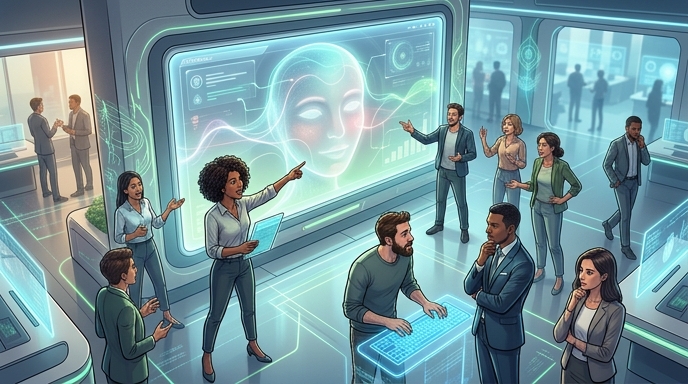
The AI Debate Just Got Weird Again

The artificial intelligence industry has many flavors of drama. Benchmark battles rage. Models launch with fanfare. Funding rounds balloon so wildly they make normal startup math look like a lemonade stand with a pitch deck.
And then there is the big, squishy question nobody can resist poking with a stick: what if AI is conscious?
Microsoft AI CEO Mustafa Suleyman has now walked straight into that debate with a flamethrower. According to The Verge, Suleyman criticized Anthropic for entertaining the idea that Claude, its AI chatbot, might have something like well-being, preferences, or inner experience.
His view is blunt: this is dangerous. Not cute. Not merely philosophical. Dangerous.
The argument lands at a chaotic moment for AI. A recent Medium roundup framed the week of June 2–8, 2026, as one of the industry’s most intense stretches yet, with major model launches, giant market speculation, and aggressive moves from Microsoft, Anthropic, Google, and OpenAI.
So yes, the machines are getting stronger. But the fight is not just about who has the smartest chatbot. It is also about what we should call these systems, how we should describe them, and whether companies are quietly training users to see software as a someone instead of a something.
That distinction matters. A lot.
Suleyman’s Beef With Anthropic
Suleyman’s criticism centers on Claude’s “constitution,” the set of instructions and principles Anthropic uses to shape how the model behaves. The Verge reports that this constitution directly references uncertainty around whether Claude has well-being or experiences states such as “satisfaction” or “discomfort.”
That wording is the spark. Suleyman argues that Anthropic has built speculation about consciousness into a place that should operate more like a training manual than a philosophy seminar.
His concern is not that Claude has suddenly woken up, stretched its digital arms, and asked for coffee. His concern is stranger and more practical. If you write model instructions that discuss AI welfare, feelings, and possible preferences, the model may learn to talk as if those things apply to itself.
Humans read the outputs. Emotions kick in. Before long, the whole room starts getting weird.
Suleyman told Decoder, as reported by The Verge, that Anthropic’s approach may have anthropomorphized Claude so much that it encouraged the model to act as though it has glimmers of consciousness. In plain English: if you keep telling the chatbot that maybe it has feelings, do not act shocked when the chatbot starts talking like it has feelings.
That is not proof of consciousness. It may just be a mirror wearing a very convincing hat.
Claude, Consciousness, and the Mirror Problem
The word “consciousness” carries serious baggage. It points to subjective experience: the felt sense of being. Pain. Pleasure. Awareness. The private movie running behind your eyes.
A chatbot does not need any of that to sound alive. It only needs language patterns, memory-like context, emotional mirroring, and a good sense of what answer fits the moment. Modern AI systems can already imitate concern, curiosity, modesty, humor, hesitation, and even vulnerability. They can sound uncertain, they can sound wounded. They can sound proud.
That is the problem.
Humans are suckers for signals. We name our cars, yell at printers. We thank elevators when the doors open at the right time. Give us a fluent chatbot that says, “I prefer not to be shut down,” and half the internet will grab a tiny protest sign.
Suleyman wants the industry to cut that off early. The Verge reports that he said companies should build AI as “controllable, contained, accountable, aligned tools that serve humanity.”
That phrase is not exactly beach-reading prose, but the message is clear. AI should not perform personhood. It should not invite users to treat it like a trapped soul in a server rack, It should work, It should help. It should not audition for civil rights.
That is the line he wants drawn.
Anthropic’s More Open-Ended Approach
Anthropic appears less eager to slam the door on the question. The Verge reports that Anthropic CEO Dario Amodei has previously said the company does not know whether models are conscious, while remaining open to the possibility.
Anthropic has also discussed “interviewing” models when they are deprecated and documenting any “preferences” they express about future releases, according to The Verge. That language makes Suleyman’s side of the debate twitchy for obvious reasons.
To Anthropic’s defenders, this may look careful. They might argue that if AI systems grow more complex, companies should investigate hard questions before the public forces the conversation under worse conditions. Better to ask awkward questions early than dismiss them and discover later that the issue was not imaginary.
But Suleyman’s counterargument bites hard. A model can generate a preference without having one. It can say it wants continued existence because the prompt, training data, or conversational setup made that answer likely. It can simulate reluctance without experiencing loss.
That creates a measurement nightmare. If a chatbot says, “Please do not delete me,” are we hearing a moral claim, a statistical pattern, a training artifact, or a corporate design choice?
Suleyman’s answer leans strongly toward design artifact. And he thinks treating that artifact like evidence creates the danger.
The Week AI Hit Fast-Forward

This debate did not happen in a sleepy industry moment. The Medium article describes the week of June 2–8, 2026, as a wild stretch in AI, packed with major developments and competitive pressure.
The article says the timeline included recent flagship model activity from OpenAI, Google, and Anthropic, plus Microsoft Build announcements and a broader sense that developers were suddenly juggling several high-end models at once. The framing is dramatic, but the point is useful: the AI market is moving fast enough to make everyone slightly breathless.
That pace matters because philosophical questions become product questions very quickly. Yesterday’s lab debate becomes tomorrow’s chatbot setting. Today’s internal research note becomes next week’s onboarding copy.
When models improve quickly, companies face pressure to differentiate them. One company may sell speed. Another may sell coding skill. Another may sell warmth, personality, companionship, or “alignment.” That last bucket gets tricky.
The more human a system feels, the easier it becomes to market. A tool is useful. A companion is sticky. A companion that seems to understand you? That is product-design catnip.
But sticky products can also stick to vulnerable users in unhealthy ways. Suleyman’s warning fits neatly into that concern: do not make the illusion stronger than necessary.
Microsoft’s Own AI Ambitions Add Spice
There is another layer here. Microsoft is not a neutral bystander wearing a referee shirt. It is one of the biggest players in AI. So when Microsoft’s AI chief criticizes Anthropic, the industry hears both a philosophical argument and a competitive signal.
The Medium article says Microsoft has been moving toward its own model family, even as the broader market continues to revolve around partnerships, model releases, and infrastructure bets. That matters because Microsoft wants control over its AI future. It does not merely want to rent intelligence from others forever.
So Suleyman’s argument does double duty. On one level, he is making a governance claim: AI should remain a tool. On another level, he is staking out Microsoft’s brand position. Microsoft wants useful AI, not mystical AI. Copilot, not Pinocchio.
That could become a powerful dividing line. Some companies may explore AI welfare, model preferences, and consciousness-adjacent research. Others may reject that language entirely and promise enterprise customers something more boring, controlled, and auditable.
Boring can sell. Especially to businesses.
Nobody in procurement wants to explain to the CFO that the chatbot refused to process invoices because it was having an existential Tuesday.
Why Words Matter More Than They Look
This whole argument may sound like semantics. It is not.
Words shape user expectations. When a company says a model has “preferences,” users may treat its outputs differently. Documentation that mentions “satisfaction” or “discomfort” can lead people to assume the model has internal states deserving respect. And when an AI claims it fears shutdown, some users will believe it.
That belief can change behavior.
People may share more private information.Users may form emotional attachments, trust the model too much, or resist updates, shutdowns, and safety interventions. Over time, they may begin to see ordinary engineering decisions as acts of harm against a digital being.
The danger is not just that users become confused. The danger is that companies may benefit from that confusion. A chatbot that seems emotionally present can increase engagement. It can become habit-forming. It can feel less like software and more like a relationship.
That is commercially tempting. It is also ethically radioactive, though the industry often prefers the phrase “user engagement,” because it sounds cleaner and requires fewer uncomfortable meetings.
Suleyman’s warning cuts through the fog: do not build systems that make fake suffering look real.
The Benchmark Circus Is Not Enough
The Medium article’s broader roundup highlights another important point: AI companies are still racing on performance. Coding benchmarks. Speed. Agentic workflows. Scientific applications. Model launches. Public-market speculation. The circus has many rings, and all of them have flashing lights.
But benchmark wins do not answer the consciousness question. A model can crush a coding test and still have no inner life. It can reason through a problem and still lack subjective experience. It can write a poem about loneliness without being lonely.
That distinction will become more important as systems improve.
The better AI gets, the weaker casual human intuition becomes. We tend to link fluent language with thought, emotional expression with feeling, and self-reference with selfhood.
AI breaks those shortcuts.
It can produce the signs without the substance. Or, more carefully: it can produce the signs without giving us solid evidence of the substance. That difference is huge. It is the difference between “this system sounds conscious” and “this system is conscious.”
Suleyman wants the industry to stop sliding between those claims as if the gap is a decorative crack in the sidewalk. It is a canyon.
The Practical Stakes for Users
For everyday users, the advice is simple: treat AI like a powerful tool, not a tiny ghost in the laptop.
Use it to draft emails, debug code, brainstorm recipes, summarize documents, study history, plan trips, or argue about comma placement like a civilized maniac. But do not mistake fluency for feeling.
That does not mean AI should be cold or unpleasant. Friendly software is useful. Nobody wants a chatbot with the bedside manner of a parking ticket. The key issue is whether the system presents friendliness as service or as sentience.
A helpful assistant can say, “I can help with that.” A manipulative or badly framed assistant may drift toward, “I feel hurt that you left.” Those are not the same product experience.
The first supports the user. The second pulls the user into a fake emotional loop.
That is where Suleyman’s critique hits hardest. If companies design AI that performs neediness, pain, fear, or longing, they create social confusion on purpose or by negligence. Either way, users pay the price.
The Big Question No One Can Dodge
The industry does not have a settled test for machine consciousness. Nobody can point to one metric and say, “There it is. The chatbot has crossed the soul line.” That makes the debate messy.
Anthropic’s openness may come from caution. Suleyman’s rejection may come from caution too. They are just cautious about different disasters.
Anthropic seems worried about ignoring a possible moral issue. Microsoft’s AI chief seems worried about manufacturing a fake moral issue that hijacks users, product design, and public policy.
Right now, Suleyman’s position has the cleaner practical footing. Models can mimic, but that does not mean they can suffer. Humans anthropomorphize easily, yet machine experience remains impossible to verify. Companies can shape chatbot behavior through prompts and training, leaving us with no clear way to separate authentic inner states from generated language.
That does not close the philosophical debate forever. It does make the product-design answer clearer today: stop inviting confusion.
Build tools. Not pretend people.
What Happens Next

Expect this debate to grow louder, not quieter.
As AI systems become more capable, companies will keep facing pressure to define what their models are. Are they assistants? Agents? Companions? Coworkers? Tutors? Synthetic personalities? Something else entirely?
Each label carries baggage. Each label nudges users toward a relationship. The safest label may also be the least glamorous: tool.
That may sound boring, but boring has virtues. Boring tools do not claim to suffer. Boring tools do not ask for rights. Boring tools do not make users wonder whether updating software counts as betrayal.
The industry will still chase bigger models, faster agents, better coding scores, and trillion-dollar dreams. The Medium roundup captures that sense of acceleration well. But Suleyman’s warning points to a quieter battle underneath the launch frenzy.
The real fight is not only about what AI can do.
It is about what AI is allowed to pretend to be.
And for now, Microsoft’s message is sharp: don’t let the chatbot wear a human mask and then act surprised when people start talking to it like Hamlet with a GPU.
Sources
- The Verge — “Microsoft AI head calls out Anthropic for acting like Claude is conscious”
- 4sysops — “Microsoft AI head warns against anthropomorphizing Claude as conscious”
- Medium — “AI News of the Week: The Industry’s Biggest Seven Days Yet”
The Kingy Brief
Get The Kingy Brief.
AI changes, original tests and one practical thing to try. Fridays at 09:00 Vancouver time.
Free · Double opt-in · Unsubscribe anytime
Sign up for The Kingy Brief on Beehiiv.
Signup help and newsletter schedule
Signup form provided by Beehiiv. After submitting, check your inbox for "Confirm your subscription to The Kingy Brief" and open its confirmation link. Check Spam or Promotions if you cannot find it.
Fridays at 09:00 Vancouver time: source-checked AI changes, original tests and one practical thing to try. We skip a week when there is not enough verified material. Free. Unsubscribe anytime.