The AI Price Fight Is Getting Real
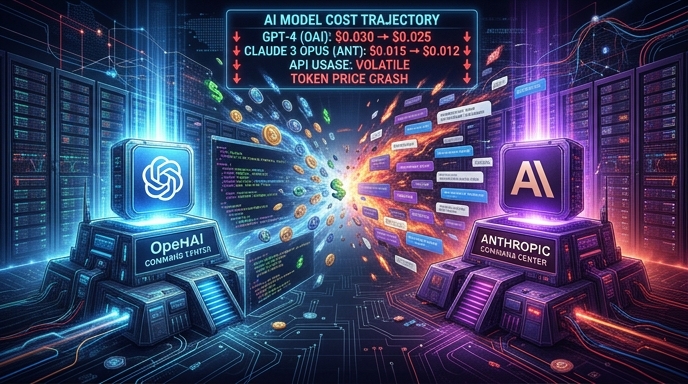
The AI boom has spent the last few years sounding like a superhero movie. Bigger models. Smarter chatbots. Faster coding tools. Flashier demos. More existential speeches from people wearing fleece vests.
Now the plot has shifted.
OpenAI is reportedly considering cutting the price of the tokens that customers use to access its AI models. That may sound like a dull accounting tweak. It is not. In the AI business, tokens are the meter running in the taxi. Every prompt, reply, code suggestion, document summary, agent workflow, and chatbot answer burns through them.
According to reports cited by Android Authority, The Decoder, CNBC, TechGenyz, and The Tech Portal, OpenAI has discussed lowering token costs as competitive pressure from Anthropic grows.
Nothing has been finalized. No official price cut has been announced. Still, the message is loud: the AI market is moving from “look what this model can do” to “look what this model costs.”
That is a less glamorous fight. It may also be the fight that decides who wins.
Tokens: Tiny Units, Giant Bills
A token is a small chunk of text. Sometimes it is a word. Sometimes it is part of a word. AI companies use tokens to measure how much work a model performs.
For casual users, this can feel invisible. You type a question. The chatbot answers. Magic, apparently. Maybe a little too much magic if it starts inventing legal cases or confidently misidentifying your houseplant.
For businesses, though, tokens become line items. Big ones.
A company using AI for customer support may process millions of messages. A legal team may feed long contracts into a model. A software team may ask a coding agent to read huge repositories, suggest fixes, write tests, and explain errors. Each step eats tokens.
That is why even a small price cut can matter. At enterprise scale, “a little cheaper” can mean real money. Not lunch money. Budget-meeting money.
The reports suggest this is exactly where the pressure is building. Businesses want AI tools, but they also want the math to work. The bill cannot keep growing like a sci-fi monster that escaped the lab.
Anthropic Is No Longer the Polite Side Character
For a while, OpenAI looked like the default name in modern AI. ChatGPT became a verb-adjacent cultural event. Developers built on OpenAI models. Enterprises signed deals. Rivals chased.
Then Anthropic got louder.
Its Claude products, especially Claude Code, have gained strong attention among developers. The Decoder notes that Claude Code went viral with software builders, and several reports frame it as a major reason Anthropic has become a more serious threat to OpenAI’s enterprise and developer business.
That matters because coding tools are token-hungry little beasts. They do not just answer one question and take a nap. They inspect files. They revise code. They explain errors. They retry tasks. They plan multi-step changes. They burn through context.
If developers like Claude Code, and if companies start routing more work through Anthropic, OpenAI has a problem. Not a “somebody said something mean on X” problem. A revenue problem.
So the reported price-cut discussions make sense. OpenAI does not want customers drifting toward Claude because the tool feels better, cheaper, or both.
In AI, loyalty is still fragile. Switching providers can be annoying, but it is often easier than ripping out old-school enterprise software. The moat is not always a castle. Sometimes it is wet cardboard with an API key.
Why a Price War Helps Customers
For developers and businesses, an AI price war could be excellent news.
Lower token prices would make experiments cheaper. Startups could test more products. Enterprises could deploy AI across more departments without triggering a finance-team migraine. Coding assistants could run longer tasks. Customer-service bots could handle larger volumes. Internal copilots could process more documents.
In plain English: cheaper tokens mean people can use more AI before the bill gets ridiculous.
This could also help AI move beyond flashy pilots. Many companies have tested AI tools, shown off demos, and then quietly asked, “Wait, what is the return on this?” That question matters. A tool that saves three minutes but costs like a luxury yacht subscription has a problem.
Lower prices would improve that equation.
They could also pressure the whole market. If OpenAI cuts prices, Anthropic may respond. Google may respond. Other model providers may respond. Open-source model hosts may sharpen their pitch. The buyer suddenly has leverage.
That is when markets get interesting. Not polite. Interesting.
The AI companies have spent years telling everyone that their tools will transform work. Fine. Now customers are asking for transformation at a discount.
Why a Price War Hurts AI Companies
Here is the ugly part: AI is expensive to run.
Training frontier models costs huge amounts of money. Serving them also costs money. Every answer requires compute. Every coding agent session needs infrastructure. Every long-context workflow leans on servers, chips, energy, engineers, and data-center capacity.
So when an AI company cuts prices, it may win customers while squeezing its margins.
That is the basic tension. Lower prices can drive adoption. They can also deepen losses if usage grows faster than efficiency improves. The reports point to this risk directly: OpenAI and Anthropic both face massive infrastructure demands, and a price war could make the economics tougher.
This is not unusual in technology. Cloud computing had price cuts. Streaming had price wars. Ride-hailing had subsidy wars. E-commerce had years of “lose money now, dominate later.”
But AI has a special twist. The product can be spectacularly useful and spectacularly expensive at the same time.
That creates a brutal question for OpenAI: can it make AI cheaper while still building a durable business?
That question gets even sharper if public-market investors are watching.
The IPO Shadow Looms Over Everything

Several reports connect the pricing drama to the wider race toward public listings. TechGenyz says OpenAI confirmed it submitted a confidential S-1 filing with the U.S. Securities and Exchange Commission, while also saying IPO timing has not been finalized. Other reports say Anthropic has also taken steps toward a possible public offering.
That context matters.
Private investors often reward growth stories. Public investors can reward growth too, but they tend to ask nastier questions. How big are the losses? How durable are the margins? How much infrastructure spending sits ahead? How sticky are customers? How much pricing power does the company really have?
A token price war complicates the story.
On one hand, lower prices could help OpenAI show adoption momentum. More usage. More customers. More developer love. More enterprise penetration. Lovely charts. Strong vibes.
On the other hand, cutting prices before an IPO can look like a warning flare. It may suggest customers are resisting costs. It may suggest rivals have real leverage. It may suggest the market is not as captive as the hype implied.
The truth may be both. AI demand is real. So is cost pressure.
That combination makes for a spicy investor roadshow. Bring popcorn. And spreadsheets.
The Enterprise Backlash Was Predictable
Businesses love productivity. They do not love mystery bills.
The recent AI wave encouraged companies to push models into everything: coding, research, customer service, analytics, sales, legal review, marketing, and operations. Some of that work creates obvious value. Some of it creates beautiful dashboards and vague enthusiasm. Some of it probably creates expensive nonsense with a confident tone.
That is where the pushback starts.
If a company spends heavily on AI, executives eventually ask what changed. Did engineering ship faster? Did support costs fall? Did sales improve? Did lawyers save time? Did employees actually use the tools? Or did everyone just run giant prompts because the tool felt futuristic?
The Decoder points to a term floating around Silicon Valley: “tokenmaxxing.” It describes the idea of consuming lots of AI tokens in the name of productivity, even when the return is unclear.
That is a perfect tech-industry word. Slightly absurd. Slightly useful. Deeply annoying by the third time someone says it in a meeting.
Still, the concept matters. If companies cannot prove AI returns, they will pressure vendors on price. That appears to be happening now.
OpenAI’s Codex Push Fits the Moment
OpenAI has also been putting more focus on coding tools. Android Authority notes that OpenAI has intensified its coding ambitions around Codex as Anthropic gains momentum with Claude Code.
This is not random. Coding may be one of the most valuable AI markets because developers are expensive, codebases are complex, and even modest productivity gains can matter. A good coding agent can save time. A bad one can create chaos with comments.
The stakes are high.
If Claude Code becomes the tool developers reach for first, OpenAI risks losing influence in one of AI’s most important daily workflows. If Codex gains ground, OpenAI can defend a crucial lane.
Pricing sits right in the middle of that fight. Developers may prefer the better model. Procurement teams may prefer the cheaper one. Engineering leaders may want both. Finance may want everyone to stop acting like tokens grow on trees.
That is why token prices are not some boring backend issue. They shape product adoption.
A powerful AI coding tool that costs too much may stay trapped in limited use. A slightly cheaper tool with strong performance can spread quickly.
Google Is the Other Giant in the Room
Anthropic may be the headline rival, but Google is still lurking like a dragon with a cloud division.
The Tech Portal frames the broader pressure as coming from Anthropic and Google. That makes sense. Google has massive AI talent, its Gemini models, deep infrastructure, and long experience running enormous computing systems. It also has existing relationships with enterprises through Google Cloud.
That infrastructure advantage matters in a price war.
If AI pricing falls, companies with stronger compute efficiency and deeper infrastructure may have more room to maneuver. They can absorb lower prices better than smaller players. They can bundle AI into existing products. They can use cloud relationships to win enterprise deals.
OpenAI has enormous brand power and developer mindshare. Anthropic has momentum with Claude. Google has scale.
That triangle makes the market more competitive. It also makes pricing pressure harder to avoid.
The AI industry spent years racing to build the smartest model. Now the next race may be about who can deliver intelligence cheaply, reliably, and at scale.
That sounds less cinematic. It is probably more important.
What Is Confirmed — and What Is Not
The cleanest version of the story is this: OpenAI is reportedly considering token price cuts. The discussions are not final. The company has not announced official cuts. The reports tie the move to rising competition from Anthropic, especially around developer and enterprise usage.
That much is the safe ground.
The unsafe ground is pretending we know the exact size, timing, or final shape of the cuts. We do not. The sources do not establish that OpenAI has made a final decision. They also do not prove how Anthropic will respond.
So do not read this as “OpenAI definitely slashes prices tomorrow.” Read it as “OpenAI appears to be preparing for a market where AI customers care much more about cost.”
That distinction matters.
Reports also mention IPO activity and competitive valuation narratives, but both OpenAI and Anthropic remain private companies. Their full financials are not public in the way public-company financials are. Any claim about losses, margins, or future listings should be treated carefully unless it comes from official filings or direct company statements.
The headline is big. The facts are narrower.
But narrow facts can still point to a huge shift.
The Bigger Shift: AI Is Becoming a Utility
The most important part of this story is not OpenAI versus Anthropic. It is the direction of the market.
AI is starting to look less like a magical premium product and more like a utility layer. Businesses want it available everywhere. Developers want it inside their tools. Consumers want it in apps, phones, browsers, and workflows. Once something becomes a utility, price matters brutally.
Electricity changed the world. People still care about the bill.
AI may follow a similar path. The winners will not only build impressive models. They will build models that customers can afford to use constantly.
That is the awkward truth hiding under the hype. A model can be brilliant, but if every serious workflow makes the finance department twitch, adoption slows. A model can be slightly less glamorous, but if it is cheap, fast, and good enough, it may win a lot of work.
That is why this reported pricing move matters. It suggests the AI market has entered a more mature phase.
The demo era is not over. But the invoice era has arrived.
What Happens Next
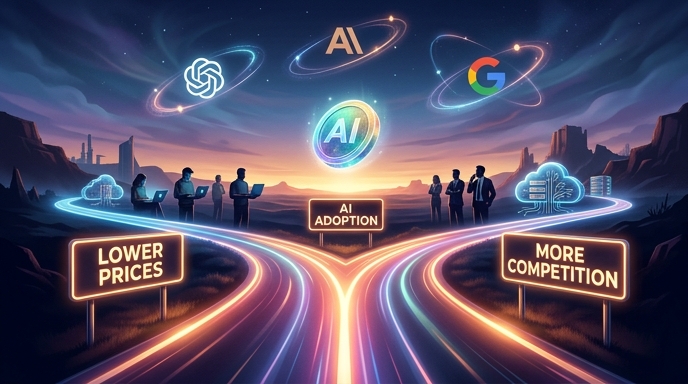
If OpenAI cuts token prices, customers will probably cheer first. Developers will test more. Enterprises will renegotiate. Rivals will respond. Analysts will sharpen their knives.
Anthropic could match cuts, ignore them, or compete through product quality. Google could use infrastructure scale to push pricing pressure even further. Smaller AI providers may struggle if the largest players turn pricing into a demolition derby.
OpenAI, meanwhile, must balance three goals at once: defend market share, keep developers loyal, and preserve a credible long-term business model.
That is not easy.
Cut too little, and customers may keep drifting. Cut too much, and margins suffer. Wait too long, and Anthropic gains ground. Move too fast, and investors may wonder why pricing power vanished.
This is the kind of problem that sounds simple until someone has to put numbers in a spreadsheet.
Still, one thing looks clear: AI customers have more leverage than they did a year ago. The providers know it. The market knows it. And the token meter, once a quiet technical detail, has become the center of the fight.
The AI wars are no longer just about who has the smartest chatbot.
They are about who can make intelligence cheap enough to use all day.
Sources
- Android Authority: “OpenAI could cut ChatGPT prices to win you over from Claude”
- The Decoder: “OpenAI vs. Anthropic: A price war over API tokens is brewing”
- CNBC: “OpenAI mulls slashing prices ahead of competition from Anthropic, WSJ”
- TechGenyz: “OpenAI Token Price Cuts as Anthropic Rivalry Heats Up Before IPO”
- The Tech Portal: “OpenAI could significantly reduce AI model prices amid rising competition from Anthropic and Google”
Compare
Latest News
- OpenAI Is Winning the AI Revenue Race. So Why Does It Still Lose Money on Every Dollar?
- Anthropic’s Draft S-1 Tests Wall Street’s Appetite for Frontier AI
Continue Reading
The Kingy Brief
Get The Kingy Brief.
AI changes, original tests and one practical thing to try. Fridays at 09:00 Vancouver time.
Free · Double opt-in · Unsubscribe anytime
Sign up for The Kingy Brief on Beehiiv.
Signup help and newsletter schedule
Signup form provided by Beehiiv. After submitting, check your inbox for "Confirm your subscription to The Kingy Brief" and open its confirmation link. Check Spam or Promotions if you cannot find it.
Fridays at 09:00 Vancouver time: source-checked AI changes, original tests and one practical thing to try. We skip a week when there is not enough verified material. Free. Unsubscribe anytime.