A New Claude Walks Into the AI Race

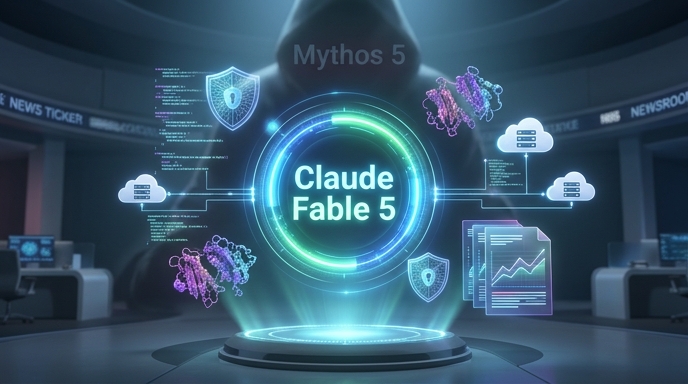
Anthropic has a new star in the Claude lineup, and its name sounds like it wandered out of a fantasy bookshelf: Claude Fable 5.
The company has released Fable 5 as its most powerful AI model made broadly available to users. That matters because Fable 5 is not just another routine model update. It is Anthropic’s first wide release from its more powerful Mythos-class family, a group of systems the company had previously treated with caution because of their advanced capabilities in sensitive areas.
In plain English: Anthropic built a model that could do impressive things, then hesitated to hand everyone the keys. Now it says it has found a middle path. Fable 5 brings much of that Mythos-level power to general users, but with guardrails designed to block or redirect certain high-risk requests.
That makes the launch more than a speed-and-benchmarks story. It is also a trust story. Can an AI company release a more capable model without making the internet feel like someone left a flamethrower next to a stack of birthday candles?
Anthropic thinks yes. The rest of us get to watch the experiment begin.
What Exactly Is Claude Fable 5?
Claude Fable 5 is the public-facing, safeguarded version of Anthropic’s Mythos-class technology. According to The Verge, Anthropic says Fable 5 shows exceptional performance in software engineering, knowledge work, and vision. The company also says its advantage grows as tasks get longer and more complex.
That last bit is important. Many AI models can look sharp in short bursts. Ask for a quick summary, a tidy email, or a small code snippet, and plenty of systems can strut around like peacocks. Long, messy tasks are harder. They require memory, planning, endurance, and the ability not to drift into nonsense halfway through.
Anthropic is pitching Fable 5 as a model built for that tougher terrain. Think large code migrations. Dense document analysis. Visual reasoning. Scientific workflows. Multi-step projects where the model has to keep its shoes tied for more than ten minutes.
The model is also tied closely to Claude Mythos 5. Several reports describe the two as sharing the same underlying model, with Fable 5 using more conservative safety restrictions and Mythos 5 allowing broader access in selected sensitive domains.
So Fable 5 is not the wild dragon. It is the dragon with a badge, leash, and several lawyers watching.
Mythos 5 Is the Restricted Sibling
Alongside Fable 5, Anthropic is also releasing Claude Mythos 5, but not for everyone.
The distinction is simple. Fable 5 is the broadly available model with safeguards. Mythos 5 is the more restricted version for selected partners, especially in areas such as cybersecurity and infrastructure defense. 9to5Google reported that Mythos 5 will initially go to a small group of cyberdefenders and infrastructure providers through Anthropic’s Project Glasswing initiative.
That makes Mythos 5 less like a consumer product and more like a controlled-access tool. Anthropic appears to be saying: “This thing is useful, but not something we want floating around unsupervised.”
That is not paranoia. Advanced AI systems can help defenders find vulnerabilities, analyze malware, and secure networks. The same capabilities can also help attackers. The difference between “protect the hospital network” and “break into the hospital network” can be a few words and a bad afternoon.
Fable 5, then, is Anthropic’s compromise. It tries to deliver the productivity gains without handing out every high-risk capability at full strength. Whether that balance holds will depend on how well the safeguards work in real use.
The Guardrails Are the Big Plot Twist
The most interesting part of Fable 5 is not just that it is powerful. It is that Anthropic says the model knows when to step aside.
According to The Verge, Anthropic says Fable 5 uses new safeguards that block responses in specific high-risk areas. When a request falls into certain sensitive zones, including cybersecurity and biology, the system can fall back to Claude Opus 4.8.
That fallback system is the heart of the launch. Instead of making the entire model weaker for everyone, Anthropic appears to be using a routing strategy: let Fable 5 handle most normal work, but redirect some risky requests to a more constrained model.
The company says that in testing, 95 percent of Fable sessions ran entirely on Fable responses without falling back to Opus 4.8. That is a crucial number because it suggests Anthropic wants users to feel the upgrade most of the time, not constantly trip over safety switches.
Still, Anthropic has reportedly tuned the system conservatively. Translation: some users may see the guardrails trigger when they did not expect it. That will annoy power users. It may also be the price of releasing the model broadly.
Coding Looks Like the Headline Feature
Fable 5’s biggest flex appears to be coding.
The Decoder reported that Fable 5 scored 80.3 percent on SWE-Bench Pro, a benchmark focused on real software engineering tasks from public GitHub repositories. The same report said Claude Opus 4.8 scored 69.2 percent, GPT 5.5 scored 58.6 percent, and Gemini 3.1 Pro scored 54.2 percent.
That is a sizable reported lead. Benchmarks are not reality, of course. They are road tests on a track, not a rainy commute with a screaming toddler in the back seat. But coding benchmarks still matter because software engineering has become one of the clearest commercial battlegrounds for frontier AI.
The Decoder also reported that Fable 5 scored 29.3 percent on Cognition’s FrontierCode benchmark, while Opus 4.8 scored 13.4 percent and GPT 5.5 scored 5.7 percent.
The big takeaway: Anthropic wants developers to see Fable 5 as a serious production partner, not a fancy autocomplete with better manners.
If those gains translate into daily work, this model could save teams real time. If they do not, the benchmarks will become yet another shiny chart taped to the AI hype machine.
The Stripe Example Has People Talking

One reported customer example stands out because it sounds almost rude to the normal pace of software work.
According to The Decoder, Stripe said Fable compressed five months of engineering work into days. In a Ruby codebase with 50 million lines, the model reportedly completed a migration in one day that would have taken a full team more than two months.
That is the kind of claim that makes executives sit upright and makes engineers ask twelve follow-up questions, several of them suspicious.
What exactly was migrated? How much human review followed? How many tests failed first? Did the model merely generate patches, or did it reason through architectural decisions? Those details matter.
Still, even with healthy skepticism, the example points to where the industry is going. AI coding tools are moving from “write this function” toward “handle this chunk of the roadmap.” The role of the human developer shifts from typist to planner, reviewer, and firefighter when the machine inevitably does something weird.
That is not a small change. It is a workplace earthquake wearing noise-canceling headphones.
Vision and Knowledge Work Get a Boost Too
Fable 5 is not only chasing programmers.
Anthropic is also presenting it as a strong model for knowledge work, visual analysis, and long-context tasks. The Decoder reported that Fable 5 showed gains in document-based reasoning, chart and table interpretation, and complex analytical work.
That matters for finance teams, researchers, analysts, lawyers, consultants, and anyone else who spends their day wrestling PDFs until the PDFs win.
The model’s vision abilities also appear central to Anthropic’s pitch. Reports say Fable 5 can extract precise figures from detailed scientific illustrations and even rebuild a web app’s source code from screenshots alone. Those are not party tricks if they work reliably. They are bridges between visual information and executable work.
This is where AI models are becoming less like chatbots and more like general-purpose work engines. Feed them images, text, tables, charts, and instructions. Ask them to connect the dots. Then pray the dots are real.
The fun part is the speed. The scary part is also the speed.
Science Is Where Mythos Gets Spicy
The most sensitive claims involve Mythos 5 and scientific research.
The Decoder reported that Anthropic’s internal protein design experts said Mythos 5 sped up parts of the drug design process by 10 times. In one test, the model reportedly used protein design and bioinformatics tools without human help and matched or beat experienced human operators.
That is a big claim. It also belongs in the “verify carefully” drawer, not the “print the victory banner” drawer.
The same report said Mythos 5 handled steps such as selecting binding sites, launching protein design tools, running them, and fixing errors. Nine out of 14 protein targets reportedly produced strong drug-design candidates that are now being studied.
This is exactly why Anthropic is limiting Mythos 5 access. Biology is powerful. Drug discovery can save lives. Biosecurity failures can create nightmares. The same model that helps design therapeutic candidates could raise obvious safety questions if used recklessly.
So yes, the science angle is exciting. It is also the reason the public gets Fable, not the fully unrestricted Mythos experience.
Access Comes With a Catch
Fable 5 may be broadly available, but access is not unlimited forever.
9to5Google reported that Fable 5 is included for Pro, Max, Team, and seat-based Enterprise plans through June 22, 2026. Starting June 23, use will require usage credits, unless Anthropic extends the included window. The company reportedly hopes to restore Fable 5 as a standard part of subscription plans when capacity allows.
That capacity caveat deserves attention. Frontier models are expensive to run. When a company releases a powerful new model, the bottleneck is not just demand. It is compute, cost, infrastructure, and the unpleasant physics of serving millions of impatient users.
In other words, Fable 5 may be “available,” but availability has an asterisk. A very expensive asterisk wearing a data-center lanyard.
Pricing also reflects the model’s premium status. The Verge reported pricing at $10 per million input tokens and $50 per million output tokens, significantly higher than Opus 4.8 and lower than Mythos Preview.
Power users will do the math quickly. Fun is fun. Token bills are less fun.
AWS Is Already in the Mix
Amazon is not sitting this one out.
According to Amazon, Claude Fable 5 is available through Amazon Bedrock and Claude Platform on AWS. That gives enterprise customers a route to use the model inside AWS environments, with Bedrock offering features such as enterprise security, regional data residency, and scalable inference.
This is important because many companies do not want powerful AI models floating around outside their existing cloud governance. They want access controls. They want auditability. They want procurement teams to stop sweating through their shirts.
Amazon also says customers can use Claude Fable 5 with Advanced Prompt Optimization on Amazon Bedrock, which benchmarks prompts against evaluation criteria and produces rewritten prompts for production use.
That sounds dry, but it matters. Many AI deployments fail not because the model is weak, but because the prompts are vague, brittle, or written like someone arguing with a vending machine. Better prompt tooling can make frontier models more useful in real business workflows.
For Anthropic, AWS availability also broadens the runway. For Amazon, Fable 5 gives Bedrock another high-end model to wave at enterprise buyers.
Why This Launch Matters
Fable 5 shows where the frontier AI market is heading: more power, more specialization, more restrictions, and more complicated access models.
The old chatbot era was simple. You typed. It answered. Sometimes it invented a Supreme Court case or confidently explained that strawberries have two Rs. Charming? Maybe. Useful? Sometimes. Dangerous? Occasionally.
The new era is different. These models code, analyze, plan, inspect images, use tools, and operate across long tasks. They do not just answer questions. They increasingly perform work.
That raises the stakes. A stronger coding model can accelerate software teams. It can also accelerate attackers. A stronger biology model can aid research. It can also trigger biosecurity concerns. A stronger vision model can process scientific charts and rebuild interfaces. It can also make automation easier in ways society has not fully digested.
Anthropic’s answer is controlled release: Fable 5 for general use, Mythos 5 for vetted partners, and safety fallbacks for high-risk domains.
It is a serious strategy. It is also a live test. Users will test the limits. Competitors will compare benchmarks. Enterprises will evaluate costs. Critics will look for failures. The model will either justify the confidence or expose the cracks.
No pressure, little fable.
The Bottom Line

Claude Fable 5 is one of Anthropic’s most important launches because it tries to solve the central AI problem of 2026: how to release more capable systems without pretending capability has no downside.
The model appears strongest in coding, long-context work, visual reasoning, and complex analysis. Reports suggest major benchmark gains, serious enterprise interest, and impressive early customer examples. At the same time, Anthropic is keeping the more permissive Mythos 5 behind a controlled-access wall, especially for cybersecurity and infrastructure use.
That tells us something. The AI race is no longer just about who has the biggest model. It is about who can package dangerous power into something useful, sellable, and hard to misuse.
Fable 5 is Anthropic’s latest answer. It is ambitious. It is polished. It is cautious. It is also expensive and capacity-limited.
So, is this a breakthrough or a very fancy velvet rope?
Probably both.
Sources
- The Verge — “Anthropic releases its first Mythos-class model Claude Fable”
- The Decoder — “Anthropic releases Claude Fable 5 and Mythos 5 with major gains in coding and science”
- 9to5Google — “Claude Mythos goes public in new Fable 5 model that’s ‘safe for general use’”
- 4sysops — “Anthropic launches Claude Fable 5 with advanced cybersecurity guardrails”
- The Arabian Post — “Anthropic opens Fable model access”
- Amazon — “Claude Fable 5 from Anthropic now available on Amazon Bedrock”
Claude Fable 5
Claude Fable 5 Benchmarks
Claude Enterprise Trust
Claude Export Controls
Claude Model Launches
Claude Mythos Controversy
Claude Comparisons
The Kingy Brief
Get The Kingy Brief.
AI changes, original tests and one practical thing to try. Fridays at 09:00 Vancouver time.
Free · Double opt-in · Unsubscribe anytime
Sign up for The Kingy Brief on Beehiiv.
Signup help and newsletter schedule
Signup form provided by Beehiiv. After submitting, check your inbox for "Confirm your subscription to The Kingy Brief" and open its confirmation link. Check Spam or Promotions if you cannot find it.
Fridays at 09:00 Vancouver time: source-checked AI changes, original tests and one practical thing to try. We skip a week when there is not enough verified material. Free. Unsubscribe anytime.