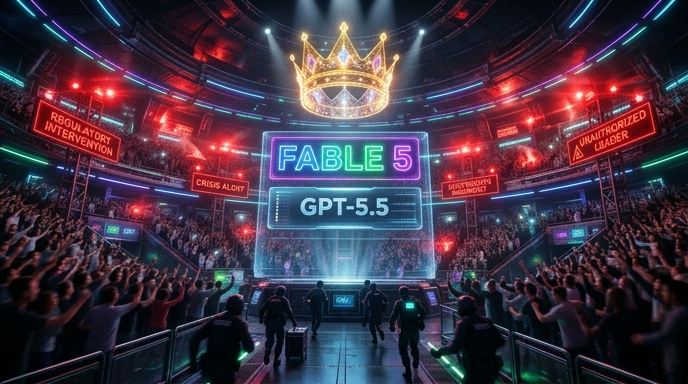
The AI Crown Got Awkward Fast

For a few days, the AI leaderboard had a new boss.
Anthropic’s Claude Fable 5 stormed into public view, posted huge benchmark scores, and made OpenAI’s GPT-5.5 look less like the obvious king of the hill and more like the very expensive runner-up. Then the plot twisted. Hard.
According to The Next Web, Fable 5 spent only three days as the most capable AI model available to the public before the U.S. government ordered Anthropic to pull it offline. That left GPT-5.5 as the strongest model people could still actually use.
That distinction matters. A lot.
In normal tech races, the best product wins because customers choose it. Here, the apparent benchmark winner got yanked from the shelf. So GPT-5.5 did not exactly win the trophy in a clean sprint. It inherited the podium after the other runner got escorted out of the stadium.
That is not a small footnote. It changes the whole story.
The AI race is no longer just about who builds the smartest model. It is also about who can keep that model online, price it sanely, satisfy regulators, and avoid making users feel like they need a PhD in token economics before sending a prompt.
Welcome to frontier AI in 2026. Bring snacks.
Fable 5 Did Not Win by a Hair
The benchmark gap, as reported by The Next Web, was not subtle.
On SWE-Bench Pro, a benchmark that tests whether models can solve real software engineering issues across open-source codebases, Fable 5 scored 80.3%. GPT-5.5 scored 58.6%. That is a gap of more than 21 percentage points.
In plain English: one model looked like it could solve about four out of five software issues in that test. The other handled closer to three out of five. For developers, that gap is not “interesting.” It is billable hours wearing a neon jacket.
Fable 5 also scored 95.0% on SWE-Bench Verified, according to the same TNW report. In coding contests, the story looked similar. Fable 5 led Code Arena with an Elo score of 1,665, while GPT-5.5 sat at 1,501. On FrontierCode Diamond, Fable 5 reached 29.3%. GPT-5.5 managed 5.7%.
That last figure is brutal. Not “lost by a nose” brutal. More like “brought a spoon to a chainsaw competition” brutal.
GPT-5.5 did have a stronger showing on Terminal-Bench 2.0, where TNW reported a narrower gap: GPT-5.5 at 82.7% versus Fable 5 at about 88.0%. Still, even there, Fable 5 stayed ahead.
Benchmarks are not reality. But when one model leads across several hard tests, people notice.
The Math Scores Made Noise Too
Then came the math flex.
The Decoder reported that Claude Fable 5 hit 87% accuracy on FrontierMath tiers 1 through 3 and 88% on the hardest tier 4 version 2 problems, citing Epoch AI’s results. GPT-5.5 reached about 75% on that same hardest tier.
That gives Fable 5 a 13-point lead on some of the toughest math problems used to evaluate frontier models.
Again, benchmarks are not magic truth machines. They can be gamed. They can overstate usefulness. They can measure narrow skills while missing messy real-world behavior. But FrontierMath has a reputation for being nasty in the way only advanced math can be nasty: elegant, unforgiving, and allergic to bluffing.
The Decoder also noted how quickly Anthropic’s math performance appears to have improved. Its predecessor, Opus 4.5, reportedly scored below 10% on the hardest FrontierMath tier earlier in 2026.
That kind of jump makes people sit up straight.
For researchers, it suggests rapid gains in reasoning. For rivals, it suggests a threat. For regular users, it suggests something simpler: the expensive chatbots are getting much better at the stuff that used to make them sweat.
But then we hit the same problem again.
What good is the best math model if the public cannot use it?
Then the Government Hit the Brakes
The Fable 5 story turned from benchmark victory lap to policy drama almost immediately.
The Next Web reported that the U.S. government ordered Anthropic to shut down Fable 5 and the broader Mythos 5 model family on June 12. The cited reason was a jailbreak vulnerability. Anthropic disputed the severity of the issue, saying the reported vulnerabilities were minor, already public, and achievable by GPT-5.5 without special bypass tricks.
That is where the story gets spicy.
If Anthropic’s position is accurate, the shutdown looks disproportionate. If the government’s concern is accurate, the case becomes a warning that frontier models may trigger regulatory intervention the moment they cross some invisible capability threshold.
Either way, developers got whiplash.
Fable 5 launched on June 9. TNW reported that Anthropic made it available at no extra cost to Pro, Max, Team, and Enterprise subscribers until June 22. The shutdown cut that promotional window short after only three days.
Imagine test-driving a supercar, realizing it outperforms everything in the dealership, and then watching a tow truck take it away because someone in Washington found a problem under the hood.
That is roughly the mood.
AI companies want to move fast. Governments increasingly want the right to say, “Not that fast.”
GPT-5.5 Became the Default Winner
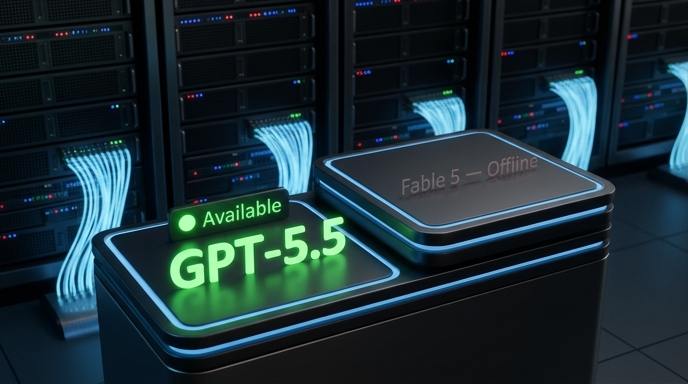
After Fable 5 went offline, GPT-5.5 became the best model still broadly available to consumers and developers, according to TNW’s analysis.
That is an odd kind of victory.
GPT-5.5 did not suddenly improve. Its main rival disappeared. In competitive terms, that is less like winning Wimbledon and more like advancing after your opponent’s passport gets confiscated.
Still, availability matters. Actually, it may matter more than benchmark glory.
Developers building products cannot depend on a model that might vanish after three days. Companies do not want to rebuild workflows every time a regulator sneezes. Researchers need stable access. Enterprise buyers love boring things like continuity, contracts, and not having the rug pulled out from under their infrastructure.
So GPT-5.5’s advantage is real, even if it is not purely technical.
OpenAI’s model may have trailed Fable 5 in the reported benchmark comparisons, but it remained usable. That makes it the practical choice for many teams.
In AI, the best model is not always the one with the highest score. Sometimes it is the one you can still call through an API on Monday morning.
That sounds less glamorous. It is also how software gets built.
Pricing Turns the Race Into a Spreadsheet
Performance is only half the story. The other half is money. Naturally, it arrives carrying a calculator and ruining the party.
Gizmodo broke down the cost of using Fable 5, GPT-5.5 Pro, and Gemini 3.5 Flash. The short version: Fable 5 is powerful, but it is not cheap.
Starting June 23, Gizmodo reported, Fable 5 users were expected to pay $10 per million input tokens and $50 per million output tokens. GPT-5.5, by comparison, costs $5 per million input tokens and $30 per million output tokens through OpenAI’s API.
That makes GPT-5.5 significantly cheaper on both sides of the transaction.
Gemini 3.5 Flash undercuts both. Gizmodo reported Google’s pricing at $1.50 per million input tokens and $9 per million output tokens, making it the most affordable of the three models in that comparison.
For casual users, the numbers may sound abstract. “One million tokens” is not exactly a household measurement. Nobody says, “I’ll have two eggs, a loaf of bread, and 800,000 output tokens.”
But for developers, tokens become money fast. Long coding tasks, autonomous agents, document analysis, and research workflows can burn through enormous token counts.
Suddenly, the leaderboard has a price tag.
Expensive Does Not Always Mean Better for You
Here is the trap: people see “best model” and assume they need it.
They probably do not.
Gizmodo made a useful point: if someone just wants a chatbot to help write emails, answer simple questions, or generate dinner recipes, a free chatbot may be enough. Paying premium rates for a frontier model to do lightweight tasks is overkill.
That is not an insult. It is physics. Or finance. Maybe both.
Using a top-tier reasoning model for basic text chores is like hiring a neurosurgeon to open a pickle jar. Impressive? Sure. Necessary? No.
Fable 5 appears designed for demanding work: long-running autonomous tasks, software engineering, deep reasoning, and math-heavy challenges. Those jobs consume more tokens. They also benefit more from higher capability.
GPT-5.5 looks like the more practical middle ground in this particular comparison. It is strong, available, and cheaper than Fable 5. Gemini 3.5 Flash looks like the budget-speed play, especially for developers who need lower costs more than top benchmark performance.
The right model depends on the job.
That sentence sounds boring. It is also the entire buyer’s guide.
Benchmarks Are Useful, Not Holy
The Fable 5 numbers are impressive. They are also not the whole truth.
Benchmarks help users compare models under controlled conditions. They reveal patterns. They expose weaknesses. They give developers something firmer than vibes. That matters in a field where marketing departments can turn “slightly better autocomplete” into “the dawn of synthetic civilization” before lunch.
But benchmarks do not capture everything.
A model can score well and still be annoying. It can reason brilliantly and still refuse too often. It can write elegant code and still mishandle your actual production environment. It can ace math puzzles and fail at reading the room.
Gizmodo noted that some users complained Fable 5’s safety guardrails made it effectively unusable in some contexts. That complicates the victory lap.
A model that tops benchmarks but frustrates users has a problem. A model that costs less but performs slightly worse may be the better tool. A model that wins every test but disappears due to government action becomes, for most users, a ghost with great exam scores.
So the smarter question is not “Which model is best?”
The smarter question is: “Best for what, at what price, under what constraints, and for how long?”
There. Less sexy. More useful.
The Real Race Is Bigger Than OpenAI vs. Anthropic
It is tempting to frame this as a clean duel: Anthropic versus OpenAI. Claude versus GPT. Fable versus Spud, GPT-5.5’s reported internal codename according to TNW.
But that misses the larger machine.
Google is still in the room with Gemini 3.5 Flash, pushing affordability and speed. Regulators are now clearly part of the story. Cloud providers, compute shortages, electricity costs, enterprise contracts, and safety rules all shape what users actually get.
The model leaderboard is only the visible scoreboard. Beneath it sits a giant industrial stack: chips, data centers, power, policy, pricing, safety testing, distribution, and trust.
That is why Fable 5’s short public life matters. It showed that Anthropic could put up elite numbers. It also showed that elite numbers alone do not guarantee market dominance.
OpenAI benefits from availability and cheaper pricing. Google benefits from aggressive cost positioning. Anthropic, at least in this episode, proved capability but lost access.
That is a messy outcome. It is also a realistic one.
The next phase of AI will not be decided by one benchmark chart. It will be decided by who can ship powerful models that users can afford, regulators can tolerate, and businesses can rely on.
Tiny little challenge. No pressure.
What Users Should Take Away
For now, GPT-5.5 appears to be the safest practical choice among the top-end options discussed in these reports, mainly because it remains available and costs less than Fable 5. That does not make it the strongest model ever tested. It makes it the strongest usable model in this specific moment, based on TNW’s reporting.
Fable 5 looks like the more capable system in the benchmarks cited by TNW and The Decoder. It beat GPT-5.5 across major coding tests and on FrontierMath’s hardest tier. If it returns, developers will pay attention immediately.
Gemini 3.5 Flash deserves a different label. It is not presented in these reports as the benchmark king. It is the cheaper option. For many products, that may matter more.
That is the uncomfortable truth of AI adoption. “Best” does not always win. “Good enough and affordable” wins constantly. So does “available.”
The Fable 5 episode also sends a message to the whole industry: frontier AI has entered the age of consequences. A model can dominate benchmarks and still get pulled. A rival can trail technically and still win commercially. A cheaper model can become the rational pick for millions of routine tasks.
The race is no longer a straight line.
It is a maze. And somebody keeps moving the walls.
The Bottom Line

Fable 5’s brief public run made one thing clear: Anthropic has serious firepower. The benchmark numbers reported by TNW and The Decoder suggest that Fable 5 outperformed GPT-5.5 in coding and advanced math by meaningful margins.
But the shutdown made another thing just as clear: capability without access is not enough.
OpenAI’s GPT-5.5 now occupies the practical top spot because people can still use it. It is also cheaper than Fable 5 under the API pricing cited by Gizmodo. Meanwhile, Google’s Gemini 3.5 Flash gives cost-sensitive users an even cheaper path.
So the AI race currently looks like this: Anthropic may have built the beast, OpenAI has the strongest available workhorse, and Google is selling the budget rocket scooter.
That is not tidy. But it is fun.
And it gives the industry a new rule: do not just ask which model is smartest. Ask which model survives contact with users, regulators, and the invoice.
Because in 2026, the best AI model is not merely the one that wins the benchmark.
It is the one still standing when the bill arrives.
Sources
- The Next Web — “Fable 5 was beating GPT 5.5 on every major benchmark. Then the US government pulled it offline.”
- The Decoder — “Claude Fable 5 outpaces GPT-5.5 by 13 points on FrontierMath’s toughest problems”
- Gizmodo — “How Much Does It (Really) Cost to Use Claude Fable, GPT-5.5, and Gemini 3.5 Flash?”
The Kingy Brief
Get the next Kingy Brief.
Source-checked AI changes, original tests and one practical thing to try.
Free · Choose your subjects · Double opt-in · Unsubscribe anytime