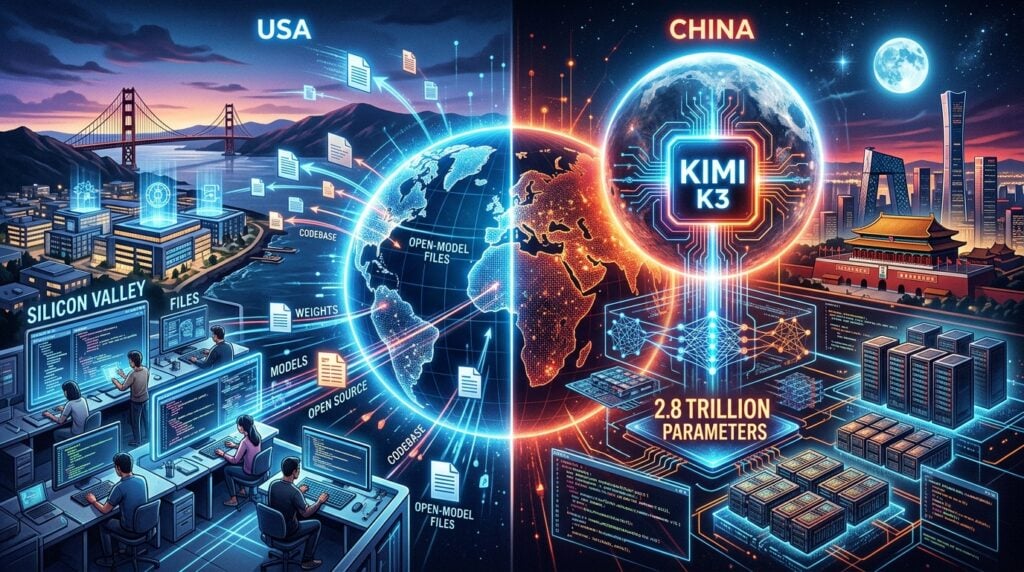
The AI Race Just Got Another DeepSeek-Style Jolt
Silicon Valley received an unpleasant midyear surprise from Beijing. Again.
Moonshot AI, a Chinese startup founded in 2023, has unveiled Kimi K3, an enormous artificial intelligence model designed for coding, research, reasoning, and other long-running digital tasks. The company describes it as the world’s first open model in the three-trillion-parameter class.
The headline number is hard to ignore: 2.8 trillion parameters.
That alone does not make Kimi K3 intelligent. Parameter counts are closer to engine size than lap time. A colossal engine can still lose the race if the rest of the machine is badly designed. However, Moonshot also published performance results suggesting that Kimi K3 can compete with some of the strongest proprietary systems from OpenAI and Anthropic.
Developers noticed immediately. Investors noticed too. Then users arrived in such large numbers that Moonshot temporarily stopped selling new subscriptions after demand pushed its computing infrastructure close to capacity.
That sequence—launch, excitement, benchmark frenzy, GPU traffic jam—unfolded in roughly one weekend.
The arrival of Kimi K3 does not conclusively prove that China has taken the global AI lead. It does demolish the comforting assumption that Chinese laboratories remain safely and consistently behind their American rivals.
That assumption now looks badly out of date.
What Exactly Is Kimi K3?
Kimi K3 is Moonshot AI’s most ambitious model so far. According to the company’s official technical introduction, it combines 2.8 trillion parameters with native visual capabilities and a context window of one million tokens.
That context window allows the model to process enormous amounts of material within one session. In principle, it could examine sprawling software repositories, lengthy research collections, corporate records, video material, or stacks of technical documents without immediately forgetting what appeared several hundred pages earlier.
Moonshot built K3 for “long-horizon” work. In ordinary language, that means jobs requiring many connected steps rather than a single prompt and a quick answer.
The model can reportedly navigate software projects, operate terminal tools, analyze images, produce presentations, conduct research, build websites, work with spreadsheets, and revise its output through repeated iterations.
Moonshot says K3 still trails Claude Fable 5 and GPT-5.6 Sol overall. That admission matters because it cuts through some of the more breathless coverage. K3 is not presented—even by its creator—as the undisputed king of AI.
But it may not need the crown.
A model that approaches the frontier while offering lower prices and downloadable weights can disrupt the market without finishing first on every leaderboard.
A Giant Model That Does Not Use Every Parameter at Once
The 2.8-trillion figure sounds computationally terrifying. It is. Yet Kimi K3 does not activate its entire brain for every word it generates.
The model uses a mixture-of-experts architecture. Instead of sending each request through every part of the network, a routing system selects specialized groups of parameters for the task at hand.
Moonshot says K3 effectively activates 16 of its 896 routed experts during computation. Picture a gigantic consultancy with hundreds of specialist departments. When someone asks a tax question, the company does not summon every architect, chemist, translator, and marine biologist into the meeting. It calls the relevant teams.
That approach can improve efficiency, although managing a model of this size remains extraordinarily demanding.
K3 also uses technologies Moonshot calls Kimi Delta Attention and Attention Residuals. These systems are intended to improve how the model handles information across long sequences and deep layers.
The company claims the complete design delivers roughly 2.5 times the scaling efficiency of Kimi K2. That is Moonshot’s own measurement, not yet a universally established result. Still, it suggests the company did more than pile parameters into a digital warehouse and hope intelligence wandered out.
The Benchmarks Caused the First Shockwave
Moonshot released a formidable collection of benchmark results alongside K3. The model performed strongly across coding, terminal operation, research, office productivity, multimodal understanding, and agent-based tasks.
According to Axios, Kimi K3 quickly reached the top tier of public AI rankings. Axios reported that it surpassed Anthropic’s Fable 5 and OpenAI’s GPT-5.6 Sol in front-end coding evaluations on Arena while placing ahead of Claude Opus 4.8 in Arena’s broader text ranking.
Those results are significant. They are not a final verdict.
Benchmark scores depend heavily on test conditions, reasoning settings, agent frameworks, tool access, sampling methods, and evaluation dates. Moonshot’s own documentation notes that different models sometimes ran through different coding harnesses. Some competing systems also encountered fallback behavior or safety restrictions during particular tests.
In short, the contestants did not always wear identical shoes.
That does not make K3’s performance meaningless. It means readers should resist converting a leaderboard position into a universal statement such as “Model A is smarter than Model B.”
K3 has shown credible frontier-level capability. Independent testing will determine how consistently that strength carries into messy real-world work.
Coding Is Where K3 Looks Especially Dangerous

Moonshot has positioned Kimi K3 as much more than a chatbot with a large memory. Its most aggressive claims concern autonomous engineering.
The company says the model can work for extended periods with limited human supervision, inspect massive codebases, use terminal tools, optimize GPU kernels, and combine visual feedback with software development.
In one company-run experiment, K3 built MiniTriton, a compact compiler modeled after Triton. Moonshot says the resulting system included its own intermediate representation, optimization passes, and code-generation pipeline.
In another demonstration, the model spent 48 hours designing and verifying a small chip for a miniature model built around its architecture. The experiment used open-source electronic-design tools and a mature 45-nanometer process library.
Those are impressive demonstrations. They remain demonstrations selected and presented by the model’s creator. They do not prove that K3 can wander into an unfamiliar corporation on Monday and replace its engineering department by Friday.
Still, they show where AI development is heading. The contest has moved beyond producing neat code snippets. Frontier laboratories now want models that can plan, test, debug, inspect results, change direction, and continue working for hours—or days.
That is a much bigger economic proposition.
“Open Source” Comes With an Important Asterisk
Several reports describe Kimi K3 as open source. A more precise term, at least until Moonshot publishes all the relevant materials and license terms, is open-weight.
Model weights are the numerical values learned during training. Releasing them allows developers to download the model, customize it, fine-tune it, study its behavior, and operate it outside Moonshot’s hosted service.
However, open weights do not automatically reveal the complete training dataset, data-cleaning pipeline, reinforcement-learning process, or every ingredient used to build the system. Traditional open-source software usually provides the human-readable instructions required to reproduce and modify a program. AI models complicate that definition.
There is another wrinkle: Kimi K3’s full weights were not available at launch.
Moonshot said it planned to publish them by July 27, 2026. Therefore, as of the initial wave of coverage, K3 was a promised open-weight model rather than a fully downloadable one.
That distinction is not pedantic bookkeeping. It is the difference between announcing that a door will open and actually handing developers the key.
If Moonshot completes the release as promised, the strategic importance of K3 will increase substantially.
Free to Download Does Not Mean Cheap to Run
Open weights can eliminate licensing barriers. They cannot repeal physics.
Kimi K3 is gigantic. Moonshot recommends deployment on supernode configurations containing at least 64 accelerators. That is not the sort of equipment most developers keep beside the office coffee machine.
Hosting the full model would require substantial memory, high-speed communication between accelerators, sophisticated inference software, reliable power, cooling, and a budget that does not faint easily.
This creates an apparent contradiction. K3 can be open, yet most people will still access it through Moonshot or another cloud provider.
That does not erase the value of open weights. Large companies, governments, research institutions, and specialized hosting firms can deploy or modify the model. Smaller developers can use quantized versions, distilled derivatives, hosted endpoints, or community adaptations.
Openness also weakens vendor lock-in. A company can inspect the model, fine-tune it for a narrow field, place it behind its own security controls, or hire another provider to operate it.
The code may be free. The electricity bill will remain aggressively employed.
Then the GPUs Started Complaining
The most revealing K3 benchmark may not have appeared on a leaderboard at all. It appeared in Moonshot’s infrastructure.
Within 48 hours, user requests had pushed demand close to the limits of the company’s available computing capacity. Moonshot consequently paused new consumer subscriptions and reserved resources for existing paying users.
Current subscribers remained unaffected, while new places were scheduled to reopen gradually as Moonshot added capacity. The company also announced separate membership categories for general Kimi access and coding workflows.
As The Decoder reported, the split is intended to distribute computing resources more effectively and protect service quality.
The shortage provides evidence of genuine curiosity and adoption. It also exposes the operational challenge hidden behind every impressive model launch.
Training a frontier system attracts the glamorous headlines. Serving millions of demanding users is the daily grind.
Coding agents make that problem worse because they often generate long outputs, call tools repeatedly, inspect files, run tests, and revise their work. One user request may trigger many expensive inference cycles.
K3 arrived promising prolonged digital labor. Users promptly asked it to perform prolonged digital labor. The GPUs filed their complaint.
Pricing May Matter More Than First Place
The American AI industry has spent years chasing the best possible model. Customers usually chase something less romantic: acceptable results at a tolerable price.
Moonshot’s official API lists Kimi K3 at $0.30 per million cached input tokens, $3 per million uncached input tokens, and $15 per million output tokens. The company says its architecture achieves a cache-hit rate above 90 percent in coding workloads.
Those figures can make K3 attractive for businesses running repetitive or context-heavy tasks, particularly when previous information can be reused through caching.
Axios reported that K3 cost roughly 40 percent less than Claude Opus 4.8 while ranking above it in Arena’s text evaluation. Exact cost comparisons vary with workload, discounts, caching, output length, and usage patterns. Still, the broader pressure is obvious.
A model does not need to dominate every benchmark if it delivers 90 or 95 percent of the useful capability at a meaningfully lower cost.
That proposition becomes even stronger when organizations can download the weights, adapt the model, and negotiate hosting arrangements.
The AI market may increasingly resemble commercial aviation. Most customers do not pay extra because an aircraft has the theoretical ability to fly slightly higher. They care about reaching the destination safely, reliably, and without selling a kidney at check-in.
Alibaba Turned One Warning Shot Into Two
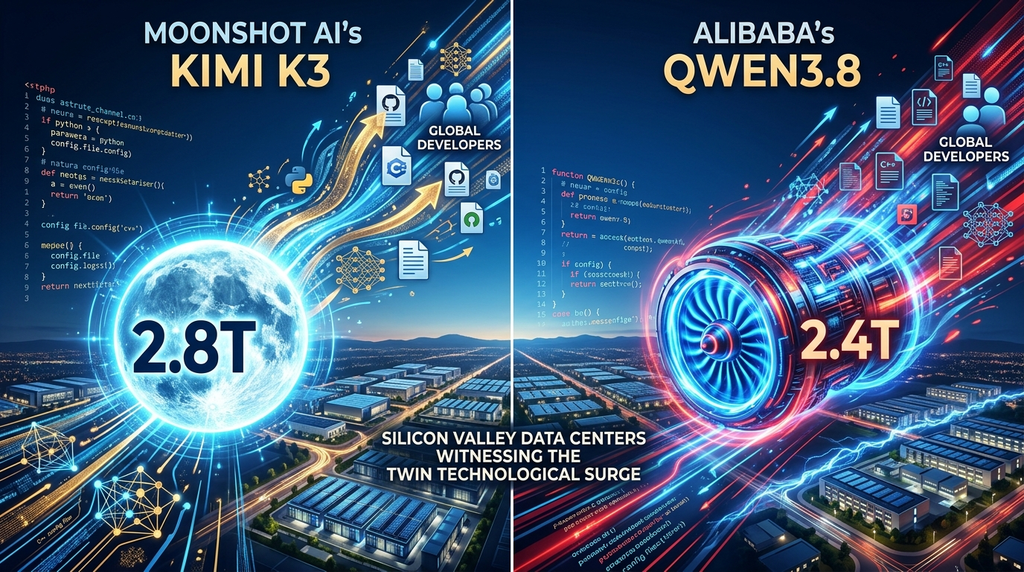
Moonshot did not disrupt the conversation alone.
Soon after K3 appeared, Alibaba previewed Qwen3.8-Max, a model with 2.4 trillion parameters. Alibaba claimed its system ranked behind only Claude Fable 5 among leading models and said it planned to release open weights.
That rapid second announcement transformed K3 from a potentially isolated breakthrough into evidence of a broader Chinese development pattern.
As The Verge reported, Chinese companies are increasingly using model openness as a competitive weapon. Instead of merely imitating the closed platforms developed in the United States, they are distributing powerful systems that developers can modify and deploy.
The strategy can accelerate adoption. Developers experiment with accessible models. Hosting companies optimize them. Researchers identify weaknesses. Startups build products around them. Improvements circulate through the ecosystem.
One powerful open model creates a product.
Several competing open models can create an industrial platform.
Moonshot, Alibaba, DeepSeek, Z.ai, and MiniMax are not moving in perfect coordination. They are rivals. Yet their collective output applies pressure to the same American business model: expensive proprietary intelligence delivered through controlled interfaces.
Did China Erase America’s AI Lead?
No definitive evidence supports that sweeping conclusion yet.
The stronger and more defensible conclusion is that America’s lead has narrowed in several important areas and may no longer provide the durable commercial protection that investors once assumed.
American laboratories still possess major advantages. They have deep research teams, vast computing partnerships, mature developer ecosystems, globally recognized products, and access to enormous pools of capital. OpenAI and Anthropic also continue developing new models. The frontier will not freeze while everyone admires K3.
Furthermore, Moonshot itself says K3 trails the strongest versions of Claude and GPT overall. Independent testing remains incomplete, and the full weights were still awaiting release during the initial coverage.
But the competitive question has changed.
It is no longer simply, “Can a Chinese laboratory build the world’s best model today?”
The sharper question is, “Can Chinese laboratories repeatedly approach the frontier quickly enough, cheaply enough, and openly enough to weaken the commercial advantage of whichever American model briefly occupies first place?”
Kimi K3 suggests the answer may be yes.
That is why reports from Axios and the Honolulu Star-Advertiser framed the release as a threat to America’s lead rather than just another model launch.
Export Controls Have Not Produced a Comfortable Gap
The United States has restricted China’s access to advanced AI chips, arguing that cutting-edge processors can strengthen Chinese economic, cyber, and military capabilities.
Those controls have created real constraints. Moonshot’s subscription pause highlights how valuable GPU capacity remains. Chinese firms cannot summon unlimited advanced computing resources through sheer patriotic enthusiasm.
Yet restrictions have not stopped China from producing increasingly competitive models.
In some respects, scarcity may encourage Chinese teams to pursue more efficient architectures, aggressive mixture-of-experts designs, quantization, lower serving costs, and alternative hardware arrangements. Necessity does not guarantee innovation, but it can make waste painfully unpopular.
American companies have also accused Chinese laboratories of using model distillation to extract capabilities from proprietary systems. Anthropic previously accused Moonshot and other Chinese developers of conducting large-scale distillation campaigns using interactions with Claude.
Those allegations must remain separate from claims about K3 itself. Public reporting has not established that K3’s performance came from any specific unauthorized distillation process.
The larger policy problem remains intact. Export controls can raise costs and slow development. Kimi K3 shows that they have not created an impassable technological wall.
China is constrained. It is not immobilized.
The Data-Center Spending Debate Just Became Louder
American technology companies are investing extraordinary sums in chips, electricity, networking equipment, cooling systems, and giant data-center campuses.
The economic argument behind that spending assumes that superior infrastructure will produce superior models—and that customers will pay premium prices for access to them.
K3 challenges the second half of that equation more directly than the first.
Even if American laboratories continue producing the strongest models, lower-priced Chinese systems could capture developers, startups, governments, and businesses that do not require the absolute frontier for every task.
That would pressure API prices and weaken returns on expensive infrastructure. It could also push American laboratories to release more capable open-weight systems of their own.
However, K3 does not prove data centers are unnecessary. The model itself is computationally voracious. Its popularity overwhelmed Moonshot’s available capacity almost immediately.
The real debate is not whether AI requires infrastructure. Obviously, it does.
The debate concerns who can convert infrastructure into useful intelligence most efficiently—and whether small performance advantages can justify enormous differences in spending and price.
K3 has not answered that question. It has made the question impossible to ignore.
What Developers and Businesses Should Watch Next
The July 27 weight release is the first major checkpoint.
Developers will want to inspect the model’s license, hardware requirements, quantization options, software compatibility, serving speed, reliability, and real-world performance. They will also test whether K3’s strengths survive outside Moonshot’s preferred tools and benchmark environments.
Long-context performance deserves special scrutiny. A model may accept one million tokens without using every part of that context accurately. Capacity and comprehension are not identical.
Businesses should examine total operating cost rather than API prices alone. A cheaper token can become expensive if a model requires more attempts, produces longer answers, needs heavier supervision, or makes costly mistakes.
Security and data governance will matter too. Some organizations may avoid hosted Chinese services while remaining interested in operating downloadable weights inside their own infrastructure.
Finally, developers should watch the derivative ecosystem. The most influential version of K3 may not be the original 2.8-trillion-parameter giant. Smaller fine-tuned, quantized, or distilled descendants could spread much further.
The mothership gets the headlines. The smaller ships may conquer the market.
A New AI Order Is Taking Shape
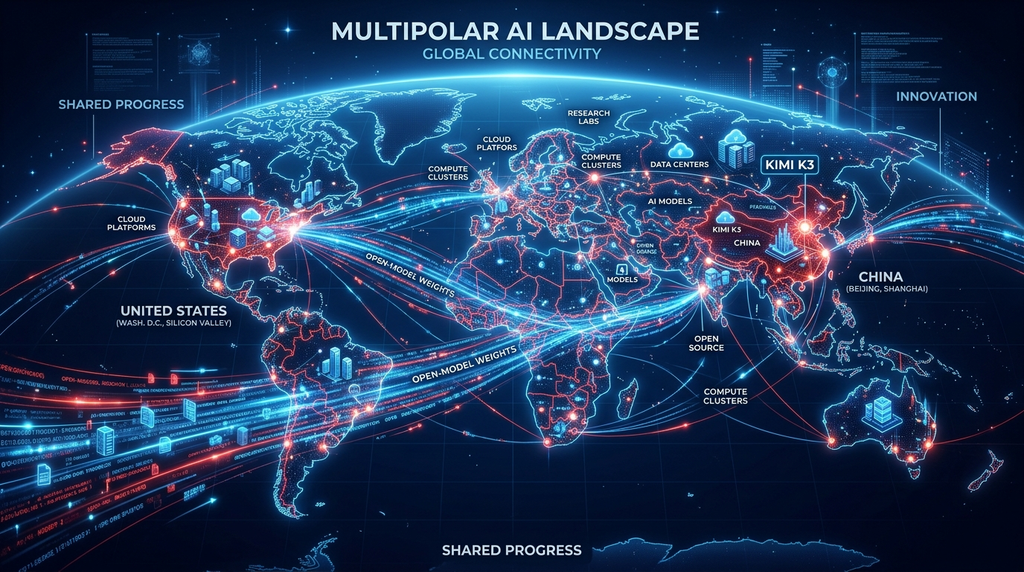
Kimi K3 has not ended American leadership. It has ended the luxury of assuming that leadership will sustain itself.
Moonshot built a vast multimodal model, pushed it close to the proprietary frontier, promised open weights, priced access aggressively, and generated enough demand to squeeze its infrastructure within 48 hours. Alibaba then followed with another enormous model and its own open-weight plans.
That combination matters more than any single benchmark score.
China is building an AI ecosystem around scale, rapid iteration, competitive pricing, and increasingly open distribution. American laboratories still produce extraordinary technology, but many rely on closed systems, premium pricing, and capital spending so large that the numbers occasionally resemble typographical errors.
The resulting contest will not produce a permanent champion. Leadership may switch by model, task, price, month, and deployment method.
For users, that competition could deliver cheaper and more capable tools.
For Silicon Valley, it delivers a less cheerful message: technical brilliance no longer guarantees comfortable margins, geopolitical dominance, or lasting control of the developer ecosystem.
Kimi K3 may not be the world’s best AI model.
It does not have to be.
It only has to be close enough, cheap enough, and open enough to make everyone reconsider what “winning” actually means.
Sources
- The Verge — China delivers a one-two punch to America’s AI dominance
- The Decoder — Moonshot pauses new Kimi K3 subscriptions after GPU demand maxes out in 48 hours
- Axios — China just erased America’s AI lead
- Honolulu Star-Advertiser — China’s latest AI breakthrough threatens America’s lead
- Moonshot AI — Kimi K3: Open Frontier Intelligence
The Kingy Brief
Get The Kingy Brief.
AI changes, original tests and one practical thing to try. Fridays at 09:00 Vancouver time.
Free · Double opt-in · Unsubscribe anytime
Sign up for The Kingy Brief on Beehiiv.
Signup help and newsletter schedule
Signup form provided by Beehiiv. After submitting, check your inbox for "Confirm your subscription to The Kingy Brief" and open its confirmation link. Check Spam or Promotions if you cannot find it.
Fridays at 09:00 Vancouver time: source-checked AI changes, original tests and one practical thing to try. We skip a week when there is not enough verified material. Free. Unsubscribe anytime.