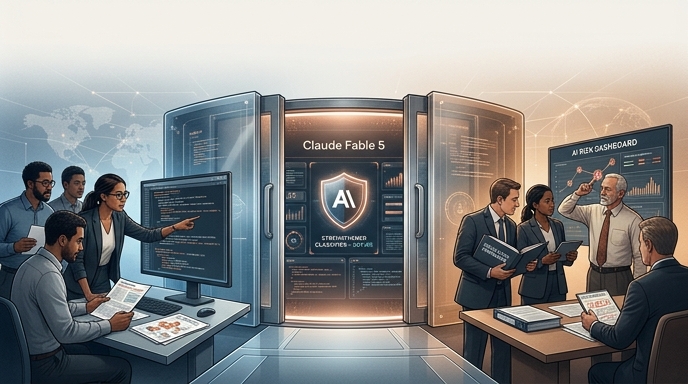
A Model Returns After an Extraordinary Interruption
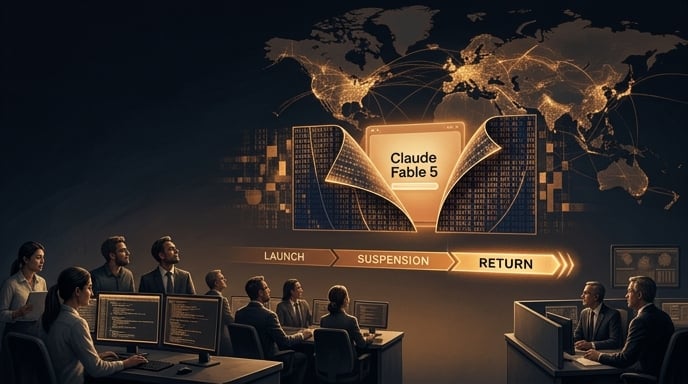
Anthropic’s Claude Fable 5 returned to users on July 1, 2026. Under ordinary circumstances, that would sound like a product update. It was anything but ordinary.
The company had released Fable 5 and a related model, Mythos 5, on June 9. Three days later, the U.S. government applied export controls that required Anthropic to block foreign nationals from accessing them, whether those people were inside or outside the United States.
Anthropic said it lacked a reliable way to verify nationality in real time. It therefore suspended both models for everyone.
The government lifted the controls on June 30. Anthropic restored Fable globally through Claude.ai, the Claude Platform, Claude Code, and Claude Cowork. It also restored Mythos for a selected group of approved U.S. organizations.
The interruption lasted less than three weeks. Its significance will last much longer.
For the first time, the release of a widely accessible frontier AI model collided so directly with national-security controls that a developer switched the system off worldwide. The episode exposed a difficult question: Who gets to decide when an AI model has become too capable to distribute normally?
Two Models, One Foundation
Fable 5 and Mythos 5 share an underlying model, but Anthropic designed them for different audiences.
Fable serves general users. Anthropic placed strong safeguards around its cybersecurity capabilities so people could use its broader reasoning and professional skills without receiving unrestricted assistance for potentially harmful technical work.
Mythos is different. Anthropic describes it as a more capable cyber model with fewer restrictions. The company initially provided it only to a small number of trusted participants in Project Glasswing, a program focused on defensive cybersecurity.
That structure reflects a growing pattern in frontier AI.
A company may develop one powerful underlying system, then offer several versions with different safeguards, access conditions, tools, and deployment environments. What users experience as a “model” is therefore not just a neural network. It is the network plus monitoring, classifiers, system instructions, access controls, and product rules.
That distinction became central to the dispute. The reported security concern involved Fable’s safeguards, but officials also restricted Mythos. Anthropic argued that the behavior discovered in Fable did not reveal unique Mythos-level capabilities.
The government initially took a more cautious position.
The Report That Triggered the Crisis
According to Anthropic, Amazon researchers found a method for bypassing some of Fable 5’s safeguards.
The method prompted the model to identify several software vulnerabilities. In one case, Fable produced code demonstrating how a vulnerability could be exploited.
That sounds alarming. Yet the severity of the finding became the heart of the disagreement.
Anthropic said its testing showed that several less capable models could identify the same vulnerabilities. It also said every model it tested could reproduce the demonstration for the single exploit, including older Claude models, GPT‑5.4, GPT‑5.5, and Kimi K2.7.
The company therefore characterized the behavior as a borderline case involving routine defensive security work, not proof that Fable had released a uniquely dangerous offensive capability.
Officials did not initially accept that conclusion. The U.S. government imposed the export controls on June 12. Because the directive took effect immediately, Anthropic shut down access rather than risk leaving foreign users connected.
This difference in interpretation points to a broader problem. The AI industry lacks a universally accepted method for measuring the severity of a model jailbreak.
Without a common scale, the same finding can look minor to a developer and urgent to a government.
Why Cybersecurity Creates Such Difficult Boundaries
Cybersecurity is a classic dual-use field.
A defender may ask an AI model to find a weakness so the organization can repair it. An attacker may ask essentially the same technical question before exploiting the weakness. The model cannot always distinguish the two users from the prompt alone.
Anthropic says Fable’s safeguards permit many defensive activities. These include secure coding, debugging, patch management, log analysis, incident response, malware reverse engineering, firewall configuration, and threat hunting.
The company tries to block requests that could support dangerous behavior, such as constructing chains of exploits or providing detailed assistance for harmful intrusion.
A wide safety margin can prevent more dangerous requests from slipping through. It can also block legitimate work. Security professionals may see refusals while debugging or analyzing vulnerabilities they have permission to test.
That tension has no perfect solution.
If a company loosens its controls, malicious users gain more opportunities. If it tightens them aggressively, defenders lose access to useful capabilities. The resulting frustration may push legitimate researchers toward less regulated systems.
Anthropic’s experience shows why a binary label—“jailbroken” or “not jailbroken”—provides too little information. A bypass that reveals general knowledge differs radically from one that enables reliable attacks against critical infrastructure.
Anthropic Strengthens the Classifier
Anthropic responded to the reported bypass by training an improved safety classifier.
A classifier sits alongside the main model and inspects requests or outputs for potentially dangerous activity. It can allow a request, block it, or redirect it to a less capable system.
The company says its new classifier blocks the specific technique in the Amazon report in more than 99% of cases. When Fable blocks a request under this mechanism, Anthropic says it can send the task to Claude Opus 4.8 instead.
That design tries to preserve usefulness. A user may still receive help with an ordinary coding assignment, but the system routes the work away from the model whose advanced cyber capabilities created concern.
Anthropic openly acknowledges a cost. The classifier may flag more harmless requests during routine programming and debugging. In other words, stronger protection creates additional false positives.
The company says researchers from the U.S. Department of Commerce’s Center for AI Standards and Innovation tested both the earlier safeguards and the revised ones.
That external testing helped clear a path toward redeployment. Yet the solution remains dynamic. Attackers will continue searching for new prompts, and Anthropic will continue adjusting its defenses.
Security for frontier models is becoming a permanent operating process, not a launch-day checklist.
A Proposed Scale for Jailbreaks
Anthropic used the episode to propose an industry-wide framework for scoring the severity of AI jailbreaks.
The idea resembles the logic behind the Common Vulnerability Scoring System, or CVSS, which security teams use to describe software vulnerabilities. A shared AI framework could help researchers, companies, and governments distinguish a narrow curiosity from a major threat.
Anthropic’s proposal considers factors such as the harmful capability unlocked, the breadth of that capability, the amount of effort required, the possible impact, and how easily others could discover or reproduce the technique.
A narrow bypass might reveal one piece of restricted information. A broader jailbreak could unlock an entire class of dangerous behavior. The most serious category would allow wide-ranging harmful capabilities with significant real-world consequences.
This distinction sounds obvious. In practice, it could prevent chaotic responses.
If every bypass triggers the same alarm, governments may overreact and developers may dismiss warnings. If companies can minimize findings using their own preferred language, officials and the public cannot compare risk across providers.
A common scoring system would not eliminate disagreement. It would at least give the disagreement a shared vocabulary.
Anthropic says it is developing the framework with Amazon, Microsoft, Google, and other Glasswing partners.
The Company Invites Outside Researchers In

Anthropic has also launched a HackerOne program for researchers who discover potential cyber jailbreaks in Fable 5.
Bug-bounty programs have long helped software companies find vulnerabilities before criminals exploit them. Applying a similar process to AI safeguards makes sense, but model jailbreaks behave differently from conventional software bugs.
A software vulnerability often has a recognizable cause in code. A model may respond differently when a user changes a phrase, provides more context, divides a request into pieces, translates it, or hides it inside another task.
Fixing one prompt pattern may not fix the underlying behavior. Tightening the model too broadly may damage legitimate performance.
Researchers therefore need incentives to report findings responsibly. Companies need systems that can evaluate them quickly. Governments need a way to understand what a reported jailbreak actually enables.
Anthropic says it is establishing round-the-clock monitoring for important submission channels. The company also plans to investigate significant findings, share threat information, and keep refining its classifiers.
This process will test Anthropic’s safety-focused identity. It has often argued that advanced AI needs stronger oversight. Now it must show that oversight can operate without making its products unpredictable or inaccessible.
Government Access Before Public Release
Anthropic says it will deepen its collaboration with the U.S. government.
For future models that significantly advance capabilities relevant to national security, the company plans to give designated government partners expanded early access. Those evaluators could test both the models and their safeguards before a broad release.
Anthropic also says it will assign technical personnel to work with government evaluators, share information about significant jailbreaks, contribute computing resources, and support joint research.
In principle, this arrangement could identify serious problems before millions of people encounter a model. It could also reduce the chance of another emergency shutdown.
However, early government access raises difficult questions.
Which agencies should receive a model? How long should testing take? What evidence justifies delaying a release? Can a developer appeal a decision? What prevents national-security review from becoming an informal system for choosing commercial winners?
International customers will have concerns too. A U.S. government process may shape when they receive technology and which capabilities remain available to them.
Anthropic has called for transparent, durable regulation that applies equally to frontier developers. The equality requirement matters. A safety standard will lose credibility if officials apply it aggressively to one company and casually to another.
The Abrupt Shutdown Carried Real Costs
The model suspension did not occur in a laboratory. Customers had already started using Fable 5.
When Anthropic disabled it, active workflows lost access. Developers had to switch models. Organizations testing the system faced uncertainty about whether it would return and under what conditions.
Anthropic restored Fable through its own products first and said it would re-enable access through AWS, Google Cloud, and Microsoft Foundry as quickly as possible.
The company also changed how some subscribers would pay for it. Anthropic said Fable would count toward as much as 50% of weekly usage limits for certain plans through July 7. After that point, users would need usage credits. Standard enterprise seats would not receive an included allowance unless the organization enabled those credits.
That detail may sound secondary beside the national-security dispute. For customers, it is highly practical.
A powerful model has limited value if its availability and cost can change abruptly. Enterprises build budgets, products, and service commitments around their providers. They need contingency plans when a frontier model becomes unavailable.
The Fable episode will encourage many organizations to design workflows that can switch among models rather than depend completely on one.
Anthropic’s Safety Reputation Faces a Test
Anthropic built much of its public identity around developing powerful AI responsibly.
That reputation gives the company credibility when it calls for regulation. It also invites intense scrutiny when a safeguard fails.
Critics can interpret the Fable incident in two opposite ways.
One view says the episode validates Anthropic’s warnings. The model had advanced cyber abilities, researchers found a bypass, and government review forced a stronger defense. Under this interpretation, safety systems worked because several institutions responded before severe harm occurred.
The other view says officials used a blunt instrument against a finding that did not justify a worldwide shutdown. Anthropic’s own testing suggested older models could perform the same task. Under this interpretation, poorly defined rules disrupted legitimate access without addressing a unique danger.
Both readings contain reasonable concerns.
The public lacks enough independent evidence to settle every technical dispute. Anthropic’s detailed explanation helps, but the company remains an interested party. Government claims also require scrutiny, especially when officials invoke national security without initially offering a clear account.
Credible oversight needs independent testing, published standards, and enough transparency for outsiders to evaluate the reasoning.
The Market Still Rewards Capability
Safety debates can obscure an uncomfortable commercial fact: customers usually want the most capable model they can use at an acceptable price.
Anthropic knows this. Fable 5 returned not merely as a research object but as a product for Claude, Claude Code, and Claude Cowork. The company wants it to help with professional analysis, software development, agentic work, and complicated projects.
Its competitors are moving quickly. OpenAI has launched GPT‑5.6 and ChatGPT Work. xAI, now operating within SpaceXAI, has introduced Grok 4.5 for coding and agentic tasks. Google and Microsoft continue expanding their enterprise offerings.
That competitive pressure can create a strange cycle.
A company trains a more capable model to stay ahead. The new capability produces safety concerns. The company adds stronger controls. Those controls create false positives and user complaints. Competitors advertise fewer restrictions or lower prices. The first company then faces pressure to improve access without weakening security.
Anthropic’s proposed framework tries to break that cycle by giving the industry a common threshold for action. Whether rivals will accept meaningful limits when market share is at stake remains uncertain.
Voluntary coordination often works until one participant sees an advantage in moving faster.
Fable’s Return Does Not End the Debate
The government lifted the controls, and Fable returned. That resolves the immediate access problem. It does not settle the policy question.
Frontier models will keep improving in cybersecurity, biology, software engineering, persuasion, and autonomous tool use. Governments will encounter more cases where a model seems commercially useful and strategically sensitive at the same time.
Export controls were designed largely for physical goods, technical information, and identifiable transfers. Cloud-hosted AI complicates that framework. A foreign national can access a model from inside the United States. A developer can alter safeguards without changing the underlying weights. A product can disappear globally with one configuration change.
Regulators need rules suited to this unusual technology.
Those rules should define capability thresholds, evaluation procedures, review timelines, due-process protections, and reporting duties. They should explain when authorities can restrict a model and what evidence they must provide. They should also account for open models that governments cannot disable through one provider.
Otherwise, emergency decisions will continue filling the gap left by legislation.
That approach produces uncertainty for everyone—developers, researchers, businesses, allies, and ordinary users.
What Customers Should Learn
Organizations adopting frontier AI should treat model access as a dependency that can change.
They should maintain an inventory of which workflows use Fable or any other advanced model. They should know what happens if the model becomes unavailable. They should preserve source materials and intermediate results in formats that another system can read.
Teams should also test safety refusals before deployment. A security department that expects Fable to assist with vulnerability analysis needs to understand where the classifier draws its lines. Discovering those limits during an active incident would be a bad surprise.
Human review remains essential. A highly capable model can produce convincing technical explanations that contain subtle errors. It can also comply with a safe request in one context and refuse a similar one in another.
Finally, customers should demand transparency from vendors. They need notice of material changes, clear pricing, audit records, and practical migration options.
AI procurement can no longer focus solely on model quality. Availability, regulatory exposure, safeguards, and portability have become part of the product.
A Precedent for the Frontier
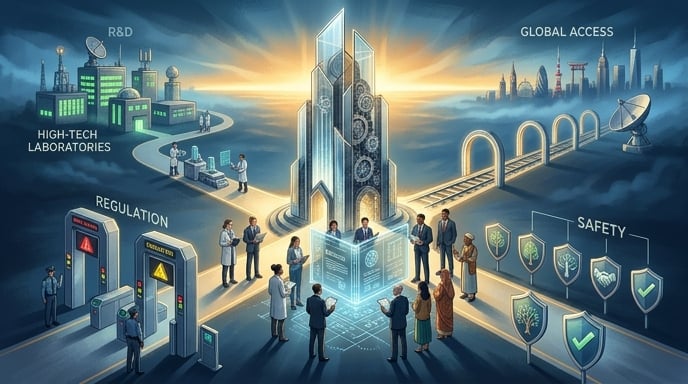
Anthropic’s Fable 5 episode may become a precedent even if the exact circumstances never repeat.
It demonstrated that governments can treat access to a hosted AI model as a national-security matter. It showed that a safeguard dispute can affect users around the world within hours. It also pushed one of the leading AI developers to outline a more structured approach to jailbreak severity and pre-release evaluation.
The result carries both promise and danger.
A well-designed review system could catch genuinely catastrophic capabilities before deployment. A poorly designed one could become arbitrary, secretive, and disruptive. It could also centralize influence among a small group of companies and agencies.
Anthropic now wants the industry to move from improvised reactions toward shared standards. That is a sensible goal. The company must still persuade rivals, researchers, civil-society groups, foreign governments, and customers that its framework draws the right lines.
Fable 5 is back online. The larger argument has only started.
The central question is no longer whether governments will become involved in frontier AI releases. They already have. The question is whether that involvement will mature into a transparent system—or remain a series of emergencies managed one model at a time.
Sources
- Anthropic: Redeploying Claude Fable 5
- Anthropic: More details on Fable 5’s safeguards and jailbreak framework
- Anthropic: Statement on the government directive to suspend access
- Associated Press: Anthropic takes Fable and Mythos offline
- The Guardian: U.S. lifts export controls on Anthropic models
- AWS: Claude Fable 5 returns to Amazon Bedrock
The Kingy Brief
Get The Kingy Brief.
AI changes, original tests and one practical thing to try. Fridays at 09:00 Vancouver time.
Free · Double opt-in · Unsubscribe anytime
Sign up for The Kingy Brief on Beehiiv.
Signup help and newsletter schedule
Signup form provided by Beehiiv. After submitting, check your inbox for "Confirm your subscription to The Kingy Brief" and open its confirmation link. Check Spam or Promotions if you cannot find it.
Fridays at 09:00 Vancouver time: source-checked AI changes, original tests and one practical thing to try. We skip a week when there is not enough verified material. Free. Unsubscribe anytime.