
Brussels Opens Two of Google’s Biggest Doors

The European Union has ordered Google to loosen its grip on two enormously valuable digital territories: Android and Google Search.
In two binding decisions adopted on July 16, 2026, the European Commission told Google to give competing artificial intelligence assistants broader access to Android’s operating-system features. It also instructed the company to share certain anonymized Search data with eligible rival search engines and AI chatbots.
That sounds bureaucratic. It is anything but.
The decisions could determine whether AI assistants such as ChatGPT, Claude, Perplexity, and future European challengers can operate as genuine alternatives to Gemini on Android phones not merely as downloadable apps sitting politely in a folder.
Under the new requirements, rival assistants could eventually respond to wake words, understand what appears on a phone’s screen, use device sensors, interact with other apps, and complete multistep tasks in the background.
The Search decision attacks a different advantage: data. Google has accumulated oceans of information about queries, clicks, rankings, and user behavior. Rivals need similar feedback to improve their own search products.
Europe’s message is blunt: If Google uses Android and Search data to give Gemini and Google Search an unbeatable head start, competitors must receive a meaningful route onto the same racetrack.
Google, unsurprisingly, thinks Brussels may be removing the guardrails along with the gate.
This Is Not a Fine At Least Not Yet
The Commission has not fined Google through these two decisions. Instead, it has specified what the company must build and change to comply with the European Union’s Digital Markets Act, or DMA.
That distinction matters.
A fine punishes past behavior. A specification decision lays down technical instructions for future compliance. In this case, Brussels is not merely shouting “compete fairly” from the regulatory balcony. It is describing the doors Google must install, who should be allowed through them, and which locks may remain.
The Commission opened the two specification proceedings on January 27, 2026. Officials consulted Google and interested third parties before adopting the final measures nearly six months later.
Under Article 6(7) of the DMA, Google must provide developers with free and effective interoperability with hardware and software features controlled by Android. A separate obligation under Article 6(11) requires Google to share anonymized Search data with third-party search engines on fair, reasonable, and nondiscriminatory terms.
If Google fails to comply, the situation can become considerably more expensive. DMA violations can produce fines reaching 10 percent of a company’s worldwide annual turnover. Repeated violations can trigger even higher penalties.
So, no, this is not a financial punishment. It is the regulatory equivalent of handing Google architectural drawings and saying, “The renovation starts now.”
Why Android Matters So Much
Android is not simply another Google product. It is one of the most important distribution systems in the technology industry.
According to the European Commission, Android runs on devices used by roughly 60 percent of European mobile users. That gives Google an enormous channel through which it can distribute Gemini and weave the assistant into everyday phone activity.
Deep operating-system integration makes an AI assistant far more useful. An ordinary chatbot can answer a question. A system-level assistant can read relevant context, open another app, change a setting, draft a message, start navigation, schedule an appointment, or finish a task while the user does something else.
Gemini already benefits from Google’s control of the entire stack. Google develops Android, supplies system services, operates major apps, builds AI models, and controls the assistant sitting at the intersection of those products.
Rival assistants can be downloaded, but installation alone does not create equality. If one assistant holds the keys to the microphone, screen, system settings, background processes, and application interfaces while competitors wait in the lobby, the app store contains choice mostly in the decorative sense.
The EU wants to turn nominal choice into functional choice. That is the heart of the Android ruling.
Eleven Android Features Enter the Spotlight
The Commission’s decision covers 11 Android features that AI services need to behave like full-fledged assistants.
Those features fall into four broad groups: invocation, contextual understanding, actions across apps and the operating system, and access to device resources.
Invocation includes launching an assistant through a long press or a voice command. Context covers data from applications, sensors, the screen, and other sources that help an assistant understand what the user is doing. Action features let the assistant perform tasks inside apps or adjust Android settings. Resource access includes on-device AI models and the hardware capacity needed to run third-party models.
The practical examples are far more interesting than the regulatory labels.
A rival assistant could draft and send an email, add an item to a shopping list, offer live translation, retrieve a flight number at the appropriate moment, or order food through a delivery app. It could also interact with Android settings, control media, enable Do Not Disturb, or turn off Bluetooth.
The Commission says competing services should receive access comparable to what Google gives Gemini. That does not mean every assistant automatically receives every permission. Users must still provide consent, and sensitive capabilities may require security checks.
Still, Android’s VIP section is about to admit more guests.
“Hey Google” May No Longer Have the Room to Itself
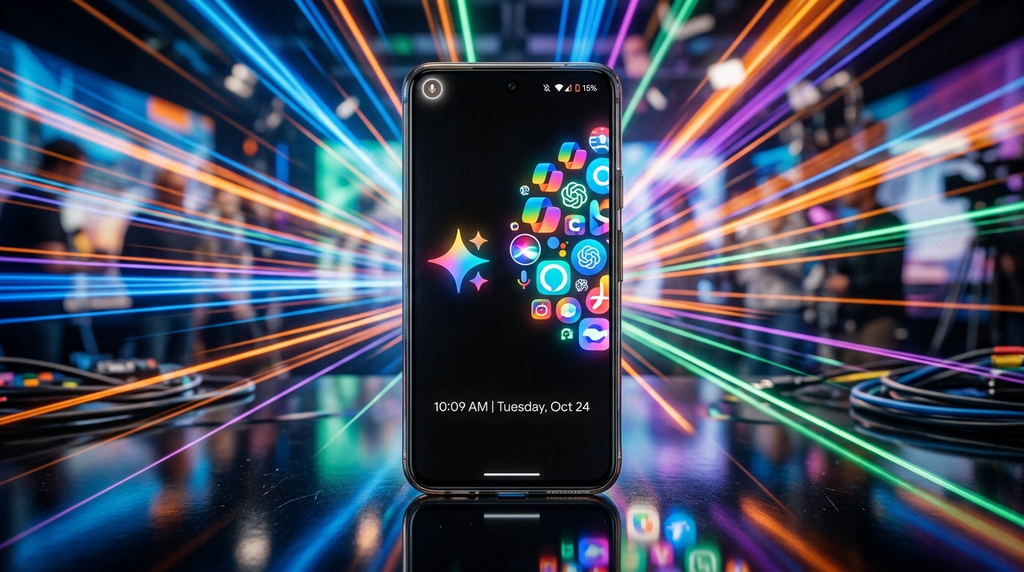
One of the most visible changes involves wake-word activation.
Today, Google can deeply integrate its own voice activation into Android. The phone can listen for “Hey Google” even while the display is off, the device is in standby, or battery-saving features are active.
The EU wants third-party assistants to receive comparable access to Android’s always-on hotword system. A user could theoretically choose a different wake phrase for a preferred AI assistant and summon it without first opening an app.
That sounds like a small interface tweak. It is actually a major competitive advantage.
Friction kills usage. If Gemini responds instantly while another assistant requires unlocking the phone, locating an icon, and tapping through several screens, most people will use Gemini even if they prefer the rival’s model.
The measures also contemplate concurrent wake-word support, allowing more than one assistant to listen for its designated phrase. That more complex feature has a later deadline, reaching into 2028.
The phone could therefore become a territory shared by multiple assistants. One might specialize in research. Another could handle personal organization. A third might control smart-home devices.
Of course, a handset listening for several robot names could also become the technological equivalent of calling three dogs in a kitchen. Useful, perhaps. Calm? Probably not.
Cameras, Microphones, Screens, and the Privacy Problem
The most controversial section concerns “ambient data”: continuous real-time input from a phone’s microphone, camera, speakers, screen, location services, and sensors.
The EU says third-party AI assistants should receive access under the same conditions for consent and user awareness that apply to Google’s services. This could enable live visual guidance, object recognition, sound detection, screen assistance, and highly personalized responses.
It could also create a security nightmare if implemented badly.
An assistant that sees the screen may encounter private messages, authentication codes, financial information, confidential documents, and malicious instructions hidden inside otherwise ordinary content. An assistant allowed to operate other apps could turn a misinterpreted or manipulated prompt into an unwanted action.
Google argues that the Commission has underestimated these dangers. In a company statement, Google President of Global Affairs Kent Walker said the rulings risk undermining privacy and security protections for millions of Europeans.
That objection is not frivolous. Agentic AI expands the attack surface of a phone because the assistant can observe information and act upon it.
The Commission’s answer is consent, certification, process isolation, encryption, proportional security requirements, and equal treatment. The real test will arrive during implementation.
Rival Assistants Could Start Operating Other Apps
The decision goes beyond letting another chatbot answer questions. It could allow rival AI assistants to take meaningful action inside applications.
Through structured integrations, qualifying assistants may interact with supported functions such as sending messages, creating notes, scheduling meetings, placing calls, navigating with Maps, or controlling media.
Screen automation goes further. An assistant could open an app inside a separate virtual display, inspect its interface, and imitate taps or typing to complete a multistep task. The user could continue doing something else while the assistant works in the background.
Imagine asking an assistant to buy everything on a shopping list. It might read the list, open a supermarket app, locate each item, fill the basket, and prepare the order. The assistant should reconfirm the transaction before crossing an irreversible line.
This is where smartphones begin shifting from app launchers to agent platforms.
App developers will need to prepare. Their interfaces may increasingly serve two audiences: humans who tap and swipe, and AI agents that navigate functions programmatically or visually. Developers may also need mechanisms for hiding sensitive screens or rejecting automation in high-risk areas.
The app economy spent years optimizing for fingers. Now it may have to accommodate synthetic fingers that never get tired and occasionally misunderstand the assignment.
Google Search’s Data Advantage Comes Under Attack
The second decision targets the feedback machinery behind Google Search.
Search engines improve by studying what people search for, which results they see, what they click, how results rank, and whether users reformulate their queries. A service operating at Google’s scale gathers an extraordinary volume of this information.
That produces a reinforcing cycle. Better search attracts more users. More users generate more data. More data helps improve search. Then the improved product attracts still more users.
The Commission wants eligible competitors to access anonymized versions of the data Google uses to optimize its own Search service. The covered information can include query, click, view, and ranking data.
Importantly, eligibility extends beyond conventional search engines. AI chatbots that provide search functionality may also qualify. That recognizes an obvious market shift: people increasingly ask conversational AI systems questions they once typed into a traditional search box.
The requirement does not force Google to publish its complete Search archive on the open internet. Access will be limited, contractual, technically controlled, and subject to eligibility standards.
Nevertheless, even carefully restricted data sharing could help rivals identify weak results, improve ranking systems, understand rare queries, and build better retrieval tools.
Google’s most valuable asset may not be its famous homepage. It may be the behavioral history quietly accumulated behind it.
Anonymized Does Not Mean Risk-Free
Search data can expose intimate details. People ask search engines about illnesses, relationships, finances, legal troubles, political beliefs, passwords, addresses, and worries they may never discuss with another human.
Removing a name does not automatically make such information harmless. A distinctive combination of location, timing, device characteristics, and unusual queries may still point toward an individual.
The Commission’s framework therefore requires multiple layers of anonymization. Direct identifiers and attributes that could help reconnect records must be removed. Queries containing rare or sensitive terms may be suppressed. Metadata must also be generalized so individual users disappear into sufficiently large groups.
Recipients face contractual restrictions. They cannot attempt to reidentify users, combine the material with unrelated datasets, disclose it onward, or use it beyond permitted purposes. Independent audits form part of the safeguards.
The final rules also restrict eligibility. As detailed by The Hacker News, recipients generally need at least 50,000 average monthly users in the EU over the preceding year. Google can assess whether a particular recipient presents serious cybersecurity or data-protection risks.
Google still argues that the anonymization is inadequate and that users may not understand where their search information is going.
That dispute will not disappear because a regulation uses the word “anonymous.” Data has a stubborn habit of remaining revealing.
The Clock Is Now Ticking

The two decisions operate on different schedules.
Google must begin implementing the Search data-sharing requirements from January 2027. The framework includes rules for eligibility, access, anonymization, permissible use, auditing, and pricing. The data will not necessarily be free; the DMA allows a cost-based arrangement under fair, reasonable, and nondiscriminatory conditions.
The larger Android changes are expected by July 2027, alongside the next major iteration of the operating system. Some reporting identifies that release as Android 18, though Google’s final consumer branding and rollout details remain its responsibility.
Before then, Google must develop documentation, interfaces, security procedures, and a certification structure for sensitive capabilities. Rival developers will need time to build against those systems.
Not every feature carries the same restrictions. Less sensitive capabilities may become broadly available under normal user-consent rules. More powerful functions particularly those involving app data, automation, contextual intelligence, or system control can face certification and security requirements.
The Commission says Google cannot impose stricter integrity standards on competitors than it applies to its own services. That provision matters because a security review controlled entirely by the dominant platform could otherwise become a beautifully polished competitive moat.
Brussels wants guardrails. It does not want guardrails that quietly form a wall.
Google’s Security Argument Has Teeth
It would be convenient to frame Google’s opposition as a giant corporation whining because regulators found the keys to its castle. Reality is messier.
Google argues that phone manufacturers already vet deeply integrated assistants. Opening powerful Android permissions to external services, it says, could weaken safeguards around sensitive device functions.
The company also warns that sharing Search data may expose private queries, business secrets, and information relevant to national security. Walker said the decisions discount evidence of potential harm and called for an adaptable, evidence-based process.
Those claims contain both legitimate risks and strategic self-interest. The two can exist simultaneously.
Google has strong reasons to protect users. A catastrophic incident involving Android would damage its platform, even if a third-party assistant caused the problem. Google also has strong reasons to protect Gemini’s privileged position and Search’s data advantage.
The Commission acknowledges the danger. Its rules allow security testing, consent controls, eligibility assessments, encryption, isolation, auditing, and restrictions against reidentification. It may revise the measures as threats and markets evolve.
The central disagreement is therefore not whether security matters. Everyone says it does. The fight concerns who controls the security standard, how demanding it may be, and whether “safety” becomes a defensible requirement or an all-purpose excuse for excluding competitors.
That argument will get loud.
Europe Is Regulating the AI Distribution Layer
Much of the AI race focuses on model performance: reasoning scores, context windows, hallucination rates, and the occasional benchmark chart that resembles a bowl of alphabet soup.
The EU is focusing on something more fundamental distribution.
The best model does not automatically win. The assistant with privileged access to an operating system, default placement, user context, hardware resources, and billions of daily interactions may enjoy a far greater advantage than a modest lead on a benchmark.
This is why Android interoperability matters. It separates the quality of an assistant from the power of the company controlling the phone beneath it.
The same principle applies to Search data. A new competitor may have excellent engineers and models, but it cannot recreate decades of query and click feedback by enthusiasm alone. Data advantages compound.
Europe is effectively arguing that dominant platforms should not be allowed to convert control of yesterday’s infrastructure into automatic control of tomorrow’s AI market.
Critics will call that forced sharing and regulatory engineering. Supporters will call it the minimum intervention required to produce genuine competition.
Both descriptions contain part of the truth. Brussels is absolutely redesigning the competitive environment. It is doing so because officials believe the existing environment was designed very profitably by Google.
Apple Should Be Watching Closely
The decisions also send a message beyond Mountain View.
Apple faces similar European pressure over interoperability, platform access, and the distribution of AI features. Recent coverage from CNN contrasts how Apple and Google have responded to the EU’s demands, particularly as Apple has cited DMA concerns when delaying advanced Siri features in Europe.
Google has chosen a different tactical path. It has protested, negotiated, secured implementation time, and continued operating in the market. That does not mean it likes the outcome. It means Google appears willing to fight over the engineering details while preparing to comply.
The Android ruling may become a template for future disputes involving Apple’s operating systems and other gatekeeper platforms. If an integrated assistant gains unique access to microphones, cameras, screens, applications, or on-device models, European regulators may ask whether rivals deserve comparable access.
That could reshape the basic architecture of personal computing. Operating systems have traditionally treated first-party assistants as privileged components. The EU increasingly views that privilege as a competitive issue rather than a neutral design choice.
Google is today’s test case. It is unlikely to be the last.
More Choice Is Coming But So Is More Responsibility
For European users, the most appealing outcome is straightforward: more capable assistants, deeper competition, and less dependence on whichever AI service arrives preinstalled.
A person might select an assistant based on privacy, language support, reliability, personality, price, or specialized skills. Switching assistants could become more meaningful because the replacement would retain access to essential system features.
Yet choice transfers responsibility.
Users will need to understand what they authorize. An assistant with access to the microphone, screen, messages, location, and applications is not a novelty chatbot. It is a powerful software agent sitting inside one of the most personal devices people own.
Developers will need to prove that their assistants honor user intent, minimize unnecessary data access, resist prompt injection, protect credentials, and request confirmation before sensitive actions.
Google must build an access system that does not quietly favor Gemini. The Commission must supervise that system without freezing Android development or imposing technically naïve requirements. Rival providers must demonstrate that they deserve the trust they have demanded.
That is a crowded accountability chain. If something goes wrong, everyone will point toward the person standing next to them.
Competition may be healthy. It is rarely tidy.
The AI Assistant War Just Became a Platform War

The EU’s decisions could produce more than a few new settings inside Android. They challenge Google’s ability to combine control of the operating system, Search infrastructure, user data, and Gemini into one nearly unassailable package.
Rival assistants may gain the tools to compete at the system level. Search challengers may receive data that helps them improve faster. Users may finally choose an AI assistant without accepting a severely weakened experience.
But none of this guarantees a flourishing market.
Competitors still need strong models, reliable products, security engineering, developer support, and enough money to operate at scale. Shared access can lower the drawbridge. It cannot make every approaching army competent.
Google also retains formidable advantages: brand recognition, infrastructure, first-party applications, engineering talent, existing user relationships, and years of integration work.
The Commission is not handing victory to Google’s rivals. It is trying to ensure that the contest exists.
The result will depend on implementation. If access is slow, unreliable, excessively expensive, or buried beneath procedural obstacles, the rules may produce impressive paperwork and little competition. If the access is genuinely comparable, Android could become the world’s most important open battleground for AI assistants.
Gemini is not being evicted. It is simply being told that the house may need more bedrooms.
Sources
- The Verge — Google ordered to open Android and Search to rivals in Europe
- CNN — Apple, Google and European AI regulation
- The Hacker News — EU orders Google to open Android microphone, camera and screen access
- Financial Post — Google must give Gemini rivals Android access
- UPI — EU issues Google specification requirements for AI and Android
- SFGATE and Associated Press — EU forces Google to share Search data and open Android
- European Commission — Android AI interoperability and Google Search data-sharing decision
- Google — The DMA should not undercut security and privacy for Europeans
The Kingy Brief
Get The Kingy Brief.
AI changes, original tests and one practical thing to try. Fridays at 09:00 Vancouver time.
Free · Double opt-in · Unsubscribe anytime
Sign up for The Kingy Brief on Beehiiv.
Signup help and newsletter schedule
Signup form provided by Beehiiv. After submitting, check your inbox for "Confirm your subscription to The Kingy Brief" and open its confirmation link. Check Spam or Promotions if you cannot find it.
Fridays at 09:00 Vancouver time: source-checked AI changes, original tests and one practical thing to try. We skip a week when there is not enough verified material. Free. Unsubscribe anytime.