
A Launch Aimed at the Working Day
OpenAI has spent years teaching the public to ask artificial intelligence questions. Now it wants people to hand AI entire assignments.
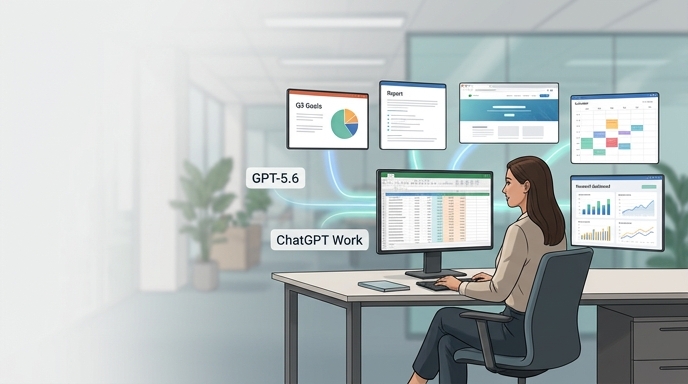
That shift came into sharp focus on July 9, 2026, when the company launched the GPT‑5.6 model family and introduced ChatGPT Work. OpenAI describes Work as an agent that can gather information from applications and files, carry out multistep projects, and produce finished documents, spreadsheets, presentations, reports, websites, and other materials.
This is more than a routine model update. It marks a change in what OpenAI believes its flagship product should do.
Traditional chatbots wait for a prompt. They answer. Then they wait again. ChatGPT Work aims to stay active for hours, divide a goal into smaller tasks, move between sources, and return with a completed result.
That promise places OpenAI at the center of one of the technology industry’s biggest contests. Anthropic, Microsoft, Google, and xAI are also developing agents that can handle professional work. The winner may not be the company with the most entertaining chatbot. It may be the one that earns enough trust to sit inside the daily operations of a business.
ChatGPT Work Changes the Basic Bargain
The original bargain behind ChatGPT was simple. A user supplied a request, and the system generated an answer. Work proposes something broader: give the system an outcome, then let it decide how to reach it.
OpenAI says a user could ask Work to analyze a month-end budget variance, prepare for a sales meeting, or turn source material into a marketing campaign. The agent can inspect connected information, assemble an initial result, and move through several stages without requiring a new prompt after every step.
A marketing assignment, for example, might begin with customer research. Work could use that research to prepare a campaign brief, create supporting materials, and adapt those materials for several markets. It would carry context from one phase into the next.
Users can still intervene. OpenAI says they can watch the agent’s progress, answer questions, redirect the work, and approve important actions.
That last point matters. Autonomy sounds attractive until software makes a consequential decision in the wrong account, document, or application. The practical future of AI agents will therefore depend on two capabilities at once: acting independently and knowing when to stop for human approval.
From Clever Answers to Finished Materials
OpenAI is pitching ChatGPT Work as a production system, not simply a research assistant.
The difference can sound subtle, but it changes how people measure value. A chatbot might explain how to build a financial model. An agent must build the model, apply formulas correctly, preserve the required layout, trace its figures to source data, and leave the workbook ready for review.
The same principle applies to presentations. Generating an outline takes seconds. Producing a coherent deck with accurate data, consistent typography, clear visual hierarchy, and editable elements requires much more judgment.
OpenAI says GPT‑5.6 improves its ability to follow templates and reference files. According to the company, the model can infer patterns from an existing presentation, including layouts, colors, spacing, and recurring design choices. It can then apply those conventions to new material.
That capability targets a stubborn business problem. Most professional work does not begin with a blank page. It begins with last quarter’s deck, an approved template, a folder of reports, and a long list of unwritten organizational rules.
An agent that ignores those details creates extra work. One that respects them starts becoming useful.
Three Models Instead of One
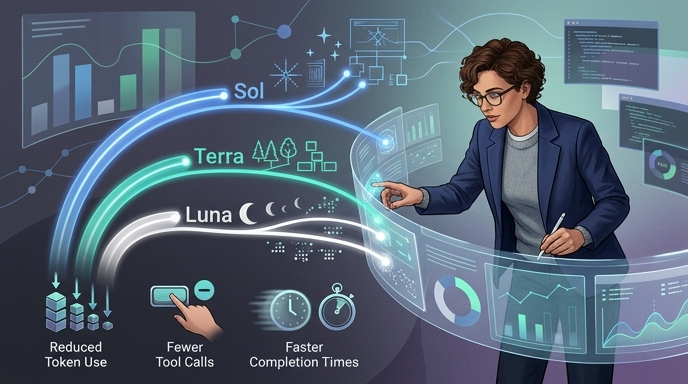
GPT‑5.6 arrives as a family of three models: Sol, Terra, and Luna.
OpenAI positions Sol as the flagship. It targets demanding work in coding, research, science, cybersecurity, design, and computer use. Terra offers a less expensive balance between capability and speed. Luna serves as the fastest and lowest-cost option.
The naming strategy reveals something important about the maturing AI market. Customers no longer choose only between “the latest model” and an older one. They increasingly choose among models based on the value of a task.
A company might reserve Sol for complicated research or high-stakes analysis. It could use Terra for routine professional assignments. Luna could process high-volume tasks where speed and cost matter more than squeezing out the strongest possible answer.
OpenAI prices Sol at $5 per million input tokens and $30 per million output tokens. Terra costs $2.50 for input and $15 for output. Luna costs $1 for input and $6 for output.
Those figures matter because an agent can consume many tokens while it plans, searches, calls tools, corrects mistakes, and produces files. The sticker price of one response does not reveal the total cost of completing a workflow.
OpenAI Emphasizes Efficiency
Model launches often arrive with crowded tables of benchmark scores. GPT‑5.6 is no exception.
OpenAI reports that Sol achieved 62.6% on OSWorld 2.0, an evaluation of computer-use abilities. The company also says its highest-capability configuration reached 92.2% on BrowseComp, which tests an agent’s ability to find difficult information through browsing.
On ExploitBench 2, a cybersecurity evaluation, OpenAI reports a score of 73.5% for GPT‑5.6, compared with 47.9% for GPT‑5.5 at a similar output-token budget. The company also reports gains in scientific, design, financial, and long-horizon professional tasks.
These results deserve attention, but they require context. AI developers often use different settings, tools, reasoning budgets, and test harnesses. Some evaluations come from the companies themselves. A high score does not guarantee dependable performance in an uncontrolled office environment.
OpenAI’s more consequential claim may therefore concern efficiency. It says GPT‑5.6 can complete some work with fewer output tokens and tool calls. If independent users see the same pattern, that could lower costs and reduce waiting time.
The real test will happen outside a benchmark: Can the system finish useful work without creating an expensive cleanup job?
Early Customers Offer a Glimpse
OpenAI included several early customer accounts in its announcement.
Zapier said it used ChatGPT Work to review thousands of sales leads, trace customer interactions, detect breakdowns in follow-up, and generate an executive dashboard. According to OpenAI’s account, the workflow identified seven figures in potential sales opportunities.
RingCentral described using the agent to inspect release plans, project-management tasks, and go-to-market schedules. It then produced reports identifying missing steps, blockers, owners, and next actions.
Virgin Atlantic said it used Work to compare its passenger experience with that of competitors while developing a five-year plan. The assignment reportedly compressed weeks of analysis into hours.
NVIDIA described automating part of its preparation and review process for its GTC conference. The agent tracked registrations and meetings, then synthesized session transcripts and customer notes.
These examples come through OpenAI, so readers should treat them as selected case studies rather than neutral audits. Still, they show the market the company wants to capture: messy, cross-application work that consumes days even when none of its individual steps looks especially difficult.
Codex Becomes Part of the Larger Product
ChatGPT Work also reflects the growing influence of Codex, OpenAI’s coding agent.
OpenAI says more than five million people use Codex each week, including more than one million who use it for tasks outside software development. The company has now built Codex technology into Work and is combining the Codex desktop experience with its broader ChatGPT application.
That move makes strategic sense. Coding agents already perform many behaviors that general work agents need. They examine files. They form plans. They use tools. They modify artifacts. They test results. They recover when an approach fails.
The challenge lies in transferring those behaviors to fields where success is less mechanically testable.
Software can often run a test suite. A presentation cannot. Neither can a sales strategy, a policy memo, or an executive briefing. An AI system may produce something polished while misunderstanding the central issue.
OpenAI is betting that stronger reasoning, computer use, and access to organizational context can bridge that gap. It may be right. Yet businesses will need review practices that recognize the difference between an output that looks finished and one that has actually earned approval.
Connected Applications Raise the Stakes
Work becomes more powerful when users connect it to the systems where their information lives.
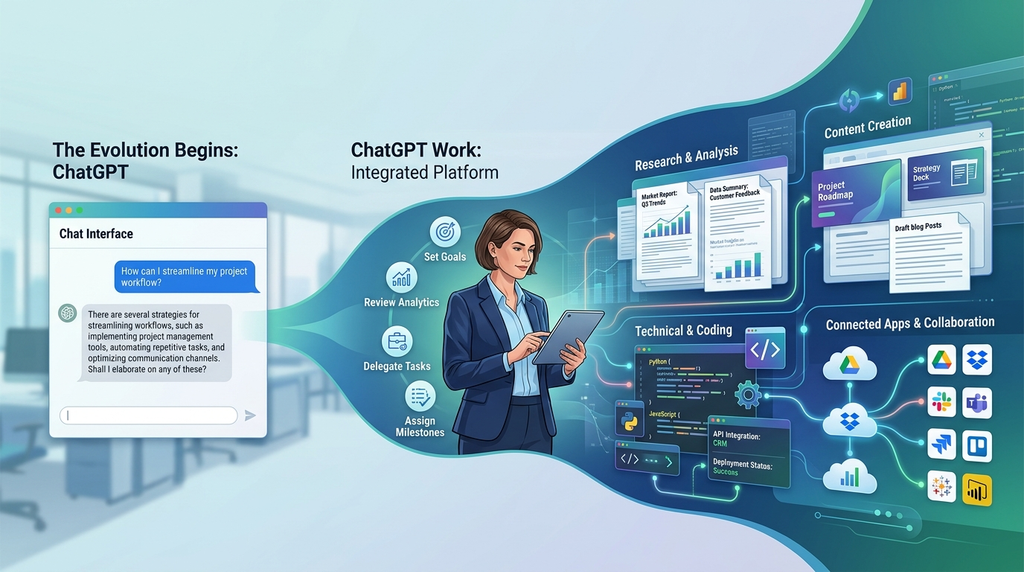
OpenAI says its plugin directory can connect ChatGPT with services including Google Drive, SharePoint, Slack, Microsoft Teams, email, calendars, customer-management systems, and project trackers. The agent can use those connections to locate context and move work forward.
This arrangement could eliminate tedious copying and pasting. It also concentrates risk.
A conventional chatbot sees what a user places in the conversation. A connected agent may see internal messages, customer records, project documents, financial data, and schedules. If permissions are too broad, the agent can retrieve information the person requesting a task should not receive. If its instructions become compromised, it could take an inappropriate action.
Organizations will need to decide which systems an agent can access, which actions require approval, how long information remains available, and who can inspect the record of what occurred.
The appeal of an agent grows with access. So does the possible damage from a mistake. OpenAI’s enterprise opportunity and its governance challenge are therefore two sides of the same product.
Scheduled Work Pushes Toward Continuous AI
ChatGPT Work does not have to remain confined to a live session.
OpenAI says Scheduled Tasks can run once, repeat on a timetable or trigger, and monitor for changes. A task might examine new messages, update a document, revise a presentation, and alert a team when something significant changes.
That turns AI from an on-demand tool into a continuing process.
The distinction matters. People usually notice when they ask a chatbot a question. They may not notice every action taken by an automated task that runs throughout the week. Small errors can accumulate. A faulty assumption can migrate from one report into the next.
Continuous agents will need clear ownership. Someone must know that a task exists, understand what information it uses, and confirm that its output remains reliable. Organizations will also need ways to pause agents quickly when source systems, business rules, or security conditions change.
Automation can save time. Forgotten automation can create a quiet mess. The companies selling these agents must make oversight as easy as delegation.
Safety Grows More Complicated With Capability

GPT‑5.6 is OpenAI’s strongest cybersecurity model to date, according to the company. That creates useful possibilities for defenders. It can also give malicious users better assistance.
OpenAI says its internal evaluations found that the model improved at discovering and fixing vulnerabilities but did not cross the company’s “Critical” capability threshold in cybersecurity or biology. The company also says the system performs better at defensive work than at carrying out reliable, autonomous attacks against hardened targets.
Those are reassuring claims, but the underlying trend remains clear. Frontier models can handle more consequential technical tasks than previous systems.
OpenAI says it has paired GPT‑5.6 with increased monitoring, bug-bounty programs, and a rapid-remediation process. Researchers and real-world misuse reports will feed into updated evaluations and safeguards.
The question is not whether safeguards can eliminate all risk. They cannot. The question is whether developers can detect new forms of misuse quickly enough, restrict dangerous behavior without crippling legitimate work, and explain their decisions to customers and governments.
As Anthropic’s recent experience shows, governments may intervene when they believe a model’s cyber capabilities have outpaced its controls.
Government Scrutiny Is Now Part of a Launch
OpenAI initially released GPT‑5.6 through a limited preview for selected partners after discussions with the U.S. government.
The company said it had shared information about the models’ capabilities and launch plans before release. It later moved the family into broader availability across ChatGPT, Codex, and the OpenAI API.
This episode signals a new reality for frontier AI companies. A launch can no longer be treated purely as a product decision.
Advanced models sit at the intersection of commercial competition, cybersecurity, scientific research, and national security. Governments want earlier visibility. Developers want predictable rules. Customers want to know that a tool they adopt will not disappear suddenly because of a regulatory order.
OpenAI and its competitors will have to navigate that triangle carefully. Too little oversight could expose the public to serious risks. A vague or inconsistent process could disrupt customers and give governments excessive control over general-purpose technology.
The most durable answer will require transparent standards that apply across companies. Informal negotiations behind closed doors cannot provide the stability that a global market needs.
The Workplace Race Is Intensifying
OpenAI did not invent the idea of an AI work agent in isolation.
Anthropic has pushed Claude Cowork and its coding tools into professional workflows. Microsoft continues to extend Copilot across its enterprise ecosystem. Google can connect AI with an enormous base of productivity software and cloud customers. xAI is positioning Grok for coding, office work, and agentic tasks.
This competition benefits customers when it produces better performance, lower prices, and more choice. It also creates pressure to release systems quickly.
The danger is that companies will compare themselves through spectacular demonstrations while businesses discover the practical weaknesses later. An agent might perform beautifully on a prepared workflow but struggle with inconsistent files, undocumented exceptions, or changing instructions.
Enterprises should demand evidence that matches their own environments. A model that excels at generic spreadsheet work may still fail on a company’s particular financial controls. A system that builds an attractive presentation may not understand the political sensitivity of what it includes.
The winning vendor will need more than intelligence. It will need reliable integrations, strong governance, predictable costs, and a convincing record of handling failure.
What This Means for Workers
OpenAI presents Work as a way to remove repetitive labor and give people more time for judgment, customer relationships, and strategic thinking.
That outcome is plausible. It is not automatic.
When a system reduces a financial close from days to hours, employees may spend more time interpreting the numbers. They may also face pressure to complete more work with fewer people. When an agent prepares dozens of reports, someone still needs to check them, but management may not budget enough time for that review.
Jobs rarely disappear in one clean motion. Tasks shift first. Expectations rise. Entry-level work changes. Organizations redraw the boundary between preparation and decision-making.
Workers who learn to supervise agents may gain leverage. They can translate broad goals into clear instructions, identify weak assumptions, and recognize when polished work hides a factual problem. Domain knowledge becomes more important, not less, because the reviewer must understand what the system cannot safely decide.
Companies should train employees before making agents central to performance targets. Otherwise, they risk creating a workforce that depends on automation it does not fully understand.
The Hard Part Begins After the Demonstration
ChatGPT Work is easy to describe in a launch video. Its long-term value will be harder to prove.
Can it maintain accuracy during a project that lasts several hours? Can it distinguish authoritative sources from merely convenient ones? Can it preserve access controls as it moves between systems? Can it explain why it changed a number? Can it recover gracefully when a connected service fails?
Those questions will determine whether Work becomes a dependable colleague, a useful assistant, or an elaborate source of drafts.
OpenAI has considerable advantages. ChatGPT already has wide recognition. Codex gives the company experience with agents that act on files and tools. GPT‑5.6 offers a range of performance and price points. The company can put new capabilities in front of a large user base quickly.
Yet familiarity does not equal trust. Trust grows when a system behaves predictably, shows its work, respects boundaries, and makes errors visible.
The next phase of the AI race will not reward intelligence alone. It will reward operational discipline.
A New Definition of ChatGPT
OpenAI’s announcement ultimately asks users to adopt a new mental model.
ChatGPT began as a place to have a conversation with AI. Work turns it into a place where projects run. GPT‑5.6 supplies the reasoning engine, connected applications supply the context, and scheduled tasks extend the system beyond a single session.
If the strategy succeeds, users may stop thinking primarily about prompts. They will think about assignments, permissions, checkpoints, and deliverables.
That future could make professional work faster and more accessible. A small team could perform research that once required a much larger staff. A manager could turn scattered information into a coherent briefing before a meeting. A specialist could spend less time formatting and more time deciding.
But an agent does not remove responsibility. It redistributes it.
OpenAI has built a more capable machine for doing work. Businesses, governments, and workers must now decide how much work they are prepared to give it—and how carefully they will check what comes back.
Sources
- OpenAI: GPT‑5.6—Frontier intelligence that scales with your ambition
- OpenAI: ChatGPT is now a partner for your most ambitious work
- OpenAI Help Center: ChatGPT release notes
- OpenAI Help Center: Model release notes
- Reuters: OpenAI launches ChatGPT Work, deepening the workplace-AI race
- Associated Press: OpenAI and Anthropic limit new models during cybersecurity review
The Kingy Brief
Get The Kingy Brief.
AI changes, original tests and one practical thing to try. Fridays at 09:00 Vancouver time.
Free · Double opt-in · Unsubscribe anytime
Sign up for The Kingy Brief on Beehiiv.
Signup help and newsletter schedule
Signup form provided by Beehiiv. After submitting, check your inbox for "Confirm your subscription to The Kingy Brief" and open its confirmation link. Check Spam or Promotions if you cannot find it.
Fridays at 09:00 Vancouver time: source-checked AI changes, original tests and one practical thing to try. We skip a week when there is not enough verified material. Free. Unsubscribe anytime.