Update, 5 August 2026 — licence correction. This article was published on 18 July 2026, nine days before Kimi K3’s weights were released, and it states in several places that they would ship under a Modified MIT licence, the family used for the K2 generation. They did not. The weights were released under a bespoke Kimi K3 License, which adds a separate-agreement requirement for large Model-as-a-Service operators and a prominent-attribution requirement for very large products. Those Modified MIT references were part of the July 18 report. They are superseded and corrected in the article below. For the licence as it actually shipped, see Is Kimi K3 open source? Commercial use is allowed — with conditions.
The original July 18 article reported Moonshot AI’s Kimi K3 launch as a turning point for open weights. Moonshot’s current model card describes a 2.8-trillion-parameter, open-weight model built for coding, knowledge work and reasoning. The launch drew immediate comparisons with the earlier DeepSeek moment.
Most of that coverage was running on autopilot. The reflexive “cheap Chinese model” frame missed two details that still matter. First, Moonshot’s retained API schedule lists $15 per million output tokens, so this was not presented as a bargain-only release. Second, the benchmark horse race is less interesting than the economic question: when capable weights ship under a commercially usable licence with conditions, what happens to everyone building on top? Does the application layer bloom, or get flattened? Who captures the value — and who loses a moat?
This is a deep dive into those questions. We will lay out what Moonshot says Kimi K3 is, why its launch pricing matters, how to read the vendor benchmark comparisons, and then work through the strategic question: whether more capable open weights expand the application layer or compress it. The product facts come from Moonshot’s retained materials; the application-layer argument is editorial analysis, not a new market measurement.
What Is Kimi K3? Specs, Architecture, and the Launch Details
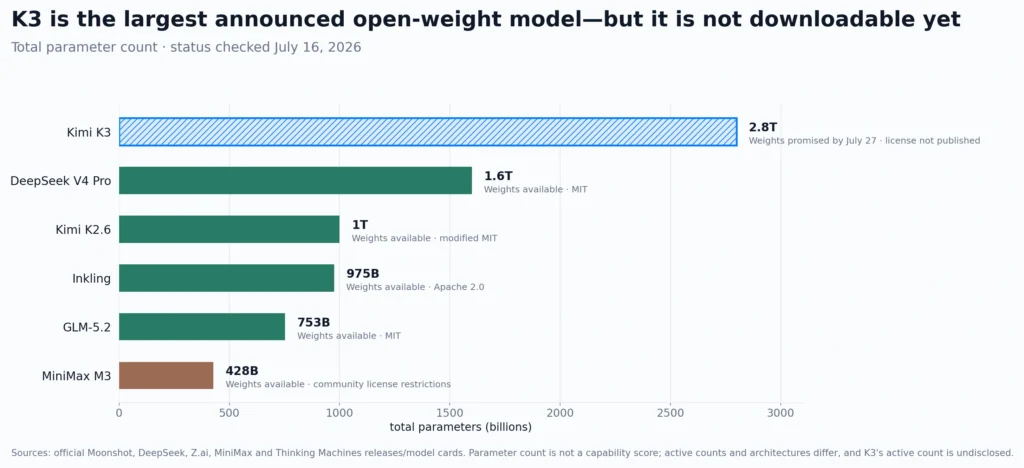
The July article reported Kimi K3 as the third major generation of Moonshot AI’s Kimi line. Moonshot’s October 8 model card documents roughly 2.8 trillion total parameters, a 1,048,576-token context window, native vision and an API with OpenAI- and Anthropic-compatible interfaces. The card also documents low, high and max reasoning settings, with max as the default. Moonshot’s launch page lists access through Kimi, Kimi Work, Kimi Code and the Kimi API.
The architecture: sparse by design
The 2.8-trillion figure deserves an immediate asterisk, because it describes total capacity rather than per-token compute. Moonshot’s model card lists 896 experts with 16 selected per token, plus Kimi Delta Attention and Attention Residuals. Moonshot also reports a cache-hit rate above 90% for coding workloads. These are vendor architecture and serving claims; Kingy did not reproduce the training or cache measurements.
The addition of native vision matters for the workloads Moonshot is chasing. Its materials position K3 for long-horizon coding, repository work, terminal tools, visual iteration and knowledge work. Those are publisher-described capabilities and examples, not results from an independent Kingy product test.
Open-weight, not quite open-source — what changed after launch
At publication on July 18, the weights were not yet downloadable, and Moonshot said they would follow by July 27. They later appeared on Hugging Face under the custom Kimi K3 License, rather than the launch-week expectation of Modified MIT. The October 8 model-card capture confirms downloadable weights. “Open-weight” remains the precise label: the reviewed release materials do not make the training data and full training code part of the release. That distinction matters for reproducibility, auditability, and for anyone whose compliance team asks hard questions.
The released weights do not make self-hosting a laptop hobby. At 2.8 trillion parameters, simple ~2-bit weight arithmetic implies roughly 700 GB before runtime overhead. That is an estimate, not a Kingy deployment result; practical requirements depend on quantization, runtime and hardware. The realistic consumers are inference providers, large enterprises and well-funded teams, not individual tinkerers. That shapes the economics of everything that follows.
The company behind it
The strategic point does not depend on a valuation figure. K3 shows a model developer choosing to release very large weights while also selling first-party access. That pairing — downloadable model plus commercial API — is the useful fact for this analysis.
Kimi K3 Pricing: The Part Almost Everyone Got Wrong
If you absorbed the K3 story through a simple “open means cheap” frame, Moonshot’s own API schedule complicates it. Its retained launch page lists $3.00 per million cache-miss input tokens, $0.30 per million cache-hit input tokens and $15.00 per million output tokens. This article did not perform a billing test, and it does not present current consumer-plan prices.
The durable point is positioning rather than a cross-vendor price race: Moonshot attached a substantial output-token price to a model whose weights it also released. Competitor prices and consumer plans change independently, so this is not current shopping guidance.
| Model | Cache-hit input ($/M) | Cache-miss input ($/M) | Output ($/M) |
|---|---|---|---|
| Kimi K3 | $0.30 | $3.00 | $15.00 |
Moonshot-published Kimi API schedule retained on October 8, 2026. This is a vendor list-price snapshot, not a Kingy billing result or a cross-provider comparison.
Two wrinkles complicated the launch economics in opposite directions. At launch, Moonshot said K3 would use maximum thinking effort by default; the October 8 model card documents low, high and max settings, with max still the default. Long agentic loops can inflate output-token counts, where K3’s launch schedule charged most. Working in its favor, the $0.30 cache-hit input rate and Moonshot’s claimed 90%-plus cache hits on coding workloads could cut effective input costs for integrations built around a stable prefix. These are vendor pricing and cache claims, not a Kingy billing test.
At launch, before the weights were released, Moonshot had a temporary API-exclusivity window and listed K3 at $3 per million input tokens and $15 per million output tokens. The later weight release opened the model to third-party serving under the shipped licence. The July 18 thesis was that hosted-market rates would eventually matter more than Moonshot’s launch API schedule; this article does not recertify current third-party prices.
Kimi K3 Benchmarks: Where It Actually Stands
Moonshot says K3’s overall performance trails Claude Fable 5 and GPT-5.6 Sol while reporting frontier-level results across its evaluation suite. Its retained materials publish benchmark tables and extensive notes about harnesses, reasoning settings, fallbacks and cited external results. Those disclosures are useful, but they remain Moonshot’s evaluation package rather than an independent Kingy rerun.
The honest synthesis is narrower than the launch-week leaderboard rhetoric: Moonshot presents K3 as its most capable model and an open 3T-class release, while acknowledging an overall gap to the strongest proprietary models.
The standard caveats apply with extra force here. Reasoning settings and harness choices make cross-model comparisons sensitive to configuration. The October 8 model card publishes weights, benchmark tables and methodology notes, but this review did not rerun those evaluations. Treat Moonshot’s bars as vendor claims. For broader context, see our frontier model comparison and the GPT-5.6 family breakdown.
Why the Launch Mattered Beyond the Benchmark Chart
The July article treated K3 as more than a product launch because a model of this scale was paired with downloadable weights. Contemporary market-reaction language remains part of the article’s historical frame.
The strategic pressure is easier to state without a ticker: a developer that sells access while releasing weights challenges both closed-model pricing and the differentiation of other open-model labs. That is the lesson the article draws for mid-tier providers. It is an argument about positioning, not a verified claim about any company’s share price.
The timeline question still matters, but the retained sources do not establish the launch-week quotation or six-month expectation in the original draft. The defensible point is that Moonshot’s own materials present K3 as a large open-weight model near the proprietary frontier. Whether that changes compute economics or demand is the editorial question developed below, not a measured conclusion.
The Real Question: Do Cheap, Open Models Mean More AI Applications — or Fewer?
Strip away the launch-week noise and K3 forces a strategic question: when highly capable weights become downloadable, does the ecosystem above them expand or contract? Expansion could mean more experiments, more competition and more infrastructure demand. Consolidation could pull workflows into a smaller number of broad assistants. The sections below weigh those mechanisms as editorial analysis; they do not claim a retained market dataset settles the answer.
The case for more: lower unit cost and more control
The strongest argument for expansion is the Jevons-style hypothesis: when the unit cost of a useful input falls, total consumption can rise because more use cases become economical. That is the lens this article applies to model intelligence.
Open weights can also widen supply. Teams may self-host, fine-tune or choose among multiple serving providers instead of depending on one API. That flexibility is real in the licence and model release. This article does not claim a current adoption percentage.
Open weights add a second, structural argument: they permit forms of adaptation and deployment that a closed API does not. The Kimi K3 License grants rights to use, modify, deploy, fine-tune and redistribute the software, subject to its conditions. That can turn a model into a component a team can shape.
One more distinction does a lot of quiet work here. The force that kills applications is closed-model capability absorption — the frontier assistant swallowing your product as a feature. The force that spawns applications is open-weight availability — raw capability anyone can shape. K3 is unambiguously the second force. It hands ammunition to the long tail rather than the incumbents, because the incumbents already had frontier models; the long tail just got one it can own.
The case for fewer: absorption, weak differentiation and execution risk
The bear case deserves a fair hearing. A general-purpose assistant can absorb a workflow that once supported a separate product, and a thin wrapper can lose its distinction when comparable capability becomes widely available. That is a strategic risk, not a quantified failure count in this review.
Second, building more things is not the same as building more viable things. Lower barriers can produce more attempts without improving distribution, workflow fit or retention.
Third, first-party API pricing can remain substantial even when weights are downloadable. Organizations also have to evaluate licence terms, data handling, procurement and hosting operations for their own circumstances. Those frictions can slow adoption without proving that the broader application layer will shrink.
Weighing it: the editorial conclusion
Put the two cases side by side and the author’s conclusion remains expansion with heavy churn: lower barriers create more attempts, while shared capability makes each attempt harder to defend. That is a judgment, not a reproduced market series.
So the honest answer is: more applications, with a catch. The catch is that each individual application becomes less defensible, because everyone is drawing from the same ambient pool of capability. Which brings us to the question of where the value actually goes.
Winners and Losers: Where Value Migrates When Models Commoditize
The author’s thesis is that margin moves above and below the model. When comparable weights are available to many builders, the model becomes more like shared substrate. Value then depends more on serving, workflow position, proprietary data, distribution and trust. K3 makes that thesis concrete because its weights and first-party API coexist.
Start below the model, at the serving layer. Once K3’s weights shipped, providers could compete on price, latency, quantization quality and reliability around the same underlying model. That makes “same model, different serving” a real purchasing decision.
Above the model, the stronger applications are those with assets a downloadable file cannot replicate: proprietary data, embedded workflow position, regulatory approvals, brand and distribution. Hardware and serving providers may benefit from commercially usable weights, but the Kimi K3 License includes conditions and should not be described as simply permissive. Whether any buyer’s total cost falls depends on serving and operations, not the weight download alone.
The vulnerable group is easier to identify without a stock chart: providers and thin wrappers differentiated only by access to capability that others can also obtain. Benchmark marketing also weakens when vendor tables depend on different harnesses and settings. The older moats — distribution, workflow fit and trust — matter more as the underlying models converge.
Our view is that a wider field of credible products makes distribution more important. Savings at the model layer do not automatically become margin if teams must spend more to earn attention and trust. That is a strategic forecast, not a measured industry budget series.
The Second-Order Effects Nobody Is Pricing In
Three downstream consequences of K3-style proliferation deserve more attention than they are getting.
Churn becomes a permanent tax
Faster model cadence means faster model death. The July article reported that Moonshot closed kimi-k2.5 and the legacy moonshot-v1 series to new users and scheduled an August 31 sunset, after earlier K2 and kimi-latest discontinuations. That launch-era migration warning remains historically relevant, but this review did not recover current endpoint-status evidence. K3’s launch configuration defaulted to maximum reasoning; the October 8 model card now documents low, high and max settings. Open weights can soften model churn for teams able to self-host, while everyone else still depends on provider lifecycle decisions. It is a growing part of what we track on the Kingy Launch Radar, because launch coverage without retirement coverage is half a story.
The flood makes trust the scarce good
Here is the uncomfortable corollary of near-free frontier capability: the cost of producing content, reviews, benchmarks, launch pages, and entire competitor products is heading toward zero — which means the volume of all of them is heading toward infinity. Leaderboards get gamed, launch feeds get spammed, AI-written reviews of AI products review each other into a hall of mirrors. When generation is free, the average unit of signal is worth less, and the premium on verified, methodology-backed evaluation rises in direct proportion. This dynamic is exactly why we invested in a validation-first scoring pipeline — the reasoning is laid out in Kingy Score v2 — and why we expect independent evaluation, disclosed methodology, and auditable claims to become the dividing line between AI media that survives the flood and AI media that becomes part of it.
Machines start doing the choosing
The third shift is quieter. As agents take over more selection decisions — which library to install, which API to route to, which tool to recommend — discovery itself becomes machine-mediated. An agent evaluating “which model should handle this workload” does not watch launch keynotes; it reads structured data, pricing endpoints, and changelogs. In a world of hundreds of viable open models, the winners of distribution may increasingly be whoever is most legible to machines, not just most visible to humans. That is a channel most AI companies have not even begun to optimize, and it compounds the previous point: machine-readable trust data only works if someone trustworthy is producing it.
The Bear Case: What Could Break This Thesis
Intellectual honesty requires naming the scenarios under which the expansion thesis fails, and there are four serious ones.
First, consolidation could still win. If frontier assistants absorb workflows faster than open weights help new applications differentiate, the application layer could concentrate into a handful of broad products. This review does not claim a current usage series settles that question.
Second, the economics of open-weight development remain unresolved. Releasing weights while selling first-party access can support several business models, but the retained sources do not establish Moonshot’s training cost, financing structure or long-term margin. If large releases are not economically durable, the supply of frontier-scale open weights could slow.
Third, geopolitics could bifurcate the market. Procurement, data-governance and export-control rules can restrict where a model is used even when its weights are available. This is a scenario for buyers to assess against current law and policy, not a claim that every organization faces the same restriction.
Fourth, there is a safety overhang. Downloadable weights cannot be withdrawn in the same way as access to a hosted API, and downstream users can modify safeguards. How regulators and buyers respond is uncertain. This is a risk scenario in the author’s thesis, not a claim that a specific incident or rule is imminent.
What the July 18 Analysis Said to Watch
The original article identified five checkpoints. The first resolved with downloadable weights and a different licence than expected; the remaining bullets preserve the launch-era watchlist and are not a current status report:
- July 27 — the weights. The weights later shipped under the custom Kimi K3 License, not the Modified MIT terms anticipated at publication. The August 5 correction above records that outcome.
- Early August — hosted pricing. The July article proposed watching third-party serving rates after the weight release. This review does not recertify those provider prices.
- August 31 — the announced sunset. The July article reported that Moonshot planned to retire kimi-k2.5 and the moonshot-v1 series on that date. This review did not recover a current official status capture for those endpoints, so the item remains a dated launch-era checkpoint rather than current migration advice.
- Competitor response. The July article proposed watching whether rival labs answered with price changes, open releases or other positioning. This remains an editorial watch item, not a claim about a completed response.
- The next release. The July article expected other labs to respond quickly. That forecast is preserved as dated context.
The Bottom Line
Kimi K3’s significance was never really the benchmark chart. It is the licence attached to the benchmark chart. The July 18 thesis was that capability within arm’s reach of the frontier was about to become a downloadable file; the weights later shipped under the custom Kimi K3 License. The rest remains the author’s argument: more applications, faster churn, thinner moats, cheaper tokens, and a rising premium on the two things proliferation cannot commoditize — distribution and trust. We track later launches on the Launch Radar and across the Kingy AI tool directory.
Kimi K3: Frequently Asked Questions
What is Kimi K3?
The July article records Kimi K3’s launch date as July 16, 2026. Moonshot’s model card describes a mixture-of-experts system with roughly 2.8 trillion total parameters, 16 of 896 experts selected per token, a 1,048,576-token context window and native visual understanding. The October 8 model card documents low, high and max reasoning settings, with max as the default.
What did Kimi K3 cost in the reviewed launch snapshot?
Moonshot’s retained launch materials list API pricing at $3.00 per million cache-miss input tokens, $0.30 per million cache-hit input tokens and $15.00 per million output tokens. The table above reproduces only that vendor schedule; it is not a current purchasing quote or a cross-provider comparison.
Is Kimi K3 open source?
Kimi K3 is available as downloadable weights under the custom Kimi K3 License. The licence permits use, modification and redistribution, with additional terms for some large commercial deployments. The pre-release Modified MIT expectation described earlier in this July 2026 article was superseded when the weights shipped.
How does Kimi K3 compare to Claude Fable 5 and GPT-5.6?
Moonshot’s published materials say K3 trails Claude Fable 5 and GPT-5.6 Sol overall while reporting competitive results on several coding and agentic benchmarks. Those comparisons use disclosed but differing harnesses and reasoning settings. The launch-week independent rank reported earlier in this essay was not reproduced in this review.
Can I run Kimi K3 locally?
Only with serious infrastructure. Simple 2-bit arithmetic on 2.8 trillion parameters implies roughly 700 GB for weights before runtime overhead, but this article did not perform a K3 deployment test. Actual requirements depend on quantization, runtime and hardware; most users will use an API or hosted provider.
Which Kimi models are being retired?
The July 2026 article reported that kimi-k2.5 and the legacy moonshot-v1 series were closed to new users and scheduled for an August 31 platform sunset. It also reported earlier K2 and kimi-latest discontinuations. This review did not recover a current official endpoint-status source, so check Moonshot’s current model documentation before making a migration decision.
The Kingy Brief
Get The Kingy Brief.
AI changes, original tests and one practical thing to try. Fridays at 09:00 Vancouver time.
Free · Double opt-in · Unsubscribe anytime
Sign up for The Kingy Brief on Beehiiv.
Signup help and newsletter schedule
Signup form provided by Beehiiv. After submitting, check your inbox for "Confirm your subscription to The Kingy Brief" and open its confirmation link. Check Spam or Promotions if you cannot find it.
Fridays at 09:00 Vancouver time: source-checked AI changes, original tests and one practical thing to try. We skip a week when there is not enough verified material. Free. Unsubscribe anytime.