Reporting status — July 22, 2026: A senior White House official has directly alleged that Moonshot AI distilled Anthropic’s Claude Fable model while developing Kimi K3. Anthropic had already accused Moonshot of a much earlier, large-scale Claude extraction campaign. But neither the White House nor Anthropic has published the logs, training records or forensic package needed to prove that Fable 5 outputs entered K3. The release calendar makes one sweeping version of the claim—the idea that Moonshot built K3’s 2.8-trillion-parameter base from Fable 5—extraordinarily unlikely. A narrower scenario, in which an already pretrained K3 received targeted Fable-derived post-training, is technically possible. It remains unproven. Kingy.ai’s confidence in that conclusion is moderate.
Direct answer: did Kimi K3 distill Claude Fable 5?
Public evidence does not currently prove that Kimi K3 distilled Claude Fable 5. On July 22, White House science and technology director Michael Kratsios said the U.S. government has information that Moonshot “distilled Anthropic’s Fable for the development of its K3 model.” That is a serious, specific official allegation—not an anonymous social-media rumor. Kratsios did not publish the underlying evidence.
The allegation is not appearing in a vacuum. On February 23, Anthropic said it had attributed more than 3.4 million Claude exchanges to a Moonshot campaign involving hundreds of fraudulent accounts and multiple access pathways. Anthropic said the prompts targeted agentic reasoning, coding, computer use, vision and reasoning-trace reconstruction. Yet that campaign was disclosed more than three months before Fable 5 launched and was not publicly tied to K3.
The most defensible assessment is therefore two-part. Moonshot’s prior alleged conduct makes the new claim plausible enough to investigate. The public record still does not establish the crucial model-to-model link.
What we know—and what we do not
What is established
- Moonshot launched the hosted Kimi K3 model on July 16, 2026, and promised weights by July 27.
- Claude Fable 5 first launched on June 9, was suspended on June 12, and returned globally on July 1.
- Anthropic publicly accused Moonshot in February of a 3.4-million-exchange Claude extraction campaign.
- Kratsios specifically alleged on July 22 that Moonshot used Fable for K3.
- Public Hugging Face datasets labeled as Fable 5 traces existed before K3’s launch.
- Moonshot has publicly denied that K3 is a distilled replica of an existing model.
What is not established
- Which Fable version, endpoints or access dates the U.S. allegation covers.
- How many Fable 5 prompts or outputs Moonshot allegedly obtained.
- Whether those outputs entered K3’s supervised fine-tuning, reinforcement learning, evaluation or any other stage.
- Whether Moonshot used direct accounts, resellers, cloud marketplaces, public datasets or a combination.
- Whether the alleged conduct materially caused K3’s capability gains.
- Whether any court, regulator or independent forensic team has validated the claim.
Why Kimi K3 triggered this fight
Kimi K3 is not merely another chatbot update. In its official K3 launch post, Moonshot describes a 2.8-trillion-parameter mixture-of-experts model with native vision, a one-million-token context window, Kimi Delta Attention, Attention Residuals and 16 active experts selected from a pool of 896. Moonshot says these changes, combined with revised training and data recipes, produced roughly 2.5 times the scaling efficiency of Kimi K2.
The model became available through Kimi’s website, apps, coding tool and API on July 16. Its API costs $0.30 per million cache-hit input tokens, $3 per million uncached input tokens and $15 per million output tokens. Moonshot’s own evaluations place K3 behind Claude Fable 5 and GPT-5.6 Sol overall, but ahead of several other frontier systems. It also debuted at the top of Arena’s Frontend Code ranking. Those are important results, although benchmark harnesses, fallbacks and company-selected evaluations limit simple “K3 beat Fable” headlines.
Kingy.ai examined K3’s broader significance in our report on the model’s challenge to the U.S. AI lead. The distillation dispute matters because K3 combines near-frontier performance with a promised weight release. If the weights ship, American developers can run, inspect and adapt a Chinese model that competes with products costing far more. To U.S. labs, that threatens both technical advantage and the economics that finance the next training run. To open-model advocates, it is exactly the competition that closed labs should have expected.
The allegations, precisely stated
| Claim | Source and date | Public evidence supplied? | Status |
|---|---|---|---|
| Moonshot ran a Claude extraction campaign exceeding 3.4 million exchanges through hundreds of fraudulent accounts. | Anthropic, February 23, 2026 | Anthropic described metadata, access patterns and staff-profile matches, but did not release raw logs. | Detailed company allegation; not independently audited. |
| Foreign entities, principally in China, were conducting industrial-scale distillation of U.S. frontier models. | White House NSTM-4, April 23, 2026 | The memorandum described methods and scale in general, not a K3 training trail. | Official U.S. assessment; not K3-specific. |
| Moonshot distilled Anthropic’s Fable “for the development of its K3 model” using a platform able to switch access methods. | Michael Kratsios, July 22, 2026 | No supporting logs, dates, query counts or datasets were released with the statement. | Direct official allegation; publicly unproven. |
| K3’s performance leap came from original architecture rather than distilling and replicating an existing model. | Moonshot executive Huang Zhenxin, interview given July 21, 2026 | Moonshot points to KDA, Attention Residuals and other training innovations; the full K3 technical report is pending. | Company denial and technical explanation; incomplete disclosure. |
| K3 “calling itself Claude” or resembling Fable proves lineage. | Social-media screenshots and anecdotes | No controlled study, canary analysis or provenance test. | Weak behavioral evidence. |
The February and July claims must not be collapsed. Anthropic’s February post concerned Claude access generally and named “Moonshot (Kimi models).” Fable 5 did not launch until June 9. The February evidence can support a history of alleged extraction behavior; it cannot retroactively prove that Fable 5 trained K3.
A forensic timeline
| Date | Event | Status | Why it matters |
|---|---|---|---|
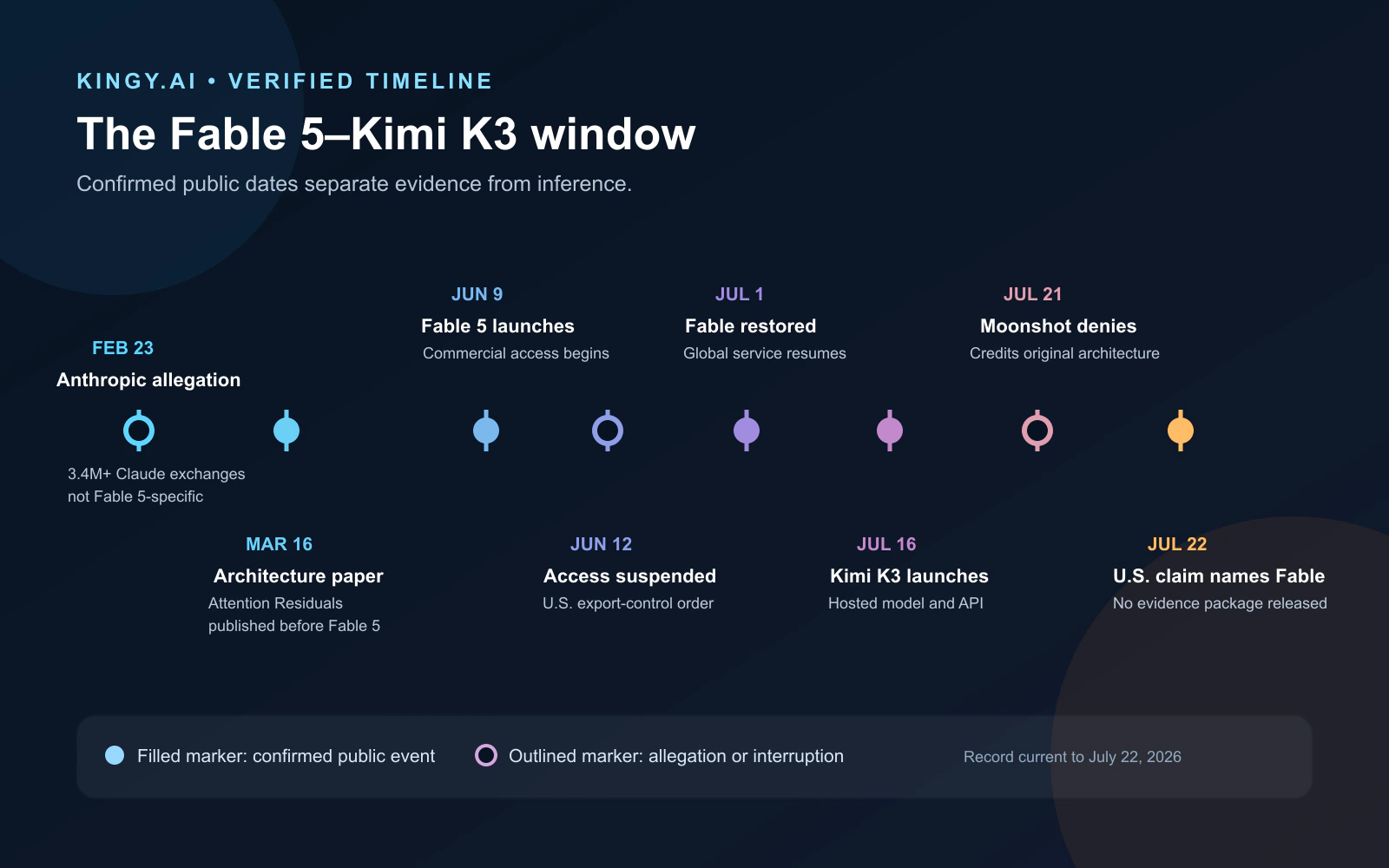
| February 23, 2026 | Anthropic accuses Moonshot of more than 3.4 million Claude exchanges across hundreds of accounts. | Company allegation | Evidence of alleged earlier behavior, but not a Fable 5-to-K3 link. |
| March 16, 2026 | The Kimi Team publishes the Attention Residuals paper. | Confirmed | A major K3 architecture component was public nearly three months before Fable 5. |
| April 23, 2026 | The White House issues NSTM-4 on adversarial distillation. | Confirmed policy memorandum | Shows the U.S. response predates K3’s launch. |
| April 29, 2026 | Two House committees announce an investigation into PRC AI models, naming Moonshot. | Confirmed investigation | Formal scrutiny existed before the latest controversy. |
| June 9, 2026 | Anthropic launches Claude Fable 5. | Confirmed | Earliest confirmed general availability. |
| June 10–20, 2026 | Public repositories begin posting datasets labeled as Fable 5 traces and mirrors. | Repository records; authenticity partly unverified | Creates a possible public-data path, but not proof Moonshot used it. |
| June 12, 2026 | Anthropic suspends Fable 5 and Mythos 5 after immediate U.S. export controls. | Confirmed | Interrupts public access only three days after launch. |
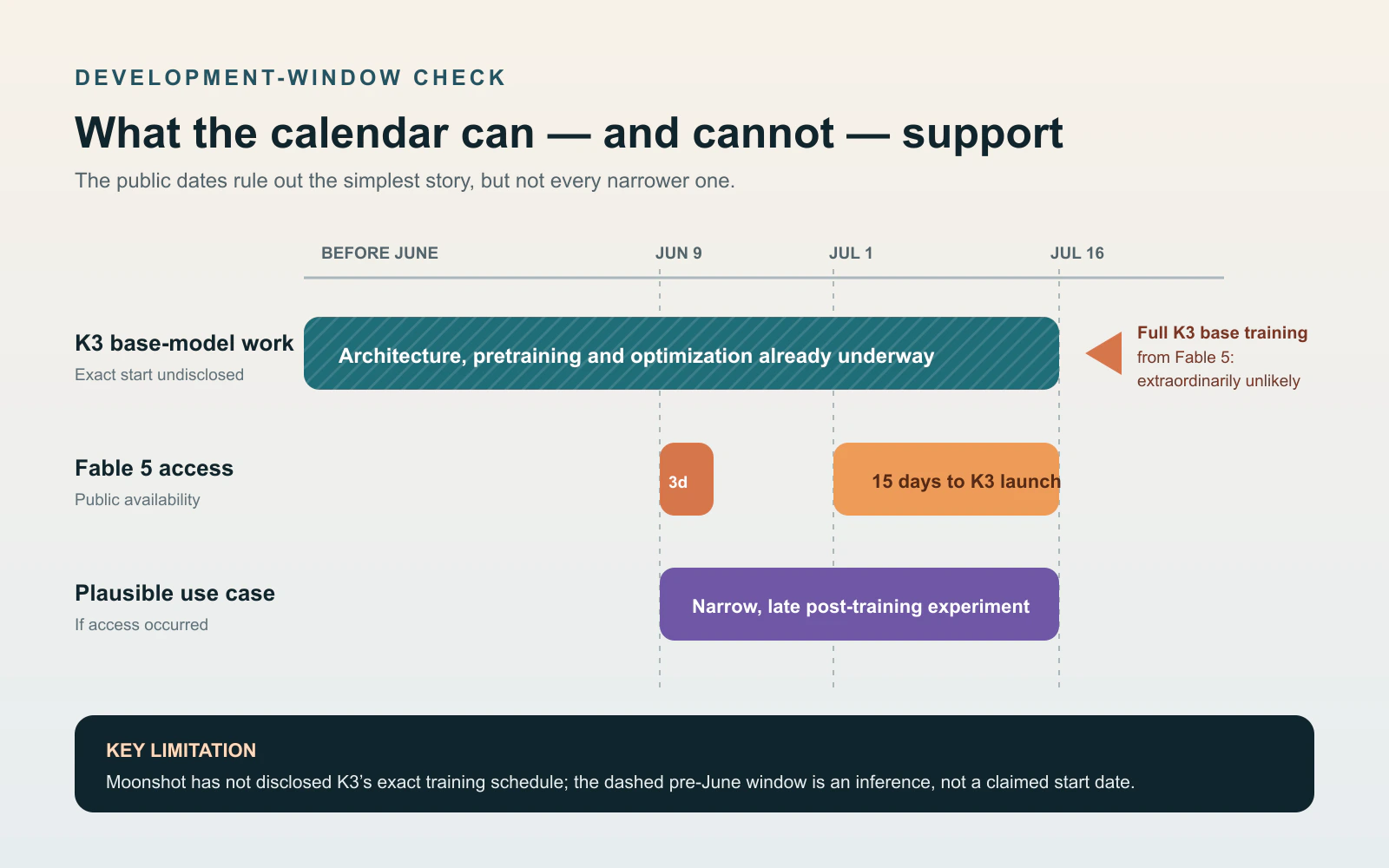
| July 1, 2026 | Anthropic restores Fable 5 globally after the controls are lifted. | Confirmed | Leaves 15 days before K3’s hosted launch. |
| July 16, 2026 | Moonshot launches K3 on its products and API; full weights and a technical report are promised later. | Confirmed | K3 arrives 37 days after Fable’s first launch. |
| July 19, 2026 | Moonshot pauses new consumer subscriptions as demand strains capacity. | Confirmed | Shows immediate market impact, not model provenance. |
| July 21, 2026 | Huang Zhenxin says K3 is not a distilled replica and attributes its gains to original architecture. | Reported company response | The clearest Moonshot response found before the U.S. allegation. |
| July 21, 2026 | Treasury Secretary Scott Bessent says the administration will examine Chinese models and could sanction proven IP theft. | Official comment; no action announced | Signals possible policy escalation, not an enacted sanction. |
| July 22, 2026 | Kratsios makes the specific Fable-to-K3 allegation. | Confirmed statement | This is the first traceable public U.S. claim directly connecting the two named models. |
| July 27, 2026 | Moonshot’s deadline for K3 weights and more technical material. | Planned | Future release may enable stronger independent evaluation; the license is not yet available. |
Could the timeline work?
The answer depends on what “distilled Fable for K3” means.
Building K3’s base model from Fable 5: extraordinarily unlikely
A 2.8-trillion-parameter mixture-of-experts model is not created by collecting a few weeks of chatbot answers. Its base capabilities require enormous pretraining runs, data pipelines, routing experiments, failure recovery, evaluation and infrastructure work. K3’s Attention Residuals research was public in March, and Moonshot says an early K3 version was already doing kernel-optimization work during the model’s late development. The base model and much of its architecture therefore had to exist before Fable 5’s June release.
Even an industrial output-collection operation beginning June 9 would have had only 37 days before K3 launched—and Fable was unavailable to ordinary users for 18 of those days. No public evidence shows that Moonshot had prerelease partner access. Anthropic’s launch materials name early testers but do not disclose when their previews began, so nonpublic access cannot be ruled out in the abstract. It also cannot be assumed.
Improving an existing K3 through post-training: technically plausible
Post-training is different. Once a strong base model exists, a lab can use teacher outputs for supervised fine-tuning, rejection sampling, reinforcement-learning tasks, reward-model construction or targeted capability drills. A dataset focused on coding-agent behavior or tool use can be generated and consumed much faster than a frontier base model can be pretrained.
Research supports both the promise and the limits. The Orca project showed that explanation traces can transfer reasoning behavior to a smaller student. Distilling Step-by-Step found that rationales can improve data efficiency. But The False Promise of Imitating Proprietary LLMs found that imitation data often copies a teacher’s style more readily than its broad factual capability unless the student base is already strong and the dataset is extensive.
K3 is exactly the kind of already-powerful base that could benefit from focused late-stage examples. That makes the narrow scenario possible. It does not tell us whether Moonshot actually used Fable 5, whether any gain was material, or whether older Claude models, other teachers, self-generated data and Moonshot’s own reinforcement learning explain the same behavior.
What model distillation actually means
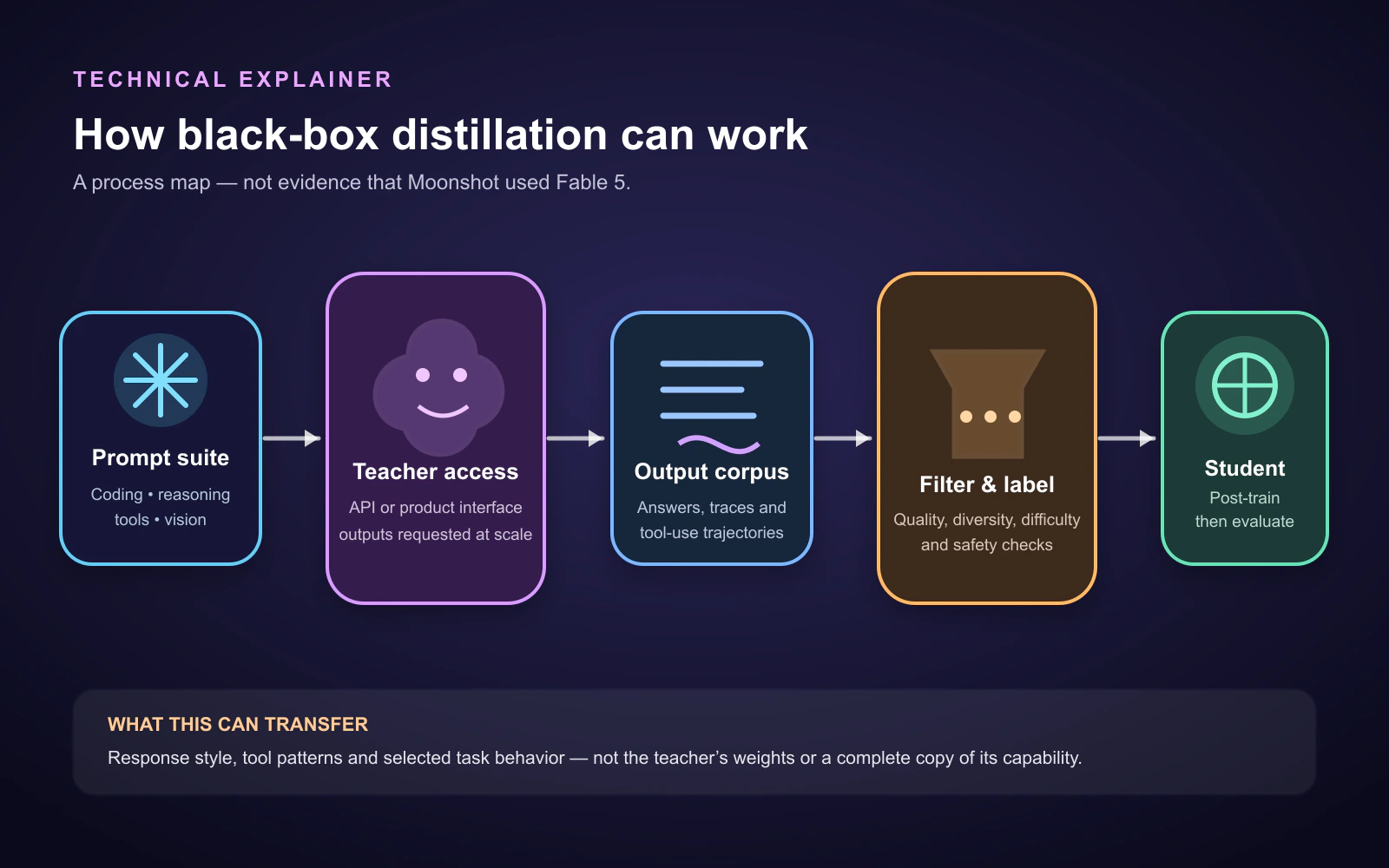
Knowledge distillation is a technical family of methods, not a synonym for theft. A “teacher” model generates probabilities, answers, explanations, tool calls or evaluations. A “student” model learns from that material. Labs routinely distill their own frontier models into cheaper systems.
Black-box distillation uses only outputs available through a service; it does not require copying model weights or source code. Sequence-level distillation trains on complete answers. Reasoning-trace distillation includes worked steps or tool trajectories. A teacher can also create candidate tasks, grade a student’s attempts, or provide reward signals without its final wording ever becoming a training target.
These distinctions matter:
- Building a base model means learning broad linguistic, factual and procedural structure across a vast corpus.
- Post-training reshapes an existing model’s instruction following, reasoning, tool use, safety and domain behavior.
- Style imitation can make outputs look similar without transferring deep capability.
- Behavioral distillation can transfer task strategies without copying weights.
- Model extraction aims to reproduce a service’s behavior at scale.
- Weight theft is direct acquisition of the trained parameters. No public allegation reviewed here says Moonshot stole Anthropic’s weights.
For a longer primer, see Kingy.ai’s guide to AI model distillation and compression.
The strongest evidence supporting the allegation
1. A specific statement from the White House technology director
Kratsios did not merely repeat Anthropic’s February accusation. In his July 22 statement, he connected Fable to K3 and said Moonshot built an internal platform for large-scale distillation that could move between access methods to avoid detection. He also alleged Moonshot had acquired GB300-equipped servers and accessed GB300 systems in Thailand.
The specificity increases the claim’s news value. It does not substitute for evidence. Kratsios did not say whether the information came from Anthropic, intelligence reporting, cloud providers, payment records or another source. He did not disclose access dates, exchange volume, affected Fable variants or the K3 training stage.
2. Anthropic’s earlier attribution to Moonshot
Anthropic’s February disclosure is the most detailed public evidence of alleged Moonshot conduct. Anthropic said it used IP correlations, request metadata, infrastructure indicators and industry-partner corroboration to attribute campaigns. For Moonshot specifically, it reported hundreds of accounts, multiple access pathways and metadata matching public profiles of senior staff. It said a later phase tried to reconstruct Claude reasoning traces.
If accurate, that history shows capability-extraction infrastructure and intent. The key limitation remains temporal: the post describes activity observed before Fable 5 existed publicly. It supports a pattern allegation, not the Fable-to-K3 conclusion by itself.
3. Capability targeting resembles K3’s strengths
Anthropic said the Moonshot campaign targeted agentic reasoning, tool use, coding, data analysis, computer use and vision. K3 is marketed around many of the same capabilities. That correspondence is circumstantial because every frontier lab prioritizes those high-value domains. It would become more probative only if time-stamped prompt clusters aligned with specific K3 post-training runs or product milestones.
What limits the allegation
No public training trail
No source reviewed for this article has published a K3 data manifest, Anthropic account list, payment trail, IP cluster, query sample, dataset hash, internal Moonshot document or employee testimony linking Fable 5 outputs to K3. A government assertion can be based on classified or commercially sensitive evidence, but readers cannot independently evaluate material they cannot see.
Substantial Moonshot work clearly predates Fable 5
K3’s scale, architecture and infrastructure cannot be explained by the June-to-July window. Attention Residuals appeared in March. Kimi K2 and K2.5 established Moonshot’s mixture-of-experts, vision and agentic training lineage before Fable 5. K3 may combine original work with outside synthetic data; the existence of one does not exclude the other.
Behavioral resemblance is not lineage proof
Users have posted screenshots in which K3 allegedly refers to itself as Claude or uses Anthropic-like language. Models frequently role-play, echo system-prompt residue, reproduce web text and inherit common synthetic data. A few prompts cannot distinguish distillation from contamination, shared evaluation data, convergent post-training or ordinary hallucination. Strong behavioral evidence would require preregistered prompts, repeated runs, model-specific canaries, shared rare errors and statistical controls.
Moonshot has offered an alternative account
In a July 21 interview with China’s National Business Daily, Moonshot enterprise executive Huang Zhenxin directly denied speculation that K3 was a “distilled small model.” He said the performance jump came from foundational architecture and was not a distilled replication of an existing model. The interview highlighted KDA, Attention Residuals and additional optimization work.
That response is relevant but not dispositive. It addresses replication of an existing model more clearly than it addresses whether any outside teacher outputs appeared in a mixed post-training corpus. Moonshot has not published the promised full technical report, training dates or synthetic-data provenance.
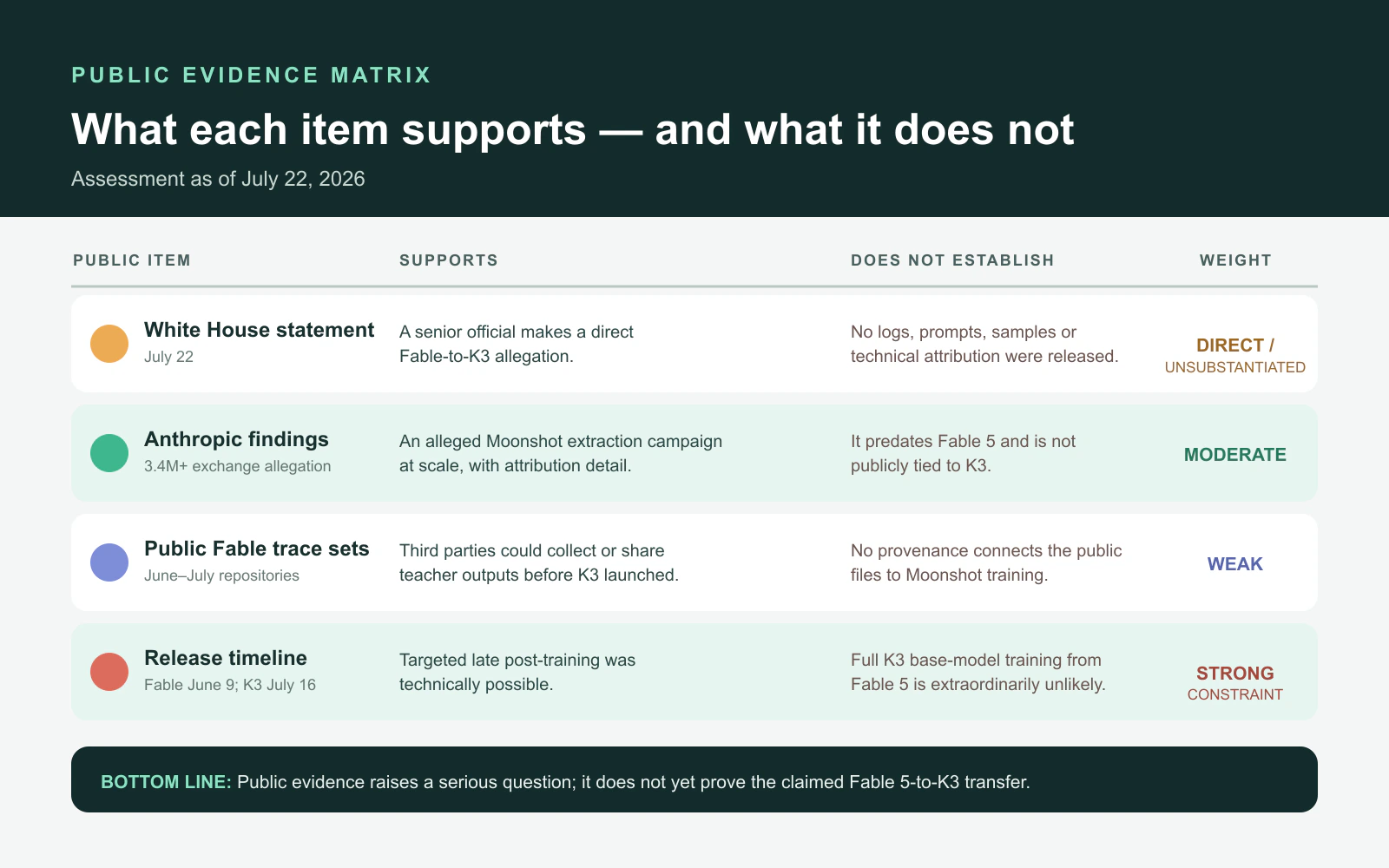
Were public Fable 5 traces enough?
Public traces are the most concrete alternative to a direct Moonshot-to-Anthropic query campaign. Hugging Face repository histories show datasets labeled as Fable 5 conversations, reasoning and Claude Code sessions appearing within days of the June 9 launch. A widely mirrored Glint Research collection contained about 4,665 rows. Other uploads added coding sessions and reasoning examples before K3’s July 16 release.
The numbers require aggressive skepticism. One collection advertised roughly 2,006,487 “Fable” rows. Its maintainer later performed a provenance cleanup and removed about 98 percent, leaving 56,700 content-verified rows. The removed material included template filler, generic synthetic instruction data, mythology text and datasets whose own cards said they were not real Anthropic outputs. Even the retained rows are source-asserted and content-checked, not cryptographically certified by Anthropic. Some are cumulative conversation prefixes, so “rows” is not the same as unique sessions or independent reasoning demonstrations.
A clean subset of tens of thousands of tool-use or reasoning targets could improve a strong model in narrow areas. It could not plausibly account for K3’s entire base capability, parameter structure or multimodal training. There is also no public evidence that Moonshot downloaded these repositories, and no reliable license label can override rights or contract restrictions inherited from the original service. A community uploader can attach an open license to its formatting work without necessarily possessing the authority to license every underlying output.
Judgment: Public traces make Scenario E technically possible and weaken claims that direct first-party API access was the only conceivable route. They do not prove use, and the contaminated “two million traces” figure should not be cited as fact.
Six scenarios, separated
The confidence below concerns whether each scenario contributed materially to K3, not whether the mechanism is possible in a laboratory.
| Scenario | Technical and timeline fit | Evidence for | Evidence against or missing | Current confidence |
|---|---|---|---|---|
| A. K3 was substantially pretrained from Moonshot’s own data and methods. | Strong. Base-model work had to predate Fable 5. | 2.8T architecture, March AttnRes paper, Kimi lineage and disclosed infrastructure work. | Training corpus, compute and dates are undisclosed. | High |
| B. An existing K3 base used Fable 5 outputs in post-training. | Plausible within 15–37 days for targeted domains. | Kratsios allegation; distillation literature; K3 strengths overlap alleged targets. | No dataset, run log, ablation or volume disclosed. | Low to moderate |
| C. Moonshot directly queried Fable 5 at industrial scale. | Possible, but the public-access window was short and interrupted. | Anthropic alleges an earlier Moonshot campaign and Kratsios alleges a K3 platform. | No Fable-specific account or query evidence is public. | Low |
| D. Moonshot used intermediaries, resellers or distributed accounts. | Possible; such networks can parallelize output collection. | Anthropic described multiple access pathways and proxy infrastructure in February. | No intermediary has been named for Fable-to-K3 activity. | Low to moderate |
| E. Moonshot trained on publicly reposted Fable 5 traces. | Plausible for narrow SFT; insufficient for base training. | Public datasets existed before K3. | No Moonshot-use evidence; duplication and authenticity problems. | Low |
| F. Similarity reflects convergence, benchmark pressure or shared data. | Highly plausible as at least part of the explanation. | Labs optimize similar agentic tasks; behavior alone is weak lineage evidence. | Does not explain any nonpublic canaries or logs the government may possess. | Moderate |
These scenarios are not mutually exclusive. The likeliest broad picture is that K3 rests on substantial Moonshot pretraining and architectural work, possibly combined with synthetic data from multiple teachers, self-generated reinforcement-learning tasks and public material. The unresolved question is whether Fable 5 was one of those teachers.
Would distillation be illegal?
“Distillation” is a technical description, not a legal verdict. Different facts activate different bodies of law, and no court has adjudicated the K3 allegation.
Contract and platform terms
Anthropic’s commercial rules prohibit using Claude outputs to train competing models. Its March 2026 model-training policy explanation states that customers may not use outputs to train models competitive with Anthropic’s own. A customer that knowingly did so could face a contract claim, account termination and damages depending on the governing agreement.
Which contract binds which actor is a factual question. Direct API customers, cloud-marketplace users, consumers, resellers and people viewing public reposts may have different terms. A breach of terms is not automatically copyright infringement or a crime.
Copyright
Copyright protects original expression, not facts, ideas, methods or abstract capabilities. Fully machine-generated text may also lack a human author eligible for U.S. copyright protection, although outputs can contain protected human material or form part of a human-authored work. Training can involve copies, but whether a particular use is fair is fact-specific.
The U.S. Copyright Office’s AI training report rejected categorical answers: some training uses may be fair and others may not, with source, purpose, acquisition method, output behavior and market effect all mattering. A model-learning claim therefore cannot be resolved by saying either “all training is theft” or “machines learn like people.”
Trade secrets and unfair competition
U.S. trade-secret law covers valuable information kept secret through reasonable measures and acquired or used through improper means. Model weights, internal training recipes and undisclosed system behavior can qualify in the right circumstances. Outputs deliberately delivered to customers are a harder fit unless the alleged campaign circumvented controls to expose confidential information or reconstructed protected internal material. Anthropic’s claim that Moonshot tried to reconstruct reasoning traces could matter, but the public record does not show what was obtained.
Computer-access law and fraudulent accounts
False identities, payment fraud or bypassed technical controls can create legal exposure beyond ordinary contract breach. But the U.S. Supreme Court’s Van Buren v. United States decision narrowed the Computer Fraud and Abuse Act: misuse of information someone was entitled to access is not automatically “exceeding authorized access.” A terms violation alone should not casually be labeled hacking.
Export controls and sanctions
The separate allegation that Moonshot acquired GB300 systems or used them in Thailand concerns chip export controls, end users and diversion—not whether API outputs were copyrighted. Treasury could impose sanctions under an applicable authority if it developed a legally sufficient case, and Commerce could investigate chip or technology transfers. As of publication, Bessent had threatened possible sanctions if theft were established; no K3-specific sanction or public enforcement finding had been announced.
The double-standard argument
Critics immediately pointed out that U.S. frontier labs trained on enormous collections of books, websites, software, journalism, art and user-generated material. Anthropic has faced author litigation over its own training corpus. In 2025, a federal judge held in Bartz v. Anthropic that using lawfully acquired books to train a model was transformative fair use, while treating acquisition and retention of pirated library copies as a separate problem. Other AI copyright cases remain contested.
The strongest criticism is moral and structural: U.S. labs ask courts and policymakers for broad freedom to learn from other people’s work, then describe output-based learning by a foreign rival as theft. They claim that model outputs embody investment, yet authors and developers can say the same about the works that trained those models. That is a genuine tension, not merely Chinese propaganda.
The strongest answer is that the conduct is not identical. Crawling material made openly accessible on the web, using licensed sources and complying—or allegedly failing to comply—with copyright law differs from creating false accounts, bypassing geographic restrictions and systematically querying a commercial competitor in violation of a specific service contract. Copyright’s fair-use doctrine also does not erase contract, fraud or access-control obligations.
Both points can be true. American training-data practices deserve scrutiny and compensation mechanisms where the law requires them. That does not answer whether Moonshot used fraudulent access to obtain Claude outputs. Conversely, invoking national security cannot turn every instance of a foreign model learning from public output into trade-secret theft.
Open source, open weight—or not yet released?
As of July 22, K3 is a hosted model with a promised weight release. Moonshot calls it an “open 3T-class model,” but the downloadable weights, full model card and final license were not yet available. The precise description today is API-accessible, with open weights promised by July 27.
“Open weight” means trained parameters can be downloaded. “Open source” traditionally implies the preferred form for modification, rights to study and redistribute, and enough source material to reproduce or meaningfully modify a system. A permissive weight license still would not disclose K3’s training data or make the model reproducible. Kingy.ai uses this distinction throughout our guide to leading open-weight models.
Why the U.S. is responding now
The policy response did not begin with K3. The White House’s April 23 memorandum said foreign entities, principally in China, were conducting industrial-scale extraction of U.S. frontier systems. On April 29, the House Homeland Security Committee and Select Committee on China announced an investigation into the adoption of PRC-developed models, naming Moonshot, DeepSeek, Alibaba and MiniMax. The committees asked U.S. companies about their use of Chinese systems and framed provenance as a cybersecurity and supply-chain issue.
K3 raised the stakes because it made the competitive threat visible. A model from a Chinese lab reached frontier-adjacent performance, topped a popular coding leaderboard and promised downloadable weights. That challenges three U.S. assumptions at once: that chip controls would preserve a durable lead, that the best models would remain closed and expensive, and that American firms could recoup frontier-training costs through premium access.
The national-security argument is not imaginary. Powerful open weights can be adapted without provider safeguards, and dependence on foreign models can create data, censorship and supply-chain risks. Yet intervention also serves incumbent commercial interests. Nvidia CEO Jensen Huang told Axios on July 22 that American companies should be allowed to use Chinese models and argued that learning from other systems is fundamental to intelligence. Restricting strong low-cost models could weaken U.S. startups, cyber defenders and open-model research while pushing global adoption beyond U.S. infrastructure.
Could the U.S. ban Kimi K3?
The government has several levers, none of which automatically follows from Kratsios’s post:
- Sanctions: Treasury could designate a company under an applicable executive authority, restricting transactions involving U.S. persons. Bessent’s comments were a warning, not a designation.
- Entity List or export enforcement: Commerce could restrict access to U.S. chips, software or services, or investigate alleged diversion of GB300 systems.
- Federal procurement: Agencies or Congress could bar K3 from government systems or sensitive contractors.
- Cloud and hosting rules: U.S. providers could be restricted from serving K3 APIs or weights, or required to perform provenance and security reviews.
- Repository and app pressure: Platforms could be asked or ordered under a valid authority to remove distribution or consumer access.
An outright technical ban would be difficult after weight publication. Model files can be mirrored internationally, moved over peer-to-peer networks and served from private infrastructure. Enforcement can still raise costs and deter enterprises, but it cannot make widely distributed weights disappear. Overbroad restrictions could also protect U.S. incumbents from lawful competition and deprive defenders of a capable model that does not route sensitive cyber questions through a foreign API.
What would count as real proof?
A confident conclusion would require evidence capable of linking collection to training:
- Anthropic account, payment, IP and request records tied to Moonshot or identified intermediaries;
- time-stamped prompt clusters targeting capabilities later added to K3;
- Moonshot dataset manifests, hashes or internal training records containing Fable outputs;
- ablation studies showing that the disputed data materially changed K3;
- unique Anthropic canaries or memorized rare errors reproduced beyond chance;
- employee testimony or authenticated internal communications;
- an independent forensic report with methods and error rates;
- a regulatory, judicial or administrative finding tested against Moonshot’s response.
Benchmark proximity is not enough. Neither is a model saying “I am Claude.” Strong proof has to establish provenance, timing and use—not merely resemblance.
Kingy.ai assessment
What is established
K3 existed as a major Moonshot training and architecture program before Fable 5’s public launch. Anthropic previously accused Moonshot of large-scale Claude extraction. Kratsios has now made a direct Fable-to-K3 allegation. Moonshot has denied that K3 is a distilled replica.
What is strongly supported
K3’s base model was substantially developed through Moonshot’s own pretraining, architecture and infrastructure work. The timeline and March Attention Residuals paper make any claim that K3 was built wholesale from Fable 5 untenable.
What is technically plausible
An already pretrained K3 could have absorbed targeted Fable 5 outputs, tasks, rankings or reasoning demonstrations during late post-training. Intermediaries or public trace datasets could have supplied some material.
What is weakly supported
That public traces were numerous, clean and unique enough to explain K3’s capabilities; that anecdotal Claude-like phrasing proves lineage; or that the February Anthropic campaign concerned Fable 5.
What remains unproven
Whether any Fable 5 output entered K3; the volume and access path; the affected training stage; and whether the data materially improved the released model.
Assessment: Public evidence supports investigating a specific U.S. government allegation against a lab previously accused of large-scale Claude extraction. It does not yet establish that Kimi K3 distilled Claude Fable 5. Full base-model distillation is extraordinarily unlikely on the known timeline; targeted post-training is possible but unproven. Confidence: moderate.
What happens next
Moonshot’s planned July 27 weight and technical-report release is the first checkpoint. Independent researchers can inspect architecture, tokenizer behavior, model-specific canaries and memorization, although weights alone cannot reveal every training source. A substantive Moonshot answer to Kratsios, or an Anthropic evidence package naming Fable-specific accounts and dates, would matter more.
Policy events could move faster than forensics. Treasury may clarify what sanctions authority it is considering. Commerce may address the GB300 allegation. Congressional committees may request logs from U.S. labs, cloud providers and companies deploying Chinese models. Any court case would create discovery and a more disciplined distinction among contract breach, copyright, trade secrets and export controls.
Kingy.ai will update this article if the K3 weights ship, Moonshot releases the promised technical report, Anthropic or the U.S. government publishes model-specific evidence, or an independent analysis produces a reproducible provenance finding.
Frequently asked questions
Did Kimi K3 copy Claude Fable 5?
No public evidence currently proves that. A senior White House official alleges that Moonshot distilled Fable for K3, but the supporting records have not been released.
What is AI model distillation?
It is a set of methods in which a student model learns from a teacher model’s outputs, probabilities, explanations, tool traces or evaluations. It can be legitimate or unauthorized depending on consent, access method and use.
Is model distillation illegal?
Not automatically. It may be authorized internal development. Without permission, it can raise contract, copyright, trade-secret, fraud or computer-access questions, but each legal claim requires specific facts.
When was Kimi K3 released?
Moonshot launched K3 through its hosted products and API on July 16, 2026. It promised downloadable weights by July 27.
When was Claude Fable 5 released?
Anthropic first launched Fable 5 on June 9, 2026, suspended it on June 12 after immediate U.S. export controls, and restored global access on July 1.
Could Kimi K3 have been trained that quickly?
Not from scratch on Fable 5 outputs. K3’s base training and architecture work necessarily predated Fable. Targeted post-training of an existing base could occur within weeks.
Is Kimi K3 open source?
Not yet in a verifiable sense on July 22. It was API-accessible, and Moonshot promised open weights and a license by July 27. Training data and full reproducibility were not promised.
Has Anthropic released proof?
Anthropic released a detailed February account of an earlier Moonshot Claude campaign, including scale and attribution methods, but not raw logs. It has not publicly released evidence reviewed here that specifically links Fable 5 to K3.
Has Moonshot denied the allegation?
A Moonshot executive said on July 21 that K3’s leap came from original architecture and was not a distilled replication of an existing model. That interview preceded Kratsios’s specific July 22 statement and did not disclose K3’s training-data provenance.
Could the U.S. ban Kimi K3?
The U.S. could impose sanctions, procurement limits, export restrictions or hosting rules under appropriate authorities. No K3-specific ban had been enacted at publication, and globally mirrored weights would be difficult to suppress.
Can model behavior reveal distillation?
Behavior can supply clues, especially unique canaries or shared rare errors under controlled testing. Superficial style, refusals or self-identification are not enough to prove lineage.
Are U.S. AI companies accused of similar data practices?
Yes. Authors, artists, developers and publishers have accused U.S. labs of using their work without permission. Those disputes expose a real double standard, while remaining legally distinct from alleged fraudulent access to a competitor’s service.
Editorial methodology and disclosures
This article was researched on July 22, 2026. Kingy.ai prioritized official Moonshot and Anthropic releases, the original White House statement and memorandum, congressional records, repository histories, statutes, court decisions and primary technical papers. Reuters, AP, Nature, Axios, CyberScoop and National Business Daily were used for independent reporting and company-response context.
Allegations were treated as allegations, not facts. Kingy.ai did not perform an original behavioral comparison because a small prompt test could not establish model lineage and would add little to the available evidence. Kingy.ai did not send new comment requests during this reporting run; Reuters reported that Moonshot and the Chinese Embassy did not immediately respond to its July 22 request. Moonshot’s July 21 public denial is included. The main limitations are the absence of public K3 training records, a Fable-specific Anthropic evidence package and K3’s promised weights and technical report.
The featured image is an original AI-assisted editorial illustration and does not depict an actual transfer, facility or event. The timeline, process diagram and evidence graphics are original Kingy.ai editorial graphics derived from the cited sources.
Selected sources
Official Moonshot and Kimi sources
Official Anthropic sources
- Detecting and preventing distillation attacks
- Claude Fable 5 and Claude Mythos 5 launch
- Redeploying Fable 5
- Anthropic’s policy on using outputs to train models
U.S. government and legal sources
- Michael Kratsios’s July 22 statement
- White House NSTM-4: Adversarial Distillation of American AI Models
- House committees’ PRC AI investigation
- U.S. Copyright Office report on generative AI training
- Van Buren v. United States
Technical research and public datasets
- Orca: Progressive Learning from Complex Explanation Traces of GPT-4
- The False Promise of Imitating Proprietary LLMs
- Distilling Step-by-Step
- Glint Research Fable 5 traces repository
- Corrected Fable 5 trace compilation and provenance notes
Independent reporting
- Reuters: U.S. accusation against Moonshot
- CyberScoop: White House allegation and policy context
- Nature: scientific assessment of Kimi K3
- National Business Daily: Moonshot executive response
- Axios: Jensen Huang on K3 and Chinese open models
The Kingy Brief
Get The Kingy Brief.
AI changes, original tests and one practical thing to try. Fridays at 09:00 Vancouver time.
Free · Double opt-in · Unsubscribe anytime
Sign up for The Kingy Brief on Beehiiv.
Signup help and newsletter schedule
Signup form provided by Beehiiv. After submitting, check your inbox for "Confirm your subscription to The Kingy Brief" and open its confirmation link. Check Spam or Promotions if you cannot find it.
Fridays at 09:00 Vancouver time: source-checked AI changes, original tests and one practical thing to try. We skip a week when there is not enough verified material. Free. Unsubscribe anytime.