
Open models are becoming the infrastructure beneath a growing share of local, sovereign, customizable, and cost-sensitive AI. Closed models still command a premium where buyers need the newest capability, integrated tools, operational reliability, or a vendor willing to carry contractual responsibility. The industry will not choose one philosophy. It is dividing into layers—and hybrid systems are emerging as the practical winner.
Updated July 22, 2026. Model availability, prices, license terms, and export rules can change quickly; the dated facts in this guide should be rechecked before a buying decision.
Source status checked October 8–10, 2026: Kimi K3 weights are now available under the Kimi K3 License; the July 22 launch account below remains a dated snapshot. DeepSeek’s hosted deepseek-flash route serves V4.1 Flash, and its legacy deepseek-v4-flash alias no longer serves the July V4 release. OpenAI’s API model guide recommends GPT-6 Astra as its flagship. The model lineup and illustrations remain July snapshots; the pricing table separately identifies the exact models, token modes, thresholds, and October evidence dates behind each row.
1. Direct answer
Neither open nor closed AI will win the whole industry.
Open-weight models are likely to win much of the deployable intelligence layer: local applications, sovereign infrastructure, specialized fine-tunes, research, predictable high-volume workloads, and products that need long-term control over a model version. Closed systems are likely to retain the frontier and managed-service premium: the newest reasoning and agentic capabilities, polished multimodal products, centralized abuse controls, global serving infrastructure, support, and enterprise contracts.
For most organizations, the strongest default is not a permanent allegiance. It is a hybrid model portfolio: route each workload to the least expensive model that satisfies its accuracy, safety, latency, privacy, and reliability requirements. Keep sensitive or stable tasks inside an approved boundary. Escalate the hard cases to a managed frontier model when the quality gain is worth the cost and dependency.
This leads to a more useful 2026 verdict:
- Open models win important layers of the stack.
- Closed systems retain an edge at the frontier and in managed operations.
- Hybrid routing wins the enterprise architecture.
- No licensing label substitutes for testing the actual model, deployment, and contract.
That conclusion is less dramatic than declaring one camp dead. It is also much closer to how AI is being bought and deployed.
2. What “open” means in AI
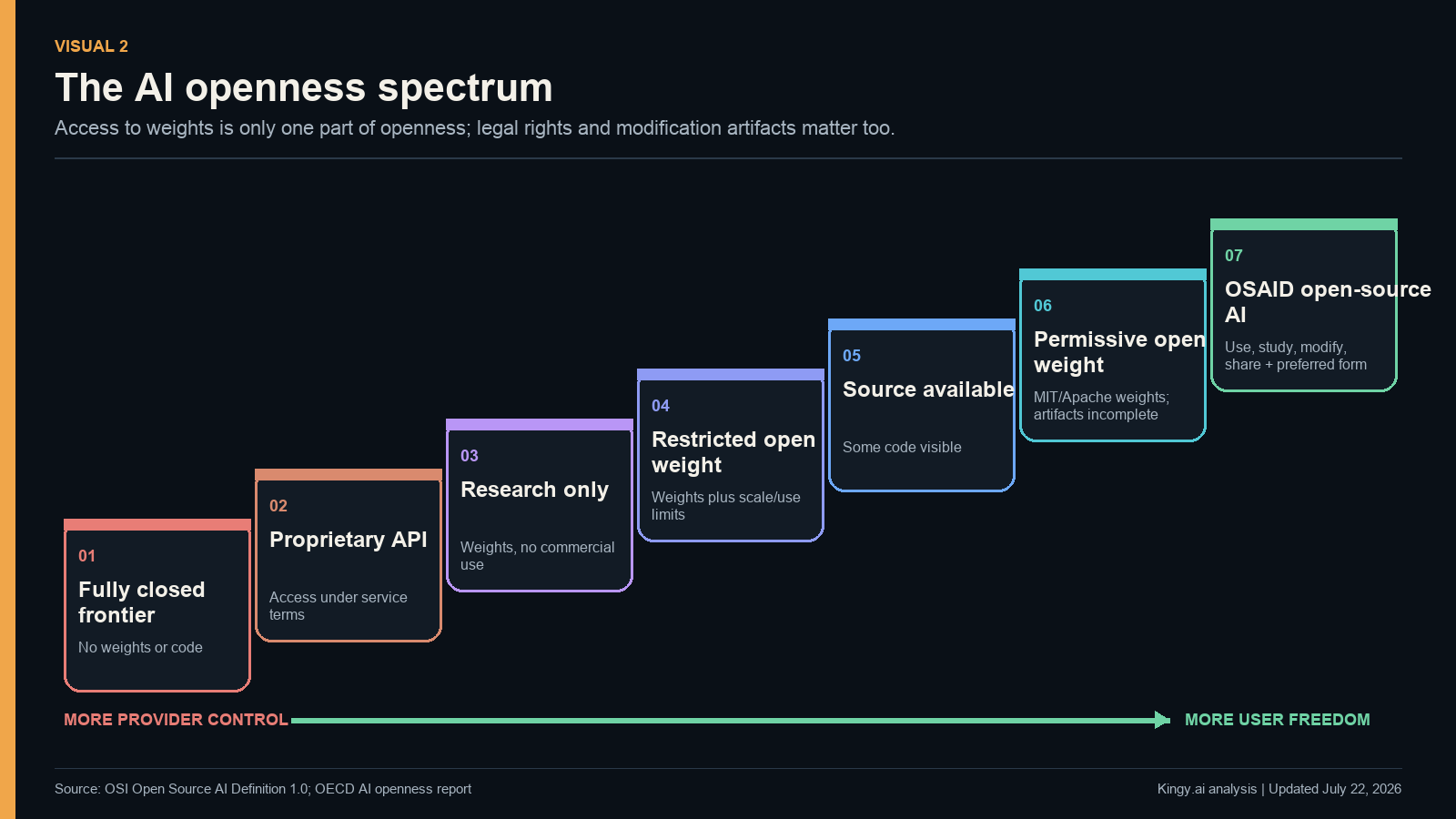
“Open model” is too vague to support a technical or purchasing decision. A model can expose its weights while hiding its training data. It can publish code while forbidding commercial use. It can carry a familiar software license on the weights while requiring a separate acceptable-use policy. It can be locally deployable but impossible for most teams to reproduce.
The familiar shorthand—open-source AI vs proprietary AI—therefore collapses several different questions. The same is true of treating all closed AI models as one category.
A useful analysis separates five axes:
- Artifact access: Are the weights, architecture, inference code, training code, evaluation code, checkpoints, and data information available?
- Legal freedom: May users run, study, modify, fine-tune, redistribute, and commercialize the system?
- Deployment control: Can it run through a vendor API, in a private cloud, on premises, in an air-gapped environment, or on a device?
- Operational governance: Who controls versions, logging, monitoring, patches, safeguards, deprecation, support, and incident response?
- Measured performance and risk: Does the specific model meet the workload’s quality, latency, robustness, safety, and provenance requirements?
The Open Source AI Definition 1.0 sets a high bar. It requires the freedom to use, study, modify, and share an AI system for any purpose. It also requires the preferred form for modification: sufficient information about training data, the relevant training and inference code under open terms, and the model parameters.
That produces the following taxonomy.
| Category | Weights available | Training code available | Training data disclosed | Commercial use | Typical restrictions |
|---|---|---|---|---|---|
| Open-source AI under an OSAID-style definition | Yes | Yes | Sufficient information for substantial equivalence | Yes | Open-license conditions; no field-of-use prohibition |
| Permissively licensed open-weight AI | Yes | Sometimes | Often partial or absent | Usually | Weight-license notices; other artifacts may use different terms |
| Source-available AI | Maybe | Some code is viewable | Usually partial or absent | License-dependent | Inspection without full modification or redistribution rights |
| Research-only model | Often | Sometimes | Variable | No | Noncommercial, affiliation, publication, or research-purpose limits |
| Restricted/community-license model | Usually | Partial or absent | Usually partial or absent | Conditional | Revenue, scale, geography, use-case, naming, attribution, or AUP limits |
| Proprietary API model | No | No | Usually limited | Under contract | Usage policies, rate limits, retention terms, regions, version lifecycle |
| Fully closed frontier system | No | No | Minimal | Only through offered products | Provider controls access, safeguards, monitoring, updates, and retirement |
The important lesson is that openness is not binary. A model can be open on one axis and closed on another.
For a current model-by-model inventory, see Kingy.ai’s State of Open-Weight AI Models.
3. Open source versus open weight
An open-weight model gives users the learned parameter files needed for inference. That is valuable. It can enable local deployment, private fine-tuning, independent evaluation, quantization, model merging, interpretability research, offline use, and protection against an API being retired.
But weights are an output of training, not the complete source of the system. Without the data recipe, processing pipeline, training code, evaluation setup, and legal permissions, another team may be unable to reproduce or meaningfully audit the model. The OECD’s analysis of AI openness likewise recommends treating openness as a spectrum across artifacts and licenses rather than equating downloadable weights with open source.
This distinction changes real decisions:
- Reproducibility: A checkpoint can be runnable without being reproducible.
- Commercial rights: An organization may possess the files but still lack permission for its scale, region, or use case.
- Provenance: A permissive weight license does not prove that the training data was transparent or lawfully obtained.
- Safety research: Weight access enables deeper experiments, but absent training artifacts can limit causal understanding.
- Exit risk: Downloadable weights protect against provider retirement, but dependencies on particular accelerators, serving software, or data pipelines can create a different lock-in.
“Open weight” is not a criticism. It is a precise description—and often the most accurate one for models marketed as open source.
4. How closed models work
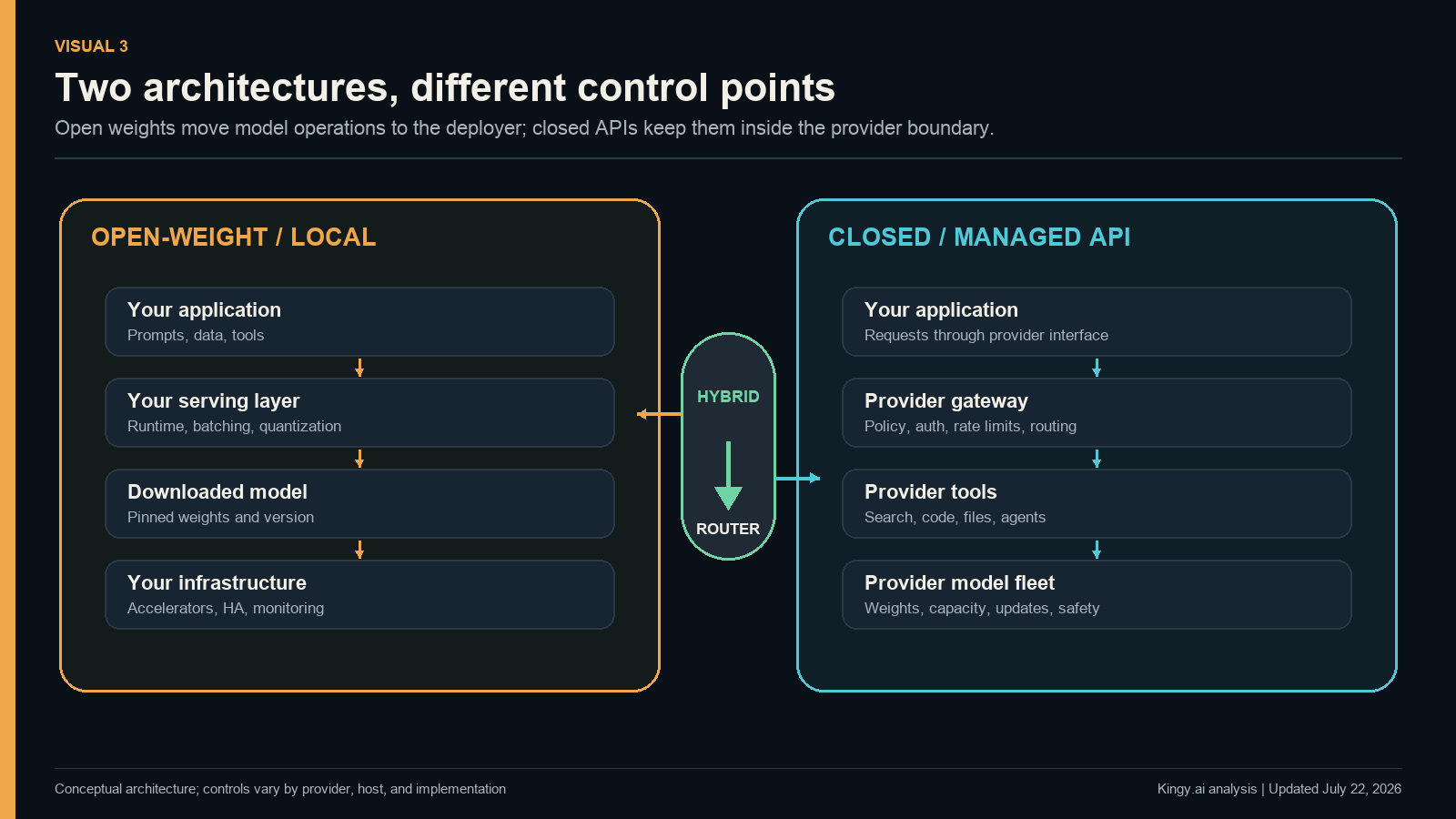
With a closed model, the provider retains the weights, training system, and serving infrastructure. Customers send requests through an API or a hosted product and receive outputs. The vendor decides which versions exist, what tools are available, how safeguards are enforced, where the service operates, and when a model is updated or retired.
That loss of direct control buys something tangible. A managed provider can combine the base model with optimized inference, prompt caching, retrieval, web search, code execution, computer use, monitoring, rate limiting, and multi-region capacity. It can patch a vulnerability across its fleet, suspend abusive accounts, and offer support or contractual service levels. Customers avoid buying accelerators and staffing an inference platform before they know whether demand will materialize.
Closed does not mean that every customer’s data becomes training data. Major commercial APIs generally state that business/API content is not used for training by default. Yet privacy depends on the exact plan, endpoint, feature, region, retention policy, and contract. For example, default abuse-monitoring logs, web-search tools, stored files, prompt caching, and third-party connectors can have different retention behavior from stateless inference.
Nor does closed mean static. Providers can silently improve routing and safety, but model updates can also change behavior. The buyer is trading artifact control for a managed outcome.
5. Capability comparison
The capability debate is often distorted by two mistakes: treating every downloadable model as small, and treating every vendor benchmark as comparable.
By 2026, open-weight systems cover a broad range—from device-sized models to trillion-parameter mixtures of experts. They can reason, code, use tools, process images, and support very long contexts. The best closed systems still tend to lead on the newest combinations of reasoning, agentic reliability, multimodality, and product integration, but the size of that lead changes by task.
The Stanford 2026 AI Index reported a 3.3-percentage-point gap between the top closed and top open model as of March 2026, with six of the ten leading models closed. That is evidence of convergence with a persistent frontier premium—not proof that either side has permanently won.
The practical comparison should be workload-specific:
| Question | Open-weight deployment | Closed/managed system |
|---|---|---|
| Peak frontier reasoning today | Often follows the newest closed frontier | Often strongest first, but model-specific |
| Narrow domain after customization | Can be excellent with fine-tuning and workflow design | Strong with retrieval, prompting, or vendor tuning where offered |
| Agentic tools | Ecosystem quality varies; operator assembles the stack | Integrated tools and harnesses can improve reliability |
| Multimodality | Increasingly common, with uneven serving maturity | Frequently packaged as a polished product/API |
| Long context | Large advertised windows exist on both sides | Managed serving simplifies capacity but introduces price tiers |
| Repeatability | Versions can be pinned indefinitely | Provider may update aliases, policies, or routing |
| Independent evaluation | Deep testing is possible with weights | Limited to observable API behavior and provider disclosures |
Benchmarks deserve discipline. Agent scaffolds, reasoning budgets, tool permissions, context, quantization, judge models, and retry policies can alter results. A vendor’s chart is useful evidence about what it measured—not an automatic ranking of real deployments.
The right question is not “Which model tops a leaderboard?” It is “Which tested system clears our acceptance threshold at the required cost and failure rate?”
For the same reason, a list of the “best open AI models” is only useful when it states the workload, license, hardware, and evaluation conditions.
6. Cost comparison
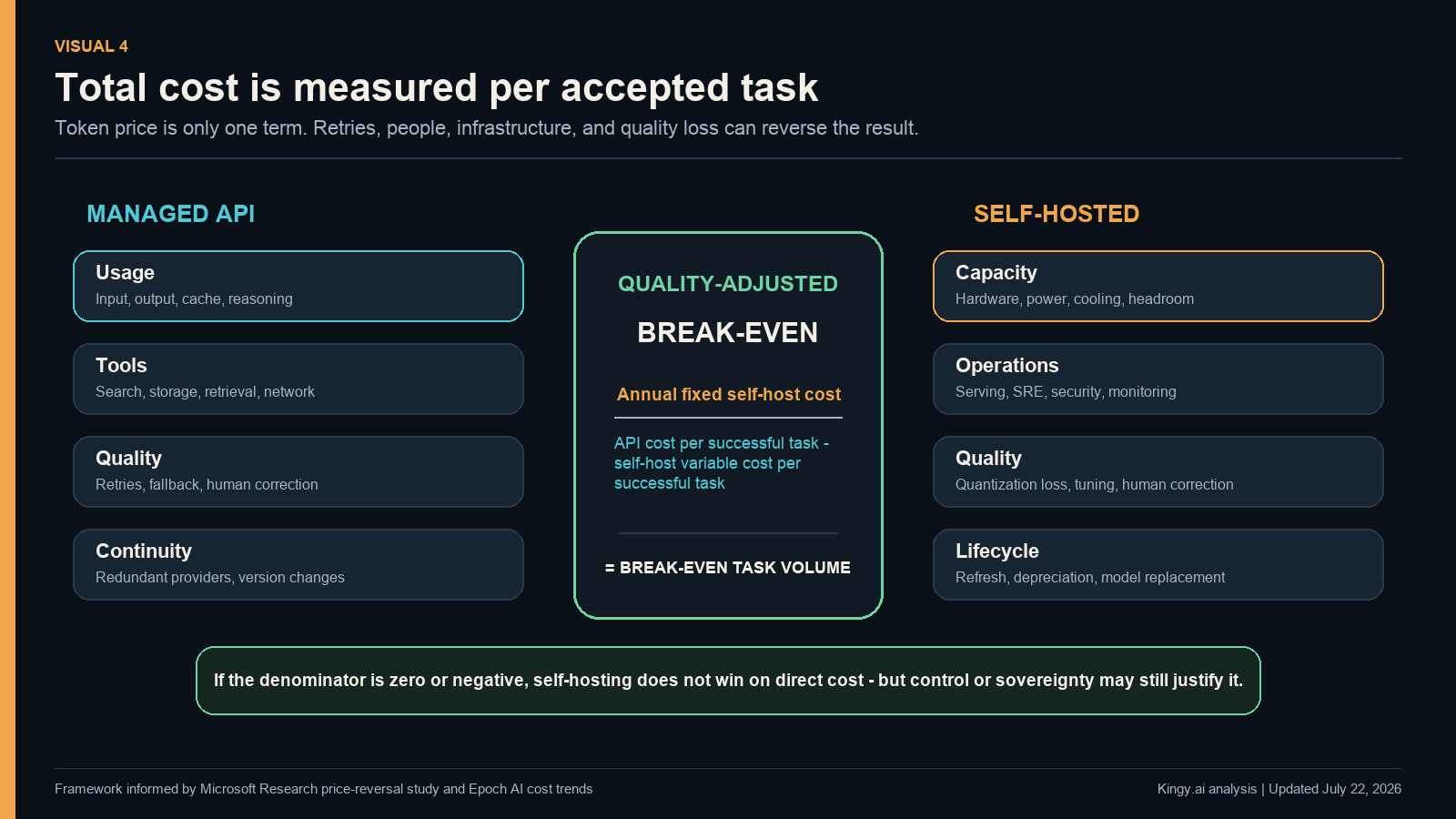
Downloadable weights do not make inference free. API list prices do not reveal total cost. The correct unit is cost per accepted, completed task at the required latency and reliability.
A closed API bill can include input, output, cached, and reasoning tokens; tool calls; retrieval; storage; network traffic; batch or priority premiums; retries; fallback models; and human correction. Self-hosting replaces some variable fees with hardware or reserved capacity, power, cooling, networking, storage, engineering, security, monitoring, redundancy, and model-refresh costs.
Official provider pages retained between October 8 and October 9, 2026 listed the following model-specific API token prices. These rows are not interchangeable across model versions or token modes:
| Model/API | Input per 1M tokens | Output per 1M tokens | Exact retained mode and condition |
|---|---|---|---|
DeepSeek V4.1 Flash (deepseek-flash) |
$0.30 peak cache miss; $0.15 off-peak | $1.20 peak; $0.60 off-peak | Peak cache-hit input was $0.006; off-peak cache-hit input was $0.003. Peak hours and Chinese-public-holiday rules are defined on DeepSeek’s page. |
| Mistral Large 3 (25.12) | $0.50 | $1.50 | Hosted Mistral API list price for mistral-large-2512; open weights are separately available. |
| xAI Grok 4.5 | $2.00; $0.30 cached | $6.00 | Short-context pricing below 200K prompt tokens. At or above 200K, the full request was $4.00 input, $0.60 cached input, and $12.00 output. |
| Google Gemini 3.1 Pro Preview | $2.00 | $12.00 including thinking | Standard paid tier for prompts at or below 200K tokens. Above 200K, input was $4.00 and output was $18.00. |
| Kimi K3 | $3.00 cache miss; $0.30 cache hit | $15.00 | Official Kimi API rates stated on the K3 product page. |
| OpenAI GPT-5.6 Sol | $4.00; $0.40 cached | $20.00 | Promotional standard rate for prompts at or below 272K input tokens. Above 272K, the full request was $8.00 input, $0.80 cached input, and $30.00 output. |
| Anthropic Claude Fable 5.1 | $10.00; $0.25 cache reads | $50.00 | Claude Platform rate for model claude-fable-5-1; US-only inference was listed at 1.1× input and output pricing. |
Sources: official DeepSeek, Mistral, xAI, Google, Kimi, OpenAI, and Anthropic pages. Prices exclude many ancillary and enterprise charges. They are a dated source comparison, not a current quote; recheck the provider page before buying.
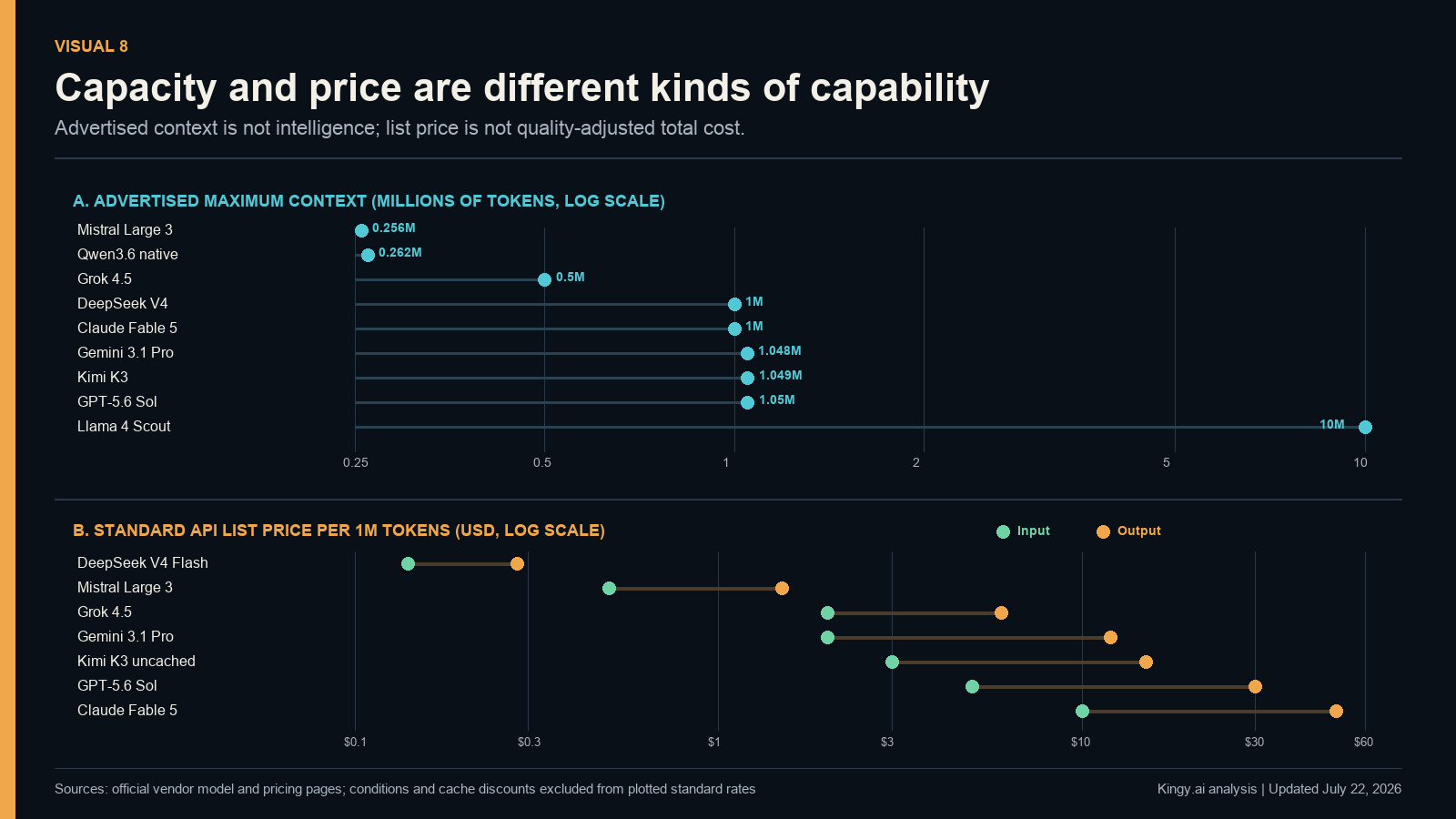
Even this table cannot rank total cost. A cheaper model may emit more reasoning tokens, require more retries, or produce more rejected answers. Microsoft Research found that headline API price reversed the actual cost ranking in 21.8% of model-pair comparisons in its study, in some cases by as much as 28 times.
A useful self-hosting break-even model is:
Annual task volume at break-even = annual fixed self-hosting cost ÷ (API cost per successful task − self-hosted variable cost per successful task)
If the denominator is zero or negative, self-hosting never wins on direct economics. It may still be justified by sovereignty, offline operation, availability, or control.
In practice:
- APIs usually win for uncertain, bursty, low-to-medium-volume demand and fast-moving frontier requirements.
- Self-hosting becomes plausible when volume is high and predictable, an eligible model clears the quality threshold, utilization stays high, and the organization already has strong platform operations.
- Managed hosting of open weights is the middle path: more portability and model choice than a proprietary API, without the full burden of an on-premises fleet.
To turn per-token rates into a workload estimate, use Kingy.ai’s AI Token Cost Calculator, then confirm every rate on the provider’s current pricing page.
7. Privacy and control
Local inference can keep prompts, retrieved documents, and outputs inside a boundary chosen by the deployer. That is a real advantage for confidential data, offline environments, and organizations that cannot send material to an external service.
It does not automatically make the system private. Operators can still log sensitive prompts, expose an inference endpoint, mishandle backups, import a compromised model, or allow an agent to call unsafe tools. The UK Information Commissioner’s Office notes that local processing may still be regulated personal-data processing with a controller responsible for security and minimization.
Managed APIs can offer strong controls: encryption, regional data residency, customer-managed keys, access policies, audit logs, contractual non-training commitments, and—where approved—modified monitoring or zero-data-retention options. But coverage is feature-dependent.
For example:
- OpenAI’s API data-controls documentation says API data is not used for training by default, while standard abuse-monitoring logs may retain content for up to 30 days; approved customers can receive different controls subject to endpoint limitations.
- Anthropic’s commercial retention guidance gives a 30-day default for first-party API inputs and outputs, with contractual, safety, and legal exceptions; its zero-retention coverage is also feature-dependent.
- Google’s Gemini API terms distinguish unpaid services from paid services, while search grounding, caching, and other features can have their own data-governance implications.
- xAI’s security guidance says API content is not used for training without permission and describes a 30-day default, while zero-retention mode disables persistence-dependent features.
Privacy therefore comes from architecture, configuration, contracts, and operations—not from the word “local” or “enterprise.”
8. Security and misuse
There is no single scale on which open or closed models are simply “more secure.” They expose different control points.
| Security dimension | Open/local potential advantage | Closed/API potential advantage |
|---|---|---|
| Input confidentiality | Data can remain inside a chosen boundary | Mature enterprise controls and contractual terms |
| Inspectability | Independent researchers can test weights and code | Provider has deeper internal telemetry and training knowledge |
| Abuse control | Deployer controls its own environment | Central rate limits, monitoring, account suspension, and revocation |
| Safeguard persistence | Deployer can harden a model for its domain | Ordinary users cannot remove weight-level safeguards |
| Supply chain | Artifacts can be hashed and versions pinned | Customer operates fewer serving dependencies |
| Incident response | System can be isolated and kept on a fixed version | Provider can patch its fleet and aggregate threat intelligence |
| Availability | No external API retirement or outage | Managed multi-region capacity and failover may be available |
Open weights can accelerate both beneficial and harmful work. The U.S. NTIA report on open model weights concluded that the available evidence did not justify broad restrictions at the time, but it also did not rule out future restrictions if marginal risks or capability thresholds changed. The OECD identifies a genuine asymmetry: safeguards can be altered, centralized monitoring becomes harder, and released weights cannot be recalled in practice.
At the same time, openness expands independent safety research. A CSET review found that several important research use cases—especially fine-tuning and interpretability—depend heavily or exclusively on weight access. And security varies more by model provenance and hardening than by label alone: CAISI’s DeepSeek evaluation found substantial differences among tested open-weight models.
The balanced formulation is this: closed systems are more controllable at distribution time; open systems are more inspectable and controllable by the deployer. Neither property guarantees safety after tools, data, users, and operational incentives enter the system.
9. Fine-tuning and customization
Open weights provide the broadest technical freedom to adapt a model. A team can use full fine-tuning, low-rank adapters, preference optimization, distillation, quantization, pruning, model merging, custom decoding, or a specialized serving stack. It can inspect intermediate behavior and keep the resulting derivative inside its own environment.
That freedom has costs. Training recipes can be incomplete. A fine-tune can damage general capability, weaken safeguards, overfit a small dataset, or create new compliance obligations. Evaluation and rollback must be part of the project, not an afterthought.
Closed providers usually expose narrower customization: system instructions, retrieval-augmented generation, tool definitions, structured outputs, prompt caching, and—on selected models—provider-managed fine-tuning. Those controls solve many business problems without creating a new model artifact to maintain. They are also faster for a small team.
The decision depends on what must change:
- If the problem is fresh knowledge, start with retrieval.
- If the problem is repeatable format or behavior, test prompting and structured outputs.
- If the model must learn a narrow pattern at scale, compare fine-tuning.
- If the system must run under strict hardware, latency, or sovereignty constraints, open-weight adaptation becomes more attractive.
- If the requirement is peak general reasoning, a closed frontier model may still be the better base.
For the mechanics and trade-offs of teacher-student compression, see Kingy.ai’s guide to AI model distillation.
For deployment-side guidance on quantization, VRAM, runtimes, and validation, see the Local AI Models setup and hardware guide.
10. Local AI
The local AI vs API decision is the clearest domain where downloadable weights change what is possible. Models can run on a workstation, server, private cluster, edge device, or air-gapped network without sending every request to the developer of the model.
This enables offline assistants, low-latency on-device features, private document workflows, industrial environments with unreliable connectivity, and long-lived systems that cannot depend on a public endpoint. It also gives the operator control over batching, caching, version pinning, and update timing.
Hardware remains the boundary. A small quantized model may run on consumer hardware; a large mixture-of-experts model may require an expensive multi-accelerator system. Repository size is not the full memory requirement: weights, key-value cache, activations, runtime overhead, concurrency, and redundancy all matter. Quantization can reduce memory and improve throughput, but its quality effect must be measured on the target workload.
Local is best when the chosen model actually clears the task threshold and the organization can operate the environment. Otherwise, “private but unreliable” is not a win.
For the broader sovereignty and infrastructure case, read Own Your AI Stack.
For a focused example of how inference hardware changes cost and serving strategy, see Kingy.ai’s OpenAI Jalapeño inference-chip guide.
11. Enterprise deployment
Enterprises rarely face a pure model choice. They face a system choice involving identity, data access, tools, logs, evaluations, support, continuity, procurement, and liability.
Closed platforms often offer the fastest path to strong capability with SSO, role-based access, audit controls, regional options, compliance documentation, support, and negotiated service terms. Open-weight deployments offer stronger version control, architectural flexibility, local processing, and exit protection, but move more operational responsibility to the buyer or its hosting partner.
Regulated deployments should require, regardless of model type:
- A model and data bill of materials.
- Version pins, checksums, and provenance records.
- Evaluations for the intended use, language, and affected population.
- Privacy, security, and sector-specific impact assessments.
- Least-privilege tool access and human approval for consequential actions.
- Audit logs, change control, incident response, rollback, and provider fallback.
- Written responsibility for the model provider, host, integrator, and deployer.
NIST AI 600-1 recommends procurement risk assessments for both open-source and proprietary generative-AI tools, approved provider lists, evaluation rights, vulnerability monitoring, and contingency planning. The lesson is not that regulated industries must choose closed AI. It is that neither model type removes the organization’s obligations.
A hybrid stack is often the realistic answer: keep highly sensitive, stable, or offline workloads in an approved local or sovereign environment; use contracted managed endpoints for tasks that benefit materially from frontier capability; and enforce the same evaluation and tool-governance layer across both.
12. Developer ecosystems
Openness accelerates experimentation because developers can inspect, modify, compress, port, and host the artifact without waiting for a vendor roadmap. Derivatives can serve languages, devices, scientific fields, or deployment constraints that are too small for a frontier lab to prioritize. Research becomes easier to replicate when the relevant artifacts are available.
Closed platforms can create equally powerful ecosystems through stable APIs, SDKs, integrated tools, hosted sandboxes, structured output, usage telemetry, and distribution. A developer may care more about a dependable computer-use tool or global low-latency endpoint than about possessing weights.
The most durable developer strategy is portability at the application layer:
- Keep prompts, schemas, evaluations, and tool contracts versioned.
- Separate the model gateway from business logic.
- Avoid relying on undocumented model quirks.
- Maintain a representative evaluation suite and fallback provider.
- Store enough telemetry to compare cost per accepted task, not just token volume.
- Treat safety permissions and tool scopes as application responsibilities.
Open ecosystems reduce one kind of dependence. Good architecture prevents the replacement model from becoming a new trap.
13. Reliability and support
Reliability is broader than uptime. It includes latency variance, rate limits, output stability, capacity during demand spikes, model retirement, support response, and the ability to recover from a bad release.
A mature closed provider can operate multi-region infrastructure, optimize kernels, pool demand, and offer contracted support. OpenAI, for example, publishes an Enterprise priority-processing option with a 99.9% uptime SLA and a latency commitment for eligible traffic; that premium service should not be generalized to standard API requests. Google Cloud publishes service-level objectives for specified covered Vertex AI services, while preview products can be excluded.
Self-hosting lets an organization pin a model, reserve capacity, and keep operating through an external provider outage. It also makes the organization responsible for replicas, failover, capacity planning, patching, monitoring, and incident response. A local cluster with no spare capacity is not more reliable than an API simply because it is owned.
Support follows the same pattern. A commercial API can provide an accountable vendor. An open model can be supported by a cloud host, integrator, community, or the internal team—but responsibility must be explicit. “There is a repository” is not a service plan.
Long-term availability favors downloadable artifacts, provided the organization preserves everything needed to run them. Operational reliability often favors managed services, provided the contract covers the relevant path.
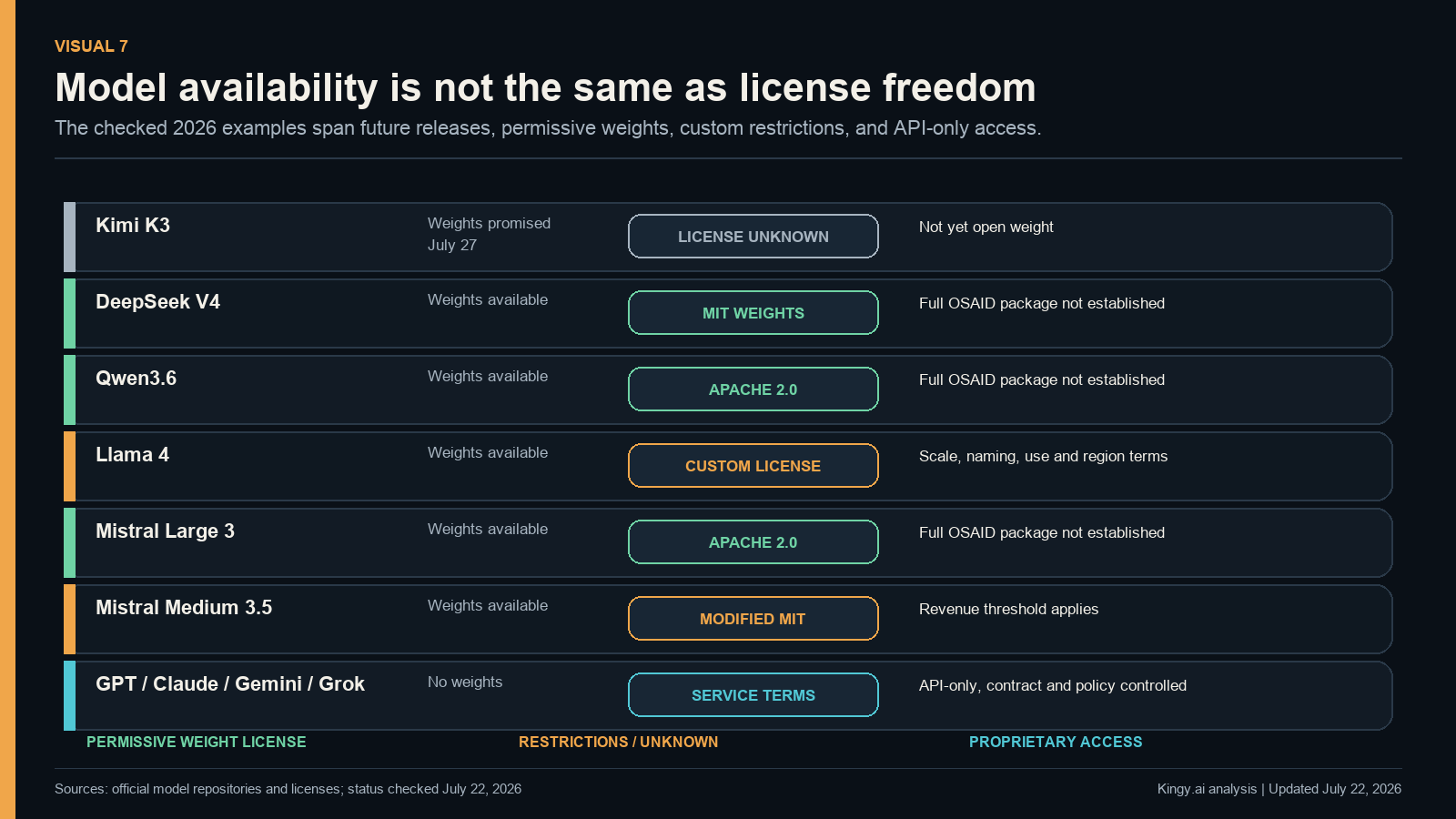
14. Licensing
Licensing is where loose use of the word “open” becomes expensive.
Review the entire artifact stack: weights, architecture and code, tokenizer, libraries, training and evaluation data, inherited base-model obligations, output terms, acceptable-use policies, patents, trademarks, attribution, geography, export controls, warranty, indemnity, termination, and update rights.
| Model or family | Weight availability | Primary license posture | Evidence-bound conclusion |
|---|---|---|---|
| Kimi K3 | Yes, checked October 10 | Custom Kimi K3 License | Downloadable open weight under model-specific terms; the retained material does not establish the full OSAID package |
| DeepSeek V4 Pro/Flash | Yes | MIT for checked weight repositories | Permissively licensed open weight; full OSAID package not established |
| Qwen3.6 | Yes | Apache 2.0 for checked weight repository | Permissively licensed open weight; full OSAID package not established |
| Llama 4 Scout/Maverick | Yes | Meta custom community license and AUP | Restricted open weight; attribution, scale, naming, use, and regional conditions apply |
| Mistral Large 3 | Yes | Apache 2.0 | Permissively licensed open weight; full OSAID package not established |
| Mistral Medium 3.5 | Yes | Modified MIT with a revenue threshold | Restricted open weight for affected companies |
| GPT-5.6, Claude Fable 5, Gemini 3.1 Pro, Grok 4.5 | No | Service and enterprise terms | Proprietary/API-only access under contract |
The Llama 4 license, for example, contains attribution, naming, acceptable-use, and large-platform provisions; the accompanying use policy adds restrictions. The checked Mistral Medium 3.5 license restricts ordinary licensed use above a specified consolidated monthly-revenue threshold unless separate rights are obtained.
Under Article 53 of the EU AI Act, the free-and-open-source exception for general-purpose AI providers is limited. It does not remove every obligation, including relevant copyright-policy and training-content-summary duties, and it does not apply to systemic-risk models. Open licensing is not a general compliance exemption.
15. Business models
Open models can compress the price of standardized inference and make model access less scarce. That does not eliminate profitable businesses. It changes where they earn margins.
Open-model companies can monetize hosted inference, enterprise deployment, support, fine-tuning, proprietary data, optimized serving, orchestration, and hardware demand. A widely adopted weight release can establish a standard that benefits the originator’s cloud or enterprise services. Managed hosts can compete on latency, reliability, privacy, and regional capacity even when they serve the same artifact.
Closed labs monetize access to scarce capability and an integrated product stack. They can charge a premium for frontier quality, fast serving, agentic tools, support, safety operations, and contractual assurances. Falling inference prices and model routers put pressure on that premium, but a small quality advantage can remain economically valuable if it materially improves task completion.
The strongest business model may be hybrid: publish or broadly license some models to grow adoption, while monetizing managed endpoints and enterprise services. Mistral and Qwen already illustrate mixed portfolios; “open company” and “closed company” are becoming less useful labels.
The durable moats are shifting toward compute supply, distribution, proprietary data and feedback, workflow integration, low-cost verification, reliability engineering, trust, and the willingness to assume responsibility. Owning a competent base model is less likely to be sufficient on its own.
16. National-security implications
Open weights can reduce dependence on a foreign vendor, support air-gapped and sovereign deployments, strengthen multilingual ecosystems, and give governments control over long-lived infrastructure. They can also diffuse advanced capabilities irreversibly, make centralized misuse monitoring impossible, and weaken policies aimed only at chips or cloud access.
Closed APIs preserve revocation, identity checks, sanctions screening, usage monitoring, and the ability to withhold or retire a model. They also concentrate strategic capability in a few companies and jurisdictions. Customers become exposed to account termination, policy changes, extraterritorial legal demands, and geopolitical interruptions.
The risk is not purely about where a server sits. Training can encode political bias or censorship into downloadable weights. CAISI’s evaluation found that certain DeepSeek behaviors aligned with Chinese government narratives persisted in downloaded models, not only in the provider’s API. Self-hosting removes the live provider connection; it does not erase the training history.
Policy is volatile. NTIA’s geopolitical analysis identifies both the resilience benefits and the risk that widely available weights can transfer capability to countries of concern. U.S. export-control claims should be dated: BIS rescinded the January 2025 AI Diffusion Rule while preserving and updating other advanced-compute restrictions and guidance. A 2026 buyer must check the relevant model, chips, cloud service, destination, end user, and end use—not rely on a general statement that “open models are unrestricted.”
17. Kimi K3, DeepSeek, Qwen, Llama, and Mistral
These families show why the open-model market cannot be reduced to a single category.
Kimi K3
Moonshot launched Kimi K3 through its apps and API on July 16, 2026. It describes a 2.8-trillion-parameter mixture-of-experts model with native vision and a one-million-token context. Moonshot said the full weights would arrive by July 27 and acknowledged that overall performance still trailed leading closed systems. At this guide’s July 22 cutoff, K3 was not yet a downloadable open-weight model. The weights were available when checked on October 10 under the custom Kimi K3 License; that later release does not rewrite the launch-day record.
That sequence matters. An announced release and an available, inspectable artifact are different evidence states.
Kingy.ai’s Kimi K3 deep dive examines the launch economics, benchmarks, and promised weight release in more detail.
DeepSeek V4
DeepSeek V4 Preview offers Pro and Flash variants with a one-million-token context. The checked V4 Pro repository provides MIT-licensed weights. That makes it a strong example of permissively licensed open weight, but the public package checked for this guide does not establish the complete data and training artifacts required for an OSAID open-source designation.
DeepSeek’s published API prices are exceptionally low. Its very large model artifacts still make serious self-hosting an infrastructure project, not a free download in the economic sense.
Qwen
Qwen demonstrates a split strategy. Qwen3.7-Max is a proprietary hosted flagship, while Qwen3.6-35B-A3B and other Qwen3.6 variants provide Apache-2.0 weights. The 35B-A3B model combines native vision, agentic tooling, and a large context window in a much more deployable scale than the biggest frontier mixtures.
The family is commercially friendly at the weight-license layer, but a full OSAID conclusion would require auditing the complete training/data package.
Llama 4
Meta’s Llama 4 Scout and Maverick remain major downloadable models. Scout is positioned as a long-context, lower-active-parameter mixture of experts; Maverick is the larger system. Meta says quantized Scout can fit on a single H100 and FP8 Maverick on an eight-H100 host, illustrating the wide hardware range hidden behind the word “local.”
Their custom community license is not an OSI-approved open-source license. Large-platform provisions, attribution, naming, acceptable-use, and regional conditions make Llama 4 a restricted open-weight family.
Mistral
Mistral’s portfolio contains both permissive and restricted weight releases. Mistral Large 3 uses Apache 2.0 for the checked repository and is a large, multi-GPU system. Mistral Medium 3.5 is newer and smaller but uses modified terms with a revenue threshold. Buyers must evaluate the exact model, not infer rights from the company name.
Together, these examples show the direction of travel: open-weight capability is broadening, licensing is fragmenting, and managed hosting remains economically important even when weights are available.
18. OpenAI, Anthropic, Google, and xAI
The market for proprietary LLMs is just as heterogeneous.
OpenAI
GPT-5.6 Sol was the OpenAI API model profiled at this guide’s July 22 evidence cutoff, with a 1.05-million-token context, text and image input, 128K maximum output, and a broad managed-tool surface spanning search, code execution, computer use, and MCP. OpenAI documents enterprise controls and an optional priority-processing service with an uptime and latency commitment. The trade-off is direct dependence on OpenAI’s prices, policies, serving path, and model lifecycle.
Anthropic
Claude Fable 5 emphasizes long-running agents, subagents, vision, tool use, and self-checking. Its one-million-token context and high published token price place it in the premium tier. Anthropic’s June-to-July 2026 Fable availability change after an export-control dispute also offers a concrete reminder: a closed model can be technically available yet politically interruptible.
Gemini 3.1 Pro Preview is Google’s highest-end publicly accessible Pro model in the checked lineup, with native support for text, image, video, audio, and PDF inputs. Gemini 3.6 Flash is the newer stable workhorse. The distinction matters: preview capability and production stability are different buying propositions, and Google’s lineup should be rechecked immediately before publication.
xAI
Grok 4.5 combines text/image input, reasoning controls, functions, code execution, and live web/X search with aggressive list pricing. Its current model page lists a 500,000-token context window and serving regions in us-east-1 and us-west-2. As with every provider, regional availability, retention mode, and enterprise reliability commitments must be verified for the customer’s actual path.
These companies reveal why a “closed-model score” is unhelpful. One may offer better frontier reasoning; another may offer stronger multimodality, real-time data, pricing, governance, or serving guarantees. Closed is an access model, not a capability grade.
For a current side-by-side of the managed frontier, see Kingy.ai’s GPT-5.6 vs Claude, Grok, Muse, and Gemini comparison.
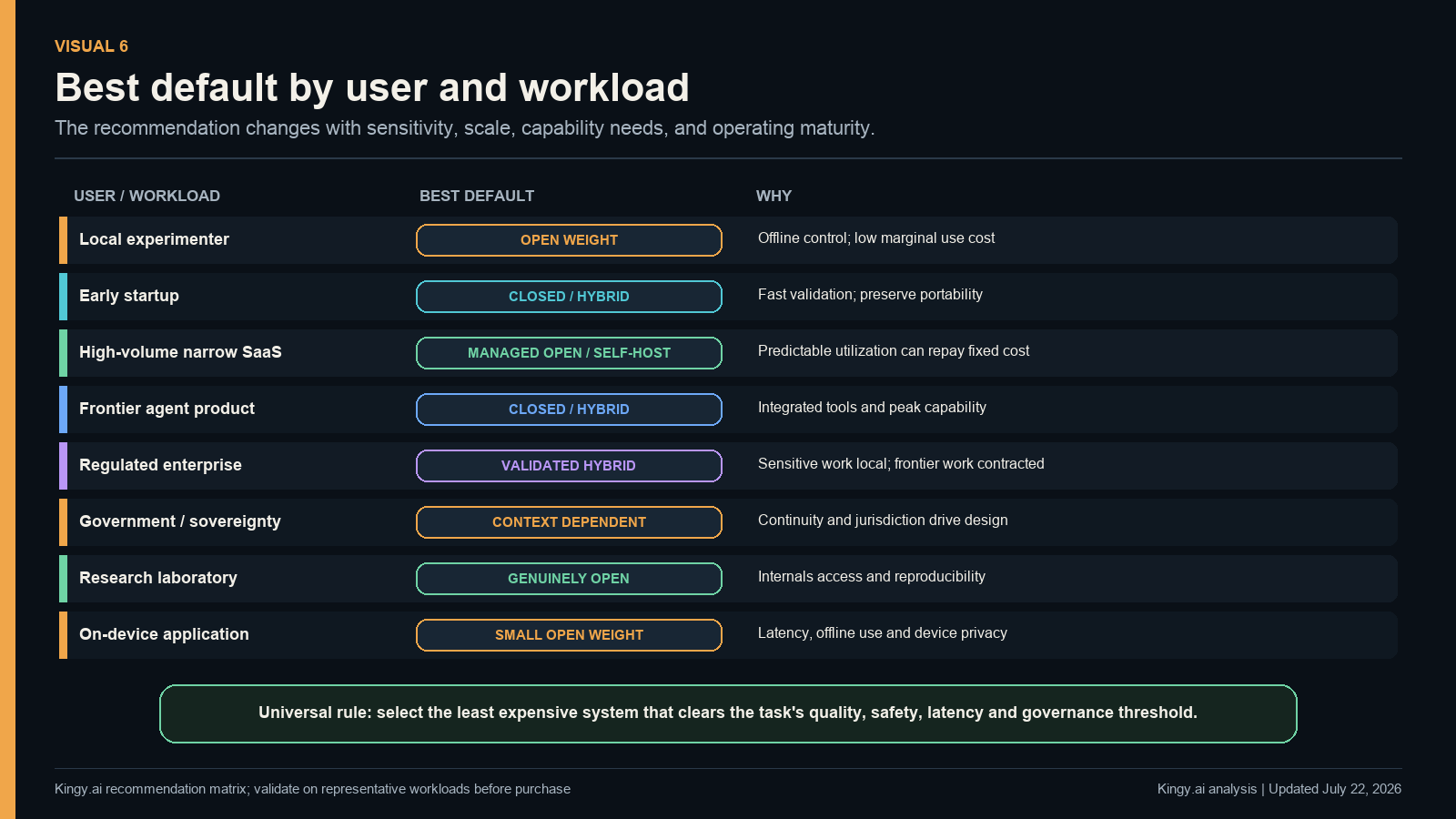
19. Which approach wins by use case?
| User or organization | Best default | Why | Important caveat |
|---|---|---|---|
| Individual experimenting locally | Small permissively licensed open-weight model | Offline control, learning, and low incremental use cost | Hardware, setup, and lower peak quality |
| Early-stage startup | Closed API behind a model abstraction layer | Fast path to strong capability and product validation | Instrument costs and preserve provider portability |
| High-volume narrow SaaS workload | Benchmark managed-open or self-hosted open | Predictable utilization and specialization may justify fixed cost | Compare successful-task cost, not token price |
| Startup needing frontier agents or multimodality | Closed frontier or hybrid router | Integrated tools and stronger frontier capability | Tool permissions and failure containment matter more than label |
| Regulated enterprise | Validated hybrid | Sensitive/stable work locally; frontier work through contracted endpoints | Two stacks increase governance and integration complexity |
| Healthcare, finance, or legal decision support | Validated hybrid with human review | Balances control, evidence, and capability | Neither approach removes sector obligations |
| Government or public administration | Sovereign open or jurisdiction-aligned managed deployment | Continuity, data control, inspectability, reduced foreign dependence | Provenance, support, compute, and misuse governance |
| Defense or intelligence | Mission-specific; often isolated open or managed model | Air gap and fixed-version control may be essential | High-capability weights require exceptional security |
| Research laboratory | Genuinely open model | Fine-tuning, internals research, and reproducibility | Compute and missing data artifacts may remain barriers |
| Consumer/on-device application | Small open-weight model | Privacy, latency, and offline availability | Device constraints and quality |
| Global enterprise seeking best available quality | Router spanning closed and managed-open options | Avoids a false single-provider choice | Requires continuous evaluation and routing governance |
| Sovereignty-sensitive organization | Jurisdictionally aligned open weight or sovereign cloud | Reduces API and legal-jurisdiction dependence | Hardware and software supply chains may remain foreign |
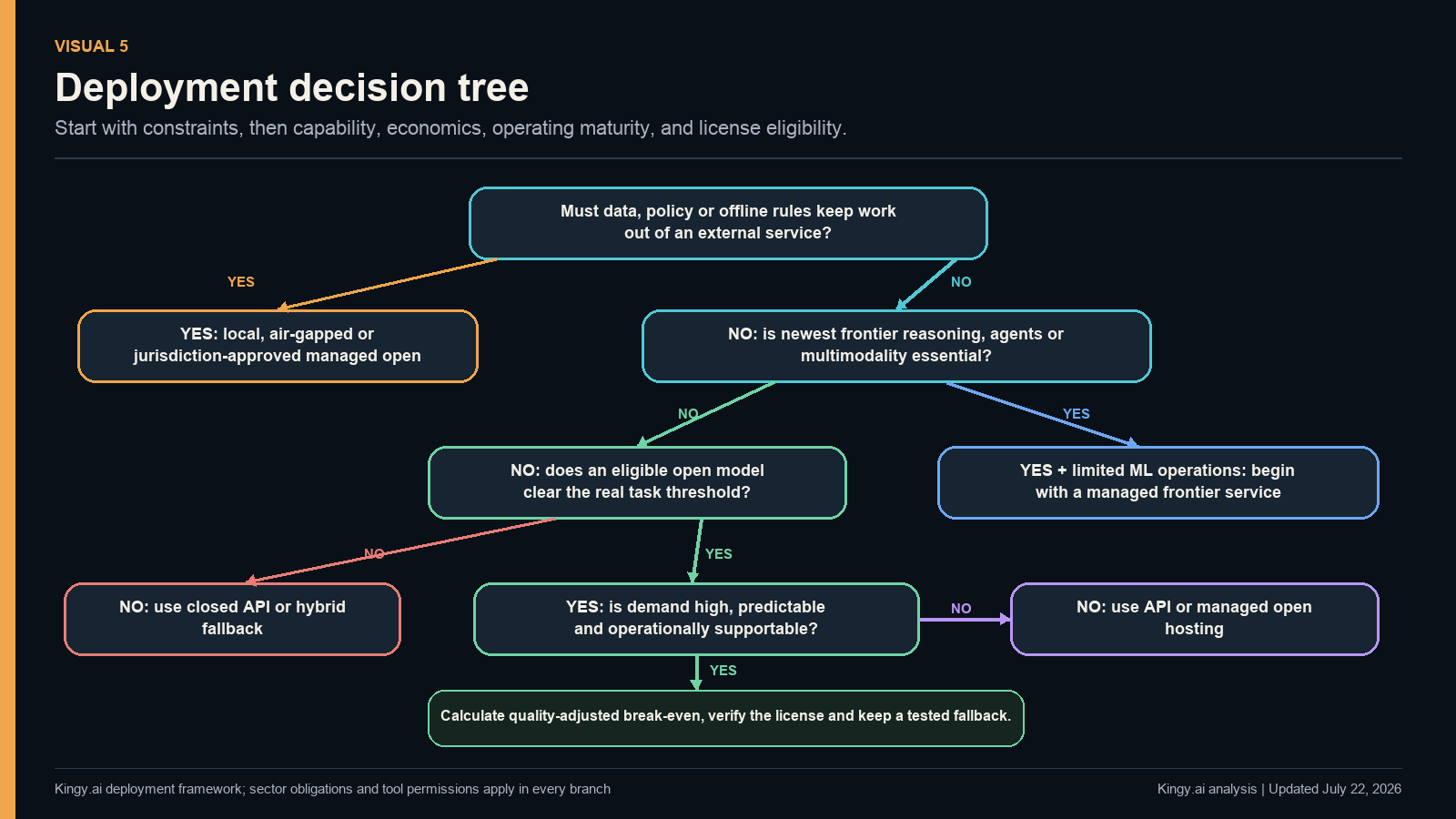
Deployment decision tree
- Must policy, classification, residency, or offline requirements keep the workload out of an external model service? If yes, choose on-premises, air-gapped, or jurisdiction-approved managed open deployment.
- Does the workload require the newest frontier reasoning, agentic, or multimodal capability? If yes and the organization lacks deep ML operations, begin with a closed or managed service.
- Does an eligible open-weight model meet the real task’s accuracy, safety, language, and latency threshold? If no, use a closed model or hybrid fallback.
- Is demand high and predictable enough to amortize capacity, redundancy, and staffing? If no, prefer an API or managed open endpoint.
- Can the organization operate evaluation, monitoring, patching, incident response, and high availability? If no, do not treat self-hosting as the default.
- Does the complete license and provenance review permit the intended commercial, geographic, derivative, and regulated use? If no, reject the model.
Whichever branch wins, sandbox tools, use least privilege, require human approval for consequential actions, keep immutable audit records, continuously evaluate, and maintain a rollback and provider-exit path.
20. Will open models catch frontier labs?
They will probably catch many capability tiers, but “catch” is a moving target.
If progress slows, open-weight models can approach a plateau and make competent general intelligence abundant. If frontier progress continues, closed labs may repeatedly lead by a few months while open releases commoditize the previous tier. If progress accelerates and safety or geopolitical concerns rise, the very top may become more controlled even as older capabilities spread.
Open ecosystems have structural advantages in experimentation, adaptation, multilingual coverage, and parallel optimization. Closed labs have structural advantages in concentrated compute, proprietary training pipelines, coordinated product development, live usage data, and the ability to fund expensive frontier runs.
The likely pattern is a frontier staircase: closed systems often occupy the newest step, while open weights move onto the step below and expand its uses. Occasionally an open or open-weight model will lead on a particular task, price point, language, or deployment constraint. The aggregate gap can narrow without disappearing everywhere.
This is enough to commoditize large portions of intelligence even if the absolute frontier remains scarce.
21. What the market may look like by 2030
The OECD’s AI trajectories through 2030 treats stalled, slower, continuing, and accelerating progress as plausible rather than assigning one forecast. Mapping those possibilities onto open and closed AI produces four useful scenarios.
Scenario 1: Open commoditization
Progress slows or plateaus. Open weights catch the frontier, base-model margins compress, and value shifts to distribution, integration, proprietary data, verification, and support.
Scenario 2: The frontier staircase
Capability keeps advancing at a steady pace. Closed labs repeatedly lead; open models follow with a rolling lag and dominate mature capability tiers. Hybrid routing becomes standard enterprise architecture.
Scenario 3: Controlled frontier, abundant lower tier
Progress accelerates. Safety, compute, and release concerns widen the gap at the top. Closed access dominates highly autonomous frontier systems, while open models continue to commoditize prior generations and local applications.
Scenario 4: Sovereign model blocs
Geopolitical fragmentation produces U.S., Chinese, European, and other regional stacks shaped by procurement, export controls, cloud sovereignty, data law, and industrial policy. Open weights become strategic infrastructure, but provenance and embedded political behavior receive more scrutiny. “Best model” becomes secondary to “legally and operationally deployable model.”
These scenarios can coexist across industries and regions. A consumer device market may commoditize while defense systems become more controlled. The market will not move in one direction at one speed.
22. Kingy.ai assessment
The open-versus-closed argument is often framed as ideology. In practice, it is an allocation problem.
Open weights are already strong enough to prevent the base-model layer from becoming a permanent monopoly. They offer genuine leverage: local deployment, customization, audit access, version control, sovereignty, and competitive pressure on prices. But the word “open” frequently overstates the available artifacts and legal freedoms, and self-hosting transfers substantial operational risk to the deployer.
Closed platforms retain a defensible premium when they deliver better task completion, safer tool execution, stronger multimodality, faster inference, integrated products, global capacity, and contracts that enterprises can enforce. But that premium is vulnerable to falling inference costs, open-model improvements, and routing layers that can replace a provider workload by workload.
Our assessment is therefore conditional:
- Open models will win deployment freedom and commoditized capability.
- Closed systems will retain the newest frontier and managed-service premium.
- Neither side wins security, privacy, or cost by default. Those outcomes depend on implementation.
- Hybrid portfolios will win most serious enterprise environments.
The strategic mistake is to lock an organization to one model philosophy. The better strategy is to own the evaluation, governance, tool-permission, and routing layer. Models will change. The decision system should survive them.
23. FAQ
Are open-weight models really open source?
Not necessarily. Open weights make model parameters downloadable, but an open-source AI definition also considers training and inference code, data information, legal freedom to modify and share, and the preferred form for modification. Many popular releases are best described as permissively licensed or restricted open weight.
What is the biggest advantage of downloadable weights?
Control. Organizations can run the model locally, pin a version, fine-tune or quantize it, evaluate it independently, and keep operating if a hosted endpoint changes or disappears. That control comes with hardware and operational responsibility.
Are closed AI models more capable?
The strongest closed systems often lead at the newest frontier, especially in integrated reasoning, agents, and multimodality. The gap varies by task, and open-weight models can lead on price, local latency, customization, or a specialized domain.
Which is cheaper: local AI or an API?
It depends on utilization and quality-adjusted task cost. APIs usually win for bursty or uncertain demand. Self-hosting can win for high, predictable volume when an eligible model meets the quality threshold and the operator can keep accelerators well utilized.
Does self-hosting guarantee privacy?
No. It can keep data inside a chosen boundary, but logging, access control, backups, agents, supply-chain security, and applicable privacy law still matter.
Are proprietary APIs safer?
They offer centralized monitoring, rate limits, account suspension, and rapid fleet-wide patches. They also create concentration, vendor, retention, and service-dependency risks. Safety depends on the model and deployment, not just the access method.
Which approach is better for startups?
Most early startups should begin with a strong managed API behind a portable model gateway. This minimizes infrastructure work while the product is uncertain. High-volume or sovereignty-sensitive startups should benchmark managed-open and self-hosted alternatives early.
Which approach is better for regulated industries?
A validated hybrid is often the best default: sensitive or stable workloads inside an approved boundary, frontier tasks through contracted endpoints, and consistent evaluation, audit, human-review, and tool-governance controls across both.
Can open models be used commercially?
Only if the exact license and all inherited terms allow the intended use. MIT and Apache-style weight licenses are often permissive, while community, research-only, revenue-threshold, geographic, and acceptable-use restrictions can materially limit commercial deployment.
Will open models commoditize intelligence?
They are likely to commoditize mature capability tiers and standardized inference. That does not commoditize the whole product. Compute, distribution, proprietary data, workflow integration, verification, reliability, and accountability can remain scarce.
Is Kimi K3 open source?
Kimi K3 was not open weight at this guide’s July 22, 2026 cutoff. By the October 10 source check, its weights were available under the custom Kimi K3 License. That supports calling it open weight under model-specific terms, but the retained material does not establish the complete training-data and code package required for the stronger open-source-AI label.
What will win by 2030?
The most plausible broad outcome is layered: open weights dominate many local, sovereign, specialized, and mature capability tiers; closed systems retain a frontier and managed-service premium; hybrid routing becomes normal enterprise infrastructure.
24. Sources
Primary and institutional sources were prioritized. Vendor benchmark claims remain vendor claims unless independently reproduced.
- Open Source Initiative — Open Source AI Definition 1.0
- OECD — AI openness: models, data and ecosystems
- Stanford HAI — 2026 AI Index, technical performance
- Moonshot AI — Kimi K3 launch
- DeepSeek — V4 Preview announcement
- DeepSeek — V4 Pro model card
- DeepSeek — API pricing
- Qwen — Qwen3.6-35B-A3B model card
- Meta — Llama 4 announcement
- Meta — Llama 4 license
- Meta — Llama 4 acceptable-use policy
- Mistral AI — Mistral Large 3 model repository
- Mistral AI — Mistral Medium 3.5 license
- OpenAI — GPT-5.6 launch
- OpenAI — GPT-5.6 Sol model documentation
- OpenAI — API data controls
- Anthropic — Claude Fable 5
- Anthropic — Commercial data retention
- Google — Gemini 3.1 Pro Preview
- Google — Gemini 3.6 Flash
- Google — Gemini API pricing
- xAI — Grok 4.5 documentation
- xAI — API pricing
- Microsoft Research — The price-reversal phenomenon
- NIST — Artificial Intelligence Risk Management Framework: Generative AI Profile
- CAISI — Evaluation of DeepSeek AI models
- NTIA — Report on open model weights
- CSET — The Use of Open Models in Research
- European Union — Artificial Intelligence Act
- OECD — Exploring possible AI trajectories through 2030
Editorial note: This guide is an analysis, not legal, security, or procurement advice. License and policy terms must be reviewed for the exact model, artifact, provider, region, and use case.
The Kingy Brief
Get The Kingy Brief.
AI changes, original tests and one practical thing to try. Fridays at 09:00 Vancouver time.
Free · Double opt-in · Unsubscribe anytime
Sign up for The Kingy Brief on Beehiiv.
Signup help and newsletter schedule
Signup form provided by Beehiiv. After submitting, check your inbox for "Confirm your subscription to The Kingy Brief" and open its confirmation link. Check Spam or Promotions if you cannot find it.
Fridays at 09:00 Vancouver time: source-checked AI changes, original tests and one practical thing to try. We skip a week when there is not enough verified material. Free. Unsubscribe anytime.