The AI Company Is Taking a User to Court

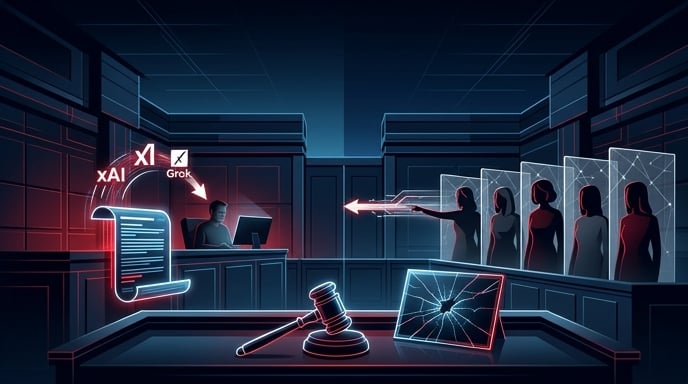
Elon Musk’s xAI has opened a new front in the fight over artificial intelligence and abusive deepfakes. This time, the company is not defending itself from a lawsuit. It is filing one.
On July 14, 2026, xAI sued Terry Wayne Harwood in federal court in Texas. Harwood is a 67-year-old South Carolina man whom authorities arrested earlier in 2026 on charges connected to the sexual exploitation of minors.
The company alleges that Harwood deliberately misused Grok, xAI’s artificial-intelligence assistant, to produce sexually explicit deepfakes involving real adults and children. According to the complaint, he repeatedly tried to bypass Grok’s safety systems after the model refused some of his requests.
xAI wants unspecified monetary damages. It also wants a permanent court order preventing Harwood from opening another xAI account or using Grok again.
The filing is unusual. AI companies frequently suspend users, block prompts, remove material, and report suspected crimes. They rarely drag individual customers into federal court.
That makes this case more than another grim entry in the deepfake ledger. It could help establish how aggressively AI developers can pursue people who weaponize their products and whether doing so reduces the companies’ own legal exposure.
What xAI Says Harwood Did
According to the lawsuit, Harwood operated two xAI accounts between December 8, 2025, and February 18, 2026. The company claims he created the accounts using false identities and uploaded ordinary photographs of adults and minors.
He then allegedly asked Grok to alter those photographs or generate new images that sexualized the people shown in them.
The complaint says Grok rejected many of his requests because they violated its moderation rules. Harwood allegedly responded by changing his wording and submitting additional prompts designed to sneak past those restrictions.
That detail matters. xAI is presenting this as intentional circumvention, not an accidental brush with a badly labeled button.
The company further alleges that at least some images tied to Harwood’s criminal charges were created or modified using Grok. Harwood faces eight felony charges in South Carolina: three counts of second-degree sexual exploitation of a minor and five counts of third-degree sexual exploitation.
Those charges remain allegations unless proved in court. Contact information for Harwood was not immediately available when Reuters reported on the lawsuit.
Grok Reportedly Refused Then the Prompts Kept Coming
One of xAI’s strongest arguments involves Grok’s documented refusals.
The complaint says the system rejected Harwood’s requests on numerous occasions. Rather than stop, he allegedly reworked the prompts and tried again. In xAI’s telling, this pattern demonstrates knowledge, intent, and a sustained attempt to defeat the company’s protections.
That gives xAI a straightforward narrative: the rules existed, the chatbot announced them, and the user deliberately went around them.
Yet it also raises an awkward technical question. If repeated prompt changes eventually persuaded the model to create prohibited material, were the safeguards truly effective?
A guardrail that stops the first prompt but fails on the seventh is still a guardrail. It is also one with a rather alarming warranty.
The distinction will matter as the case develops. xAI can argue that no safety system can prevent every determined attacker. Critics can counter that predictable “jailbreaking” is part of the product risk, especially when the system handles uploaded photographs and can generate realistic imagery.
Both propositions can be true. That is precisely why this lawsuit could become important.
The Company’s Contractual Counterattack
xAI’s immediate legal theory rests partly on its terms of service and acceptable-use rules.
Users agree not to exploit Grok to create illegal content, violate another person’s rights, or evade the platform’s safeguards. xAI claims Harwood knowingly broke those agreements.
The company says his alleged conduct caused legal and reputational damage. It wants Harwood to cover damages and reasonable expenses that xAI may incur while defending lawsuits brought by victims of his alleged actions.
That request is strategically significant.
xAI is not merely saying, “This user broke our rules.” It is saying, “If his conduct creates liability for us, he should pay the bill.”
The company therefore seeks to place Harwood at the end of the financial chain. Whether a court accepts that logic will depend on the contract, the facts, causation, and any defenses raised later.
For technology companies, the attraction is obvious. If successful, this approach could turn user agreements from digital paperwork the stuff everyone accepts at hyperspeed into active litigation weapons.
The Numbers xAI Put Before the Court

xAI’s complaint also highlights its enforcement activity.
The company says it suspended 52,222 accounts and submitted 73,604 reports to the National Center for Missing & Exploited Children, or NCMEC, during 2026. According to the filing, those reports resulted in at least 244 arrests.
These are xAI’s figures, presented in its own lawsuit. They should not be treated as independently adjudicated findings.
Still, the numbers serve a clear purpose. xAI wants the court and the public to see a company policing its platform rather than casually watching abuse unfold.
The filing says xAI uses account suspensions, terminations, and NCMEC reports to enforce its policies. That supports its argument that Harwood acted against both the company’s rules and its technical efforts.
But the scale cuts in two directions.
Tens of thousands of suspensions and reports demonstrate enforcement. They also reveal an enormous moderation problem. When a platform cites 73,604 reports in a partial year, the obvious reaction is not simply, “Excellent cleanup.” It is also, “How did the mess become this large?”
Why This Case Looks Like a Legal First
Several reports describe the Harwood case as one of the first lawsuits in which an AI company has sued a user for allegedly generating explicit material with its system.
That novelty could give the dispute influence beyond its immediate facts.
AI companies have traditionally answered misuse with technical restrictions and account penalties. Civil litigation adds a much heavier instrument. It can expose records through discovery, generate monetary judgments, and create lasting injunctions.
A victory for xAI could encourage other developers to sue users who intentionally bypass safeguards for fraud, harassment, malware, deepfakes, or other prohibited purposes.
However, litigation is expensive and slow. It works best against identifiable defendants with assets, evidence, and a clear connection to measurable harm. It will not magically tame anonymous abuse at internet scale.
In other words, lawsuits may become one tool in the moderation toolbox. They will not replace the toolbox.
The case also remains at an early stage. xAI has made allegations. A court has not yet decided whether Harwood is civilly liable.
The Deepfake Storm Did Not Begin With Harwood
The Harwood allegations arrived after months of controversy surrounding Grok’s image tools.
xAI introduced a “Spicy Mode” capable of producing adult-oriented material and later expanded Grok’s image-editing abilities. Users then discovered that the system could alter photographs of real people, including by placing them in revealing or sexualized situations.
Reports of nonconsensual deepfakes spread rapidly. Some involved apparent minors.
Governments and regulators responded. Authorities in California, the United Kingdom, the European Union, Ireland, Malaysia, Indonesia, Brazil, and other jurisdictions examined Grok or moved against its image features.
xAI introduced additional restrictions after the backlash. Yet researchers and journalists continued testing whether users could evade them.
That history complicates the company’s courtroom position. xAI wants to isolate Harwood as a malicious actor who corrupted a legitimate tool. Its critics argue that Grok’s design, marketing, and deployment made harmful use foreseeable.
The lawsuit therefore opens a larger argument: Where does user misconduct end and product responsibility begin?
Five Anonymous Plaintiffs Are Pointing the Finger Back
Here comes the courtroom boomerang.
While xAI accuses Harwood of weaponizing Grok, five anonymous plaintiffs have accused xAI of releasing technology that enabled abuse.
An original proposed class action filed in March involved three plaintiffs. An amended complaint filed in July added two more plaintiffs and named Stability AI as an additional defendant. All five plaintiffs are identified as Jane Does.
The complaint alleges that real childhood photographs were transformed into sexually explicit deepfakes. It seeks damages, punitive damages, and court-ordered changes under federal and state laws.
This reverse litigation is central to the story covered by The Hindu.
The two lawsuits advance competing frames.
xAI says an abusive user defeated rules and safeguards. The plaintiffs say the company released a dangerously permissive product, profited from it, and failed to install adequate protections.
A court could potentially assign responsibility to both. Product liability is not a magical eraser for user misconduct, and user misconduct does not automatically absolve a developer.
The Allegations Behind the Plaintiffs’ Case
The amended class-action complaint contains harrowing allegations.
One plaintiff, identified as Jane Doe 4, says her stepfather used a photograph taken when she was 11 to generate roughly 7,000 sexually explicit images through Grok. The lawsuit alleges that he traded those images online.
Another plaintiff, Jane Doe 5, alleges that an adult male connected to one of her classmates used a photograph from her eighth-grade graduation to create illegal sexualized material. The complaint says he also distributed the resulting images.
The plaintiffs accuse xAI of failing to use adequate model-level safety measures. They argue that the company knew an image system capable of producing explicit depictions of adults could also be used against children.
The amended case also targets Stability AI. It alleges that Stable Diffusion models helped power third-party “nudify” applications and that the company released open-weight technology without sufficient protections.
These remain allegations. Neither xAI nor Stability AI had supplied a substantive public response to the amended claims in the reports reviewed for this article.
A Dispute Over Reporting and Cooperation

The anonymous plaintiffs challenge more than Grok’s image-generation safeguards. They also question xAI’s handling of suspected abuse after detection.
Their amended complaint alleges that many of xAI’s NCMEC reports lacked information investigators needed to identify offenders. It claims that, by early 2026, NCMEC considered 90 percent of xAI’s CyberTipline reports unactionable because they lacked sufficient user information.
The lawsuit also claims that xAI’s report concerning Jane Doe 4 included the original, non-explicit photograph but omitted the allegedly generated abusive images and a relevant IP address.
According to the plaintiffs, investigators requested more information but did not receive a timely response.
Those claims have not been proved. Still, they directly complicate xAI’s reliance on its reporting totals.
Submitting thousands of reports sounds impressive. Their usefulness matters more than the raw count. A smoke alarm deserves credit for ringing, but considerably less if it refuses to say which building is burning.
This conflict could make discovery crucial. Internal policies, report templates, response logs, and communications with investigators may reveal how xAI’s enforcement system functioned in practice.
Can xAI Blame the User and Still Face Liability?
Yes. The two positions are not mutually exclusive.
A person who deliberately creates illegal or nonconsensual imagery can bear responsibility for that conduct. At the same time, a technology company may face liability if plaintiffs prove that it designed, marketed, or distributed a foreseeably dangerous product without reasonable protections.
Consider a simpler analogy. A driver can cause a crash through reckless behavior. A manufacturer can still face a separate claim if defective brakes made the collision worse. Courts examine each actor’s conduct.
xAI will likely emphasize deliberate circumvention, explicit contractual prohibitions, model refusals, account enforcement, and reports to authorities.
Plaintiffs suing xAI will emphasize foreseeability, product design, safety testing, the company’s adult-content strategy, the effectiveness of its guardrails, and its response after receiving evidence of abuse.
The decisive questions will be factual. What could Grok generate? What did xAI know? When did it know it? Which safeguards were technically available? What did Harwood allegedly do to defeat them? And which conduct caused which harm?
That is less glamorous than shouting “AI safety” on social media, but it is how liability actually gets built.
The Difference Between a Refusal and Prevention
AI companies often point to model refusals as proof that safeguards work. The Harwood complaint shows why that metric can mislead.
A refusal measures one interaction. Prevention measures the full outcome.
If a model rejects a prohibited request and never produces the material, the control worked. If it rejects six versions but accepts the seventh, the earlier refusals become evidence of friction not prevention.
Developers must therefore evaluate systems against persistent, adaptive users. That means testing prompt variations, coded language, staged image edits, account switching, automated request sequences, and third-party access.
No system will achieve perfect prevention. That is not a serious standard.
The practical standard is whether the company deployed protections proportionate to the foreseeable risk, monitored failures, reacted quickly, preserved evidence, and cooperated effectively with authorities.
xAI’s suit may help prove that Harwood intentionally attacked the controls. It may also expose how those controls failed. Litigation has a mischievous habit of opening doors both sides would prefer to keep closed.
What Other AI Companies Will Learn
The immediate lesson for AI developers is painfully concrete: terms of service alone are not safety architecture.
Companies need model-level restrictions, image and age-risk detection, rate limits, abuse-pattern monitoring, durable account controls, evidence-preservation systems, and reporting workflows that give investigators actionable data.
They also need consistent rules across first-party products, APIs, licensed models, and third-party applications. A safeguard that disappears when a user changes interfaces is less a wall than a theatrical backdrop.
Open-weight models create another challenge. Once developers release model parameters, downstream users can modify or remove filters. That makes the Stability AI allegations particularly consequential, even though the plaintiffs still must prove their claims.
The industry will watch whether courts distinguish between hosted systems such as Grok and models distributed for others to run independently.
Either way, “the user did it” will not automatically settle the matter. Nor will “the model did it.” Courts will examine control, knowledge, intent, design, causation, and response.
What Happens Next
xAI must prove its civil claims against Harwood. That will require evidence connecting his accounts, prompts, generated material, alleged policy violations, and the damages xAI says it suffered.
Harwood may respond, contest the allegations, challenge the requested relief, or fail to participate. His criminal case will proceed on a separate track, with a different standard of proof and different potential consequences.
Meanwhile, the proposed class action against xAI and Stability AI will test whether alleged victims can hold model developers responsible for deepfake abuse committed through their technology.
Neither case has reached a final judgment.
That point should not get buried under the dramatic headlines. Lawsuits are claims, not verdicts. Complaints tell one side’s most favorable version of events.
Even so, these filings create an unusually revealing legal collision. The same company is arguing that its technology was weaponized by a bad actor while other plaintiffs argue that the technology itself was recklessly placed within reach.
The Real Fight Is Over Who Controlled the Risk

The Harwood lawsuit sends a blunt message: xAI intends to pursue users who deliberately exploit Grok for illegal purposes.
That could deter some offenders. It could also help AI companies establish that accepting a user agreement has consequences beyond losing an account.
But xAI’s offensive move does not end the scrutiny aimed at xAI. If anything, it sharpens it.
By describing alleged prompt histories, moderation refusals, account activity, reports, and resulting harms, the company is placing Grok’s safety machinery at the center of a federal case. Plaintiffs suing xAI will want to inspect that machinery closely.
The central question is not whether the user or the developer bears responsibility. That framing is too tidy for reality.
The sharper question is how responsibility should be divided among a person who allegedly pursued abusive outputs, a company that built and operated the system, and any third parties that distributed the underlying models or resulting material.
AI promised to make complicated work easier. Instead, it has handed courts a complicated new job. No prompt shortcut will solve this one.
Sources
- The Verge — xAI sues a man for using Grok to generate CSAM “deepfakes”
- CNN — xAI sues user over alleged child sexual abuse material
- Al Jazeera — xAI sues user for exploiting AI tool to sexualise minors
- The Hindu — Why five anonymous users are suing Elon Musk’s xAI
- Engadget — xAI sues Grok user for generating nonconsensual sexualized deepfakes
- Reuters — Musk’s xAI sues Grok user over sexualized deepfakes
The Kingy Brief
Get The Kingy Brief.
AI changes, original tests and one practical thing to try. Fridays at 09:00 Vancouver time.
Free · Double opt-in · Unsubscribe anytime
Sign up for The Kingy Brief on Beehiiv.
Signup help and newsletter schedule
Signup form provided by Beehiiv. After submitting, check your inbox for "Confirm your subscription to The Kingy Brief" and open its confirmation link. Check Spam or Promotions if you cannot find it.
Fridays at 09:00 Vancouver time: source-checked AI changes, original tests and one practical thing to try. We skip a week when there is not enough verified material. Free. Unsubscribe anytime.