The State of Open-Weight AI Models is not a purity contest. It is a control question.
If a company can run a capable model on its own infrastructure, tune it to its own workflow, inspect the license, route sensitive jobs away from external APIs, and keep inference costs predictable, the buying conversation changes. The model may still be weaker than the best closed frontier model on some tasks. It may still need expensive GPUs. It may still need safety work. But the organization is no longer only renting intelligence from a remote black box.
That is why open-weight models matter in 2026. The market now includes OpenAI’s gpt-oss open models, Meta’s Llama 4 open-weight models, Alibaba’s Qwen3 family, DeepSeek’s R1 and V-series ecosystem, Google’s Gemma open models, Mistral’s open model lineup, Microsoft’s Phi small language models, NVIDIA’s Nemotron family, Ai2’s OLMo work, and Cohere’s Command A+ release. This is no longer a side channel for hobbyists. It is infrastructure.
Kingy.ai built this report for founders, developers, AI buyers, investors, creator-led AI companies, and GTM teams who need to understand where open weights actually help. For the broader series, start with the Kingy AI Reports hub, State of AI Coding Tools 2026, State of AI Video Tools 2026, and State of AI Agents 2026. For launch monitoring, use the AI Launch Tracker, AI Launch Intelligence, and Submit an AI Launch.
Executive Summary
- Open-weight AI models are now a mainstream procurement and product strategy, not just a research preference.
- The useful distinction is not “open versus closed.” It is API-only, weights-available, permissive-license, code-plus-recipes, data-transparent, and full-model-flow.
- License clarity is a product feature. Apache 2.0, MIT, custom community licenses, usage policies, and model-card limits create different commercial realities.
- The strongest open-weight story is control: data residency, customization, private deployment, fine-tuning, routing, cost modeling, and resilience.
- The strongest closed-model story still matters: frontier capability, managed safety, uptime, tool ecosystems, and lower operational burden.
- Open weights can be cheaper at scale, but they are not automatically cheap. GPU, inference engineering, monitoring, evals, red-teaming, and support can erase the savings.
- This report uses public sources only. It does not include private Kingy.ai client data, unverified benchmark claims, unverifiable traction, sponsor spend, customer claims, funding claims, or private usage data.
Table of Contents
- What open-weight means now
- The openness ladder
- Model family comparison
- Kingy Open-Weight Utility Score
- Deployment map
- Why licenses decide product strategy
- Local models versus enterprise open weights
- Benchmark traps and evaluation rules
- Buyer checklist
- FAQ, sources, and update note
What Open-Weight Means Now
“Open-source AI” is often used too loosely. In practical buyer language, an open-weight model is a model where the trained weights are available for download or self-hosting. That is not the same thing as a fully open-source model. It is not even always the same thing as a commercially permissive model.
OpenAI’s public page says its gpt-oss models are open-weight reasoning models available in 120B and 20B sizes and supported by Apache 2.0. Google’s Open Source post says Gemma 4 moved under Apache 2.0. Qwen’s Qwen3 announcement lists multiple dense and MoE open-weighted models under Apache 2.0. Mistral says Magistral Small is open-weight and available under Apache 2.0. DeepSeek’s R1 release says code and models were released under MIT for that release. Those are meaningful details because licenses decide what a company can do after the demo works.
Meta’s Llama 4 is also open-weight, but under Meta’s Llama community license rather than Apache or MIT. That does not make it useless. It means the buyer must read the license instead of assuming “open” means unrestricted. NVIDIA describes Nemotron as open models with weights, training data, and recipes. Ai2 positions OLMo around a complete model flow. Those two examples matter because some of the most interesting 2026 work is not just releasing weights. It is releasing enough process for serious teams to inspect, adapt, and reproduce.
The boring part matters. If a founder says “we use open-source models,” ask which model, which license, which weights, which quantization, which hosting path, which evals, and which fallback. The answer tells you whether the company has a strategy or a slogan.
The Open-Weight Openness Ladder
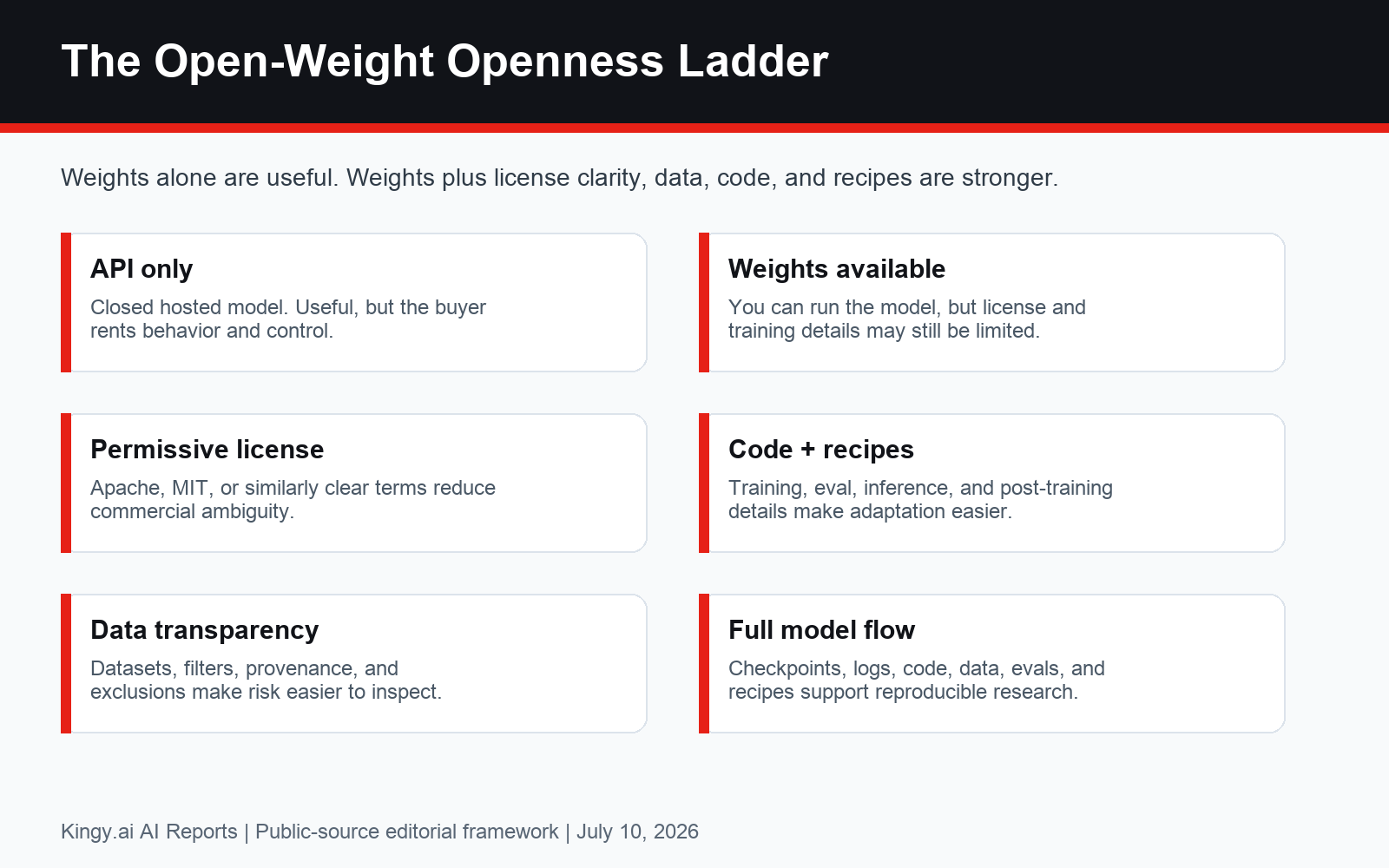
Open models sit on a ladder:
| Level | What it means | Buyer value | Main risk |
|---|---|---|---|
| API only | Closed hosted model. | Fast access, strong managed platform. | Low control over weights, hosting, and model internals. |
| Weights available | Download or self-host the model. | Deployment control and privacy options. | License or training details may still be narrow. |
| Permissive license | Apache, MIT, or similarly clear terms. | Cleaner commercial use and redistribution planning. | Safety, data, and eval work still sit with the user. |
| Code and recipes | Training, inference, eval, or post-training details. | Easier customization and implementation. | More engineering burden. |
| Data transparency | Dataset details, filters, exclusions, or provenance. | Better governance and research inspection. | Data rights and quality still need diligence. |
| Full model flow | Weights, code, data, checkpoints, logs, evals, and recipes. | Reproducibility and deep research control. | Harder to productize without specialists. |
Most companies do not need the top rung for every workload. A marketing team building an internal content classifier may only need a permissive small model and a good eval. A national lab, regulated enterprise, or model startup may care deeply about training data, recipes, and post-training path. The key is matching openness to the job.
Model Family Comparison
| Model family | Lane | License / openness note | Best fit | Caution | Source |
|---|---|---|---|---|---|
| OpenAI gpt-oss | reasoning and agentic developer workloads | Apache 2.0, per OpenAI public pages | Teams that want open-weight reasoning models with a permissive license, tool-use orientation, and deployment control. | Not served through the normal OpenAI API according to OpenAI help; buyers still need hosting, evals, and safety work. | Source |
| Meta Llama 4 | multimodal open-weight ecosystem | Meta Llama 4 Community License | Builders who value the Llama ecosystem, multimodal inputs, long context options, and broad tooling support. | The license is not the same as Apache or MIT; buyers should read usage terms and scale restrictions before standardizing. | Source |
| Qwen3 | broad open-weight model family | Apache 2.0 for listed Qwen3 models | Developers who need a wide size ladder from small local models to MoE models with strong general and coding utility. | Model choice matters more than the brand; context, hardware, quantization, and release channel should be checked per model. | Source |
| DeepSeek R1 / V-series | reasoning, coding, and low-cost API/self-host lanes | MIT for R1 materials per release; check each current model card | Teams evaluating open reasoning models, distillation paths, and cost-sensitive inference options. | Do not treat all DeepSeek models as identical; API model names, deprecations, and weight availability change by release. | Source |
| Google Gemma | local, edge, education, and commercial app building | Apache 2.0 for Gemma 4, per Google Open Source | Teams that need a clean permissive license, smaller deployment targets, and models from phone-to-cloud ranges. | Gemma is attractive for deployment control, but buyers should benchmark actual task quality against larger alternatives. | Source |
| Mistral open models | European open model and enterprise deployment stack | Apache 2.0 for Magistral Small per Mistral announcement | Organizations that want open-weight options, European vendor alignment, reasoning models, and commercial deployment routes. | Some Mistral models are open and some are hosted/proprietary; check the model page before making license claims. | Source |
| Microsoft Phi | small language models and constrained deployment | Open-source access via Azure, Hugging Face, and Ollama per Microsoft product page | Teams that need compact models for local, education, device, edge, or low-latency workflows. | Small models are not universal substitutes for frontier models; task-specific evaluation matters. | Source |
| NVIDIA Nemotron | open models for specialized agents and accelerated infrastructure | Open weights, training data, and recipes per NVIDIA pages; verify exact model license | GPU-rich teams building specialized agents, sovereign AI stacks, and post-trained enterprise models. | The headline model class is infrastructure-heavy; smaller teams may access it through hosted providers instead of self-hosting. | Source |
| Ai2 OLMo | fully open research and reproducible model flow | Fully open model flow per Ai2 positioning; check specific model card | Researchers and builders who care about data, code, training details, intermediate artifacts, and reproducibility. | A fully open research model can be more transparent than a commercial winner, but product fit still needs testing. | Source |
| Cohere Command A+ | enterprise multilingual, agentic, and sovereign deployment | Open-weight release per Cohere; model docs list Command A+ availability | Enterprises looking for open-weight control over multilingual, RAG, reasoning, and agentic workloads. | Verify current license, hardware requirements, and managed deployment terms before procurement. | Source |
This table is intentionally conservative. It does not say “best model” because there is no universal best model. A small Phi or Gemma model can be the best answer on a laptop, in a classroom, in an edge device, or in a low-latency classifier. A larger Qwen, Llama, Mistral, DeepSeek, gpt-oss, Nemotron, OLMo, or Command A+ model may be better for reasoning, agents, RAG, coding, multilingual work, or private enterprise workflows. A closed model may still beat all of them on a specific frontier task.
The useful buyer question is: where does control improve the outcome enough to justify operating the model yourself?
Kingy Open-Weight Utility Score
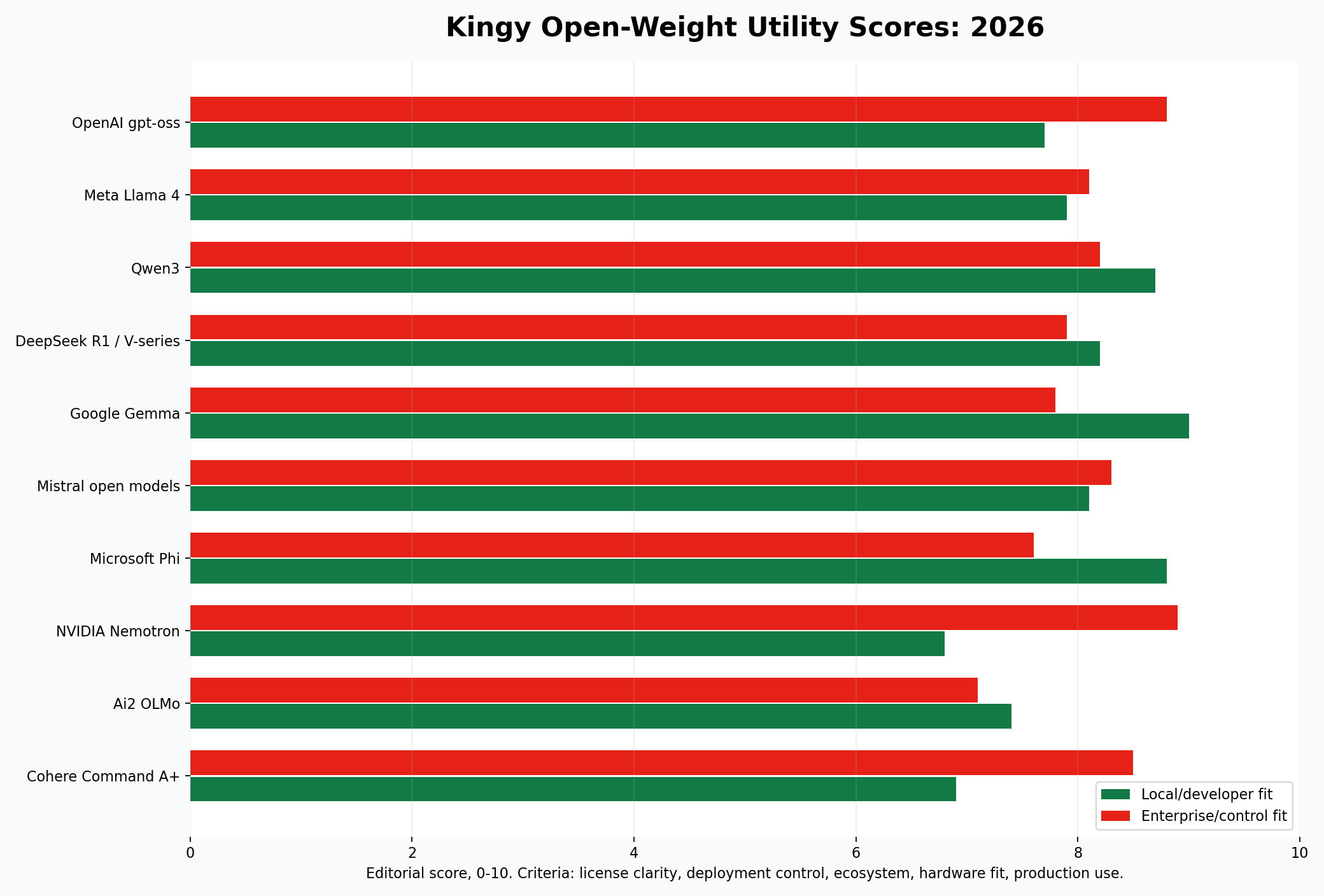
This score is an editorial framework, not an external benchmark. Kingy scored each family from 0 to 10 on two practical dimensions:
| Dimension | Weight in analysis | What it rewards |
|---|---|---|
| Local/developer fit | 50% | License clarity, model size options, consumer or single-GPU utility, tooling support, and developer ergonomics. |
| Enterprise/control fit | 50% | Private deployment, governance, model adaptation, agent/RAG use, vendor credibility, and production path. |
| Model family | Local/developer fit | Enterprise/control fit | Openness level | Interpretation |
|---|---|---|---|---|
| OpenAI gpt-oss | 7.7 | 8.8 | 4/5 | Strong fit with workload testing |
| Meta Llama 4 | 7.9 | 8.1 | 3/5 | Strong fit with workload testing |
| Qwen3 | 8.7 | 8.2 | 4/5 | Strong fit with workload testing |
| DeepSeek R1 / V-series | 8.2 | 7.9 | 4/5 | Strong fit with workload testing |
| Google Gemma | 9.0 | 7.8 | 4/5 | Strong fit with workload testing |
| Mistral open models | 8.1 | 8.3 | 4/5 | Strong fit with workload testing |
| Microsoft Phi | 8.8 | 7.6 | 4/5 | Strong fit with workload testing |
| NVIDIA Nemotron | 6.8 | 8.9 | 5/5 | Useful in narrower lanes |
| Ai2 OLMo | 7.4 | 7.1 | 5/5 | Specialist or infrastructure-sensitive |
| Cohere Command A+ | 6.9 | 8.5 | 4/5 | Useful in narrower lanes |
Scores are deliberately framed as fit, not truth. They are based on public product pages, model cards, docs, release notes, and ecosystem availability. They are not private benchmark results. They are not a claim that Kingy.ai trained, fine-tuned, red-teamed, or production-tested every model. They are a buyer framework for deciding what to evaluate first.
Deployment Map
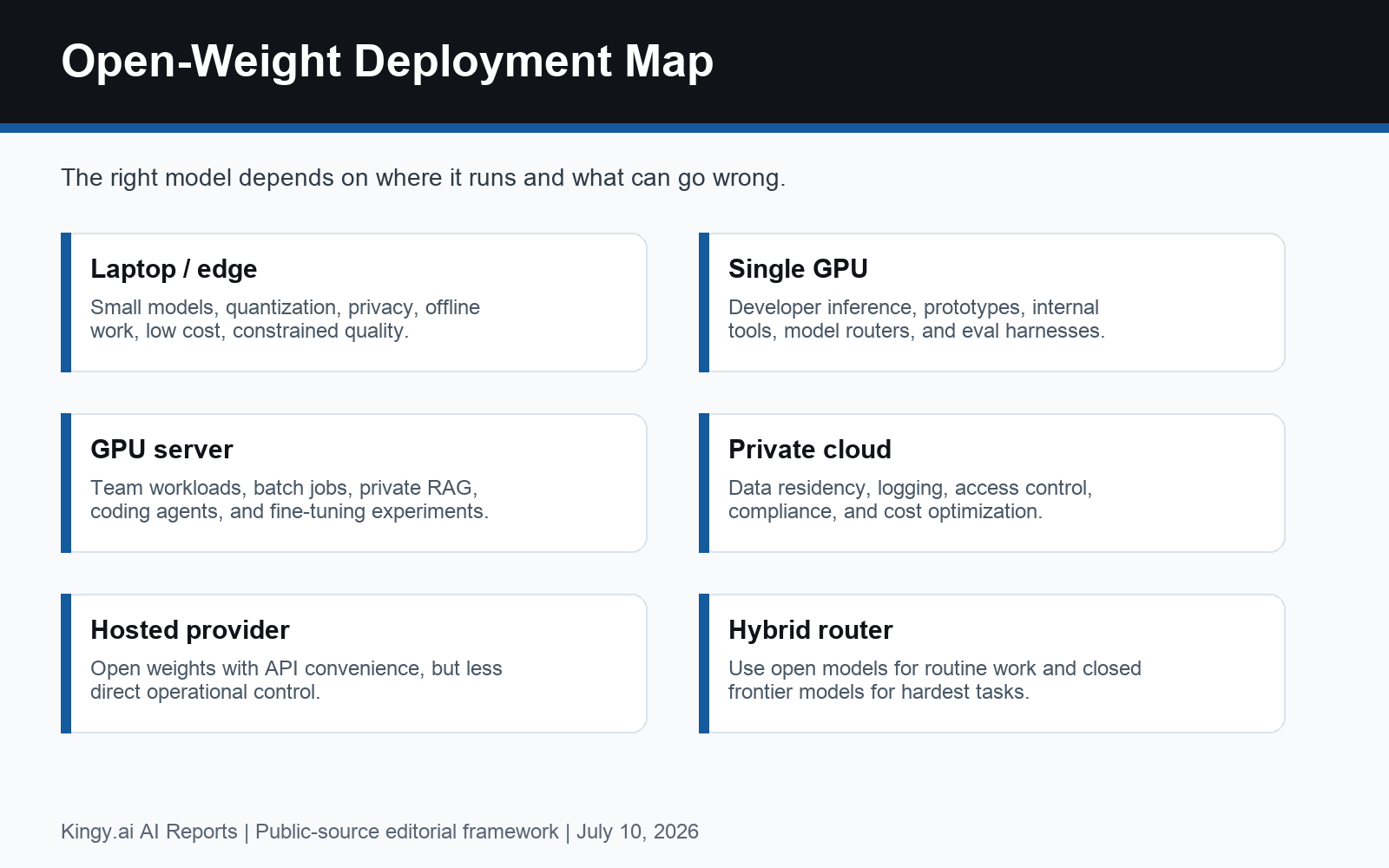
Open-weight models create deployment options that closed APIs do not. Those options create power and complexity.
| Deployment path | Best for | What to verify |
|---|---|---|
| Laptop or edge device | Private drafting, offline work, education, demos, device AI, local tooling. | RAM/VRAM, quantization quality, latency, license, update path. |
| Single GPU workstation | Developer agents, coding assistants, private RAG experiments, batch workflows. | Throughput, context length, tool support, memory, eval harness. |
| GPU server | Team inference, internal assistants, regulated workflows, fine-tuning. | Queueing, observability, cost per task, uptime, security boundary. |
| Private cloud | Data residency, governance, enterprise access control. | IAM, audit logs, network controls, autoscaling, incident response. |
| Hosted open-weight provider | API convenience with model choice. | Data terms, model version, latency, pricing, exit plan. |
| Hybrid model router | Cost control and quality routing. | Fallback logic, eval thresholds, user-visible failure handling. |
The hybrid route may become the default for serious AI products. Use an open model for routine classification, extraction, drafting, local privacy, or high-volume workflows. Route only the hardest tasks to a closed frontier model. The product value is not ideological. It is quality per dollar, control per risk, and latency per job.
Why Licenses Decide Product Strategy
Open weights without license clarity are risky for companies. A founder can ship a prototype on almost anything. A business that wants to sell into enterprises needs to know whether it can use the model commercially, fine-tune it, redistribute derivatives, host it for customers, bundle it into an app, expose it through an API, or operate it in a regulated workflow.
That is why Apache 2.0 and MIT references matter in this report. OpenAI, Google, Qwen, Mistral, and DeepSeek have all made specific public license statements for specific model releases or families. Microsoft says Phi is available open source through Azure AI Foundry Models, Hugging Face, and Ollama, and model cards should be checked for the exact license. Meta’s Llama license is influential but different. NVIDIA and Ai2 emphasize deeper openness around recipes, data, or model flow. Cohere’s Command A+ story is about enterprise control and sovereign deployment.
The catch is that license status can vary inside the same company’s catalog. Mistral has open models and hosted commercial models. DeepSeek has multiple API model names and deprecation notices. Meta has released open-weight Llama models while also building closed products. OpenAI has open-weight gpt-oss models and closed frontier API models. A serious buyer tracks the model card, not just the brand.
Local Models Versus Enterprise Open Weights
There are two open-weight markets that often get blended together.
The first is the local model market. It is about laptops, desktops, single GPUs, offline workflows, local coding assistants, private notes, classrooms, small agents, and experimentation. This is where Gemma, Phi, Qwen, smaller DeepSeek distills, smaller Llama variants, Ollama, LM Studio, llama.cpp, and quantized model files become practical. The buyer wants speed, privacy, low cost, and enough quality for a specific job.
The second is the enterprise open-weight market. It is about private cloud, GPU fleets, model gateways, RAG systems, coding agents, workflow agents, regulated data, sovereignty, cost predictability, and post-training. This is where gpt-oss, Llama, Qwen, DeepSeek, Mistral, Nemotron, Command A+, and OLMo can matter. The buyer wants control, governance, and a model road map that does not depend entirely on one external API.
These markets overlap, but they are not the same. A model that is excellent on a MacBook may not be the best enterprise reasoning model. A model that is impressive on a GPU cluster may be irrelevant for a founder who needs something that runs locally during sales calls. The right answer depends on the workload.
Benchmark Traps and Evaluation Rules
Benchmarks are useful. They are also easy to misuse. Hugging Face’s leaderboard ecosystem and Artificial Analysis are helpful because they give public comparison surfaces, but no leaderboard replaces your own task evaluation.
Use public benchmarks to shortlist. Use private evals to decide.
For open-weight models, Kingy recommends six evaluation rules:
- Test the exact model and quantization you will deploy. A full-precision model-card result may not survive a heavily quantized local setup.
- Measure cost per successful task, not cost per token. Cheap tokens are irrelevant if the model needs repeated retries.
- Test refusal, safety, and data leakage behavior. Open deployment shifts more risk management to your team.
- Check long-context quality, not just long-context length. A huge context window is not useful if retrieval, attention, or answer quality falls apart.
- Test tool use and structured output if the product needs agents. A chat benchmark does not prove reliable tool calling.
- Maintain a fallback route. If the open model fails a high-value task, route to a better model or a human.
This is not just a model race. It is an operations race. The winning team is often the one with better evals, routing, observability, caching, prompts, fine-tuning, and product design.
Buyer Checklist
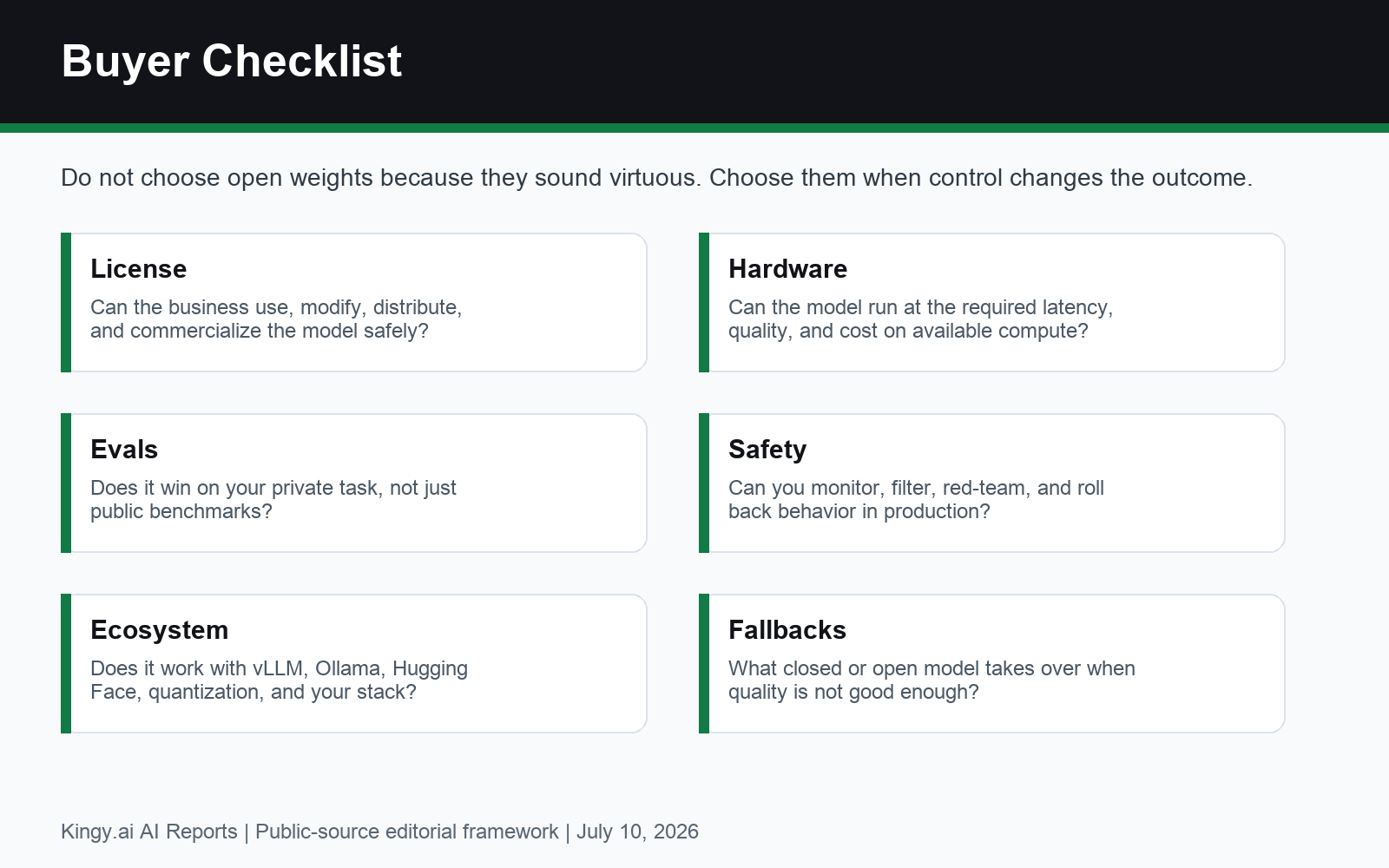
Before standardizing on an open-weight model, ask:
| Question | Why it matters |
|---|---|
| What exact model ID and version are we using? | Brand-level claims hide model-level differences. |
| What license applies to this model? | Commercial use, distribution, and hosted access depend on it. |
| What hardware does it require at our target latency? | A free model with expensive inference may not be cheap. |
| What private evals did it pass? | Public benchmarks do not map cleanly to every business job. |
| What data can it see? | Local deployment helps privacy only if data handling is designed correctly. |
| How will we monitor outputs? | Self-hosting does not remove safety, policy, or quality obligations. |
| What is the fallback? | Open models should be part of a resilient model strategy. |
| Who owns updates? | Model drift, new releases, deprecations, and security fixes need ownership. |
For founders, the strategy is simple: do not sell open weights as a vibe. Sell the concrete advantage. Is it lower marginal inference cost? On-prem deployment? Data residency? Fine-tuning? Offline mode? Faster iteration? Better developer trust? A stronger story for regulated buyers? Make the control point obvious.
For AI companies with a credible open-weight story, start with For AI companies, submit product launches through Submit an AI Launch, review the Editorial Sponsorship Standards, and use Sponsor Kingy AI or the Media Kit when the launch has a real technical angle. For broader AI coverage, browse AI Tools, AI Category Maps, and AI News. To think about creator-led distribution economics, use the AI Sponsored Video ROI Calculator.
What To Watch Next
Three shifts will decide the next phase.
First, open-weight models will become more specialized. Instead of one model trying to win everything, expect stronger coding models, reasoning models, small device models, safety classifiers, multilingual enterprise models, vision-language models, and post-trained vertical models.
Second, model routing will become a product feature. Companies will not choose one model forever. They will route by task, data sensitivity, latency, cost, and risk. Open models will handle more routine work. Closed frontier models will handle the hardest tasks. Humans will remain in the loop for high-impact failures.
Third, transparency will become more valuable. The market is learning that weights are only one layer. Data, training recipe, evals, safety behavior, license, provenance, and incident response all matter. The best open-weight companies will make these boring details easier to inspect.
FAQ
What is an open-weight AI model?
An open-weight AI model is a model whose trained weights are available for download or self-hosting. It may or may not be fully open source. Always check the model license, usage policy, model card, and release notes.
Are open-weight models always cheaper?
No. Open weights can reduce dependency on a hosted API and may be cheaper at scale, but infrastructure, GPUs, inference engineering, monitoring, evals, safety, support, and maintenance all cost money.
Are open-weight models safe for enterprise use?
They can be, but only with the right controls. Enterprises need access control, logging, evals, red-teaming, data boundaries, monitoring, incident response, and clear ownership. Self-hosting moves more responsibility to the buyer.
What is the best open-weight model in 2026?
There is no universal best model. Gemma, Phi, and smaller Qwen-family models can be strong local choices. gpt-oss, Llama, Qwen, DeepSeek, Mistral, Nemotron, OLMo, and Command A+ are important larger or enterprise lanes. The best model is the one that passes your private eval at the right cost, latency, license, and risk level.
Should startups build on open weights or closed APIs?
Many should use both. Open weights can create control, privacy, margin, and customization. Closed APIs can provide frontier quality, managed infrastructure, and faster shipping. A good model router beats ideological purity.
Source List
- OpenAI open models
- OpenAI gpt-oss model card
- OpenAI gpt-oss help center
- Meta Llama 4 announcement
- Meta Llama models repository
- Qwen3 announcement
- Qwen repository
- DeepSeek R1 release
- DeepSeek R1 repository
- DeepSeek API model list
- Google Gemma
- Gemma 4 Apache 2.0
- Mistral model overview
- Mistral Magistral
- Microsoft Phi
- Phi-4 model card
- NVIDIA Nemotron
- NVIDIA Nemotron model card
- Ai2 OLMo
- OLMo repository
- Cohere Command A+
- Cohere models docs
- Hugging Face Open LLM Leaderboard
- Artificial Analysis open models
- vLLM docs
- Ollama library
Downloadable Report Assets
- Download the visual PDF packet: state-open-weight-ai-models-visual-report.pdf
The Kingy Brief
Get The Kingy Brief.
AI changes, original tests and one practical thing to try. Fridays at 09:00 Vancouver time.
Free · Double opt-in · Unsubscribe anytime
Sign up for The Kingy Brief on Beehiiv.
Signup help and newsletter schedule
Signup form provided by Beehiiv. After submitting, check your inbox for "Confirm your subscription to The Kingy Brief" and open its confirmation link. Check Spam or Promotions if you cannot find it.
Fridays at 09:00 Vancouver time: source-checked AI changes, original tests and one practical thing to try. The weekly restart begins October 9, 2026. We skip a week when there is not enough verified material. Free. Unsubscribe anytime.