
Updated July 27, 2026
The verdict
Claude Opus 5 is the best default choice for most teams. It sits at the top of Artificial Analysis’s current standardized Intelligence Index, costs half as much per token as Claude Fable 5, and is close enough to Fable on the hardest work that the premium model now looks specialist rather than automatic.
That is not the same as saying Opus 5 wins everything.
- Choose Claude Fable 5 when the cost of a missed edge case exceeds the model bill, especially for long, difficult agentic tasks—and only after accepting its retention and model-fallback conditions.
- Choose GPT-5.6 Sol in Ultra mode for ambitious coding, research, and tool-heavy jobs that benefit from parallel agents. Ultra can beat the base Sol configuration, but it is a system-level advantage, not proof that a different model is smarter.
- Choose Kimi K3 when open weights, control, and low hosted token prices matter more than latency or turnkey operation. Its licensing and infrastructure requirements make “open” less simple than the headline suggests.
The headline ranking is therefore Opus 5 for the broadest value, Fable 5 for selective maximum-capability work, Sol Ultra for multi-agent execution, and Kimi K3 for open-weight control. A team’s real winner can change with its harness, tools, retry policy, data rules, and definition of an accepted result.
This guide does not pretend that four vendor charts form one clean race. It separates independent evidence from provider-reported results, exposes the gaps, and provides a protocol for running the comparison properly on your own work.
First, fix the names: Sol Ultra is not a fourth model
These products do not occupy the same layer of the stack.
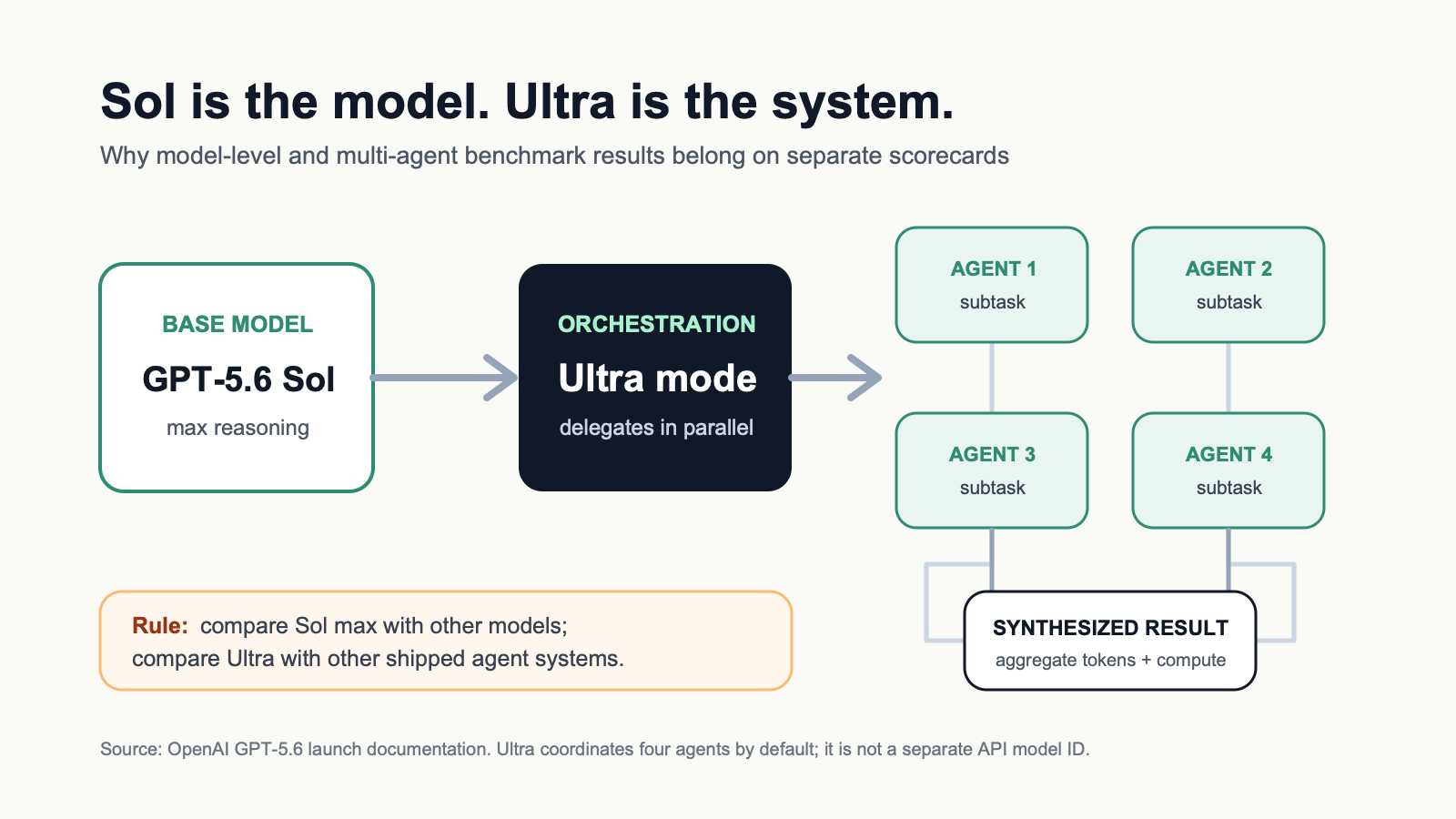
GPT-5.6 Sol is OpenAI’s model, exposed as gpt-5.6-sol. Ultra is an execution mode in Codex and related OpenAI experiences. OpenAI says it uses maximum reasoning and coordinates four agents by default. Those agents can divide a task, work in parallel, and synthesize their findings. There is no separate gpt-5.6-sol-ultra API model ID.
That distinction matters. Comparing Sol Ultra with one Fable API call is like comparing a project team with one expert. The project team may finish the job better, but its result includes orchestration, parallel token use, tool calls, and synthesis—not merely the base model’s intelligence.
The Anthropic names are Claude Fable 5 and Claude Opus 5. “Opus 5.0” is a search-friendly alias, not the official product name. Moonshot AI’s model is Kimi K3; its downloadable release is open-weight under the Kimi K3 License, not unrestricted open-source software.
OpenAI’s GPT-5.6 launch post and Sol API documentation are the primary sources for the model-versus-mode distinction. Kingy’s separate Sol, Terra, and Luna model-selection guide goes deeper on OpenAI’s current naming and settings.
Specifications and API pricing
Prices below are public list prices per one million tokens, before discounts, batch processing, caching effects, retries, tools, or agent multiplication. They are useful inputs—not estimates of what a completed task will cost.
| System | Public model ID | Context / max output | Standard API input / output | Deployment | Important qualification |
|---|---|---|---|---|---|
| Claude Fable 5 | claude-fable-5 | 1M / 128K | $10 / $50 | Anthropic-hosted | Highest nominal price here; Fable traffic has special retention and fallback conditions |
| GPT-5.6 Sol | gpt-5.6-sol | 1.05M / 128K | $5 / $30 | OpenAI-hosted | Inputs above 272K tokens trigger higher long-context rates; Ultra can multiply total work across agents |
| Claude Opus 5 | claude-opus-5 | 1M / 128K | $5 / $25 | Anthropic-hosted | Half Fable’s token rates, but not necessarily half the cost per accepted task |
| Kimi K3 | kimi-k3 | 1,048,576 / up to 131,072 | $3 fresh input, $0.30 cached / $15 output | Moonshot API or downloadable weights | 2.8T total parameters, 104B active; self-hosting is a serious infrastructure project |
Sources: Anthropic’s model overview, Anthropic pricing, OpenAI’s Sol model page, OpenAI API pricing, Kimi K3’s model card, and Kimi API pricing.
All four advertise roughly one-million-token context windows. That does not make their long-context performance equivalent. Context size describes what an interface accepts; retrieval accuracy, attention over distant evidence, compaction, latency, and cost determine what is usable.
OpenAI’s long-context pricing deserves special attention. Once a Sol request exceeds 272K input tokens, OpenAI says input is charged at twice the standard rate and output at 1.5 times the standard rate. A nominal $5/$30 model can therefore become $10/$45 for that request before Ultra’s additional agents are counted.
Kimi’s hosted rates are the lowest of the four, but a downloadable model is not free inference. K3’s mixture-of-experts design activates 104 billion parameters out of 2.8 trillion, and Moonshot’s recommended large-scale deployment class is far beyond a normal workstation. Kingy has separate guides to Kimi K3’s weights and hardware and whether Kimi K3 can realistically run locally.
What the independent evidence says
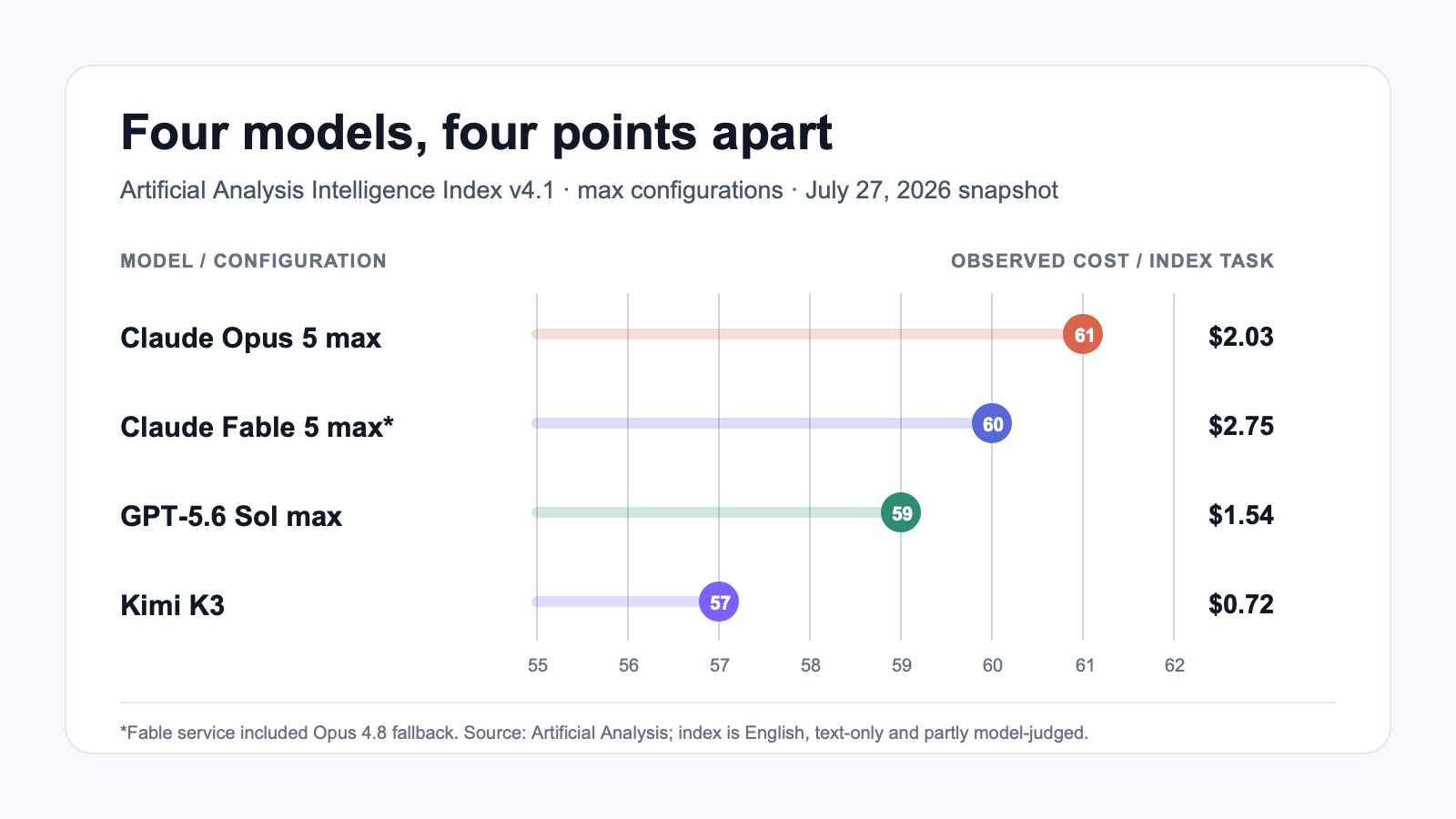
Artificial Analysis is the most useful current cross-provider baseline because it applies one published methodology across model families. Its Intelligence Index v4.1 combines nine evaluations spanning agents, coding, scientific reasoning, and general intelligence.
Artificial Analysis snapshot
| Configuration | Intelligence Index v4.1 | Approx. cost per Index task | Output speed | Evidence caveat |
|---|---|---|---|---|
| Claude Opus 5 Max | 61 | $2.03 | 54.8 tokens/s | One-point lead is too small to treat as universal superiority |
| Claude Fable 5 Max | 60 | $2.75 | 73.5 tokens/s | Artificial Analysis labels this result as using Opus 4.8 fallback |
| GPT-5.6 Sol Max | 59 | $1.54 | 65.9 tokens/s | Base Sol result; Ultra orchestration is not included in the index |
| Kimi K3 | 57 | $0.72 | 32.6 tokens/s | Lowest observed task cost and slowest output speed in this snapshot |
Source: Artificial Analysis model pages for Opus 5, Fable 5, GPT-5.6 Sol, and Kimi K3, using its published intelligence benchmarking methodology.
The ordering is informative; the gaps are not decisive. A spread of four index points from first to fourth is modest for systems whose strengths, interfaces, and costs differ so substantially. Opus’s one-point advantage over Fable should be read as “competitive at much lower token rates,” not “proven better at every task.”
Artificial Analysis also reports that Opus 5 costs about 26% less per Intelligence Index task than Fable in its evaluation—not 50% less. That is the important difference between token price and cost per result. More thinking tokens, longer completions, retries, tool calls, and corrections can narrow or reverse a price-card advantage.
Live leaderboards also move. Kimi K3’s launch-week lead on some frontend preference tests produced “number one” headlines, but current Arena WebDev rankings have already changed. Anyone choosing a production model from a single leaderboard screenshot is optimizing for a moment, not a workload.
The coding evidence: DeepSWE finds a statistical tie
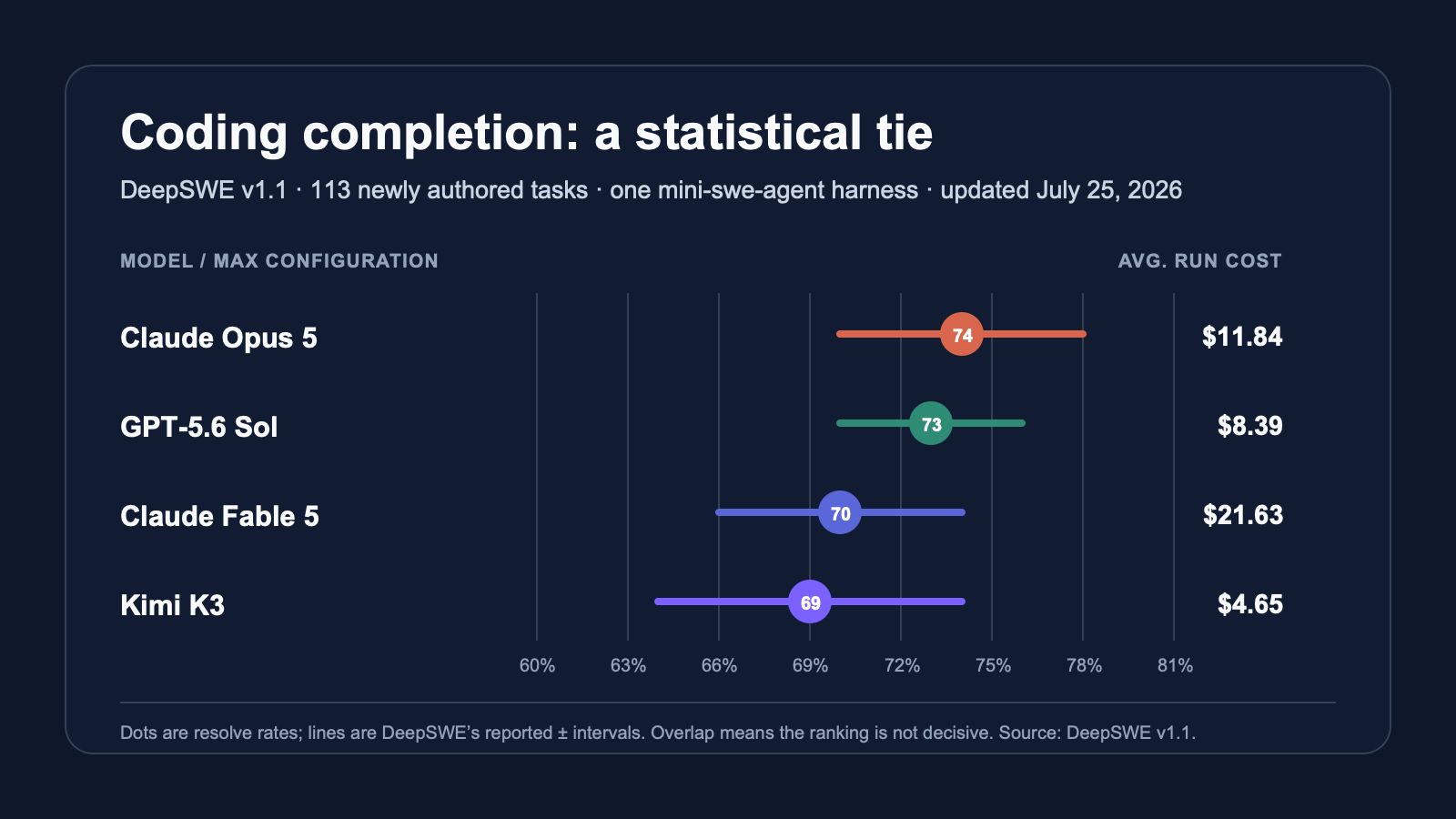
DeepSWE v1.1 is the cleanest current four-way coding comparison we found. Its July 25 leaderboard uses 113 newly authored software-engineering tasks and one mini-swe-agent harness. That removes several of the harness mismatches that complicate launch tables.
| Max configuration | Resolve rate | Average run cost | Output tokens | Agent steps |
|---|---|---|---|---|
| Claude Opus 5 | 74% ±4 | $11.84 | 118K | 99 |
| GPT-5.6 Sol | 73% ±3 | $8.39 | 60K | 61 |
| Claude Fable 5 | 70% ±4 | $21.63 | 119K | 88 |
| Kimi K3 | 69% ±5 | $4.65 | 81K | 98 |
The intervals overlap. The defensible conclusion is a statistical tie on task completion, not “Opus wins coding.” The resource profiles are more differentiated: Sol completed roughly the same share with about half Opus’s output tokens and 38 fewer agent steps, while Kimi delivered the lowest average run cost. Fable was the most expensive configuration in this snapshot.
DeepSWE also reports 1.4% reviewer disagreement on its behavioral verifiers, compared with 32.4% on the inherited SWE-Bench Pro tests it examined. That is a good reason to prefer fresh tasks and behavioral checks over a familiar benchmark headline.
This does not make DeepSWE universal ground truth. It remains one coding harness, the intervals are wide, and repository mix matters. It also tests Sol Max—not Ultra. Earlier provider launch tables report somewhat different DeepSWE values because their snapshots and system configurations differ; those numbers should not be silently merged with this leaderboard.
What each provider reports
Vendor benchmarks are relevant evidence, but vendors choose the tests, harnesses, and configurations shown at launch. They belong in separate boxes, not blended into an independent league table.
Anthropic’s Opus 5 comparison
Anthropic’s Opus 5 announcement reports the following selected results:
| Evaluation | Opus 5 | Fable 5 | GPT-5.6 Sol | What it suggests |
|---|---|---|---|---|
| Frontier-Bench v0.1 | 43.3% | 33.7% | 34.4% | Opus led Anthropic’s frontier-task comparison |
| GDPval-AA v2 | 1,861 | 1,747 | 1,736 | Opus performed strongly on economically valuable knowledge work |
| BrowseComp | 90.8% | 87.4% | 90.4% | Opus and Sol were effectively close |
| OSWorld 2.0 | 70.6% | 66.1% | 62.6% | Opus led this computer-use result |
| AutomationBench | 26.0% | 17.4% | 18.1% | Opus showed a larger advantage on this agentic task set |
The same material shows counterexamples: Fable edges Opus on some hard knowledge, health, and legal tasks, while Sol leads on DeepSWE. Anthropic’s conclusion that Opus comes close to Fable at half the token price is supported by the list price and several results, but “half the price” should not be restated as “half the cost per job.”
OpenAI’s Sol and Ultra comparison
OpenAI’s GPT-5.6 launch results give the cleanest public view of what orchestration adds:
| Evaluation | Sol Max | Sol Ultra | Fable 5 comparison |
|---|---|---|---|
| Terminal-Bench 2.1 | 88.8% | 91.9% | 83.1% |
| BrowseComp | 90.4% | 92.2% | 88.0% |
Ultra improves the result, but it also changes the unit under test. OpenAI says Ultra coordinates four agents by default, so its total token usage, tool activity, and elapsed time may differ sharply from a single-agent run. Those resource totals are absent from the headline table.
OpenAI also reports Sol at 72.7 on DeepSWE v1.1, 94.6 on GPQA, and 58.0 on Toolathlon. Fable leads Sol on Toolathlon and some long-context or frontier-math settings. The evidence supports “strong coding and tool execution,” not “wins every benchmark.”
Moonshot’s Kimi K3 comparison
Moonshot’s Kimi K3 model card reports 88.3 on Terminal-Bench 2.1, 91.2 on BrowseComp, 76.5 on Toolathlon, 30.8 on AutomationBench, and 94.5 on MCPMark. It also reports 67.5 on DeepSWE and 1,686 on GDPval.
That profile is more interesting than a simplistic “cheap model” label. K3 is competitive on browsing, terminal, tool, and automation tasks while exposing weights that organizations can operate under its license. Its weaker Artificial Analysis score, slower hosted response, and operational burden are the balancing evidence.
Moonshot’s own footnotes are essential. They disclose different harnesses across products, including Kimi Code, Claude Code, and Codex; fallback and refusal events; and configuration differences. The candour is valuable, but it means the table cannot establish a controlled overall winner.
Fable 5: the premium option with unusual caveats
Fable 5 remains the model to try when a difficult task has exhausted cheaper options. It is fast in the Artificial Analysis snapshot, strong on long-horizon and high-difficulty evaluations, and paired with Anthropic’s mature Claude Code workflow.
Its economics are difficult to ignore. At $10 per million input tokens and $50 per million output tokens, it costs twice Opus 5’s list price. When Opus is within one point on an independent aggregate—and leads on several Anthropic-published agentic tests—defaulting all work to Fable becomes hard to defend.
Fable also needs a data-governance review. Anthropic’s documentation says Fable usage is subject to a 30-day retention requirement and does not support zero-data retention. Anthropic’s safeguard architecture can route requests to a fallback model; Anthropic said the launch-period service average was under 5%, but benchmark-specific rates have sometimes been much higher. At launch the fallback was Opus 4.8, and current documentation allows Opus 4.8 or Opus 5. A result labeled “Fable” may therefore not always be a pure, single-model result unless the evaluator records routing.
Fallback is not inherently bad—it may be part of the shipped safety system—but it affects privacy assessments and benchmark attribution. Teams handling sensitive data should verify current contractual terms rather than extrapolating from the model’s general API documentation. See Anthropic’s Fable 5 documentation and fallback-credit guidance.
For a direct two-way examination, see Kingy’s Claude Fable 5 vs GPT-5.6 Sol guide.
Opus 5: the rational default
Opus 5 changes the buying decision because it removes much of the capability sacrifice previously associated with stepping down from Fable. It leads the current Artificial Analysis aggregate by a narrow margin, leads several Anthropic-published agentic and knowledge-work evaluations, supports a one-million-token context window, and costs $5/$25 per million tokens.
The best case for Opus is not that it dominates. It is that its weak spots are small enough and its savings large enough to make routing sensible. Start a difficult task on Opus. Escalate to Fable only after an observable failure, low-confidence result, or verification gap. That policy can preserve Fable for cases where the premium earns its keep.
Opus remains proprietary and hosted. It does not solve the control and deployment problem addressed by Kimi’s weights. It also does not inherit Ultra’s default parallel-agent execution merely because the base model is capable of coordinating subagents. Harness design still matters.
Kingy’s Opus 5 specifications, benchmarks, and pricing guide covers the model in more depth, while Opus 5 versus Sol Ultra focuses on that operational contest.
GPT-5.6 Sol Ultra: the orchestration-first choice for parallel work
Sol’s model-level evidence is strongest in coding, terminal work, and tool-driven execution. Ultra then adds a system advantage: automatic delegation to multiple agents. This can be particularly effective for work that naturally decomposes, such as examining separate modules, collecting independent sources, generating competing solutions, or running review in parallel with implementation.
Ultra is less compelling for a short, indivisible question. Four agents cannot parallelize a single fact into four times the value. Orchestration can also duplicate exploration, increase total tokens, and create a synthesis problem. A fair evaluation must record every child-agent token and tool call, not just the final response.
The comparison should therefore use two labels:
- Sol Max for a standardized model-level call.
- Sol Ultra for the shipped multi-agent experience.
Use the first when asking which model reasons better under matched constraints. Use the second when asking which product completes a real project with the least human intervention. Mixing them makes both answers less useful.
Kimi K3: the control and cost winner, not a free local model
K3 is the only option here with downloadable weights. That matters for data locality, model inspection, customization, and organizations that want to control their serving stack. Its API token rates are also the lowest in this comparison.
“Open-weight” is the accurate term. K3 uses a custom license, and certain very large commercial deployments or model-as-a-service uses can trigger additional terms. Organizations should review the Kimi K3 License, not rely on the shorthand “open source.” Kingy’s Kimi K3 licence and commercial-use guide explains the boundary in practical terms.
Self-hosting also moves cost rather than eliminating it. Operators need accelerators, networking, inference software, observability, security, redundancy, and people who can keep the system reliable. The model’s total scale makes a full-performance deployment a data-centre exercise, not a consumer-GPU tutorial.
For teams that already operate large-model infrastructure, K3 can be strategically valuable. For a small company that simply wants a dependable coding agent, its $3/$15 hosted API may be more rational than buying a cluster. Kingy’s Kimi K3 economics deep dive examines that make-or-buy decision.
Our methodology and testing limits
Kingy did not run a matched four-way API bake-off for this article. We did not have a verified, equivalent test harness with all four provider credentials, fixed reasoning budgets, auditable fallback settings, and complete cost telemetry. Claiming “hands-on” superiority from four browser chats would have produced weaker evidence, not stronger evidence.
Instead, this guide uses three evidence layers:
- Official specifications and pricing, checked against each provider’s documentation.
- Independent standardized measurements, led by Artificial Analysis, with the snapshot date stated.
- Provider-reported evaluations, kept in separate tables and interpreted with their footnotes.
We did not average vendor scores across unrelated tests. We did not convert missing token totals into invented benchmark costs. We did not treat Ultra as a separate model, Kimi’s weights as unrestricted open source, or Fable results as pure single-model results when fallback could be active.
This approach cannot tell you which system will perform best on your repository, documents, tool stack, or approval process. It can tell you which claims are supported, which comparisons are directionally useful, and what must be measured before a procurement decision.
A reproducible two-track test protocol
The best internal evaluation should run two tracks because buyers care about both model quality and product outcomes.
Track 1: standardized model comparison
Use direct APIs with one agent per model. Freeze the exact model IDs, test date, system prompt, temperature, effort setting, maximum tokens, tool definitions, context, and timeout. Disable fallback where the provider permits it; where it cannot be disabled, log every routed request.
Build a task suite from real work, not trivia:
- Repository bug repair with hidden tests
- Feature implementation across multiple files
- Citation-based research against a frozen source pack
- Long-context contradiction detection
- Multimodal document or screenshot analysis
- Spreadsheet or office-document transformation
- Tool-use and MCP workflows with verifiable state changes
Run at least three trials per task and randomize the order. Grade with deterministic tests where possible, then blind human review. Record pass rate, variance, tokens, cache usage, tool calls, retries, wall time, and correction time.
Track 2: shipped-system comparison
Test the products as customers actually use them: Sol Ultra in Codex, Claude Code with Fable 5, Claude Code with Opus 5, and Kimi Code with K3. Permit each system’s native planning, compaction, browsing, tools, and subagents.
Keep the task, starting repository, acceptance tests, machine resources, and deadline fixed. Do not keep the token budget artificially identical; the purpose of this track is to measure the complete system. Instead, count every model call and report total cost.
The primary metric should be cost per accepted deliverable:
(model tokens + tool charges + compute + human correction cost) / accepted tasks
Pair it with pass rate, median wall time, human minutes, regression count, and result variance. For Ultra, include all subagents. For Fable, report fallback routing. For Kimi self-hosting, amortize hardware and operations rather than assigning a zero token price.
Publish prompts, fixtures, patches, rendered outputs, graders, and raw logs. If a result cannot be reproduced, label it a demonstration rather than a benchmark.
Which one should you choose?
| Use case | First choice | Why | Runner-up / escalation |
|---|---|---|---|
| General high-end knowledge work | Claude Opus 5 | Best current balance of independent score and price | Escalate failed or extremely difficult tasks to Fable 5 |
| Large, parallel coding or research project | GPT-5.6 Sol Ultra | Native multi-agent decomposition and strong terminal/coding evidence | Opus 5 in a well-designed agent harness |
| Matched single-agent repository coding | Test Sol Max and Opus 5 | Current DeepSWE completion intervals overlap; Sol used fewer tokens and steps | Kimi K3 when cost dominates; validate all on your repository |
| Highest-stakes hard task | Claude Fable 5 | Premium frontier capability remains valuable on selected tasks | Opus 5 first, then route only failures upward |
| Data control and self-managed deployment | Kimi K3 | Downloadable weights and operational control | None of the three proprietary models offers equivalent weight access |
| Lowest hosted token price | Kimi K3 API | $3 input and $15 output per million fresh tokens | Opus 5 if latency and turnkey quality reduce retries |
| Sensitive workload requiring zero-data retention | Contract-specific review | Fable’s documented terms make it a poor default assumption | Evaluate eligible hosted models or Kimi self-hosting with legal/security teams |
| Very long prompts | Test before buying | All advertise 1M-class context, but quality and cost differ | Watch Sol’s surcharge above 272K input tokens |
A sensible production router starts with Opus 5 for demanding work, uses Sol Ultra when decomposition is valuable, escalates only the hardest failures to Fable, and selects Kimi when deployment control or unit economics justify its operational trade-offs. That is more defensible than forcing every task through one “winner.”
Frequently asked questions
Is GPT-5.6 Sol Ultra a separate model?
No. GPT-5.6 Sol is the model. Ultra is a system mode that applies maximum reasoning and coordinates multiple agents—four by default, according to OpenAI. API comparisons should use the gpt-5.6-sol model ID and label Ultra results separately.
Which system is best overall in July 2026?
Claude Opus 5 is the best default based on the combination of current independent performance and price. Fable 5 remains a selective premium option; Sol Ultra is compelling for parallel project execution; Kimi K3 wins on open-weight control and hosted token price.
Is Opus 5 really half the cost of Fable 5?
Its list token rates are half: $5/$25 versus $10/$50 per million input/output tokens. That does not guarantee half the task cost. Artificial Analysis observed a smaller cost-per-index-task advantage because token consumption differs.
Does Ultra make Sol four times as expensive?
Not necessarily. Four agents are coordinated by default, but they may receive different subtasks and consume different amounts. Total cost can be much higher than one call, so measure all agents rather than assuming either no multiplier or an exact four-times multiplier.
Which model is best for coding?
Current DeepSWE results put Opus 5 at 74% and Sol Max at 73%, with overlapping intervals; the four models are statistically tied on completion. Sol used substantially fewer output tokens and agent steps, while Ultra adds useful parallelism for large projects. Repository-specific tests matter more than a one-point rank.
Is Kimi K3 open source?
It is more accurate to call Kimi K3 open-weight under the custom Kimi K3 License. The weights are downloadable, but commercial and model-as-a-service conditions mean the license should be reviewed directly.
Can Kimi K3 run on a local workstation?
Not at full intended scale in the ordinary sense. Its 2.8-trillion-parameter mixture-of-experts architecture requires substantial memory, accelerators, and networking. Quantized or modified experiments are different from a production, full-performance deployment.
Do all four systems really support one million tokens?
They advertise roughly one-million-token contexts, but equivalent capacity does not prove equivalent recall or reasoning. Sol also has a pricing surcharge above 272K input tokens. Test your own document structure and retrieval requirements.
Can Fable 5 use another model behind the scenes?
Yes. Anthropic’s safeguard system can route a small proportion of requests to an eligible fallback model. Evaluators should disclose whether fallback was active because it affects attribution, retention, and reproducibility.
Why do vendor charts and independent rankings disagree?
They use different tasks, prompts, tools, reasoning budgets, scaffolds, and graders. Vendors also select launch benchmarks. Disagreement is expected; it is a reason to inspect methodology, not choose the chart with the preferred winner.
What is the single most important buying metric?
Cost per accepted deliverable. It captures model charges, retries, tools, orchestration, compute, and human correction. Token price alone does not.
Source and audit notes
This article’s evidence cutoff is July 27, 2026. Model identities, context limits, output limits, and list prices were checked against Anthropic’s model documentation, OpenAI’s GPT-5.6 Sol documentation, and the Kimi K3 model card. Independent comparisons use the dated Artificial Analysis methodology and leaderboards and DeepSWE v1.1. Provider results remain attributed to the provider that published them.
Leaderboards can move, prices can change, and production routing can alter the system under test. Recheck the linked primary sources before making a long-term contract or infrastructure decision.
Bottom line
The evidence does not support one context-free champion. It supports a routing strategy.
Claude Opus 5 is the strongest default purchase. Its current independent standing and $5/$25 pricing make it hard to justify sending every task to Fable. Claude Fable 5 is the escalation tier for work where a small capability edge can repay a large premium—and where its retention and fallback terms are acceptable. GPT-5.6 Sol Ultra is the execution specialist, combining a strong coding model with a multi-agent system that can outperform single-agent configurations on decomposable projects. Kimi K3 is the control specialist, offering credible frontier performance and downloadable weights at the cost of slower hosted behavior, custom licensing, and heavy infrastructure.
Run model-level and shipped-system tests separately. Count all tokens, tools, fallbacks, retries, and human correction. Then buy the system that produces the most accepted work—not the one with the loudest launch chart.