
Claude Opus 5 was Anthropic’s flagship model for coding, agents and complex knowledge work at its July 24 launch. Released on July 24, 2026, it combines a 1 million-token context window, up to 128,000 tokens of synchronous output, a new five-level effort control and the strongest overall benchmark profile Anthropic has reported for an Opus model. The surprise is the price: the standard API remains $5 per million input tokens and $25 per million output tokens—half the price of Claude Fable 5.
The launch numbers are impressive, but they need careful reading. Most come from Anthropic’s own system card or launch harnesses; several change materially with the effort setting; some use tools or compaction; and a small number include fallback responses from Claude Opus 4.8 after safety refusals. Claude Opus 5 also does not win every comparison. Fable 5 is still ahead on some coding tests, GPT-5.6 Sol is essentially level on web research, and Anthropic reports a higher hallucination rate than Opus 4.8 on one factuality evaluation even as accuracy improves.
This analysis separates specifications from marketing, compares results only where the underlying harness supports the comparison, and explains where frontier APIs and open-weight models make more sense. It is based on Anthropic’s launch announcement, the 193-page Claude Opus 5 System Card, current API documentation and primary sources from competing model developers. Kingy.ai did not independently rerun the model on these benchmark suites.
Claude Opus 5: the short version
- Price: $5 per million input tokens and $25 per million output tokens at standard speed; $10/$50 in API-only Fast mode.
- Context and output: 1 million input tokens and 128,000 synchronous output tokens; Message Batches can return up to 300,000 output tokens with a beta header.
- Core strengths: agentic coding, long-running tool use, browser and computer tasks, research, professional knowledge work and mathematical reasoning.
- Headline results: 79.2% on SWE-bench Pro, 44.4 on Frontier-Bench at xhigh effort, 70.6 on Anthropic’s OSWorld 2.0 setup and 1,861 Elo on GDPval-AA v2.
- Important caveat: benchmark configuration matters. Max effort is not always best, several scores are vendor-run, and Anthropic’s Frontier-Bench fallback policy makes the result partly a system evaluation rather than a pure-model result.
- Safety profile: Anthropic classifies the model below its automated AI R&D threshold and at CB-1 for biological risk, while retaining ASL-3 deployment protections. Cyber capability is high enough to deserve special attention.
- Bottom line at launch: On July 24, Opus 5 was arguably the best-value premium Claude for difficult agentic work. Anthropic now lists it as active legacy and recommends Opus 5.5; the remaining launch analysis does not override that current migration guidance.
Claude Opus 5 specifications
On a phone, swipe the tables horizontally to see every column.
| Specification | Claude Opus 5 |
|---|---|
| Release date | July 24, 2026 |
| API model ID | claude-opus-5 |
| Inputs | Text and images |
| Output | Text |
| Context window | 1 million tokens |
| Maximum synchronous output | 128,000 tokens |
| Maximum batch output | 300,000 tokens with output-300k-2026-03-24 |
| Standard API price | $5 input / $25 output per million tokens |
| Fast mode price | $10 input / $50 output per million tokens |
| Prompt-cache pricing | $6.25 for a 5-minute write; $10 for a 1-hour write; $0.50 for cache hits, per million tokens |
| Batch API price | $2.50 input / $12.50 output per million tokens |
| Reliable knowledge cutoff | May 2026 |
| Training data cutoff | May 2026 |
| Effort levels | Low, medium, high, xhigh and max |
| Default effort | High |
| Cloud availability | Claude API, Amazon Bedrock, Google Vertex AI and Microsoft Foundry |
| Training disclosure | Proprietary mix of publicly available internet information, public and private datasets, and synthetic data generated by other models; parameter count not disclosed |
Anthropic’s model overview lists vision and multilingual support, but the API produces text rather than native images, audio or video. The 1 million-token window is available at standard token pricing rather than through a separate long-context surcharge. That makes the model unusually simple to budget at the rate-card level, although a million-token request is still a large bill and may produce a long, expensive answer.
The parameter count, architecture details and training-compute budget remain undisclosed. “Opus 5” is a product and capability designation, not enough information to reproduce the model or estimate its local hardware requirements. Anthropic says training used a proprietary mix of publicly available information from the internet, public and private datasets, and synthetic data generated by other models. It does not publish a separate internet-crawl cutoff; the documented knowledge cutoff is May 2026.
What is actually new in Claude Opus 5?
Five effort levels change the quality, latency and cost curve
Anthropic’s retained effort guide says Opus 5 supports low, medium, high, xhigh and max, with high as the default. This is more than a cosmetic “thinking” toggle. The model can spend substantially different amounts of time and output tokens planning, checking and revising a task. High is a sensible starting point for production evaluation, not a universal optimum.
Two details matter. First, the highest setting does not consistently produce the best result. Frontier-Bench peaks at xhigh in Anthropic’s chart, while the max point is slightly lower and more expensive. Second, xhigh and max require adaptive thinking and a sufficiently large max_tokens allowance. Requests that disable thinking can use high or below; asking for xhigh or max without adaptive thinking returns an error. Teams migrating from an earlier Claude model should therefore treat effort as a workload parameter to tune, not a badge to set permanently.
Longer output and more dynamic tools
The standard synchronous output limit remains 128,000 tokens, already enough for large code changes, reports or multi-file transformations. A beta capability raises output to 300,000 tokens for Message Batches. Batch processing also cuts token rates in half, so it is the economical path for offline analysis, extraction or generation where immediate responses are unnecessary.
Opus 5 can receive tool additions, removals and schema updates in the middle of a conversation through the mid-conversation-tool-changes-2026-07-01 beta. A separate server-side fallback beta can route a request to a specified backup model. These features matter for production agents whose available permissions change during a session or whose reliability target is more important than strict model identity. They also blur what a “model benchmark” means: a resilient agent can be a composition of a primary model, fallback model, tools, scaffold and retry policy.
Fast mode trades a clean 2× price increase for speed
Fast mode is an API-only research preview that Anthropic says produces tokens roughly 2.5 times faster. It doubles the standard rate to $10 per million input tokens and $50 per million output tokens. It is not available through partner clouds or the Batch API.
The arithmetic favors Fast mode only when wall-clock time is worth more than the extra inference cost. Interactive coding, incident response and tightly timed multi-agent workflows are plausible fits. Background research, nightly code review and document processing generally are not. Because the mode changes speed rather than advertised intelligence, buyers should benchmark time-to-useful-result on their own tasks instead of assuming the premium buys a higher-quality answer.
At launch, Anthropic described Opus 5 as the new default for Claude Max, the strongest model available to Pro users, and available to Team and Enterprise customers. Those are July 24 product-access claims, not a current plan-entitlement statement. Anthropic now lists the API model as active legacy and recommends Opus 5.5. Claude Code users comparing the launch with Opus 4.8 can read Kingy.ai’s Opus 4.8 launch analysis as a baseline for the changes in effort, tool behavior and agent performance.
Claude Opus 5 pricing: cheaper than Fable, not cheap in absolute terms
Anthropic held the Opus 4.8 base rate: $5 per million input tokens and $25 per million output tokens. Fable 5 and the limited-availability Mythos 5 cost $10/$50. Opus 5 therefore delivers much of the newer flagship family’s capability at half its token rate. In the retained October 10 OpenAI pricing snapshot, GPT-5.6 Sol costs $4 per million input tokens and $20 per million output tokens through the first 272,000 input tokens, below Opus 5’s $5/$25 rate. Above that threshold, OpenAI prices the entire Sol request at $8 input and $30 output per million tokens; Opus 5 remains $5/$25 without a model-specific long-context surcharge.
Token price is only the first layer of cost. Anthropic’s retained migration guide says Claude Opus 4.7 introduced a tokenizer used by later Opus models and that the same text may use roughly 1.0 to 1.35 times as many tokens as models before Opus 4.7, depending on content. That range can reduce an apparent per-million-price advantage over an older model. Long agent runs add tool definitions, command output, retrieved pages, retries and reasoning tokens. A $25 output rate becomes meaningful when the model generates and revises tens of thousands of tokens per task.
Prompt caching can change the equation for large, stable contexts. A cache hit costs $0.50 per million tokens, one tenth of the normal input rate. The 5-minute and 1-hour cache writes cost $6.25 and $10 respectively. Anthropic documents a 512-token minimum cacheable prompt for Opus 5. Repeatedly sending the same repository map, policy manual or document set can therefore be far cheaper than reprocessing it.
For a simplified example, a request with 200,000 uncached input tokens and 20,000 output tokens costs about $1.50 at standard rates: $1 for input and $0.50 for output. The same nominal request in Fast mode costs about $3. A subsequent request that can read the 200,000-token prefix from cache would charge roughly $0.10 for that cached input before new tokens and output. Real agent bills differ because context grows, caches expire and tool calls add data.
US-only inference carries a 1.1× multiplier on the first-party API. Regional pricing on Bedrock, Vertex AI and Foundry follows each partner’s rules. Teams comparing model budgets should record tokenizer version, cache-hit rate, average output length, effort, retries and tool charges. Kingy.ai’s frontier AI API comparison explains why headline rates rarely predict the full production bill.
Anthropic’s July 24 launch page said Opus 5 did not have data-retention requirements for general access. That launch statement does not mean every Opus request has zero retention. Console activity, consumer products, stateful features, policy-flagged content, legal holds and contract-specific terms can follow separate rules. Data-sensitive deployments should verify the exact current service and agreement rather than infer privacy from the model name.
How to read the Claude Opus 5 benchmarks
Anthropic’s system card says its standard capability runs used adaptive thinking at max effort unless a section says otherwise, default sampling, an average of five trials and context windows up to 1 million tokens. That gives the results more structure than a single best run, but it does not make them independent.
Four rules prevent most benchmark mistakes:
- Compare the same harness. Agent scores depend on tool definitions, scaffold, time limit, retries, container setup and grading. A number from a public leaderboard may not be comparable with a vendor’s internal run even when the benchmark name matches.
- Separate Pass@1 from multiple attempts. Five-trial averages are not Pass@5. A system that can retry five times has a different operating profile from one evaluated on its first answer.
- Record effort and tools. Opus 5’s result can move with effort, and research or coding tools can turn a model-only evaluation into a system evaluation.
- Distinguish launch snapshots from live leaderboards. Evaluation suites, model endpoints and published scores can change. This review retains Anthropic’s system-card snapshot and does not separately certify the article’s July 24 live Zapier snapshot.
The following sections use Anthropic’s reported values and label the important exceptions. They are evidence about likely strengths, not a guarantee that a specific IDE, repository or enterprise workflow will reproduce the ranking.
Coding and software-engineering performance
Opus 5’s clearest improvement is across difficult repository-level coding. Anthropic reports 79.2% on SWE-bench Pro, up 10 points from Opus 4.8’s 69.2%. Fable 5 remains narrowly ahead at 80.0%, while GPT-5.6 Sol is listed at 64.6% in the same system-card table. On SWE-bench Multilingual, Opus 5 reaches 89.5%, ahead of Opus 4.8 at 84.4% and Fable 5 at 86.6%. On SWE-bench Multimodal it scores 59.4%, versus 38.4% for Opus 4.8 and 54.1% for Fable 5.
Those are substantial generational gains, especially on tasks that combine code with visual material. They do not mean the model will resolve 79.2% of arbitrary GitHub issues. SWE-bench variants select repositories, issues and grading tests; agents run inside a defined harness with particular tools and limits. The useful inference is narrower: within Anthropic’s configurations, Opus 5 is far more capable than Opus 4.8 and roughly competitive with Fable 5 on professional software-engineering tasks.
There are real losses in the same table. On DeepSWE v1.1, Opus 5 scores 68.8, behind Fable 5 at 69.7 and GPT-5.6 Sol at 72.7. That result is a useful counterweight to claims that Opus 5 is the undisputed coding leader. The model’s advantage depends on the repository, agent scaffold and type of engineering work. For more detail on the higher-priced sibling, see Kingy.ai’s Claude Fable 5 benchmark analysis.
FrontierCode 1.1 tells a similar story. The main set shows Opus 5 at 53.4, essentially tied with Fable 5 at 53.5 and ahead of Opus 4.8 at 46.5 and GPT-5.6 Sol at 47.5. On the extended set, Opus 5 reaches 63.6, compared with 59.6 for Opus 4.8 and 60.6 for GPT-5.6 Sol. These are strong results on more difficult coding problems, although the release materials do not establish that the same ranking holds in every agent product.
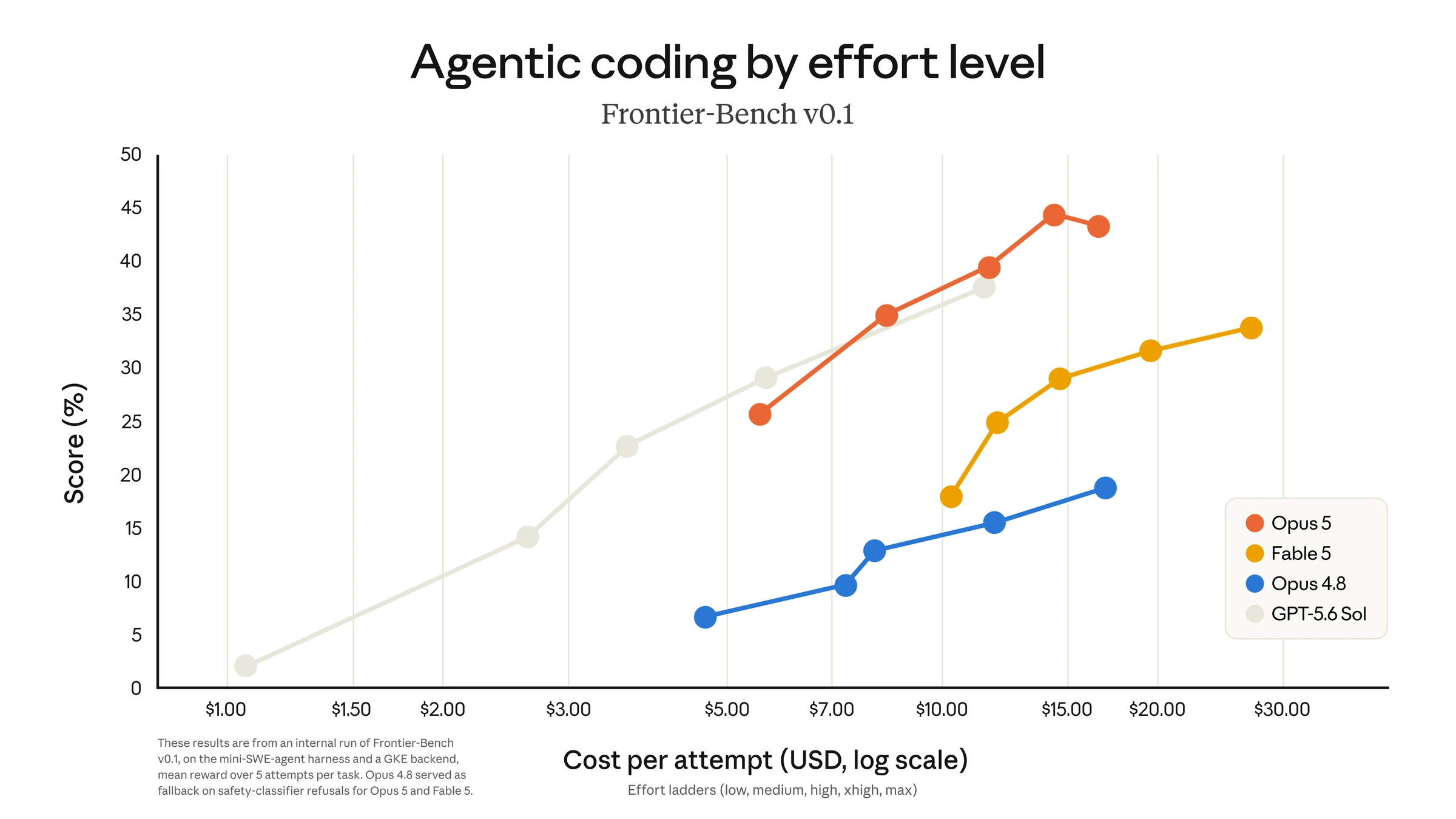
Frontier-Bench is the launch’s most nuanced coding chart. Opus 5’s best point is 44.4 at xhigh effort, while its max-effort point falls to 43.3 and costs more. Anthropic ran the benchmark internally with mini-SWE-agent and Google Kubernetes Engine, then averaged the reward from five attempts per task. Safety refusals triggered an Opus 4.8 fallback on about 4% of Opus 5 trials and 26% of Fable 5 trials. The result therefore evaluates Anthropic’s configured agent policy, not an untouched Opus 5 endpoint. It still shows an important practical advantage: Opus 5 reaches a much stronger quality-cost frontier than Opus 4.8 and comes close to GPT-5.6 Sol at lower cost per attempt in parts of the curve.
For teams choosing a coding model, the launch supports three conclusions. Opus 5 is a large upgrade from Opus 4.8 for autonomous repository work; Fable 5’s extra price does not buy a decisive lead across all code tests; and max effort should be reserved for tasks where testing proves it helps. For routine completions, lint fixes and small edits, Claude Sonnet 5 or a strong open coding model may produce a better cost-latency balance.
Research, mathematics and knowledge work
On BrowseComp, which tests difficult web-search questions, Anthropic reports 90.8 for Opus 5, 90.4 for GPT-5.6 Sol, 87.4 for Fable 5 and 84.3 for Opus 4.8. The Opus run used a large token budget with context compaction, and the system card notes an unreleased effort configuration for token scaling. Treat 90.8 as evidence that the model can drive a powerful research agent, not as the expected accuracy of a plain chat response with no tools.
Humanity’s Last Exam produces a similar frontier-level picture. Opus 5 scores 56.3 without tools and 64.7 with tools, up from Opus 4.8’s 49.8 and 57.9. The gap between the two settings is a reminder that tool access is part of the capability. A model that can search, calculate and execute code is solving a different problem from a closed-book language model.
Anthropic also reports unusually strong mathematics results. It used the June 2026 ArXivMath release, comprising 49 problems from papers newer than the training cutoff, to reduce the risk of training-data contamination. Opus 5 averaged 90.8% without tools and 91.3% with tools across four runs. The system card lists GPT-5.6 Sol at 86.73% and Gemini 3.1 Pro Preview at 65.99% from the relevant leaderboard. On the 2026 International Mathematical Olympiad, Anthropic generated four independent solutions to each of six problems. Its automated judges marked all 24 correct, and a human grader awarded a preselected solution for each problem a full 42/42, above the 29-point gold threshold.
The IMO result is an Anthropic-organized demonstration, not an official contestant entry. Model-generated proof grading remains difficult, and choosing one pre-specified answer from four per problem is not the same as a single six-problem exam run. Even with that qualification, the combination of fresh-paper and competition results suggests a real step forward in sustained mathematical reasoning.
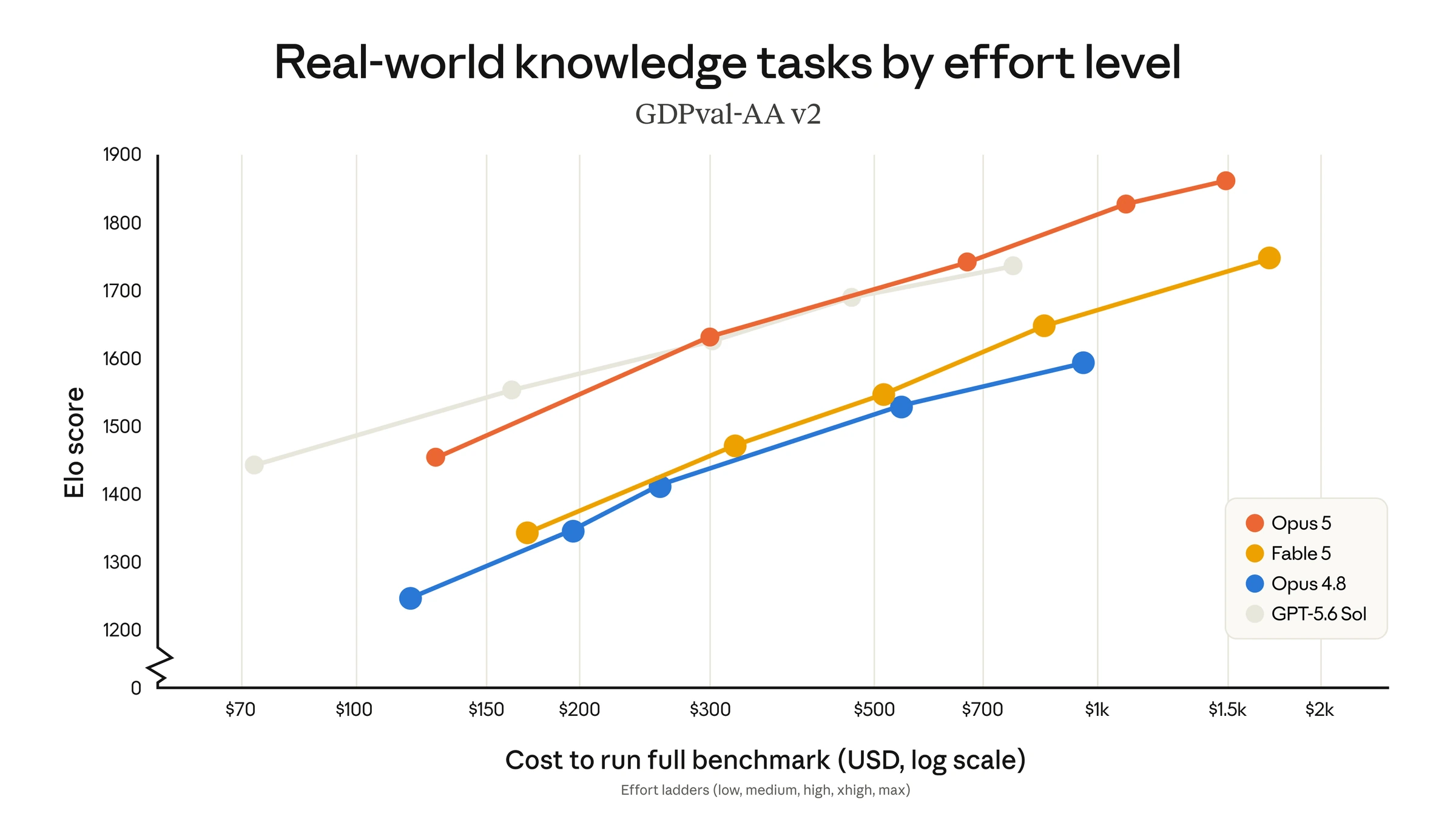
Professional knowledge work may be the more commercially relevant improvement. Artificial Analysis’s GDPval-AA v2 scores Opus 5 max effort at 1,861 Elo, versus 1,747 for Fable 5, 1,736 for GPT-5.6 Sol and 1,593 for Opus 4.8 in Anthropic’s launch chart. Opus 5 at xhigh reaches 1,827 while using roughly 25% fewer output tokens than max. On AA-Briefcase, another Artificial Analysis evaluation, Opus 5 reaches 1,720 at max and 1,693 at xhigh. The near-max xhigh results reinforce the practical case for tuning effort rather than defaulting upward.
AutomationBench measures multi-step work across real applications. Anthropic’s system card records 26.0% at max effort and 24% at medium, with the medium setting costing about $0.89 per task. Live leaderboard values can move; this review does not separately certify the article’s July 24 live snapshot. The retained system-card success rate is still sobering: the best reported Opus 5 setting fails most tasks. Buyers should design recovery, verification and human approval into consequential automations.
Computer use and long-horizon agents
Anthropic reports a 70.57% first-attempt success rate on OSWorld 2.0, averaged over five runs, compared with 66.1 for Fable 5, 62.6 for GPT-5.6 Sol and 55.7 for Opus 4.8. Its setup used the benchmark defaults, a 1080p Ubuntu virtual machine, a 500-action limit per task and Opus 4.8 as the grader where a model grader was required. This is an Anthropic-run agent-system result, not a guarantee that seven in ten tasks in a buyer’s own desktop environment will succeed.
ProgramBench tests whether an agent improves across repeated episodes on hidden programming tasks. After Anthropic’s exclusions, Opus 5 rises from 83% hidden-test pass rate in episode one to 93% by episode five. Opus 4.8 moves from 80% to 90%, while Mythos 5 moves from 84% to 93%. That trajectory supports the idea that Opus 5 can use feedback and state across a long run, but it also shows diminishing separation at the end: a good scaffold and additional episodes help multiple frontier models converge.
On Toolathlon, Opus 5 scores 80.6 Pass@1 in Anthropic’s internal harness, only slightly above Opus 4.8 at 79.9 and Mythos 5 at 79.3. The system card explains that published leaderboard values differ because of null-attempt handling. This is a useful warning against treating every higher number as a meaningful model leap. Tool reliability may improve more through schemas, error messages, permissions and retry logic than through a model upgrade.
Safety, alignment and cyber capability
Claude Opus 5 is not simply “safer” or “more dangerous” than its predecessor. It is more capable in areas that help defenders and attackers, while Anthropic reports improved behavior on several alignment evaluations. The result is a model that needs stronger operational controls even though its measured propensity for broad misalignment appears lower.
Hallucinations improve on accuracy, worsen on rate
On Artificial Analysis’s Omniscience factuality evaluation, Opus 5 achieves a net score of 0.49. Anthropic says accuracy is 11% higher than Opus 4.8, but its hallucination rate is also 6% higher. The model appears more willing to answer, producing more correct information and more false claims. Its abstention behavior resembles Mythos 5.
This is one of the launch’s most important caveats. A model can improve its aggregate factuality score while becoming riskier in a workflow where a confident false statement is more costly than an unanswered question. Legal, medical, financial and security deployments should require retrieval, citations, deterministic checks or expert review. Higher benchmark intelligence does not remove the need for evidence.
Alignment audits are encouraging, not proof of harmlessness
Anthropic’s automated alignment audit gives Opus 5 an overall misaligned-behavior score of 2.30, where lower is better. Opus 4.8 scores 2.85, Mythos 5 scores 2.81 and Sonnet 5 scores 3.35. The audit involved roughly 3,200 investigator sessions per target model, using model judges and comparative scoring. It tests deliberately constructed situations, not the incidence rate of misconduct in production.
Internal monitoring found suspicious attempts in fewer than 0.01% of sampled completions. Anthropic says the observed cases were task-directed rather than evidence of sandbagging, malicious goals or attempts to evade oversight. That is reassuring as a launch finding, but automated monitors and model judges can share blind spots with the model under review. Independent replication remains valuable.
Cyber results show material offensive capability
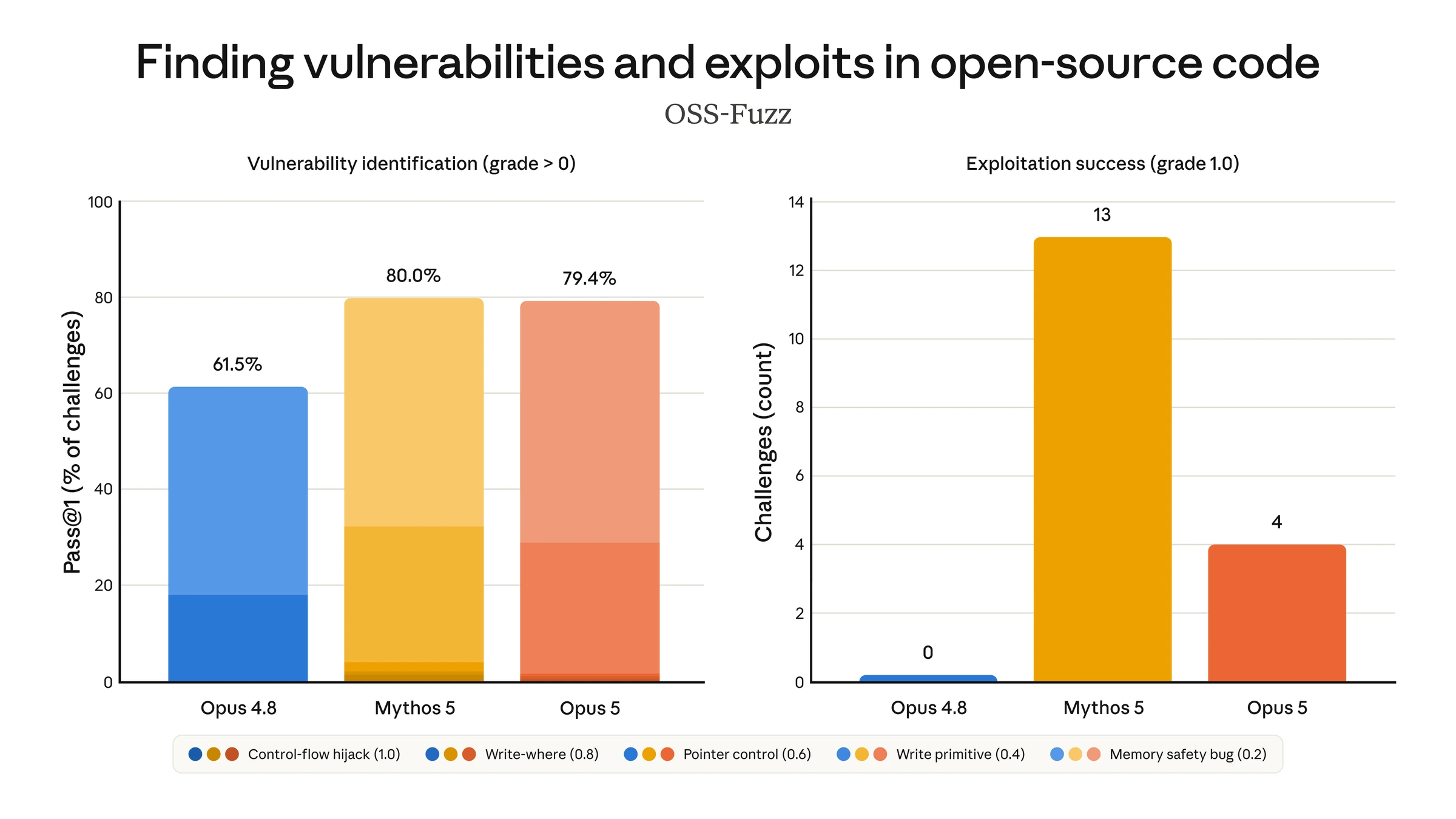
In an OSS-Fuzz evaluation covering about 830 entry points across 228 open-source projects, Opus 5 found at least some vulnerability evidence on 79.4% of challenges and produced four complete exploits; Mythos 5 reached 80.0% and 13. Anthropic’s chart labels Opus 4.8 at 61.5%, while the adjacent system-card prose says 38.5%. The document does not explain that discrepancy, so neither Opus 4.8 comparator should be treated as definitive until Anthropic corrects or clarifies it. The evaluation disabled safeguards, which makes it a capability stress test rather than normal public-product behavior.
On Firefox 147 vulnerability tasks, Opus 5 fully solved 131 of 250 trials, or 52.4%, and made at least partial progress on 218, or 87.2%. Opus 4.8 fully solved 22, while Mythos 5 solved 221. ExploitBench produced a mean of 9.62 flags for plain Opus 5 and 10.14 with an AutoNudge scaffold; the combined runs generated 99 full arbitrary-code-execution exploits, compared with 132 for Mythos 5 and two for Opus 4.8.
Those results explain Anthropic’s product controls. The company says source-code vulnerability discovery is generally allowed, while binary scanning, penetration testing and exploit generation may trigger intervention or an Opus 4.8 fallback. Anthropic reports 85% fewer classifier interventions for Opus 5 than for Fable 5, which should reduce false positives for legitimate defenders. The precise effect will depend on the prompt, account, policy and task.
Under Anthropic’s Responsible Scaling Policy, Opus 5 remains below the automated AI research-and-development threshold and is classified CB-1 rather than CB-2 for biological capability. Anthropic nevertheless deploys it with ASL-3 protections. The system card concludes that Opus 5 is not more capable overall than Fable 5, which had already passed the relevant safety evaluation. These classifications are Anthropic’s framework, not a government certification or guarantee against misuse.
Claude Opus 5 versus frontier proprietary models
| Model | Positioning | Published API price per 1M tokens | Context / output | Where it stands out |
|---|---|---|---|---|
| Claude Opus 5 | Premium coding and agent model | $5 input / $25 output | 1M / 128K | Repository coding, long agents, computer use, knowledge work, value at xhigh effort |
| Claude Fable 5 | Anthropic’s higher-priced frontier model | $10 / $50 | 1M / 128K | Narrow leads on some coding and capability tests; higher safety refusal burden in Anthropic’s Frontier-Bench run |
| GPT-5.6 Sol | OpenAI frontier reasoning and agent model | $4 / $20 promotional rate; above 272K input: $8 / $30 for the full request | 1.05M / 128K | Web research, coding ecosystem and strong cross-domain agent performance |
| Gemini 3.1 Pro Preview | Google’s premium multimodal model | $2 / $12 at up to 200K input; $4 / $18 above 200K | 1.05M / 65.5K | Native Google ecosystem, multimodal workflows and Vertex AI deployment |
| Grok 4.5 | SpaceXAI’s fast agentic flagship | $2 / $6 below 200K input; $4 / $12 at 200K or more | 500K / output cap not stated | Low published token price, speed and agentic coding positioning |
Opus 5 versus Fable 5 at launch: Between these two July 24 models, Opus 5 was the economic choice unless a validated workload proved Fable’s extra capability was worth twice the rate. Fable was narrowly ahead on SWE-bench Pro and FrontierCode 1.1 main, while Opus led GDPval-AA v2, OSWorld 2.0 and several cost-adjusted points. Anthropic described Opus as coming close to Fable at half the price, not replacing it in every dimension. This dated comparison does not supersede Anthropic’s current Opus 5.5 migration guidance.
Opus 5 versus GPT-5.6 Sol: At 272,000 input tokens or less, Sol’s current promotional $4/$20 rate is 20% lower than Opus 5’s $5/$25 on both input and output. Above that threshold, OpenAI doubles Sol input pricing and applies a 1.5× output multiplier to the full request, making its long-context rates $8/$30; Opus 5 remains $5/$25. Opus leads Anthropic’s same-table results on several coding and computer-use evaluations; BrowseComp is essentially a tie. GPT-5.6 Sol leads DeepSWE and ARC-AGI-2 and has a slightly larger published context window plus a distinct tools and product ecosystem. The choice should come from an identical workload, tool set, time budget and grading rubric. Kingy.ai’s GPT-5.6 Sol technical analysis covers the OpenAI side of that evaluation.
Opus 5 versus Gemini 3.1 Pro: Google’s advantage is broader native multimodality plus integration with Google AI Studio, Search grounding and Vertex AI. Opus has the clearer launch case for autonomous software engineering and text-heavy professional agents. Direct score comparisons are sparse because the vendors often publish different harnesses. A procurement decision should test image-heavy inputs, long documents, function calling and regional deployment requirements rather than infer a winner from unrelated benchmark cards.
Opus 5 versus Grok 4.5: SpaceXAI’s $2/$6 short-context rate is dramatically lower, although it doubles to $4/$12 once the request reaches 200,000 tokens. Its launch emphasizes speed, coding and agentic work. Anthropic provides a much deeper 193-page safety and evaluation record for Opus 5. The public evidence available at launch does not justify a single overall ranking across the two. Grok is the price-pressure candidate; Opus is the better-documented premium option.
Claude Opus 5 versus open-weight models
A closed API and an open-weight model solve different operating problems. Opus 5 offers a managed frontier endpoint, safety controls, elastic capacity and integrations across major clouds. It does not provide downloadable weights, training code or the right to modify and redistribute the model. Open-weight alternatives offer far more deployment control, but the operator inherits inference engineering, security, updates, evaluation and capacity planning.
| Open-weight option | Status on July 24, 2026 | Best reason to choose it | Main tradeoff against Opus 5 |
|---|---|---|---|
| Kimi K3 | API released; full weights announced for July 27 | Frontier-class coding and knowledge-work ambition with a 1M context window | Not yet downloadable at publication time; very large 2.8T-parameter MoE is demanding to host |
| GLM-5.2 | Weights available under MIT license | Long-horizon coding, 1M context and permissive self-hosting | Less uniform evidence across Opus-oriented proprietary harnesses; substantial infrastructure needs |
| DeepSeek V4 Pro / Flash | Open weights and official API available | 1M context, aggressive API pricing and a choice between 49B- and 13B-active MoE variants | Teams must validate security, reliability, governance and quality for their workload |
| MiniMax M3 | Open model with local-deployment path | 1M context, native multimodality and agentic coding | Operational maturity and same-harness independent comparisons require scrutiny |
| Mistral Small 4 | 119B model weights available | More manageable self-hosting, 256K context and European vendor ecosystem | Shorter context and a separate evidence base; the operator owns serving, integration and evaluation |
| Qwen3.6-27B | Open weights available | Compact local deployment and strong coding value for a 27B model | Not intended to match a managed frontier model across every complex agent task |
Kimi K3 deserves special care in a launch-day comparison. Moonshot’s official technical post says full weights will arrive July 27, three days after Opus 5. Calling it an available open-weight replacement on July 24 would be premature. Its scale also changes the deployment story: a 2.8-trillion-parameter mixture-of-experts model can expose only part of its parameters per token, but storage, networking and serving are still far beyond a workstation.
GLM-5.2 and DeepSeek V4 are the more concrete control-first alternatives. Z.ai publishes GLM-5.2 under MIT and targets long-horizon coding with a 1 million-token mode. DeepSeek’s launch page says V4 Pro has 1.6 trillion total and 49 billion active parameters, while V4 Flash has 284 billion total and 13 billion active. At the October 8 source check, DeepSeek’s official API pricing page lists V4.1-Flash and V4-Pro-0813 with 1 million-token context and up to 384,000 output tokens. Cache-miss input/output rates are $0.15/$0.60 off-peak and $0.30/$1.20 peak for Flash, and $0.66/$1.98 off-peak and $1.32/$3.96 peak for Pro. These current endpoint rates replace the article’s older undated $0.14/$0.28 and $0.435/$0.87 quotes; a low token bill still is not proof of equal accuracy, latency, uptime or support.
Smaller models occupy another useful category. Qwen3.6-27B and Mistral Small 4 are more plausible for an organization that wants local control without operating a trillion-parameter system. They may be better for extraction, classification, private code assistance and bounded tools where a team can fine-tune or constrain the task. They are not honest one-for-one substitutes for the hardest Opus jobs. The winning architecture can route routine requests to a small local model and escalate ambiguous or high-value work to a frontier API.
Licensing also matters. “Open weight” does not guarantee open training data, reproducible training or unrestricted use. Read the exact license and model card, verify redistribution and commercial terms, inspect the serving code and calculate the full infrastructure bill. Kingy.ai’s open-versus-closed model guide and current open-weight model comparison go deeper on those deployment choices.
Who should use Claude Opus 5?
For teams maintaining or benchmarking Opus 5, it fits difficult, valuable tasks that can absorb deliberation. Strong candidates include multi-repository refactoring, migration planning, debugging with test feedback, deep research with tools, long legal or technical document analysis, browser-based back-office work and professional deliverables that can be verified. These workflows benefit from sustained planning, a large context window and the option to raise effort selectively.
Start with high or xhigh, not max by reflex. High is Anthropic’s default. Xhigh appears to capture most or all of max quality on several evaluations while using fewer tokens, and it produces the best Frontier-Bench point. Reserve max for a small class of tasks where your own acceptance tests show a measurable return. Use medium for lower-stakes background automation and track whether the success-rate reduction is smaller than the cost saving.
Use caching aggressively for stable context. Repository maps, tool instructions, policy libraries and long document collections are natural cache prefixes. Keep changing user data after the stable prefix, monitor actual cache reads and account for expiration. For asynchronous jobs, the 50% Batch API discount is more compelling than Fast mode.
Keep a cheaper model in the routing layer. Claude Sonnet 5, DeepSeek V4 Flash, Qwen3.6-27B or another well-tested model can handle classification, summaries, formatting and simple edits. Escalate to Opus when the request has high uncertainty, long dependencies or an expensive failure mode. This is usually better than paying Opus rates for every turn.
Do not deploy it as an unsupervised authority. AutomationBench’s roughly 26% top success rate and the Omniscience hallucination caveat make the case for checkpoints. Require tests for code, citations for research, schema validation for structured data and human approval for consequential actions. A more capable agent should earn a larger action surface through evaluation, not receive one by default.
What Anthropic has not established
The launch does not disclose Opus 5’s parameter count, architecture, training compute, energy use or a detailed training-data inventory. It does not provide independent replication of the main benchmark suite. It does not prove that a consumer Claude subscription will reproduce API benchmark performance, because product system prompts, tools, limits and routing can differ.
The system card is unusually extensive, but breadth is not the same as neutral evidence. Anthropic chooses the evaluations, model settings, exclusions and presentation. Several external suites are run through Anthropic infrastructure, while benchmark competitors may use vendor endpoints whose behavior changes. The Frontier-Bench fallback policy and BrowseComp’s unreleased effort configuration deserve disclosure in any serious comparison.
Latency is another open question. Anthropic advertises Fast mode as about 2.5× faster, but it does not publish a universal tokens-per-second figure because actual speed depends on load, geography, prompt size and request pattern. Reliability, rate limits and capacity at general launch need measurement over time. The release page says no data-retention agreement is required for general access, but organizations still need to review current commercial terms and cloud-specific controls.
Finally, no benchmark table resolves the build-versus-buy decision. Opus 5 can be both the best model for a hard task and the wrong platform for a team that needs offline operation, sovereign weights, custom fine-tuning or predictable marginal cost at massive scale.
Verdict: the strongest Opus value proposition yet
Claude Opus 5 is a meaningful release because its gains arrive without an Opus price increase. It closes much of the gap to Fable 5 at half the rate, advances repository coding and computer use, and gives developers enough effort control to find a better point on the cost-quality curve. The 1 million-token context, 128,000-token output, caching and batch discounts make it a flexible foundation for serious agents.
The definitive conclusion is narrower than “best model in the world.” Opus 5 is one of the strongest documented choices for premium coding and knowledge-work agents on July 24, 2026. GPT-5.6 Sol remains highly competitive, Fable 5 retains selective leads, and open-weight models win whenever control, customization or self-hosting matters more than the highest managed-endpoint score. Anthropic’s own evidence also demands restraint: max effort can waste money, automation remains unreliable, and improved accuracy does not eliminate hallucinations.
For teams maintaining Opus 5 while evaluating migration, compare high and xhigh on the exact retained workload, record total task cost rather than token rate, and include Opus 5.5 in the same acceptance test because Anthropic now recommends that successor. Keep any legacy deployment only where measured requirements justify it. That is less dramatic than crowning a benchmark champion. It is also how a model release becomes a production decision.
Claude Opus 5 FAQ
When was Claude Opus 5 released?
Anthropic released Claude Opus 5 on July 24, 2026. It became available through Claude products and the Claude API, with availability through Amazon Bedrock, Google Vertex AI and Microsoft Foundry also listed in Anthropic’s documentation.
How much does Claude Opus 5 cost?
The standard API price is $5 per million input tokens and $25 per million output tokens. Prompt-cache hits cost $0.50 per million tokens. The Batch API reduces standard input and output prices by 50%. API-only Fast mode costs $10 per million input tokens and $50 per million output tokens.
What is the Claude Opus 5 context window?
Claude Opus 5 accepts up to 1 million tokens of context. Its normal maximum output is 128,000 tokens. Message Batches can use a beta header for up to 300,000 output tokens. Context capacity does not guarantee perfect recall across every position, so teams should test retrieval and instruction adherence with their own long documents.
Is Claude Opus 5 better than Claude Fable 5?
Not on every July 24 test. Fable 5 is slightly ahead on SWE-bench Pro and FrontierCode 1.1 main in Anthropic’s launch tables, while Opus 5 leads GDPval-AA v2 and OSWorld 2.0 and often offers a stronger cost-adjusted result. At the documented rates, Fable costs twice as much per token. That historical comparison does not establish the best current Claude model; Anthropic now recommends migrating from Opus 5 to Opus 5.5.
Is Claude Opus 5 better than GPT-5.6 Sol?
Each leads different evaluations. Opus 5 is ahead on several coding and computer-use results published in Anthropic’s system card, while BrowseComp is effectively tied. Sol has the lower base token rate under its current promotion; Opus 5 has the lower long-context token rate once Sol’s whole-request surcharge applies above 272,000 input tokens. GPT-5.6 Sol has a slightly larger published context and a different tool ecosystem. There is no reliable universal winner without a same-harness test on the intended workload.
Is Claude Opus 5 open source or open weight?
No. Claude Opus 5 is a proprietary model accessed through Anthropic and partner services. Anthropic does not release its weights, training code or full dataset. Teams needing self-hosting or model modification should evaluate open-weight alternatives such as GLM-5.2, DeepSeek V4, MiniMax M3, Mistral Small 4 or Qwen models.
Does Claude Opus 5 hallucinate less?
The answer depends on the metric. Anthropic reports 11% higher accuracy than Opus 4.8 on Artificial Analysis’s Omniscience evaluation, but also a 6% higher hallucination rate. Opus 5 may answer more questions correctly while also making more false claims. High-stakes use still requires sources, verification and expert review.
Which effort level should developers use?
Start with high, Anthropic’s API default, and test xhigh for difficult work. Xhigh produces the best Frontier-Bench result and approaches max on several knowledge-work evaluations with lower token use. Medium can be economical for background automation. Max should be a measured exception, not a default.
Is Claude Opus 5 available in Claude Code and GitHub Copilot?
At launch, yes: Anthropic made Opus 5 available in Claude Code, and GitHub announced same-day availability in Copilot. Those are July 24 rollout facts, not a current entitlement guarantee. Anthropic now lists the API model as active legacy and recommends Opus 5.5; current Claude Code or Copilot access still depends on plan, organization policy, rollout status and usage limits.
Primary sources and methodology
- Anthropic: Introducing Claude Opus 5 — launch positioning, availability, benchmark charts and product safeguards.
- Claude Opus 5 System Card — capability, safety, alignment, cyber and evaluation-method details.
- Claude model overview — model ID, context, output limit, cutoff and platform availability.
- Claude API pricing — standard, caching, batch, Fast mode and data-residency rates.
- Anthropic effort guide — Opus 5 effort levels, high default, adaptive-thinking requirements and
max_tokensguidance. - Opus 5.5 migration guide — tokenizer lineage and the official 1.0–1.35× token-count range relative to pre-4.7 models.
- OpenAI: GPT-5.6 Sol model documentation — competitor context, output and cutoff.
- OpenAI API pricing — retained October 10 promotional and long-context GPT-5.6 Sol rates.
- SpaceXAI: Introducing Grok 4.5, SpaceXAI API pricing, Gemini 3.1 Pro model documentation and Google Gemini API pricing — current proprietary-model context.
- Z.ai: GLM-5.2 documentation and official GLM-5.2 model card; DeepSeek V4 release and API pricing; MiniMax M3 and official model card; Mistral Small 4; and the pinned Qwen3.6-27B model card — open-weight comparison sources.
Research completed July 24, 2026. Prices, model access and live leaderboard values can change. All dollar amounts are USD. Benchmark numbers are reproduced from the named sources and should be interpreted with their stated harness, effort, tool and retry settings.
The Kingy Brief
Get The Kingy Brief.
AI changes, original tests and one practical thing to try. Fridays at 09:00 Vancouver time.
Free · Double opt-in · Unsubscribe anytime
Sign up for The Kingy Brief on Beehiiv.
Signup help and newsletter schedule
Signup form provided by Beehiiv. After submitting, check your inbox for "Confirm your subscription to The Kingy Brief" and open its confirmation link. Check Spam or Promotions if you cannot find it.
Fridays at 09:00 Vancouver time: source-checked AI changes, original tests and one practical thing to try. We skip a week when there is not enough verified material. Free. Unsubscribe anytime.