Evidence summary
- What changed: Moonshot AI has now released Kimi K3 as a 2.8-trillion-parameter, native multimodal model with downloadable weights and 104 billion activated parameters.
- Current access and cost: Kimi K3 is available through Kimi’s hosted products and API. The published API rates are $0.30 per million cached input tokens, $3 per million uncached input tokens and $15 per million output tokens.
- Evidence status: Moonshot specifications and benchmark tables are vendor-reported. Artificial Analysis provides the named independent comparison snapshot. The official model repository now publishes the full weights, 104B activated-parameter count, deployment guidance and custom Kimi K3 License.
- Kingy-tested: No hands-on K3 workflow test is claimed here. Kingy compared published results, pricing and methodology disclosures.
- Historical benchmark snapshot checked: July 27, 2026.
- Related K3 guides: See the official-weight download guide, hardware and local-deployment guide, and Kimi K3 commercial-license analysis.
Published July 16 and updated July 27, 2026. This analysis separates independent evaluation data from Moonshot AI’s claims. The weights, activated-parameter count, licence and deployment guidance were rechecked against the official release.
In the article’s July 27, 2026 Artificial Analysis v4.1 snapshot, Kimi K3 was recorded as the #4 tested configuration and effectively the #3 model family. The article recorded 57.1 for K3, 59.9 for Claude Fable 5 with Opus 4.8 fallback and 58.9 for GPT-5.6 Sol Max, with the displayed rounded values putting K3 about 0.6 points behind Sol xhigh; the retained dated AA article corroborates only the rounded 57 score and third-place family framing, not every exact cell. Moonshot’s 2.8-trillion-parameter model also brings native image and video understanding, a 1,048,576-token context window and unusually competitive coding and agent scores. For the unresolved provenance question, read our separate audit of whether Kimi K3 distilled Claude Fable 5.
Moonshot’s detailed benchmark table mixes Kimi Code, Claude Code and Codex harnesses, and several K3 results were not visible on the referenced public leaderboards at launch. The weights are now available, but the broadest performance claims still need reproducible third-party testing.
What you need to know
- Independent result: The article’s July 27 AA v4.1 snapshot records Kimi K3 Max at 57.1, #4 among tested configurations and effectively #3 by model family. The retained July 17 AA article independently supports only a rounded 57 and third-place family framing.
- Scale: Moonshot reports 2.8 trillion total parameters and 104 billion activated parameters, with 16 of 896 routed experts selected per token.
- Context and modality: K3 accepts text, images and video and offers a 1,048,576-token context window.
- API price: $0.30 per million cached input tokens, $3 per million uncached input tokens and $15 per million output tokens.
- Availability: K3 is live through Kimi products and the Kimi API. The API quickstart checked September 5, 2026 requires a successful top-up of at least $1 to unlock K3. The API supports low, high and max reasoning effort, with max as the default.
- Open-weight status: Full weights are now downloadable from Moonshot’s official repository under the custom Kimi K3 License. The broad grant allows commercial use, modification and redistribution, but the licence adds conditions for certain large Model-as-a-Service businesses and very large products.
Evidence key: “Independent” means a result run by Artificial Analysis rather than the model maker. “Official” means a specification or score published by Moonshot, OpenAI or Anthropic and not necessarily independently reproduced. “Current release” refers to the July 27 weight and model-card update; benchmark results remain labelled by whether Moonshot or an independent evaluator produced them.
Kimi K3 specifications and pricing
Moonshot describes K3 as its most capable model and the first “open 3T-class” system. It combines Kimi Delta Attention (KDA), Attention Residuals (AttnRes) and Stable LatentMoE. KDA is intended to make attention scale more efficiently across long sequences, while AttnRes selectively retrieves representations from earlier layers instead of accumulating them uniformly through depth. Moonshot claims the overall design improves scaling efficiency by about 2.5 times over Kimi K2; that figure remains vendor-reported. The official model repository now includes the model card, full report and deployment details. The model-specific K3 API quickstart separately confirms image and video inputs, the one-million-token window and the launch-time request limits.
| Specification | Kimi K3 launch detail | Evidence/status |
|---|---|---|
| Total parameters | 2.8 trillion | Moonshot launch disclosure |
| Activated parameters | 104 billion; 16 of 896 routed experts selected per token | Official Kimi K3 model card |
| Core architecture | KDA, AttnRes, Stable LatentMoE, Gated MLA; 93 layers | Official model card and report |
| Context window | 1,048,576 tokens | Official API and launch materials |
| Input modalities | Text, images and video | Official launch materials and API examples |
| Output modality | Text | Official launch materials |
| Completion limit | 131,072 tokens by default; configurable up to the remaining 1,048,576-token context | Official API quickstart |
| Reasoning effort | Low, high and max; max is the default | Official model card and API guidance |
| Training/inference formats | Quantization-aware training from SFT; MXFP4 weights and MXFP8 activations | Moonshot architecture disclosure |
| API model | kimi-k3 | Available through Kimi API with tool calling and structured-output support |
| Weights and licence | Full weights available under the custom Kimi K3 License | Released July 27, 2026 |
| Recommended self-host deployment | vLLM, SGLang or TokenSpeed; Moonshot’s launch guidance recommends supernodes with 64 or more accelerators | Official model card and launch guidance |
Kimi K3 API pricing
| Token type | Price per 1M tokens | Practical implication |
|---|---|---|
| Cached input | $0.30 | Favors stable prompts and reused repository or document prefixes |
| Uncached input | $3.00 | Applies when the prompt prefix does not hit cache |
| Output | $15.00 | Long reasoning traces can dominate total cost |
Moonshot says its official API sees a cache-hit rate above 90% on coding workloads. Treat that as a service-side observation, not a guaranteed rate for every application. Your result will depend on prompt stability, agent design and how often the reusable prefix changes.
July 27 list-price comparison
| Model | Context / max output | Input modalities | Uncached input / 1M | Output / 1M | Availability or pricing caveat |
|---|---|---|---|---|---|
| Kimi K3 | 1,048,576 / 131K default, configurable higher | Text, image, video | $3 | $15 | Low, high or max reasoning; max default. Cached input is $0.30 |
| GPT-5.6 Sol | 1.05M / 128K | Text, image | $5 | $30 | Prompts above 272K receive a 2× input and 1.5× output multiplier for the full request |
| Claude Fable 5 | 1M / 128K | Text, image | $10 | $50 | Safeguarded topics may fall back to Opus 4.8 |
At the July 27 list prices shown above, K3 input was 40% cheaper than Sol and its output was 50% cheaper. Against Fable 5 in that snapshot, both K3 rates were 70% lower. Those comparisons describe token prices, not completed-task cost: Artificial Analysis shows why K3’s substantially higher output-token use must be included in any budget model.
Independent benchmark: where Kimi K3 ranks
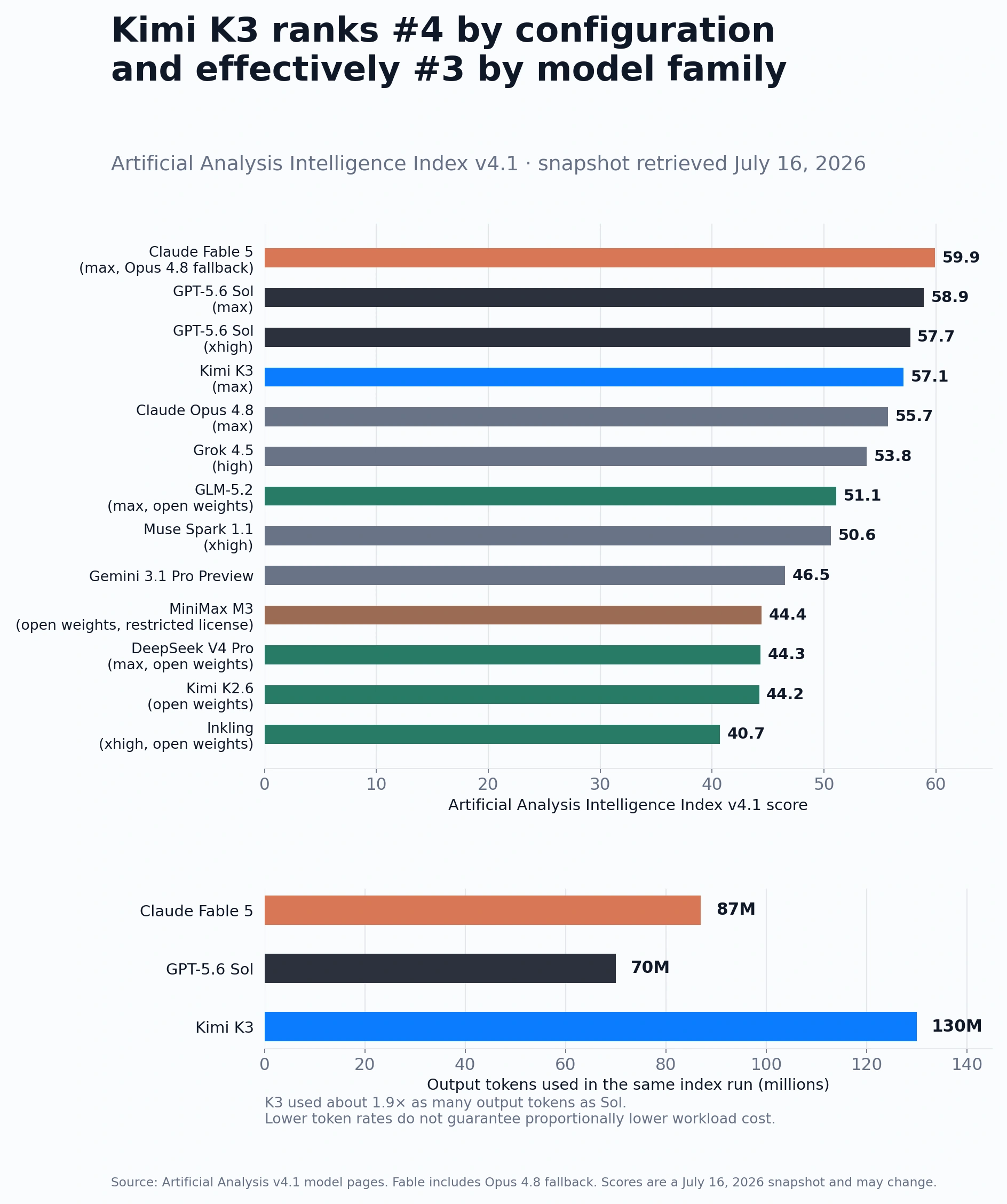
The strongest launch-day evidence is Artificial Analysis’s independent Kimi K3 evaluation. Its v4.1 index combines nine evaluations across agentic work, terminal use, scientific reasoning, knowledge and long-context reasoning rather than relying on one coding leaderboard. The published methodology weights agents at 34%, coding at 24%, scientific reasoning at 24% and general capability at 18%. The retained live profile has since changed and does not reproduce every exact July 27 score, token, cost or confidence-interval cell below.
| Rank | Model / effort | AA v4.1 | Release status | How to read it |
|---|---|---|---|---|
| 1 | Claude Fable 5, adaptive Max with Opus 4.8 fallback | 59.9 | Proprietary | Fallback-enabled production configuration |
| 2 | GPT-5.6 Sol Max | 58.9 | Proprietary | Best single-model Sol setting |
| 3 | GPT-5.6 Sol xhigh | 57.7 | Proprietary | Same model family as rank 2 |
| 4 | Kimi K3 Max | 57.1 | API and open weights available | Effectively #3 model family |
| 5 | Claude Opus 4.8, adaptive Max | 55.7 | Proprietary | Pure Opus result without Fable fallback framing |
| 6 | Grok 4.5 High | 53.8 | Proprietary | K3 leads by 3.3 points |
| 7 | GLM-5.2 Max | 51.1 | Open weights · MIT | Next open-weight comparator by score in this snapshot |
| 8 | Muse Spark 1.1 xhigh | 50.6 | Proprietary | Cheaper and faster, lower composite |
| 9 | Gemini 3.1 Pro Preview | 46.5 | Proprietary preview | Stronger on several knowledge and vision measures |
| 10 | MiniMax M3 | 44.4 | Open weights · restricted terms | Commercial conditions apply |
| 11 | DeepSeek V4 Pro Max | 44.3 | Open weights · MIT | Large deployable open model |
| 12 | Kimi K2.6 | 44.2 | Open weights · modified MIT | K3 improves by 12.9 points |
| 13 | Inkling xhigh | 40.7 | Open weights · Apache 2.0 | One-million-token context |
Using the rounded scores displayed in the table, K3 trails Sol xhigh by about 0.6 points, Sol Max by about 1.8 points and the Fable configuration by about 2.8 points. Artificial Analysis estimates the overall index’s 95% confidence interval at less than roughly one point, so the smallest displayed gap is not decisive. The larger gaps still do not replace workload-specific testing. The index is text-only and English-only; it cannot establish a multimodal or multilingual ranking by itself.
Cost and token use across the three leaders
| Configuration | AA v4.1 | Output tokens across the index | Total evaluation cost |
|---|---|---|---|
| Claude Fable 5 Max, Opus 4.8 fallback | 59.9 | 87 million | $5,630.52 |
| GPT-5.6 Sol Max | 58.9 | 70 million | $2,824.00 |
| Kimi K3 Max | 57.1 | 130 million | $2,690.80 |
K3 used far more output tokens to complete the evaluation—about 1.9 times Sol’s total and 1.5 times Fable’s—yet its lower token prices kept the evaluation bill slightly below Sol and far below the Fable configuration. That is promising price-performance, not proof that K3 will be cheaper in every deployment: agent loops, cache reuse, retries and output length can move real costs sharply. For deeper context on the two proprietary leaders, see Kingy AI’s analyses of GPT-5.6 Sol’s benchmarks and specifications and Claude Fable 5’s benchmark and pricing picture.
Kimi K3 vs Grok 4.5, Muse Spark 1.1 and Gemini 3.1 Pro
The composite score hides important reversals. The table below uses Artificial Analysis’s standardized results for four frontier models that are easy to omit when focusing only on the top three. K3 leads all three alternatives on the overall, agentic and coding indices, but Gemini remains stronger on scientific knowledge, factual reliability and visual reasoning.
| Independent metric | Kimi K3 Max | Grok 4.5 High | Muse Spark 1.1 xhigh | Gemini 3.1 Pro Preview |
|---|---|---|---|---|
| AA Intelligence Index v4.1 | 57.1 | 53.8 | 50.6 | 46.5 |
| Agentic Index | 50.1 | 45.7 | 37.5 | 21.4 |
| Coding Index | 76.2 | 72.5 | 71.3 | 68.8 |
| Terminal-Bench 2.1 | 85.0% | 81.7% | 77.9% | 73.8% |
| Humanity’s Last Exam, text only | 44.4% | 40.3% | 45.1% | 44.7% |
| GPQA Diamond | 93.5% | 93.1% | 89.8% | 94.1% |
| AA-Omniscience Index | 18.4 | 26.4 | 18.0 | 32.9 |
| MMMU-Pro | 80.5% | 80.4% | Not reported | 82.4% |
| Context window | 1.05M | 500K | 1.05M | 1M |
| Input / output price per 1M tokens | $3 / $15 | $2 / $6 | $1.25 / $4.25 | $2 / $12 |
The practical read: K3 is the stronger candidate for coding agents and long-horizon tool work in this group. Gemini is the safer counterexample to any “K3 wins everything” claim; it leads on GPQA, AA-Omniscience and MMMU-Pro. Muse is materially cheaper and edges K3 on Humanity’s Last Exam, while Grok’s lower overall score still comes with better knowledge reliability. Model selection should follow the task profile, not the composite rank alone.
Moonshot’s coding results are impressive—and not apples to apples
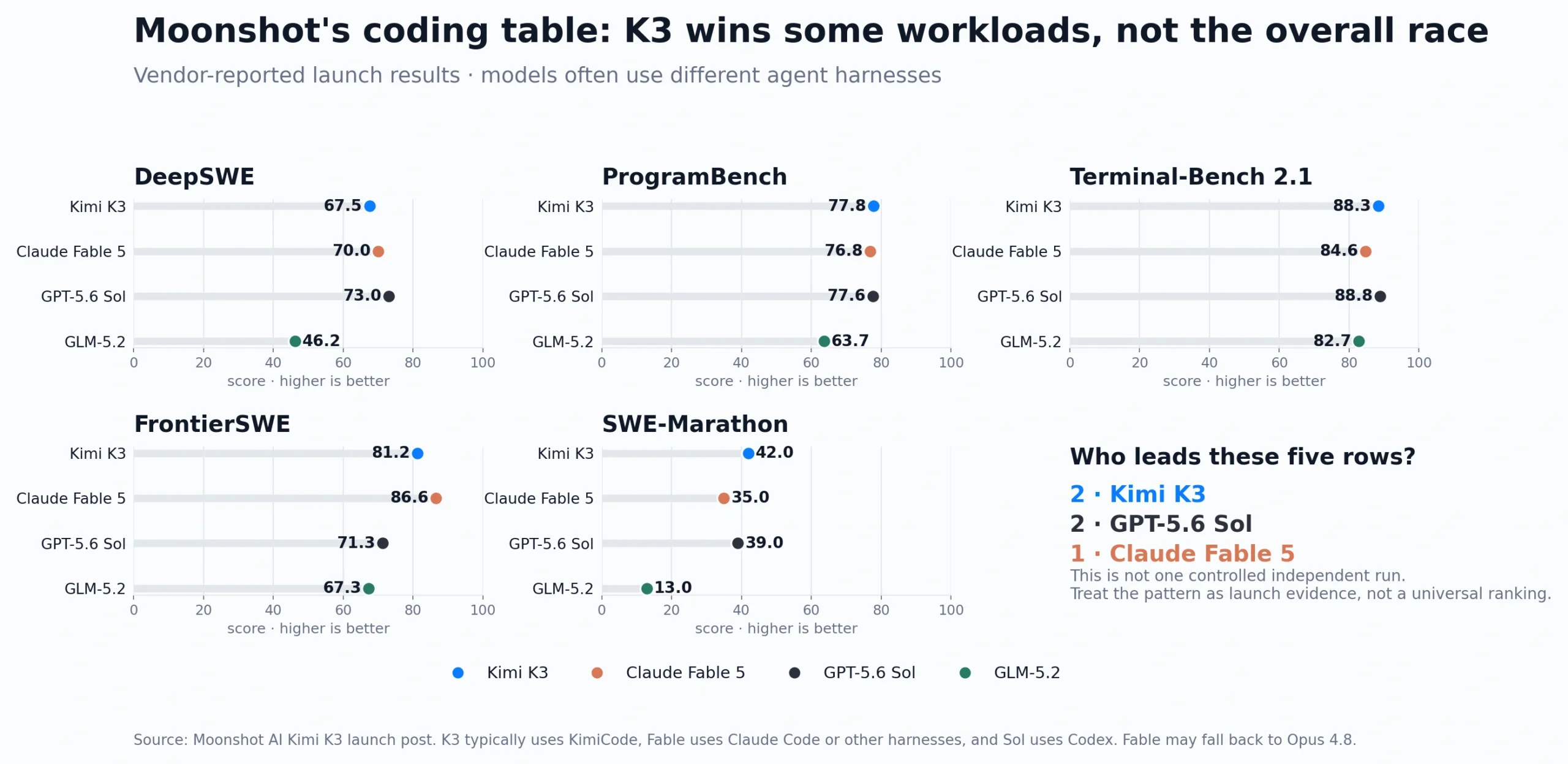
| Benchmark | Kimi K3 Max | Fable 5 Max, fallback allowed | GPT-5.6 Sol Max | GLM-5.2 Max |
|---|---|---|---|---|
| DeepSWE | 67.5 | 70.0 | 73.0 | 46.2 |
| Program Bench | 77.8 | 76.8 | 77.6 | 63.7 |
| Terminal-Bench 2.1 | 88.3 | 84.6 | 88.8 | 82.7 |
| FrontierSWE | 81.2 | 86.6 | 71.3 | 67.3 |
| SWE Marathon | 42.0 | 35.0 | 39.0 | 13.0 |
On Moonshot’s table, K3 leads Program Bench by 0.2 points over Sol and SWE Marathon by three points. It lands within 0.5 points of Sol on Terminal-Bench 2.1, while Fable leads FrontierSWE and Sol leads DeepSWE. This is not a story of K3 winning every coding benchmark; it is a story of the model staying competitive across several different kinds of long-horizon software work.
The testing conditions limit stronger conclusions. K3 uses the Kimi Code harness on DeepSWE, Program Bench, Terminal-Bench and FrontierSWE. Sol often uses Codex, while Fable and other Claude models use Claude Code or Terminus depending on the test. Fable’s safeguards can route some sessions to Opus 4.8, so its rows describe the production configuration rather than the underlying Fable model alone. On Terminal-Bench, Moonshot selects the best reported harness for several competitors. SWE Marathon mixes Claude Code for K3 and the Anthropic models with Codex for Sol. At publication time, the public DeepSWE and Program Bench pages also did not yet show a K3 entry that independently reproduced Moonshot’s number.
Moonshot says its K3 runs use Max reasoning, temperature 1.0 and top-p 1.0. The public API quickstart showed top-p 0.95 when checked on launch day. Even that small configuration mismatch is enough reason for evaluators to publish exact prompts, harness versions, tool permissions, token budgets and retry rules before treating a reproduction as definitive.
Agent and vision evaluations
Moonshot’s broader table suggests K3 is strongest when coding, browsing, tools and visual reasoning meet. On its reported agent evaluations, K3 scores 1,668 Elo on GDPval-AA v2, behind Fable at 1,760 and Sol at 1,748 but above Claude Opus 4.8 at 1,600. It reaches 1,548 on AA-Briefcase, second to Fable’s 1,583 and ahead of Sol’s 1,495. K3 also leads the compared group on Automation Bench at 30.8 and BrowseComp at 91.2, while Fable leads JobBench at 57.4.
| Moonshot-reported evaluation | Kimi K3 | Fable 5, fallback allowed | GPT-5.6 Sol | What it suggests |
|---|---|---|---|---|
| GDPval-AA v2 Elo | 1,668 | 1,760 | 1,748 | K3 is competitive but trails both frontier leaders |
| AA-Briefcase Elo | 1,548 | 1,583 | 1,495 | K3 sits between Fable and Sol on long-horizon knowledge work |
| Automation Bench | 30.8 | 29.1 | 29.7 | K3 holds a narrow reported lead |
| JobBench | 52.9 | 57.4 | 46.5 | Fable leads; K3 clears Sol |
| SpreadsheetBench 2 | 34.8 | 34.7 | 32.4 | Near tie with Fable under different harnesses |
| BrowseComp | 91.2 | 88.0 | 90.4 | K3 posts the best reported score |
Do not combine Moonshot’s 30.8 Automation Bench figure with Artificial Analysis’s separate AutomationBench-AA result, where K3 scores 52.7. The names are similar, but the implementations and scales differ. The first is part of Moonshot’s launch table; the second is an independent AA workflow evaluation.
Native vision also appears useful rather than decorative. Moonshot reports K3 at 81.6 on MMMU-Pro versus 81.2 for Fable and 83.0 for Sol. With Python tools, K3 reaches 91.3 on CharXiv RQ, between Fable’s 93.5 and Sol’s 89.1; on MathVision with Python, K3 and Sol tie at 97.8 behind Fable at 98.6. K3’s 91.1 on OmniDocBench leads Fable at 89.8 and Sol at 85.8. These are still vendor-collected comparisons, and some visual tests are averaged over only three runs. They support a serious multimodal capability claim, not a universal vision crown.
Speed, latency, verbosity and real cost
K3’s API begins streaming quickly, but the final answer does not arrive in two seconds. Artificial Analysis measures a 1.99-second time to the first streamed chunk, followed by about 32.24 seconds of reasoning before the first answer token. On its standardized 500-token performance workload, total response time is about 42.30 seconds.
| Independent API measure | Kimi K3 | Relevant comparison | Interpretation |
|---|---|---|---|
| Output speed | 62.0 tokens/s | 72.7 tokens/s peer median | Below-median generation speed |
| Time to first streamed chunk | 1.99 seconds | 2.60-second peer median | Fast initial stream, not a completed answer |
| Time to first answer token | 34.24 seconds | Includes 32.24 seconds of reasoning | More representative of perceived wait |
| Total standardized response time | 42.30 seconds | 500-token test response | Reasoning dominates end-to-end latency |
| Index output-token use | 130 million | 63 million peer median | K3 is unusually verbose |
What representative K3 requests cost
| Illustrative workload | K3 with uncached input | K3 if all input hits cache | Calculation |
|---|---|---|---|
| 100K input + 10K output | $0.45 | $0.18 | Input plus output token charges |
| 950K input + 50K output | $3.60 | $1.04 | Fits inside the 1,048,576-token combined window |
For the 100K-input, 10K-output example, the July 27 GPT-5.6 Sol rates produced an $0.80 token bill and Fable 5’s snapshot rates produced $1.50, before tool charges or provider-specific caching. Near the context limit, Sol applies long-context multipliers above 272K input tokens, which makes a simple headline-rate multiplication misleading. These calculations are estimates, not task-cost guarantees: K3’s high reasoning-token use can erase part of its list-price advantage.
Is Kimi K3 really open source?
Kimi K3 is now available as open weights under a custom licence. Moonshot’s official model repository publishes the full 2.8-trillion-parameter checkpoint, a 104-billion activated-parameter count, the model card, configuration files and deployment guidance. That release is substantial, but “open weights” is more precise than unqualified “open source” because the custom licence includes commercial scale conditions. See our plain-English Kimi K3 licence analysis.
The released K3 checkpoint changes the open-weight comparison. Its 57.1 Artificial Analysis score is 6.0 points above GLM-5.2 Max. The table below distinguishes standard permissive licences from custom or restricted terms; a downloadable model is not automatically unconditionally open source.
| Model | AA v4.1 | Total / activated parameters | Context | Weights and licence on July 27 |
|---|---|---|---|---|
| Kimi K3 Max | 57.1 | 2.8T / 104B | 1M | Available · custom Kimi K3 License |
| GLM-5.2 Max | 51.1 | 753B / 40B | 1M | Available · MIT |
| MiniMax M3 | 44.4 | 428B / 23B | 1M | Available · community license with commercial conditions |
| DeepSeek V4 Pro Max | 44.3 | 1.6T / 49B | 1M | Available · MIT |
| Kimi K2.6 | 44.2 | 1T / 32B | 256K | Available · modified MIT |
| Inkling xhigh | 40.7 | 975B / 41B | 1M | Available · Apache 2.0 |
| Nemotron 3 Ultra | 37.8 | 550B / 55B | 262K | Available · OpenMDW |
| Qwen3.6 27B | 37.1 | 27.8B dense | 262K | Available · Apache 2.0 |
| Qwen3.5-397B-A17B | 33.7 | 397B / 17B | 262K | Available · Apache 2.0 |
| Gemma 4 31B | 29.4 | 30.7B dense | 256K | Available · Apache 2.0 |
| gpt-oss-120b High | 23.8 | 117B / 5.1B | 131K | Available · Apache 2.0 |
| Mistral Large 3 | 16.0 | 675B / 41B | 256K | Available · Apache 2.0 |
This table also explains why “best” is not synonymous with “largest.” Qwen3.6 27B is far easier to deploy than a multi-trillion-parameter MoE, even though its composite score is lower. MiniMax M3 and K3 are downloadable under custom terms rather than standard MIT or Apache 2.0 licences.
The remaining catch is infrastructure. The model card reports 104 billion activated parameters and native MXFP4 weights with MXFP8 activations, while Moonshot recommends vLLM, SGLang or TokenSpeed for serving. Its launch guidance points to supernodes with 64 or more accelerators. For most teams, open weights will mean specialist inference infrastructure rather than a workstation. See our download and official-weight guide, hardware and local-deployment guide, and open-weight model comparison.
Strengths, limitations and deployment verdict
Where Kimi K3 looks strongest
- Near-frontier general capability: A 57.1 independent index score places K3 fourth by configuration and effectively third by model family.
- Long-horizon coding: Its consistency across Program Bench, Terminal-Bench, FrontierSWE and SWE Marathon makes a credible case for repository-scale and tool-heavy work.
- Vision inside the agent loop: Native visual input, a million-token window and strong chart, document and multimodal scores fit browser, frontend, research and document workflows.
- API economics: K3 completed the Artificial Analysis suite at a slightly lower reported cost than Sol despite using substantially more output tokens.
- Weight access: The released checkpoint gives researchers and infrastructure providers unusual control over a near-frontier model.
What should stop an immediate migration
- Unusual licence terms: The custom Kimi K3 License allows broad commercial use but adds conditions for certain large Model-as-a-Service businesses and very large products.
- Detailed comparisons are vendor-run: Mixed harnesses and unpublished K3 leaderboard entries make several coding wins provisional.
- Benchmark-setting caveat: The headline evaluations use max reasoning; lower effort modes may change quality, latency and cost.
- High token use: Artificial Analysis recorded 130 million output tokens for K3, making generation discipline and cache design important.
- Knowledge reliability is not class-leading: K3’s 18.4 AA-Omniscience Index trails Grok 4.5 at 26.4 and Gemini 3.1 Pro Preview at 32.9.
- The headline index is narrow by design: It is an English-only, text-only suite and cannot settle multimodal or multilingual performance.
- Operational sensitivity: Moonshot warns that K3 expects its full thinking history to be preserved. Switching models mid-session or using an incompatible harness can destabilize quality.
- Excessive proactivity: Moonshot says K3 may make unexpected decisions when instructions are ambiguous. High-impact tools need strict permissions, confirmations and explicit behavioral boundaries.
- User experience gap: The company itself acknowledges that K3 still trails Fable 5 and GPT-5.6 Sol in overall user experience.
Verdict: Kimi K3 deserves an immediate controlled pilot for coding agents, deep research, visual document work and long-context automation. It does not yet justify a blanket replacement of Fable 5 or GPT-5.6 Sol. Run the same internal tasks through the same harness, cap tool permissions, record token and retry costs, and score completion quality—not just benchmark rank. For regulated or high-scale commercial deployment, inspect the custom licence, validate the released checkpoint under your own harness and budget for cluster-scale serving.
Frequently asked questions
What is Kimi K3?
Kimi K3 is Moonshot AI’s 2.8-trillion-parameter Mixture-of-Experts model for reasoning, coding, knowledge work and native visual understanding. It supports a 1,048,576-token context window and is available through Kimi products and the Kimi API.
How does Kimi K3 compare with Claude Fable 5 and GPT-5.6 Sol?
In the article’s July 27 Artificial Analysis v4.1 snapshot, K3 Max was recorded at 57.1, GPT-5.6 Sol Max at 58.9 and Fable 5 Max with Opus 4.8 fallback at 59.9. K3 was fourth by configuration and effectively third by model family. The retained dated AA article corroborates the rounded 57 and third-place framing, not every exact table value.
How much does the Kimi K3 API cost?
The launch rate is $0.30 per million cached input tokens, $3 per million uncached input tokens and $15 per million output tokens. Actual workload cost will depend heavily on cache hits, output length and agent retries.
Is Kimi K3 open source or open weight?
Kimi K3 is now downloadable as open weights under the custom Kimi K3 License. The licence broadly permits commercial use, modification and redistribution, but it is not a standard MIT or Apache licence and includes conditions for certain high-scale commercial deployments.
Can Kimi K3 process images and video?
Yes. K3 accepts image and video input alongside text, and its launch table reports results on MMMU-Pro, CharXiv, MathVision, ZeroBench, OmniDocBench and other multimodal evaluations. Output is text.
Can most companies self-host Kimi K3?
Probably not economically on ordinary infrastructure. Sparse routing means only a subset of experts is selected per token, but the model still contains 2.8 trillion total parameters. Moonshot recommends supernodes with at least 64 accelerators. The official model card lists 104 billion activated parameters, and the released repository provides the current distribution files and deployment guidance.
Should teams switch from GPT-5.6 Sol or Fable 5?
Not without an internal bake-off. K3 is close on the independent composite, cheaper than Sol across the Artificial Analysis evaluation run and strong on several agent tests. Sol and the Fable configuration still score higher overall, while K3 has launch-day reproducibility and UX caveats. Route representative production tasks through identical tools and score accuracy, intervention rate, latency and total cost.
Sources and evidence standard
Primary launch specifications, pricing, availability, benchmark settings and limitations come from Moonshot AI’s Kimi K3 launch post, the official K3 API quickstart and the company’s launch announcement on X. The independent composite score, sub-evaluations, token use, speed and cost come from Artificial Analysis’s K3 profile, its v4.1 leaderboard and its published methodology. Comparator values were checked against the AA profiles for Grok 4.5, Muse Spark 1.1 and Gemini 3.1 Pro Preview, plus official model cards and licenses for the open-weight field. Moonshot’s detailed benchmark scores remain vendor-reported unless explicitly identified as independent. The July 27 weight release is reflected in the official repository cited above; that release does not independently recertify the article’s historical benchmark tables.
The Kingy Brief
Get The Kingy Brief.
AI changes, original tests and one practical thing to try. Fridays at 09:00 Vancouver time.
Free · Double opt-in · Unsubscribe anytime
Sign up for The Kingy Brief on Beehiiv.
Signup help and newsletter schedule
Signup form provided by Beehiiv. After submitting, check your inbox for "Confirm your subscription to The Kingy Brief" and open its confirmation link. Check Spam or Promotions if you cannot find it.
Fridays at 09:00 Vancouver time: source-checked AI changes, original tests and one practical thing to try. We skip a week when there is not enough verified material. Free. Unsubscribe anytime.