Answer first: No—not wholly in 128GB unified memory. A 128GB Mac can address the files, but the smallest audited Unsloth GGUF is about 594GB and its guide calls for roughly 610GB of memory; storage-backed experiments are not normal local inference.
Evidence refresh (August 9, 2026): Moonshot’s current model card still identifies Kimi K3 as a 2.8T-parameter, 104B-active, one-million-token model. Preserve the distinction between official weights, third-party GGUFs and unverified runtime anecdotes.
What this guide now answers
- minimum storage and memory
- why mmap is not the same as fitting in RAM
- Mac Studio tiers that still do not fit
- API versus local break-even
Related Kingy intelligence
- full Kimi K3 hardware and cost guide
- AI model records
- open-weight launch tracker
- AI Model-Fit Calculator — estimate the same model file against a local machine’s memory budget; the result estimates fit, not speed or output quality.
Evidence, testing and corrections
This refresh is a source audit unless the original article explicitly identifies a preserved hands-on test ledger. Official product facts, vendor claims, third-party builds and community observations remain separately labeled. If a cited source changes, use Kingy’s correction process rather than silently changing the historical evidence date.
Frequently asked questions
Can Kimi K3 fit in 128GB RAM?
No. The audited smallest GGUF is several times larger than 128GB.
Can SSD offload make it practical?
It can make an experiment start, but does not turn it into responsive in-memory inference.
Primary sources checked: Source 1 · Source 2 · Source 3 · Source 4
Unsloth’s new 1-bit GGUF makes Kimi K3 locally runnable, but the smallest build is 594GB and its guide calls for roughly 610GB of memory. A 128GB Mac can address the weights, not hold them.
The answer in one sentence: Kimi K3 can now run from local weights, but it does not fit in a standalone 128GB Mac Studio; SSD-backed execution may produce tokens, while useful Mac performance remains unproven.
Testing disclosure: This is a source-based feasibility analysis, not a hands-on 128GB Mac benchmark. Kingy inspected the published model files, documentation, implementation pull requests, hardware specifications and Unsloth’s demonstrations. We did not download the 594GB quant, run it on a Mac, or independently reproduce the reported 36-token-per-second B200 result.
Quick verdict
Unsloth has achieved something technically impressive. Its smallest Kimi K3 GGUF reduces a roughly 1.56TB released checkpoint to 594GB, and the company has shown that build generating coherently on local hardware. “Kimi K3 can run locally” is therefore a defensible claim.
The ordinary reading, “this enormous model now runs normally on a 128GB Mac Studio,” is not supported. Unsloth’s guide lists approximately 610GB of combined RAM, VRAM or unified memory for the smallest quant. A 128GB Mac is 482GB below that guidance before macOS, inference buffers and context state enter the calculation.
The distinction is simple but consequential: runnable is not resident, and resident is not necessarily usable.
| Claim | Verdict | What the evidence supports |
|---|---|---|
| Kimi K3 can run from local weights | True | The GGUF files are public and Unsloth demonstrated the 1-bit build on four B200 GPUs. |
| Kimi K3 fits in 128GB unified memory | False | The smallest quant is 594GB; Unsloth recommends about 610GB total memory. |
| A standalone 128GB Mac may emit tokens | Plausible | Memory mapping can fetch weights from SSD, but this is not the same as holding them in memory. |
| A 128GB Mac is practical for K3 | Unproven | No reproducible Mac command, time to first token, decode speed, tested context or stability data has been published. |
| The 1-bit model retains 78.9% “accuracy” | Misleading shorthand | The figure is top-1 next-token agreement, not retained task or benchmark accuracy. |
Best for
- Researchers exploring how far local inference and extreme quantization can be pushed.
- Teams with at least roughly 610GB of accessible high-speed memory and tolerance for experimental software.
- Mac owners who treat the exercise as a systems experiment rather than a daily assistant.
Skip it if
- You expect a normal point-and-click 128GB Mac deployment.
- You need predictable interactive speed, concurrency or production support.
- You need the native model’s published benchmark quality to carry over automatically to the smallest quant.
What changed since Kingy’s first hardware analysis
When Kingy examined the original Kimi K3 release on July 27, the hardware conclusion was stark: the roughly 1.56TB checkpoint was beyond even a 512GB Mac Studio. That analysis remains correct for the native released weights.
Two days later, Unsloth changed the narrower feasibility question. It published several GGUF variants, including the 594GB UD-IQ1_S, and supplied a new llama.cpp path. The new build does not make Kimi K3 small. It makes Kimi K3 small enough to map on local storage and fit in unusually large multi-GPU or pooled-memory systems.
That is why this article updates rather than reverses Kingy’s original Kimi K3 hardware analysis and its guide to the native open-weight download. The answer to “Can local software address these weights?” is now yes. The answer to “Do the weights fit on a 128GB Mac?” remains no.
The memory math: 128GB versus 594GB
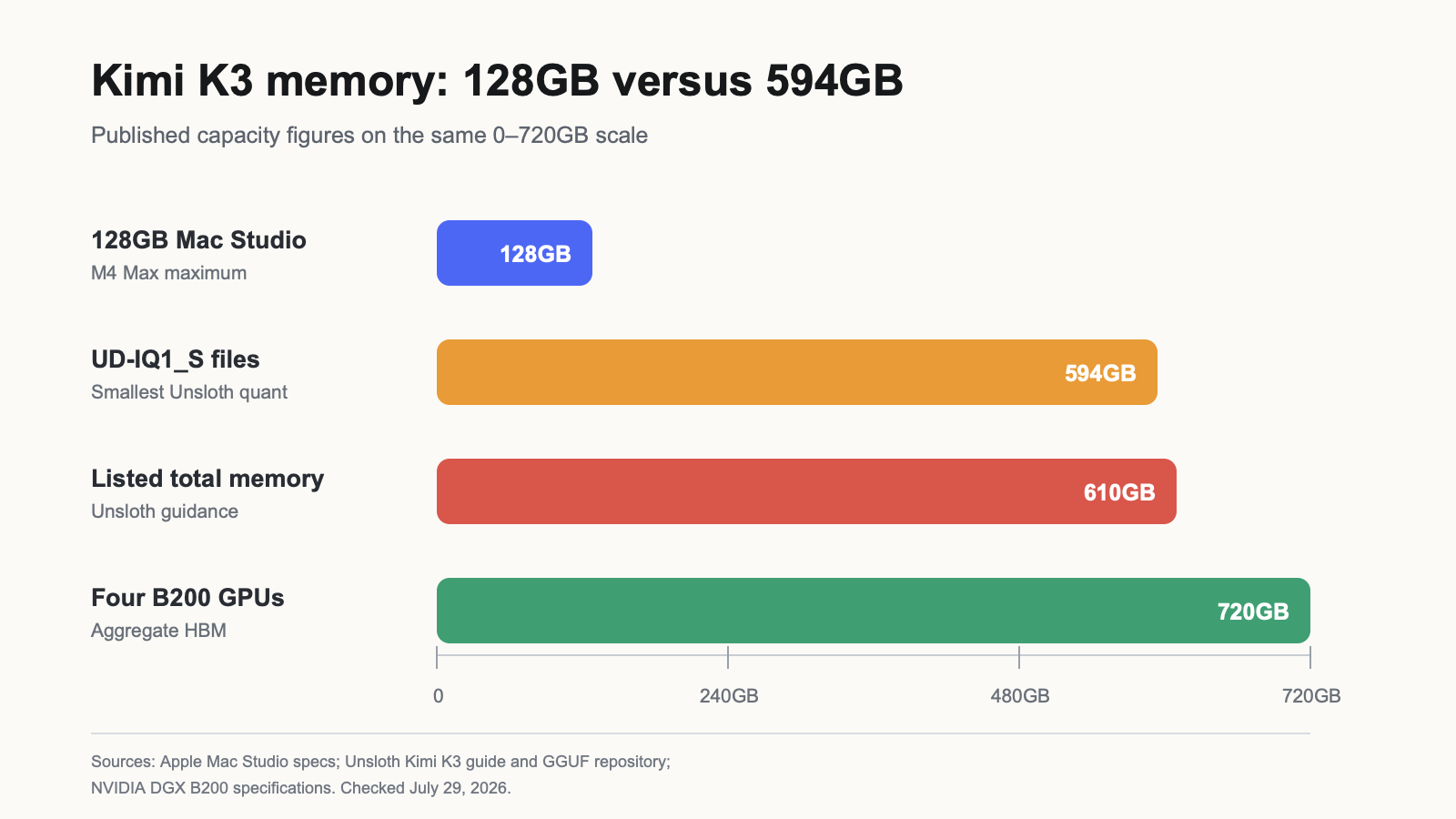
The smallest published Unsloth quant is not approximately 128GB. It is 593,997,933,024 bytes, distributed across 14 GGUF shards: 594.0GB in decimal units, or about 553.2GiB in binary units. The optional BF16 vision projector adds roughly another 0.9GB. The files are listed in Unsloth’s Hugging Face repository.
Unsloth’s own rule of thumb is that combined RAM and VRAM should approximately match the quant size. Its table assigns UD-IQ1_S a 610GB total-memory requirement.
Using the figures as marketed:
- The 594GB weight set is 4.64 times a 128GB Mac’s physical memory.
- The Mac is 482GB below Unsloth’s 610GB recommendation.
- A 512GB M3 Ultra Mac Studio is also below the 553.2GiB file size before overhead.
- Four 180GB B200 GPUs provide 720GB of HBM, enough for the 594GB quant plus working headroom.
The exact Unsloth wording matters. Its social post says “Mac Studio + 128GB RAM device,” while the guide describes a Mac Studio “connected to a 128GB RAM device.” It does not unequivocally say “a Mac Studio with 128GB.”
One arithmetically plausible reading is a 512GB M3 Ultra Mac Studio plus a separate 128GB memory node, producing 640GB raw capacity. Apple’s 2025 Mac Studio supports up to 512GB unified memory on M3 Ultra. But this remains an editorial inference: Unsloth has not published the second device, interconnect, runtime command, memory allocation or performance.
How can it “run” without fitting?
llama.cpp normally memory-maps GGUF files. Instead of copying the entire model into physical memory at startup, the operating system maps the files into the process’s address space and loads pages when the runtime touches them.
When the mapped model is comfortably smaller than available memory, that design reduces startup friction. When a model is several times larger than physical memory, the storage system becomes part of the inference loop. Pages are loaded, evicted and potentially loaded again as different weights are needed.
That can make an oversized model technically executable. It does not make SSD storage behave like Apple’s unified memory.
An internal Mac Studio SSD can move data quickly by consumer-storage standards. Unified memory operates at a radically different bandwidth and latency regime. Kimi K3’s mixture-of-experts routing compounds the problem because different tokens can activate different experts. A system that cannot keep those experts resident may spend much of its time waiting for weights rather than calculating tokens.
Unsloth acknowledges the basic trade-off in its guide: if RAM plus VRAM falls below the quant size, the model may still work, but it will be “much slower” because of disk offloading. What the company has not published is the measurement readers need: how much slower on a specific 128GB Mac?
Without a documented command, context length, prompt-processing speed, decode speed and memory-pressure trace, it would be irresponsible to invent a number.
Why “104B active” does not mean a 104B-sized model
Moonshot’s model card describes Kimi K3 as a 2.8-trillion-parameter mixture-of-experts model with 104 billion parameters activated for each token. It contains 896 routed experts and selects 16 per token.
The 104B figure describes sparse computation, not storage. The router may select one group of experts for one token and a different group for the next. All experts therefore have to remain available in memory, on another device or on storage.
That separation explains both sides of the story. Kimi K3 does not perform the full arithmetic of a dense 2.8T model for every token, which makes inference less impossible than the headline parameter count suggests. But its weight files do not collapse to the footprint of a conventional 104B model.
What the four-B200 demonstration proves
In a follow-up post, Unsloth said its 1-bit Kimi builds remained capable after quantization and highlighted a test running the GGUF on four B200 GPUs at 36 tokens per second. The company also showed a one-shot coding demonstration involving a glass aquarium whose panel cracks and bursts.
This is useful evidence that the 1-bit files are functional. It is not a controlled quality comparison against GPT-5.6 Sol or Claude Opus 5, and it is not a Mac benchmark.
NVIDIA documents 1,440GB of total GPU memory across eight B200 GPUs, or 180GB each. Four therefore provide approximately 720GB of HBM. That configuration has enough aggregate GPU memory to hold the 594GB quant, and it uses NVIDIA’s datacenter interconnect and low-precision compute stack.
The result supports Unsloth’s roughly 610GB requirement. It tells us almost nothing about a 128GB Mac that must repeatedly fetch experts from SSD.
The aquarium example should also be read for what it is: a qualitative demonstration. A defensible model comparison would need a disclosed prompt, matched sampling and reasoning settings, repeated trials, an evaluation rubric and preferably blind scoring. One impressive output establishes possibility, not a general capability rate.
“78.9% accuracy” is not task accuracy
The original Unsloth post says the smallest model retains approximately 78.9% “accuracy.” The accompanying guide uses a more precise label: 78.875% top-1 agreement, with a reported uncertainty of ±0.107 percentage points.
Top-1 agreement asks whether the quantized model and reference model assign the highest probability to the same next token. It does not measure whether the model solves 78.9% of coding tasks, retains 78.9% of its reasoning ability or achieves 78.9% of the native checkpoint’s benchmark scores.
At the token level, the top-ranked prediction differs roughly one time in five. That is a substantial distribution change. But it also cannot be converted mechanically into “21.1% less intelligence,” because text generation is sequential: one changed token can redirect everything after it, while many different token choices can still lead to a correct answer.
Unsloth’s table provides useful quantization diagnostics, including perplexity and Kullback–Leibler divergence, but it does not publish a broad downstream benchmark suite for UD-IQ1_S. Until those task-level results exist, the native and hosted results examined in Kingy’s Kimi K3 benchmark analysis should not be attached to the 1-bit build.
There is another naming caveat. “1-bit” is a convenient label for a dynamic mixed-precision recipe, not a literal statement that every one of the model’s 2.8 trillion parameters occupies exactly one bit. Dividing the 594GB file by the parameter count yields an average near 1.7 stored bits per parameter before the separate vision projector.
Apple Silicon support is still experimental
The software path was moving quickly on launch day.
As checked on July 29, the upstream llama.cpp text-support pull request remained open. The Unsloth pull request adding full-size fixes and a MoonViT image path was also open and stacked on the upstream branch.
Several practical consequences follow:
- The safest assumption is that a specific fork and commit are required until support lands in a normal release.
- Generic Hugging Face launcher snippets are not proof that every current llama.cpp, Ollama or LM Studio build handles the full model correctly.
- The upstream work notes that one K3 operation lacks a Metal/Vulkan kernel and falls back to CPU per node.
- Unsloth’s local multimodal work implements the image path; its pull request says audio is not included.
- Long-context architectural support does not establish practical one-million-token use on a memory-starved Mac.
This is not a criticism of an active open implementation. It is a reason to timestamp any how-to guide and pin exact commits instead of promising a stable consumer workflow.
Pros, cons and the real trade-offs
What local Kimi K3 offers
Data control. Once the weights and runtime are downloaded, text inference can be performed without sending prompts to a hosted model. That can matter for confidential code or documents. Web tools, telemetry, public tunnels and remote nodes alter that privacy boundary, so “local” alone is not a complete security model.
Model control. A team can pin a particular checkpoint and runtime, inspect the weights, reproduce an environment and avoid vendor rate limits or outages.
Research value. Running a 2.8T MoE from consumer-adjacent hardware is a worthwhile systems experiment. Unsloth’s compression work expands what independent researchers can explore.
No metered inference bill. After hardware, storage and electricity are paid for, there is no per-token model fee.
What it costs
Storage. The smallest text build is nearly 600GB. Download caches, working copies and the projector can increase the actual free-space requirement.
Memory pressure. A standalone 128GB Mac must leave most weights file-backed. That is the central performance constraint, not a minor setup detail.
Quantization uncertainty. The smallest build has materially different token probabilities, while independent downstream capability retention remains unknown.
Experimental software. Forks, open pull requests, incomplete kernels and changing launch instructions raise maintenance and reproducibility costs.
Context and concurrency. The advertised 1,048,576-token context window is a model maximum, not evidence of fast local prefill. Multiple concurrent sessions multiply memory and throughput demands.
Opportunity cost. The time spent downloading, compiling, diagnosing and waiting may cost more than API usage, even when the machine is already owned.
License review. The weights use the custom Kimi K3 License, not a standard OSI software license. It grants broad rights but contains additional conditions for very large products and model-as-a-service businesses. Kingy’s Kimi K3 license guide explains those thresholds in more detail.
What should a 128GB Mac owner do?
If the goal is to prove that an enormous MoE can generate from SSD-backed local weights, the Unsloth build is a fascinating experiment. Budget at least 600GB of storage, pin the exact runtime revision, use modest contexts and record the result carefully.
If the goal is an everyday coding assistant or private document model, choose a smaller quantized model that fits comfortably in unified memory. A model that remains resident will usually provide a far better interactive experience than a much larger model stalled on storage.
If the goal is Kimi K3’s actual capability, the official API is the practical baseline. Moonshot currently lists Kimi K3 at $0.30 per million cached input tokens, $3 per million uncached input tokens and $15 per million output tokens. Pricing can change, but those rates offer a useful comparison against hardware, power and engineering time.
If the goal is serious on-premises Kimi K3 deployment, start with Unsloth’s approximately 610GB memory target rather than the 128GB headline, and treat the software stack as pre-mainline until the relevant changes merge.
FAQ
Can Kimi K3 literally run on one 128GB Mac Studio?
It may be able to generate using memory-mapped, SSD-backed weights, because Unsloth says undersized systems can use disk offloading. The 594GB quant does not fit in 128GB, and Unsloth has not published a reproducible standalone-Mac performance result.
Does an external SSD add usable model memory?
It adds storage capacity, not unified-memory bandwidth. It may hold the GGUF files, but fetching experts from storage remains far slower than accessing resident weights.
Is 36 tokens per second a reasonable Mac expectation?
No. That number came from four NVIDIA B200 datacenter GPUs with approximately 720GB of aggregate HBM. It should not be extrapolated to Apple Silicon.
Does “78.9% accuracy” mean Kimi K3 loses only 21.1% of its ability?
No. The figure is top-1 next-token agreement against a reference. It is neither a task-success score nor a direct percentage of retained intelligence.
Does 104B active parameters mean only 104B parameters need to be loaded?
No. Kimi K3 activates a subset of experts for each token, but the router can select different experts later. The full 2.8T weight pool must remain accessible.
Can the one-million-token context be used on a 128GB Mac?
The architecture supports that maximum, but no practical 128GB-Mac demonstration has been published. Context state and, more importantly, prompt-processing time make the headline maximum a poor assumption for this setup.
Is Kimi K3 open source?
“Open-weight” is the more precise description. The weights are downloadable under a custom Kimi K3 license; deployments should review its commercial conditions.
Final verdict
Kimi K3 is now locally addressable. That is real progress. Unsloth transformed a roughly 1.56TB release into a 594GB GGUF and demonstrated that the extreme quant can produce useful-looking output on sufficiently large local hardware.
A standalone 128GB Mac Studio is not that hardware. It can potentially substitute storage for missing memory and turn inference into a proof of concept, but no published evidence shows that configuration delivering an interactive or production-worthy experience.
The honest four-part answer is:
- Technically runnable: plausible through SSD-backed mapping.
- Resident in 128GB unified memory: no.
- Demonstrated to be interactive on a 128GB Mac: no.
- Production-suitable on a 128GB Mac: no evidence.
Try it for the systems experiment, not because “local” has made 594GB behave like 128GB.
Methodology and limitations
Kingy checked Unsloth’s July 29 posts, guide and Hugging Face repository; Moonshot’s model card, technical documentation, pricing and license; Apple’s Mac Studio specifications; NVIDIA’s DGX B200 specifications; and the relevant llama.cpp pull requests. File-size arithmetic uses the published 594.0GB/553.2GiB figure and the exact shard total surfaced by Hugging Face repository revision 3d4b61ab4b6789d401191c476cbb4567246db8f5.
Kingy did not run the model, measure SSD traffic or power, validate the proposed multi-device Mac topology, or independently score the 1-bit build. Runtime status and pricing were checked on July 29, 2026 and may change.
Official sources
- Unsloth’s Kimi K3 local-running guide
- Unsloth’s Kimi K3 GGUF repository
- Moonshot’s Kimi K3 model card
- Kimi K3 technical report
- Upstream llama.cpp Kimi K3 text-support pull request
- Unsloth’s full-size and vision pull request
- Apple Mac Studio specifications
- NVIDIA DGX B200 specifications
- Official Kimi K3 API pricing
- Kimi K3 License