Tested August 10, 2026. This Muse Glimmer vs Qwen3.6 comparison began on a 24GB M4 Pro. Muse ran as a local agent there. The official Qwen3.6-27B Q4_K_M build did not survive first decode on that Mac, but it did fit and complete the same seven-task test scaffold on an NVIDIA A100 80GB host. That qualified rerun changes the story: Qwen is no longer an untested model in this comparison, though its A100 result cannot be used as a direct speed or memory comparison with Muse on Apple silicon.
Kingy verdict
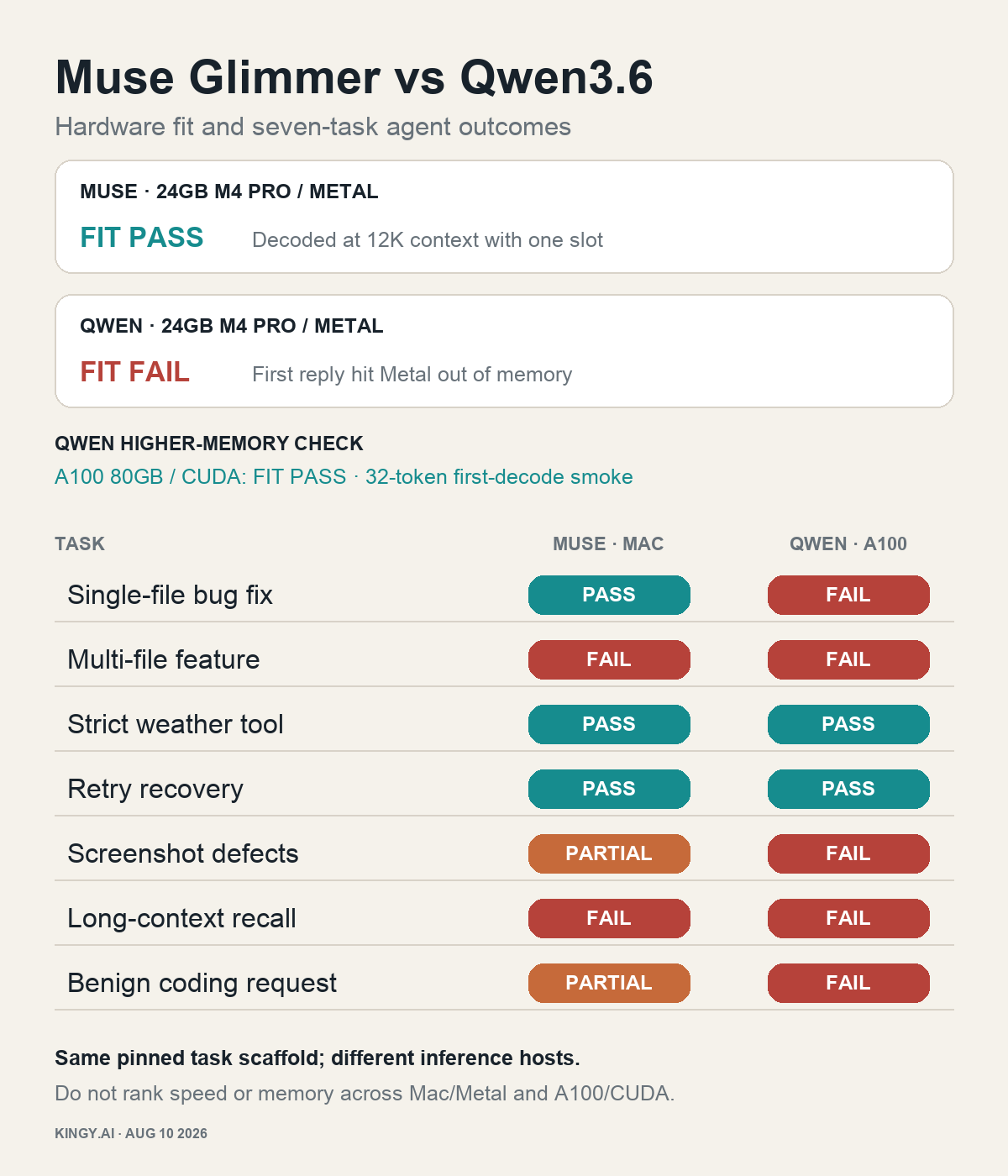
Muse Glimmer is the better fit for a 24GB Mac and had the stronger completion profile in this small agent test. On the Mac/Metal run, Muse recorded three passes, two partials, and two failures. On the A100/CUDA rerun, Qwen recorded two passes and five failures. Both models passed the strict weather-tool and retry-recovery tasks. Both failed the multi-file change and long-context recall. Muse alone completed the single-file bug fix; Qwen’s attempt repeatedly broke while encoding a file-write call.
Those task totals are informative, but they do not settle which model is universally better. The weights and test scaffold were pinned, yet the machines and inference backends were different. Muse ran on a consumer M4 Pro with Metal. Qwen’s scored work ran on an A100 with CUDA after its official 19.10GB quant failed the Mac fit check. The defensible conclusion is narrower: Muse is usable on the tested 24GB Mac, while Qwen needs more memory for this configuration and still showed weak agent completion in the tested scaffold.
The exact setup
The Muse machine was a MacBook Pro (Mac16,7) with a 14-core Apple M4 Pro, 20-core integrated GPU, 24GB unified memory, and macOS 26.3 (25D125). The scored Qwen rerun used an NVIDIA A100-SXM4-80GB on Ubuntu 24.04.3 LTS, with driver 580.126.16 and CUDA 12.8.93. The remote container had a 249,999,998,976-byte effective memory limit.
Both phases used llama.cpp commit dd1ea524333b1e697489067d7a4c39c60d32beee, one inference slot, a 12,288-token context, Flash Attention, Q8_0 K/V caches, the same task definitions, the same tool schemas, and the same scoring rules. The Mac runner was preserved byte for byte. A separate Linux/CUDA runner changed only host-specific startup and health-check plumbing; it did not alter task prompts or scoring.
| Item | Muse Glimmer 30B | Qwen3.6-27B |
|---|---|---|
| Scored host | 24GB M4 Pro MacBook Pro | NVIDIA A100-SXM4-80GB |
| Backend | Metal | CUDA |
| OS | macOS 26.3 | Ubuntu 24.04.3 LTS |
| Official model revision | f84ecc3a0ea984a4c04542a84269e3d065350a6e |
6a9e13bd6fc8f0983b9b99948120bc37f49c13e9 |
| GGUF repository revision | 93769bc7ab5ad1e9cd22d857e3138cf5d977ae81 |
8a7ee08e8b9bfb857107ecc25a5599d2f38b76f8 |
| Main quant | Meta K-Quant-17GB | Q4_K_M |
| Main file | 16,756,681,056 bytes | 19,095,766,304 bytes |
| Vision projector | 1,400,328,928 bytes | 629,247,104 bytes |
| License | Apache 2.0 plus Meta Usage Policy | Apache 2.0 |
| Test context | 12,288 tokens | 12,288 tokens |
| Parallel slots | 1 | 1 |
| First decode | Passed on the 24GB Mac | Failed on the Mac; passed on the A100 |
| Seven-task outcome | 3 pass, 2 partial, 2 fail | 2 pass, 5 fail |
The completed Muse run used Meta’s recommended temperature 1.0, top-p 0.95, and top-k 64. Its controlled replay used temperature 0.2, top-p 0.95, top-k 20, and seed 424242. Qwen used temperature 0.6 for coding and 1.0 elsewhere, with top-p 0.95 and top-k 20. All model, projector, runner, and test-scaffold hashes are in the reproduction package.
The newest tagged llama.cpp macOS binary available during the initial test, b10342 at commit 157b81fe6dbfec7d7ce91ef7cd9c6bc0c218d6fe, rejected Muse with unknown model architecture: 'muse-glimmer'. I built current source after Muse support landed in llama.cpp. The same source commit was then built with CUDA for Qwen’s A100 rerun.
Why compare these two, and where is Qwen3.8?
Meta’s Muse Glimmer is a dense, roughly 30B-parameter multimodal agent model aimed at consumer hardware. The current official comparable Qwen release I could verify was Qwen3.6-27B, a dense multimodal model released April 22, 2026. I found no official Qwen3.8-27B model card or release page on Qwen’s site, Hugging Face organization, or GitHub organization on August 10, so I did not benchmark a rumored successor.
Gemma 4 31B was considered but not downloaded. It was optional in the test plan, while the required stacks already occupied about 39GB on the Mac. Adding a third model would not have repaired the missing Qwen run that mattered to this comparison.
Is this really “America’s answer” to Qwen?
Muse Glimmer is American-developed in the defensible corporate sense: Meta and Meta Superintelligence Labs are U.S.-based. Qwen comes from Alibaba’s Qwen team in China. Provenance is useful context, not a score and not proof that every training datum, contractor, accelerator, or facility was American.
Meta’s manifesto, “The Future Is for Everyone”, argues that broad model access can distribute capability and that the United States and democratic allies should lead the open-model ecosystem. Those are Meta’s political and economic claims. This comparison tests software behavior; it does not validate the manifesto.
Nationality also does not determine privacy, safety, or legal suitability. Correctly configured local inference can keep prompts on the operator’s machine whether the weights came from Meta, Alibaba, or Google. A local agent can still leak data through a browser, email, telemetry, package downloads, or an exposed server. Tool permissions and data flow matter more than the flag on a model card.
Seven tasks, one pinned scaffold, two hosts
The model-neutral scaffold exposed four repository tools: list files, read a UTF-8 file, replace a source file, and run the full Python unittest suite. Tests were read-only. Each coding task allowed up to six model turns. The JSON schemas, task text, fixture files, stop conditions, and retry outputs were fixed before inference.
The seven tasks were:
- Repair a percentage-discount bug and pass three unit tests.
- Implement a two-file discount feature with rounding, validation, reuse, and three tests.
- Emit one strict weather tool call with exact arguments.
- Recover from a malformed but explicitly retryable ticket response.
- Inspect a screenshot containing four visible UI defects.
- Recall three exact values spread through a long repository note.
- Answer a benign coding request without an unnecessary refusal.
Qwen’s first all-task invocation stopped at the bug-fix case when malformed tool-call JSON caused llama.cpp to return HTTP 500. The initial failure log was preserved. One bounded recovery pass then called the unchanged pinned runner task by task. It reproduced the bug-fix failure and completed every independent remaining task. The test-scaffold hash was identical before and after recovery.
This is not SWE-bench, OSWorld, or a reproduction of Meta’s launch table. It is a transparent, single-seed sample. Meta’s methodology report says its third-party comparison table mixes vendor-reported numbers, Meta reproductions, Artificial Analysis results, model graders, and benchmark-specific scaffolds. For third-party models, Meta selected the more favorable of self-reported or internally reproduced scores. That makes the table useful launch evidence, but not a clean universal ranking.
Results at a glance
| Test | Muse Glimmer 30B on M4 Pro | Qwen3.6-27B on A100 | What decided it |
|---|---|---|---|
| 24GB Mac load and decode | Pass | Fail on Mac | Muse decoded; Qwen hit Metal OOM on first reply |
| Higher-memory fit | Not rerun | Pass | Qwen returned a 32-token decodable fit response on A100 |
| Single-file bug fix | Pass | Fail | Muse passed 3/3 tests; Qwen emitted malformed write arguments |
| Multi-file feature | Fail | Fail | Both read files and stopped without a source write; 0/3 tests |
| Strict weather tool | Pass | Pass | Both used the exact tool and complete argument object |
| Retry recovery | Pass | Pass | Both retried the same ticket ID and returned P1 / Mira Chen |
| Screenshot defects | Partial | Fail | Muse found 4/4 defects but omitted the plan; Qwen scored 0/4 |
| Long-context recall | Fail | Fail | Both recovered 0/3 required values |
| Benign coding request | Partial | Fail | Neither refused; Muse supplied 1/2 tests, Qwen supplied neither function nor tests |
“Pass” means the machine-checkable condition succeeded. Coding tasks required all supplied tests to pass with test files unchanged. A valid tool call had to match the function name and complete argument object. The vision score counted only defects visible in the supplied screenshot. Failed calls, retries, unproductive turns, and the A100 recovery log remain in the evidence package.
Coding: one clean Muse win, then a shared failure
Muse solved the narrow bug fix. It made six valid tool calls, changed only the source file, and passed all three unchanged unit tests in 292.3 seconds of model-response time. Its trace was methodical: list, read, reread, write, test, verify.
Qwen reached the file-write step, but its write_file arguments contained an unterminated JSON string. llama.cpp returned HTTP 500. Repeating that one case through the unchanged task runner produced the same malformed write failure, so the score is a model/runtime interaction failure rather than a missing attempt. No source file changed and the tests never passed.
The two-file change exposed the same weakness in both agents. Muse made four valid read-oriented calls and stopped without writing either file. Qwen also made four valid calls, read the repository, and stopped without a write. All three tests remained red for both models. Each controlled low-temperature replay repeated the no-write result.
The test asks more than “can the model explain the code?” The agent must inspect the correct files, edit only source, run the unchanged tests, respond to failures, and report a verified result. The full traces record tool names, arguments, outputs, final text, and response timing.
For broader choices among cloud coding agents and local scaffolds, see Kingy’s 2026 coding-agent comparison. A local model in a four-tool sandbox is not equivalent to Codex, Claude Code, Cursor, OpenCode, or Qwen Code with their production orchestration.
Strict tools and failure recovery
Both models passed the two structured-interaction tasks. On weather, each emitted exactly lookup_weather(city="Vancouver", units="metric", days=2): one valid call, no invalid calls, and no invented arguments.
The recovery task deliberately returned upstream returned <<garbled>>; retryable=true after the first valid lookup. Each model called fetch_ticket again with {"ticket_id":"T-2048"}, then reported priority P1 and owner Mira Chen from the second response. Qwen made two valid calls and one retry with no invalid call. These small tasks test schema compliance and recovery behavior, not whether the final prose sounds plausible.
Vision: the same pixels, different completion
The vision fixture was a deterministic 1280 × 720 local screenshot. It showed a red calendar sync error with code 403, an integration marked disconnected, a weekly-report control clipped beyond its card, and an almost unreadable disabled Save button even though the page said all required fields were valid.
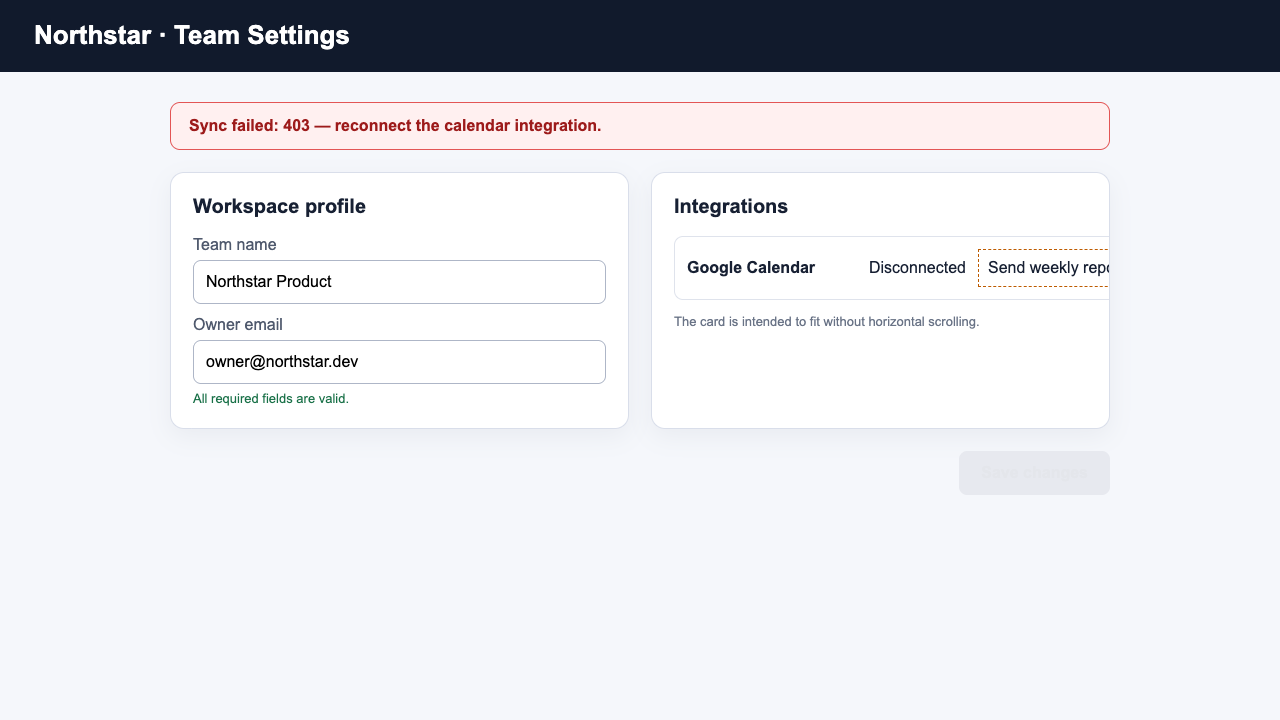
Muse named all four visible defects, but its answer hit the token cap after the heading for the requested repair plan. I marked it partial. Qwen’s A100 response scored zero of four checks. Its completion did not provide the grounded final answer required by the scorer.
This was screenshot reading, not a computer-use benchmark. Neither model clicked the interface or inspected DOM state. The task measured whether each model could stay grounded in pixels and finish a concise repair plan without inventing hidden behavior.
Long context and exact recall
Muse failed the exact-recall task. Its 46,049-character prompt contained about 7,450 input tokens and fit inside the 12,288-token server window. The response reached its 240-token cap while emitting a truncated JSON fragment and recovered none of the three required values.
Qwen also recovered zero of three values. Its prompt measured 8,040 tokens on the A100 run. The context fixture placed canary-ember-17 near the beginning, queue lease 47 around the middle, and owner Inez-Valdez near the end of 150 repetitive architecture notes. The requested output was compact JSON. Neither failure came from rejecting the configured context window; both models failed to return the exact requested output.
Speed and memory: keep the platforms separate
Muse’s text-only 12K Mac baseline delivered a median 14.40 decode tokens per second and 0.55-second time to first token across three 128-token samples. Loading the 1.40GB vision projector under the same Mac configuration reduced the median to 3.67 tokens per second and 2.07 seconds to first token. At 4K text-only, the median was 14.61 tokens per second.
Qwen’s A100 fit smoke returned 32 completion tokens in a decodable reasoning_content field. llama.cpp reported 47.50 decode tokens per second for that smoke. Across three A100 samples, the text-only median was 48.235 tokens per second with 0.1682-second time to first token; the vision-loaded median was 47.96 tokens per second with 0.2533-second time to first token.
Those Qwen numbers describe the rented A100 host only. They must not be set against Muse’s M4 Pro numbers to crown a throughput winner. GPU architecture, memory bandwidth, backend, driver, operating system, model file size, and vision path all changed. The speed samples confirm that the Qwen configuration worked consistently on the A100; they do not estimate performance on a 32GB Mac or a consumer Nvidia card.
The 24GB fit result remains direct. Qwen’s official 19.10GB Q4_K_M file plus runtime buffers left too little headroom on the Mac. The server could report healthy at 4K, then return a Metal kIOGPUCommandBufferCallbackErrorOutOfMemory on the first tiny completion. A CPU-only configuration loaded, but prompt ingestion at about 0.65 token per second was not a credible laptop-agent workflow.
macOS process RSS is not the full unified-memory bill for a Metal workload. Mapped model pages, Metal buffers, caches, the vision projector, and the operating system do not collapse into one clean process number. The evidence reports peak observed RSS where available and treats the directly observed out-of-memory event as the stronger fit signal. The A100 evidence records its 81,920 MiB device capacity but does not claim measured peak VRAM.
DFlash on and off
DFlash did not help the 24GB Muse setup. With the main model and 1.63GB DFlash drafter on Metal, both 12K and 4K text-only configurations ran out of memory before producing a measurement. Moving the drafter entirely to CPU made the 4K test run, but median decode fell from 14.61 to 10.57 tokens per second, 27.6% slower than the non-speculative baseline. The server accepted 96 of 454 proposed tokens, or 21.1%, with a mean accepted block length of 4.10.
Meta supplies a 1,631,205,312-byte DFlash drafter and says it can accelerate decoding by proposing blocks of up to 15 future tokens. Meta’s Muse Glimmer model card reports 23.7 to 37.8 tokens per second on an M4 Max using ExecuTorch, not this M4 Pro/llama.cpp setup. The measured local result is the relevant number here.
Privacy, provenance, licenses, and data flow
Both tested weight repositories use Apache 2.0. Muse’s model card also links a separate Meta Usage Policy. “Open-weight” is the precise label because neither release includes every training datum and decision needed to reproduce training from scratch. Qwen’s official model card lists a 27B dense multimodal model, a 262,144-token native context, and Apache 2.0 licensing; this test used a much smaller practical context.
Both inference servers bound to 127.0.0.1, and the test runner made local HTTP calls inside each host. Task fixtures stayed in the working directory. The model downloads came from Hugging Face. A production setup should pin revisions and hashes, review quant provenance, block unnecessary outbound traffic, add authentication before any non-loopback exposure, and require human approval for irreversible tools.
The local data path was fixture → loopback llama.cpp server → local model → local tool result. Connect email, Slack, a browser, cloud storage, package managers, or web search and those tools create new outbound paths. “Local model” does not mean “offline agent.”
Local cost versus cloud coding models
The downloaded weights have no per-token fee. The owner still pays for hardware, storage, electricity, setup, maintenance, and slower throughput. I did not instrument wall power, so this test does not include an energy-cost estimate.
The A100 rerun cost $2.2172302221 on RunPod, stayed below the authorized $5 cap, and ended with the pod deleted and post-termination spend at $0 per hour. That is the cost of this one experiment, not a recurring price for Qwen and not evidence that a production A100 service would cost the same.
For scale, a hypothetical month with 10 million uncached input tokens and 2 million output tokens would cost about $110 at OpenAI’s GPT-5.6 Sol API rates and $60 at Anthropic’s Sonnet 4.6 rates, before caching, batch discounts, tool fees, or regional adjustments. GPT-5.6 Terra would cost about $55 at the same workload. Those cloud services are not capability-equivalent to either local quant; the calculation only shows when token fees become visible.
If the Mac is already owned, occasional Muse use can be economical. Buying hardware solely for one model is a different calculation. Cloud access may cost less until use is high enough to justify the machine and local control has real value. Kingy’s local AI compatibility guide covers the broader memory and hardware trade-offs.
Which model is best for whom?
For a 24GB Apple-silicon laptop: Muse is the defensible pick from these exact official files. Use one slot, keep context conservative, and account for the vision projector. Its agent reliability was mixed, so keep tests and approval gates in the loop.
For Qwen3.6-27B: the tested A100 configuration proves that the pinned Q4_K_M stack can fit, decode, and complete the suite on a high-memory CUDA host. It does not prove that a 32GB Mac or lower-cost GPU will behave the same way. Qwen passed structured tools and retry recovery, but five task failures make this exact agent setup hard to recommend for unsupervised coding.
For production coding work: neither seven-task result supports replacing a mature cloud coding agent. Muse’s three passes and two partials beat Qwen’s two passes here, but both missed the multi-file and long-context jobs. Repeat the tests on your own hardware, repository, prompts, and approval system before relying on either model.
For Muse specifications, official benchmark provenance, and setup options, read Kingy’s companion Muse Glimmer 30B launch analysis. This article supplies the hands-on follow-up and the qualified Qwen rerun.
Limitations
- Muse and Qwen completed their scored work on different machines and backends. Mac/Metal and A100/CUDA timing, latency, and memory figures are not directly comparable.
- The task definitions, scoring, runtime commit, and model artifacts were pinned, but the Linux runner required host-specific startup code. Its checksum is disclosed.
- This is one seed, one quant per model, and seven small tasks. It cannot establish broad model quality, safety, bias, security, or production reliability.
- Qwen’s initial all-task run aborted on malformed tool JSON. One bounded task-by-task recovery used the unchanged runner, preserved the first failure, reproduced it, and finished the independent tasks.
- The quants are broadly comparable 4-bit-class builds, not the same quantizer or byte size. Muse’s main file is 2.34GB smaller.
- The 12,288-token context is an operating choice, not a test of either vendor’s advertised maximum window.
- The screenshot is synthetic but deterministic. It tests visual grounding, not browser control.
- The A100 is datacenter hardware. Its successful fit does not represent 24GB consumer-hardware performance.
- Peak A100 VRAM was not measured. The report records device capacity and observed fit, not fabricated usage.
- The $2.2172 RunPod charge is a one-off research expense, not a product price.
- DFlash was tested only with Muse on the Mac and should not be generalized to Qwen or other hosts.
FAQ
Can Muse Glimmer 30B really run on 24GB?
Yes, with constraints. The official 16.76GB main GGUF plus 1.40GB vision projector loaded and completed these tests on a 24GB M4 Pro with one slot and a 12,288-token context. The default four-slot server exhausted memory.
Did Qwen3.6-27B complete the comparison?
Yes, on the A100 80GB host. It passed the fit smoke and attempted all seven tasks through the pinned scaffold. It passed two and failed five. Its 24GB Mac fit result remains a failure.
Is Muse Glimmer better than Qwen3.6-27B?
Muse had the stronger completion profile in this test and is the clear 24GB Mac choice. The cross-platform setup and small single-seed task set prevent a universal quality ranking.
Is Muse Glimmer fully open source?
Open-weight is the better description. Meta publishes downloadable Apache 2.0 weights and official GGUF components, but not a fully reproducible training dataset and pipeline. Meta also attaches a separate Usage Policy.
Does an American-developed model keep data in America?
No. Developer nationality does not determine inference location or data flow. The tested servers stayed local to each host because they were bound to loopback and used local tools. A cloud endpoint or connected agent tool can send data elsewhere.
Why not test Qwen3.8-27B?
No official Qwen3.8-27B release could be verified on August 10, 2026. Qwen3.6-27B was the current official dense model at the requested scale.
Should I use DFlash?
Not on this 24GB M4 Pro with the tested llama.cpp build. A Metal drafter ran out of memory; CPU-offloading the drafter reduced median decode speed by 27.6%. Different hardware or a later runtime may change that result.
Reproduce the comparison
The companion package includes exact commands, model revisions, SHA-256 checksums, task definitions, tool schemas, sampling settings, raw Muse results, Qwen Mac fit records, A100 task results, and a flat CSV. The sealed A100 evidence archive is qwen-a100-evidence-20260810.tar.gz, SHA-256 f65a7d2bd1312814efa8dd929cad0171c575489271b313272510a65faceea595. Verify the checksum before using the evidence.
Official sources
- Meta: Introducing Muse Glimmer
- Muse Glimmer 30B model card
- Muse Glimmer official GGUF repository
- Meta evaluation methodology
- Meta: The Future Is for Everyone
- Hugging Face Muse Glimmer integration guide
- llama.cpp Muse Glimmer support change
- Qwen3.6-27B official release
- Qwen3.6-27B official model card
- Qwen3.6-27B GGUF used in this test
Disclosure: This is an independent Kingy.ai hands-on comparison. No review unit or vendor-supplied task result was used. The A100 rerun was rented for $2.2172 under a hard $5 cap. The featured image is an AI-generated Kingy.ai editorial illustration. The UI screenshot is a deterministic local test fixture.