Google Wants AI to Do More Than Tell You to Bring an Umbrella
Weather forecasts have always helped answer ordinary questions.
Should you bring an umbrella? Will the barbecue survive Saturday? Is that dark cloud actually heading your way?
Google DeepMind now wants artificial intelligence to answer much bigger ones.
How much electricity will a wind farm generate tomorrow? How much sunlight will reach a solar installation this afternoon? Could rapidly changing cloud cover force a power grid to find backup generation?
That is where WeatherNext 3 comes in.
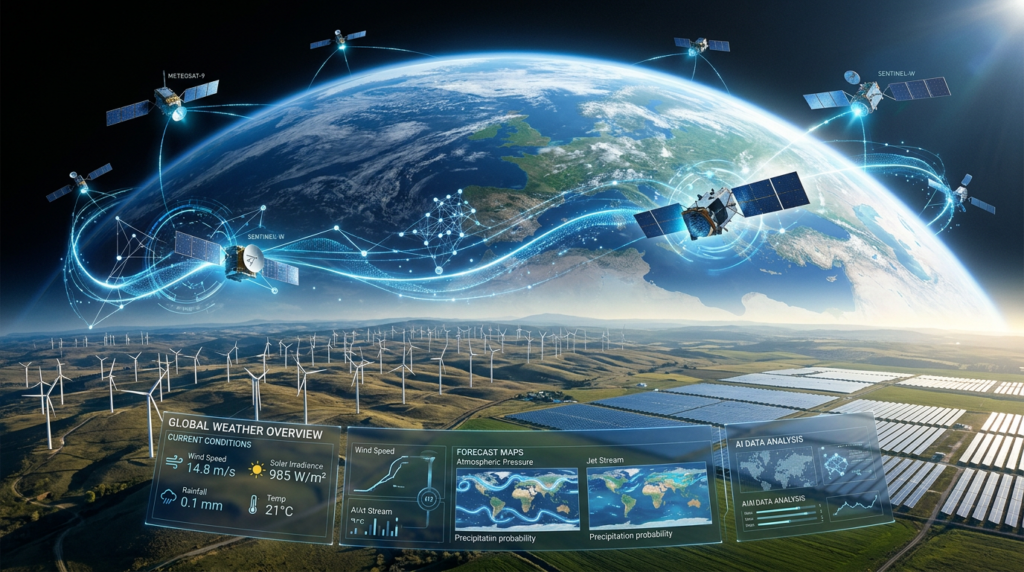
Google DeepMind and Google Research unveiled the system on September 3, calling it their most advanced global weather AI model yet. It generates new forecasts every hour, incorporates real-time satellite observations, and can provide some surface-weather information at resolutions as fine as roughly five kilometers.
Google has also designed it to forecast variables directly useful to renewable-energy operators, including wind speeds around turbine height, cloud cover, and solar radiation reaching the ground.
That turns WeatherNext 3 into more than a smarter weather app.
It could become part of the infrastructure that helps energy systems predict and manage renewable generation.
And that makes it one of the more practical AI launches of 2026.
Weather Forecasting Is Having Its AI Moment
Traditional numerical weather prediction models use equations describing physics to simulate how the atmosphere will evolve.
They are powerful. They are also computationally expensive.
AI models take a different route.
Instead of recalculating every atmospheric interaction from scratch, machine-learning systems learn patterns from massive weather datasets and use those patterns to generate forecasts.
This approach has gained momentum because AI models can produce results much faster during inference.
That matters when conditions change quickly.
WeatherNext 3 pushes this further by turning AI forecasting into something continuous rather than occasional.
Google says the system is being integrated across Search, Gemini, Maps, Google Maps Platform, and Cloud.
That is a significant shift.
AI weather forecasting is no longer just a research experiment or benchmark competition.
It is becoming a service layer inside products used by consumers, developers, and businesses.
Real-Time Satellite Data Is the Big Upgrade
One of WeatherNext 3’s most important changes is how it sees the atmosphere.
Many earlier AI weather systems depended heavily on processed datasets generated by numerical weather models.
Those datasets are useful, but they can introduce delays.
WeatherNext 3 directly ingests global geostationary satellite observations, giving it a fresher view of current conditions before producing a forecast.
That matters because the atmosphere changes fast.
Clouds develop.
Storms reorganize.
Rain bands shift.
Temperatures swing.
A forecast that starts with more recent observations has a better chance of capturing those changes.
The accompanying research paper says the system was designed partly to address a limitation of earlier AI weather models: their dependence on preprocessed analysis data rather than direct observations.
In practical terms, WeatherNext 3 gets a more immediate look at what the atmosphere is doing before trying to predict what happens next.
That is one reason Google can issue updated global forecasts every hour.
Five-Kilometer Forecasting Brings More Local Detail
Global forecasting always involves a trade-off.
You want coverage of the entire planet.
You also want enough detail to capture local weather.
Doing both is difficult.
WeatherNext 3 narrows that gap.
Google says some temperature and moisture variables can be produced on a grid of roughly five kilometers, while other surface and atmospheric variables operate at broader resolutions.
That matters because weather can change sharply over short distances.
Mountains influence rainfall.
Coastlines alter wind.
Cities trap heat.
Nearby areas can experience very different conditions.
Higher resolution helps models represent some of those differences more clearly.
Google also argues that this could be especially valuable in regions where running very high-resolution traditional forecasting systems is expensive.
It does not make every local forecast perfect.
Weather remains chaotic.
But finer detail, combined with frequent updates, makes the output more useful for sectors that depend heavily on precise conditions.
Renewable energy is one of them.
Wind Farms Need Better Forecasts
/
Wind turbines have one inconvenient requirement.
They need wind.
Not vaguely windy weather somewhere nearby. They need usable wind at the right speed, at the right height, at the right time.
That makes forecasting crucial.
Grid operators need to know how much electricity wind farms are likely to produce hours in advance.
If generation drops unexpectedly, the system has to compensate through batteries, backup plants, imports, or demand management.
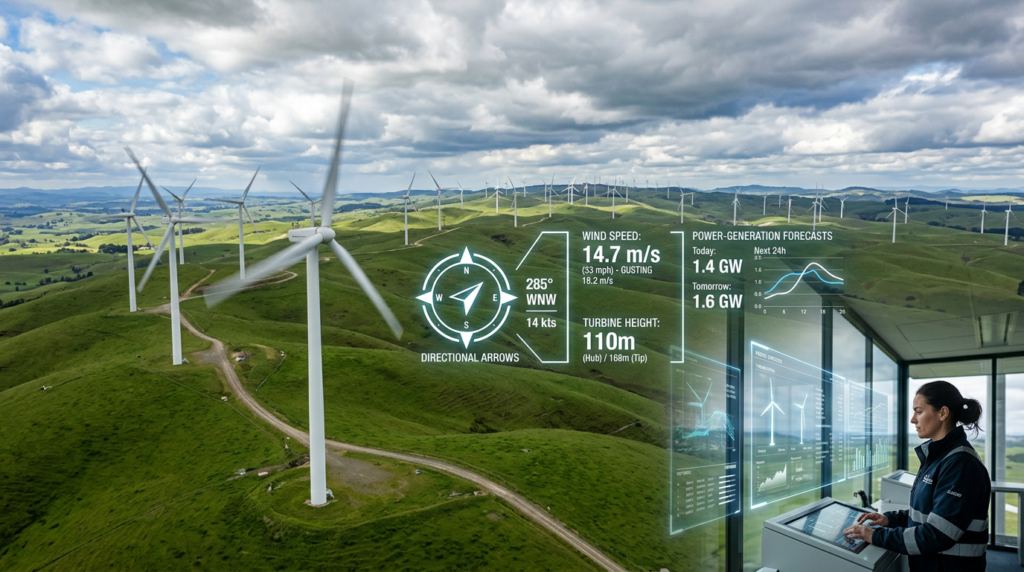
WeatherNext 3 includes forecasts for 100-meter wind speeds, roughly corresponding to the operating height of many turbines.
That is a practical improvement.
Instead of relying only on general near-surface wind forecasts, renewable-energy systems can use information more directly related to turbine output.
Better forecasts can improve scheduling.
They can reduce uncertainty.
They can help operators prepare for shortfalls before they happen.
As grids rely more heavily on wind generation, those advantages become increasingly valuable.
AI is not generating the electricity.
It is helping operators predict how much nature will.
Solar Power Has the Same Problem, Just With Clouds
Solar energy seems simple.
Sun shines.
Panel generates power.
Cloud arrives.
Panel becomes considerably less enthusiastic.
In reality, solar forecasting involves many variables.
Cloud thickness, cloud height, atmospheric conditions, and incoming radiation all influence generation.
WeatherNext 3 includes cloud-layer data and solar irradiance variables designed to help estimate how much solar energy reaches the ground.
That can improve production forecasts.
Suppose a utility expects heavy solar generation during the afternoon.
Then a large cloud system begins moving toward the region.
A more accurate forecast gives operators time to respond before output drops.
They might adjust battery use.
Change market bids.
Ramp other generators.
Import electricity.
That is the real value here.
The clean-energy transition does not only need more wind turbines and solar panels.
It needs better information about what those assets are likely to produce.
WeatherNext 3 is designed to help provide it.
Rainfall Forecasting Also Gets an Upgrade
Renewable energy is only part of the story.
Google has also focused heavily on precipitation.
Rain is notoriously difficult to forecast accurately, especially at local scales.
According to Google’s developer documentation, WeatherNext 3 trains against multiple precipitation datasets, including ECMWF reanalysis, NASA’s IMERG satellite data, and Google’s own satellite-radar information.
Google reports reductions of up to 50% in certain precipitation forecast error scores compared with numerical weather prediction baselines under specific evaluation conditions.
That does not mean all rain forecasts suddenly become 50% more accurate everywhere.
Forecasting metrics are more complicated than that.
Still, better precipitation prediction has enormous practical value.
Agriculture depends on it.
Flood management depends on it.
Transport depends on it.
Hydropower depends on it.
Rain and cloud forecasts also influence solar output.
So even improvements aimed at traditional weather forecasting can feed directly into energy planning.
Sometimes the most useful AI breakthrough is simply knowing sooner that the sky is about to misbehave.
WeatherNext 3 Is Already Moving Into Google Products
A forecasting model becomes much more important when people can actually use it.
Google says WeatherNext 3 data is being integrated into Search, Gemini, Maps, Google Maps Platform, and Google Cloud.
That gives the model broad distribution.
Consumers may encounter improved weather information through familiar Google services.
Developers can build weather-sensitive applications.
Businesses can feed forecasts into operational systems.
Researchers can access WeatherNext data through Google Cloud.
This is what separates WeatherNext 3 from a research demo.
It has a route into real-world products.
One caveat remains.
Integration does not necessarily mean every user in every country instantly sees a clearly labeled WeatherNext 3 forecast.
Product availability and interfaces can vary.
But the direction is obvious.
Google is turning AI-based forecasting into part of its broader information ecosystem.
Traditional Weather Models Are Not Going Away
AI is improving rapidly, but traditional numerical weather models still matter enormously.
They incorporate decades of atmospheric science and simulate physical processes directly.
National meteorological agencies depend on them.
Professional forecasters often compare several models alongside observations and expert judgment.
AI adds another powerful tool.
It does not make atmospheric physics obsolete.
That distinction matters most during extreme weather.
A model can perform extremely well overall and still struggle with a particular storm, region, or weather pattern.
The strongest future may therefore be hybrid.
Physics-based models provide physical structure.
AI models offer speed and pattern recognition.
Satellites provide direct observations.
Meteorologists add context and judgment.
Together, those systems could produce forecasts that are faster, more detailed, and more resilient than any single approach on its own.
The meteorologists are not getting fired.
They are just getting much fancier tools.
Renewable Energy Makes Forecast Accuracy More Valuable
The timing of WeatherNext 3 matters because electricity systems are changing quickly.
Wind and solar capacity continue to expand.
Battery storage is growing.
Electricity demand is rising because of electric vehicles, industrial electrification, and massive data centers.
That creates a new forecasting challenge.
Traditional power plants can usually generate when operators tell them to.
The sun and wind are less cooperative.
The sun has never accepted a meeting invite.
The wind does not answer Slack.
Grids therefore need increasingly accurate predictions of renewable generation.
Weather models are becoming part of energy infrastructure.
So are batteries.
So are smart markets and demand-response systems.
WeatherNext 3 fits into that ecosystem by providing information directly relevant to power generation.
That is the deeper story.
AI weather forecasting is becoming operational technology, not just a scientific curiosity.
The Bigger Story Is AI Becoming Scientific Infrastructure
WeatherNext 3 represents something broader than a new forecasting model.
It shows how AI can move beyond chatbots and become infrastructure for science.
Google DeepMind has already applied machine learning to protein structures, mathematics, and weather prediction.
Weather is especially well suited to this approach because the planet generates enormous volumes of observational data.
WeatherNext 3 combines that data with machine learning to produce forecasts that are faster, more detailed, and easier to distribute through cloud services.
That creates a useful chain.
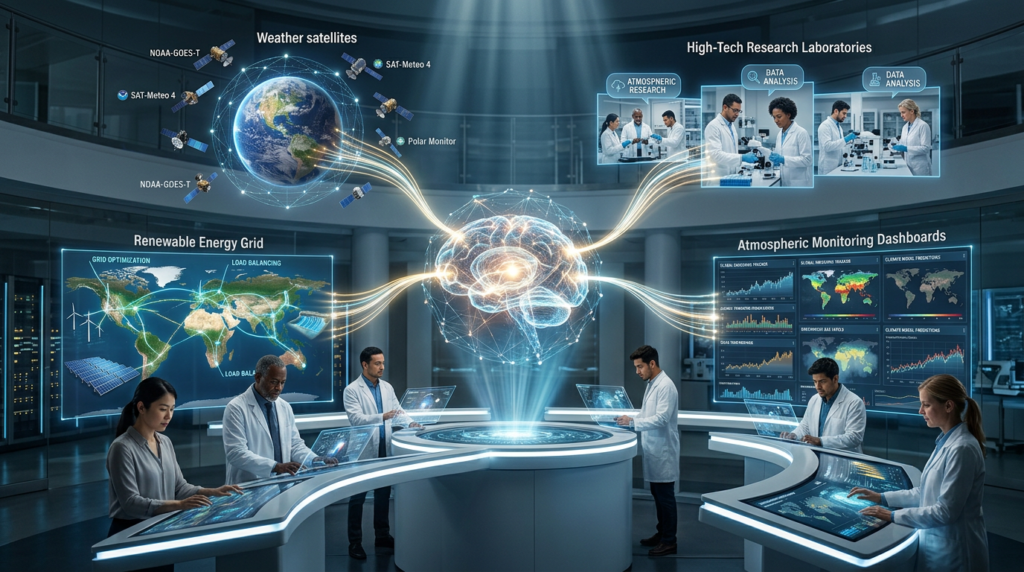
Satellite observations feed the model.
The model generates forecasts.
Developers and businesses access the output.
Energy operators, researchers, and consumers use that information to make decisions.
That is much less flashy than a humanoid robot doing a backflip.
It may also be more economically useful.
If better atmospheric predictions improve farming, logistics, renewable power, and disaster preparation, the impact spreads far beyond weather apps.
Not every AI revolution needs a chatbot window.
Some of the most important ones may run quietly in the background.
WeatherNext 3 Shows What Practical AI Looks Like
The AI industry spends plenty of time asking enormous questions.
When will AGI arrive?
Which company has the smartest model?
Who won this week’s benchmark battle?
WeatherNext 3 offers something refreshingly concrete.
Take a difficult real-world problem.
Feed the system massive amounts of observational data.
Generate updated forecasts quickly.
Deliver information that people and businesses can use.
That is the promise.
WeatherNext 3 will not eliminate uncertainty.
Weather will still surprise us.
Storms will still change direction.
Clouds will still ruin somebody’s beach day with impressive timing.
But even modest improvements in forecasting can create large economic benefits when repeated across energy, agriculture, transport, and disaster planning.
For renewable power, better forecasts could improve grid scheduling.
For farmers, better rainfall information could improve planning.
For businesses, faster updates could reduce operational surprises.
For governments, more detailed weather data could strengthen preparedness.
Google DeepMind is not trying to control the weather.
It is trying to understand it better.
And as renewable energy becomes more important, that may turn out to be one of AI’s most useful jobs.
Sources
- Google — Introducing WeatherNext 3, our most advanced and accurate global weather AI model
- Google DeepMind — WeatherNext
- arXiv — WeatherNext 3: Increasing resolution and performance of global weather models with raw observations
- Google for Developers — WeatherNext model documentation
- TechCrunch — Google’s latest AI weather model gives you no excuse to forget your umbrella
- Ars Technica — Google’s AI weather model now uses more raw satellite data
- The Guardian — Weatherwatch: AI model beats standard methods at predicting cyclones
- Reuters — Why the next industrial race will be won on electricity
The Kingy Brief
Get the next Kingy Brief.
Source-checked AI changes, original tests and one practical thing to try.
Free · Choose your subjects · Double opt-in · Unsubscribe anytime