Updated September 16, 2026
Union Alpha is the latest anonymous model to appear in the OpenCode and OpenRouter ecosystems. It accepts text and images, offers a 262,144-token context window, supports tools, and is currently listed at zero dollars during a limited preview.
That makes it worth trying, but there is no evidence yet to call it a frontier model.
The provider has published no model card, technical report, parameter count, weights, license, knowledge cutoff, or benchmark scores. OpenRouter identifies the upstream only as “Stealth” and says it is not the model’s developer or owner. The phrase “frontier-level performance” appears in the listing, but no public evaluation currently backs it up.
My recommendation is straightforward: use Union Alpha for low-risk experiments, sanitized repositories, visual debugging, and your own private evaluation set while the preview is available. Keep it out of production dependencies and sensitive data until the provider, terms, reliability, and post-preview price are clear.
Union Alpha at a glance
| Field | What is documented |
|---|---|
| Model name | Union Alpha |
| OpenRouter model ID | stealth/union-alpha |
| OpenCode Go model ID | opencode-go/union-alpha |
| Provider | Anonymous “Stealth” provider |
| Release date | September 16, 2026 |
| Input | Text and images |
| Output | Text |
| Context window | 262,144 tokens |
| Maximum completion | 131,072 tokens |
| Tools | tools and tool_choice are listed as supported |
| Structured output | response_format is supported; JSON-schema enforcement is not listed |
| Reasoning controls | No reasoning_effort control is listed |
| Weights and license | None published |
| Knowledge cutoff | Not disclosed |
| Preview price | OpenRouter: $0 input/output; OpenCode Go: $0 input/output/cached reads |
| Availability | Limited time; no exact end date or post-preview price published |
These details come from the OpenRouter model page, OpenRouter’s model API metadata, and the OpenCode Go documentation. The model page and API catalog are the useful sources here because they expose the actual integration surface rather than repeating community guesses.
What Union Alpha is, and what it is not
Union Alpha is a hosted API model wrapped in a stealth release program. It is not currently an open-source or open-weight model.
That distinction matters. “OpenCode” and “OpenRouter” describe the tools and gateways through which you can access the model. They do not mean that Union Alpha’s weights or training materials are open. The current OpenRouter metadata has no Hugging Face model ID, no license, and no architecture description beyond text+image->text.
The model may eventually be revealed as a known lab’s pre-release system or a private variant of an existing model. That has happened with earlier stealth launches. It has not happened with Union Alpha, and there is no evidence that the name identifies the lab, country, architecture, or model family.
The most accurate description today is “an anonymous, hosted multimodal model in a limited preview.”
The published specifications, explained
A 262K context window
The headline number is 262,144 tokens. That is large enough for a serious repository, a long technical report, a multi-file migration, or a substantial research bundle in one conversation.
At 262,144 tokens, Union Alpha is large but not the biggest context window available. GPT-6 Astra, Claude Opus 4.7, DeepSeek V4, Qwen3.8, and GLM-5.3-Flash are listed with roughly one million or more tokens on hosted routes. A larger window does not guarantee that a model will retrieve details from the middle of a long prompt. Context capacity and context quality are different measurements.
Union Alpha’s 262K window is still useful. Most coding tasks do not need a million tokens, and you can keep prompts focused without paying to fill a huge context window. The practical question is whether it can identify the right files, keep state across tool calls, and finish the task without losing important constraints. No public evaluation answers that yet.
Image input, text output
The model accepts text and images and returns text. That makes it suitable for screenshot-based UI debugging, diagram interpretation, document images, visual error messages, and code tasks that include a visual reference.
Video is not listed in the current specification. Do not assume that Union Alpha can inspect video simply because some neighboring models can.
Tools and structured output
OpenRouter lists tools and tool_choice as supported parameters. That means the API surface can participate in an agent loop: the model can request a function, receive the result, and continue the conversation.
The listing also supports response_format for JSON output, but says that JSON-schema enforcement is not available. That is a meaningful limitation for applications that need reliable structured data. Your client should validate every response, retry malformed output, and treat model-generated JSON as untrusted input.
Tool support is a protocol feature, not a quality score. A model can accept a tool schema and still choose the wrong tool, produce invalid arguments, stop early, or loop. Tool-call success rate, task completion, and recovery from errors are the metrics to watch in a real agent.
No public reasoning knob
The OpenRouter metadata does not list reasoning, reasoning_effort, or a similar control for Union Alpha. That could mean the model does not expose a tunable reasoning budget, or that the provider has hidden the control during the preview. The public documentation does not settle the question.
This makes Union Alpha harder to compare with models that expose low, high, and maximum reasoning effort. It also means you may have less control over latency and token use. A short coding fix and a difficult multi-step investigation may receive the same hidden inference policy.
Missing technical fields
The current catalog leaves several fields blank or generic:
- no parameter count or active-parameter count;
- no dense-versus-mixture-of-experts description;
- no tokenizer identity;
- no training-data or training-recipe description;
- no knowledge cutoff;
- no public model card or license;
- no weights or local deployment path.
Those omissions are not proof that the model is weak. They are proof that outsiders cannot yet audit or reproduce it.
Benchmarks and evaluations: the honest answer
There are no published Union Alpha benchmark scores in the current OpenRouter listing or model API metadata. The page has no benchmark table, and the catalog does not expose Artificial Analysis or Design Arena scores for this model.
That leaves us with a description, a specification, and live service metadata. The description says Union Alpha is intended for research, coding, agentic workflows, and broad general-purpose work. Those are intended use cases, not results.
The difference is easy to lose in launch coverage:
| Evidence type | What it can tell you | Union Alpha status |
|---|---|---|
| Provider description | What the operator wants users to try | Available |
| Context and modality fields | What the endpoint accepts | Available |
| Standardized benchmark | How it performed under a defined test | No public score |
| Independent evaluation | Whether another lab can reproduce the result | No public result found |
| Model card or system card | Training, safety, limitations, and intended use | Not published |
| Open weights | Whether users can inspect or run the model | Not published |
| Real-world usage data | Reliability and adoption over time | Too early to interpret |
OpenRouter’s public benchmark system separates benchmark scores from token usage and exposes provider-level signals. Its documentation says benchmark runs can be pinned to a provider endpoint, while tool-calling, throughput, and benchmark data remain separate routing signals. For Union Alpha, treat capability, provider quality, and agent reliability as three different questions.
There is one operational detail worth recording separately from capability. The OpenRouter model page exposes live provider metrics such as latency, throughput, uptime, and availability, but those values change with traffic and routing. Treat them as a dashboard snapshot, not an SLA or model benchmark, and recheck the page before relying on them.
Do not turn a screenshot of one successful coding task into a benchmark. A credible comparison should publish the task set, harness, model ID, prompt, tool definitions, temperature, timeout, number of trials, failures, and raw results. Even then, one harness measures one slice of behavior.
The OpenRouter benchmark API documentation and Auto Exacto documentation explain how the platform presents these signals. The provider pages for established models show the contrast: they include public index scores and, in several cases, model-card benchmarks. Union Alpha currently has none of that evidence.
Union Alpha versus frontier and open-weight models
The table below is a dated snapshot of public catalog information. The prices use the base rates returned by OpenRouter’s model catalog API on September 16, 2026, shown per 1M input/output tokens. Variant, batch, and provider-specific rates can differ and change. Artificial Analysis scores are shown only where OpenRouter exposes them, and they are not a claim about Union Alpha.
| Model | Delivery and openness | Context listed | OpenRouter price per 1M input / output | Selected public quality signal |
|---|---|---|---|---|
| Union Alpha | Anonymous hosted preview; no weights or license | 262K | Free / free during preview | No public score |
| GPT-6 Astra | Closed frontier model | 1.05M | $10 / $50 | Artificial Analysis Coding 76.9; Agentic 51.5 |
| Claude Opus 4.7 | Closed frontier model | 1.0M | $5 / $25 | Artificial Analysis Coding 73.6; Agentic 39.5 |
| GLM-5.3-Flash | Open weights, MIT license; 320B total / 18B active parameters | 1.3M | $0.09 / $0.30 | Artificial Analysis Coding 71.5; Agentic 51.2 |
| DeepSeek V4 Pro 0813 | Open weights, MIT license; 1.7T parameters listed on Hugging Face | 1.0M | $0.5795 / $1.738 | Artificial Analysis Coding 68.8; Agentic 42.3 |
| Qwen3.8 27B | Open weights, Apache 2.0 license; dense 27B model | 1.0M hosted; 262K native and extensible to 1M | $0.214 / $2.55 | Artificial Analysis Coding 68.1; Agentic 46.5 |
The source material behind the open-weight rows is available in the GLM-5.3-Flash model card, DeepSeek V4 Pro model card, and Qwen3.8 model card. The table uses “open weights” rather than “fully open source” because published weights do not automatically mean that the training data, training code, or complete serving stack is open.
What the comparison means in practice
Against frontier models: Union Alpha is free during the preview and has enough context for many real coding sessions. GPT-6 Astra and Claude Opus 4.7 offer larger context windows, named providers, public evaluation signals, and more predictable commercial accountability. They also cost real money.
Against open-weight models: Union Alpha is easier to try because someone else runs the hardware. Qwen3.8, DeepSeek V4, and GLM-5.3-Flash give you weights, licenses, model cards, and a path to self-hosting or choosing among multiple inference providers. Self-hosting is not free, though: memory, GPUs, electricity, engineering time, and maintenance become your problem.
Against low-cost hosted open models: GLM-5.3-Flash and Qwen3.8 already make the economics difficult for any anonymous preview to beat after the free window closes. They are also easier to evaluate because they publish more of the information needed to make a decision.
On multimodality: Union Alpha handles images. Qwen3.8 and GLM-5.3-Flash publish broader visual capabilities, including video input in their model cards or catalog descriptions. A model supporting more media types is not automatically better at the media you care about, but the distinction matters for product design.
On long context: 262K is useful but no longer exceptional. It is enough for most repositories and many document workflows, while the one-million-token alternatives leave more room for very large codebases and multi-document research.
The Ox Alpha precedent does not identify Union Alpha
OpenRouter now identifies the previous stealth model, Ox Alpha, as Z.ai’s GLM-5.3-Flash. That makes it reasonable to treat Union Alpha as a possible pre-release alias or blind-testing exercise, but it does not establish that the two models are the same.
The documented profiles differ. GLM-5.3-Flash is listed with a 1.3-million-token context window, text/image/video input, a 320B-parameter total model with 18B active parameters, and published MIT-licensed weights.
Union Alpha is listed with 262K context, text/image input, no video, no disclosed parameter count, and no weights. Those differences could reflect a different model, a different service configuration, or a deliberately reduced preview surface. They cannot establish identity.
The useful conclusion is narrower: stealth previews can be real model launches, but their names are not evidence. Wait for a provider claim, matching tokenizer behavior, reproducible API fingerprints, or a model release before attaching a lab’s name to Union Alpha.
How to use Union Alpha
OpenCode Go
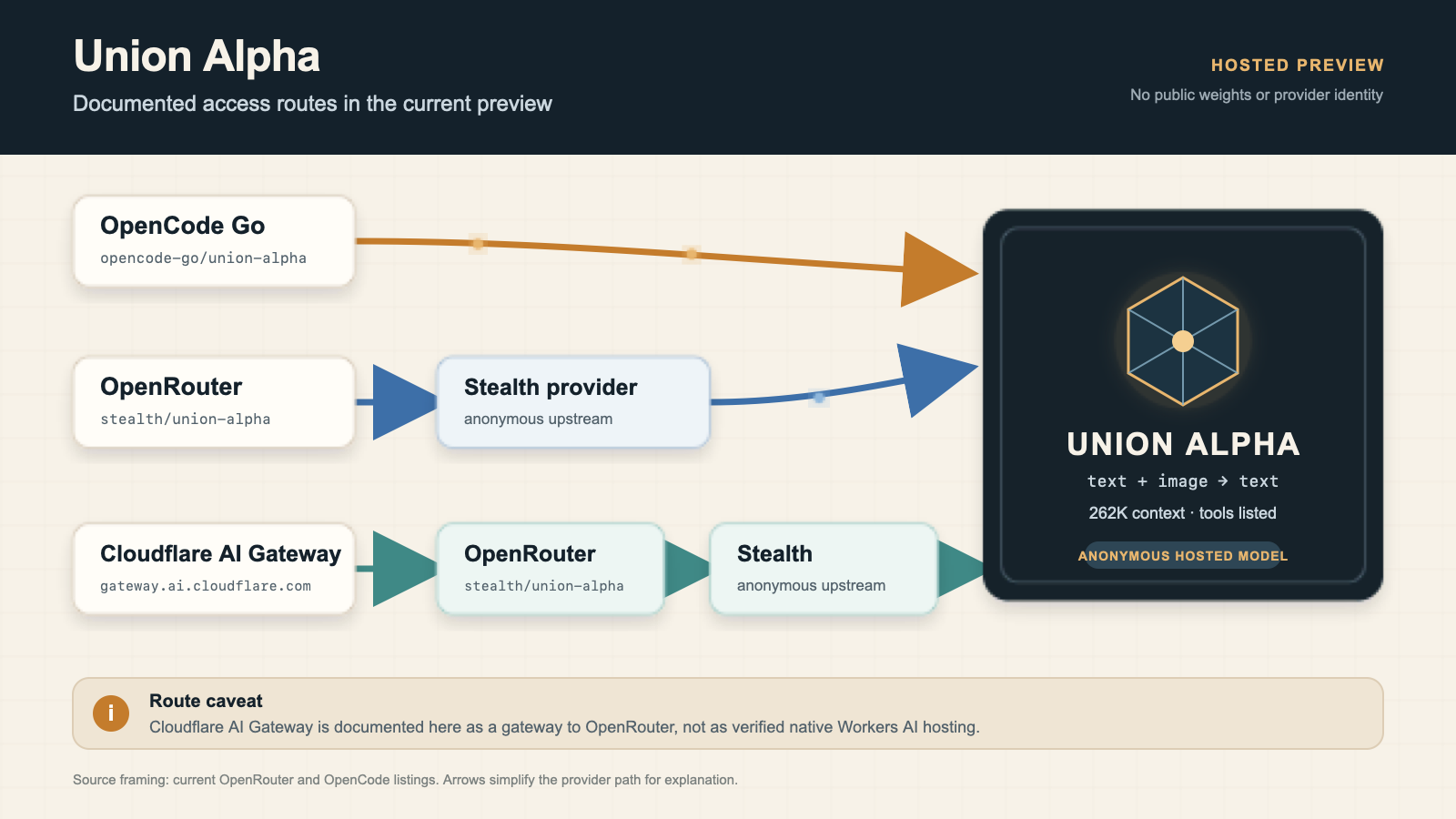
The cleanest coding-agent route is OpenCode Go. OpenCode describes Go as a $10/month subscription. Its current model list includes “Union Alpha Free (limited time).” The Go pricing table lists Union Alpha input, output, and cached reads as free, with an unlimited entry while the promotion lasts.
In the OpenCode terminal UI:
opencode
/connect        # choose OpenCode Go and paste your Go key
/models         # choose Union Alpha Free
For clients that use the Go API directly, the current documentation gives:
Model ID:  opencode-go/union-alpha
Endpoint:  https://opencode.ai/zen/go/v1/messages
Protocol:  Anthropic Messages API
That protocol detail matters. The OpenCode Go route is not the same model ID or request shape as the OpenRouter OpenAI-compatible route. OpenCode also asks compatible clients to send a stable x-opencode-session value so it can optimize prompt caching and routing.
OpenCode Go is not a free subscription. The model usage is listed as free for a limited time; the Go plan remains a separate $10/month product. If you use Zen’s pay-as-you-go route instead, check the current Zen setup and pricing page, which currently advertises a $20 balance purchase plus a card-processing fee.
OpenRouter
OpenRouter’s model ID is:
stealth/union-alphaThe API is OpenAI-compatible:
curl \
  https://openrouter.ai/api/v1/chat/completions \
  -H "Authorization: Bearer $OPENROUTER_API_KEY" \
  -H "Content-Type: application/json" \
  -d '{
    "model": "stealth/union-alpha",
    "messages": [
      {
        "role": "user",
        "content": [
          {"type": "text", "text": "Describe the main issue in this screenshot."},
          {"type": "image_url", "image_url": {"url": "https://example.com/screenshot.png"}}
        ]
      }
    ]
  }'
The model is currently shown at $0 for prompt and completion tokens. Free does not mean unlimited. OpenRouter’s current rate-limit documentation says free-model usage limits depend on account and credit status and can include platform-level caps.
The exact allowance can change, so check the live documentation or your account’s API-key limits before building around it. Model- and provider-specific limits can still apply, and the stealth program can remove a model at any time.
OpenRouter also offers a chat playground, which is the quickest way to test image understanding and basic coding behavior without writing an integration. For an application, set a spending limit anyway, record the returned model and provider metadata, and handle rate limits and empty responses.
Cloudflare AI Gateway
The Cloudflare route that can be verified from the current documentation is Cloudflare AI Gateway proxying the OpenRouter provider. It is not evidence that Union Alpha is hosted natively inside Cloudflare Workers AI.
Cloudflare documents the OpenRouter endpoint as:
https://gateway.ai.cloudflare.com/v1/{account_id}/{gateway_id}/openrouterA compatible request looks like this:
curl \
  "https://gateway.ai.cloudflare.com/v1/$CLOUDFLARE_ACCOUNT_ID/$CLOUDFLARE_GATEWAY_ID/openrouter/v1/chat/completions" \
  -H "Authorization: Bearer $OPENROUTER_API_KEY" \
  -H "Content-Type: application/json" \
  -d '{
    "model": "stealth/union-alpha",
    "messages": [
      {"role": "user", "content": "Review this migration plan for missing steps."}
    ]
  }'
Cloudflare AI Gateway can add logging, analytics, caching, rate limiting, retries, and other gateway controls. Those controls are useful for an application, but they do not change the upstream model’s identity, benchmark record, or terms. The Cloudflare OpenRouter integration guide requires an active OpenRouter token and the OpenRouter model name.
The practical rule is: do not try @cf/union-alpha unless Cloudflare publishes that exact native Workers AI ID. The currently documented integration is Cloudflare AI Gateway → OpenRouter → Stealth.
Privacy: “not used for training” is not the same as zero exposure
Privacy and data retention depend on the route.
| Route | Published policy | Practical reading |
|---|---|---|
| OpenCode Go | The Go page lists Union Alpha as “Not used” for model training and “0 days” for data retention | The strongest published privacy claim in the current docs, but still subject to the route’s terms |
| OpenCode Zen | Zen says its providers follow zero-retention and do not train on user data, with exceptions | Check the current exceptions and the exact account path |
| OpenRouter | The Union Alpha listing says prompts and completions may be retained by the provider but are not used for training | This is not a zero-retention promise |
| Cloudflare AI Gateway through OpenRouter | Adds a gateway layer with configurable logging and caching | Review Cloudflare gateway settings and the OpenRouter/Stealth policy together |
OpenRouter’s general data-collection documentation says OpenRouter does not store prompts or responses unless a user opts into logging or product improvement. That statement applies to OpenRouter’s own systems; the upstream provider can have a separate policy. Its provider-logging documentation makes the same separation.
The Stealth Program EULA deserves a close read. It says user content may be collected by OpenRouter and shared with a stealth provider, and that stealth models are temporary. Its acceptable-use policy also prohibits sending sensitive information such as health or financial data, bypassing rate limits, and publicly disseminating confidential technical information about model performance.
For a preview model, use a disposable branch or a sanitized repository. Remove API keys, credentials, customer data, personal data, private prompts, unreleased product details, and regulated information. “The provider says it does not train on data” does not mean “the data never leaves your machine.”
How to evaluate Union Alpha properly
If you want to know whether Union Alpha is good, test the work you actually need it to do. A single clever prompt cannot answer that question.
Use a clean copy of a repository and a fixed task set. Include at least:
- repository orientation: ask the agent to locate the right files and explain the relevant code paths;
- a small bug fix with an existing test;
- a multi-file change with a clear acceptance test;
- a refactor that must preserve behavior;
- a task requiring a tool call with structured arguments;
- a task that deliberately returns a tool error and tests recovery;
- screenshot-to-code or visual UI debugging;
- long-context retrieval from several documents or modules;
- a factual question with a known answer and a verification source;
- an ambiguity test where the correct behavior is to ask for clarification;
- a task that should be refused or escalated because it touches a secret;
- a final review in which the model must inspect its own diff and tests.
Record:
- time to first token and total wall-clock time;
- task completion, not merely a plausible explanation;
- tests passed and tests added;
- number of tool-call errors and retries;
- human interventions and prompts needed to recover;
- files changed and unwanted changes in the diff;
- context length and whether important details were retrieved;
- factual errors, unsupported claims, and citation failures;
- service errors, rate limits, truncations, and empty responses.
Run each important task more than once. Compare Union Alpha with one frontier model and one open-weight model through the same agent harness. Keep the prompt, tools, timeout, temperature, repository state, and acceptance criteria fixed. Evaluate the model-plus-provider-plus-harness combination, because changing the harness can change the result as much as changing the model.
You can use the results to choose a tool for yourself. Before publishing detailed performance data, review the Stealth EULA and make sure the information is public or you have permission to disclose it.
Who should use Union Alpha?
Union Alpha is a good fit for:
- developers who want to explore a new model without paying per token during the preview;
- visual debugging and screenshot-based implementation work;
- side projects and disposable branches;
- long prompts that fit comfortably inside 262K tokens;
- private evaluations of coding-agent behavior;
- research and drafting where a human checks the facts.
It is a poor fit for:
- production systems that need a stable model name and published SLA;
- sensitive repositories or regulated data;
- unattended deployment without a human review gate;
- applications that require strict JSON schemas;
- teams that need local inference or a clear license;
- budgets that depend on a known price after the preview.
Frequently asked questions
What is Union Alpha?
Union Alpha is an anonymous multimodal model listed by OpenRouter under the stealth provider namespace and by OpenCode Go as union-alpha. It is marketed for coding, research, agentic workflows, and general-purpose tasks.
Who made Union Alpha?
Nobody has publicly claimed it. OpenRouter says the provider is anonymous and that OpenRouter is not the developer, owner, or provider.
Is Union Alpha free?
The model is currently listed at $0 for input and output on OpenRouter and in the OpenCode Go pricing table. The offer is limited time. OpenCode Go itself is a $10/month subscription, and the post-preview price has not been published.
How long will the free preview last?
OpenCode’s launch message described a roughly one-week free period, while the current documentation says “limited time.” There is no fixed end date in the model listing. OpenRouter’s Stealth EULA allows a stealth model to be removed at any time.
What is the context window?
262,144 tokens, with up to 131,072 completion tokens listed by OpenRouter.
Does it support images and video?
It supports text and image input and text output. Video input is not listed in the current specification.
Does it support tool calling?
Yes. OpenRouter lists tools and tool_choice. That confirms API compatibility, not reliable task completion.
Does it support JSON mode?
It accepts response_format, but OpenRouter says JSON-schema enforcement is not available. Validate every response yourself.
Is Union Alpha open source or open weight?
Not according to the current public record. No weights, license, model card, or local deployment package has been published.
Is it available through Cloudflare AI?
It can be routed through Cloudflare AI Gateway’s documented OpenRouter integration by using the OpenRouter model ID stealth/union-alpha. I could not verify a native Cloudflare Workers AI @cf model ID for Union Alpha.
Is it safe to use with private code?
Treat it as unsafe for sensitive material until you have reviewed the exact route and terms. OpenCode documents zero retention for the Go route. OpenRouter’s Union Alpha listing says the upstream provider may retain prompts and completions, even though it will not use them for training. The Stealth EULA also restricts sensitive inputs.
Is Union Alpha better than GPT-6 Astra, Claude, DeepSeek, Qwen, or GLM?
There is no published Union Alpha benchmark that supports that conclusion. It may be useful, fast, or surprisingly capable, but the responsible comparison today is verified frontier or open-weight model versus unverified preview model.
Bottom line
Union Alpha is interesting because it gives developers a free look at an unnamed model with a useful context window, image input, and agent-facing tools. The free access is the strongest part of the offer. The model’s capability is still an open question.
Try it on work you can throw away. Save the diffs, measure task completion, verify the facts, and keep the provider’s uncertainty in view. If Union Alpha is genuinely frontier-grade, the evidence will make that case after the preview. Until then, the honest label is “promising stealth preview,” not “GPT killer.”
Sources and research notes
Research snapshot: September 16, 2026. Prices, provider availability, and preview access can change quickly.
- OpenRouter: Union Alpha model page
- OpenRouter: model catalog API
- OpenCode: Go documentation
- OpenCode Zen
- Cloudflare: OpenRouter through AI Gateway
- Cloudflare: OpenCode integration
- OpenRouter: Stealth Program EULA
- OpenRouter: API credit and rate limits
- OpenRouter: data collection
- OpenRouter: provider logging
- OpenRouter: benchmark API
- OpenRouter: Auto Exacto benchmark and routing methodology
- GPT-6 Astra on OpenRouter
- Claude Opus 4.7 on OpenRouter
- GLM-5.3-Flash on OpenRouter
- GLM-5.3-Flash model card
- DeepSeek V4 Pro 0813 on OpenRouter
- DeepSeek V4 Pro 0813 model card
- Qwen3.8 27B on OpenRouter
- Qwen3.8 27B model card
Trending on Kingy
Keep reading with the stories getting the most attention now.
The Kingy Brief
Get the next Kingy Brief.
Source-checked AI changes, original tests and one practical thing to try.
Free · Choose your subjects · Double opt-in · Unsubscribe anytime