Google Builds an AI-Powered Map of Human DNA
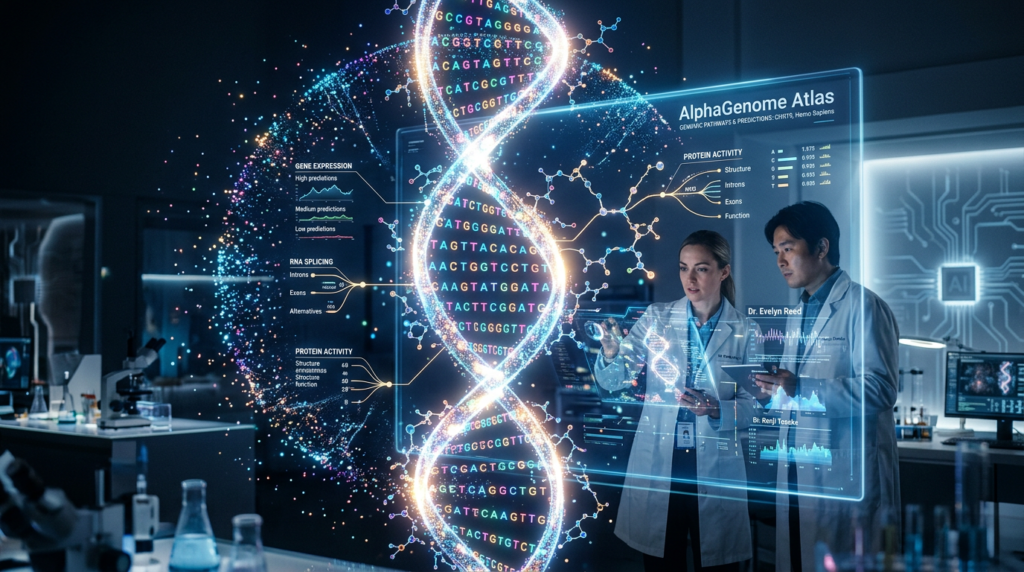
Google DeepMind has released AlphaGenome Atlas, a massive AI-powered resource that predicts the molecular effects of every possible single-letter change in the human genome.
That adds up to approximately nine billion genetic variants.
The project gives researchers a precomputed map of how individual DNA changes could affect gene regulation, protein production, RNA processing and other biological activity. Scientists can explore the predictions through a website without running the underlying AlphaGenome model themselves.
Google calls it the most comprehensive catalogue yet of how genetic mutations may influence molecular biology. The company hopes it will help researchers identify important variants, investigate rare diseases and find promising directions for new treatments.
The word “predicts” deserves emphasis. AlphaGenome Atlas does not prove that a mutation causes a disease. It does not diagnose patients, prescribe treatments or replace laboratory research.
Instead, it helps scientists decide where to look.
That distinction matters because the human genome contains a dizzying amount of information. Researchers frequently encounter thousands or millions of genetic differences while investigating a condition. Most will have little or no meaningful effect. Finding the handful that deserve closer attention can resemble hunting for a typo in a library where several books occasionally rearrange their own punctuation.
AlphaGenome Atlas tries to narrow the search.
According to Google DeepMind’s announcement, academic researchers can use the platform through a free website, an application programming interface and Google’s Antigravity research environment.
Why Nine Billion Variants Exist
Human DNA uses four chemical bases commonly represented by the letters A, C, G and T. Together, these letters form the instructions that help cells develop, operate and respond to their environment.
The human genome contains roughly three billion base positions. At every position, the existing DNA letter could theoretically change into one of the other three letters.
Three billion positions multiplied by three possible substitutions produces approximately nine billion single-letter variants.
Some changes do nothing noticeable. Others contribute to ordinary differences between people. A smaller number can alter biological processes or increase the risk of disease.
Scientists have spent decades cataloguing genetic variants. The difficult part is often interpreting them.
A DNA test might identify a previously unseen change, but that discovery immediately raises another question: Does it matter?
Testing every possible mutation in cells, tissues or living organisms would be impractical. The task would require extraordinary time, money and laboratory capacity.
AlphaGenome approaches the problem computationally. The underlying model compares normal and altered DNA sequences, then predicts how each change could affect molecular processes.
DeepMind has now run those calculations across the reference human genome in advance. Instead of asking researchers to process one variant at a time, the Atlas stores billions of predictions in a searchable resource.
It is less like handing scientists a compass and more like pre-drawing a gigantic map—although plenty of the landscape still requires boots, microscopes and experimental confirmation.
AlphaGenome Moves Beyond Protein-Coding DNA
Many genetic tools focus primarily on mutations within protein-coding regions. These sections contain instructions that cells use to construct proteins, the molecular machines responsible for much of the body’s structure and activity.
However, protein-coding sequences account for only around 2% of the genome.
The remaining 98% is commonly called noncoding DNA. That description can sound like biological filler, but much of it performs important regulatory work. Noncoding regions can influence when genes activate, where they operate and how strongly they express themselves.
Some act like switches. Others resemble volume controls, punctuation marks or distant managers sending instructions across the genome.
Disease-associated variants frequently appear in these regulatory regions. Unfortunately, their effects can be harder to interpret because they do not simply change one component of a protein.
AlphaGenome examines both coding and noncoding DNA. It predicts effects involving gene expression, RNA splicing, chromatin accessibility and other mechanisms that control how genetic instructions function.
That broad coverage is one reason researchers view the system as potentially valuable.
As IEEE Spectrum explains, regulatory elements can behave differently across cells and tissues. Some influence genes located far away from the original DNA change.
The Atlas includes thousands of molecular predictions for every variant across hundreds of human and mouse cell types and tissues.
In other words, the same mutation may not behave identically everywhere. Biology enjoys complexity. It apparently considered simple documentation beneath it.
The Atlas Is a One-Petabyte Research Resource
AlphaGenome Atlas contains roughly one petabyte of data. That equals about one million gigabytes, although comparisons become slightly surreal at this scale.
Google says the Atlas is more than 30 times larger than the AlphaFold Database, which contains over 200 million predicted protein structures.
Creating it required far more than pointing AlphaGenome at nine billion mutations and waiting patiently.
DeepMind’s early calculations suggested the team needed to increase processing speed by around 80 times to complete the project within a reasonable period. Researchers used techniques including model distillation, optimized GPU operations and the removal of redundant calculations.
The resulting platform stores predictions that scientists would otherwise need to generate individually using substantial computing resources.
That could expand access to genomic AI. A researcher without powerful hardware can visit the Atlas portal, select a variant and examine its predicted effects. The user does not need to write code or operate the full AlphaGenome model.
Scientists who require more technical access can use the AlphaGenome API. The Atlas is also available as a skill within Google Antigravity, the company’s agentic research and development platform.
The website is free for noncommercial academic research. DeepMind says commercial access through Google Cloud will follow.
Reducing repeated calculations also makes scientific work more efficient. Thousands of laboratories no longer need to spend their own computing budgets generating the same initial predictions.
The model has already done the heavy lifting. Researchers can concentrate on asking better questions—and on convincing their laboratory equipment to cooperate before lunch.
A Single Score Helps Scientists Rank Mutations
Nine billion predictions create a new problem: Scientists still need a quick way to identify which variants deserve attention.
DeepMind’s answer is the AlphaGenome Variant Impact score, or AVI.
AVI condenses information from AlphaGenome and AlphaMissense into one number representing the predicted importance of a genetic variant. AlphaMissense is DeepMind’s earlier system for assessing mutations that alter proteins, while AlphaGenome covers a wider collection of regulatory effects.
The combined score helps researchers rank variants before investigating them more deeply.
A high score does not mean a mutation has definitely caused a disease. It signals that the variant may disrupt an important molecular process and therefore warrants closer examination.
The Atlas also explains which biological features contributed to each score. A researcher can investigate whether the model expects the mutation to alter RNA splicing, gene expression, protein function, chromatin accessibility or another process.
That interpretability makes the score more useful than a mysterious number delivered without context.
DeepMind says AVI achieved leading performance across several benchmarks involving variant pathogenicity and rare diseases. Those results come from the company’s testing and will require continued scrutiny from independent researchers as more scientists use the platform.
AVI works across coding and noncoding regions. This lets researchers rank variants throughout the genome using one system rather than juggling disconnected tools.
Think of it as a sophisticated sorting mechanism. It does not solve the biological mystery. It moves the most interesting suspects toward the front of the line.
Rare-Disease Researchers Test the Atlas
One of AlphaGenome Atlas’ most promising uses involves rare diseases that have resisted diagnosis.
Patients with these conditions may undergo extensive genetic testing without receiving a definitive answer. Researchers can identify numerous unusual variants, yet struggle to determine which one—if any—explains the symptoms.
DeepMind collaborated with the GREGoR Consortium and researchers from institutions including the Broad Institute and Boston Children’s Hospital to test AVI on unresolved cases.
In one example described by DeepMind, researchers used the score to prioritize variants that earlier studies had overlooked. Their investigation highlighted a mutation affecting DNM1, a gene strongly associated with epileptic encephalopathy.
AlphaGenome predicted that the variant created an incorrect RNA splice site. This error could cause the cell to process its genetic instructions improperly, producing an abnormal extension in the resulting protein.
The researchers did not stop at the AI prediction. Experimental screens validated the predicted mechanism and identified nearby variants with similar effects.
That sequence illustrates the Atlas’ proper role.
The model generated a promising hypothesis. Researchers then examined that hypothesis using laboratory evidence. AI narrowed the search, while experimentation determined whether the prediction held up.
Nature has previously documented how researchers are using AlphaGenome and related AI models to investigate difficult rare-disease cases.
For families who have spent years seeking answers, faster variant prioritization could prove enormously valuable. It will not solve every case. But even shortening the diagnostic journey for some patients would represent meaningful progress.
The Atlas Searches Through Genetic Noise

Rare diseases are only one part of the story. AlphaGenome Atlas may also help researchers study common traits across large populations.
Every person carries an enormous collection of genetic differences. When scientists search for relationships between rare variants and a particular trait, harmless mutations can create overwhelming statistical noise.
Gareth Hawkes, a Medical Research Council fellow at the University of Exeter, applied AlphaGenome Atlas to genomic information from more than 54,000 UK Biobank participants.
Instead of treating rare variants as an undifferentiated pile, Hawkes grouped them according to their predicted molecular effects. DeepMind reports that this approach uncovered 22% more noncoding genetic associations than conventional analysis detected.
The study highlighted regulatory variants connected to the abundance of important proteins circulating in the body. These included PLA2G7, which has links to aging, and EGLN1, which helps cells respond to oxygen availability.
Hawkes also explored possible connections between noncoding variants and body mass index. He focused on the 1% of mutations the Atlas predicted would have the greatest biological impact.
That narrower analysis identified 19 genetic regions that could guide future research.
These findings do not establish simple genetic explanations for body weight or other complex traits. Such characteristics usually reflect interactions among many genes, environmental factors and individual circumstances.
What the Atlas can do is make patterns easier to see. It turns down some of the background noise so researchers can hear the faint signals hiding underneath.
The scientific investigation must still determine what those signals mean.
Reading the Hidden Words of the Genome
AlphaGenome Atlas includes more than variant scores. It also contains a collection of over 2,500 recurring DNA sequences, sometimes called motifs.
These short patterns function like regulatory words within the genome. They can provide binding sites for transcription factors—proteins that help turn genes on or off.
Finding a motif can reveal why a DNA change matters.
If a mutation disrupts a sequence used by a transcription factor, the affected gene might activate at the wrong time, in the wrong tissue or at an unusual level. The final consequence may depend on numerous interacting mechanisms, but identifying the damaged regulatory element gives scientists a place to begin.
Researchers Julia Zeitlinger and Melanie Weilert of the Stowers Institute for Medical Research used the Atlas to examine these motifs. Their work helped distinguish transcription factors that affect DNA accessibility from those that can also activate or suppress genes.
This type of research digs beneath a simple prediction of “important” or “unimportant.” It asks what molecular machinery a variant might disturb and how that disruption could change cellular behavior.
DeepMind links each AVI score to the specific features that influenced it. Researchers can move from the broad ranking to a more detailed interpretation of the possible mechanism.
That layered design makes the platform useful for different kinds of scientific questions. One team may need to screen thousands of variants quickly. Another may want to investigate a single mutation at extremely high resolution.
The Atlas supports both routes: start with the map, then zoom in until the terrain becomes delightfully complicated again.
AlphaGenome Builds on the AlphaFold Playbook
AlphaGenome Atlas follows a strategy Google DeepMind used successfully with AlphaFold.
AlphaFold predicts the three-dimensional structures of proteins. DeepMind and its partners later created a large public database containing hundreds of millions of those predictions, saving researchers from running the model repeatedly.
That database turned an advanced AI system into shared scientific infrastructure.
AlphaGenome Atlas attempts something similar for genetic variants. The underlying model already existed. DeepMind introduced AlphaGenome in 2025 and published a detailed paper in Nature in 2026.
The new contribution is scale and accessibility.
DeepMind has applied the model across the entire reference genome, stored the output and built tools that let researchers explore it without specialized computing hardware.
The similarities to AlphaFold are encouraging, but the biological problems differ.
A protein structure represents a physical arrangement that researchers can compare against experimental measurements. Predicting the effects of regulatory DNA can involve shifting relationships across cell types, tissues, developmental stages and environmental conditions.
Genomes do not operate as static instruction manuals. They behave more like elaborate productions in which different scenes use different actors, lighting cues and stage directions.
AlphaGenome attempts to model part of that performance.
DeepMind describes the Atlas as a baseline rather than an endpoint. As the underlying model improves, the company expects future maps to become more comprehensive and precise.
That framing is sensible. Scientific databases gain value through continued testing, correction and refinement—not from pretending version one has already decoded life.
What AlphaGenome Atlas Cannot Do
The size of the Atlas makes it tempting to describe it as a complete solution to human genetics. It is not.
AlphaGenome generates predictions. Researchers must validate important findings through experiments, clinical evidence and additional analysis.
The system examines up to one million DNA base pairs around a selected variant. That is a large window, but some regulatory elements influence genes across even greater distances. Those interactions may fall outside the model’s view.
Many diseases also involve combinations of variants rather than one decisive mutation. Lifestyle, environment, development and chance can further alter health outcomes.
A strong AVI score therefore does not provide a diagnosis. A low score cannot automatically prove that a variant is harmless.
Independent genomicist Carl de Boer told IEEE Spectrum that AlphaGenome appears to be a useful resource and described it as a leading model in the field. He also noted its heavy computational demands and the inherent difficulty of predicting long-range genetic regulation.
The Atlas reduces the computing burden by making results available in advance. It does not eliminate the scientific limitations.
This is not a weakness unique to AlphaGenome. It reflects the complexity of biology.
Good research tools do not need to answer every question. They need to produce useful, testable hypotheses more efficiently than existing methods.
By that standard, AlphaGenome Atlas has considerable potential. It can help researchers rank possibilities, identify plausible mechanisms and decide which experiments deserve scarce time and resources.
It offers directions, not verdicts.
A Free Portal Broadens Access to Genomic AI
DeepMind has made AlphaGenome Atlas available through a free online portal for noncommercial research.
That accessibility could matter almost as much as the model’s performance.
Running advanced genomic models can require technical expertise and expensive hardware. Smaller laboratories, clinicians and researchers in less well-funded institutions may struggle to use them at scale.
Precomputed predictions lower that barrier. Scientists can search the Atlas and examine visualizations without downloading a one-petabyte dataset or assembling a miniature data center beneath the laboratory stairs.
Researchers who need automated access can use the AlphaGenome API. The base model is also available for academic use through GitHub, while commercial access already exists through Google Cloud’s Model Garden. DeepMind says commercial access to the Atlas itself will arrive on Google Cloud.
The company also offers the Atlas within Google Antigravity. That integration points toward a future in which AI research agents can query genomic predictions while coordinating broader scientific workflows.
Such systems might help researchers review literature, identify candidate variants, compare molecular effects and design follow-up studies. Human scientists would still determine whether the assumptions, evidence and experimental design make sense.
Broad access also encourages independent evaluation. The more researchers use the resource, the more quickly they can identify where it performs well—and where its predictions fall short.
A scientific atlas improves when explorers return with corrections.
AI Could Help Laboratories Spend Their Time Better
The practical value of AlphaGenome Atlas lies in prioritization.
Biologists face more possible experiments than they can ever perform. Every investigation consumes money, equipment, samples and human effort. Choosing the wrong candidates can delay meaningful discoveries for months or years.
The Atlas offers another layer of evidence for making those choices.
A rare-disease team can rank unexplained variants. A population geneticist can group mutations according to predicted function. A molecular biologist can examine the regulatory motifs surrounding a suspicious DNA change.
None of those scientists must accept the AI’s output as fact.
Instead, they can treat it as a high-speed screening system. The model searches billions of possibilities and highlights patterns. Researchers apply domain knowledge, clinical context and laboratory testing to determine which patterns survive contact with reality.
That partnership suits AI particularly well. Machines can process enormous datasets without becoming bored. Humans can question assumptions, recognize biological context and design experiments that distinguish an interesting prediction from a genuine discovery.
The Atlas may also reduce duplicated computational work. Rather than having hundreds of teams generate the same predictions separately, DeepMind provides a shared starting point.
That frees researchers to spend more time on interpretation and validation.
Science rarely advances because someone produced the largest spreadsheet in history. It advances when the information inside that spreadsheet leads to a better question, a sharper experiment or an answer that previously remained out of reach.
AlphaGenome Atlas gives scientists plenty of new places to look.
A Promising Map, Not the Final Destination
AlphaGenome Atlas represents an ambitious attempt to organize one of biology’s largest search spaces.
Google DeepMind has calculated predicted effects for nine billion possible single-letter DNA changes, packaged them into a one-petabyte resource and made the results accessible to academic researchers.
The early examples are encouraging.
Researchers have used the system to prioritize a DNM1 variant associated with a rare neurological condition, uncover additional noncoding associations in UK Biobank data and study regulatory sequences that help control gene activity.
Those successes do not mean the genome has surrendered all its secrets. Predictions will sometimes be incomplete or wrong. Long-distance genetic interactions remain difficult to model, while complex diseases rarely reduce to one convenient mutation.
Even so, a map does not need to contain every tree to help someone cross a forest.
AlphaGenome Atlas could shorten the distance between genomic data and testable biological insight. It may help scientists identify disease mechanisms, select experimental targets and investigate previously overlooked regions of DNA.
The project also strengthens DeepMind’s argument that AI can contribute to scientific infrastructure, not merely consumer chatbots. AlphaFold gave researchers a vast library of predicted protein structures. AlphaGenome Atlas now offers a similarly expansive starting point for studying genetic variation.
The next phase belongs to the scientific community.
Researchers will test the predictions, challenge the assumptions and discover which parts of the map lead somewhere valuable.
Nine billion possibilities remain a daunting number. At least scientists no longer have to approach them without directions.
Sources
- Google DeepMind: AlphaGenome Atlas—A predictive map of every possible DNA letter change
- IEEE Spectrum: Google DeepMind maps nine billion possible DNA variants
- The Verge: Google’s Atlas of the human genome could pave the way for new treatments
- Nature: How DeepMind’s genome AI could help solve rare-disease mysteries
- AlphaGenome Atlas research portal
- AlphaGenome API and model resources
The Kingy Brief
Get The Kingy Brief.
AI changes, original tests and one practical thing to try. Fridays at 09:00 Vancouver time.
Free · Double opt-in · Unsubscribe anytime
Sign up for The Kingy Brief on Beehiiv.
Signup help and newsletter schedule
Signup form provided by Beehiiv. After submitting, check your inbox for "Confirm your subscription to The Kingy Brief" and open its confirmation link. Check Spam or Promotions if you cannot find it.
Fridays at 09:00 Vancouver time: source-checked AI changes, original tests and one practical thing to try. We skip a week when there is not enough verified material. Free. Unsubscribe anytime.