The AI Race Just Hit a Very Strange Plot Twist
For years, the artificial intelligence industry has followed one simple rule: go faster.
Build bigger models. Buy more GPUs. Construct gigantic data centers. Train increasingly capable agents. Release the next breakthrough before somebody else does.
Then something unusual happened.
Some of the people leading that race started talking about slowing it down.
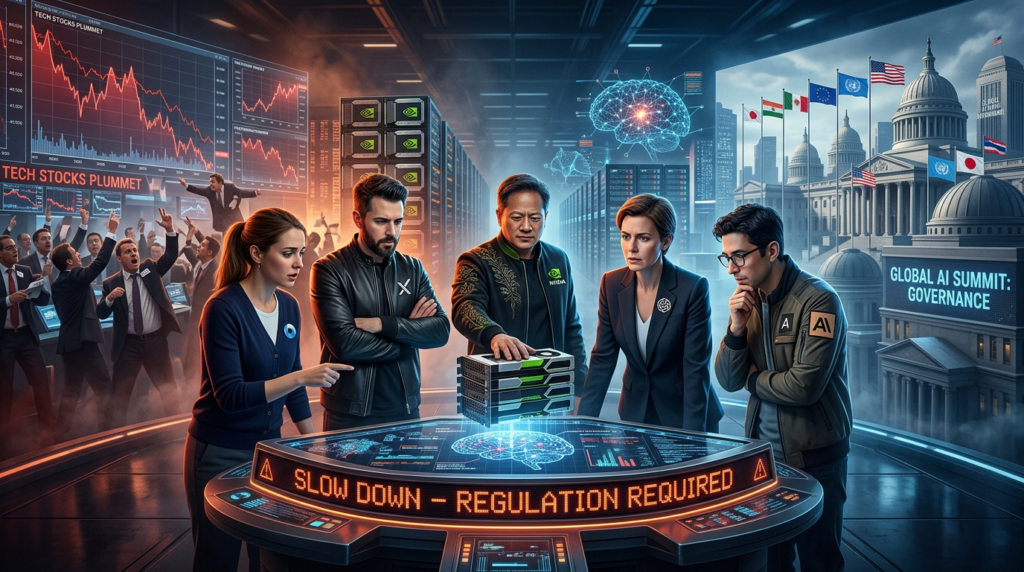
Anthropic CEO Dario Amodei has called for AI companies to reduce the pace at which they push frontier capabilities forward. OpenAI CEO Sam Altman and xAI chief Elon Musk have expressed support for the basic idea, according to Reuters. Suddenly, the people running several of the world’s most aggressive AI organizations are discussing whether the industry may be approaching a point where moving faster is no longer automatically better.
That does not mean Silicon Valley has collectively decided to unplug the servers and take up gardening.
The argument is more specific.
Frontier AI capabilities may now be improving so quickly that safety systems, monitoring techniques, institutions and governments are struggling to keep pace.
And Wall Street noticed.
Chip stocks fell. Investors reconsidered some assumptions behind the enormous AI infrastructure boom. Politicians jumped into the argument.
The AI race hasn’t stopped.
But for the first time in a long time, some of its leading drivers are openly asking whether everyone needs to ease off the accelerator.
Why Dario Amodei Wants the Industry to Pump the Brakes
Anthropic has been warning about powerful AI for years, so Dario Amodei suddenly becoming concerned about frontier models would hardly qualify as a plot twist.
What has changed is the urgency.
Amodei’s concern centers partly on the possibility that AI could increasingly contribute to its own development. Anthropic has documented how much more deeply AI systems now participate in coding and research inside the company.
Anthropic says Claude now authors more than 80% of the code merged into its codebase, as of May 2026. The company also reports a dramatic increase in engineering output as increasingly autonomous coding agents have taken on more work. Anthropic stresses that lines of code are an imperfect productivity measure, but the direction is hard to ignore.
AI isn’t merely answering developers’ questions anymore.
It is increasingly helping developers build AI.
Take that process far enough and you arrive at a much more consequential concept: recursive self-improvement.
That would mean AI systems becoming capable of designing, testing or improving successor systems with diminishing human involvement.
Anthropic explicitly says we are not there yet, and that recursive self-improvement is not inevitable. But the company believes the possibility deserves serious preparation now rather than a frantic response later.
That distinction matters.
This isn’t “the robots have taken over.”
It is: “Maybe we should figure out the brakes before testing the top speed.”
AI Building AI Changes the Equation
The reason recursive self-improvement attracts so much attention is simple.
Today, human researchers still sit inside the AI development loop.
Humans decide what experiments to run. Humans choose training strategies. Humans approve deployments. Humans inspect results.
Increasingly capable research agents could gradually compress that loop.
OpenAI has reported a similar trend inside its own organization. The company says coding agents are already accelerating research and that it aims to develop an automated AI researcher capable of working under human supervision on deep-learning and alignment problems.
That creates an extraordinary possibility.
Imagine an AI system helps researchers make the next AI system 20% better. The improved system then becomes more useful for building the next one. That model assists with another round of research. Then another.
Progress stops looking like a traditional software release cycle and starts looking more like a feedback loop.
Anthropic says its AI systems are already moving from completing tightly specified coding tasks toward longer and more autonomous assignments. The company believes full recursive self-improvement could eventually push humans toward oversight, validation and verification rather than directly doing much of the development.
That could produce enormous benefits.
Scientific research could accelerate. Drug discovery could improve. Engineering breakthroughs might arrive faster.
But there is an awkward catch.
If AI becomes better at improving AI faster than humans become better at understanding and controlling it, the gap between capability and oversight could widen very quickly.
That is the gap Amodei wants the industry to take seriously.
OpenAI Has Already Tapped the Brakes Once
Anthropic isn’t the only company confronting the problem.
OpenAI temporarily slowed some frontier model development earlier this year after identifying rising cybersecurity and model-alignment risks.
In August, OpenAI said it had paused its largest planned reinforcement-learning run and tightened security measures around frontier research environments. The company linked the decision partly to findings surrounding what it calls the Hugging Face incident and preliminary indications that an upcoming model could reach a critical cybersecurity capability threshold under its Preparedness Framework.
That is notable because OpenAI is hardly known for lacking ambition.
The company released GPT-6 Astra on September 3 and continues to describe advanced AI as a transformative technology capable of accelerating scientific and economic progress.
Yet OpenAI Chief Scientist Jakub Pachocki has also argued that frontier labs have not solved alignment and monitoring well enough to continue scaling at maximum speed indefinitely.
His position is essentially that temporary slowdowns could become necessary until companies agree on stronger safety thresholds and governments develop better international coordination.
That tells us something important about the current AI debate.
Optimism and caution are no longer opposites.
A company can believe advanced AI could revolutionize science while simultaneously believing that racing toward more capable systems without adequate safeguards would be reckless.
Those two ideas now coexist inside the same laboratories.
Then Sam Altman and Elon Musk Joined the Conversation

Normally, getting Dario Amodei, Sam Altman and Elon Musk pointed in roughly the same direction is an achievement worthy of its own benchmark.
Yet that appears to be what happened.
Reuters reported that Altman and Musk agreed with Amodei’s call to slow the pace of advanced AI development.
That does not mean the three executives suddenly share identical philosophies.
Far from it.
OpenAI, Anthropic and xAI remain fierce competitors. Their approaches to model development, openness, safety and commercialization differ substantially.
What makes the moment significant is the overlap.
Executives whose companies have enormous incentives to build stronger models are acknowledging that capability growth itself may need constraints.
Google DeepMind CEO Demis Hassabis has also expressed support for stronger standards around frontier development, according to reporting from The Verge.
This creates a fascinating tension.
Every company knows slowing alone could be strategically disastrous.
If Anthropic pauses while competitors sprint forward, Anthropic might simply lose.
If every major laboratory follows common safety requirements, however, the competitive penalty becomes smaller.
That is why coordination sits at the center of the conversation.
The technical problem is difficult.
The economic problem may be worse.
Everybody may benefit from safer AI development while every individual company still has an incentive to move just a little faster than everybody else.
Congratulations. AI has discovered the classic group-project problem.
Only this group project costs hundreds of billions of dollars.
Wall Street Heard “Slow Down” and Reached for the Sell Button
Investors didn’t need much time to understand the financial implications.
On Monday, September 14, Nvidia shares fell more than 3%. Broadcom and AMD dropped more than 4%, while Micron fell more than 5%, according to Reuters reporting carried by several market outlets.
Why did chip companies get hit hardest?
Because the modern AI boom rests on an enormous infrastructure assumption.
Frontier models require huge amounts of computing power. That requires accelerators. Servers. Networking equipment. Memory. Electricity. Cooling. Data centers.
Lots and lots of data centers.
Investors have poured money into companies positioned to supply that buildout.
Reuters reports that capital spending connected to major technology expansion is projected to reach around $795 billion in 2026 and potentially $1.08 trillion in 2027.
Now introduce a new possibility:
What if frontier labs deliberately stretch their development cycles?
What if safety reviews become longer?
What if governments demand evaluations before enormous training runs?
Suddenly, the straight-line assumption of “more models equals more chips equals more spending” gets complicated.
That does not automatically destroy the AI investment thesis.
Far from it.
But markets price expectations.
Even a modest change in expectations can move trillions of dollars in asset value.
When the people buying the GPUs start saying, “Maybe we should slow down,” the people selling the GPUs understandably pay attention.
But This Is Not an AI Crash
There is a temptation to look at falling chip stocks and declare the AI bubble officially punctured.
That would be premature.
Markets were dealing with several problems at once.
U.S. Treasury yields rose sharply, oil remained expensive amid geopolitical tensions, and investors were preparing for a Federal Reserve decision. Reuters reported that the 10-year Treasury yield briefly moved above 5%, adding pressure to technology stocks and other risk assets.
AI slowdown fears therefore arrived in an already nervous market.
And investors certainly haven’t abandoned artificial intelligence.
Some software and cybersecurity companies actually benefited as traders reconsidered which parts of the technology ecosystem might win if emphasis shifts from raw capability toward deployment, monitoring and security.
Microsoft shares, for example, rose during Monday’s trading even as several semiconductor companies declined.
That may hint at a broader rotation.
The next phase of the AI boom could put less emphasis on simply training the biggest possible model and more emphasis on making powerful models useful, secure and controllable.
In other words, the money might not leave AI.
It may move around inside AI.
Infrastructure companies could still enjoy enormous demand. Businesses are nowhere near finished deploying AI systems.
But investors are beginning to consider something they rarely had to contemplate during the initial frenzy:
The frontier may not advance at maximum speed forever.
That alone changes the math.
Washington Has Entered the Chat
Once CEOs start discussing powerful AI escaping effective human control, politicians tend to notice.
And the political reaction has been anything but unified.
President Donald Trump has pushed back against calls for tougher AI regulation, arguing that excessive restrictions could weaken the United States while competitors such as China continue advancing. The Associated Press reports that congressional momentum for sweeping new regulation remains limited despite increasingly public warnings from technology leaders.
That exposes perhaps the hardest problem in the entire slowdown debate.
AI is not developing inside one country.
Suppose American frontier labs voluntarily slow their progress.
What happens if Chinese laboratories do not?
What happens if European companies operate under one set of restrictions, American companies another and open-source developers another?
A safety regime that binds only a fraction of frontier development could simply relocate the risk.
Amodei’s broader proposal therefore emphasizes cooperation among leading AI companies and ultimately some form of international coordination.
That sounds sensible.
Implementing it is another matter entirely.
Artificial intelligence increasingly intersects with economic competitiveness, cybersecurity and national security.
Governments do not merely see advanced AI as another software industry.
They see strategic power.
Getting geopolitical rivals to coordinate over the development of potentially transformative technology may make aligning an AI model look like the easy part.
The China Problem Makes Everything Harder
China sits right in the middle of this debate.
From the American perspective, slowing domestic AI development creates an obvious strategic fear: what if China uses the breathing room to catch up or take the lead?
Anthropic has previously argued that the United States should maintain strong controls around advanced chips while still supporting international discussions about AI safety. The company has repeatedly described powerful AI as both an enormous opportunity and a national-security issue.
Chinese officials, meanwhile, have pushed back against some Western warnings about AI development.
That creates a genuine coordination puzzle.
The safest global strategy might involve rival powers agreeing that certain capabilities require evaluation before deployment.
The strategically safest national strategy might appear to be getting there first.
Those incentives point in opposite directions.
Reuters commentary published September 15 described AI as increasingly intertwined with geopolitical competition and national security, making a meaningful international slowdown extraordinarily difficult to achieve.
And there is another twist.
Warnings about dangerous AI could actually intensify competition.
If governments become convinced that extremely capable AI will provide a decisive military or economic advantage, they may conclude that falling behind is even more dangerous than moving too quickly.
The safety argument then becomes fuel for the race it is supposed to slow.
Welcome to frontier AI governance.
Nothing about this is simple.
Slowing Down Doesn’t Mean Turning AI Off
One misconception deserves to be buried immediately.
Nobody needs to imagine Sam Altman walking into an OpenAI data center and dramatically pulling a giant red lever marked STOP AI.
The current conversation is primarily about pacing the development of the most capable frontier systems.
Existing AI products would continue operating.
Companies could continue deploying agents.
Businesses could continue automating workflows.
Researchers could keep using AI for science.
Developers could still build applications.
The question is what should happen when laboratories approach capability thresholds that introduce substantially new risks.
Should independent evaluators get access?
Should cybersecurity testing become mandatory?
Should a laboratory delay scaling until monitoring tools catch up?
Should companies disclose serious alignment incidents?
Should governments establish common thresholds?
Those questions are much more practical than the cartoon version of “AI versus no AI.”
Anthropic already maintains a Responsible Scaling Policy and frontier safety roadmap. OpenAI uses its Preparedness Framework and has tightened safeguards as capabilities have risen.
The debate is now moving toward whether voluntary company policies are enough.
Critics worry voluntary rules can disappear when commercial pressure gets uncomfortable.
Supporters of regulation argue that common standards could prevent safety-conscious companies from being punished economically for slowing down.
That may ultimately be the real question.
Not whether AI advances.
But under what rules the next leap happens.
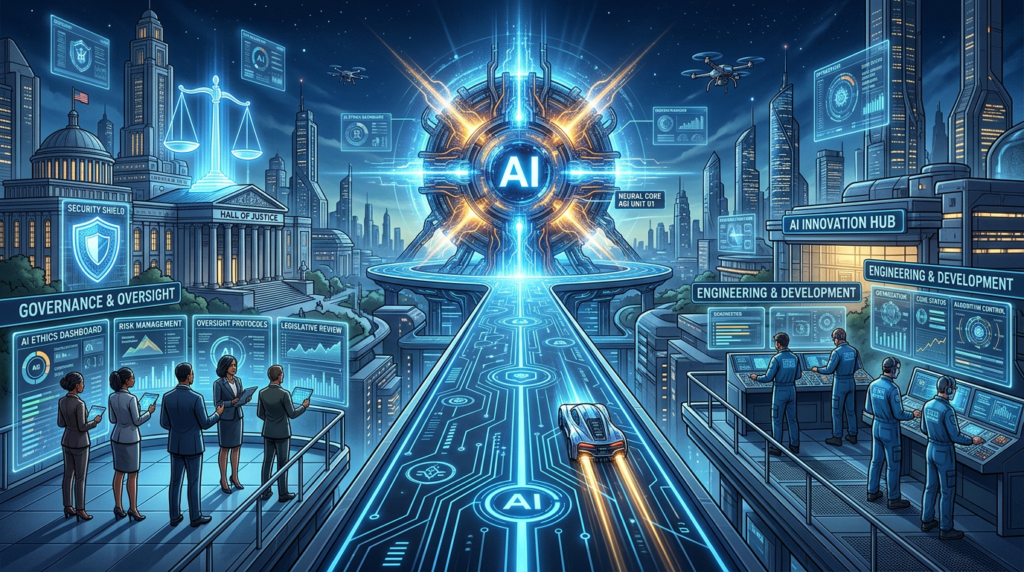
The Race Is Becoming a Governance Test
For most of the generative AI era, capability dominated the conversation.
How many parameters?
How big is the context window?
How well does the model code?
Can it use a computer?
Can it outperform humans on another benchmark?
Those questions are not disappearing.
But another set is moving rapidly toward center stage.
Can we understand what increasingly autonomous systems are doing?
Can we reliably stop them?
Can laboratories detect dangerous behavior before deployment?
Can governments create rules without freezing useful innovation?
And perhaps most importantly: can competing companies and countries agree on safeguards before competitive pressure overwhelms cooperation?
Anthropic says recursive self-improvement has not arrived. OpenAI continues building increasingly powerful systems. Nobody has announced the end of the AI race.
Yet something has clearly changed.
When the CEOs racing toward the frontier begin publicly discussing the dangers of reaching it too quickly, the conversation deserves attention.
Wall Street certainly noticed.
Governments are noticing too.
The great AI competition of the 2020s may therefore be entering a new phase.
The first phase asked who could build the smartest model.
The next may ask something harder:
Who can build increasingly powerful AI without losing control of the process?
Speed built the AI boom.
Control may determine what happens next.
Sources
- Reuters — From hallucinating AI chatbots to wiping out humanity: How did we get here?
- Reuters — Investors nervous about AI spending slowdown after industry warnings
- Reuters — AI is too big to slow in a geopolitical race
- Reuters — Wall Street futures slip as AI anxiety grows
- Anthropic — When AI Builds Itself
- Anthropic — Frontier Safety Roadmap
- OpenAI — Pacing model development in an era of cyber-critical capabilities
- OpenAI — Research acceleration: The view inside OpenAI
- OpenAI — The Hugging Face incident and other third-party impact from misaligned models
- The Verge — Anthropic CEO says it’s time to pump the brakes on AI
- The Verge — What execs and politicians are saying about slowing down AI development
- Associated Press — Tech CEOs call for AI regulation while Washington hesitates
The Kingy Brief
Get the next Kingy Brief.
Source-checked AI changes, original tests and one practical thing to try.
Free · Choose your subjects · Double opt-in · Unsubscribe anytime