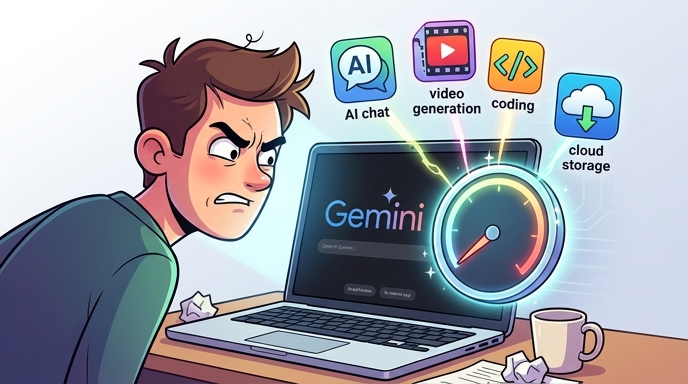
The Meter Finally Showed Up

Google has changed the way Gemini usage limits work, and the reaction has been about as calm as a printer jam during tax season.
The old system felt simple. You got a certain number of prompts per day, You used them. You ran out. Annoying? Sure. But at least the rules looked like rules.
Now Google has moved Gemini to a compute-based usage model. That means Gemini no longer counts only how many messages you send. It also considers how complicated your prompt is, what model or feature you use, and how long your chat has become. Google says your limit refreshes every five hours until you hit a weekly cap.
That sounds reasonable on paper. A tiny text question should not cost the same as a video-generation request or a long coding session. But users do not live on paper. They live inside apps, subscription pages, confusing meters, and sudden lockouts.
And this is where the story gets spicy.
From Daily Prompts to Compute Math
The big change is not that Gemini has limits. Every major AI system has limits. The real issue is that Google swapped a visible, predictable limit for a fuzzier one.
PCWorld reported that Gemini’s new limits factor in prompt complexity, features such as image and video generation, Deep Research, Pro models, extended thinking, Deep Think, and chat length. The limits refresh every five hours until a weekly ceiling kicks in.
That creates a new user experience. You might ask one short question and barely move the meter. Or you might run a large prompt through a heavier model and watch your quota vanish like snacks at a writers’ room table.
Google argues this model allocates resources more fairly. A basic text prompt uses less compute than complex video or coding work. That is true. But fairness also depends on transparency. If users cannot predict what a task will cost, they cannot plan.
AI subscriptions used to feel like buffet access. Now they feel more like theme-park tokens. You can still ride. Just check your wristband, your tier, your model, your feature, your chat length, and possibly the moon phase.
The Five-Hour Clock Changes the Mood
The five-hour refresh window sounds generous until you hit the wall early.
Google’s support materials say the Gemini app’s compute-based limits refresh every five hours until a weekly limit is reached. Google’s AI subscription page also says limits depend on prompt complexity, features used, and chat length.
That “until” matters. It means the five-hour reset does not necessarily save heavy users forever. If they burn through enough compute, they can still collide with the weekly cap.
This changes how people behave. Users now have to think before they prompt. Should they start a fresh chat also should they avoid video? Should they skip extended thinking and should they use a lighter model? Lastly should they save the big task for later?
That may be rational from an infrastructure standpoint. AI compute is expensive. Video generation, deep research, agentic coding, and long-context reasoning can chew through resources quickly.
But consumer software succeeds when it feels obvious. Gemini now asks ordinary users to think like cloud-cost managers. That is not exactly “AI for everyone.” That is “AI for everyone who enjoys invisible accounting.”
Paid Users Feel the Pinch
The backlash becomes sharper because paid users expected breathing room.
PCWorld reported that Google AI Plus users get limits twice as high as the standard tier, AI Pro users get four times the standard limits, and AI Ultra users get much higher access. Google’s public AI plan pages also frame paid plans as expanded-access tiers with more Gemini features, more storage, and broader product access.
That sounds clean. Pay more, get more. Simple.
But frustration grows when “more” still feels uncertain. A user does not buy a $20 monthly AI plan to feel like every serious prompt might trip an alarm. They buy it to stop thinking about limits.
Android Authority reported one especially ugly example: a Google AI Pro subscriber said a single avatar-based video-generation prompt consumed an entire five-hour allowance in minutes, and the video failed anyway. Google Gemini lead Josh Woodward reportedly responded, “Yikes, let us take a look!”
That anecdote does not prove the whole system is broken. One case never does. But it captures the emotional problem perfectly. Users can forgive limits. They hate surprise limits. They hate paying for a task that fails and still burns the meter.
That feels less like a subscription and more like feeding coins into an arcade machine that eats quarters.
Video and Coding Are the Hungry Monsters
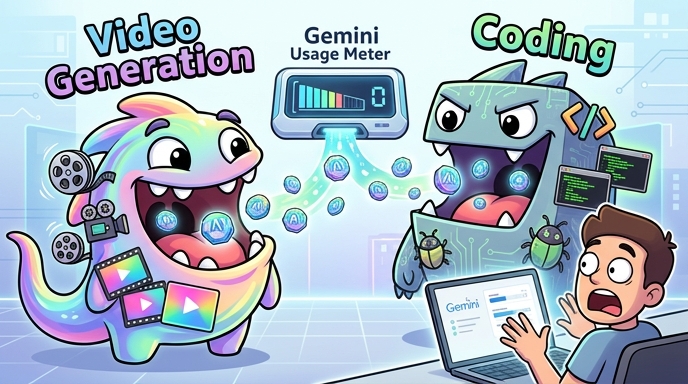
Not every Gemini task costs the same. That is the whole point of the new system.
AI Fire’s usage guide argues that heavy tasks such as coding and video generation can burn through Gemini capacity quickly, especially inside the main chat. It recommends moving large PDFs to NotebookLM and coding work to Google AI Studio to preserve Gemini app usage.
That advice makes practical sense. Use the right Google tool for the job. But it also exposes the new complexity. Users now need a workflow map just to avoid wasting quota.
Want text? Gemini app may be fine.
Want big documents? Try NotebookLM.
Want coding? Maybe AI Studio.
Want video? Watch the meter like it owes you money.
The new model nudges users toward specialization. That may help Google manage compute. It may even improve workflows for power users who know the ecosystem. But it also makes the product feel less magical.
The old promise of chatbots was simple: type what you want. The new reality says: type what you want, but first consider cost class, context length, tool routing, model choice, and whether this prompt deserves the fancy brain.
That is not a conversation. That is an invoice warming up.
The Transparency Problem Is the Real Villain
Google can defend compute-based limits. The math makes sense. The communication does not.
A prompt-based cap gives users a clear unit. A compute-based cap gives them a mystery meter. The system may know why one request costs 3% and another costs 37%, but users often do not.
Android Authority noted complaints from Gemini users who said the new system made it hard to tell how much usage a single task would consume.
That uncertainty creates bad behavior. People start hoarding prompts. They break chats into smaller pieces, They avoid advanced features, They second-guess experiments. They stop playing.
That matters because AI products grow through experimentation. Users learn by trying odd prompts, testing boundaries, and asking follow-ups. If every ambitious prompt feels financially radioactive, people become cautious.
And cautious users do not discover the best features.
Google needs clearer cost previews. It should show estimated impact before expensive tasks, It should explain why a prompt consumed a large chunk. It should distinguish failed attempts from successful outputs. And yes, it should give paid users enough room to use the product without feeling hunted by a progress bar.
Google Is Not Alone Here
This is not just a Gemini story. It is an AI industry story.
PCWorld connected Google’s shift to broader pressure across the AI market. The article noted that GitHub recently changed Copilot plans toward an AI-credit model based on usage, while AI providers face rising demand from advanced agentic features that can trigger large amounts of model work from a single user request.
That is the bigger picture. The industry sold AI as unlimited magic. Infrastructure sent the bill.
Large models cost money to run. Long contexts cost more. Video costs more. Agentic coding costs more. Deep research costs more. The more these products act like workers instead of autocomplete boxes, the more they consume.
So companies are retreating from flat-rate fantasy. They are building meters, credits, tiers, caps, top-ups, and smaller-model fallbacks.
Google’s own blog says that if users hit caps on its biggest models, it can shift them to smaller, faster models, while AI Pro and Ultra subscribers can buy pay-as-you-go top-up AI credits for products such as Antigravity, Flow, and eventually the Gemini app.
That may be sustainable. It is also less fun.
The Subscription Ladder Gets Taller
Google now has a clearer ladder: free access, AI Plus, AI Pro, and AI Ultra.
PCWorld reported that AI Plus receives twice the standard usage limit, AI Pro receives four times, and AI Ultra receives much higher access under the new system. It also noted Google’s newer premium AI plan changes, including higher-priced Ultra tiers.
Google’s subscription page lists AI Plus, AI Pro, and AI Ultra as bundles that include Gemini access, Flow, NotebookLM, Google AI features in Workspace-style apps, and cloud storage. AI Pro includes 5TB of storage, while Ultra starts with much higher storage and higher AI access.
The business logic is obvious. Google wants casual users on free or Plus, serious users on Pro, and heavy users on Ultra.
The user logic is also obvious. People want to know what they are buying.
“Four times standard” sounds good until “standard” feels like smoke. “Higher limits” sounds nice until one video attempt devours a five-hour window. Subscription tiers need plain-English examples.
How many serious coding sessions? another questions is How many video attempts? How many long research chats? How many extended-thinking runs?
Without examples, users fill the gap with anger. The internet, as always, brought its own gasoline.
The Social Backlash Has Teeth
The harshest reactions have come from users who feel blindsided.
Android Authority reported growing frustration on Reddit and elsewhere after Google’s updated quota system arrived. Search-result snippets for Android Police and Neowin also describe the rollout as a shift toward five-hour and weekly Gemini limits, with Neowin framing it as the end of “unlimited” access.
That word — unlimited — is dangerous. Even when companies do not literally promise infinite usage, users often experience generous AI tools as functionally unlimited. Then a meter appears, and the vibe collapses.
The emotional contract breaks before the legal one does.
Users do not need perfect infinity. They need predictability, They need notice, They need controls that make sense. They need failed generations to not feel like robbery by algorithm.
Google can still fix this. The company already acknowledged at least one complaint publicly, according to Android Authority. But fixing the mood will take more than a tweet-length “we’re looking into it.”
The product needs a clearer bargain.
What Users Can Do Right Now
Users cannot rewrite Google’s quota system. But they can stop wasting it.
First, avoid using the heaviest models for basic questions. If a simple answer will do, do not summon the dragon.
Second, start new chats when old threads become bloated. Google says chat length affects compute usage, so long conversations may cost more.
Third, route specialized work to specialized tools. AI Fire recommends NotebookLM for large files and Google AI Studio for coding tasks, instead of burning everything inside the main Gemini chat.
Fourth, treat video generation as expensive. The reporting and user complaints around avatar-based and video tasks suggest these features can drain limits quickly.
Fifth, watch the usage meter before ambitious sessions. Boring? Yes. Effective? Also yes.
The new Gemini era rewards deliberate usage. That may annoy people who liked the old carefree flow. But until Google improves transparency, users need to act like prompt accountants.
Not glamorous. Very 2026.
The Bottom Line
Google’s compute-based Gemini limits are not irrational. They may even be inevitable.
The old prompt-count model treated a tiny text request and a monster video-generation job too similarly. That was never going to last. AI companies cannot offer infinite premium compute forever while users casually ask models to code apps, make videos, read giant files, and run deep research loops.
But Google has a product-design problem, not just a compute problem.
The new system feels murky. Paid users feel constrained. Heavy features feel risky. Failed generations can still sting. And the five-hour meter turns AI from a creative partner into something that occasionally resembles a mobile game energy system.
That is the wrong vibe.
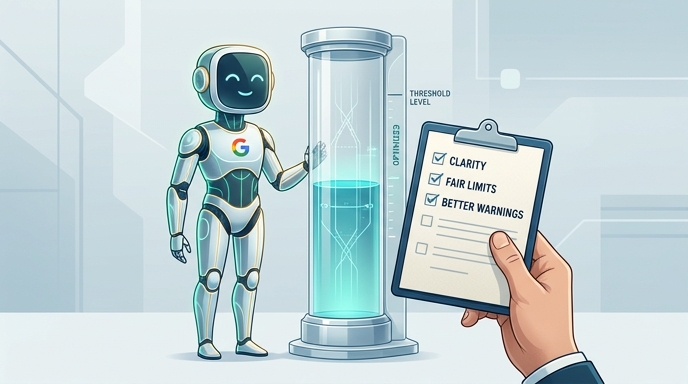
Gemini should feel powerful, not stingy. It should make users curious, not cautious. If Google wants compute-based pricing and limits, it needs compute-based clarity: estimates, explanations, refunds for failed heavy jobs, clearer tier examples, and better warnings before expensive requests.
Until then, the message to Gemini users is simple: the magic still works, but now it has a meter. And that meter has opinions.
Sources
- Android Authority — “Gemini user hits 5-hour usage cap after a single prompt, Google responds” (Android Authority)
- PCWorld — “Google just made big changes to Gemini usage limits” (PCWorld)
- AI Fire — “Practical Gemini Usage Survival Guide” (AI Fire)
- Google Help — “Gemini Apps limits & upgrades for Google AI subscribers” (Google Help)
- Google Blog — “Google AI subscription updates from Google I/O 2026” (blog.google)
- Google AI subscriptions page (Google One)
- Android Police — “Google is changing how Gemini usage limits work” (Android Police)
- Neowin — “Google silently kills unlimited Gemini access as strict new usage limits roll out” (Neowin)
The Kingy Brief
Get The Kingy Brief.
AI changes, original tests and one practical thing to try. Fridays at 09:00 Vancouver time.
Free · Double opt-in · Unsubscribe anytime
Signup help and newsletter schedule
Signup form provided by Beehiiv. After submitting, check your inbox for "Confirm your subscription to The Kingy Brief" and open its confirmation link. Check Spam or Promotions if you cannot find it.
Fridays at 09:00 Vancouver time: source-checked AI changes, original tests and one practical thing to try. The weekly restart begins October 9, 2026. We skip a week when there is not enough verified material. Free. Unsubscribe anytime.