The People Have Moved. The Price Is Still a Question.
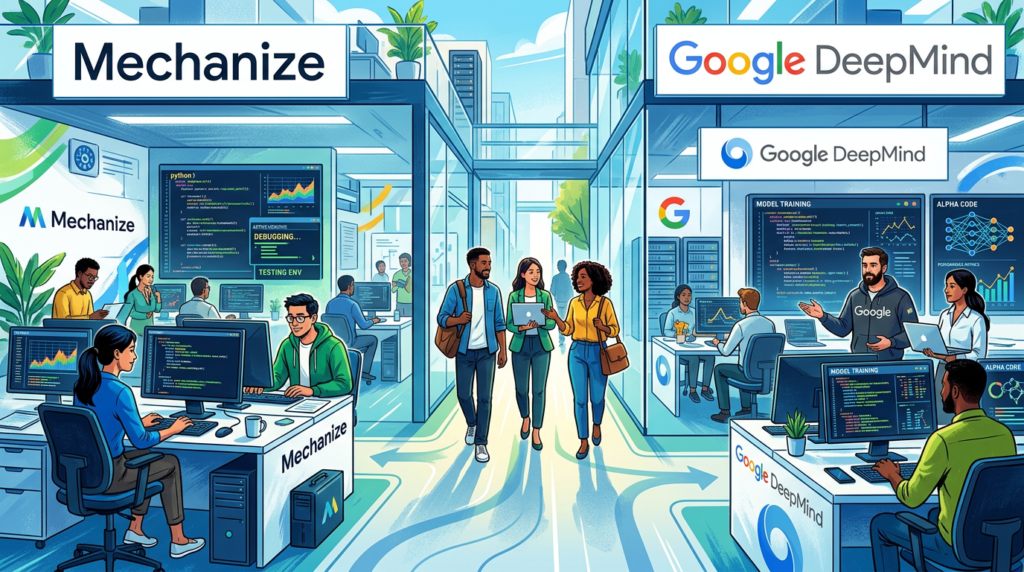
Google has completed a talent deal with Mechanize, a startup that builds training environments for AI coding agents, according to Business Insider. Mechanize co-founder and former CEO Tamay Besiroglu has joined Google DeepMind as a research scientist. More than a dozen former Mechanize employees have also moved to Google, the publication reported, citing public professional profiles.
The headline-sized number needs a little care. Business Insider reported in August that the companies were discussing a deal worth more than $1.5 billion involving talent and technology. Its new report says the talent deal is complete, but the final terms were not disclosed. We cannot establish from that report what Google ultimately paid.
Google and Besiroglu declined to comment to Business Insider. Mechanize has not published an announcement explaining the completed arrangement on its press releases page.
So, what can we say confidently? A group of people who built tools for training coding agents is now working inside Google. That may sound less flashy than a giant acquisition. In the race to make AI better at real software work, it could be the more revealing detail.
Meet the Startup Behind the Deal
Mechanize is a San Francisco company with a mission that does not believe in starting small: it wants to help automate valuable work across the economy. For now, its focus is much narrower and easier to picture. It builds environments and evaluations for AI coding agents, according to its website.
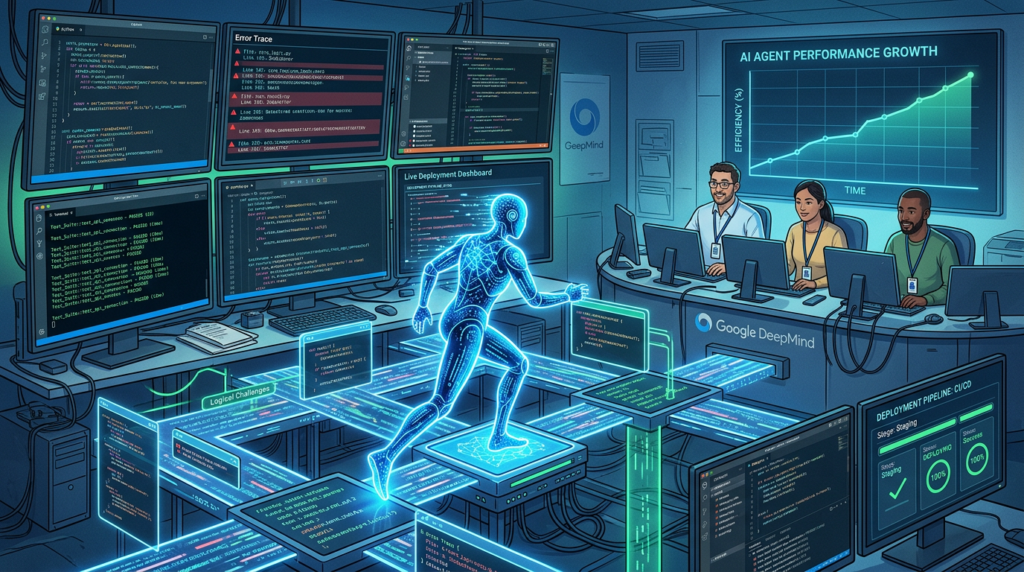
An environment gives an AI model a software task to carry out. Perhaps it must add a feature, deploy an application, or debug a codebase it has never seen. A grader then assesses how well it performed. Those results can be used to evaluate a model or help train it through reinforcement learning.
That is different from selling a chatbot to a developer who needs a quick answer. Mechanize works on the practice ground: the tasks, tools, and scoring systems that can help a model learn where it succeeds and where it falls over.
The company was announced in April 2025 by Matthew Barnett, Besiroglu, and Ege Erdil. Its public description remains focused on coding, even as it sets out a much larger long-term ambition.
A startup that builds practice sessions for AI sounds like a niche business. Google’s interest suggests that the quality of those sessions matters a great deal.
Why Coding Agents Need More Than Code Examples
Modern AI models have seen a tremendous amount of code. That helps them suggest functions, explain errors, and produce a convincing first draft. Yet a real software task rarely ends when the first draft appears.
A developer has to understand the request, inspect an unfamiliar project, make changes without breaking other features, and check whether the result actually works. If the first approach fails, they need to find out why. There may be a test suite, a deployment problem, or an instruction that was ambiguous from the start.
Mechanize’s approach is to put agents into environments where they must do such work. Its description of its business says models perform tasks including feature development and debugging, while a grader scores the outcome. The score provides feedback during training and evaluation.
Think of the difference between studying recipes and cooking dinner in a busy kitchen. Reading helps. Then the oven acts up, an ingredient is missing, and somebody changes the order. The useful test is what reaches the table.
For coding agents, the useful test is whether a change solves the problem in its actual setting. That is the capability Google is reportedly bringing more specialists into DeepMind to pursue.
The Work Happening Inside DeepMind
Business Insider reports that many of Mechanize’s former employees at Google are working on “midtraining” efforts. It does not provide a detailed account of their individual projects or say when Mechanize’s technology will appear in a Google product.
The general idea is that building a capable model takes more than one pass through a pile of data. Researchers can refine its abilities using targeted tasks and feedback. Mechanize’s stated specialty—designing coding environments and evaluations—fits naturally into that kind of effort. That connection is an inference from the reported roles and the startup’s published work, not a product roadmap Google has announced.
Besiroglu’s move is notable, too. Before Mechanize, he co-founded Epoch AI, an organization known for research and analysis of AI progress. At Mechanize, he helped build a company centered on testing what agents can actually accomplish. Business Insider says his professional profile now lists him as a research scientist at DeepMind.
The public evidence tells us where the people went. It does not tell us which Gemini model they may work on, which internal system they will improve, or how much performance might change. Those are the results to watch, rather than claims to make today.
A $9.1 Million Raise, Then Billion-Dollar Talks
The pace of Mechanize’s story has been brisk. It announced itself in April 2025. A year later, it said it had raised $9.1 million at a $500 million post-money valuation. By August, Business Insider was reporting discussions with Google about a talent-and-technology deal that some sources valued above $1.5 billion.
Those figures make an arresting sequence. They should not be mashed into a tidy calculation of somebody’s return.
The $500 million figure was Mechanize’s stated valuation for its funding round. The later $1.5 billion-plus figure described an arrangement being negotiated, not a newly disclosed valuation of Mechanize or a confirmed final payment. Business Insider’s September report leaves the completed deal’s terms undisclosed.
Even with that limit, the scale of the reported talks says something. The negotiating parties were discussing a sum far larger than Mechanize’s announced funding raise. Google had previously paid billions in another coding-related talent and licensing arrangement.
For AI companies, the valuable asset may include a combination of researchers, engineering judgment, training methods, and rights to use technology. We do not know how any final Mechanize deal divided value among those pieces. The people, at least, have unmistakably arrived at Google.
Did Google Buy Mechanize?
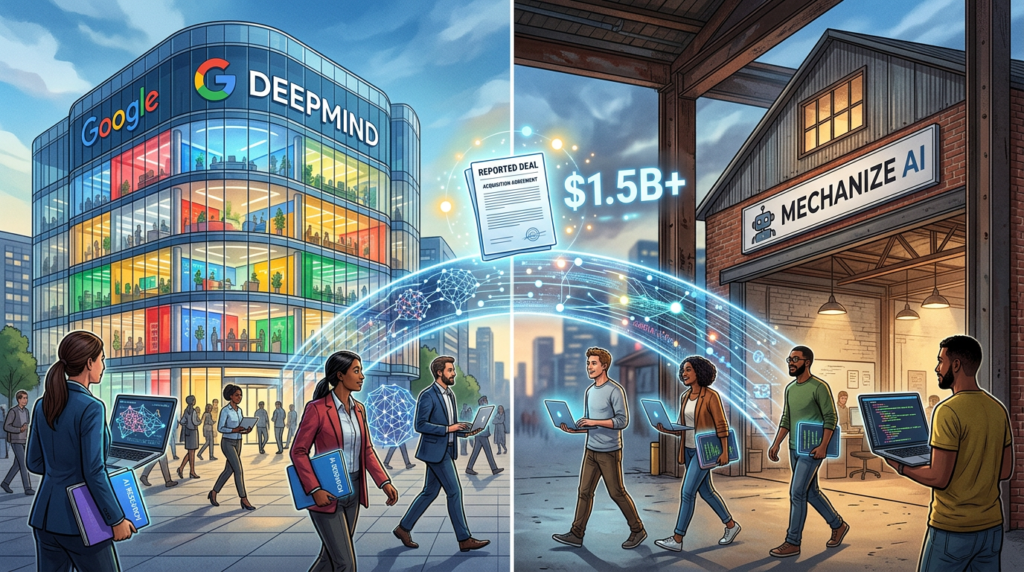
That is the question most likely to produce an inaccurate headline. The available reporting says Google completed a talent deal. It does not establish that Google acquired Mechanize outright.
In August, Business Insider reported that Google was discussing hiring some employees and obtaining a non-exclusive license to Mechanize’s technology. A non-exclusive license would let Google use specified technology without necessarily preventing its owner from licensing it elsewhere. Those were reported terms under discussion at the time; the final license terms have not been disclosed.
There is another clue that the company did not simply disappear into Google. Mechanize’s former chief of staff, Guive Assadi, now describes himself as its CEO, Business Insider reported. Mechanize’s website still describes its work and advertises engineering roles.
Neither clue reveals everything about its ownership, customers, or future. They do support a basic distinction: moving a team and licensing technology is not automatically the same as buying the entire startup.
So “Google acquired Mechanize for $1.5 billion” reaches further than the evidence. “Google completed a Mechanize talent deal after reported $1.5 billion-plus talks” tells readers what happened and where the uncertainty begins.
Google Has Run a Similar Play Before
Mechanize is not Google’s first major talent-and-technology deal in AI coding. In July 2025, Google hired leaders and researchers from Windsurf, another coding startup, while gaining a license to its technology. Reuters reported that the licensing arrangement was worth about $2.4 billion and that Google did not acquire a stake in Windsurf.
Windsurf’s CEO, Varun Mohan, and co-founder Douglas Chen went to Google DeepMind. Mohan now leads Google’s Antigravity coding program, according to Business Insider’s Mechanize follow-up.
The comparison helps explain the structure without pretending the deals are identical. In each case, Google sought expertise connected to coding agents. In the Windsurf arrangement, the license and personnel moves were publicly described in more detail. For Mechanize, the final terms remain private.
There is a practical appeal to bringing researchers directly into a model-building organization: they can work with the teams and systems they are meant to improve. Whether this particular move gives Google a measurable advantage is still unknown.
For now, Windsurf provides a precedent for Google’s approach. Mechanize provides a fresh test of what that approach produces.
What Mechanize Says Agents Still Get Wrong
Mechanize’s founders have been candid about the gap between impressive coding demos and dependable software engineering. In a 2025 essay, they argued that AI systems can perform well on narrow coding tasks yet still struggle with reliability, long-term work, and unfamiliar situations.
One difficulty is easy to recognize even if you have never written a line of code: how do you grade a task when the request itself is fuzzy? A test can check whether a program runs. It is harder to automatically judge whether the result is maintainable, whether it meets a customer’s unstated needs, or whether it creates a problem for the next person who edits it.
The founders argued that richer training environments could expose these weaknesses. An agent should encounter something closer to the complexity of an actual job, then receive useful feedback on its decisions.
That is Mechanize’s view, not a demonstrated guarantee that its methods will solve every problem. It does, however, explain why a team specializing in environments and grading could interest a frontier AI lab.
Writing a neat-looking answer is one thing. Completing a messy assignment, checking the result, and recovering from mistakes? That is where the serious training begins.
There’s Even a Game Boy Test
If “AI evaluation environment” sounds hopelessly abstract, Mechanize offers a wonderfully concrete example. Its site describes GBA Eval, a benchmark that asks coding agents to build a Game Boy Advance emulator from scratch within 24 hours.
An emulator has to reproduce the behavior of another computing system well enough to run its software. That makes the assignment broader than asking an AI to write a single function. It must work through connected technical problems and produce something whose behavior can be tested.
The benchmark does not prove that an agent can replace a software engineer. No single test can. Its appeal is that the task requires sustained work and offers a clearer way to examine the outcome than simply admiring a screen full of generated code.
This is the sort of distinction Mechanize’s team works on: choosing tasks that reveal capability, and finding ways to score performance. A model may sound confident while it is stuck. A demanding task makes that harder to hide.
Whether GBA Eval itself has any role in Google’s work is unknown. It is a public illustration of the expertise Google is recruiting: the art of asking an AI a hard coding question and checking whether it truly answered.
The Startup Has a Life Beyond the Departures
A dozen-plus employees moving to Google is a major change for a young company. It does not tell us that everyone left or that Mechanize’s work has ended.
Business Insider reported that Assadi, formerly Mechanize’s chief of staff, now identifies as its CEO. Mechanize’s current site continues to describe its coding-agent environments and evaluations, lists research and essays, and invites engineers to apply.
The company has not publicly explained what the Google arrangement means for its remaining staff or future customers. We also do not have the final licensing agreement. If a non-exclusive license was part of the completed deal, its precise scope would matter to anyone assessing what Mechanize can build or offer next. At present, the August discussion is all the public reporting establishes about that proposed term.
Windsurf offers one example of how a startup can continue after senior figures join Google, but it is not a script Mechanize must follow. The companies had different teams, products, and agreements.
Mechanize’s next announcement will be more informative than guesswork about its fate. What we can see today is a leadership change alongside an ongoing public presence.
What the Deal Could Mean for Developers
If DeepMind uses the incoming team’s expertise effectively, developers might eventually notice coding agents that handle more of a task without losing the plot. They could become better at navigating unfamiliar projects, checking changes, or recovering when an approach fails.
That is a possible outcome, not a feature Google has announced as a result of the Mechanize deal. The hiring report contains no release date, product name tied to the newcomers, or before-and-after performance test.
Google has several developer-facing AI offerings, including Antigravity, Gemini Code Assist, and Jules. It would be tempting to pick one and declare it the beneficiary. The evidence does not let us do that. Model research may also affect more than one product over time.
For developers, the standard for judging progress should stay delightfully ordinary: Does the tool understand the assignment? Does its code work? Can someone maintain it? Does it explain what changed? A bigger research team is a means to pursue better answers, not proof that the answers have arrived.
That makes this a story about potential with a real event at its center. People with relevant skills joined Google. Their impact is the part still to come.
The Real Test Comes After the Headlines
Google’s Mechanize move tells us where it sees value in the AI coding race. It has brought Besiroglu and more than a dozen former colleagues into DeepMind. Their old company specializes in realistic software tasks and ways to grade what an agent actually accomplishes. Google has made a similar kind of talent-and-license move before with Windsurf.
The deal’s financial story is less settled in public. Business Insider reported $1.5 billion-plus talks in August, then confirmed the talent deal’s completion in September. It said the final terms were not disclosed. Until those terms emerge, the reported negotiating figure should remain a reported negotiating figure.
Several questions are now worth following. What will Mechanize build under its new CEO? Will Google explain the rights it obtained to the startup’s technology? Most of all, will future Google models handle real coding work more reliably?
That last question cuts through the spectacle of the price tag. Mechanize builds tests for the gap between looking capable and being capable. Its former team has moved to one of the world’s largest AI labs. Now Google gets its turn at the harder test: showing what the move can actually accomplish.
Sources
- Business Insider: Google completes its Mechanize talent deal
- Business Insider: The $1.5 billion-plus talks reported in August
- Mechanize: Company overview and coding-agent evaluations
- Mechanize: Founding announcement
- Mechanize: $9.1 million funding announcement
- Mechanize: How to fully automate software engineering
- Mechanize: GBA Eval
- Reuters: Google’s earlier Windsurf talent and licensing deal
- Google AI: Developer tools
The Kingy Brief
Get the next Kingy Brief.
Source-checked AI changes, original tests and one practical thing to try.
Free · Choose your subjects · Double opt-in · Unsubscribe anytime