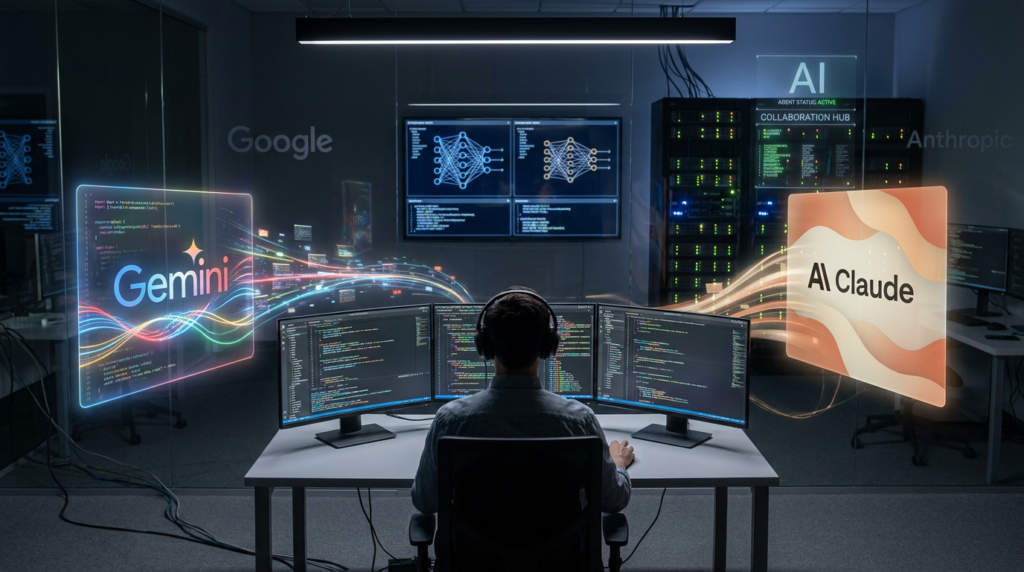
For years, the biggest technology companies have preached the power of their own artificial intelligence models.
Google has Gemini. Anthropic has Claude. OpenAI has GPT and Codex. Each company wants developers to believe its technology offers the best path into an increasingly AI-powered future.
Inside Google, however, something interesting is happening.
According to a new report from Business Insider, Google is allowing engineers across the company to use Anthropic’s Claude, expanding access that had previously been restricted to selected teams and high-priority projects. Engineers can access Claude through Google’s Antigravity development environment, although usage is reportedly governed by quotas. Gemini remains Google’s primary internal AI tool. (Business Insider)
Yes, you read that correctly.
Google engineers can now use one of Gemini’s biggest competitors to help them write software.
At first glance, that sounds like someone at Coca-Cola handing employees a Pepsi and saying, “Fine, try this too.”
But the reality is more interesting.
Google isn’t abandoning Gemini. Far from it. Instead, the decision illustrates how quickly AI-assisted software development is evolving—and how valuable the best coding models have become.
When productivity is on the line, model loyalty apparently has limits.
And Google’s decision could offer an early glimpse of where enterprise AI is heading: not toward one model ruling everything, but toward workplaces where people choose different frontier models for different jobs.
Google Engineers Get Another AI in the Toolbox
The most important part of the announcement is its scale.
Business Insider reports that Claude access is now available to engineers throughout Google, rather than being limited to a relatively small collection of teams.
Previously, Google’s policy restricted broader use of outside AI coding systems, including Claude and OpenAI’s Codex. Certain teams at Google DeepMind and other high-priority projects had already received access to Claude. (Business Insider)
Now that door is opening wider.
Engineers can reportedly access Anthropic’s model through Antigravity, Google’s AI-powered development environment.
Google isn’t giving Claude unlimited freedom, however.
Business Insider reports that Claude operates under a quota system, meaning engineers have limits on how much they can use it. Gemini also remains Google’s preferred and primary internal AI model. (Business Insider)
That’s an important distinction.
This isn’t Google replacing Gemini with Claude.
It’s Google acknowledging that another frontier model can be useful enough to belong in its engineers’ toolbox.
And software development is particularly suited to that approach.
One model might be excellent at analyzing a massive existing codebase. Another could perform better at debugging. Another might be faster for routine code generation.
When thousands of engineers are involved, even modest productivity improvements can add up quickly.
The question becomes less philosophical.
Which model gets the job done?
Claude Has Been Knocking on Google’s Door for a While
Today’s decision didn’t appear out of nowhere.
There have been signs for months that Claude’s coding abilities were attracting attention inside Google.
Back in April, the Los Angeles Times reported that some Google engineers internally preferred Anthropic’s Claude Code for certain development tasks. That reporting came amid concerns within Google about competition in AI coding tools. (Los Angeles Times)
An even more striking example surfaced earlier this year.
In January, reporting highlighted comments from a senior Google engineer who said Claude Code had produced a working system in roughly an hour related to work her team had been developing for considerably longer. (The Decoder)
One anecdote doesn’t establish that Claude is universally better than Gemini.
Coding-model performance depends heavily on the task, codebase, instructions, surrounding tools and development environment.
But stories like these illustrate why engineers want options.
AI coding assistants are evolving beyond sophisticated autocomplete.
Modern coding agents can inspect repositories, modify multiple files, run commands, diagnose problems and carry out increasingly complicated software-development workflows.
Anthropic has made coding a major focus of Claude’s development.
Its newest Claude Fable 5.1 and Mythos 5.1 models are explicitly positioned around coding and knowledge work. (Anthropic)
When engineers discover that a particular model handles a particular job well, preventing them from using it can become a productivity decision rather than merely a branding decision.
Google now appears increasingly willing to make that trade-off.
Antigravity Makes This Even More Interesting
Claude isn’t simply being handed to Google engineers as a completely separate application.
The model is being made available through Google Antigravity.
That detail matters.
Antigravity is Google’s agent-oriented development environment, designed around the idea that AI agents can take on larger portions of software-development work rather than merely suggesting the next few lines of code.
The environment supports agents working on complicated tasks while interacting with development tools.
And crucially, Antigravity was already designed with a degree of multi-model flexibility.
Claude support therefore doesn’t necessarily undermine Google’s development platform.
In an odd way, it can make Antigravity more valuable.
Think about the difference.
If Antigravity only works brilliantly when Gemini is the best model for a task, its usefulness is partly tied to Gemini’s relative performance.
If Antigravity becomes a place where engineers can select among several leading models, Google potentially owns the environment even when somebody else’s model performs part of the work.
That’s a powerful position.
The model layer of AI is changing incredibly quickly. Today’s benchmark champion can become tomorrow’s second-place finisher after one product launch.
Development platforms can potentially survive those shifts.
The winning coding environment may therefore not be the one attached exclusively to the world’s strongest model.
It could be the one that lets developers easily use whichever model is strongest for the job in front of them.
Google’s decision to expand Claude access makes that possibility harder to ignore.
Gemini Isn’t Being Pushed Aside
There’s an obvious temptation to interpret the news as a defeat for Gemini.
That would go too far.
Google still considers Gemini its primary AI system for internal engineering, according to Business Insider’s reporting. Claude access is supplemental and subject to quotas. (Business Insider)
Google also continues aggressively developing its own models and AI-development ecosystem.
The company has enormous incentives to make Gemini successful.
Gemini sits across Google’s consumer products, cloud services, developer offerings and broader AI strategy. Giving employees access to Claude doesn’t erase any of that.
Instead, the decision exposes something fascinating about frontier AI development.
Even the companies building these models can benefit from their competitors’ models.
That’s because AI capabilities aren’t perfectly uniform.
Imagine two extraordinarily talented programmers.
One might excel at designing architecture. Another might be brilliant at tracking down obscure bugs.
You wouldn’t necessarily fire one because the other exists.
You’d use them where they’re strongest.
AI models increasingly look similar from a workflow perspective.
Google can continue developing Gemini while allowing engineers to reach for Claude when Claude fits the task.
More importantly, Google’s engineers can learn from the comparison.
If employees repeatedly choose Claude for a certain category of programming task, that provides useful information about where Gemini needs improvement.
Your competitor’s product suddenly becomes a very large internal benchmark.
That’s awkward.
But also incredibly useful.
Google and Anthropic Are Rivals—and Partners
The relationship between Google and Anthropic makes this story much stranger than a typical competitor-product rollout.
Google isn’t merely competing with Anthropic.
It’s also backing it.
Google has been an investor and infrastructure partner to Anthropic for years, and the relationship has continued expanding even as Claude has become one of Gemini’s most serious competitors.
Business Insider’s latest report says Google plans investments of up to $40 billion in Anthropic. (Business Insider)
Previous reporting has similarly described Google’s enormous financial commitment to the Claude maker as part of a broader relationship involving AI infrastructure and cloud computing. (AI Magazine)
So Google occupies several positions simultaneously.
It builds Gemini.
It competes against Claude.
It invests in Anthropic.
It provides cloud infrastructure connected to Anthropic’s operations.
And now its own engineers can use Claude more broadly.
Welcome to the AI industry, where “competitor” apparently needs several footnotes.
But there is logic behind the arrangement.
Google Cloud competes to provide infrastructure regardless of which AI model ultimately wins a particular customer.
Google can also benefit financially from Anthropic’s growth while continuing to compete fiercely at the model and product layers.
This kind of overlap isn’t unique to AI.
Technology companies have spent decades simultaneously competing and cooperating.
The difference is speed.
Frontier AI moves so quickly that these relationships are becoming intertwined at remarkable rates.
Productivity Is Becoming More Important Than Model Loyalty

Why would Google let engineers use a competitor?
The simplest answer might be the most important.
Productivity.
Business Insider reports that Google’s broader rollout follows employee demand and comes as the company pushes for greater productivity through AI-assisted development. (Business Insider)
Software engineering is one of the clearest areas where generative AI has moved from interesting experiment to serious workplace tool.
Coding assistants can help generate boilerplate code, explain unfamiliar repositories, create tests, identify bugs, refactor software and perform increasingly autonomous development tasks.
At Google’s scale, the economics become interesting very quickly.
Suppose an AI assistant saves an engineer only a small amount of time every week.
Multiply that across thousands of engineers.
Then multiply it again across an entire year.
Suddenly, choosing the right coding model isn’t a minor software preference. It potentially becomes a meaningful operational decision.
That’s why restricting engineers to one model simply because the company created it can become counterproductive.
There is another advantage.
Competition inside the development environment may force every model to improve.
Gemini doesn’t merely compete with Claude in public benchmarks or enterprise sales pitches.
Google engineers can potentially compare them during actual software-development work.
If Gemini performs better, engineers have reason to choose it.
If Claude performs better, Google gets evidence about where improvement is needed.
That’s an uncomfortable feedback loop.
It’s also a potentially excellent one.
Anthropic’s Coding Strategy Is Paying Off
For Anthropic, getting broader access inside Google represents another notable achievement for Claude.
Anthropic has spent considerable effort turning Claude into a serious development platform rather than treating programming as simply another chatbot capability.
Claude Code has become central to that strategy.
Anthropic’s newer models continue emphasizing coding, agents and knowledge work. Its current Fable and Mythos generation is positioned specifically around advanced professional workloads. (Anthropic)
The company has also been building infrastructure for enterprises that want tighter control over Claude Code deployments.
Earlier this year, Anthropic introduced an enterprise gateway intended to make Claude Code easier to manage through Amazon Web Services and Google Cloud, including features involving centralized policies, authentication and spending controls. (DevOps.com)
That matters because enterprise adoption involves much more than having a clever model.
Large organizations need permissions.
They need security.
They need spending controls.
They need monitoring.
They need predictable access.
And they need ways to integrate AI into existing development environments without turning every engineer’s laptop into the Wild West.
Google’s quota-controlled Claude rollout fits into that broader shift.
AI coding is becoming infrastructure.
Once that happens, the battle isn’t simply about which chatbot produces the prettiest Python function.
It’s about which models can operate reliably inside enormous organizations.
Claude gaining broader availability inside Google is a powerful example of how far Anthropic’s coding ambitions have traveled.
Google Isn’t the Only Giant Looking Beyond Its Own Walls
Google’s move also reflects a broader trend.
Major technology companies increasingly appear willing to give employees access to outside AI systems when those tools offer practical benefits.
Business Insider reports that Amazon has faced similar employee pressure and has also enabled access to third-party coding tools. (Business Insider)
This points toward an interesting future for enterprise AI.
For years, the assumption was that companies would choose their preferred AI ecosystem.
Pick Microsoft.
Pick Google.
Pick OpenAI.
Pick Anthropic.
Then build around it.
Reality may become messier.
A company could use Gemini for one workload, Claude for another, an OpenAI model for a third and specialized or open models elsewhere.
Employees won’t necessarily care which corporate logo sits behind the model.
They’ll care whether it works.
That creates pressure on AI platforms to become interoperable.
It also makes orchestration increasingly important.
Companies need systems capable of controlling which models employees can access, what information those models can see, how much they can spend and which tasks they’re allowed to perform.
The AI market could therefore begin resembling cloud computing.
Many large organizations don’t rely exclusively on one cloud provider.
They mix technologies according to cost, capability and business requirements.
AI may follow a similar path.
Google allowing Claude into its engineering environment is a surprisingly strong signal in that direction.
The Coding War Is Becoming a Battle of Agents
There’s another reason this story matters.
AI coding is moving beyond the assistant era.
The next battlefield is agents.
Traditional coding assistants wait for instructions and suggest code.
Agentic systems can potentially accept a goal, examine a codebase, develop a plan, edit files, run tests, diagnose failures and continue iterating with relatively limited intervention.
Google Antigravity was built around that agent-oriented future.
Anthropic has been pushing Claude aggressively toward increasingly autonomous software-development workflows.
OpenAI is doing the same with Codex.
The question is therefore becoming larger than:
“Which model writes the best code?”
Instead:
“Which AI system can reliably complete the most useful engineering work?”
That’s a much harder challenge.
Writing an impressive function is one thing.
Understanding a giant production repository, modifying the correct components, respecting dependencies, running tests and avoiding unintended consequences is another.
The surrounding development environment matters enormously.
So does the model.
So does context management.
So do tools.
That’s why Google’s decision is interesting strategically.
Antigravity can potentially serve as Google’s agentic development layer while multiple models compete underneath it.
Gemini doesn’t disappear.
Claude doesn’t take over.
Instead, engineers gain another capable agentic brain they can potentially deploy when appropriate.
The AI coding race just became less about individual products and more about stacks of interchangeable intelligence.
Competition Could Make Gemini Better
There’s a positive angle for Google here that shouldn’t be overlooked.
Letting employees use Claude could ultimately make Gemini better.
Internal dogfooding has long been one of Silicon Valley’s most useful development techniques.
Employees use the company’s own products.
They discover weaknesses.
They report problems.
The products improve.
But something changes when employees can simultaneously use a competitor.
Now there is a reference point.
If Claude consistently completes certain tasks faster, Google’s AI teams can investigate why.
If Gemini handles another workload better, they can identify that advantage too.
This creates real-world comparative data that benchmarks can’t always capture.
Public coding benchmarks are useful, but software engineering inside Google is considerably more complicated than solving a standardized collection of programming exercises.
Google operates gigantic production systems developed over decades.
Its engineers work across enormous codebases, proprietary tools and highly specialized infrastructure.
Seeing how frontier models behave inside that environment could provide extremely valuable insights.
Google effectively gains another measuring stick.
Anthropic gains additional exposure.
Engineers gain more choice.
And Gemini gains a very motivated competitor sitting nearby.
Competition has a funny habit of sharpening products.
Even when that competition is sitting inside your own development environment.
The Future Workplace May Be Multi-Model
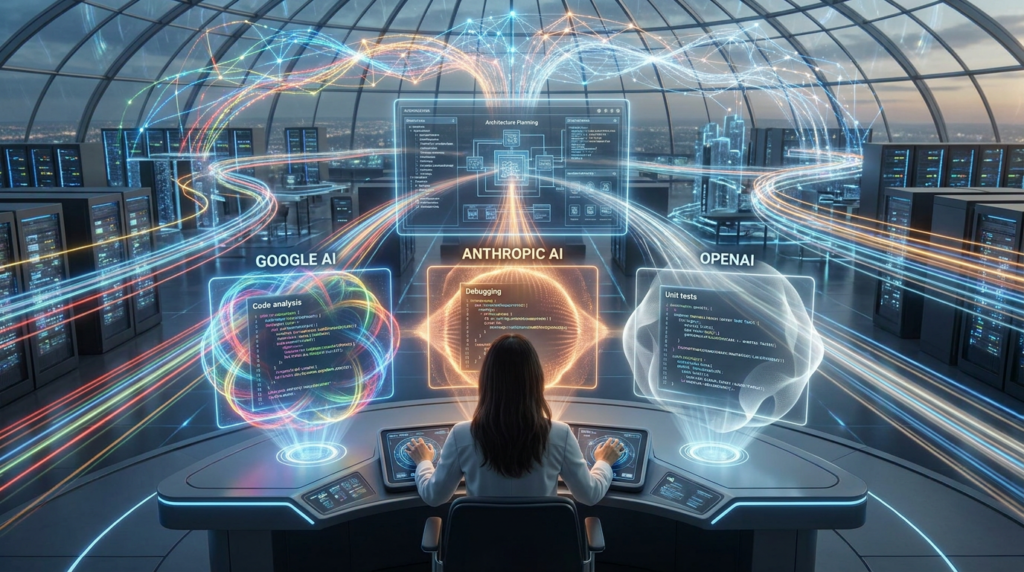
The most important lesson from Google’s Claude rollout may have little to do with either Google or Anthropic specifically.
It could tell us something about the future of AI at work.
The early generative-AI era encouraged people to think in terms of products.
“I’m using ChatGPT.”
“I’m using Gemini.”
“I’m using Claude.”
But increasingly capable AI systems could make those distinctions less important.
Imagine an engineering platform receiving a task and automatically selecting whichever approved model is best suited to complete it.
A debugging task goes to one model.
Architecture planning goes to another.
Fast code generation goes somewhere else.
A highly sensitive internal task stays on a locally controlled system.
The employee doesn’t necessarily choose.
The platform does.
We’re not fully there yet.
But Google’s decision makes the concept easier to imagine.
Google owns Gemini, yet its engineers now have broader access to Claude.
That tells you something.
At the frontier of AI development, even one of the world’s most powerful technology companies apparently sees value in having more than one intelligence available.
The AI coding war isn’t ending.
It’s becoming more complicated.
Google will continue pushing Gemini.
Anthropic will continue pushing Claude.
OpenAI will continue advancing Codex.
Every company wants developers.
Every company wants enterprise adoption.
Every company wants its models embedded into tomorrow’s software-development workflows.
But Google’s latest move suggests the winner may not take all.
Developers may simply take the best tool available for each job.
And if that means Google engineers occasionally asking Claude for help while building Google’s future?
Well, 2026’s AI industry has certainly produced stranger plot twists.
Sources
- Business Insider — Google Finally Lets All Engineers Use Anthropic’s Claude
- Seoul Economic Daily — Google Lets Engineers Use Rival Anthropic’s Claude
- Los Angeles Times — Google’s Internal Struggle in the AI Coding Race
- Anthropic — Claude Fable 5.1 and Claude Mythos 5.1
- Anthropic — Claude and Claude Code
- The Decoder — Google Engineer Describes Claude Code’s Development Performance
- DevOps.com — Anthropic Adds Enterprise Gateway for Claude Code on AWS and Google Cloud
- AI Magazine — Why Google Is Increasing Its Investment in Anthropic
- The Next Web — Google’s Gemini Coding Challenges and AI Development Competition
The Kingy Brief
Get the next Kingy Brief.
Source-checked AI changes, original tests and one practical thing to try.
Free · Choose your subjects · Double opt-in · Unsubscribe anytime