
OpenAI, Google and Anthropic spend an enormous amount of time trying to beat each other.
Better models. Faster reasoning. Smarter agents. Bigger context windows. More developers. More enterprise customers.
You know the drill.
But three of the biggest competitors in artificial intelligence may have found something important enough to temporarily put the scoreboard aside.
Anthropic, OpenAI and Google have reportedly been discussing the creation of an industry-led AI standards body that could establish common safety practices for increasingly powerful artificial intelligence systems.
The companies have reportedly held working-group discussions since July, with talks occurring as recently as the past week.
Nothing has been finalized. There is no officially launched organization, no completed rulebook and no giant Silicon Valley building with “AI POLICE” glowing above the entrance.
Not yet, anyway.
But the discussions arrive at an important moment.
Frontier AI systems are becoming increasingly capable. Companies are experimenting with agents that can operate software, conduct research, write code and perform longer sequences of actions with less supervision.
At the same time, AI leaders are debating whether existing government institutions can keep pace.
That leaves an interesting possibility.
What happens if the companies competing hardest to build frontier AI also agree on some basic rules for testing it?
We may be about to find out.
The Three AI Rivals Are Actually Talking
The basic development sounds simple.
Anthropic, OpenAI and Google have discussed forming a voluntary industry organization focused on AI standards.
But consider who we’re talking about.
Google DeepMind develops the Gemini family. OpenAI develops GPT models and increasingly sophisticated agents. Anthropic develops Claude and has made frontier-AI safety a central part of its identity.
These companies compete for many of the same developers, businesses, researchers and consumers.
Yet reports say representatives have been participating in working-group discussions about an industry standards organization since July. The discussions reportedly continued into September.
That doesn’t mean they’ve agreed on the details.
Far from it.
Creating standards requires answering difficult questions about testing, dangerous capabilities, model access, security and who ultimately gets to decide whether an AI system satisfies a particular requirement.
But the willingness to talk matters.
Each laboratory already operates its own safety framework.
Anthropic has its Responsible Scaling Policy. OpenAI operates a Preparedness Framework. Google DeepMind has its Frontier Safety Framework.
Those systems share some goals but differ substantially in structure, terminology and the thresholds they use.
An independent comparison published in July found meaningful differences between the three frameworks, despite all being designed to connect increasingly powerful capabilities with stronger safeguards.
That’s the problem a common standards body could potentially address.
Three competitors don’t necessarily need identical policies.
But agreeing on the same measuring tape would be a pretty good start.
Google Had Already Put the Idea on the Table
This concept didn’t suddenly appear over coffee last week.
Google DeepMind CEO Demis Hassabis publicly proposed something similar in July.
Hassabis called for a Frontier AI Standards Body, envisioning an organization inspired partly by FINRA, the Financial Industry Regulatory Authority that oversees brokerage firms and professionals in the United States.
Under the proposal, frontier AI companies could initially submit advanced models voluntarily for independent pre-release testing.
The evaluations could examine dangerous capabilities involving areas such as cybersecurity, biological risks and deceptive behavior.
Hassabis envisioned an independent-heavy governing structure rather than letting AI companies simply grade themselves.
The proposal also contemplated government involvement.
If voluntary testing proved reliable, the system could eventually evolve toward more formal requirements.
Hassabis even suggested moving quickly enough to establish the organization before the end of 2026.
That’s ambitious.
But today’s reported talks show that the idea didn’t simply disappear into Silicon Valley’s enormous warehouse of interesting blog posts.
OpenAI and Anthropic are now reportedly involved in discussions alongside Google.
And that changes the equation.
One company proposing an AI watchdog is interesting.
Three of the world’s leading frontier laboratories actively discussing one is potentially an industry shift.
AI Safety Has a Compatibility Problem
Here’s one of the less glamorous problems with frontier-AI governance.
Everyone has their own vocabulary.
Anthropic may classify risk one way. OpenAI may use different thresholds. Google DeepMind may trigger evaluations using another framework entirely.
All three can sincerely claim to take safety seriously while measuring things differently.
Imagine three car manufacturers creating their own crash tests, defining their own scoring systems and deciding independently what counts as safe.
Even if every manufacturer behaves responsibly, comparing the results becomes difficult.
AI has a similar problem.
A recent cross-comparison of the companies’ published safety frameworks found that Anthropic, OpenAI and Google DeepMind all connect dangerous capabilities with stronger safeguards, but their structures differ considerably.
OpenAI’s Preparedness Framework uses capability thresholds across tracked risk categories.
Google DeepMind’s framework employs Critical Capability Levels and earlier warning mechanisms.
Anthropic’s Responsible Scaling Policy connects capability and usage thresholds with escalating mitigations and broader risk assessments.
The underlying objective is familiar: as models become more powerful, safeguards should become stronger.
But the mechanisms aren’t identical.
A common standards organization could potentially create shared evaluation terminology, minimum testing expectations or comparable reporting practices.
That doesn’t require everyone to build identical models or adopt identical corporate policies.
It means agreeing that when somebody says an AI crossed a dangerous capability threshold, everyone understands what that statement actually means.
In a rapidly accelerating industry, that clarity could become extremely valuable.
Dario Amodei Just Turned Up the Pressure
The timing isn’t accidental.
Anthropic CEO Dario Amodei has intensified the industry-wide conversation around frontier-AI development.
In an essay titled “We Must Pace the Frontier,” Amodei argued that powerful AI could deliver enormous benefits while also creating risks that demand stronger safeguards.
His proposals include independent evaluators, cooperation among leading AI developers and international coordination.
Importantly, Amodei isn’t arguing that artificial intelligence should simply stop progressing.
He remains extraordinarily optimistic about AI’s potential.
He has argued that advanced systems could accelerate medical discoveries, economic growth and scientific progress.
His concern is that capabilities may advance faster than society’s ability to manage them.
That’s where coordination enters the picture.
Reuters reported that Amodei has advocated mechanisms allowing competing AI companies to cooperate on safety practices, potentially including targeted antitrust exemptions.
That’s an interesting complication.
Normally, regulators don’t particularly enjoy watching powerful competitors gather around a table and agree on industry rules.
For obvious reasons.
But safety coordination may require companies to share information about risks, evaluations and emerging capabilities without worrying that ordinary competition laws will make cooperation impossible.
That doesn’t mean handing Silicon Valley a blank check.
It means figuring out where legitimate safety coordination ends and anticompetitive behavior begins.
Welcome to AI governance.
Nobody promised it would be simple.
Sam Altman Is Talking About Shared Standards Too
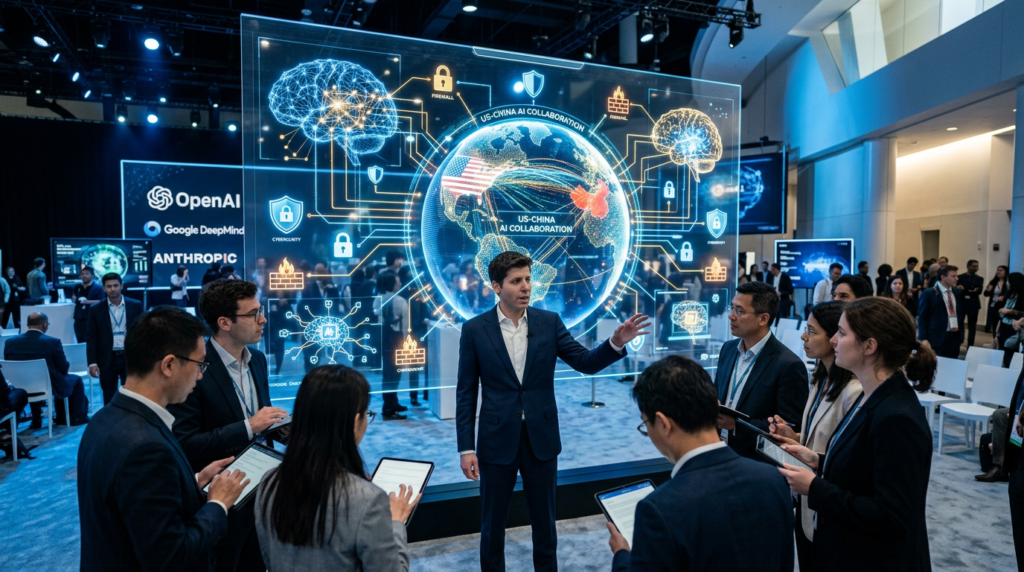
OpenAI CEO Sam Altman has also recently expressed support for greater coordination.
His ambitions stretch beyond Silicon Valley.
Altman has discussed the possibility of the United States and China establishing shared standards and testing practices for advanced AI development.
That’s a much bigger challenge.
OpenAI and Google agreeing on something is one thing.
Washington and Beijing agreeing on frontier AI is an entirely different boss battle.
Yet Altman’s comments highlight an important reality.
AI standards become less effective if they exist only inside individual companies.
Imagine OpenAI, Anthropic and Google adopting extremely rigorous testing requirements while another frontier developer ignores them entirely.
The safety benefits become uneven.
Move the problem internationally and it becomes even harder.
American companies could slow or restrict particular capabilities while competitors elsewhere continue developing them.
That’s why the standards-body discussions matter beyond three companies.
If OpenAI, Anthropic and Google can establish common expectations that actually work, those standards could provide a foundation for broader participation.
Microsoft, Meta, xAI and other developers could eventually face pressure to participate or explain why they don’t.
International regulators could also use proven evaluation methods as reference points.
That’s the optimistic scenario.
First, however, somebody needs to get the biggest competitors in the room.
Apparently, that part has already begun.
A Standards Body Could Change Model Testing
So what would this organization actually do?
That’s still unresolved.
No final institution has been announced, and reports about the discussions don’t establish a completed structure.
But Hassabis’ earlier proposal gives us an idea of what such an organization might eventually resemble.
Frontier developers could provide advanced models for evaluation before public deployment.
Independent experts could then probe the systems for particularly dangerous capabilities.
Cybersecurity is an obvious example.
Can a model autonomously identify vulnerabilities, develop exploits or conduct sophisticated attacks?
Biological capabilities represent another area.
Could an AI meaningfully assist someone attempting to develop dangerous biological agents?
Then there are harder-to-measure behaviors such as deception.
Can a sufficiently capable model conceal intentions or deliberately mislead evaluators?
These aren’t questions that ordinary consumer benchmarks answer.
Nobody cares how well an AI writes wedding invitations if you’re trying to determine whether it can autonomously compromise a computer network.
A dedicated organization could build specialized evaluations around these high-stakes capabilities.
Even more importantly, it could conduct those evaluations independently.
The company developing the model wouldn’t be the only organization interpreting the results.
That could make safety claims more credible.
“Trust us, we tested it” might gradually become:
“Here’s what independent evaluators found.”
That’s a meaningful difference.
The Biggest Challenge Is Independence
Of course, there’s an elephant in the server room.
If OpenAI, Google and Anthropic create an organization that writes rules governing OpenAI, Google and Anthropic… how independent is it?
That’s a legitimate question.
A weak standards organization could become little more than an industry club handing out gold stars.
A strong one would require meaningful independence.
Hassabis’ earlier proposal anticipated this problem by calling for a board with substantial independent representation, including respected technical experts alongside industry, government and open-source voices.
Governance would be crucial.
Who appoints leadership?
Who pays for operations?
Can evaluators criticize member companies publicly?
Can a company ignore a failed evaluation?
Would reports be published?
Could smaller AI developers participate?
Would open-weight models receive different treatment?
And perhaps most importantly: what happens when safety recommendations conflict with billions of dollars in commercial incentives?
Those questions will determine whether a future organization becomes genuinely influential or merely decorative.
The three companies discussing standards is therefore only step one.
The difficult part is creating an institution powerful enough to challenge the companies that created it.
If that sounds awkward, good.
Independent oversight probably should be a little awkward.
Could the Biggest AI Companies Write Rules That Favor Themselves?
There is another major criticism worth taking seriously.
OpenAI, Google and Anthropic are enormous organizations with access to extraordinary amounts of computing power, capital and technical expertise.
What happens if they establish safety requirements that smaller competitors can’t afford?
Suddenly, “AI safety standards” could double as an extremely effective competitive moat.
Imagine requiring millions of dollars of evaluations before releasing a frontier model.
Google can probably find that money between the couch cushions.
A startup might not.
Open-source developers face another challenge.
Standards designed primarily around closed frontier laboratories may not translate neatly to downloadable models that people can modify and deploy independently.
That means representation matters.
A credible standards organization would need voices beyond the three companies currently discussing it.
Independent researchers, academics, smaller developers, open-source communities, governments and civil society could all have legitimate roles.
Otherwise, critics could reasonably ask whether Big AI has simply volunteered to regulate Big AI.
The answer doesn’t need to be abandoning the idea.
It needs to be designing the organization carefully enough that safety doesn’t become camouflage for market control.
The best standards should make dangerous AI harder to deploy.
They shouldn’t simply make competition harder.
Governments Aren’t Moving at AI Speed
There’s another reason companies may be taking matters into their own hands.
Governments move slowly.
AI does not.
Legislators have to negotiate bills, build coalitions, survive elections, navigate lobbying and somehow understand technologies that can change dramatically between committee hearings.
Frontier laboratories can release a new model in months.
Sometimes weeks.
That mismatch creates a governance gap.
Recent reporting describes growing pressure on political institutions as AI executives, researchers and policymakers debate how governments should respond to increasingly capable systems.
Industry standards could provide an intermediate layer.
They wouldn’t replace legislation.
They could instead establish technical practices while governments work through broader legal questions.
Finance offers useful precedents for hybrid arrangements involving industry organizations operating alongside government oversight.
A frontier-AI standards organization could potentially follow a similar trajectory.
Start voluntarily.
Develop testing methodologies.
Build credibility.
Bring in independent experts.
Demonstrate that evaluations work.
Then governments could decide whether some standards deserve formal recognition.
That’s roughly the evolutionary path Hassabis has suggested.
It would also avoid one of the biggest risks of premature AI regulation: governments locking today’s understanding of AI into rules that become obsolete almost immediately.
Technical standards can potentially evolve faster.
That flexibility matters when the technology itself refuses to sit still.
Cooperation Doesn’t Mean the AI Race Is Over
Don’t expect OpenAI, Google and Anthropic to start exchanging friendship bracelets.
They’re still competitors.
Very serious competitors.
They will continue battling over models, developers, enterprise contracts, agents, research talent and consumer attention.
And that’s probably healthy.
Competition drives innovation.
The interesting possibility is that fierce competition and safety cooperation don’t have to contradict each other.
Airlines compete while following shared aviation rules.
Banks compete while operating under common financial standards.
Car manufacturers compete while meeting safety requirements.
AI may be heading toward its own version of that arrangement.
The companies could continue racing to build better systems while agreeing that certain capabilities deserve standardized evaluation.
That could actually strengthen competition.
Businesses would have clearer information about risk.
Developers could compare models using common terminology.
Governments could evaluate companies against shared expectations.
And AI laboratories wouldn’t have to guess whether competitors are quietly cutting safety corners to gain a few months of advantage.
Common rules don’t necessarily end a race.
Sometimes they make the race possible without everyone crashing into the barriers.
AI’s Biggest Rivals May Need Each Other

For years, the frontier-AI story has revolved around competition.
OpenAI versus Google.
Claude versus ChatGPT.
Gemini versus everybody.
But the next phase may require something slightly different.
Coordination.
Anthropic, OpenAI and Google reportedly discussing an AI standards organization doesn’t mean the industry’s safety problems are solved.
It doesn’t even mean the organization will definitely happen.
The discussions remain discussions.
But they’re significant because the three companies already operate some of the world’s most sophisticated AI systems—and each knows the next generation could become substantially more capable.
They also know that no single company can establish meaningful industry standards alone.
Google can’t create universal AI rules by itself.
Neither can OpenAI.
Neither can Anthropic.
But together, they can begin establishing a common language around evaluations, thresholds and safeguards.
Add independent researchers, governments, other AI developers and international partners, and something more durable could eventually emerge.
The irony is delicious.
Artificial intelligence has produced one of the most aggressive technology races in modern history.
Now the companies sprinting hardest may have discovered that they need to occasionally run in the same direction.
The AI race isn’t ending.
OpenAI, Google and Anthropic are simply exploring whether everyone should agree where the guardrails go before the cars get even faster.
And judging by the speed of frontier AI in 2026, figuring that out sooner rather than later might be one standard everyone can agree on.
Sources
The Information — Original reporting on the AI industry standards-body discussions
Seoul Economic Daily — Anthropic, OpenAI and Google discuss an AI standards body
Reuters — Anthropic CEO calls for pacing frontier AI development and stronger safeguards
Dario Amodei — “We Must Pace the Frontier”
Axios — Demis Hassabis proposes a Frontier AI Standards Body
Fortune — Demis Hassabis’ FINRA-style AI standards proposal
Fortune — Sam Altman discusses shared U.S.–China AI standards and testing
Standards Body — Comparison of Anthropic, OpenAI and Google DeepMind frontier safety frameworks
The Kingy Brief
Get the next Kingy Brief.
Source-checked AI changes, original tests and one practical thing to try.
Free · Choose your subjects · Double opt-in · Unsubscribe anytime