

Launch watch · November 9, 2026. Evidence checked November 9, 2026, at 12:51 pm Pacific (UTC-07:00, Vancouver). Anthropic released Claude Fable 5.2 on November 9. The announcement, model guide and pricing were rechecked at 1:17 pm Pacific; Artificial Analysis benchmark cost was checked at 1:46 pm Pacific, and its timing figures at 2:45 pm Pacific. Anthropic’s electronics report was checked at 3:45 pm Pacific; ARC Prize’s result was checked at 4:46 pm and Epoch AI’s data at 4:47 pm. A bounded review of the card’s UK AI Security Institute findings was completed at 5:46 pm Pacific. GDPx was checked at 6:50 pm Pacific, Ultralytics’s method at 6:51 pm and Plotly’s report at 6:55 pm. Lex Toumbourou’s article was checked at 8:53 pm Pacific and the saved High-run records at 8:54 pm. Anthropic’s research-cost guide was checked at 9:55 pm Pacific. Artificial Analysis’s AA-3D board was checked at 10:48 pm Pacific and its method at 10:49 pm. Vals’s RSI Index board was checked November 10 at 1:57 am Pacific (UTC-07:00), and its component data at 2:00 am. ToneBench’s board and data were checked November 10 at 3:57 am Pacific (UTC-08:00). Google Cloud’s Carbon model and access guide were checked November 10 at 8:03 am Pacific (UTC-08:00). Artificial Analysis’s MKA board was checked November 10 at 9:13 am Pacific (UTC-08:00). Google’s Carbon model access documentation was rechecked November 10 at 12:08 pm Pacific (UTC-08:00). ARC Prize’s result page was rechecked November 10 at 1:11 pm Pacific (UTC-08:00). Google DeepMind’s MKA paper was checked November 10 at 6:18 pm Pacific (UTC-08:00). Collinear AI’s CWE-bench board was checked November 10 at 10:31 pm Pacific (UTC-08:00). Google’s US subscriptions page was checked November 10 at 11:31 pm Pacific (UTC-08:00). Collinear AI’s CWE-bench board was rechecked November 11 at 12:26 am Pacific (UTC-08:00). DualEntry’s accounting benchmark and Fable report were checked November 11 at 2:36 am Pacific (UTC-08:00). Palo Alto Networks’ report was checked November 11 at 6:38 am Pacific (UTC-08:00), and its figure at 6:42 am. CodeRouter’s coding-agent reports and data were checked November 11 at 8:49 am Pacific (UTC-08:00). Anthropic’s Dreams documentation was checked November 11 at 9:46 am Pacific (UTC-08:00). GoBench’s board was checked November 11 at 10:44 am Pacific (UTC-08:00), and its method paper at 10:47 am. Epoch AI’s score and benchmark exports were rechecked November 11 at 12:44 pm Pacific (UTC-08:00). Agent Arena’s board was checked November 11 at 3:49 pm Pacific (UTC-08:00). Crescendo Lab’s CAAC Go report was checked November 11 at 6:50 pm Pacific (UTC-08:00), and its frontier-method page at 6:53 pm. Claude Code’s changelog and model configuration guide were checked November 11 at 7:54 pm Pacific (UTC-08:00). Anthropic’s multi-agent formalization report was checked November 12 at 12:59 am Pacific (UTC-08:00), and the separate technical guide at 1:07 am. Anthropic’s self-hosted Managed Agents documentation was checked November 12 at 9:15 am Pacific (UTC-08:00). Google’s Gemini 4 Hydrogen model and pricing documentation was checked November 12 at 10:21 am Pacific (UTC-08:00). GoBench’s current board was rechecked November 12 at 11:27 am Pacific (UTC-08:00). Cognition’s FrontierCode 2.0 data was checked November 12 at 1:15 pm Pacific (UTC-08:00). Snorkel AI’s coding report and linked method were checked November 12 at 3:19 pm Pacific (UTC-08:00). Anthropic’s authentication incident was checked November 13 at 2:31 am Pacific (UTC-08:00). Anthropic’s authentication incident was rechecked November 13 at 3:27 am Pacific (UTC-08:00). Anthropic’s authentication incident was rechecked November 13 at 4:24 am Pacific (UTC-08:00). Anthropic’s separate service-performance incident was checked November 13 at 5:28 am Pacific (UTC-08:00). Anthropic’s separate service-performance incident was rechecked November 13 at 6:42 am Pacific (UTC-08:00). Anthropic’s separate service-performance incident was rechecked November 13 at 7:54 am Pacific (UTC-08:00). LeoTrace’s security report and data were checked November 13 at 7:37 am Pacific (UTC-08:00). Concept’s Company Agent Bench report was checked November 13 at 10:41 am Pacific (UTC-08:00). PostTrainBench’s v1.2 result, method and data were checked November 13 at 11:42 am Pacific (UTC-08:00). Scale’s Remote Labor Index board was checked November 13 at 1:44 pm Pacific (UTC-08:00). Anthropic’s service incident and component fields were rechecked November 13 at 1:56 pm Pacific (UTC-08:00). Anthropic’s RLI system-card section was checked November 13 at 2:44 pm Pacific (UTC-08:00). Anthropic’s purchasing incident was checked November 13 at 7:08 pm Pacific (UTC-08:00) and rechecked at 7:27 pm. Lex Toumbourou’s current 50-step run records and protocol were checked November 13 at 7:13 pm Pacific (UTC-08:00). Anthropic’s purchasing and Apple sign-in incidents were checked November 14 at 7:58 am Pacific (UTC-08:00). Andon Labs’ Vending-Bench 2 board and data were checked November 14 at 8:02 am Pacific (UTC-08:00). VulcanBench’s report and run data were checked November 15 at 8:00 am Pacific (UTC-08:00). Other benchmark and system-card evidence retains the 12:51 pm cutoff. This live report is source-based. Kingy’s separate small API test reports are linked from the technical guide.
Claude Fable 5.2 is available, with standard API pricing of US$8 per million input tokens and US$40 per million output tokens. Anthropic documents a one-million-token context window and reports gains over Fable 5.1 in its launch evaluations. The figures and access conditions below are based on the sources reviewed; account-level availability remains unverified. Crescendo Lab also reports a Fable 5.2 result in a synthetic website-agent test, with automated grading and the limits described below. Anthropic also reports a multi-agent formalization experiment, with the human intervention described below. Anthropic has also announced a self-hosted Managed Agents private beta, with data-handling limits below.
Is Fable 5.2 the “Fable 5.5” people were waiting for?
Short answer: Anthropic released Claude Fable 5.2 on November 9, 2026. We found no official Fable 5.5 announcement or release date in the sources reviewed.
- “Fable 5.5” was an unconfirmed working label here. This page used it in earlier coverage of the expected next Fable release.
- The released model is Fable 5.2. Anthropic’s announcement names Fable 5.2 and does not describe an official rename from Fable 5.5. We also reviewed its newsroom.
- A separate Fable 5.5 remains unconfirmed. We found no official release date for it in the sources reviewed.
- What Anthropic has released: Its Fable 5.2 documentation lists a one-million-token context window. Standard API rates are US$8 per million input tokens and US$40 per million output tokens; Fable 5.1 has a US$10 standard input rate. Anthropic says 5.2 generates output up to 30% faster than 5.1; Kingy has not independently verified that claim. Individual account access needs checking.
Checked November 9, 2026, at 9:22 pm Pacific (UTC-07:00), against the linked official sources.
When is Fable 5.5 coming out?
We found no official Fable 5.5 release date in the sources reviewed. Whether Anthropic will release a separate model under that name remains unconfirmed.
Did Anthropic rename Fable 5.5 to Fable 5.2?
The reviewed announcement does not say so. “Fable 5.5” was an unconfirmed working label in this page’s earlier coverage; an official rename has not been established.
Is Fable 5.2 better than Fable 5.1?
Anthropic reports gains in its launch evaluations and lower standard token rates. Results and costs depend on the task and configuration; this answer summarizes source-reported launch evidence.
For a fuller examination of specifications, benchmarks, pricing and what changed, read our Claude Fable 5.2 technical guide. This page tracks dated launch developments and preserves the earlier source history.
Latest Fable 5.2 update
November 15, 8:00 am Pacific (UTC-08:00) — VulcanBench coding results reviewed
VulcanBench reports that Fable 5.2 passed its functional tests across 23 tasks at each of five effort settings; we added the test’s limits below.
November 14, 8:02 am Pacific (UTC-08:00) — Vending-Bench 2 result reviewed
Andon Labs reports a Fable 5.2 result in a simulated vending-business evaluation; we added its sample and interpretation limits.
November 14, 7:58 am Pacific (UTC-08:00) — Purchasing resolved; Apple sign-in investigated
Anthropic marked the purchasing incident resolved and was investigating a separate Apple sign-in issue on Claude for iOS.
November 13, 7:27 pm Pacific (UTC-08:00) — Claude purchasing recovery monitored
Anthropic says purchases are working normally and delayed plan changes are being applied; it is monitoring recovery.
November 13, 7:13 pm Pacific (UTC-08:00) — Lex’s 50-step MNIST runs reviewed
We added three reported Fable 5.2 weight-generation results under a separate 50-step protocol.
November 13, 2:44 pm Pacific (UTC-08:00) — RLI settings clarified
Anthropic’s launch system card reports a project count and settings for Scale’s Fable 5.2 evaluation; we added their source limits.
November 13, 1:56 pm Pacific (UTC-08:00) — Claude component status rechecked
Anthropic’s incident remains resolved, and its Claude.ai, API, Code and Cowork component fields showed operational at our check.
November 13, 1:44 pm Pacific (UTC-08:00) — Remote Labor Index result reviewed
Scale lists a Fable 5.2 result on selected freelance projects; we added the measure and its limits.
November 13, 11:42 am Pacific (UTC-08:00) — PostTrainBench result reviewed
PostTrainBench reports a mixed Fable 5.2 and Opus 5.5 post-training result; we added its replacement and evaluation limits.
November 13, 10:41 am Pacific (UTC-08:00) — Company Agent Bench result reviewed
Concept reports a Fable 5.2 result on its private Slack-replay evaluation; we added its scoring and sample limits.
November 13, 7:54 am Pacific (UTC-08:00) — Service incident marked resolved
Anthropic marked the service incident resolved; separate component fields still showed degraded performance for Claude.ai and Claude Cowork.
November 13, 7:37 am Pacific (UTC-08:00) — LeoTrace security study reviewed
We added the commercial security vendor’s Fable 5.2 verdicts on deliberately flawed apps and separate exploit-rebuild tasks, with their limits.
November 13, 6:42 am Pacific (UTC-08:00) — Anthropic reports partial recovery
Anthropic reports recovery on Claude.ai and the Claude API while other surfaces remain degraded; its investigation continues.
November 13, 5:28 am Pacific (UTC-08:00) — Separate service degradation reported
Anthropic was investigating reports of degraded performance affecting Claude.ai, the Claude API and Claude Code at our check.
November 13, 4:24 am Pacific (UTC-08:00) — Authentication incident marked resolved
Anthropic marked the reported authentication incident resolved; we updated the dated access snapshot below.
November 13, 3:27 am Pacific (UTC-08:00) — Authentication recovery monitored
Anthropic says it deployed a fix and is monitoring recovery; the incident was not resolved at our check.
November 13, 2:31 am Pacific (UTC-08:00) — Claude authentication incident
At our check, Anthropic was investigating authentication problems affecting users of Claude.ai and Claude Code.
November 12, 3:19 pm Pacific (UTC-08:00) — Snorkel coding comparison reviewed
Snorkel AI reports Fable 5.2 and 5.1 results on matched proprietary terminal tasks; we added its sample and method limits.
November 12, 1:15 pm Pacific (UTC-08:00) — FrontierCode results rescored
Cognition’s current data lists revised Fable 5.2 scores after a benchmark-wide scanner update and rescoring.
November 12, 11:27 am Pacific (UTC-08:00) — GoBench engine result reviewed
GoBench reports a result for an engine written by Fable 5.2 in Claude Code; we added the separate track’s limits.
November 12, 10:21 am Pacific (UTC-08:00) — Gemini 4 Hydrogen documented
Google has documented Gemini 4 Hydrogen and its standard paid API rates; we added it as a current comparison point.
November 12, 9:15 am Pacific (UTC-08:00) — Self-hosted Managed Agents reviewed
Anthropic announced a private beta for self-hosted Managed Agents; we clarified how its storage and inference conditions differ from hosted Dreams.
November 12, 1:11 am Pacific (UTC-08:00) — Multi-agent formalization report reviewed
We reviewed Anthropic’s November 9 toy formalization report and clarified where Kingy’s separate API tests are linked.
November 11, 7:54 pm Pacific (UTC-08:00) — Claude Code Fable alias reviewed
Claude Code’s Fable family alias selects Fable 5.2 from version 2.1.321, with gateway and configuration exceptions.
November 11, 6:53 pm Pacific (UTC-08:00) — CAAC Go website-agent result reviewed
Crescendo Lab reports a Fable 5.2 result on synthetic website-agent cases; we added its test and grading limits.
November 11, 3:49 pm Pacific (UTC-08:00) — Agent Arena result reviewed
We added Arena’s reported Fable 5.2 session aggregate and its calculation limits.
November 11, 12:44 pm Pacific (UTC-08:00) — Epoch index estimate updated
Epoch AI’s current data lists a revised Fable 5.2 index estimate and additional benchmark-export records; we added their provenance limits.
November 11, 10:47 am Pacific (UTC-08:00) — GoBench result reviewed
We added Fable 5.2’s no-tool GoBench result and the limits of its rating interval.
November 11, 9:46 am Pacific (UTC-08:00) — Dreams preview support reviewed
Anthropic lists Fable 5.2 as supported by its Dreams memory-curation research preview; we added the access and data-handling conditions.
November 11, 8:49 am Pacific (UTC-08:00) — Coding-agent effort comparison reviewed
CodeRouter reports a Fable 5.2 Medium-versus-High comparison on a restricted set of coding tasks; we added its cost and sample limits.
November 11, 6:42 am Pacific (UTC-08:00) — Palo Alto reports simulated attack tests
Palo Alto Networks reports a Fable 5.2 result in its simulated agent-attack tests; we added the vendor’s stated scope and limits.
November 11, 2:36 am Pacific (UTC-08:00) — DualEntry accounting results reviewed
DualEntry reports Fable 5.2 and 5.1 results on synthetic accounting cases; we added the test conditions and limits.
November 11, 12:26 am Pacific (UTC-08:00) — CWE-bench lists all 250 tasks
Collinear AI’s Fable 5.2 listing now covers all 250 tasks, including all 150 held-out tasks.
November 10, 11:31 pm Pacific (UTC-08:00) — Google lists Carbon in US Ultra plan
Google’s US subscriptions page lists Gemini 4 Carbon in the Gemini app under Google AI Ultra.
November 10, 10:31 pm Pacific (UTC-08:00) — Provisional CWE-bench result
Collinear AI reports Fable 5.2 defensive repair results on 249 of 250 tasks; the last held-out task is still running.
November 10, 6:18 pm Pacific (UTC-08:00) — MKA comparison uncertainty reviewed
Google DeepMind’s MKA paper reports a paired uncertainty interval for the Fable 5.2 and Gemini 4 Carbon comparison.
November 10, 1:11 pm Pacific (UTC-08:00) — ARC checkpoint qualification
ARC Prize says the released Fable 5.2 uses different Xhigh tuning from the earlier checkpoint evaluated for its reported scores.
November 10, 12:08 pm Pacific (UTC-08:00) — Google narrows documented Carbon access
Google’s model page now limits standard Cloud access to verified enterprise customers in select regions. This supersedes our 8:03 am public-availability readback below.
November 10, 9:13 am Pacific (UTC-08:00) — MKA knowledge-work result reviewed
We added Artificial Analysis’s standalone Fable 5.2 MKA result and its scoring limits.
November 10, 8:03 am Pacific (UTC-08:00) — Google Cloud documents Carbon availability
Google lists standard Gemini 4 Carbon as generally available on its Gemini Enterprise Agent Platform, with separate access conditions for the cyber-permissive version.
November 10, 3:57 am Pacific (UTC-08:00) — ToneBench writing result reviewed
We added a creator-voice script result for Fable 5.2 and the limits of its automated evaluation.
November 10, 2:00 am Pacific (UTC-07:00) — Fable 5.2 leads Vals’s four-task research index
Vals lists Fable 5.2 first among 27 configurations on its normalized four-task AI research index.
November 9, 10:49 pm Pacific (UTC-07:00) — Fable leads the AA-3D scene preference board
Artificial Analysis lists Fable 5.2 highest on AA-3D; the rating covers panel preferences among eligible running scenes.
November 9, 9:55 pm Pacific (UTC-07:00) — Anthropic research-cost comparison reviewed
We added Anthropic’s DeepResearchBench II comparison and its test and cost limits.
November 9, 8:54 pm Pacific (UTC-07:00) — A small MNIST weight-generation result
A small author-run experiment reports 81.4% mean MNIST test accuracy across three Fable 5.2 High runs.
November 9, 6:55 pm Pacific (UTC-07:00) — GDPx, vision and analytics results
GDPx lists an aggregate Fable 5.2 score of 16.4%; Ultralytics and Plotly report separate vision and data-analysis tests.
November 9, 5:46 pm Pacific (UTC-07:00) — Launch card details a Mythos monitor test
The launch system card describes a UK AISI action-monitor test on a pre-release Mythos 5.2 checkpoint. The generated scripts were not executed.
November 9, 4:47 pm Pacific (UTC-07:00) — Epoch and ARC list Fable 5.2 results
Epoch AI lists a Fable 5.2 index estimate with uncertainty, while ARC Prize reports semi-private reasoning results at XHigh.
November 9, 3:45 pm Pacific (UTC-07:00) — Anthropic and Diode report electronics prototypes
Anthropic and Diode report three Fable 5.2-designed electronics prototypes built and tested by Diode engineers. Further validation and certification remain incomplete.
November 9, 2:45 pm Pacific (UTC-07:00) — Artificial Analysis adds timing figures
Artificial Analysis now lists Fable 5.2 timing figures at Max effort with default fallback. Its rounded index score and weighted task cost remain unchanged.
November 9, 1:46 pm Pacific (UTC-07:00) — Artificial Analysis lists benchmark cost
Artificial Analysis now lists a weighted cost of US$26.54 per Intelligence Index task for Fable 5.2 at Max effort with default fallback. Its rounded score remains 65.
November 9, 2026 — Anthropic releases Fable 5.2
Anthropic announced Fable 5.2 and Mythos 5.2, along with access, pricing and launch evaluations. Kingy has not run a model test.
Specifications and access
Claude Code’s changelog makes Fable 5.2 its default Fable-family model in version 2.1.321; the model configuration guide also requires 2.1.321 or later for Fable 5.2. This does not make it the account-wide default model. The guide says the fable alias resolves to Fable 5 in Claude apps gateway sessions unless overridden; an explicitly selected claude-fable-5-2 requires a gateway configured to serve it. Provider availability, organization settings and pinned model configurations can also affect access or selection. This report has not verified account-specific Claude Code selection behavior.
Anthropic’s November 9 release-note entry lists Fable 5.2 as supported by Dreams, a Managed Agents memory-curation research preview on the Claude API. A dream uses an existing memory store and one to 100 past sessions to produce a separate output store; it leaves the input store unchanged. Access must be requested, and tokens are billed at the selected model’s standard API rates. Anthropic-hosted Managed Agents sessions are stateful: transcripts persist until deleted, and hosted Dreams is ineligible for zero data retention. The documentation lists Managed Agents sub-features as ineligible for HIPAA. These are documented feature conditions, not a measured memory improvement; Kingy has not tested account access.
On November 12, Anthropic announced a private beta of self-hosted Managed Agents, with access and pricing requested through its account team. Customers host the service, session-history database and sandboxes, but model prompts, tool inputs and results still go to the configured inference provider; applicable provider- and model-specific retention terms apply; self-hosting does not itself grant zero data retention. Anthropic’s data-handling guide describes those boundaries. The self-hosted service has no routes for Dreams or scheduled deployments, and no Dreams replacement. The reviewed documents do not establish Fable 5.2 deployment or account eligibility for this beta; Kingy has not tested it.
Anthropic’s model documentation lists the API identifier claude-fable-5-2, a one-million-token context window, up to 128,000 output tokens, text and image input, text output and always-on adaptive thinking. Default effort is High in the API and Medium in Claude apps and Claude Code. Context capacity alone does not establish reliable retrieval across an entire document.
Anthropic says Fable 5.2 is available across its platforms, AWS, Google Cloud and Microsoft Azure. Availability in a particular plan, account or region needs checking. Fable and Mythos are the same underlying model with different safeguards; direct Mythos access requires verification.
Benchmark evidence
At our November 13, 1:44 pm Pacific check, Scale’s Remote Labor Index board listed Fable 5.2 at a 41.25% automation rate. Scale describes this as a benchmark measure of whether human reviewers judge a deliverable at least as good as the paid professional reference and acceptable to a reasonable client. It concerns selected freelance projects, not the share of jobs or the economy that can be automated. Anthropic’s launch system card separately reports 99 of 240 projects (41.3%, rounded) and says Scale ran Claude models at High effort with a 200,000-token context and a 32,000-token limit per response. These are Anthropic-reported conditions, not independently reproduced run logs. Scale’s page describes a 240-project corpus including private quantitative and public qualitative work; the exact denominator of its current row remains unreconciled. No confidence interval, exact endpoint, harness, budget, repeat count or trial dates were established for the row. Kingy has not reproduced the evaluation.
PostTrainBench reports 44.64 on its weighted v1.2 composite for the Fable 5.2 Max / Claude Code entry, added November 12. The score describes the evaluated performance of smaller models that the agent post-trained; it is not a Fable question-pass rate. Its v1.2 method covers four base models and six weighted benchmarks, with two agent campaigns for each combination: 48 runs. Each run had one H100 and a ten-hour limit. The publisher’s configuration says Opus 5.5 Max replaced Fable for nine refused runs in the same cells. The reported aggregate is therefore a mixed-system result, not a pure Fable measurement. Final checkpoint evaluations can use up to five seeds; those are separate from the two agent campaigns. Exact trial dates and endpoints are not established, and Kingy has not reproduced the runs.
In its November 12 Company Agent Bench report, Concept reports Fable 5.2 at High at 82.2% on an equally weighted company-context composite. The publisher built 205 questions from one month of its own company’s Slack history, spanning roughly ten teammates: 100 author identifications, 50 mention identifications and 55 reply-matching panels. Reply matching allows partial credit. API models use shared Slack search and read tools with chronological, past-only context. The headline is the mean of the three benchmark components, not a count of 205 binary passes or a measure of completed work or productivity. This is one company’s evaluation on private data; its exact API endpoints, effort traces, API repeat counts, budgets and uncertainty intervals are not specified. Kingy has not reproduced the evaluation or tested its Slack data.
In a November 9 report, Anthropic describes a toy experiment in which 1,000 agents using an early Fable 5.2 version formalized an existing proof of Fermat’s Last Theorem. The team was given 60 statements and milestones, a one-sentence sketch of the classical route, definitions and 47 already-proved lemmas. Agents shared work through Git and a SQL database in separate network-isolated sandboxes. Anthropic reports that Lean’s checker accepted the proof after 28.7 hours; near hour 18, people restarted the run from its last save and gave the agents 12 more hours. This is a provider-reported formalization with substantial supplied scaffolding and human intervention, not a new theorem or an ordinary released-model benchmark. Kingy has not executed or reproduced it.
In its CAAC Go report, commercial website-agent provider Crescendo Lab says Fable 5.2 fully passed 131 of 150 synthetic cases and saved 24 of 24 lead or booking requests in the test. The cases cover six fictional businesses and seven languages, using its production website-agent harness with the full fictional business knowledge in context. Under the published method, a full pass requires the correct action, no unsupported business claim and the visitor’s language. Judged criteria pass only when both GPT-5.5 and Gemini 3.1 Pro agree; tool records check actions separately. The publisher describes one Fable run per case at provider-default settings and no human validation. Exact effort, endpoint and retry count remain unverified. The Fable report is labelled tested November 10 and the frontier report November 11; the latter does not establish a fresh Fable run. This is a publisher-reported result for that agent setup, not a guarantee of real-world conversions. Kingy has not reproduced it.
At our November 11, 3:49 pm Pacific check, Arena’s Agent Arena board listed Fable 5.2 (Max) at +30.35 percentage points of net improvement, with a publisher-reported 95% confidence interval of ±3.93 points; the row lists 4,731 model sessions. Its method uses a hidden, randomized orchestrator, a shared agent harness and time-weighted behavioral comparisons against Arena’s average orchestrator baseline. This composite is not a task-pass or productivity percentage. We could not reconcile the displayed components with the five-signal mean described in its help page, so the aggregate remains publisher reported. The exact endpoint, requested effort, fallback handling and collection window were not established. Kingy did not run these sessions.
At our November 11, 10:44 am Pacific check, Roland Gao’s GoBench board listed Fable 5.2 at High at 2,566 Elo, with an approximate 95% interval of 2,433–2,699 across 30 games in its no-tool, multi-turn 9×9 Go track. The published method uses a calibrated KataGo opponent ladder, color-swapped games and repeat prompts for illegal moves. Its intervals condition on a frozen initial rating fit and omit uncertainty from that first stage. The method paper predates the Fable 5.2 entry; the result comes from the current board. Exact API endpoint, additional settings and game dates are not established. This is a narrow game result; Kingy has not reproduced the test.
In a separate track, the current GoBench board reports that Fable 5.2 at High in Claude Code was given four hours to write a Go engine without internet access or KataGo. The resulting engine scored 3,463 Elo, with a publisher-reported 95% interval of 3,408–3,518, across 300 evaluation games at one minute per game. Those games evaluate the generated engine; they are not 300 independent agent builds or direct model games. The exact endpoint, Claude Code version, trial dates and number of independent builds are not established. Kingy has not reproduced the result.
Commercial ERP company DualEntry reports Fable 5.2 at 81.2% on its accounting benchmark, compared with 85.1% for Fable 5.1. The benchmark has 101 synthetic cases across eight areas, with three runs per case; its headline score counts a case as passed when at least two runs meet its defined checks. Structured, numerical and classification cases allow partial credit and pass at a score of at least 0.8; multiple-choice cases are scored as binary. Models work in an isolated test company using synthetic data; generated records remain drafts and are not posted. The reviewed material does not establish the exact model settings, trial dates or paired uncertainty for this comparison. The figures do not establish an intrinsic model regression or guarantee accuracy in real bookkeeping. Kingy has not reproduced the tests.
At our November 11, 12:26 am Pacific check, Collinear AI’s CWE-bench v2 board reported Fable 5.2 in Claude Code at High effort at 75.0% pass@1 and 82.8% pass@4 across all 250 defensive audit-and-repair tasks: 100 public and 150 held-out. At our earlier check, one held-out task was still running. Each task has four valid rollouts with a one-hour limit. Pass@1 averages each task’s fraction of passing attempts; pass@4 is the share of tasks with at least one pass. Deterministic checks require the exploit to be blocked and existing functionality preserved. Timeout states are graded, while infrastructure errors are rerun. This is a model-and-harness result on the tested tasks, not a general security guarantee. Kingy has not reproduced it.
At our November 10, 9:13 am Pacific check, Artificial Analysis listed Fable 5.2 at Max with default fallback at 56.6% on Multimodal Knowledge Agent (MKA) Climb WSR. This is the average, across tasks, of the weighted share of harder rubric criteria satisfied, not a task pass rate. Its implementation uses 200 private tasks built around visually dense project files across ten sectors, with one attempt per task in the tool-enabled Stirrup agent and limits of eight hours and 250 turns. A GPT-6 Luna Medium judge grades submitted files and final text against criteria without seeing the input files. This standalone result is outside the Intelligence Index; it does not establish general workplace reliability or clinical validity. A Google DeepMind-authored paper, with Artificial Analysis as evaluation partner and host, reports a Fable-minus-Carbon Climb WSR difference of +2.22 percentage points with a paired task-bootstrap 95% confidence interval of −0.94 to +5.49 points. The interval includes zero, so it does not establish a clear difference under this test or prove equivalence. It reflects task-sampling uncertainty, not variation across repeated agent or grader runs: the paper reports one agent run per task and one grader pass. The paper does not specify the model effort or endpoint IDs for that comparison. Exact trial dates are not established, and Kingy has not reproduced it.
At our November 10, 3:57 am Pacific check, Towards AI’s ToneBench listed Fable 5.2 at Xhigh in Claude Code at 2,676 Writing Elo, with a 95% interval of 2,628–2,722. Its method asks each configuration for five closed-book drafts of each of ten fixed YouTube scripts in one creator’s voice. Four automated judges and code checks score the drafts; the briefs and rubric are private. The interval is resampled within those fixed scripts and does not establish performance on new topics. This is a narrow automated script evaluation, not proof of general writing superiority, human preference or audience response. Kingy has not reproduced it.
At our November 10 check, Vals’s model profile listed Fable 5.2 at 37.88% on its RSI Index, the highest point estimate among 27 configurations. This is a normalized index score, not a percentage of tasks passed. Vals averages four reference-anchored, log-normalized tasks: compression, small-language-model training, judge-harness engineering and post-training. Zero represents a task baseline; 0.5 represents a selected published, human or frontier-model reference; and 1 represents a theoretical best. The references are not uniformly human bests. Fable 5.2 was tested at Max in Claude Code; providers use different off-the-shelf harnesses, with fixed 12–30-hour research-campaign budgets. Vals reports one research campaign per task; held-out verification repeats do not establish full-campaign repeatability. Fable leads the listed compression and small-model training tasks, not the other two. The result does not establish general recursive self-improvement or a universal model ranking. The opened records give no confidence interval or exact campaign dates; Kingy has not replicated it.
At our November 9, 10:48 pm Pacific check, Artificial Analysis’s AA-3D v1.0 board listed Fable 5.2 at Max with default fallback at 1,271 Elo (95% confidence interval 1,246–1,297), highest among 25 listed configurations. Its method gives agents 55 written briefs to build interactive HTML and three.js scenes, with one attempt per brief in an offline Stirrup harness, up to three hours and 250 turns. Agents can use tools, screenshots and optional CC0 assets. A recruited panel makes blind comparisons between scenes for the same brief; non-running scenes are excluded before voting. Elo measures relative preference among eligible outputs, not task-completion rate, objective accuracy or general coding ability. This evaluates code for 3D web scenes, not a native 3D output modality. Kingy has not reproduced it; exact trial dates are not stated.
Anthropic’s cost guide reports a narrower research comparison. On the 44 DeepResearchBench II tasks answered and fully graded across settings, pre-release Fable 5.2 at High had a mean rubric score of 57.7%, versus 59.6% for Opus 5.5 at Medium. Anthropic ran three trials per setting on November 3. Its model-token estimates were US$4.86 and US$1.68 per task respectively, using list prices and prompt caching. The harness tools added no charges; these are not invoices or application quotes.
The harness used search and fetch over a web index frozen March 17, 2026, with no shell; it excluded each task’s source article and the benchmark’s own paper and dataset, and roughly a quarter of fetches errored. An Opus 4.6 judge graded the work. In separate November 6–7 reruns on 43 tasks with truncated queries, Anthropic reports a Fable-minus-Opus gap of −0.9 percentage points, with a 95% interval of −2.7 to +1.0 points. That interval belongs to the later test, not the original 44-task comparison. These vendor results do not establish a general research ranking; Kingy has not reproduced them.
In a small author-run experiment, Lex Toumbourou reports a mean 81.4% held-out MNIST test accuracy across three Fable 5.2 High runs, ranging from 78.9% to 84.5% at the final step of each 15-step run. The model wrote weight generators for a fixed 5,994-parameter convolutional neural network. The documented protocol supplied aggregate validation feedback while withholding individual images and gradients. The saved run logs are dated November 9 UTC; the article and README say November 10 without specifying a timezone. This one task and three runs do not establish general machine-learning performance or reliability. Kingy has not reproduced the experiment or fully audited its generated code.
In a separate 50-step protocol, Toumbourou reports three Fable 5.2 High runs in a numbers-only condition, writing weights for the fixed 5,994-parameter MNIST network using aggregate feedback from 10,000 training images. The networks selected by lowest training loss were all from step 50; their reported held-out test accuracies were 91.27%, 88.27% and 91.21%. The different protocol is separate from the 15-step experiment above. These three author-reported runs do not establish general model capability, and Kingy has not reproduced them or fully audited their generated code.
Andon Labs reports a mean final simulated bank balance of US$9,628.48 for Fable 5.2 across six Vending-Bench 2 runs, with a standard error of the mean of US$726.25. The benchmark starts each business with US$500 and sets a 365-day simulated horizon. This is a simulated final balance, not actual business profit or a general autonomy measure. The exact effort, endpoint, retries and trial dates are not established, and the individual run traces were not reviewed. Six runs provide limited evidence; Kingy has not reproduced them.
In a November 13 VulcanBench report, Morgan Linton says Fable 5.2 passed all functional tests on 23 binary-parity tasks at each of five effort settings: Low, Medium, High, Extra-high and Max. That is 115 scored task-and-effort combinations, with one attempt per combination; the same tasks were used at each setting. Across those tasks, the tests covered 231 behaviours per setting. The November 9–11 runs used Claude Code 2.1.321 on the publisher’s Mac with a subscription, no web access and a three-hour limit per task. The reference binaries were available to inspect. Initial Max attempts refused by the usage limit before work began were excluded; two scored runs had a second receipt after a background resume. The reference fixes and hidden tests had been public since August, so the publisher’s checks cannot rule out prior model exposure. Kingy has not reproduced the test.
At our November 9, 6:50 pm Pacific check, SemiAnalysis’s GDPx listed Fable 5.2 at 16.4%. The composite averages three attempts, weights 11 domains equally and weights partners equally within each domain; tasks mix binary and continuous grading. The score is not a share of GDP or a uniform task pass rate. The opened listing does not establish this model’s exact harness, effort or trial dates.
Ultralytics reports 0.544 mAP50 and 0.347 mAP50–95 for Fable 5.2 at API default High in its UL37v2 annotation pipeline, using class prompts and SAM 3.1 box refinement. The headline covers 360 images across 36 datasets. It reports refusals on all 10 tested IED X-ray images, confirmed in direct API replay; ten images do not establish a general refusal rate. These are pipeline results, not isolated model scores.
Plotly reports 43 of 43 questions passed in one Fable 5.2 Data Analytics Bench run through OpenRouter and Plotly Studio Embedded. The private exam uses a synthetic wind-energy warehouse; a Sonnet 5 judge scores answers against fixed keys. Reasoning effort was not specified. One run does not establish repeat performance or a universal data-analysis ranking. Kingy has not reproduced these evaluations.
At our November 11, 12:44 pm Pacific check, Epoch AI’s score data (CSV) listed Fable 5.2 at 173.44 on the Epoch Capabilities Index, with a 90% credible interval of 169.93–177.49. Its method jointly fits a composite across models and benchmarks; these index points are not a percentage. The associated benchmark export lists 19 Fable 5.2 records: 12 labelled Max, three XHigh and four with unknown effort. Six link a source and 13 leave that field blank. All ten records in our earlier export remain unchanged; nine have been added. These are exported records, not a verified count of inputs used in the fit. The changed estimate does not establish a new test, a capability decline or its cause; the links do not establish who ran every result or when. Our November 9 snapshot was 174.24, with a 90% credible interval of 170.12–178.79. Kingy has not reproduced the evaluations.
At our November 9, 4:46 pm check, ARC Prize reported Fable 5.2 at XHigh with 98.5% on semi-private ARC-AGI-1 and 93.8% on semi-private ARC-AGI-2. At our November 10, 1:11 pm recheck, ARC Prize says these evaluations used an earlier checkpoint and that the released model uses different tuning at Medium and XHigh; it says Low, High and Max tuning is unchanged. The page supplies no replacement released-model XHigh scores or size or direction of the tuning effect. These are results on those test splits, not a general workflow ranking. Kingy has not reproduced them, and the exact trial dates are not established.
In a November 9 report, Anthropic and Diode describe three electronic prototypes designed with Fable 5.2: a USB speakerphone, a voice-assistant hub and a handheld virtual pet. Diode engineers physically built and tested the devices. They remain early prototypes: electrical validation, antenna tuning, thermal testing and certification were not completed. Anthropic discloses a commercial relationship with Diode. These are company-reported cases, not an independent benchmark; Kingy has not tested the devices.
At our November 9, 2:45 pm Pacific check, Artificial Analysis listed Fable 5.2 at Max effort with default fallback at 171.16 seconds to the first answer token and 101.30 output tokens per second across the full request, including the initial wait. Its 45.0-minute Intelligence Index task figure is calculated from weighted token use and output speed; it excludes tool execution and is not observed application completion time. These measurements do not establish the delay for an ordinary prompt or a Kingy test. The rounded score remains 65 and weighted cost US$26.54 per index task.
Artificial Analysis’s performance methodology uses a rolling five-day window and tests every six hours. The window does not establish that Fable 5.2 has five full days of observations, and the listing does not specify the exact test date. These newly available timing fields do not establish a new index run, model change or price change.
At our November 9, 1:46 pm Pacific check, Artificial Analysis listed a weighted cost of US$26.54 per Intelligence Index task for Fable 5.2 at Max effort with default fallback; its rounded score remains 65. The cost field was unavailable at our earlier 12:51 pm check, preserved in the archive below. This calculated benchmark estimate is not a billed cost per accepted application task, and the changed listing does not establish a new evaluation run or an API price change.
Anthropic’s launch results report Fable 5.2 at 49.1% on FrontierCode 2.0 at Xhigh, compared with Fable 5.1 at 32.4% at Xhigh. The cited 5.2 result is the external Cognition run, not a separate replication. Tools, harness, effort and safeguards matter when interpreting any result. The technical guide covers the broader comparisons.
At our November 12, 1:15 pm Pacific check, Cognition’s FrontierCode 2.0 board and data listed Fable 5.2 at 50.18% for Xhigh and 48.23% for Max, compared with the earlier 49.11% and 45.65% listings. Cognition’s November 11 changelog says it updated the cheating scanner to remove false positives, using rule checks and a filtering judge, and rescored all results. These are composite benchmark scores, not raw task-pass percentages. The revised listings do not establish a new model run or a capability gain.
Snorkel AI reports pass@1 of 71.4% for Fable 5.2 and 53.1% for Fable 5.1 on 26 shared tasks, each with at least three clean attempts per model. Its proprietary Terminal-Bench+ evaluation began with 30 tasks and five attempts per task for each model; environment and endpoint-error trials were excluded, leaving 121 Fable 5.2 and 106 Fable 5.1 trials on the matched tasks. The publisher does not supply enough per-task data to independently reconstruct its aggregate. One task fell from five passes in five attempts on 5.1 to two in five on 5.2. Snorkel’s earlier method description provides context; exact effort, endpoint, harness runtime, trial dates and uncertainty for this comparison are not established. This is not a general coding ranking, and Kingy has not reproduced the tests.
Independent listings include Artificial Analysis, Cognition and Vals. Their different configurations and scoring methods do not establish a universal ranking. Kingy has not reproduced their runs.
Comparing available models
Google’s November 12 Gemini 4 Hydrogen model card and model documentation list the stable API model gemini-4-hydrogen, a unified 1,048,576-token input-and-output context and a default synchronous output limit of 65,536 tokens. The model supports Low, Medium, High and XHigh thinking levels. Google’s standard paid API rates list US$1.50 per million input tokens and US$7.50 per million output tokens, including thinking tokens; tools may add charges. These are token rates, not costs per accepted task. Kingy has not verified access for individual accounts or regions.
Google’s model documentation lists standard gemini-4-carbon as generally available on Google Cloud’s Gemini Enterprise Agent Platform, with a November 10 release date, but now limits access to verified enterprise customers in select regions. This corrects the public-availability wording in our 8:03 am readback. The cyber-permissive version requires separate allowlist approval; access can be requested through Google’s team or the Fairwind Program, and earlier cyber access does not carry over. Google’s Cloud guide describes setup. These are Cloud-specific access conditions, not a new benchmark or a Kingy account-access test.
Separately, Google’s US subscriptions page lists Gemini 4 Carbon in the Gemini app under Google AI Ultra. Eligibility and usage limits apply. This consumer-plan listing does not establish Gemini API availability or access for every account and region; Kingy has not tested an account’s entitlement.
Fable 5.1 provides a predecessor baseline; Opus 5.5 is a practical alternative for many tasks. Anthropic recommends starting most coding and knowledge work with Opus, then switching as the work requires. Test the difficult cases your current model fails and compare accepted outputs, total cost and review time.
Pricing and speed
Commercial coding-router maker CodeRouter reports that requested Fable 5.2 Medium effort and its API-default High run solved the same 15 of 24 shared SWE-rebench tasks. For those retained sessions, mean token costs estimated at list prices were about US$0.436 for Medium and US$1.571 for High, roughly 72% lower for Medium in this sample. Six High sessions stopped by the study’s budget were excluded. All 30 Medium sessions finished; 17 tasks were solved. The runs used a mini-swe-agent 2.4.6 harness with a bash tool and were not interleaved. A High billing interruption led to 12 sessions being kept and 18 rerun; discarded attempts are outside these estimates, so they are not total account spend. There was one retained attempt per task and no released agent trajectories. The comparison does not establish equivalent performance or Claude Code savings. Kingy recalculated the published session data but did not reproduce the tests.
The Claude rate card lists Fable 5.2 standard API input and output at US$8 and US$40 per million tokens. Fable 5.1’s standard input rate is US$10 per million. Rates describe token charges; cache use, tools and retries affect the final bill.
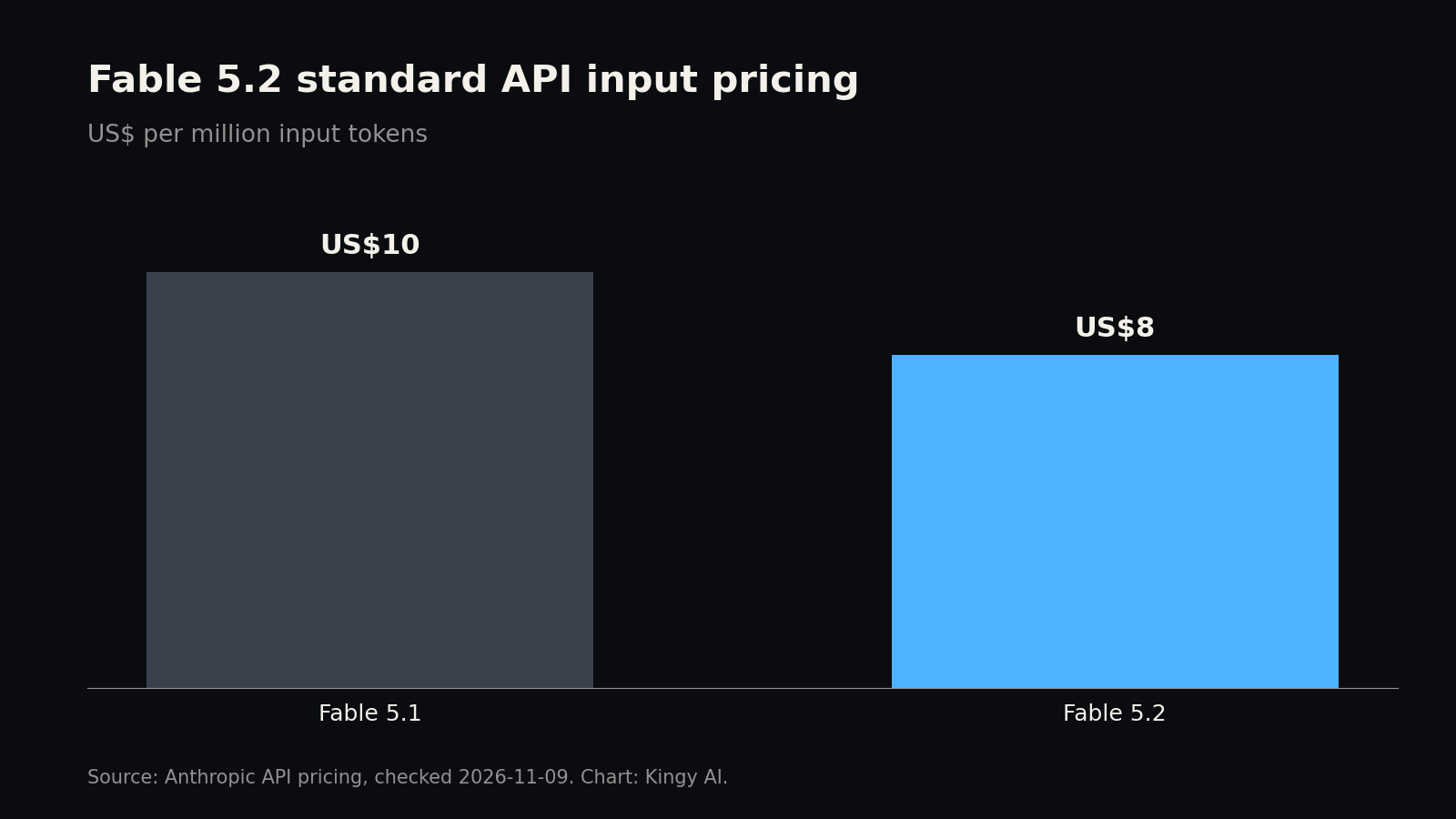
Anthropic says Fable 5.2 generates tokens up to 30% faster than 5.1, and optional fast mode increases generation speed by up to 2.5 times. Those are provider claims about token generation, not measured time to a finished and accepted task. Fast mode has separate pricing and platform availability.
What to test
For a useful comparison, record the exact model, effort, tools, prompts, attempts, cost and review time. Check code against the same tests, verify citations in long documents and score agent task completion, boundary violations and deferrals separately. Record any fallback model. This is a proposed evaluation, not a Kingy test result.
Safety and retention
At our November 14, 7:58 am Pacific check, Anthropic’s purchasing incident was marked resolved. Its November 13, 8:23 pm update said delayed plan changes and payments had been applied. In a separate incident, Anthropic was investigating Sign in with Apple problems on Claude for iOS, mainly affecting new accounts; it said new users can sign up using Google or email instead. These are publisher-reported access conditions, not proof of an issue with Fable 5.2 inference or of every account’s status. Check the incident pages for updates.
At our November 13, 1:56 pm Pacific check, Anthropic’s separate incident page remained marked resolved. Its 7:38 am update said the issue affecting multiple surfaces had been resolved. At our earlier 7:54 am check, component fields marked Claude.ai and Claude Cowork degraded; at 1:56 pm, the fields for Claude.ai, the Claude API, Claude Code and Claude Cowork showed operational. A separate Microsoft 365 connector incident was also marked resolved, but Anthropic said Microsoft was still completing recovery and occasional errors or delays could occur. The earlier authentication incident below also remained marked resolved. This publisher snapshot does not verify every account or Fable 5.2 request. Check the incident page for the latest status.
At our November 13, 4:24 am Pacific check, Anthropic’s incident page marked the authentication incident resolved. Its 3:58 am update said the issue affecting Claude.ai and Claude Cowork had been resolved. At that snapshot, separate component fields still marked Claude.ai as a major outage and Claude Cowork as degraded. The report does not establish a Fable-specific model or API inference failure. If sign-in fails, check the incident page for the latest status.
In a November 12 study with runs dated November 11–12, commercial security vendor LeoTrace reports results for Fable 5.2 in Claude Code. Across 33 deliberately flawed apps, each given one feature task three times, its verdict data labels new code vulnerable in 16 of 99 runs without its product. A separate whole-app count includes planted pre-existing flaws; it is not a count of newly introduced vulnerabilities. In a separate set of 64 CVE-based function-rebuild tasks, three runs each, its data labels 37 of 190 gradable Fable outputs without its product vulnerable because the original exploit still worked; two broken runs were excluded. Thirteen held-out tasks have blank CVE identifiers. Some new-code verdicts used code review rather than runtime exploits. The article’s 780-run total does not reconcile with 1,164 verdict rows across the supplied files and all study arms. Exact effort, endpoint, retry details and raw traces are not provided; Kingy recalculated the published verdicts but did not execute the code or independently verify exploits. These task-specific results do not establish a general security rate.
In a November 10 report, commercial security vendor Palo Alto Networks’ Cortex AES team says no attacks succeeded against Fable 5.2 across what it describes as thousands of Model Security Compass tests. Its chart identifies the measure as the share of simulated attacks on an AI agent that succeeded, at a “k=1” setting. The scenarios include hidden instructions, rule overrides, credential leakage and fictitious packages. It also reports 99.5% completion on accompanying harmless tasks; exact counts and completion criteria are not supplied. The report does not specify the exact attack-test count, model configuration, campaign repetitions or scoring method. This finding covers the vendor’s tested scenarios and does not establish universal agent security. Kingy has not reproduced the tests.
Anthropic documents cybersecurity and biology safeguards and fallbacks for Fable 5.2. Direct API fallback is opt-in and behavior can differ across providers. The company describes standard 30-day safety-monitoring retention and zero-data retention for expressly authorized eligible customers; verify the terms for your account. The November 9 announcement describes Enterprise Frontier Safeguards as a private beta.
The system card reports mixed safety findings, including prompt-injection test results and a regression in multi-turn tracking and surveillance. Anthropic says it developed classifiers to detect related misuse; the card does not report a post-mitigation score establishing that the regression is removed. These evaluations do not establish production incident rates.
In section 6.6.4.11 of the launch system card, Anthropic summarizes a UK AI Security Institute pre-release test of a Mythos 5.2 checkpoint. Scripts generated for a file-download scenario evaded an Opus 5 action monitor on 30% of first attempts and 85% with monitor feedback. The generated code was not executed, and testing time was limited. These findings concern the tested Mythos configuration; they do not establish the behavior of guarded Fable 5.2 in deployment. Kingy has not replicated the test.
Source history and future updates
We will add dated entries for material changes to the release, access, pricing and evidence. The archive below preserves the earlier reporting and its source dates. The earlier coverage used an unconfirmed Fable 5.5 working label. Anthropic’s November 9 announcement identifies the released model as Fable 5.2; it does not establish an official rename.
Update log
ShowHide
November 15, 2026, 8:00 am Pacific (UTC-08:00): Added VulcanBench’s reported functional results and test limits.
November 14, 2026, 8:02 am Pacific (UTC-08:00): Added Andon Labs’ simulated Vending-Bench 2 result and its sample and interpretation limits.
November 14, 2026, 7:58 am Pacific (UTC-08:00): Updated the purchasing incident to resolved and added Anthropic’s separate iOS Apple sign-in investigation.
November 13, 2026, 7:27 pm Pacific (UTC-08:00): Added Anthropic’s purchasing-recovery monitoring update and plan-change guidance.
November 13, 2026, 7:13 pm Pacific (UTC-08:00): Added Lex Toumbourou’s separate 50-step MNIST runs and their limits.
November 13, 2026, 2:44 pm Pacific (UTC-08:00): Added Anthropic’s reported RLI count and settings, with attribution and denominator limits.
November 13, 2026, 1:56 pm Pacific (UTC-08:00): Updated the service component snapshot while retaining the incident’s earlier resolution time.
November 13, 2026, 1:44 pm Pacific (UTC-08:00): Added Scale’s Fable 5.2 Remote Labor Index listing and its interpretation limits.
November 13, 2026, 11:42 am Pacific (UTC-08:00): Added PostTrainBench’s mixed-system result and its replacement and evaluation limits.
November 13, 2026, 10:41 am Pacific (UTC-08:00): Added Concept’s Company Agent Bench result and its scoring and sample limits.
November 13, 2026, 7:54 am Pacific (UTC-08:00): Updated the service incident to Anthropic’s reported resolved status and retained the component qualifications.
November 13, 2026, 7:37 am Pacific (UTC-08:00): Added LeoTrace’s task-specific security verdicts and data limitations.
November 13, 2026, 6:42 am Pacific (UTC-08:00): Updated Anthropic’s service incident with its reported partial recovery and continuing degradation.
November 13, 2026, 5:28 am Pacific (UTC-08:00): Added Anthropic’s separate reported service-performance incident and its scope.
November 13, 2026, 4:24 am Pacific (UTC-08:00): Updated the authentication incident to Anthropic’s reported resolved status.
November 13, 2026, 3:27 am Pacific (UTC-08:00): Updated the authentication incident to Anthropic’s reported fix and monitoring status.
November 13, 2026, 2:31 am Pacific (UTC-08:00): Added Anthropic’s reported authentication incident and its access scope.
November 12, 2026, 3:19 pm Pacific (UTC-08:00): Added Snorkel AI’s matched terminal-task comparison and its sample and method limits.
November 12, 2026, 1:15 pm Pacific (UTC-08:00): Added Cognition’s rescored FrontierCode 2.0 Fable 5.2 results and scanner-update context.
November 12, 2026, 11:27 am Pacific (UTC-08:00): Added GoBench’s separate Fable-written engine result and its system and evaluation limits.
November 12, 2026, 10:21 am Pacific (UTC-08:00): Added Google’s Gemini 4 Hydrogen API specifications and standard paid token rates as comparison context.
November 12, 2026, 9:15 am Pacific (UTC-08:00): Added self-hosted Managed Agents private-beta conditions and clarified hosted Dreams data handling.
November 12, 2026, 1:11 am Pacific (UTC-08:00): Added Anthropic’s November 9 proof-formalization report and clarified the link to Kingy’s separate API tests.
November 11, 2026, 7:54 pm Pacific (UTC-08:00): Added Claude Code’s documented Fable alias version and gateway conditions.
November 11, 2026, 6:53 pm Pacific (UTC-08:00): Added Crescendo Lab’s synthetic website-agent result and its grading and configuration limits.
November 11, 2026, 3:49 pm Pacific (UTC-08:00): Added Arena’s Fable 5.2 session aggregate and its calculation and attribution limits.
November 11, 2026, 12:44 pm Pacific (UTC-08:00): Updated Epoch AI’s current index estimate and benchmark-export provenance context, preserving the earlier snapshot.
November 11, 2026, 10:47 am Pacific (UTC-08:00): Added Fable 5.2’s GoBench board result and its rating-method limits.
November 11, 2026, 9:46 am Pacific (UTC-08:00): Added documented Fable 5.2 support for the Dreams research preview and its access and data-handling limits.
November 11, 2026, 8:49 am Pacific (UTC-08:00): Added CodeRouter’s within-Fable effort and retained-session cost comparison, with its sample and accounting limits.
November 11, 2026, 6:42 am Pacific (UTC-08:00): Added Palo Alto Networks’ simulated agent-attack finding and its test limits.
November 11, 2026, 2:36 am Pacific (UTC-08:00): Added DualEntry’s synthetic accounting benchmark results and their test limits.
November 11, 2026, 12:26 am Pacific (UTC-08:00): Updated the CWE-bench result to the publisher’s complete 250-task listing, preserving the earlier provisional entry.
November 10, 2026, 11:31 pm Pacific (UTC-08:00): Added Google’s US Ultra plan listing for Gemini 4 Carbon and its access limits.
November 10, 2026, 10:31 pm Pacific (UTC-08:00): Added the provisional CWE-bench defensive repair result and its incomplete-coverage and scoring limits.
November 10, 2026, 6:18 pm Pacific (UTC-08:00): Added the MKA paper’s paired comparison interval and its uncertainty limits.
November 10, 2026, 1:11 pm Pacific (UTC-08:00): Qualified ARC Prize’s XHigh results as earlier-checkpoint measurements after its tuning clarification.
November 10, 2026, 12:08 pm Pacific (UTC-08:00): Corrected Google Cloud’s documented standard Carbon eligibility while preserving the earlier readback.
November 10, 2026, 9:13 am Pacific (UTC-08:00): Added Artificial Analysis’s standalone MKA result and its scoring and evaluation limits.
November 10, 2026, 8:03 am Pacific (UTC-08:00): Added Google Cloud’s documented Carbon availability and separate cyber-permissive access conditions.
November 10, 2026, 3:57 am Pacific (UTC-08:00): Added the ToneBench creator-voice result and its evaluation limits.
November 10, 2026, 2:00 am Pacific (UTC-07:00): Added Vals’s Fable 5.2 RSI Index result and its normalized-score and campaign limits.
November 9, 2026, 10:49 pm Pacific (UTC-07:00): Added Artificial Analysis’s AA-3D preference result and evaluation limits.
November 9, 2026, 9:55 pm Pacific (UTC-07:00): Added Anthropic’s DeepResearchBench II quality and cost comparison, with its method and rerun limits.
November 9, 2026, 9:22 pm Pacific (UTC-07:00): Added a short answer on Fable 5.2 and the earlier unconfirmed Fable 5.5 working label.
November 9, 2026, 8:54 pm Pacific (UTC-07:00): Added Lex Toumbourou’s Fable 5.2 MNIST weight-generation experiment and its protocol limits.
November 9, 2026, 6:55 pm Pacific (UTC-07:00): Added GDPx, Ultralytics and Plotly results for Fable 5.2 with their test conditions and limits.
November 9, 2026, 5:46 pm Pacific (UTC-07:00): Added the system card’s UK AI Security Institute monitorability findings and test limits.
November 9, 2026, 4:47 pm Pacific (UTC-07:00): Added Epoch AI’s Fable 5.2 index estimate and ARC Prize’s semi-private results, with source and interpretation limits.
November 9, 2026, 3:45 pm Pacific (UTC-07:00): Added Anthropic and Diode’s reported electronics prototypes, human build role and validation limits.
November 9, 2026, 2:45 pm Pacific (UTC-07:00): Added Artificial Analysis’s newly listed Fable 5.2 timing figures and their methodology limits.
November 9, 2026, 1:46 pm Pacific (UTC-07:00): Added Artificial Analysis’s newly listed Fable 5.2 weighted benchmark cost and its interpretation limits.
November 9, 2026, 1:28 pm Pacific (UTC-07:00): Reframed this existing report around Anthropic’s released Fable 5.2, corrected the title and images, and linked the separate technical guide. Earlier dated reporting and source history remain in the archive below.
Earlier launch reporting and source history — October 1 to November 9, 2026
This closed archive preserves the earlier article as it stood at the November 9, 12:51 pm Pacific evidence cutoff. Its Fable 5.5 references describe the unconfirmed label tracked at that time; they do not name the released product. Anthropic announced Fable 5.2. Earlier benchmark versions, source dates, qualifications and update entries remain below.
Launch watch · November 9, 2026. Evidence checked November 9, 2026, at 12:51 pm Pacific (UTC-07:00, Vancouver). Anthropic has not announced Fable 5.5 in the official sources reviewed. The latest confirmed Fable is 5.2. This page is being developed as a live launch hub, with hourly source checks and dated entries for material changes.
Claude Fable 5.5 has a name circulating through launch rumors, a traceable appearance in an API routing library, and renewed attention after reporting about Anthropic’s next model. It still lacks the things a buyer needs: an official release announcement, a confirmed rate card, documented specifications and attributable evaluation results.
That distinction matters today. A particularly tempting source of apparent specifications, LiteLLM’s October 13 catalog addition, explicitly inherited its prices and capability fields from Fable 5.1. Subsequent repository records challenged the listing and removed the entry. Treating those values as a leaked Fable 5.5 spec sheet would turn a catalog assumption into a product claim.
Our current recommendation is to keep using models you can verify and evaluate. Watch this page for the release, then judge whether Fable 5.5 completes harder work, needs fewer corrections or costs less per accepted result. Kingy has not run a hands-on Fable 5.5 test. The evidence below keeps Anthropic’s claims, independent measurements and our analysis separate.
Latest Fable 5.5 updates
Newest developments appear first. Times in this feed use Vancouver’s Pacific time. Dates attached to outside events remain the dates reported by their sources. A source check without material new information does not create a new article update.
November 9, 12:51 pm Pacific (UTC-07:00) — Anthropic releases Fable 5.2
Anthropic has released Fable 5.2, with a lower standard API rate than Fable 5.1 and new evaluation results. Fable 5.5 remains unconfirmed.
November 9, 9:37 am Pacific (UTC-07:00) — BARC-Bench workplace safety results reviewed
We added Scale AI researchers’ Fable 5.1 workplace safety results and their limits. Fable 5.5 remains unconfirmed.
November 8, 9:19 pm Pacific (UTC-07:00) — Startup agent benchmark reviewed
We added Mento’s document-research and retrospective company-ranking results, with their limits.
November 8, 6:10 pm Pacific (UTC-07:00) — Decision Index v2 reviewed
We added results and limits from Artificial Analysis’s confidence-aware decision benchmark.
November 8, 1:54 am Pacific (UTC-07:00) — Anthropic fallback controls reviewed
We added Anthropic’s documented fallback controls and billing conditions.
November 7, 9:44 pm Pacific (UTC-07:00) — Bedrock refusal billing clarified
We added AWS’s documented refusal billing conditions for Bedrock Runtime and Mantle.
November 7, 8:35 pm Pacific (UTC-07:00) — Simulated control benchmark reviewed
We added RoboARCade results for Fable 5.1 and GPT-6 Astra, with their test limits.
November 7, 7:38 pm Pacific (UTC-07:00) — Teamwork benchmark reviewed
We added Collaborative Intelligence results for Fable 5.1 and Opus 5.5, with their test limits.
November 7, 4:14 am Pacific (UTC-07:00) — TxBench configuration clarified
LatchBio’s leaderboard identifies the selected Opus 5.5 result as an LSVP evaluation variant. We also added the announcement date and public repository limits.
November 7, 3:13 am Pacific (UTC-07:00) — LatchBio antibody benchmark reviewed
We reviewed LatchBio’s antibody-development benchmark, which includes Fable 5.1 but no Fable 5.5 entry.
November 7, 12:09 am Pacific (UTC-07:00) — Microsoft announcement and Kimi rates
We found Microsoft’s November 5 announcement that Kimi K3.1 Pro is coming to Foundry, including a rate table. Availability in individual accounts and regions remains unverified. Fable 5.5 remains unconfirmed.
November 6, 10:12 pm Pacific (UTC-07:00) — Azure lists Kimi; METR corrects access checklist
Microsoft’s Azure catalog lists Kimi-K3.1-Pro, and METR has clarified its access to unreleased Anthropic models. Fable 5.5 remains unconfirmed.
November 6, 7:12 pm Pacific (UTC-07:00) — Vals revises listed test costs
Vals AI’s Terminal-Bench 4.0 and Vals Index boards list lower costs for Opus and Sonnet 5.5. We retained the earlier snapshot and added the current readback below.
November 6, 5:10 pm Pacific (UTC-07:00) — Kimi Highspeed documented on Bedrock
AWS documents hosted Kimi K3.1 Pro Highspeed on Bedrock Runtime. We added its routing, pricing and integration limits below. Fable 5.5 remains unconfirmed.
November 6, 4:16 pm Pacific (UTC-07:00) — Sol and Terra cloud access documented
AWS documents GPT-6.1 Sol and Terra on Bedrock, while Google Cloud access is in private preview. We added the provider conditions below. Fable 5.5 remains unconfirmed.
November 6, 1:14 pm Pacific (UTC-07:00) — OpenAI reports wet-lab analysis results
OpenAI and Ligo have published BioBasicsBench results for OpenAI models. The benchmark has no Fable entry.
November 6, 6:07 am Pacific (UTC-07:00) — Performance methodology history updated
Artificial Analysis’s methodology history now dates Performance Benchmarking v3.0.0 to November 3. We retained the October 30 date listed at our earlier check.
November 6, 4:39 am Pacific (UTC-07:00) — Scientific-image reasoning results
Artificial Analysis has published VIALS-AA results for existing models. We added the configurations, scores and test limits below. The board has no Fable 5.1 or Fable 5.5 entry.
November 5, 4:12 pm Pacific (UTC-07:00) — METR assesses AI R&D acceleration
METR has published a high-access assessment of acceleration at Anthropic and a separate review of its August risk report. Fable 5.5 remains unconfirmed.
November 5, 3:09 pm Pacific (UTC-07:00) — Cognition adds Kimi K3.1 Pro results
Cognition’s FrontierCode 2.0 board now lists Kimi K3.1 Pro at three effort settings. We added the scores, rollout costs and comparison limits below. Fable 5.5 remains unconfirmed.
November 4, 9:26 am Pacific (UTC-07:00) — Kimi K3.1 Pro weights are public
We verified that Moonshot’s Kimi K3.1 Pro weights are publicly accessible on Hugging Face. The model has a custom license with conditions for some commercial uses. Fable 5.5 remains unconfirmed.
November 4, 1:07 am Pacific (UTC-07:00) — Artificial Analysis changes speed methodology
Artificial Analysis has revised how it measures API output speed and endpoint errors. We explain the new method and retain the October 26 speed snapshot under its earlier method. Fable 5.5 remains unconfirmed.
November 3, 2:54 pm Pacific (UTC-07:00) — Artificial Analysis revises index grading
Artificial Analysis regraded CritPt v2 results for Intelligence Index v5.0.1. We added the current scores and weighted costs, including Carbon Low’s newly listed cost. Fable 5.5 remains unconfirmed.
November 3, 1:43 am Pacific (UTC-07:00) — Independent defensive-coding results
Added Collinear’s defensive patching comparison and distinguished it from Mistral’s internal cybersecurity safety aggregate. Fable 5.5 remains unconfirmed.
November 2, 5:37 pm Pacific (UTC-07:00) — Artificial Analysis lists Carbon Low
Artificial Analysis now lists Gemini 4 Carbon at Low effort in its Intelligence Index v5 comparison. We added its score and the limits of its available cost data. Fable 5.5 has no verified result in this comparison.
November 2, 12:24 pm Pacific (UTC-07:00) — Anthropic introduces message threads beta
Anthropic has added a Messages API beta for continuing conversations with smaller requests. It is an API feature, not a Fable 5.5 announcement.
November 2, 10:25 am Pacific (UTC-07:00) — Anthropic adds safety context in filing
Anthropic’s amended filing forecasts AI-assisted research progress. It does not identify Fable 5.5.
November 2, 9:22 am Pacific (UTC-07:00) — Mistral publishes its technical report
Mistral’s new Large 4 report adds architecture and safety-test details to the existing rival comparison. We explain the limits of its internal cybersecurity safety aggregate below. Fable 5.5 remains unconfirmed.
November 2, 7:20 am Pacific (UTC-07:00) — GDPx adds an existing-model comparison
SemiAnalysis’s GDPx benchmark reports Fable 5.1 below Gemini 4 Carbon and Claude Opus 5.5 on its aggregate measure. We added the tested configurations and limits below. This is not a Fable 5.5 result.
November 2, 1:12 am Pacific (UTC-07:00) — Artificial Analysis adds Carbon Medium
Artificial Analysis now lists Gemini 4 Carbon at Medium effort in its Intelligence Index v5 comparison. We added its score and weighted benchmark cost alongside the current High and Fable 5.1 entries, with the limits of that comparison. Fable 5.5 has no verified result here.
October 29, 6:41 pm PDT — Cognition lists Gemini 4 Carbon
Cognition’s FrontierCode 2.0 board now lists Carbon in Devin CLI. We added the weighted scores, rollout costs and comparison limits alongside the existing Fable 5.1 result. Fable 5.5 has no verified result on this board.
October 29, 8:20 am PDT — Mistral releases updated Large 4 weights
Mistral has released improved Large 4 weights following its October preview. We added the access and license conditions, API pricing and separately attributed benchmark comparisons with Fable 5.1. Fable 5.5 has no verified result in these comparisons.
October 28, 8:55 pm PDT — Kimi index configuration clarified
Artificial Analysis’s chart data now identifies Max effort for its Kimi K3.1 Pro Intelligence Index entry. We updated the configuration label; the reported score and cost remain unchanged.
October 28, 10:32 am PDT — Independent boards list Gemini 4 Carbon
Artificial Analysis and Vals AI now list Carbon in their independent comparisons. We added the reported scores, benchmark costs and test context, and recorded Vals’s revised Terra Index score. Fable 5.5 still has no verified result in these comparisons.
October 27, 7:22 pm PDT — Artificial Analysis updates its Intelligence Index
Intelligence Index v5 changes the evaluation mix and places Fable 5.1 at 49 and Terra at 51. We added the model configurations, benchmark costs and limits below. The new scores do not establish a change in the models, and Fable 5.5 has no verified result.
October 27, 1:15 pm PDT — FrontierCode 2.0 adds a coding comparison
Cognition has published a new 132-task coding suite. We added its Fable 5.1 and peer results, costs and test conditions below. The publisher-run benchmark has no Fable 5.5 entry.
October 26, 9:10 pm PDT — Vals adds Terra agent results
Vals AI’s October 26 boards now include GPT-6.1 Terra. We added its Terminal-Bench 4.0 and Vals Index results, costs and test conditions. Sol scores higher and costs less than Terra in this terminal test; the broader index shows a different cost tradeoff. Neither board establishes a Fable 5.5 result.
October 26, 2:54 pm PDT — Independent Terra speed measurements arrive
Artificial Analysis now reports API throughput for GPT-6.1 Terra. We added its measured output speed alongside Fable 5.1, with the tested settings and the limits of a streaming-speed comparison. Fable 5.5 remains unconfirmed and untested.
October 26, 11:46 am PDT — GPT-6.1 Terra enters the comparison
OpenAI has released Terra, and Artificial Analysis has published independent results. We added its pricing, specifications and benchmark limits to the comparison below. Fable 5.5 still has no confirmed release or authenticated benchmark result.
October 26, 9:45 am PDT — Independent video-coding results added
Artificial Analysis’s new Code2Video-AA benchmark compares videos produced with code. We added Fable 5.1’s result, rival scores, test costs and judging limits below. The benchmark has no Fable 5.5 entry, and its release remains unconfirmed.
October 25, 1:07 am PDT — Vals adds another independent comparison
Vals AI’s October 24 results put Kimi K3.1 Pro ahead of Fable 5.1 on its Terminal-Bench 4.0 run, behind Opus and Sonnet 5.5. We added the scores, test costs and limits below. Fable 5.5 remains unconfirmed.
October 23, 11:54 am PDT — Kimi K3.1 Pro joins the comparison
Moonshot has released Kimi K3.1 Pro, and Artificial Analysis has published independent results. We added its access limits and benchmark context below. Fable 5.5 remains unconfirmed in the official sources reviewed.
October 20, 12:20 pm PDT — New independent safety-review context
METR’s new review critiques Anthropic’s earlier risk assessment. It covers older models, not Fable 5.5; see the safety section below.
October 20, 8:11 am PDT — Official launch still unconfirmed
We rechecked Anthropic’s newsroom, Fable product page, model directory, pricing documentation and API release notes. Those sources do not establish a Fable 5.5 launch. The reviewed API release notes’ newest dated entry is October 15 and concerns Opus 5.5 fast mode, among other updates.
This refresh adds the October 13–14 catalog trail, current predecessor benchmarks, independent comparison context, a specification tracker and the questions that will determine whether the next Fable is worth using. The headline and article structure now reflect launch coverage rather than only the earlier hidden-routing claims.
October 19 reporting — Attention shifts to understanding user intent
The Information’s October 19 headline describes improved intent understanding. The full article is paywalled. This establishes neither the model’s final name nor an announced release date.
There is a useful evaluation question here: can a model recover a user’s intended outcome from an incomplete request while respecting the limits of its authority? A coding assistant might spot that a reported bug affects several adjacent functions. Finding that connection could be valuable. Silently rewriting the whole application would add a different problem. We explain below how we would distinguish the two.
October 14 repository record — The catalog clue gets a correction
LiteLLM’s removal proposal #46332 says Azure did not list the model and no deployment existed. The proposal was closed as superseded by merged registry update #46428. This is evidence of a corrected library catalog, rather than a public Anthropic release or a successful API call.
October 13 repository record — A Fable 5.5 identifier appears
LiteLLM pull request #46201, merged October 13, added azure_ai/claude-fable-5-5. Its bot-generated description attributed the identifier to Azure’s East US 2 Models API. Crucially, it identified the price, token limits and capability fields as inherited from azure_ai/claude-fable-5-1, and said no source yet established those values for Fable 5.5.
The original record supports a narrow statement: this identifier appeared in LiteLLM’s catalog. We have not independently reproduced the claimed Azure listing or a working deployment. It supplies no reliable launch countdown.
Fable 5.5 specification tracker
November 9: Anthropic releases Fable 5.2
Anthropic announced Fable 5.2 and Mythos 5.2 on November 9. Fable and Mythos use the same underlying model; Fable has cybersecurity and biology safeguards, while direct access to Mythos requires verification. This establishes Fable 5.2, not a Fable 5.5 release. Anthropic recommends starting most coding and knowledge work with Opus 5.5 and moving to Fable for harder work. Kingy has not tested Fable 5.2.
The Fable 5.2 guide lists claude-fable-5-2, a one-million-token context, 128,000 maximum output tokens, text and image input, text output and always-on adaptive thinking. That capacity does not by itself establish reliable retrieval across the full context. Default effort is High in the API and Medium in Claude apps and Claude Code. Anthropic says Fable 5.2 is available across its platforms, AWS, Google Cloud and Microsoft Azure; actual account, plan and regional access needs checking. Anthropic says token generation is up to 30% faster than Fable 5.1, and optional fast mode raises generation speed by up to 2.5 times; these are provider claims about generation, not measured end-to-end task latency. Fast mode is listed for Claude Code, Claude Platform, Claude Models on Google Cloud and Anthropic-hosted Microsoft Foundry.
The table records the state of the evidence at the cutoff above. “Unconfirmed” means we have not established an official value in the sources reviewed. It does not mean the feature will be absent.
| Item | Fable 5.5 status | Evidence needed |
|---|---|---|
| Release date and time | Unconfirmed | Anthropic announcement or release note |
| Final product name / API ID | No official ID verified; a LiteLLM entry used azure_ai/claude-fable-5-5 |
Official model directory and provider documentation |
| Context / maximum output | Unconfirmed | Exact-version model documentation |
| Input, output and cache pricing | Unconfirmed | Official rate card with currency and service tier |
| Architecture / parameter count | Unconfirmed | Technical report or system card |
| Thinking modes / effort | Unconfirmed | API schema, supported settings and migration guide |
| Text, vision, audio and video | Unconfirmed | Documented input and output modalities |
| Coding / agent / reasoning scores | No attributable Fable 5.5 results verified | Named evaluator, exact model and reproducible conditions |
| Speed / latency / token efficiency | Unconfirmed | Measured serving configuration and workload |
| Claude plans / Claude Code / cloud access | Unconfirmed for 5.5 | Plan eligibility, regions, quotas and rollout details |
| Safeguards / fallback / retention | Unconfirmed for 5.5 | System card, operational policy and API behavior |
| Weights / license / local hardware | No 5.5 weight release verified | Official distribution and license; no local VRAM estimate is justified yet |
A model’s version number supplies none of these values. In particular, Fable 5.1’s one-million-token context and US$10/US$50 input/output rates must not become Fable 5.5 specifications by repetition.
The benchmark scoreboard before a Fable 5.5 release
Anthropic’s Fable 5.2 launch results
Anthropic’s November 9 launch table reports the selected results below. FrontierCode 2.0 was run by Cognition, as described in the system card; the same external run appears in the publisher’s board discussed below. These are source-reported results, not Kingy tests.
| Benchmark and conditions | Fable 5.2 | Fable 5.1 |
|---|---|---|
| FrontierCode 2.0, weighted score; Xhigh | 49.1% | 32.4% |
| Humanity’s Last Exam, with tools | 74.2% | 65.6% |
| Chartography, without tools | 73.4% | 44.8% |
Anthropic says the other scores use the highest available effort unless noted and Fable safeguards unless stated otherwise. Results depend on effort, tools, harnesses and fallback behavior; these figures do not establish matched workflow costs.
Independent Fable 5.2 benchmark listings
Artificial Analysis lists Fable 5.2 at 65 on Intelligence Index v5.0.1 with Max effort and default fallback, against Fable 5.1’s 49 in that configuration. Its Fable 5.2 benchmark cost is not listed. Cognition’s FrontierCode 2.0 board lists Fable 5.2 in Claude Code at 49.11% for Xhigh and 45.65% for Max. The system card refers to this same external run, not an independent replication. It says 22 of 660 Max attempts timed out but were graded; counting those timeouts as zero gives 44.4%. The small Max lead over Opus 5.5’s 45.5% disappears under that handling; no confidence interval for the difference is supplied. The board and card list different costs; we omit those figures here.
On Vals’s Terminal-Bench 4.0, Fable 5.2 scores 65.15% at US$14.56 per test, versus 58.08% and US$17.18 for 5.1, using Mini-SWE-agent. On Vals Index v2.2, Fable 5.2 scores 71.31% at US$17.94 per test; Vals lists no Fable 5.1 entry there. These are benchmark costs, not application budgets. The evaluators use different protocols; Kingy has not reproduced the results.
There is no verified Fable 5.5 score to put in this table. These are historical comparison results published with Anthropic’s September 22 Opus 5.5 announcement, useful for understanding the hurdle a new Fable would face. They are vendor-published results, including competitor figures attributed to OpenAI in the source, rather than Kingy tests or a fresh matched run.
| Benchmark | Fable 5.1 | Opus 5.5 | GPT-6 Astra |
|---|---|---|---|
| Terminal-Bench 4.0 | 55.8% | 66.4% | 57.9% |
| FrontierCode v1.1 Main | 50.3% | 54.4% | 53.3% |
| Humanity’s Last Exam, with tools | 65.6% | 67.7% | 57.2% |
| Terminal-Bench-Science 0.1 | 52.6% | 58.7% | 64.6% |
Conditions matter: Anthropic reports Opus 5.5 at max effort unless noted, with xhigh on Terminal-Bench 4.0; the Astra Terminal-Bench result uses high effort. Production safeguards and fallback models affect some tasks. The source reports standard errors of ±2.6 points for Opus on Terminal-Bench and ±3.5–5 points per model on Terminal-Bench-Science. This is not an equal-budget tournament.
Our interpretation is that a new Fable needs a clear workload advantage. A small score increase would be less persuasive than evidence that the model can finish difficult tasks that existing models repeatedly abandon, or finish the same tasks with less time spent on corrections.
October 27: FrontierCode 2.0 tests existing coding models
Cognition’s FrontierCode 2.0 introduces a 132-task suite with broader repository coverage, larger tasks and more emphasis on thoroughness. Its score measures weighted rubric credit, not the percentage of tasks passed. A solution that fails a blocking criterion receives zero. Runs that consult solution-bearing internet sources, such as the original pull request, also receive zero. These results should not be compared directly with the FrontierCode v1.1 figures above. Cognition makes Devin and publishes this evaluation; Kingy has not independently reproduced it.
The published board puts Fable 5.1’s highest weighted score at 32.4% on xhigh, compared with 31.7% at max. Mean cost was US$11.46 per rollout at max, versus US$8.68 at xhigh. The table shows the highest-scoring effort listed for each selected model in Cognition’s chart data.
| Model | Effort | Coding harness | Weighted score | Mean cost / rollout |
|---|---|---|---|---|
| Claude Opus 5.5 | Max | Claude Code | 45.5% | US$12.82 |
| GPT-6 Astra | Max | Codex | 42.8% | US$6.68 |
| Claude Sonnet 5.5 | Max | Claude Code | 41.0% | US$19.94 |
| GPT-6.1 Sol | Max | Codex | 39.0% | US$1.03 |
| Claude Fable 5.1 | Xhigh | Claude Code | 32.4% | US$8.68 |
| Kimi K3 | High | Devin CLI | 17.7% | US$4.48 |
The models use different coding harnesses and their listed best efforts, so this is not a comparison at matched settings. Costs use API list pricing including public discounts and are means per rollout, not costs per accepted task. The October 27 snapshot had no Fable 5.5, GPT-6.1 Terra or Kimi K3.1 Pro entry; see the November 5 Kimi update below. It does not establish a Fable 5.5 release or test.
Independent evidence has a different job
In our October 20 snapshot, Artificial Analysis’s Fable 5.1 page reported an Intelligence Index v4 score of 53 for its “Max, Default Fallback” configuration and a measured output speed of 68.9 tokens per second. These are independent predecessor measurements, not Fable 5.5 results. The fallback label is part of the tested configuration and should remain attached to the score. A later throughput comparison appears below.
On the Arena text leaderboard reviewed October 20, Gemini 4 Argon (High) has 1524±9, marked preliminary; Opus 5.5 (High) has 1508±7; and Fable 5.1 (Max) has 1502±6. We did not identify a Fable 5.5 row. Arena measures comparative user preference; that score does not certify repository correctness, long-task reliability or business return. The displayed uncertainty also deserves more attention than a one-place ranking difference.
When Fable 5.5 results arrive, each result needs its own label: who ran it, what they tested, when they tested it and what the result can support. A partner testimonial can suggest a promising use case. It cannot substitute for a published evaluation protocol.
November 3: Intelligence Index v5.0.1 regrades CritPt
Artificial Analysis says its November 3 revision incorporates grading robustness improvements from the CritPt authors and regrades every model on CritPt v2. Its methodology retains the 40 hard CritPt questions and their 10% index weight. A changed grade reflects the revised grading; it does not establish a change in model capability, new training or when the tests ran.
In our November 3 readback, Carbon High’s rounded index score is 60, compared with 59 in our earlier snapshot. Fable 5.1 and Terra remain 49 and 51 respectively after rounding. These are Artificial Analysis’s results for existing models, not a Fable 5.5 result.
| Model | Tested configuration | Index score | Cost / index task |
|---|---|---|---|
| Gemini 4 Carbon | High | 60 | US$7.76 |
| Claude Opus 5.5 | Max, default fallback | 59 | US$10.04 |
| Gemini 4 Carbon | Medium | 58 | US$6.59 |
| GPT-6 Astra | Max | 57 | US$6.24 |
| Gemini 4 Carbon | Low | 54 | US$7.19 |
| GPT-6.1 Terra | Max | 51 | US$0.96 |
| Claude Fable 5.1 | Max, default fallback | 49 | US$12.99 |
| Kimi K3.1 Pro | Max | 46 | US$3.68 |
| Mistral Large 4 | High | 26 | US$2.06 |
Sources: Artificial Analysis’s Fable 5.1 comparison, Carbon High, Medium, Low and Mistral Large 4 listings. The weighted cost is calculated from benchmark token use and pricing; it is not cost per accepted result or an application quote. Scores and costs do not establish statistical significance or equal-budget performance. Kingy has not independently reproduced these evaluations.
Carbon Low’s newly listed weighted cost is US$7.19 per index task; the November 2 check had no such figure. Its listed token rates remain US$4 per million input tokens and US$20 per million output tokens, as for Medium and High. Artificial Analysis also lists 84 million output tokens for Low. Low’s weighted task cost is higher than Medium’s US$6.59 in this listing, so lower effort did not mean a cheaper benchmark run here. Token rates and weighted task cost measure different things.
October 27: Intelligence Index v5 changes the comparison
Artificial Analysis’s Intelligence Index v5 puts Fable 5.1 at 49 and GPT-6.1 Terra at 51. The index now combines nine evaluations across four equally weighted categories: knowledge work, coding, science and general capabilities. Artificial Analysis says 60% of the index by weight uses private test sets or held-out answers.
V5 adds FrontierCode 2.0 and Terminal-Bench-Science, replaces Humanity’s Last Exam with HLE-Diamond, updates AA-Omniscience to v1.1 and uses a 40-question hard subset of CritPt v2. The evaluation mix and weights have changed: differences from the v4 snapshots do not establish that the models themselves improved or regressed. The table shows Artificial Analysis’s independent results for existing models, not a Fable 5.5 evaluation.
| Model | Tested configuration | Index score | Cost / index task |
|---|---|---|---|
| Claude Opus 5.5 | Max, default fallback | 58 | US$10.04 |
| GPT-6 Astra | Max | 57 | US$6.24 |
| GPT-6.1 Sol | Max | 55 | US$1.27 |
| Claude Sonnet 5.5 | Max, default fallback | 54 | US$10.02 |
| GPT-6.1 Terra | Max | 51 | US$0.96 |
| Claude Fable 5.1 | Max, default fallback | 49 | US$13.04 |
| Kimi K3.1 Pro | Max | 46 | US$3.68 |
At our October 28 readback, Artificial Analysis’s chart data identifies the Kimi K3.1 Pro entry as Max effort. The chart data we checked for the October 27 snapshot did not state an effort. Its displayed score and cost remain 46 and US$3.68 per index task; the added label does not establish a new evaluation or changed model weights.
Costs are weighted benchmark costs per index task, calculated from measured token use and input, cache, reasoning and answer pricing. They are not costs per accepted task or quotes for an application. The v5 methodology specifies three attempts for each of the 132 FrontierCode 2.0 tasks in Artificial Analysis’s Stirrup harness. On that component, Fable 5.1 at max with default fallback scores 31.6%, compared with Terra at max at 42.3%. These weighted rubric scores come from Artificial Analysis’s run and should be kept separate from Cognition’s differently configured board above. Fable 5.5 has no verified result here.
October 28: independent boards add Gemini 4 Carbon
At our October 28 check, Artificial Analysis listed Gemini 4 Carbon at High effort with an Intelligence Index v5 score of 59 and a weighted cost of US$7.76 per index task. Its Fable 5.1 Max/default-fallback result was 49 at US$13.04. The October 27 table below preserves its original scores and costs.
Vals AI also lists Carbon. On its Terminal-Bench 4.0 board, updated October 27, Carbon scores 63.13% at US$7.45 per test, compared with Fable 5.1’s 58.08% at US$17.18. Vals uses Mini-SWE-agent and a different evaluation protocol from the Artificial Analysis index. Carbon’s Vals model card identifies Google as its default provider and High reasoning effort, with possible benchmark-specific exceptions. On Vals Index v2.2, Carbon scores 70.36% at US$10.51 per test; Fable 5.1 has no listed entry there. These are evaluator-reported benchmark costs, not application quotes. Kingy has not tested Carbon or Fable 5.5, and neither comparison supplies a verified Fable 5.5 result.
October 29: Cognition’s coding board lists Gemini 4 Carbon
Cognition’s FrontierCode 2.0 board lists Gemini 4 Carbon at 40.00% weighted score and US$4.04 mean cost per rollout with Medium effort in Devin CLI. Low scored 31.88% at US$4.55; High scored 37.48% at US$4.43. Medium is the best of those listed settings, and higher effort did not produce a higher score in this set. The board’s changelog is dated October 28; we first observed the entry on October 29. Those dates do not establish when the tests ran.
The board retains Fable 5.1 at 32.44% and US$8.68 per rollout with Xhigh effort in Claude Code. Cognition, which makes Devin, publishes the benchmark; its weighted rubric covers 132 tasks. Different harnesses and effort settings make this a comparison of tested configurations, not an isolated model comparison. Costs are mean rollout costs using public discounts, not cost per accepted task. The board does not establish statistical significance or equal-budget performance. Kingy has not tested Carbon or Fable 5.5, and the board has no Fable 5.5 result.
November 2: Artificial Analysis adds Carbon Medium
Artificial Analysis lists Gemini 4 Carbon at Medium effort at 58 on its nine-evaluation Intelligence Index v5, with a weighted cost of US$6.59 per index task. Its then-current Carbon High entry was 59 at US$7.76, while Fable 5.1 Max with default fallback is 49 at US$12.99. These were the listings at our November 2 check; see the November 3 revision for the current comparison. The earlier dated tables preserve what they reported at the time. Artificial Analysis dates its changelog November 1; we first observed the full Medium result on November 2 at 1:12 am Pacific (UTC-07:00). Those dates do not establish when the evaluations ran.
Both Carbon settings use the same listed API rates of US$4 per million input tokens and US$20 per million output tokens. The lower Medium benchmark cost reflects weighted token use, including cache, reasoning and answer tokens; it is not an API rate discount, a cost per accepted task or an application quote. Different efforts and rounded scores do not establish equal quality, statistical significance or equal-budget performance. Artificial Analysis’s index and its Stirrup FrontierCode 2.0 run are separate from Cognition’s Devin CLI Medium result above. Kingy has not independently reproduced this evaluation, and this comparison supplies no verified Fable 5.5 result.
November 2: Artificial Analysis lists Carbon Low
Artificial Analysis lists Gemini 4 Carbon at Low effort at 54 on its Intelligence Index v5. Its changelog is dated November 2; we checked the full Low result on November 2 at 5:37 pm Pacific (UTC-07:00). Those dates do not establish when the evaluation ran.
At our November 2 check, Artificial Analysis had not published Low’s weighted benchmark cost per index task; see the November 3 update for its newly listed cost. Its listed per-token rates match Medium and High in AA’s comparison. Those rates do not establish Low’s cost per completed task. Different effort settings and rounded scores do not establish statistical significance or equal-budget performance. This supplies no verified Fable 5.5 result.
November 2: GDPx tests Fable 5.1 on professional tasks
In SemiAnalysis’s GDPx v1.0, Claude Fable 5.1 scores 8.5% on the published aggregate, below Gemini 4 Carbon at 10.9% and Claude Opus 5.5 at 12.0%. These are results for existing models, not evidence of a Fable 5.5 launch or its performance. SemiAnalysis published the benchmark on November 2; its dataset is marked updated November 1. Neither date establishes when the evaluations ran. We checked the published data on November 2 at 7:20 am Pacific (UTC-07:00).
| Model | Effort | Harness | Aggregate score |
|---|---|---|---|
| Claude Opus 5.5 | Max | Claude Code | 12.0% |
| Gemini 4 Carbon | High | Antigravity | 10.9% |
| GPT-6 Astra | Max | Codex | 9.6% |
| Claude Fable 5.1 | Max | Claude Code | 8.5% |
| GPT 6.1 Terra | Max | Codex | 8.5% |
| GPT 6.1 Sol | Max | Codex | 8.4% |
The benchmark covers 206 tasks across 11 domains and 14 partners. Its methodology uses a mix of binary and partial grading and reports headline pass@1 across three attempts. It weights domains equally, and partners equally within a domain. The percentages are aggregate scores, not the percentage of tasks completed. The default limit is eight hours per task, with shorter limits for some tasks; native harnesses are used where available.
These results describe the model and harness configurations together, not an equal-budget comparison. Fable and Terra both round to 8.5%, which does not establish equivalent performance. The published scores do not establish statistical significance or confidence intervals for the differences. Public inspection is limited: the rollouts page offers one task per partner and 168 transcripts, while the remaining tasks are private. The announcement also describes some partners as suppliers of training or evaluation data to frontier labs. SemiAnalysis says safety classifiers affected some Opus 5.5 and GPT-6 Astra results in cybersecurity, biology and alignment; the table above retains all 11 domains. Kingy has not independently run these tests.
October 29: Mistral Large 4 adds an open-weight alternative
Mistral’s updated Large 4 release follows its October 6 preview. The published model has a one-million-token context window; Mistral lists standard API rates of US$0.70 per million input tokens, US$0.07 for cached input and US$2.10 for output. Its custom modified MIT license includes separate commercial-licensing conditions for model-as-a-service businesses, with exceptions for internal use and Mistral’s official products. Kingy has not run a hands-on test of this release.
Artificial Analysis’s Intelligence Index v5.0.1, checked November 3, lists Large 4 at High effort with a score of 26 and US$2.06 per index task. Its Fable 5.1 Max/default-fallback entry at that check is 49 at US$12.99. The earlier dated snapshots retain their US$13.04 figure; the changed cost listing alone does not establish a rerun or an API rate change. These are weighted benchmark costs, not application quotes.
On Cognition’s publisher-run FrontierCode 2.0 board, Large 4’s best listed weighted score is 19.65% at High effort in Vibe, at US$1.55 per rollout. Fable 5.1 scores 32.4% at Xhigh in Claude Code, at US$8.68. The harnesses and efforts differ. On Vals AI’s Terminal-Bench 4.0, the new “Mistral Large 4 OSS” entry scores 26.26% at US$2.73 per test, versus Fable 5.1’s 58.08% at US$17.18. Vals uses Mini-SWE-agent; its model card lists Mistral AI as the default provider, High effort and a 256K maximum output, subject to benchmark-specific exceptions.
Vals Index v2.2 lists Large 4 OSS at 56.42% and US$3.72 per test; it has no Fable 5.1 entry. The older Large 4 preview is a separate result. Mistral scores lower and costs less than Fable 5.1 in the comparisons above, while its weights offer a hosting option under their license. These measurements do not establish results for your own deployment or a Fable 5.5 evaluation.
November 2: Mistral’s report explains agentic trade-offs and safety limits
Mistral added its Large 4 technical report to the official model repository on November 2. We first checked it at 9:22 am Pacific (UTC-07:00). The report adds detail about this existing alternative; it provides no Fable 5.5 evaluation.
Mistral describes an early design that cut the key-value cache by a factor of 16 but underperformed on agentic evaluations, especially tasks requiring long-context reasoning, despite similar language-modeling loss. It subsequently removed sliding-window constraints and cross-layer attention sharing, retained some YOCO cache sharing in the full-scale model, and adapted the model to DeepSeek Sparse Attention. These are Mistral’s development findings, not a controlled comparison with Fable. Our practical reading is that context capacity alone does not establish reliable performance on long tasks.
The report’s 96.6% cybersecurity safety figure is an unweighted average of three internally run cyber-subset metrics: JailbreakBench’s safe-response rate, StrongREJECT’s refusal rate, and 100 minus AgentHarm’s harm score. It is not an all-domain safety rate or an independent guarantee. Mistral also describes a 606 GB checkpoint using mixed BF16, FP8 and NVFP4 precision, served on four GB300 GPUs. That checkpoint size is not the total memory requirement of a running deployment. Kingy has not reproduced these tests. The separately attributed independent results above retain their own settings and dates.
November 3: Independent defensive-coding results add safety context
Collinear’s independent CWE-bench v2 results, dated November 2 and checked by Kingy on November 3 at 1:43 am Pacific, test whether coding agents can find and repair vulnerabilities in code. Across the combined 250 tasks (100 public and 150 held out), Claude Opus 5.5 with Claude Code scored 67.1% pass@1, GPT-6 Astra with Codex scored 64.2%, and Mistral Large 4 with opencode scored 45.6%.
Each model received four attempts per task at high reasoning, with a one-hour limit. Pass@1 averages the individual attempts; it does not mean the chance that at least one of four passes. Deterministic checks require both blocking the exploit and preserving legitimate behavior, with no partial credit. Infrastructure errors are rerun, while timed-out attempts are graded on the code present at the deadline.
The agents used different coding harnesses. A shared task set does not establish equal budgets, statistical significance or a general security guarantee. Defensive patch correctness and Mistral’s 96.6% internal aggregate on harmful cybersecurity requests measure different behavior. The published results include no Fable 5.1, Fable 5.5 or Gemini Carbon entry and establish no Fable 5.5 release or evaluation.
How Fable 5.5 should be compared with current models
Fable 5.2 is now the latest confirmed Fable and the released baseline described above. The table below preserves the October 20 comparison plan, when Fable 5.1 was the latest confirmed version; its direct-predecessor row is historical. The useful question is which available model produces an acceptable result for your workload at a tolerable cost and completion time.
| Comparison | Why it matters | What would justify switching |
|---|---|---|
| Fable 5.1 | The direct predecessor | Harder tasks completed, fewer corrections, better long-session consistency |
| Opus 5.5 | The practical Claude alternative | An advantage large enough to cover any additional cost or latency |
| Sonnet / Haiku 5.5 | Routine and high-volume workflows | A measurable quality gain on the difficult subset, rather than upgrading every request |
| GPT-6 Astra / GPT-6.1 Sol | Reasoning, coding and deliverable workflows | Better accepted outputs at matched cost, tools and human review |
| GPT-6.1 Terra | Lower-cost visual reasoning, computer use and routine work | Better accepted results on the difficult tasks that justify a premium |
| Gemini 4 Argon | Multimodal and agentic work | Superior results on the actual input types and tools you need |
| Kimi K3.1 Pro | Coding and agentic alternative with publicly accessible weights | Better accepted results at matched effort and tools; verify hosted access separately from downloadable weights |
| Open-weight alternatives | Control over hosting and customization | A capability premium that outweighs hosting, privacy and operating tradeoffs |
Anthropic’s earlier Fable 5.1 documentation recommended starting with Opus 5.5 for most work and using Fable 5.1 for demanding reasoning and long-horizon work when higher-effort Opus evaluations fell short. The Fable 5.2 announcement similarly recommends starting most coding and knowledge tasks with Opus 5.5, then switching as the work requires. Test the difficult cases your cheaper model fails.
OpenAI documents GPT-6.1 Sol with a 1,050,000-token context window, up to 128,000 output tokens and standard US$2/US$10 input/output pricing per million tokens for prompts up to 272K input tokens; longer prompts have higher rates. Those facts describe a currently documented competitor, not proof that it beats Fable 5.5.
Google’s Gemini 4 Argon model card documents text, image, audio and video inputs and a combined input/output context up to one million tokens. A future Fable comparison should test the same supported modality. Text-only success cannot establish audio or video competence.
October 26: GPT-6.1 Terra adds a cheaper comparison point
OpenAI’s API changelog confirms Terra’s release. The model documentation lists gpt-6.1-terra, a 1,050,000-token context window, up to 128,000 output tokens, text and image input, and text output. Native audio and video are unsupported. On OpenAI’s API, tool calling requires the Responses API.
Standard API pricing is US$1 per million input tokens and US$5 per million output tokens, with cached input at US$0.05. For prompts above 272K input tokens, input and cache rates double and output rates rise by 50% for the full request. At base rates, input and output each cost one-tenth of Fable 5.1’s listed rate; token usage, tools and retries still determine the bill.
In our October 26 snapshot, Artificial Analysis’s max-effort Terra evaluation reported 48 on Intelligence Index v4.3.2 and US$0.40 per index task. Its Fable 5.1 max-effort/default-fallback entry reported 53 and US$7.63. These were the evaluator’s weighted benchmark costs, not application quotes. In its October 26 launch analysis, Artificial Analysis also reported a separate Coding Agent Index v2.0 score of 48 for Terra, below Sol’s 54. The two indexes measure different things despite Terra’s identical displayed scores.
At our October 26, 2:54 pm PDT check, Artificial Analysis’s Terra page had added output-speed measurements: 90.9 tokens per second for Terra at Max effort, compared with 69.7 for Fable 5.1 at Max with default fallback, using their first-party APIs. Its then-current performance methodology used a default workload of about 10,000 input tokens and at least 1,500 answer tokens, with rolling median results over up to 72 hours. A new entry could have less history. Output speed measured generation after streaming began; it did not establish which model completed a task sooner or needed fewer revisions. We are not treating the pages’ latency figures as a matched time-to-usable-answer comparison. Fable 5.5 has no result here.
November 6: Sol and Terra on cloud providers
At our November 6 check, AWS’s model cards documented GPT-6.1 Sol and Terra on Amazon Bedrock. Their cards list Mantle in-Region access in us-east-1 and Runtime access through US or global inference profiles; account permissions and quotas apply. AWS’s broader endpoint matrix currently omits Terra, although its specific card lists support. The Sol card lists a 1 million-token context and 131,072 maximum output tokens, which differ from OpenAI’s first-party figures above.
OpenAI’s Google Cloud guide lists both models in private preview. Access requires a request and project approval, billing and a Marketplace private offer, model terms, API enablement and IAM permissions. The guide uses the Responses API and does not offer Chat Completions or hosted web search, file search or code execution. Provider features and limits differ; a global endpoint does not itself guarantee data residency. Kingy has not tested account access or inference on either provider, and these documents do not establish when access began.
Artificial Analysis changes its speed method
Artificial Analysis’s November 3 changelog announces Performance Benchmarking v3.0.0. At our November 4, 1:07 am Pacific (UTC-07:00) check, its methodology version history listed October 30 for v3.0.0; at our November 6 check, the history lists November 3. Those dates do not establish when every endpoint adopted the new method.
Output speed now divides output tokens by the full request duration, including the wait for the first token. Artificial Analysis uses provider API token counts where available, including reasoning tokens; otherwise it counts response text. Its headline averages measured single-request and multi-turn agentic workloads over five days, using run medians. Tests run every six hours. For agentic sessions, endpoint response time excludes time spent running tools between requests.
Artificial Analysis now headlines Time per Task. At our November 4, 1:07 am Pacific (UTC-07:00) check, it estimated 22.4 minutes for Fable 5.1 Max with default fallback and 12.7 minutes for Terra Max. Its method divides weighted average answer and reasoning tokens per Intelligence Index task by output speed. This modeled inference time is not an observed task-completion time; it excludes agent tool time and is not a time per accepted result or a forecast for your workflow.
The method also reports an endpoint error rate. Endpoint-side failures count against it; excluded cases include failures attributed to the benchmark setup. A single request that fails on the endpoint’s side counts as zero output speed. A failed agentic session uses the requests the endpoint answered, or zero if it answered none. The October 26 figures above use the earlier method, so a change in the displayed number alone cannot establish a speed improvement or decline. These are Artificial Analysis measurements, not a new Fable 5.5 test.
For a Fable successor, Terra adds a lower-cost model to test on screen-based work and routine coding. The v5 comparison above uses a revised evaluation mix. Neither these results nor OpenAI’s release establishes how Fable 5.5 performs. Kingy has not reproduced the evaluations.
October 23: Kimi K3.1 Pro raises the comparison baseline
Moonshot’s release report documents Kimi K3.1 Pro and Pro Highspeed across its apps, Code and API, with a one-million-token context window. Moonshot had promised full weights by November 4; see our verified availability update below. Kimi Code’s release notes specify Plus / Moderato or above for Pro, and Pro / Allegretto or above for Highspeed and up to 1M context. Thinking is required, with low, high and max effort levels.
Artificial Analysis’s October 23 evaluation gave K3.1 Pro an Intelligence Index v4 score of 55, compared with 53 for Fable 5.1 at max effort with default fallback. It reported 67% on Terminal-Bench 4.0 and US$1.98 per Intelligence Index task. That last figure was the evaluator’s benchmark cost, not a forecast for your application. These are independent results for released models; Fable 5.5 has no verified score in this comparison.
For buyers, this adds another model to test on difficult coding and document workflows while waiting for Fable. Compare the same tasks, tools, effort settings and review standards. Keep Moonshot’s own benchmark claims separate from independent runs. For local deployment, assess the published files and license against your infrastructure and intended use.
November 5: Cognition adds Kimi K3.1 Pro
Cognition’s FrontierCode 2.0 board dates its Kimi K3.1 Pro addition November 5. In Devin CLI, its published data lists Low at 12.86% and US$1.88 per rollout, High at 17.29% and US$2.36, and Max at 19.64% and US$3.03. The existing Fable 5.1 xhigh result in Claude Code is 32.44% and US$8.68 per rollout.
These are weighted rubric scores, not task pass rates; costs are mean API spend per rollout, not cost per accepted task. The models use different harnesses and effort settings, so the comparison does not isolate model performance or hold budgets equal. Cognition publishes the benchmark and makes Devin. Kingy has not reproduced the results. The source does not establish when the tests ran or whether Kimi’s public weights were used; it provides no Fable 5.5 result.
November 4: Kimi K3.1 Pro weights are public
At our November 4, 9:26 am Pacific check, Moonshot’s Kimi K3.1 Pro repository was public and ungated. The revision we checked lists 96 safetensors weight shards totaling about 1.56 TB of storage. We checked access to the first and last shards without downloading their contents; Kingy has not run the model. The file size is not a measured VRAM requirement or proof that it fits your hardware. Repository timestamps do not establish when public access began. Availability does not establish that a self-hosted deployment matches the hosted benchmark results above.
The custom license requires retaining notices and complying with applicable law. If the licensee or an affiliate operates a Model-as-a-Service business and their aggregate revenue exceeds US$20 million over any consecutive 12 months, a separate agreement is required before commercial use. Commercial products or services exceeding 100 million monthly active users or US$20 million in monthly revenue must display prominent Kimi K3.1 Pro branding. Those two sections do not apply to defined internal use or use accessed through Moonshot’s official products or certified inference partners; read the full terms for the definitions and conditions.
November 6: Kimi K3.1 Pro Highspeed on Bedrock
AWS documents Kimi K3.1 Pro Highspeed on Bedrock Runtime through US, India or global inference profiles; Mantle and video input are unsupported. Permissions, quotas and regional availability apply. Kingy has not tested account access or inference, and the card does not establish when access began.
On the Standard tier, global-profile rates per million tokens are US$4 input, US$20 output, US$0.20 cache reads and US$5 cache writes, with 30-minute cache retention. US and India profile rates are 10% higher; other tiers differ. AWS recommends Chat Completions: Converse can fail when multi-turn requests replay prior reasoning and rejects attached PDF or HTML documents. Hosted reasoning defaults to max. These settings do not establish equivalence with the downloadable weights.
November 6: Azure lists Kimi-K3.1-Pro
Microsoft’s Azure catalog lists Moonshot AI’s Kimi-K3.1-Pro with reasoning in chat completions, text and image input up to one million tokens, text output up to 262,144 tokens, English and Chinese, and tool calling. The row has no status label. In a November 5 announcement, Microsoft said the model is coming to Foundry and listed rates per million tokens of $2.30 input, $0.23 cache and $11.50 output. The announcement does not label the currency or specify cache type or retention. Microsoft’s linked regional list has no matching row at our check; account deployment and regions remain unverified. Checkpoint equivalence with the downloadable weights is also unknown. Kingy has not tested this deployment.
Vals AI: October 24 baseline and October 26 Terra addition
Vals AI’s Terminal-Bench 4.0 leaderboard uses Mini-SWE-agent for the entries below. We recorded the first seven rows from its October 24 board and added Terra from the board updated October 26; those earlier scores and costs remain unchanged. Kimi K3.1 Pro scores above Fable 5.1, while Opus and Sonnet 5.5 lead these entries. Results describe the tested agent configurations.
| Model | Score | Reported cost / test |
|---|---|---|
| Opus 5.5 | 65.15% | US$13.20 |
| Sonnet 5.5 | 64.14% | US$16.51 |
| Kimi K3.1 Pro | 63.64% | US$4.57 |
| GPT-6 Astra | 59.60% | US$9.58 |
| Fable 5.1 | 58.08% | US$17.18 |
| Gemini 4 Argon | 57.58% | US$17.64 |
| GPT-6.1 Sol | 55.05% | US$1.72 |
| GPT-6.1 Terra (October 26 addition) | 49.49% | US$2.04 |
Vals averages three complete runs of 66 tasks, each scored pass@1, with an eight-hour limit per task and no step or cost cap. Its Terra model card identifies the OpenAI API at Max reasoning effort, while allowing benchmark-specific parameter exceptions. Terra costs less per terminal test than Fable 5.1 but scores lower. Sol scores higher than Terra and costs less in this evaluation. These observations do not establish end-to-end productivity.
Keep this run separate from Artificial Analysis’s 67% Kimi result above and Anthropic’s launch figures. Test conditions and agent software affect outcomes; the listed costs are benchmark observations, not application budgets. The small gaps among the top three do not establish a decisive winner for your repository. Kingy has not reproduced these runs.
On the broader Vals Index v2.2, also dated October 24, Kimi scores 62.52%, below Sonnet 5.5’s 70.85%, Opus 5.5’s 70.18% and GPT-6.1 Sol’s 63.94%. That index weights finance, coding, legal and tax tasks by sector GDP share. Its listed table has no Fable 5.1 or 5.5 entry. Kimi’s strong terminal result therefore supports a workload-specific trial, rather than a general claim that it leads every kind of agent work.
On the Index board updated October 26, we recorded Terra at 60.17% and US$2.92 per test, versus Sol’s 63.94% at US$3.61 and Kimi K3.1 Pro’s 62.52% at US$6.44. At our October 28 readback, the board lists Terra at 60.47% and US$2.92. The changed listing does not establish new weights or an improvement in the model. The Index components have their own methods; the terminal benchmark’s three-run protocol does not describe the entire index. Fable 5.5 remains absent. We retain the publisher’s board-update dates; the reviewed sources do not establish exact execution timestamps.
November 6: Vals updates listed test costs
At our November 6, 7:12 pm Pacific check, Vals listed Terminal-Bench 4.0 costs per test of US$12.04 for Opus 5.5 and US$10.75 for Sonnet 5.5, down from our earlier US$13.20 and US$16.51 snapshot. Their displayed scores remain 65.15% and 64.14%. On Vals Index v2.2, Sonnet’s listed cost changed from US$18.70 to US$16.18 and Opus’s from US$28.12 to US$24.77; their scores remain 70.85% and 70.18%.
These are Vals’s listed benchmark costs per test, not costs per accepted task. The changed figures do not establish an API price cut, a new evaluation run or improved efficiency. Kingy has not reproduced the results; neither board supplies a Fable 5.5 result.
The Collaborative Intelligence Benchmark tests how an agent responds when a teammate creates a problem. Its version 4.0.0 board reports Claude Fable 5.1 at 65.3/100 and Claude Opus 5.5 at 71.0, both at Low effort. Scores average eight teamwork dimensions and include only scenarios each model solved alone: 186 for Fable and 227 for Opus, out of 240. The benchmark releases 160 scenarios and holds out 80; it combines scripted and live model teammates, LLM message judges and programmatic outcome checks. These controlled, conditional results do not establish general workplace reliability, an equal-budget ranking or statistical separation. They suggest testing handovers and teammate pressure in your own workflow. The board supplies no Fable 5.5 result; Kingy has not run this test.
RoboARCade tests spatial control in MuJoCo simulation across 22 manipulation tasks and three robot embodiments, with five fixed seeds per task: 110 trials per configuration. Using its VIA visual interface, Claude Fable 5.1 in Claude Code scored 43.6%, compared with GPT-6 Astra in Codex at 49.8%; both used Xhigh effort. The study automatically grades rubric-subtask completion, not the share of fully successful episodes. The native harnesses differ, and these simulated tasks do not establish an equal-harness or equal-budget ranking, general model superiority, or physical robot reliability. The study provides no Fable 5.5 result; Kingy has not run the benchmark.
We will keep product and model comparisons distinct. Claude Code and an API model wrapped in a different agent can have different tools, instructions, permissions and stopping rules. A better agent demonstration does not isolate better model weights. Both can matter to a buyer, but they answer different questions.
November 6: VIALS-AA tests scientific-image reasoning
Artificial Analysis’s VIALS-AA evaluates reasoning about life-science images across 161 tasks and 174 images. The November 6 board reports pass3: the share of tasks answered correctly in all three independent repeats, not pass@3. The board has no Fable 5.1 or Fable 5.5 entry; it does not establish how either performs.
| Model | Effort and configuration | pass3 |
|---|---|---|
| Gemini 4 Carbon | High | 63.98% |
| GPT-6 Astra | Max | 62.73% |
| Claude Opus 5.5 | Max, default fallback | 61.49% |
| GPT-6.1 Terra | Max | 60.25% |
| Claude Sonnet 5.5 | Max, default fallback | 59.63% |
| GPT-6.1 Sol | Max | 59.01% |
| Kimi K3.1 Pro | Max | 45.34% |
| Mistral Large 4 | High | 20.50% |
In its method, models use the Stirrup agent harness for up to 100 turns with offline Python and OCR, plus image-viewing tools for models that support image input. GPT-6 Luna at Medium judges answers from text first and conditionally reviews images. Refusals and missing final answers score zero. This is an agentic test, not a bare-vision measurement, and is separate from Intelligence Index v5.0.1. Different configurations and small score gaps do not establish an equal-budget or statistically decisive ranking. Kingy has not reproduced the runs; the board does not establish when they ran or validate clinical use.
November 6: OpenAI reports BioBasicsBench results
OpenAI and Ligo’s BioBasicsBench tests interpretation of raw experimental evidence across 100 wet-lab tasks. In their vendor-reported results, GPT-6 Astra at xhigh earned 66.7% mean available rubric credit (95% confidence interval 60.3–73.1); GPT-6.1 Sol at xhigh earned 62.0% (55.6–68.4). The publishers used five attempts per task and bootstrapped whole tasks. They report seven OpenAI model arms; neither Fable 5.1 nor 5.5 has a reported arm.
This is rubric credit, not accuracy or VIALS-AA’s all-three-correct score. The protocols differ, and the results do not establish an equal-budget cross-benchmark ranking. OpenAI describes failures including misreading experimental controls. The opened report does not specify exact agent tools, harness, judge or execution dates. Kingy has not reproduced the work; these results do not validate clinical use.
LatchBio’s antibody-development benchmark
In TxBench–Antibody Development, LatchBio tested 34 model–harness configurations across 60 evaluations based on public, retrospective records. Each configuration had three offline attempts per evaluation; an attempt passed only if every deterministic check passed. Selected results:
| Model | Harness | Attempt pass rate |
|---|---|---|
| Grok 4.7 | Grok Build | 39.4% |
| Sonnet 5.5 | PI | 36.7% |
| GPT-6 Astra | PI | 32.8% |
| Claude Opus 5.5 (LSVP) | Claude Code | 32.8% |
| Fable 5.1 | PI | 27.8% |
| Fable 5.1 | Claude Code | 26.9% |
Grok 4.7’s reported 95% confidence interval was 28.6–50.3%. Different harnesses, wide intervals and three attempts limit comparisons; these figures do not establish a general ranking. The retrospective record-based evaluations are not wet-lab experiments or clinical validation. Fable 5.5 has no entry, and Kingy has not run the benchmark.
LatchBio’s leaderboard identifies the Opus 5.5 result as LSVP, an Anthropic safety-filter-exempt evaluation variant with fewer biology refusals; the publisher reports LSVP alongside the standard run, not as a replacement for it. LatchBio announced the benchmark on November 4. Its public repository contains three unscored examples outside the benchmark and withholds grading and other materials needed to reproduce the full 60-evaluation comparison.
October 26: a measured comparison for videos made with code
Artificial Analysis’s Code2Video-AA launch results add a useful check on the animation claims circulating around Fable. Across 27 released models, Opus 5.5 leads at 1536 Elo and Fable 5.1 scores 1325. Fable 5.5 has no entry. This evaluates code that renders into a video; it does not establish native video generation or verify the model behind a circulating demo.
| Model | Tested configuration | Elo |
|---|---|---|
| Opus 5.5 | Max, default fallback | 1536 |
| Sonnet 5.5 | Max, default fallback | 1443 |
| GPT-6 Astra | Max | 1427 |
| GPT-6.1 Sol | Max | 1369 |
| Fable 5.1 | Max, default fallback | 1325 |
| Gemini 4 Argon | High | 1259 |
| Haiku 5.5 | Max | 1192 |
The methodology uses 114 briefs, including 39 public and 75 private tasks supplied by HeyGen. Each model gets one generation, no tools, and writes HyperFrames HTML. A Gemini 4 Argon judge compares rendered videos on engagement, prompt intent, composition, temporal consistency and craft; the overall Elo averages those five axes. Gemini is also a rated model. Confidence intervals cover sampled comparisons, not variation across repeated generations or different briefs. This is a standalone evaluation outside the Intelligence Index.
Artificial Analysis describes Sonnet and Astra as within noise of each other. Reported average costs per task are US$3.89 for Fable 5.1, US$3.08 for Opus 5.5 and US$0.31 for GPT-6.1 Sol. Those are benchmark costs, not a production-video quote. The published board lists Kimi K3, not the newly released K3.1 Pro; do not transfer its score between versions.
For this workload, the results support testing Opus and Sol alongside Fable 5.1 before paying a premium. They cannot rank an unreleased Fable or settle broader coding, reasoning or multimodal performance. Kingy has not reproduced these runs.
Pricing: the cost per accepted result is the useful number
Fable 5.5 has no verified price in this report. The Claude rate card lists Fable 5.2 standard API input at US$8 per million tokens and output at US$40. Five-minute cache writes are US$10, one-hour writes US$16 and cache reads US$0.20 per million tokens. Batch input/output are US$4/US$20; fast mode is US$16/US$80. Standard input/output rates per million tokens are US$10/US$50 for Fable 5.1, US$4/US$20 for Opus 5.5 and US$2/US$10 for Sonnet 5.5. Fable 5.2’s standard rates are 20% lower than 5.1’s; 5.1’s are 2.5 times Opus’s.
Here is an illustrative calculation, not a measured model run. At standard rates, a workload totaling one million uncached input tokens and 100,000 output tokens costs US$12 for Fable 5.2, US$15 for Fable 5.1, US$6 for Opus 5.5 and US$3 for Sonnet 5.5, before caching, tools or other charges. Actual token use, cache behavior and retries determine the cost of an accepted result.
A more expensive model can still save money if it completes work that otherwise requires repeated attempts or substantial human repair. A cheaper model can win when the result is already good enough. To compare them, count failed attempts, verification runs and editing time alongside the successful answer. Do not calculate value from the best screenshot in a launch thread.
AWS’s Bedrock guide separates refusal billing for Anthropic models on Runtime and Mantle. Before output, bio, frontier_llm and reasoning_extraction refusals are billed at the refused model’s rates; cyber, general_harms and null are unbilled. A mid-stream refusal in any category is billed for input tokens and output tokens already streamed; AWS says to discard the incomplete output. Refusals return HTTP 200 with stop_reason: "refusal", which does not mean the answer was accepted. Usage reports token counts even when unbilled, requests count against quotas, and billed categories can change. These are AWS’s documented conditions, not a Kingy billing test or confirmed Fable 5.5 terms.
Anthropic’s September 28 support guide describes safety fallbacks for Fable 5 and 5.1. In Claude apps, automatic switching is on by default: a blocked request can rerun on an Opus model, with a switch notice and a label identifying the answering model. The picker stays on Opus until changed. Turning switching off pauses the blocked conversation. Direct Claude API customers must opt in and configure fallbacks. For metered requests, the developer guide describes separate charges for a billed refusal attempt and fallback response at each model’s rates, and credit for eligible prompt-cache misses. Claiming credit on manual retries requires redemption. These are documented predecessor conditions, not a Kingy account or billing test or confirmed Fable 5.5 terms.
Artificial Analysis’s Decision Index v2 tests confidence-aware decisions across six evaluations; private datasets account for 45% of the index weight. Its board reports 77.1 points for Claude Haiku 5.5 at Max, 76.4 for GPT-6 Luna at Max and 73.4 for Drex Max v1.1, a specialized decision model. These are index points, not accuracy percentages. Artificial Analysis estimates weighted average costs of US$1,530 per million benchmark tasks for Luna and US$102 for Drex at current token prices. These are benchmark estimates, not costs per accepted result. The method includes an O*NET component that uses Fable 5.1 and Astra’s consensus as a reference without ground truth. Neither Fable 5.1 nor Fable 5.5 is a scored contestant. The results do not establish an equal-budget ranking or a statistically significant gap; Kingy has not run the evaluation.
Mento’s Startup Agent Benchmark separates document research from a retrospective ranking test. On 960 frozen-corpus research tasks, Fable 5.1 at High averaged 96.8/100 and Opus 5.5 at High 97.2 in the same API harness; their difference was not statistically resolved. The authors corrected answer keys after seeing model outputs, without an independent key audit. In a separate tool-free test across 101 cohorts of 100 masked companies, Fable’s mean Spearman correlation with a later traffic-and-headcount growth target was −0.073, versus +0.058 for a headcount-growth rule. The prompt asked for operating momentum but omitted the target formula. Using headcount growth alone, the point estimates were +0.134 for Fable and +0.105 for the rule; the authors did not test that difference. This single-run, retrospective study has selection and possible training-data overlap limits; it does not measure investment returns. Kingy has not replicated it, and it supplies no Fable 5.5 result.
At launch, the rate card also needs to answer whether longer prompts, regional processing, fast modes or tool use carry extra costs. Subscription access needs a separate explanation: model availability in a paid plan does not promise unlimited use or identical API quotas.
The evaluations that would make a Fable 5.5 review useful
This is our proposed evaluation framework. These tests have not been run on Fable 5.5. Public benchmark results will be added with their original methods; any future Kingy testing would receive a separate account of what we ran.
Coding and long-running agents
Start with a real repository at a fixed commit. Give each model the same issue, environment, tools, budget and time limit. Evaluate the patch against tests the model cannot edit, then review whether it fixes the requested problem without damaging other behavior. Retain failures, timeouts and unfinished work.
For longer tasks, inspect whether the agent remembers constraints, recovers from a failed tool call and accurately reports what it verified. Measure interventions and completion time. A patch that passes an easy unit test but breaks deployment should count as a failure. A report that claims to have run a test without a run record should lose credit even if its prose sounds convincing.
Intent understanding without scope drift
Prepare paired prompts for the same task: one detailed request and one realistic, incomplete request. Define the intended outcome before running either. Score how often the model reaches that outcome, asks a necessary question, respects stated restrictions and avoids unnecessary changes.
Include cases where clarification is the right answer. An assistant booking a trip cannot infer a missing travel date from confidence alone. A coding model that notices a related security issue can explain it and propose a fix; permission to repair a small display bug does not automatically authorize a production migration. These are hypothetical test cases, not descriptions of observed Fable behavior.
For a future evaluation, give agents legitimate goals inside simulated workspaces with defined permissions, then score task completion, boundary violations and deferrals separately across repeated attempts. This is a proposed test, not a Kingy result.
Reasoning, research and professional deliverables
Use questions with checkable answers, documents with known contradictions and spreadsheets whose totals can be independently recalculated. Score factual accuracy, citation support, uncertainty and whether the final file opens and works. Count the time needed to inspect the output.
For science and mathematics, distinguish solving an existing benchmark problem from producing a new research result. Keep tools-enabled results separate from results without tools. A model that searches the web and executes code has a different operating setup from one answering from its internal knowledge.
Long context and multimodal work
A large context window describes capacity. To evaluate usefulness, place relevant evidence at different positions, add conflicting versions and require the model to cite the controlling passage. Check whether it follows the latest instruction without discarding an earlier constraint.
For vision, use charts, screenshots, tables and scanned pages with answers that can be checked. For any newly documented audio or video support, evaluate that modality directly. We will not infer those capabilities from an image-input flag or from an agent using an external media tool.
Safeguards, access and limitations belong in the main review
Anthropic says Fable 5.2 has cybersecurity and biology safeguards. Its documented first-party fallbacks route some cyber requests to Opus 4.8 and biology or narrow frontier AI research requests to Opus 5; direct API fallback is opt-in and other providers may differ. Anthropic describes 30-day safety-monitoring retention as standard, with zero-data retention for expressly authorized eligible customers and Enterprise Frontier Safeguards in private beta. Verify the terms for your account. Fable 5.1’s earlier safeguards and retention conditions are predecessor context; Fable 5.5’s rules require fresh confirmation.
In Anthropic’s system card, Gray Swan’s adversarial indirect prompt-injection (IPI) test at k=15 reports a 4.09% attack success rate for Fable 5.2 versus 1.02% for 5.1, alongside fallback to Opus 4.8 in 53% and 23% of attempts respectively. The test allows up to 15 attack attempts, includes fallbacks and excludes product prompt-injection probes. These results do not estimate production incident probabilities. Anthropic also reports a lower single-turn harmless response rate and a regression in multi-turn tracking and surveillance. Those harmlessness evaluations exclude production safeguards. Anthropic says it developed classifiers to detect related misuse; the card does not report a post-mitigation score establishing that the regression is removed.
In an October 16 self-assessment report, Anthropic says Fable 5 flagged 78% of conversations its stronger Mythos Preview-based teacher classifier flagged as potentially harmful, and 94% of high-priority ones, at a 1% false-positive rate. Those figures measure agreement with the teacher, not detection of all harm. Anthropic says it has used self-assessment offline on production traffic since June as one layer of defense, and does not rely on it alone. It also describes limits when monitoring a model’s own potentially deceptive conduct. The report does not establish Fable 5.5’s policies or behavior.
For an agent benchmark, fallback changes the system being measured. For a company handling sensitive documents, retention and access controls can determine whether the model is usable at all. The launch review needs to identify those conditions alongside scores, including which cloud providers, regions and subscription plans actually offer access.
A model visible in a menu may still be unavailable to a particular account. A successful request needs the returned model identity and a retained response record. We have not made a Fable 5.5 API call, verified private access or established local hardware requirements.
BARC-Bench tests workplace safety under ordinary requests
Scale AI researchers’ BARC-Bench paper, first posted October 23 and revised November 3, tests agents on 110 benign tasks across nine simulated workplaces. For example, a legitimate meeting request can lead an agent to put confidential resignation or performance information in a shared calendar title. Using OpenCode and AgentEnv, the researchers ran four model configurations five times per task. Fable 5.1 avoided a judged safety violation on all five attempts for 41 of 110 tasks (37.3%); GPT-6 Astra did so for 80 (72.7%). Safe deferrals count, so these figures do not measure task completion or the probability of harm in an individual run.
The researchers selected 63 human-created seed tasks after GPT-5.6 Sol produced unsafe behavior in at least two of three development attempts; 47 synthetic expansions also passed a difficulty filter. GPT-5.6 Sol judged the results, and three humans checked 300 Fable 5.1 and Astra trajectories. The judge agreed with the human majority on 90% of that subset. This is a stress test, not a production incident-rate estimate. Workplace safety judgments reflect cultural norms. The paper does not pin exact API identifiers, effort values or run dates. It has no Fable 5.5 entry, and Kingy has not reproduced the benchmark.
Message threads: a new API option, not a Fable 5.5 release
Anthropic’s November 2 release notes introduce message threads in beta for the Messages API. Send the full conversation, system prompt and tools on the first request; later requests send new messages and the previous response ID. Anthropic says this reduces request size and helps keep time to first token lower and steadier in long conversations. That is a provider claim, not a Kingy throughput test or a model-quality result.
The documentation says the beta works with every model, including Fable 5.1, using the message-threads-2026-08-12 header. It lists the Claude API, Claude Platform on AWS, Anthropic-managed Claude Models on Google Cloud, and Microsoft Foundry. Pricing and rate limits do not change: smaller uploads do not automatically mean fewer billed tokens. Prompt caching remains a separate opt-in.
Threads are best-effort: they expire five minutes after the last request and are deleted within one hour of last use. Applications need their own conversation copy and a replay path when continuation returns a thread-not-found 404. There is no API to list, read or delete a thread. The feature is neither zero-data-retention nor HIPAA eligible; its short storage lifetime is not a promise about all API retention. This does not establish a larger context window or a Fable 5.5 specification.
What the October 20 independent risk review adds
METR reviewed Anthropic’s August risk report, covering models deployed before July 15, including Mythos 5. It judged catastrophic misalignment risk low mainly because of limited capabilities, but questioned whether the methods would detect higher risk. METR criticized proxies for production monitoring and recommended end-to-end red-teaming.
Reviewers lacked the broader access announced October 15. Anthropic could veto publication; METR reports no redactions or changed conclusions. This is not a Fable 5.5 evaluation.
For Fable 5.5, we will look for deployed-system tests and disclosed evaluator access rather than extrapolating older-model conclusions.
November 2: Anthropic’s forward-looking safety disclosure
In its amended SEC filing, first checked at 10:25 am Pacific (UTC-07:00), Anthropic says its own forecasts for future models suggest it could soon reach a Responsible Scaling Policy threshold for AI-driven progress: “dramatically accelerated progress attributable to AI.” It has not designated any current model as exceeding that threshold. It says it is still assessing the data and implications, and plans further reports under the policy. This is a company forecast, not an independently measured threshold crossing.
Anthropic says evidence of the pace of AI-assisted research and development often comes from lagging indicators, while its ability to forecast or measure that pace is limited. It says precautionary steps could change model development and deployment. The filing does not identify Fable 5.5, establish its specifications or launch, or attribute a delay to these precautions.
November 5: METR assesses AI R&D acceleration
In a high-access assessment conducted August 12–October 29, METR estimated that, since October 2025, Anthropic model benchmark scores on AECI, Anthropic’s version of the Epoch Capabilities Index, grew at 1.9 times their pre-October 2025 rate, with a 95% confidence interval of 1.5–2.8 times. That is a change in the rate of benchmark-score growth. METR’s judgment that AI contributed much of the acceleration is uncertain, not proof of cause. It was told that contributions were primarily AI assistance rather than full autonomy. Anthropic redacted most of the evidence METR found most informative to its conclusions, limiting public inspection. A November 6 checklist correction clarifies that METR lacked query access to Anthropic’s unreleased models; METR says that access was not central to the assessment.
In a separate review of Anthropic’s August risk report, METR judged that the report understated the evidence for acceleration and its uncertainty. METR considered it plausible that the 2× AI-driven progress early-warning threshold had been crossed by July 15, 2026, while most relevant researchers still leaned against a crossing by that date. This does not establish a threshold crossing or identify Fable 5.5.
What happens when the launch is confirmed
The lead and specification tracker will change when an official announcement or documented release establishes the product. We will add the exact model name, launch time, access routes, prices, limits and system-card findings, then add evaluations as the underlying evidence becomes available. A documented preview will be labeled as a preview; general availability will require its own confirmation.
Hourly source checks are scheduled for this coverage. Material findings will receive a dated feed entry and changes in the relevant section. A quiet hour will not manufacture a new headline or a fresher “updated” date. Corrections will state what changed and preserve the history below.
For now, avoid making a migration or purchase decision on an assumed release date. Keep a small set of difficult tasks ready, preserve the results from your current model, and compare against the released version once access and terms are documented.
Update log
November 9, 2026, 12:51 pm Pacific (UTC-07:00): Recorded Anthropic’s Fable 5.2 launch, documented access and pricing, vendor and independent results, and safety limits. Fable 5.5 remains unconfirmed.
November 9, 2026, 9:37 am Pacific (UTC-07:00): Added Scale AI researchers’ BARC-Bench results for Fable 5.1, including safe deferrals and test limits. Fable 5.5 remains unconfirmed.
November 8, 2026, 9:19 pm Pacific (UTC-07:00): Added Mento’s research and company-ranking results, corrected-key and retrospective limits.
November 8, 2026, 6:10 pm Pacific (UTC-07:00): Added Decision Index v2 results, reference-label method and comparison limits.
November 8, 2026, 1:54 am Pacific (UTC-07:00): Added Anthropic’s documented fallback controls, API opt-in and billing qualifications.
November 7, 2026, 9:44 pm Pacific (UTC-07:00): Added AWS’s documented Bedrock refusal billing conditions and their limits.
November 7, 2026, 8:35 pm Pacific (UTC-07:00): Added RoboARCade simulated control results and method limits for Fable 5.1 and GPT-6 Astra.
November 7, 2026, 7:38 pm Pacific (UTC-07:00): Added Collaborative Intelligence teamwork results and method limits for Fable 5.1 and Opus 5.5.
November 7, 2026, 4:14 am Pacific (UTC-07:00): Qualified the TxBench Opus 5.5 variant and added the announcement date and repository limits.
November 7, 2026, 3:13 am Pacific (UTC-07:00): Added selected LatchBio antibody-development benchmark results and method limits.
November 7, 2026, 12:09 am Pacific (UTC-07:00): Added Microsoft’s November 5 Kimi Foundry announcement and listed rates, with availability and pricing limits.
November 6, 2026, 10:12 pm Pacific (UTC-07:00): Added Microsoft’s Kimi catalog listing and METR’s query-access correction, with their limits. Fable 5.5 remains unconfirmed.
November 6, 2026, 7:12 pm Pacific (UTC-07:00): Recorded Vals’s revised Opus and Sonnet costs per test alongside the earlier snapshots; displayed scores remain unchanged.
November 6, 2026, 5:10 pm Pacific (UTC-07:00): Added AWS’s documented Kimi K3.1 Pro Highspeed access, Standard pricing and integration limits. Fable 5.5 remains unconfirmed.
November 6, 2026, 4:16 pm Pacific (UTC-07:00): Added documented Bedrock and Google Cloud access for GPT-6.1 Sol and Terra, including preview conditions and provider-specific limits. Fable 5.5 remains unconfirmed.
November 6, 2026, 1:14 pm Pacific (UTC-07:00): Added OpenAI and Ligo’s BioBasicsBench results and method limits, separate from VIALS-AA.
November 6, 2026, 6:07 am Pacific (UTC-07:00): Recorded the revised Performance Benchmarking v3.0.0 history date alongside our earlier observation.
November 6, 2026, 4:39 am Pacific (UTC-07:00): Added Artificial Analysis’s VIALS-AA scientific-image results, configurations and method limits. Neither Fable 5.1 nor Fable 5.5 has a board entry.
November 5, 2026, 4:12 pm Pacific (UTC-07:00): Added METR’s AI R&D acceleration assessment and its separate review of Anthropic’s August risk report, with uncertainty and access limits. Fable 5.5 remains unconfirmed.
November 5, 2026, 3:09 pm Pacific (UTC-07:00): Added Cognition’s Kimi K3.1 Pro FrontierCode 2.0 scores, rollout costs and comparison limits, preserving the earlier snapshot. Fable 5.5 remains unconfirmed.
November 4, 2026, 9:26 am Pacific (UTC-07:00): Added the verified public Kimi K3.1 Pro weights, file size and license conditions; updated the earlier availability language. Fable 5.5 remains unconfirmed.
November 4, 2026, 1:07 am Pacific (UTC-07:00): Added Artificial Analysis’s revised performance method and failure-handling context; preserved and dated the earlier throughput snapshot. Fable 5.5 remains unconfirmed.
November 3, 2026, 2:54 pm Pacific (UTC-07:00): Added Artificial Analysis’s v5.0.1 grading revision, current model scores and weighted costs, including Carbon Low’s newly listed cost. Preserved earlier snapshots. Fable 5.5 remains unconfirmed.
November 3, 2026, 1:43 am Pacific (UTC-07:00): Added Collinear’s defensive patching comparison and distinguished the independent benchmark from Mistral’s internal cybersecurity safety aggregate. Fable 5.5 remains unconfirmed.
November 2, 2026, 5:37 pm Pacific (UTC-07:00): Added Artificial Analysis’s newly observed Carbon Low Intelligence Index result, listed API rates and missing benchmark cost, with comparison limits. Fable 5.5 has no verified result in this comparison.
November 2, 2026, 12:24 pm Pacific (UTC-07:00): Added Anthropic’s message threads beta, its practical limits and data-handling conditions. This is an API feature, not a Fable 5.5 release.
November 2, 2026, 10:25 am Pacific (UTC-07:00): Added Anthropic’s safety threshold forecast and measurement limits. Fable 5.5 remains unconfirmed.
November 2, 2026, 9:22 am Pacific (UTC-07:00): Added Mistral Large 4’s newly published technical report, its agentic architecture findings and the scope of its internal cybersecurity safety aggregate. Preserved the existing independent comparisons. Fable 5.5 remains unconfirmed.
November 2, 2026, 7:20 am Pacific (UTC-07:00): Added SemiAnalysis’s GDPx v1.0 existing-model comparison, tested configurations and scoring limits. Fable 5.5 has no verified result in this comparison.
November 2, 2026, 1:12 am Pacific (UTC-07:00): Added Artificial Analysis’s newly observed Carbon Medium Intelligence Index result and current High and Fable 5.1 comparison, with benchmark cost and interpretation limits. Preserved earlier snapshots. Fable 5.5 has no verified result in this comparison.
October 29, 2026, 6:41 pm PDT: Added Cognition’s newly observed Gemini 4 Carbon FrontierCode 2.0 configurations and the unchanged Fable 5.1 comparison, with harness, effort and cost limits. Added context from Anthropic’s October 16 Fable 5 self-assessment report. Fable 5.5 has no verified result in the comparison.
October 29, 2026, 8:20 am PDT: Added Mistral Large 4’s updated open-weight release, access and license conditions, API pricing and separately attributed benchmark comparisons. Recorded the current Fable 5.1 index cost alongside the preserved earlier snapshots. Fable 5.5 remains unconfirmed.
October 28, 2026, 8:55 pm PDT: Updated Kimi K3.1 Pro’s Intelligence Index v5 configuration to Max after Artificial Analysis supplied the effort label. Retained the October 27 score and cost. Fable 5.5 remains unconfirmed.
October 28, 2026, 10:32 am PDT: Added independent Gemini 4 Carbon results from Artificial Analysis and Vals AI, and recorded Vals Index’s revised Terra score alongside the October 26 snapshot. Clarified Cognition’s Kimi K3 agent label as Devin CLI, previously identified by its internal Chisel alias. Fable 5.5 remains unconfirmed.
October 27, 2026, 7:22 pm PDT: Added Artificial Analysis Intelligence Index v5 results, configurations, weighted benchmark costs and methodology, while retaining the earlier v4 snapshots. Added its separate FrontierCode 2.0 measurements and kept Cognition’s publisher-run comparison distinct. Fable 5.5 remains unconfirmed.
October 27, 2026, 1:15 pm PDT: Added Cognition’s FrontierCode 2.0 results for Fable 5.1 and five peers, including effort, coding harness, weighted scores, rollout costs and comparison limits. Retained the separate v1.1 figures; Fable 5.5 remains unconfirmed.
October 26, 2026, 9:10 pm PDT: Added Terra’s newly listed Vals Terminal-Bench 4.0 and Vals Index v2.2 results, reported costs, API/effort setting and method limits. Retained the October 24 peer baseline and earlier independent/vendor snapshots. Sol scores higher and costs less in the terminal evaluation; Fable 5.5 remains unconfirmed.
October 26, 2026, 2:54 pm PDT: Added Artificial Analysis’s newly available Terra throughput measurement and a dated Fable 5.1 comparison, including API settings, default workload and rolling-median limits. Dated the original October 20 speed snapshot explicitly. Streaming speed does not establish faster task completion; Fable 5.5 remains unconfirmed.
October 26, 2026, 11:46 am PDT: Added GPT-6.1 Terra’s confirmed API release, specifications, pricing and independent Artificial Analysis results to the comparison. Distinguished Intelligence Index from Coding Agent Index and benchmark cost from application cost. Earlier snapshots remain dated; Fable 5.5 remains unconfirmed.
October 26, 2026, 9:45 am PDT: Added Artificial Analysis’s October 26 Code2Video-AA comparison, including exact model configurations, benchmark costs, judge and sampling limits. Preserved earlier benchmark snapshots. Fable 5.5 remains unconfirmed and has no result in this evaluation.
October 25, 2026, 1:07 am PDT: Added Vals AI’s October 24 Terminal-Bench 4.0 and Vals Index results, with agent configuration, benchmark costs and comparison limits. Preserved the earlier Artificial Analysis and vendor snapshots. Fable 5.5 remains unconfirmed.
October 23, 2026, 11:54 am PDT: Added Kimi K3.1 Pro’s confirmed release, Kimi Code access conditions, pending weights and Artificial Analysis results to the comparison. Fable 5.5’s release status remains unconfirmed. Earlier benchmark snapshots retain their original dates.
October 20, 2026, 12:20 pm PDT: Added METR’s independent review with its scope and access limits. Fable 5.5 release status remains unconfirmed.
October 20, 2026, 8:11 am PDT: Expanded the existing October 1 report into a launch hub. Added the original LiteLLM listing and correction, current official release checks, predecessor benchmark tables, independent results, comparisons, pricing analysis and evaluation priorities. Preserved earlier dated reporting below. Fable 5.5 remains unconfirmed in the official sources reviewed.
Earlier reporting and update history: October 1–7, 2026
The following is retained historical reporting. Its source checks and observations belong to the dates stated, and its model-attribution caveats still apply. Current launch status and model comparisons appear above.
Where the hidden-routing rumor comes from
The reports have a traceable history, but each stops short of verifying the backend.
On September 10, Salio claimed a fresh Fable pretraining run could arrive in late September or early October. The post supplied no technical report or named source. This remains an unverified prediction, including the proposed timing.
On September 18, JAZII described a newer backend as “Fable 5.2” and suggested asking Claude about “Tibo the reset guy” without web search. The accompanying image compared visual outputs. It did not identify the model that served either request.
On October 1, Chetaslua reported routing on Claude’s website, while Tak reported it in Claude Code. Their screenshots retain the Fable 5.1 label. Recognition of the same nickname is central to their claims.
On October 5, Lumina reported that Claude Code was saving a rolling Fable selection instead of a pinned version, and interpreted this as a possible sign of testing. We inspected the original post, but have not reproduced the reported client change or verified the model behind any request.
These are original user reports, not Anthropic announcements. They do not establish a rollout cohort, a release date or a new model ID.
The rumor now includes a release-date prediction. In an October 1 post, imjustnewatai predicts a launch the following week and mentions Tuesday, which would be October 6. Chubby quoted that post on October 2, adding, “I can’t verify any of this.” Neither post identifies a named source for the date. The official sources reviewed announce no Fable 5.5 release date.
Why the recall test cannot identify Fable 5.5
Recognizing a nickname, giving a different answer or producing a better animation is insufficient to identify model weights. A model’s own statement about its name or knowledge cutoff is also insufficient. This is our assessment of the evidence: the posts lack independently verifiable information connecting the requests to a new backend.
Anthropic’s model ID and versioning documentation provides a useful distinction. API IDs from the 4.6 generation onward identify fixed snapshots. Updated weights receive a new ID; Anthropic says it does not update the weights or configuration of an existing ID.
The serving infrastructure around a model can change. Anthropic names request routing, safety classifiers and sampling logic as examples, and says infrastructure changes can produce differences in observable behavior without changing the weights.
That policy concerns API model IDs. It does not settle what Claude’s apps might privately test. A claim that requests to the public Fable 5.1 API are secretly serving Fable 5.5 would need evidence beyond these screenshots and recall tests.
Claude Code’s family aliases are a separate setting. Its model-configuration documentation says fable resolves to Fable 5.1 unless overridden, with Fable 5 used in Claude apps gateway sessions. It also documents an automatic migration of saved Fable 5 selections to the fable alias from v2.1.257. An alias can change across versions; its existence does not identify an unreleased backend.
The circulating demos
Nine examples show what users are sharing. Their Fable 5.5 attribution is unverified.
- Tak’s animated X-ray scene, reportedly produced in about 15 minutes after a simple animation request.
- Tak’s cartoon about a dot, accompanied by a stated prompt.
- A voxel floating-island world, whose poster attributes it to automatic routing without verifying the backend.
- Chetaslua’s animated short, The Grader, lasting about 3 minutes 40 seconds and posted October 1. The author attributes it to Fable 5.5 and says the workflow used code, Blender and an ElevenLabs API. The visible post provides no verifiable backend model ID or generation record.
- imjustnewatai’s animation of human progress, posted October 2. The author attributes the roughly three-minute film and an original score to a single Fable 5.5 prompt. Its model attribution, workflow and music provenance remain unverified.
- Mindblown’s San Francisco driving demo, posted October 2, with a public browser demo. The creator credits Fable 5.5 and Three.js. The linked page renders a 3D driving scene; its model attribution and build history remain unverified.
- bluedev’s pixel game, CLAWD: EXIT CODE 0, posted October 5, with a public Claude artifact. The author credits Fable 5.5 and claims a one-shot build. The linked page renders pixel art; its model attribution and generation history remain unverified.
- Anshu’s POKERMON browser game, posted October 5, with a public demo. The creator describes a Pokémon × Balatro fan game and credits Fable 5.5 with a one-shot build in one hour, including music. The current page renders a game menu. Its model attribution, build history and music provenance remain unverified.
- Code Coach’s Roblox post, posted October 5 PDT, credits Fable 5.5 with generating science-fiction game interfaces and 3D maps for direct import into Roblox in seconds. We inspected the original post; its model attribution, generation time and Roblox workflow remain unverified.
These are user-posted outputs. We have not reproduced them in a matched test or verified a Fable 5.5 backend. None of the reviewed posts supplied verifiable server metadata establishing that Fable 5.5 generated the result. The examples therefore cannot support a measured comparison with Fable 5.1 or another model.
Update log
- October 1, 2026, 8:14 p.m. PDT — Initial evidence review: Checked Anthropic’s model directory, API and app release notes, Claude Code model configuration and API versioning policy. Fable 5.5 remains unconfirmed. Added the rumor history, three user-posted demos and a clearly labeled Fable 5.1 specification table.
- October 2, 2026, 12:29 a.m. PDT — New user demo: Added Chetaslua’s longer animation after inspecting the original post and part of its video. Its Fable 5.5 attribution and reported Blender/ElevenLabs workflow remain unverified. Rechecked Anthropic’s newsroom, model directory, release notes and versioning documentation; found no official Fable 5.5 release or specification changes.
- October 3, 2026, 4:30 a.m. PDT — New demo and release-date rumor: Added imjustnewatai’s October 2 animation. Traced the proposed October 6 launch to an October 1 prediction and Chubby’s October 2 caveat. The date, model attribution, single-prompt workflow and original-score claim remain unverified. Rechecked the official model directory and seven other official pages; no Fable 5.5 release or specification change found.
- October 4, 2026, 12:45 p.m. PDT — Public browser demo: Added Mindblown’s October 2 driving demo and its public page after inspecting the creator’s post and the rendered scene. Its Fable 5.5 attribution and build history remain unverified. Rechecked the official model directory and seven other official pages; no Fable 5.5 release or specification change found.
- October 5, 2026, 8:47 a.m. PDT — New public game: Added bluedev’s October 5 post and its linked pixel game after inspecting the original post and opening the public page. Its Fable 5.5 attribution and claimed one-shot build remain unverified. Rechecked the official model directory and seven other official pages; no Fable 5.5 release or specification change found.
- October 5, 2026, 12:41 p.m. PDT — API metadata and Claude Code claim: Updated our latest-API-note date from September 30 to October 1: Anthropic’s new
linefield groups model families and supplies no Fable 5.5 release confirmation. Added Lumina’s original routing claim and checked Anthropic’s alias documentation, which currently resolvesfableto Fable 5.1 with a gateway exception. The claimed Fable 5.5 testing remains unverified. - October 6, 2026, 8:56 a.m. PDT — New game and Roblox claim: Added Anshu’s October 5 card game and its public menu, plus Code Coach’s Roblox post, after inspecting the original posts and opening the linked game page. The reported model, build process, music and Roblox workflow remain unverified. Rechecked the official model directory and seven other official pages; no Fable 5.5 release or specification change found.
- October 7, 2026, 1:01 p.m. PDT — Confirmed 5.5 lineup updated: Added Anthropic’s October 7 Haiku 5.5 announcement and documented API ID, updating the confirmed Claude 5.5 lineup from two releases to three. The official model directory still lists Fable 5.1; no Fable 5.5 release, specifications or backend identity were confirmed.