Arduino opened worldwide preorders for the VENTUNO Q on August 25, 2026. The $299 development board pairs a Qualcomm Dragonwing IQ8 application processor with an STM32H5 real-time microcontroller, giving robotics teams one platform for local AI inference and direct control of motors, sensors, and industrial interfaces.
The product is still a preorder, not shipping hardware. Arduino’s US store estimated delivery in four weeks when this draft was prepared. That distinction matters because the most ambitious claims, including local multimodal inference and a smooth path from prototype to production, come from Arduino and Qualcomm rather than independent tests.
| Key fact | Detail |
|---|---|
| Qualifying event | Worldwide preorders opened August 25, 2026 |
| Introductory price | $299 USD through Arduino’s US store |
| Main processor | Qualcomm Dragonwing IQ8 QCS8275 |
| AI acceleration | Up to 40 dense TOPS, according to Arduino and Qualcomm |
| Real-time controller | STM32H5F5 running the Arduino Core on Zephyr RTOS |
| Memory and storage | 16 GB LPDDR5 and 64 GB eMMC; M.2 NVMe Gen 4 expansion |
| Software | Ubuntu, Arduino App Lab, ROS 2 support, Docker, and standard Linux tools |
| Availability | Preorder; store estimated delivery in four weeks |
Why VENTUNO Q uses two processors
VENTUNO Q separates high-level computing from time-sensitive control. The Dragonwing IQ8 side runs Linux applications and AI models. Arduino says its neural processor can deliver up to 40 dense TOPS for vision, language, audio, and multimodal workloads. The STM32H5F5 side handles deterministic control through Zephyr RTOS, including GPIO, PWM, CAN-FD, and other hardware interfaces.
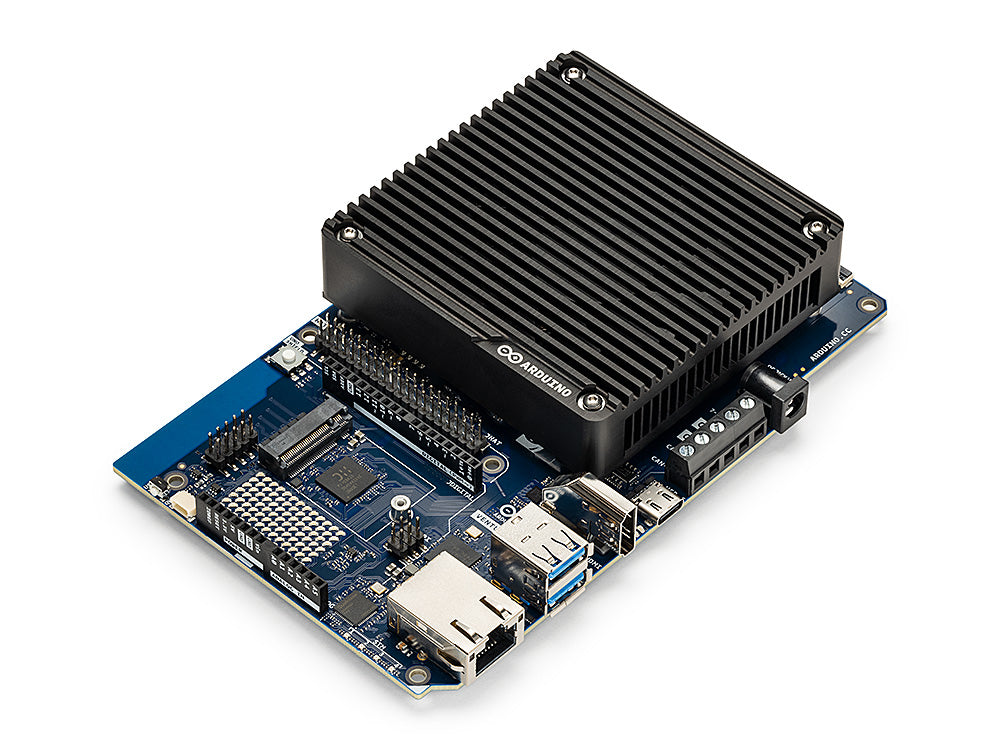
This split addresses a practical robotics problem. A Linux computer can run perception and planning software, but it is not designed to guarantee that a motor-control instruction lands within a precise timing window. A microcontroller is better suited to that work. Arduino connects the two sides through an RPC bridge, so an application can use the Linux environment for inference while delegating hard real-time jobs to the MCU.
That architecture could reduce the number of separate boards needed in a prototype. It does not remove the engineering work involved in power design, safety, motor drivers, sensing, or production validation. Teams will still need to test the complete system under the loads and environmental conditions of their own product.
Memory, storage, cameras, and networking
The board includes 16 GB of LPDDR5 memory and 64 GB of industrial-grade eMMC storage. An M.2 connector supports NVMe Gen 4 expansion, which may be useful for larger model files, recorded sensor data, or container images. Arduino ships the board with Ubuntu and says Docker and the APT package manager are available.
Its physical interfaces target robots, machine-vision systems, and industrial prototypes. Arduino lists three MIPI CSI camera connectors, USB camera support, HDMI output, DisplayPort over USB-C Alt Mode, two USB 3.0 Type-A ports, tri-band Wi-Fi 6, Bluetooth 5.3, and 2.5 Gb Ethernet. CAN-FD is available across several headers, including a dedicated screw terminal with a CAN-FD physical layer. The board also exposes I2C/I3C, SPI, PWM, UART, audio, and additional USB and power connections.
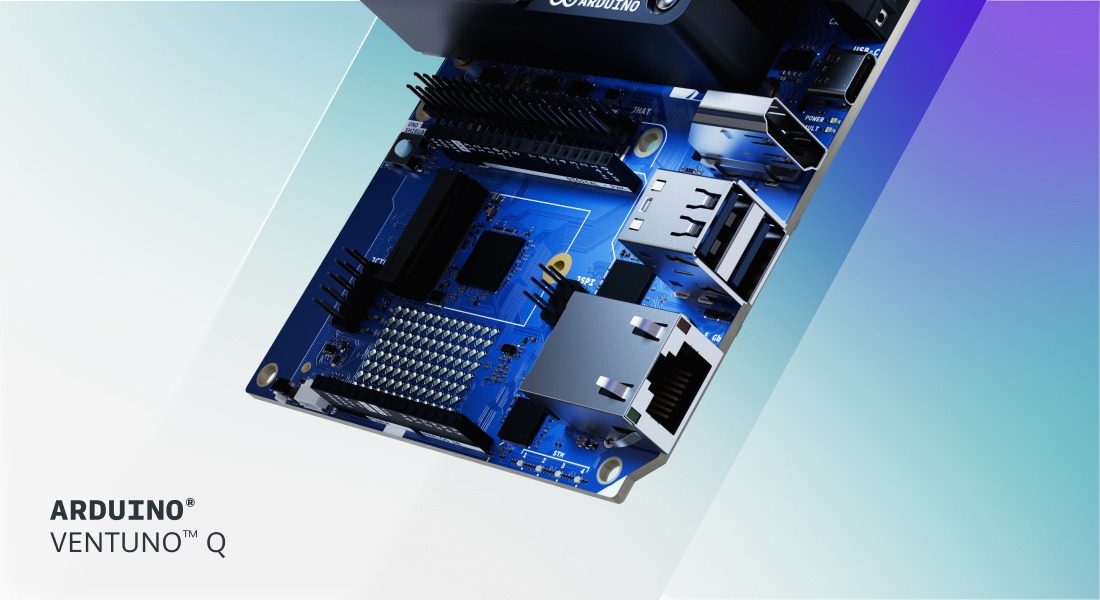
Those interfaces make the VENTUNO Q more directly useful for embodied AI than an accelerator sold only as a compute module. A team could connect cameras and sensors, run perception locally, and issue real-time control instructions from the same development platform. Whether that consolidation improves reliability or cost will depend on the application and on results from shipping hardware.
Arduino App Lab is optional
Arduino positions App Lab as the easiest way to combine Arduino sketches, Python scripts, and containerized AI models. The company says the environment includes NPU-optimized models for language, vision, speech, and gesture tasks. Developers can also import GGUF-format models from Hugging Face or train and quantize models through an Edge Impulse integration.
The board is not limited to App Lab. Arduino lists VS Code, PyCharm, Jupyter, Docker, and native Linux tools as supported workflows. ROS 2 compatibility is included for robotics development, while the MCU runs the Arduino Core on Zephyr RTOS. That mix should feel familiar to teams that already divide their software between Linux services and microcontroller firmware.
The important unknown is how much of the advertised software path works cleanly at launch. Model conversion, operator support, memory pressure, NPU utilization, and cross-processor debugging can turn a promising demonstration into a long integration project. Arduino provides more than 100 examples, but examples are starting points rather than evidence that a specific production workload will meet its latency or reliability targets.
Price and preorder status
The official US store lists VENTUNO Q at an introductory price of $299. Arduino said preorder customers could receive free accessories through September 30, 2026, while supplies last. The store estimated delivery in four weeks, but that is not the same as a confirmed shipping date. Regional taxes, import charges, distributor pricing, and final delivery timing may vary.
For comparison, developers shopping for compact edge-AI hardware may also consider Nvidia’s Jetson Orin Nano 2. The useful comparison will depend on software support, power limits, real-time control needs, camera connectivity, and the models each platform can run efficiently. Published TOPS figures alone do not settle those questions.
What remains unproven
Arduino and Qualcomm have published detailed specifications, but Kingy.ai has not tested VENTUNO Q. There are no independent results in this source package for sustained inference speed, power draw, thermal behavior, model compatibility, real-time bridge latency, or reliability under industrial workloads. The quoted 40 dense TOPS is a vendor specification, not an application benchmark.
The production story also needs scrutiny. Arduino says developers can carry their software, models, and application logic to production-certified system-on-modules based on the same Dragonwing IQ8 architecture. That may reduce migration work, but it does not prove drop-in hardware compatibility or remove certification, board design, sourcing, and validation requirements.
VENTUNO Q arrives as interest in physical AI is moving beyond research demonstrations. Products such as the Hugging Face Microduck show the demand for lower-cost robotics platforms, while industrial teams need more compute and more dependable control. Arduino’s board aims at the gap between those worlds.
Kingy.ai perspective
The VENTUNO Q’s strongest idea is the division of labour between a Linux AI processor and a real-time microcontroller. Developers have built similar two-computer systems for years, but Arduino is packaging that pattern on one board with familiar tools and a broad set of physical interfaces.
The $299 preorder price makes the board accessible enough for serious prototypes, classrooms, and small robotics teams. The buying decision should wait on workload-specific evidence. Teams should test the exact models, cameras, control loops, power envelope, and thermal conditions they plan to deploy before treating the board as a production platform.
Official details are available in Arduino’s announcement, the Arduino store listing, and Qualcomm’s release.
The Kingy Brief
Get The Kingy Brief.
AI changes, original tests and one practical thing to try. Fridays at 09:00 Vancouver time.
Free · Double opt-in · Unsubscribe anytime
Sign up for The Kingy Brief on Beehiiv.
Signup help and newsletter schedule
Signup form provided by Beehiiv. After submitting, check your inbox for "Confirm your subscription to The Kingy Brief" and open its confirmation link. Check Spam or Promotions if you cannot find it.
Fridays at 09:00 Vancouver time: source-checked AI changes, original tests and one practical thing to try. We skip a week when there is not enough verified material. Free. Unsubscribe anytime.