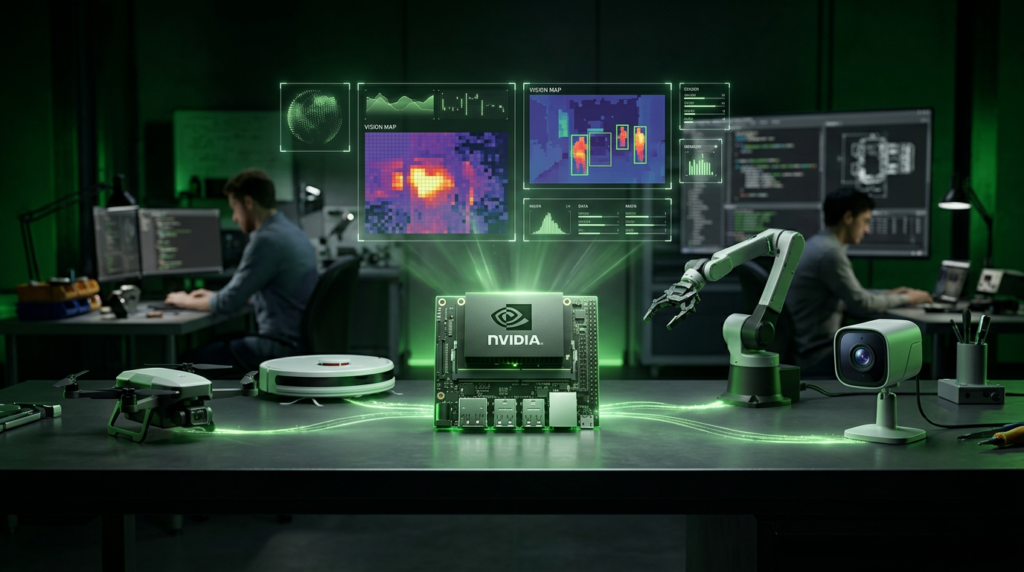
AI Is Climbing Out of the Cloud
Artificial intelligence has spent years living comfortably inside data centers. Now it wants wheels, propellers, cameras, and perhaps permission to reorganize your living room.
Nvidia’s newly announced Jetson Orin Nano 2 aims to help make that happen. The compact robotics computer is designed for developers building drones, autonomous machines, intelligent cameras, and other systems that must process information in the real world.
Instead of constantly sending data to a distant cloud server, machines equipped with the new Jetson module can run AI models locally. That means faster responses, less dependence on connectivity, and better performance in places where Wi-Fi behaves like an unreliable houseguest.
Nvidia calls this movement “physical AI.” The term covers systems that do more than generate text or images. These machines perceive their surroundings, interpret what they see, make decisions, and act.
The Jetson Orin Nano 2 sits at the entry level of Nvidia’s robotics lineup, but “entry level” is doing some heavy lifting here. The module delivers 78 trillion operations per second, or TOPS, of AI compute. Nvidia says it also doubles inference performance compared with the Jetson Orin Nano Super.
That combination could give smaller robots a surprisingly capable brain—without forcing them to drag a server rack behind them.
A Small Board With Serious Specifications
At the heart of the Jetson Orin Nano 2 sits an eight-core Arm processor, 8GB of memory, upgraded Tensor Cores, and greater memory bandwidth. Nvidia has packaged all of that inside the same compact form factor used by its predecessor.
The headline number is 78 TOPS. However, TOPS alone does not tell the entire story.
The previous Jetson Orin Nano Super can deliver up to 67 TOPS, so the raw compute figure has not literally doubled. Nvidia’s two-times claim refers specifically to AI inference performance. Improvements to the Tensor Cores, memory system, and software optimization help the new hardware process supported models more efficiently.
That distinction matters. Buyers should not treat TOPS like horsepower stickers slapped onto a race car. Different workloads, data formats, models, and optimization methods can produce very different real-world results.
Still, the upgrade looks substantial. StorageReview describes the system as an updated module and developer kit built for compact foundation models and real-time computer-vision workloads.
In practical terms, the Jetson Orin Nano 2 could process video, interpret spoken instructions, recognize objects, map indoor spaces, and make navigation decisions—all while mounted inside a relatively small machine.
Tiny board. Big ambitions. Very Nvidia.
Efficiency May Be the Bigger Upgrade
Performance attracts attention, but energy efficiency may prove more important for robotics.
A warehouse robot can return to a charging station. A delivery drone cannot politely pause in midair while somebody finds an extension cord.
According to Nvidia’s announcement, the Jetson Orin Nano 2 consumes 40% less power than the Orin Nano Super when delivering the same level of performance in its 15-watt operating mode.
That could translate into longer operating times, smaller batteries, reduced heat, or additional power for cameras and sensors. Manufacturers could also use the efficiency gain to build lighter products—especially useful for drones, where every gram earns its keep.
Lower power consumption brings another advantage: simpler thermal management. Heat sinks, fans, vents, and cooling systems consume space and complicate designs. A more efficient computer gives engineers additional room to maneuver.
This does not mean every robot will suddenly gain 40% more battery life. Motors, sensors, radios, and mechanical components also consume energy. Actual gains will depend on the complete system and the workload.
Nevertheless, reducing the computer’s appetite gives designers more options. In compact robotics, options are gold. Or lithium, depending on which department handles the battery.
Why Local AI Matters
Cloud AI works brilliantly when a device has a fast, stable connection. The physical world rarely offers such impeccable manners.
A drone might fly beyond strong cellular coverage. A farm robot may operate in a remote field. An inspection system could sit inside a factory where interference, security policies, or network congestion make cloud access unreliable.
Local inference lets a device continue operating when connectivity disappears. It can also reduce latency because sensor data does not need to travel to a server and back before the machine responds.
That delay matters when a robot faces a moving person, vehicle, wall, or unexpectedly ambitious household pet.
Processing data locally can also limit how much raw information leaves the device. A vision system may analyze camera footage onboard and transmit only an alert or result rather than streaming every frame to the cloud.
As StorageReview notes, onboard processing can maintain core perception functions in disconnected or signal-degraded environments.
Cloud services will not vanish from robotics. Developers will still use them for model training, fleet management, updates, analytics, and heavier processing. The emerging model looks hybrid: use the cloud when it helps, but keep urgent decisions close to the machine.
No robot wants to buffer while approaching a staircase.
Smaller Models Changed the Equation
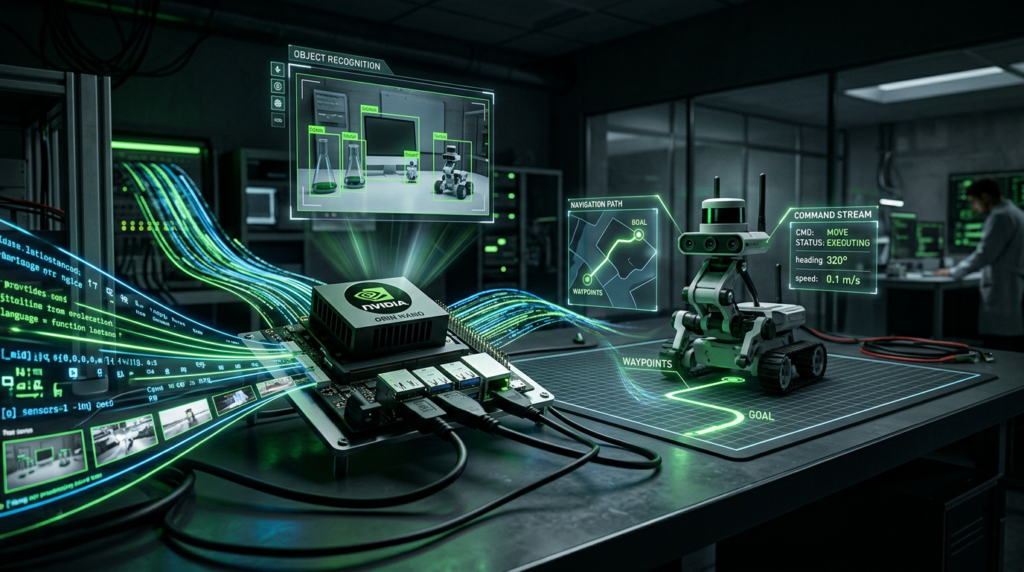
The Jetson Orin Nano 2 arrives as smaller AI models become dramatically more capable.
Nvidia argues that today’s compact and midsized models can achieve levels of accuracy associated with much larger models from the previous year. That progression makes it possible to bring language understanding, visual reasoning, and multimodal intelligence to affordable edge hardware.
The new Jetson supports large language models and vision-language models optimized for memory-efficient inference. Nvidia lists models from its Cosmos and Nemotron families alongside Gemma 4 and Qwen 3 as examples that developers can deploy through its software ecosystem.
A vision-language model can analyze visual information and connect it with written or spoken instructions. A robot might identify an object, understand a request involving that object, and choose an appropriate action.
That is more flexible than programming one rigid behavior after another. Traditional automation thrives in predictable environments. Generative and multimodal AI could help machines cope with messier situations.
Of course, “could” is carrying an important suitcase. Running a model is not the same as building a safe, dependable product. Developers still need sensors, control software, testing, safeguards, and application-specific engineering.
The Jetson Orin Nano 2 supplies compute. It does not sprinkle finished-robot dust onto a circuit board.
Wing Eyes Smarter Delivery Drones
Alphabet subsidiary Wing provides one of the clearest examples of how the technology might be used.
Wing already operates Nvidia’s Jetson Orin Nano Super and associated software in its delivery drone fleet. The company plans to evaluate the Jetson Orin Nano 2 for more responsive and energy-efficient onboard perception and reasoning.
Delivery drones must understand a constantly changing environment. Trees move. Vehicles appear. People enter landing areas. Weather changes. The machine must process sensor information quickly and react reliably.
More efficient onboard AI could help with obstacle detection, routing, landing decisions, and situational awareness. The drone would not need to depend on a continuous high-bandwidth connection for every perception task.
Still, evaluation does not equal deployment. Neither Nvidia nor Wing has announced a timetable for putting the new module into production flights. AI News makes that distinction clear: Wing is exploring the platform, not promising an immediate fleet-wide upgrade.
That caution is sensible. Aviation systems require extensive testing, and a benchmark victory means little if the machine cannot handle wind, rain, interference, or a territorial pigeon.
The potential, however, is obvious. Better performance per watt is exactly what airborne robots crave.
Matic Wants a More Understanding Home Robot
Matic Robots plans to adopt the Jetson Orin Nano 2 for its autonomous home-cleaning machines.
Cleaning sounds simple until a robot attempts it in an actual home. Chairs move. Toys migrate overnight. Cables lurk like traps. Humans issue vague instructions such as “clean around there,” accompanied by an equally vague hand gesture.
Matic wants to use the new hardware for conversational AI, gesture detection, precision mapping, semantic understanding, and autonomous cleaning. These features could help a robot recognize not only where objects are but what they mean within a room.
A traditional map may show obstacles and open floor space. A semantically richer map could distinguish a dining table from a sofa, understand that shoes belong near an entrance, or interpret a request involving a specific area.
Local processing also makes sense inside a home. Fast responses improve interaction, while onboard analysis can reduce dependence on an internet connection for immediate navigation and perception.
The challenge will be turning impressive individual capabilities into one reliable experience. Conversation, vision, mapping, and movement must cooperate. If they do not, the result may be a robot that eloquently explains why it has become trapped beneath the couch.
Nvidia provides the computing foundation. Matic still has to make the whole machine behave.
Factories and Industrial Systems Join the Party
Consumer robots and delivery drones make lively demonstrations, but industrial applications may drive much of the serious demand.
Nvidia says Cognex and Doosan Bobcat are among the early companies adopting or exploring the Jetson Orin Nano 2. Cognex specializes in machine-vision systems, while Doosan Bobcat produces compact industrial and construction equipment.
Computer vision at the edge can inspect products, identify defects, monitor processes, recognize equipment, or guide machines without sending every image to a remote server. Local processing can improve response time and help facilities keep operating when network access becomes limited.
Industrial environments also reward consistency. A machine that responds quickly nine times out of ten is a fascinating prototype. A production system needs considerably better manners.
The Jetson platform gives developers access to Nvidia’s broader software environment for accelerated inference, computer vision, and robotics. That ecosystem may matter as much as the silicon itself.
According to The Robot Report, Nvidia is positioning the module as a cost-conscious and power-efficient system for robotics at the edge.
Companies can build around an established development platform instead of assembling every software layer from scratch. That can shorten development cycles, although integration, validation, and maintenance remain substantial jobs.
Hardware is only the beginning. Robots, rather inconveniently, demand engineering.
Nvidia Is Building an Ecosystem, Not Just a Board
Nvidia says more than three million developers have built on its robotics stack. The Jetson Orin Nano 2 gives that community a new entry point for physical-AI projects.
The company has also assembled a broad group of hardware and software partners. AAEON, ADLINK, Advantech, Aetina, Antmicro, Aptiv, AVerMedia, Connect Tech, ForeCR, Seeed Studio, and many others plan to build carrier boards, customized software, hardware systems, or reference designs around the module.
That partner network solves an important problem. A Jetson module by itself is not a finished robot computer. Product developers may need custom connectors, industrial enclosures, storage, networking, camera interfaces, power management, or specialized carrier boards.
An active ecosystem lets companies choose components and reference platforms that fit their application. It also makes Nvidia’s hardware more difficult to displace. Once developers build tools, training, workflows, and products around one platform, switching carries a cost.
Blockchain.News frames the launch as another step in Nvidia’s push to strengthen its position in edge AI and robotics. That assessment fits the broader strategy.
Nvidia does not merely want to sell the brain. It wants to provide the nervous system, the development environment, and the neighborhood where all the engineers hang out.
A tidy little empire—now available in robot size.
The Price Remains a Missing Piece
Nvidia expects the Jetson Orin Nano 2 module and developer kit to arrive during the first half of 2027. The company has not announced pricing.
That omission leaves a major question unanswered.
The Jetson Orin Nano Super Developer Kit launched at $249 after Nvidia reduced the price of the earlier kit. That made it attractive to students, makers, researchers, startups, and developers who wanted a relatively accessible edge-AI platform.
The Nano 2 carries the “entry-level” label, which suggests Nvidia intends to preserve broad accessibility. Still, nobody should convert that suggestion into an imaginary price tag.
Cost will help determine which audience embraces the product. At a competitive price, the board could become popular for prototypes, university laboratories, startup products, and smaller commercial deployments. A higher price could push it toward professional and industrial projects.
Developers must also account for storage, cameras, sensors, carrier boards, cooling, power supplies, and the rest of the hardware surrounding the module. The computer may be compact, but the shopping list can grow legs.
Heise characterizes the product as a new single-board computer aimed at robots and compact AI systems. Its eventual value will depend not just on benchmark numbers but on price, software maturity, availability, and real application performance.
For now, the specifications look promising. The receipt remains mysterious.
Physical AI Is Becoming More Practical
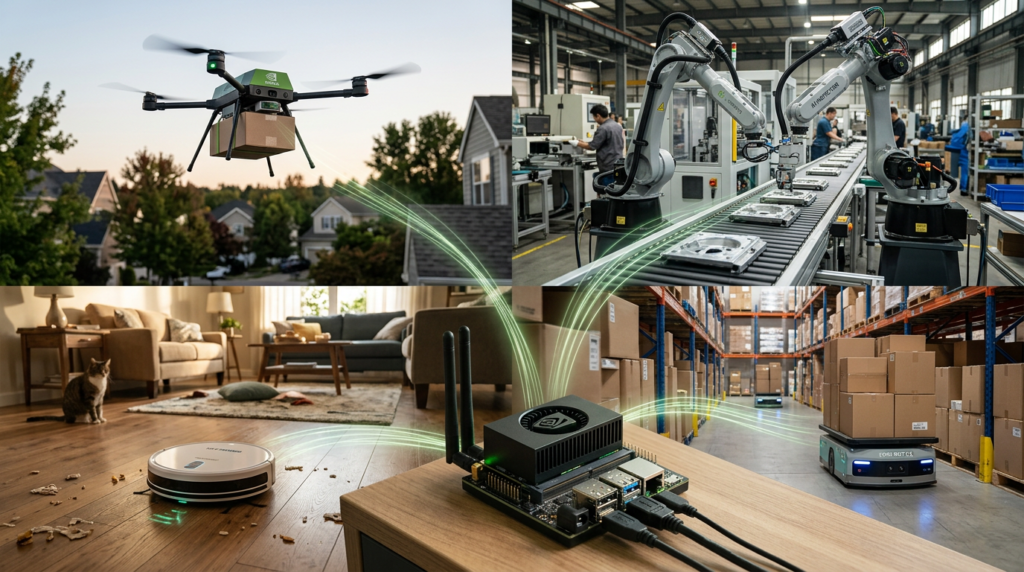
The Jetson Orin Nano 2 does not represent the most powerful robotics hardware Nvidia sells. That may be precisely why it matters.
High-end systems can run enormous models and control sophisticated machines, but many useful products do not need maximum performance. They need enough intelligence, delivered inside a small power and cost envelope.
Nvidia is betting that efficient models and compact hardware have reached the point where developers can build genuinely capable edge devices without relying on giant computers or permanent cloud connections.
The Nano 2’s 78 TOPS, 8GB of memory, eight-core Arm CPU, improved inference performance, and greater efficiency create a promising foundation. Early interest from Wing, Matic, Cognex, and Doosan Bobcat adds credibility, although most announced applications remain under evaluation or development.
The real test will arrive in 2027, when developers can run their own models, measure power consumption, examine thermals, and discover whether Nvidia’s performance claims survive contact with actual robots.
If they do, the Jetson Orin Nano 2 could help move generative AI from screens into machines that see, navigate, communicate, inspect, deliver, and clean.
The chatbot era taught computers how to talk.
The next phase may teach them how to avoid furniture.
Sources
- Nvidia Newsroom: Jetson Orin Nano 2 announcement
- Artificial Intelligence News
- Heise
- StorageReview
- Blockchain.News
- The Robot Report
The Kingy Brief
Get The Kingy Brief.
AI changes, original tests and one practical thing to try. Fridays at 09:00 Vancouver time.
Free · Double opt-in · Unsubscribe anytime
Signup help and newsletter schedule
Signup form provided by Beehiiv. After submitting, check your inbox for "Confirm your subscription to The Kingy Brief" and open its confirmation link. Check Spam or Promotions if you cannot find it.
Fridays at 09:00 Vancouver time: source-checked AI changes, original tests and one practical thing to try. The weekly restart begins October 9, 2026. We skip a week when there is not enough verified material. Free. Unsubscribe anytime.