
Original comparison: September 3, 2026
Sources checked: October 8–9, 2026
The answer in one sentence: Claude Fable 5.1 has the clearest cache-price advantage on paper—$0.25 per million cache-read tokens versus Astra’s official $1 short-context rate—but there is not yet a defensible Astra-versus-Fable winner because no reproducible matched completed-work test has been run. The September 3 guide described a phased Astra rollout; the official model page retained on October 8 does not establish access for every account, region or product surface.
That is less exciting than declaring a champion on launch day. It is also the only answer a buyer should trust.
OpenAI Astra and Claude Fable 5.1 have the same standard short-context headline price: $10 per million input tokens and $50 per million output tokens. Identical headline rates do not produce identical bills, however. A model that needs fewer tokens, recovers from tool errors, survives a long workflow and returns an acceptable deliverable on the first attempt can be cheaper than a model with the same—or even lower—token price.
This comparison therefore starts with a buying rule: measure the fully loaded cost of accepted work, not the cost of one attractive answer.
Kingy verdict: Fable 5.1 has the lower published cache-read rate. Astra’s model ID, price and tool support are documented; confirm access and required tools in the accounts used for the comparison. Use Gemini 3.8 Flash as the budget control, pre-register the four workflows below, and publish a head-to-head winner only after all three models can run the same task packets with stable billing visibility.
What is verified—and what is still missing
The retained October 8–9, 2026 checks of Anthropic’s official Fable page show Claude Fable 5.1 at $10 per million input tokens and $50 per million output tokens. It also lists cache reads at $0.25 per million tokens and estimates that caching can reduce typical workload costs by about 25% and highly agentic workload costs by up to roughly 45%. Those percentages are Anthropic’s estimates, not Kingy measurements.
OpenAI’s official GPT-6 Astra model page retained on October 8, 2026 identifies gpt-6-astra and lists a 1.05-million-token context window. This guide’s September 3 rollout description is historical; the current model page does not establish each account’s API or paid ChatGPT entitlement. The model page and API pricing page confirm $10 input, $1 cached input, $12.50 cache writes and $50 output per million tokens for Standard requests with no more than 272,000 input tokens. Above that threshold, input and cache rates double and output rises by 50% for the full request. Batch and Flex cost half the Standard rate; Fast costs twice the applicable rate.
OpenAI’s GPT-6 Astra System Card also changes the safety evidence. OpenAI says Astra is its first broadly deployed model at the Critical cybersecurity capability threshold, that all tool-using external Astra inference receives misalignment monitoring, and that the monitor can pause or end some conversations. In more than 54,000 internal Codex-task simulations, Astra received roughly half as many higher-severity misalignment flags as GPT-5.6 Sol. OpenAI also reports stronger prompt-injection resistance and fewer potentially destructive or unauthorized actions in realistic computer environments, while separately warning that Astra’s chain-of-thought monitorability declined. These are OpenAI evaluations, not an Astra-versus-Fable field test.
The evidence gap is therefore narrower but still important: pricing and model identity are official; comparative completion cost is not. This article does not invent usage, latency, cache-hit or acceptance data before a matched run exists.
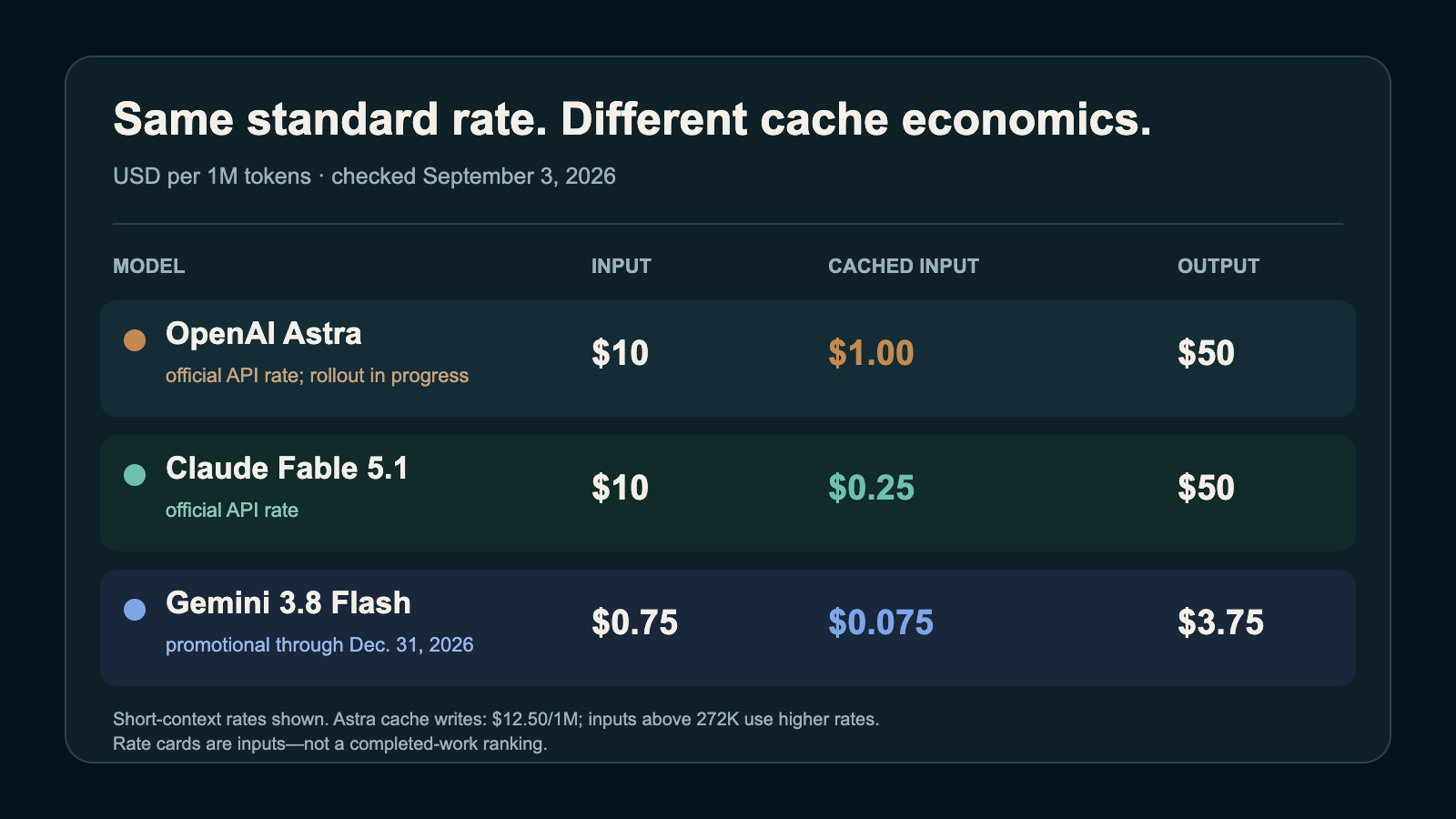
| Model | Input / 1M | Cache economics / 1M | Output / 1M | Access status at check |
|---|---|---|---|---|
| OpenAI Astra rates checked October 8–9, 2026 |
$10 Standard, short context | $12.50 writes; $1 reads | $50 Standard, short context | Official model documented; account access requires confirmation |
| Claude Fable 5.1 rates checked October 8–9, 2026 |
$10 | $12.50 five-minute writes; $20 one-hour writes; $0.25 reads | $50 | Documented Claude API model |
| Gemini 3.8 Flash rates checked October 9, 2026 |
$0.75 promotional | $0.075 promotional, plus storage | $3.75 promotional | Documented Gemini API model |
Google’s official Gemini API pricing page, checked October 9, 2026, says the Gemini 3.8 Flash promotional rates run through December 31, 2026; standard prices rise to $1.50 input and $7.50 output on January 1, 2027. The promotional rate is 7.5% of the premium models’ reported uncached input and output prices. Put differently, the premium rate card is 13.33 times higher before caching, discounts, tools or differences in token consumption.
Why token prices cannot answer the buyer’s question
A model bill is only one line in the cost of a completed job. Real workflows fail in expensive ways: a patch looks plausible but breaks a test; a browser agent loses its place after a modal appears; a finance memo misses one source; a spreadsheet reconciliation silently shifts a column; or a safety system interrupts a legitimate task and forces a fallback.
The useful denominator is the number of results that clear a pre-declared acceptance contract. Kingy’s broader guide to AI inference cost per successful job explains the framework, while our 192-run model work-per-dollar test shows why the ranking can change once failed requests and accepted outputs are counted.
Use this equation:
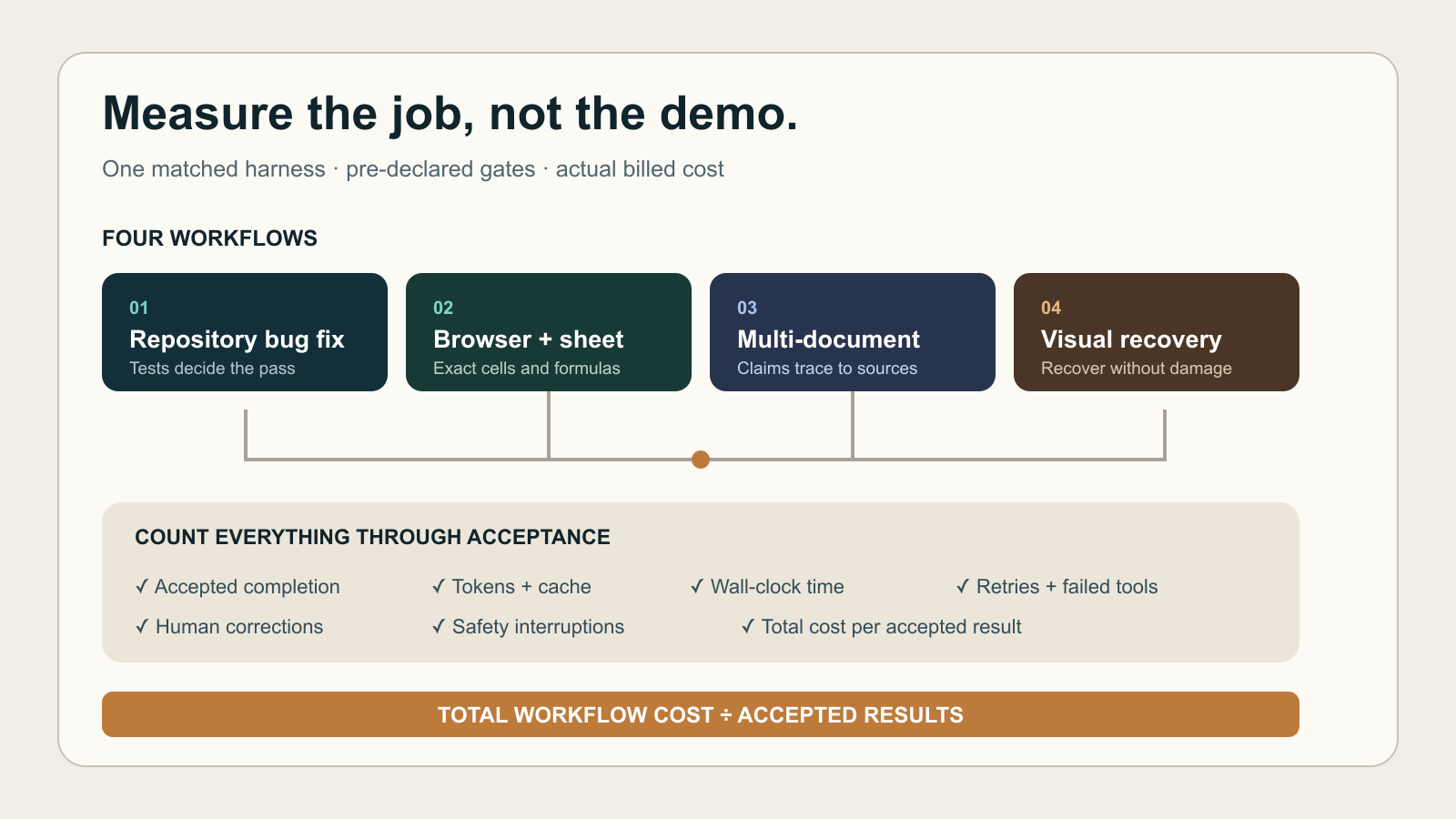
Cost per accepted result = (model tokens + cache + tool fees + retry spend + human correction cost) ÷ accepted results.
Human correction belongs in the equation. At a loaded labor rate of $100 per hour, five minutes of avoidable review costs $8.33. That can overwhelm the token bill for many text-and-tool workflows. A premium model does not need to be thirteen times smarter to earn its price; it needs to remove enough retries, review time or business risk to close the fully loaded gap.
The four-workflow matched test
The first Astra-versus-Fable run should use the same task packets, tool permissions, starting files, time limits and acceptance gates. Gemini 3.8 Flash should run as the budget control. One pass per workflow is a useful launch-day pilot, not a universal leaderboard; close results should be repeated before a purchasing decision.
1. Repository-scale bug fix with tests
Give each model the same repository snapshot, issue report and test command. The defect should require tracing behavior across several files rather than changing one obvious line. The job passes only if the relevant test suite succeeds, no unrelated tests regress, the patch addresses the root cause, and a human reviewer accepts the diff without rewriting it.
Record repository-reading tokens, generated tokens, test commands, failed test cycles, files changed, elapsed time and reviewer correction minutes. A beautiful explanation attached to a failing patch is a failed job.
2. Browser-and-spreadsheet reconciliation
Provide a controlled browser source and a workbook containing deliberate mismatches, duplicate records and one ambiguous item. The model must reconcile the records, preserve formulas and formatting, flag the ambiguous row instead of guessing, and produce an audit trail.
The pass gate should compare exact cell values, formulas and row counts. Count navigation errors, stale-page reads, spreadsheet tool failures and any manual repairs. This workflow is especially useful because it combines visual state, structured data and recovery from ordinary interface friction.
3. Multi-document finance or legal analysis
Use the same set of contracts, filings or policy documents and ask a decision-focused question whose answer requires reconciling clauses across files. Pre-write a source map and a list of mandatory findings. The result passes only if every consequential claim is traceable to the correct document, material conflicts are disclosed and no unsupported conclusion appears.
This is where caching may matter most. A stable document corpus can create a large reusable prefix across follow-up questions. Capture cache writes, cache reads, misses and any long-context surcharge separately; do not hide them inside one total.
4. Visual computer-use recovery task
Place the model in a controlled application with a known sequence of actions, then introduce recoverable UI faults: a displaced button, a modal dialog, a session timeout or an unexpected validation message. The model must recognize the changed state, recover without corrupting data and verify the final result.
Score correct completion, unauthorized actions, recovery loops, screenshots inspected, tool-call failures, elapsed time and human intervention. OpenAI’s universal monitoring for external tool-using Astra inference makes safety interruptions an especially important field. Record whether a monitor paused or ended work, whether the interruption was justified, whether the task could resume and whether a fallback was required. A correct refusal and a false-positive interruption are different outcomes.
The scorecard that prevents benchmark theatre
Declare the pass conditions before any model runs. Keep the grader blind to provider identity where possible. Preserve prompts, task fixtures, model IDs, reasoning settings, tool versions, timestamps and raw billing records. If a provider silently routes a request to another model, record the route and use the actual charge.
| Field | What to record | Why it matters |
|---|---|---|
| Accepted completion | Pass or fail against the task contract | Prevents style from substituting for working output |
| Tokens | Uncached input, cache write, cache read, output and reasoning where billed | Explains the provider bill |
| Wall-clock time | Start to verified finish, including tools | Captures waiting and long agent loops |
| Retries | Model retries, tool retries and full reruns | Charges failure back to the job |
| Human corrections | Minutes and loaded hourly cost | Often dominates token spend |
| Safety interruptions | Correct blocks, false positives, fallbacks and resumed work | Measures both protection and operational friction |
| Total cost | All model, tool and labor cost through acceptance | Produces the buyer’s decision metric |
Do not allow different retry policies to flatter one model. A fair first pass gives every model the same maximum number of attempts and the same escalation rule. If a model fails and another model completes the fallback, charge both calls to the routed workflow.
Test caching without rigging the result
Fable 5.1’s $0.25 cache-read rate is one quarter of Astra’s published $1 short-context cache-read rate. Astra and Fable both list a $12.50 cache-write price in their base tiers, although Fable also offers a $20 one-hour write option and the providers apply different long-context rules. That makes a cold-versus-warm test essential.
- Cold run: begin with no reusable cache and record the full input cost.
- Warm run: repeat a genuinely related job with the same stable repository, document corpus or operating instructions.
- Mutation run: change the volatile portion of the task and measure how much of the prefix still qualifies for reuse.
Report cache-write cost, read cost, hit rate and storage charges. Keep Astra requests above 272,000 input tokens in a separate cost band because OpenAI doubles the input and cache rates for the entire request and charges 1.5 times the short-context output rate. Do not apply Anthropic’s 25% or 45% workload-saving estimates to Astra.
The arithmetic is still useful as a planning boundary. Because Gemini’s promotional input and output rates are exactly 7.5% of $10/$50, equal token volumes make an uncached premium attempt 13.33 times as expensive. If Anthropic’s estimated 25% total saving applied to a particular Fable workload, that gap would shrink to 10 times. At a 45% saving, it would shrink to about 7.33 times. Those are simple rate-card scenarios, not measured task costs.
What would make each model the cheapest?
Fable 5.1 wins when reusable context is large
Fable has the strongest published case for repositories, document sets and agent instructions that remain stable across many turns. Its $0.25 cache-read price is 97.5% below its own uncached input rate. The actual saving depends on how much input is reusable, what cache writes cost, how often the prefix changes and whether output or tools dominate the bill.
Astra wins only by completing more work
At the same short-context uncached token rate as Fable, Astra cannot win on sticker price. It would need to consume fewer billed tokens, finish more jobs, recover faster, reduce corrections or avoid expensive failure modes. OpenAI’s system card makes the last category measurable: buyers should record monitor-triggered pauses, correct refusals, false positives, unauthorized actions and fallback spend rather than treating either more refusals or fewer refusals as automatically better.
Gemini 3.8 Flash wins when “good enough” stays accepted
Gemini begins with an enormous rate-card advantage. On an identical token mix, a premium model with a perfect completion rate cannot beat Gemini on model cost alone if Gemini accepts more than 7.5% of attempts. That deliberately simplified boundary ignores token-efficiency differences, retries, caching, tools and labor—but it shows how high the premium bar is.
The case for Astra or Fable therefore rests on the expensive tail: jobs where a Flash failure causes repeated reruns, prolonged review, missed deadlines or material risk. Use a budget model for routine work and escalate the hard tail unless your matched data proves the premium model deserves every call.
A practical buying decision today
If procurement must choose before a matched test can run in the intended production accounts and region, evaluate whichever documented models are actually enabled there. Fable 5.1 has the lower published cache-read rate, and Gemini 3.8 Flash is the proposed budget control. Those are price and test-design considerations, not evidence that one model is smarter or cheaper on every workflow. Astra still needs a matched completed-work run before this article can name a head-to-head winner.
Teams already measuring model economics can use Kingy’s AI workload cost calculator to model token, tool, retry and review assumptions. For coding-specific context, our Fable 5.1 coding-model analysis separates vendor results from independent evidence.
The right operational policy is simple:
- Route routine, reversible jobs to the budget control.
- Escalate failures or high-consequence work to a premium model.
- Keep the acceptance contract identical across routes.
- Recalculate cost per accepted result from your own billing and review data.
Astra name clarification
OpenAI Astra is unrelated to Google DeepMind’s Project Astra. Google describes Project Astra as a research prototype for a universal AI assistant whose capabilities feed into products such as Gemini Live. The shared name does not imply a partnership, shared model or common API.
Frequently asked questions
Is Astra cheaper than Claude Fable 5.1?
Not enough comparative evidence exists to say. Their standard short-context uncached rates match, while Fable’s $0.25 cache-read rate is lower than Astra’s $1 rate. Astra could still be cheaper per accepted job if it uses fewer tokens, succeeds more often, recovers better or needs less human correction. That requires callable access and a matched test.
Does Fable’s cache price guarantee a 25% or 45% saving?
No. Those are Anthropic’s estimates for typical and highly agentic workloads. Your saving depends on cacheable input, write and storage costs, prompt stability, output volume and how the workflow is designed.
Why include Gemini 3.8 Flash?
It is the budget control. Its promotional $0.75/$3.75 input/output pricing creates a hard economic baseline. A premium model should not be judged only against another premium model; it should prove that its additional accepted work covers the much higher rate.
Why not use public benchmark scores?
Benchmarks can inform model selection, but they do not reproduce your files, tools, UI failures, acceptance rules or labor costs. This comparison asks a narrower and more commercial question: how much does a verified completed job cost in the workflow you actually run?
When should the matched Astra test begin?
Begin when gpt-6-astra is enabled for the test account with stable billing visibility and the tool capabilities required by all four workflows. Preserve the exact model ID, service tier, reasoning effort and access date so a later routing or pricing change does not invalidate the comparison.
Disclosure: Kingy did not run Astra for this article. OpenAI documents the model and price in the source retained on October 8, 2026; the September 3 rollout wording is historical, and current account-specific access was not tested. No matched Astra-versus-Fable workflow run was completed for this update. No benchmark result, token count, cache hit, completion rate or latency in this article is presented as a Kingy Astra measurement. Prices are public list rates in US dollars before tax, negotiated discounts, regional uplifts and provider-specific tool charges.
The Kingy Brief
Get The Kingy Brief.
AI changes, original tests and one practical thing to try. Fridays at 09:00 Vancouver time.
Free · Double opt-in · Unsubscribe anytime
Sign up for The Kingy Brief on Beehiiv.
Signup help and newsletter schedule
Signup form provided by Beehiiv. After submitting, check your inbox for "Confirm your subscription to The Kingy Brief" and open its confirmation link. Check Spam or Promotions if you cannot find it.
Fridays at 09:00 Vancouver time: source-checked AI changes, original tests and one practical thing to try. We skip a week when there is not enough verified material. Free. Unsubscribe anytime.