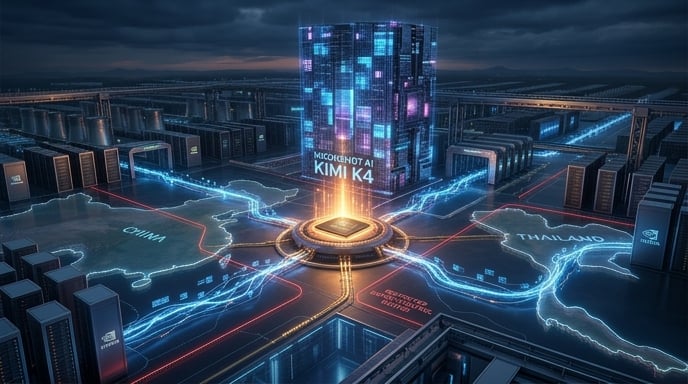
Moonshot Is Already Aiming at Its Next Target
Moonshot AI has barely finished introducing its enormous Kimi K3 model, yet the Chinese startup may already be preparing an even bigger sequel.
According to reporting summarized by Investing.com, Moonshot has started discussing Kimi K4, a planned successor that could substantially exceed K3 in size. The company is also reportedly seeking access to more of Nvidia’s advanced Blackwell processors to train it.
That would be a bold technical undertaking under normal circumstances. These are not normal circumstances.
Washington has restricted China’s access to advanced American AI hardware. Meanwhile, US officials have accused Moonshot of accessing Nvidia GB300 systems and using outputs from an American model during Kimi K3’s development. Moonshot has not publicly confirmed those accusations.
Now comes the reported Blackwell hunt.
If the claims prove accurate, Kimi K4 will represent more than another model release. It will test whether US chip controls can contain China’s frontier-AI ambitions or merely force Chinese developers to become more creative about where and how they obtain computing power.
The AI race has therefore acquired a new unofficial slogan: bigger models, scarcer chips and considerably more geopolitical paperwork.
Kimi K3 Arrived With Trillions Attached
To understand why K4 could become such a big deal, start with the sheer scale of Kimi K3.
In its official announcement, Moonshot describes K3 as a 2.8-trillion-parameter, open-weight model. It uses a mixture-of-experts architecture, meaning it does not activate every parameter for every request. Instead, it selects 16 of its 896 experts while processing a token.
That design helps control computational costs. “Helps” remains the operative word. A 2.8-trillion-parameter system is still a colossal piece of software.
K3 also supports native visual input and a one-million-token context window. Moonshot built it for long-duration coding, reasoning and knowledge work. The company says it can navigate large software repositories, operate terminal tools and complete extended engineering assignments with limited supervision.
Those are Moonshot’s claims and benchmark results, not universal independent findings. The distinction matters. Companies naturally introduce their models wearing their best clothes.
Still, the architecture is real, the scale is remarkable and the model’s weights were scheduled for public release. Moonshot also acknowledges that K3 still trails the strongest proprietary systems overall, even as it reports competitive performance across several technical evaluations.
In short, K3 was not a modest warm-up. It was Moonshot kicking open the laboratory door with 2.8 trillion muddy boots.
Why Blackwell Matters So Much
AI models do not grow merely because someone adds more zeros to a whiteboard. Training them requires vast clusters of accelerators, fast networking, memory and industrial quantities of electricity.
Nvidia’s Blackwell architecture sits near the center of that machinery.
Blackwell systems provide the enormous parallel-computing capacity needed to train and serve frontier models. The GB300 platform represents one of Nvidia’s most advanced configurations in the family. These systems combine powerful GPUs, high-bandwidth memory and specialized networking so thousands of processors can behave like parts of one giant machine.
Moonshot’s own deployment guidance illustrates the infrastructure challenge. The company recommends running Kimi K3 on “supernode” configurations containing at least 64 accelerators. That recommendation concerns inference using the finished model not the far more demanding process of training it.
If K4 grows significantly beyond K3, its appetite for compute could climb dramatically. Architectural efficiency can soften the increase, but it cannot make the hardware disappear in a puff of clever mathematics.
That explains the reported search for additional Blackwell capacity. The issue is not simply whether Moonshot wants Nvidia chips. Almost every frontier laboratory would happily accept another warehouse full.
The real questions concern where Moonshot could obtain them, who would operate them and whether that arrangement would comply with US export rules.
The Reported Training Trail Gets Complicated
The original report from The Information, subsequently summarized by several free outlets, says Moonshot trained K3 using Nvidia processors that included advanced Blackwell hardware.
Where that training happened remains contested.
US science adviser Michael Kratsios alleged publicly that Moonshot had acquired servers equipped with GB300 chips and accessed additional GB300 systems in Thailand. According to Investing.com, however, one source said Moonshot trained part of K3 inside China.
That detail carries weight because moving the necessary data across borders is not as effortless as uploading holiday photographs. Frontier-model pretraining consumes enormous datasets. Chinese rules governing cross-border data transfers can make moving those datasets to overseas facilities difficult.
The reports therefore describe a hybrid and technically awkward strategy. Moonshot allegedly combined computing resources from multiple providers because no single supplier could deliver enough Blackwell capacity.
Engineers reportedly had to make processors in separate facilities communicate efficiently. Any delay between those clusters can waste expensive compute and disrupt training.
It is an impressive engineering story if accurate. It is also an export-control headache wearing a server rack as a hat.
What the Evidence Actually Establishes
The public record needs careful handling because several different categories of information have become tangled together.
Moonshot has confirmed Kimi K3’s size, architecture, capabilities and infrastructure recommendations. Those details appear in the company’s official technical material.
Multiple publications have reported that Moonshot is considering Kimi K4 and seeking more Blackwell chips. However, those reports largely trace back to The Information and its unnamed sources. Repetition does not turn one investigation into five independent investigations.
Kratsios has publicly alleged that Moonshot acquired GB300-equipped servers and accessed other GB300 systems in Thailand. Reuters separately reported that the US Commerce Department’s Bureau of Industry and Security was investigating whether Chinese firms, including Moonshot, had accessed advanced American chips illegally.
An investigation is not a verdict.
At the time of the reports, neither Moonshot nor Nvidia had publicly provided a detailed response addressing the reported K4 procurement effort. There was also no public K4 technical report, confirmed release date or official parameter count.
Consequently, it would be inaccurate to declare that K4 is already being trained on smuggled processors. The defensible version is narrower: Moonshot is reportedly exploring K4, reportedly wants additional Blackwell compute and faces government allegations concerning its previous access to advanced Nvidia hardware.
Less dramatic? Perhaps. More accurate? Absolutely.
Two Data Centers, One Enormous Model
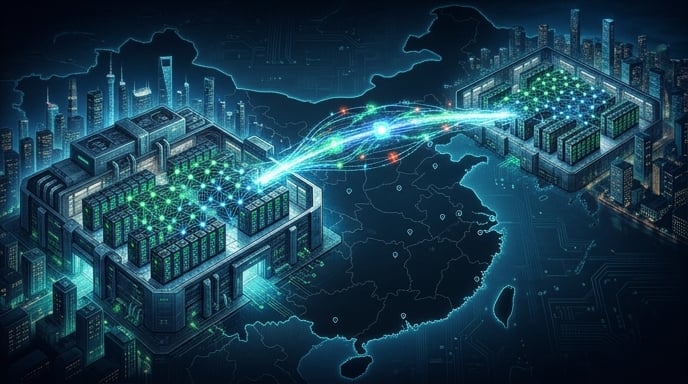
One of the most interesting elements involves Moonshot’s reported use of more than one Chinese cloud provider.
Large AI-training clusters typically rely on tightly connected processors. The GPUs exchange information constantly while updating billions or trillions of model parameters. Fast communication keeps the processors synchronized. Weak links create bottlenecks, and bottlenecks turn expensive accelerators into extremely glamorous space heaters.
According to the reports, Moonshot connected computing capacity across separate data centers because one provider could not supply enough Blackwell systems. Engineers then optimized networking between those sites.
That would be difficult.
Even small communication delays become costly when thousands of processors repeatedly exchange gigantic collections of numbers. Long-distance connections introduce additional latency and increase the chance that part of the cluster will sit idle while waiting for another part.
Moonshot’s K3 architecture may have helped. Its mixture-of-experts design activates only a fraction of the model at once, while Kimi Delta Attention and Attention Residuals aim to improve computational efficiency and information flow.
Moonshot says those changes produced roughly 2.5 times better scaling efficiency than Kimi K2. That is a company-reported estimate, but it highlights the broader strategy: when chips become difficult to obtain, squeeze more intelligence from every available processor.
Scarcity, it turns out, can be an unusually strict engineering manager.
Export Controls Meet Cloud Computing
US export restrictions were designed to prevent China from obtaining the most advanced American AI processors. Cloud access makes enforcement more complicated.
A company does not necessarily need to own a chip to use its computing power. It can rent servers from a cloud operator, employ an overseas facility or contract with an intermediary. The hardware stays in one location while workloads and results move through networks.
That creates legal and practical grey areas.
Investing.com notes that Chinese access to Nvidia hardware through an overseas data center might be permitted under some circumstances. The legality would depend on the equipment, parties, location, end use and applicable rules.
The situation therefore cannot be reduced to “Chinese company touches American chip, law explodes.”
US officials are nevertheless examining whether overseas arrangements allow restricted organizations to obtain the practical benefits of controlled hardware. Regulators must follow not only physical shipments but also remote access, subsidiaries, brokers and cloud-service agreements.
That challenge will grow. Training clusters are becoming more international, while compute can be rented across borders without moving a single server.
Export policy was built around boxes. AI infrastructure increasingly behaves like a service. The rules are now chasing the cloud quite literally.
The Distillation Dispute Adds More Heat
The hardware controversy sits beside another serious allegation: model distillation.
Distillation generally involves using outputs from a powerful model to train or improve another system. Developers commonly use legitimate forms of it to create smaller or more efficient models. The technique itself is not automatically misconduct.
The dispute concerns how the training data was obtained and whether its use violated contractual, technical or intellectual-property restrictions.
Kratsios accused Moonshot of using large-scale, covert distillation involving Anthropic’s Fable 5 model while developing Kimi K3. Moonshot has not publicly supplied evidence confirming that claim.
Reuters reported that Treasury Secretary Scott Bessent warned of possible sanctions following US allegations involving Moonshot. Reuters also noted that Washington’s accusations could disrupt planned AI-safety discussions between the United States and China.
This creates two connected but distinct controversies.
One concerns computing hardware: Did Moonshot obtain or access restricted processors?
The other concerns model development: Did it improperly harvest outputs from an American competitor?
Neither allegation should be treated as proven without supporting evidence. Yet together they show why Kimi has attracted such intense attention. Moonshot is not merely competing on benchmarks. It has landed in the middle of an argument about where AI capability comes from and who gets to control the ingredients.
China’s Compute Shortage Could Shape K4
China has invested heavily in domestic AI accelerators, but advanced processors are only one part of the equation. Companies also need complete servers, mature software, fast networking and reliable supply chains.
Reports suggest that large systems built around Chinese accelerators remain harder to obtain at frontier scale. Customers may face long waits, while developers must adapt software that has often been optimized around Nvidia’s CUDA ecosystem.
That helps explain why Nvidia hardware remains attractive despite political pressure and regulatory risk.
Moonshot reportedly also uses Nvidia H20 processors to serve Kimi K3. These chips provide less performance than unrestricted Blackwell systems but remain valuable for inference. According to the secondary reports, strong demand strained Moonshot’s available capacity shortly after K3’s release.
That illustrates an inconvenient truth. Building a model is only the opening act. Once users arrive, the company must run it repeatedly, quickly and affordably.
K4 would intensify every constraint. A larger model could require more training compute, more memory and a bigger serving fleet. Moonshot may offset some costs through sparsity, quantization and caching, but architectural ingenuity has limits.
Eventually, somebody must install the hardware, connect the cables and pay an electricity bill capable of frightening a small municipality.
K4 Could Escalate the Open-Weight Race
Kimi K3 is important partly because Moonshot positioned it as an open-weight model. Developers can inspect, download, modify and deploy released weights rather than relying entirely on a closed API.
Open weights can accelerate research and adoption. They allow organizations to run models on their own infrastructure, customize them and examine how they behave.
They also complicate control.
Once weights circulate widely, their original developer cannot easily recall them, disable access or guarantee that users preserve safety restrictions. That reality has intensified debate in Washington over Chinese open-weight systems.
Reuters reports that American officials and technology leaders remain divided. Some view lower-cost Chinese models as strategic and security risks. Others argue that restricting open models would suppress competition and protect established American laboratories.
K4 could sharpen that disagreement.
If Moonshot creates a substantially larger system and releases its weights, developers around the world could gain access to another frontier-scale model. That would challenge closed-model pricing and weaken the idea that only a handful of Western companies can operate at the frontier.
But access to Blackwell hardware could become part of the model’s political baggage. The more capable K4 becomes, the louder questions about its training resources and development methods will grow.
Every benchmark victory may arrive carrying a congressional hearing in its backpack.
Efficiency May Matter More Than Parameter Count
A larger parameter count makes a wonderful headline. It does not automatically produce a better model.
Performance depends on training data, architecture, optimization, post-training, tool integration and the number of parameters activated for each token. K3’s 2.8 trillion total parameters sound enormous, but its sparse design activates only a small selection of experts during computation.
K4 could therefore scale in several ways.
Moonshot might add more experts, activate more capacity, expand multimodal training or improve the mechanisms that route information through the network. It could also prioritize better reasoning and agentic behavior rather than chasing size for its own sake.
No public technical details currently answer those questions.
Moonshot’s K3 work suggests efficiency will remain central. The company uses lower-precision number formats, quantization-aware training and specialized caching to reduce memory and serving costs. It has also contributed implementation work to the vLLM ecosystem.
These optimizations matter because compute constraints can redirect innovation. A laboratory with unlimited hardware can often brute-force its way toward better results. A constrained laboratory must rethink architecture, networking and inference.
That does not make shortages desirable. It does make them technologically consequential.
K4’s most interesting achievement may therefore not be another trillion parameters. It may be whatever Moonshot invents to make those parameters function without an unlimited mountain of Blackwell GPUs.
The Bigger Battle Is About Access
The Moonshot story captures a central conflict in modern AI: the contest is no longer only about algorithms.
It is about access to processors, data centers, electricity, cloud services, training data and global distribution.
The United States controls many of the most important chip-design and computing technologies. China possesses a deep engineering base, major technology companies and a large domestic market. Each side is trying to turn those strengths into lasting advantage.
Export controls can slow access to hardware. They can also encourage alternative supply chains, domestic accelerator development and complicated overseas arrangements. Open-weight models can spread capabilities internationally, but their accessibility makes them difficult to regulate after release.
Meanwhile, common safety standards become harder to negotiate as each government suspects the other side of using cooperation as camouflage for competition.
Kimi K4 if and when it arrives will enter that environment.
Its technical performance will matter. So will its price, license and infrastructure requirements. Yet analysts will also examine the chips behind it, the data used to build it and the facilities where its training occurred.
The modern AI model comes with more than a model card. It comes with a geopolitical origin story.
What Happens Next
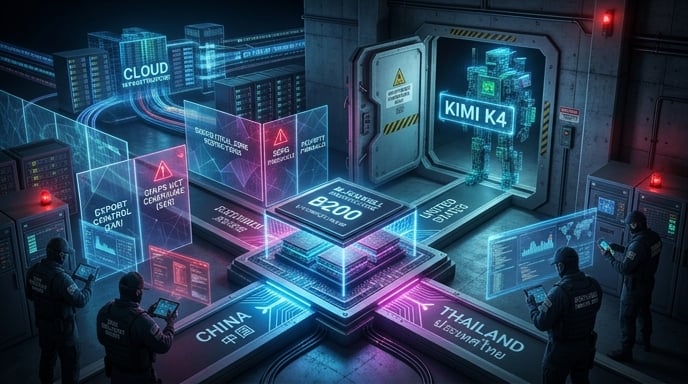
The immediate questions are straightforward, even if the answers may not be.
Will Moonshot officially announce Kimi K4? How much larger will it be? What processors will train it? Will the company release its weights? And will US investigators produce evidence concerning the alleged GB300 access?
Moonshot and Nvidia could clarify parts of the story by addressing the reports directly. Regulatory findings would also help separate suspected activity from documented violations.
Until then, caution remains essential.
The existence and specifications of Kimi K3 are confirmed. Moonshot’s interest in K4 and additional Blackwell capacity comes from attributed reporting. Claims involving Thailand, restricted hardware and distillation remain allegations or matters reportedly under investigation.
What is already clear, however, is that computing power has become a strategic resource. Moonshot wants to stay near the AI frontier. Nvidia’s Blackwell systems offer the horsepower to help it remain there. Washington wants to limit China’s access to that horsepower.
Those forces are now colliding around a model that Moonshot has not even formally unveiled.
K4 may still live on planning documents and engineering road maps. Yet it has already become a symbol of the next phase of the AI race: bigger ambitions, tighter restrictions and an increasingly blurry line between a cloud service and a geopolitical loophole.
The sequel has not arrived. The argument certainly has.
Sources
- Moonshot AI: Kimi K3—Open Frontier Intelligence
- Investing.com: Moonshot AI plans larger model despite US chip restrictions
- Reuters: As AI grows more powerful, a US-China feud threatens safety efforts
- Wccftech: Moonshot seeks additional Nvidia GPUs for Kimi K4
- Blockonomi: Moonshot AI pursues Blackwell GPUs for Kimi K4
- Michael Kratsios: Statement concerning Moonshot and GB300 access
- Techmeme: Aggregated coverage of the Moonshot and Kimi K4 report
The Kingy Brief
Get the next Kingy Brief.
Source-checked AI changes, original tests and one practical thing to try.
Free · Choose your subjects · Double opt-in · Unsubscribe anytime