
A Giant Check for a Company With Almost Nothing to Show
Nvidia has reportedly placed a $5 billion bet on an artificial intelligence startup that has no public chatbot, no app and no glossy product demo doing backflips on social media.
The company is Safe Superintelligence Inc., better known as SSI. It was founded by Ilya Sutskever, the former OpenAI chief scientist whose work helped shape modern deep learning. SSI has kept its research under tighter wraps than a magician’s final trick. Yet Nvidia, the dominant supplier of AI accelerators, apparently likes what it has seen behind the curtain.
On July 27, Nvidia and SSI announced a long-term strategic partnership. Nvidia confirmed that it had invested in the startup, while SSI secured access to Nvidia’s next-generation Vera Rubin computing systems.
The companies did not disclose a dollar figure. However, Reuters reported that Nvidia would make a $5 billion equity investment, citing a person briefed on the deal. Bloomberg initially reported the same amount.
That distinction matters. The partnership is official. The $5 billion figure is credibly reported, but it remains unofficial.
Still, even with that footnote attached, this is an enormous wager.
Why Ilya Sutskever Commands That Kind of Attention
The short explanation is that Sutskever is not merely another famous founder with a podcast microphone.
He co-founded OpenAI and served as its chief scientist. Before that, he worked with Geoffrey Hinton and Alex Krizhevsky on AlexNet, the neural network whose 2012 ImageNet performance helped ignite the modern deep-learning boom. His research also contributed to sequence-to-sequence learning and other techniques that underpin today’s AI systems.
At OpenAI, Sutskever played a central role in the research trajectory that produced the GPT family. Nvidia’s announcement also credited his leadership in work that eventually led to reasoning models such as OpenAI’s o1.
He left OpenAI in 2024 after the company’s turbulent leadership crisis involving CEO Sam Altman. Soon afterward, he formed SSI with Daniel Gross and former OpenAI researcher Daniel Levy. Gross later departed, and Sutskever became chief executive.
In most industries, a founder asking for billions without a product would receive a politely escorted tour of the lobby. In frontier AI, a scientist with Sutskever’s record can attract capital before outsiders see the machinery.
Nvidia’s investment suggests the machinery may be interesting indeed.
What Nvidia and SSI Actually Announced
Strip away the giant number for a moment and the operational deal looks just as significant.
SSI will gain access to Nvidia’s Vera Rubin platform, the chipmaker’s next-generation AI infrastructure. The companies say the arrangement will expand SSI’s available computing capacity by an order of magnitude—or roughly tenfold.
That is crucial because frontier AI research consumes staggering amounts of computing power. A brilliant new training method still needs chips, memory, networking, electricity and data-center capacity. Without those ingredients, a promising idea can remain trapped in a research notebook.
Nvidia said it received rare access to SSI’s closely guarded work before entering the partnership. SSI CEO Sutskever said the companies share a commitment to building advanced AI systems safely and described compute as essential to scaling the startup’s approach.
According to TechCrunch, a source familiar with the transaction characterized Nvidia’s investment as running into multiple billions. The publication also cited Bloomberg’s $5 billion figure.
So Nvidia is supplying three things every frontier lab craves: money, hardware and privileged access to the hardware roadmap.
That is considerably more useful than a ceremonial oversized check.
Vera Rubin Is Part of the Real Prize
The investment grabs the headline because $5 billion is a number capable of entering a room before everyone else. But SSI’s access to Vera Rubin may prove equally important.
Vera Rubin is Nvidia’s successor generation to its Blackwell architecture. It combines new GPUs, CPUs, networking and rack-scale systems designed to train and operate increasingly demanding AI models. For a research lab attempting a tenfold compute expansion, early access can compress years of infrastructure planning.
The partnership also gives SSI a closer relationship with the company that controls the most sought-after stack in frontier AI. That matters during periods when advanced chips remain scarce and every major lab wants priority.
SSI previously worked with Google Cloud and its tensor processing units. Nvidia’s deal does not automatically mean that relationship has ended. Modern AI labs often use multiple suppliers. It does, however, show that SSI is broadening and dramatically increasing its computing base.
Compute alone cannot guarantee a scientific breakthrough. If it could, every data center would be a Nobel laureate. But when a lab believes it has found a better research direction, more compute lets it test whether the idea scales.
That appears to be the experiment Nvidia is helping SSI run.
The Mysterious “New Research Direction”
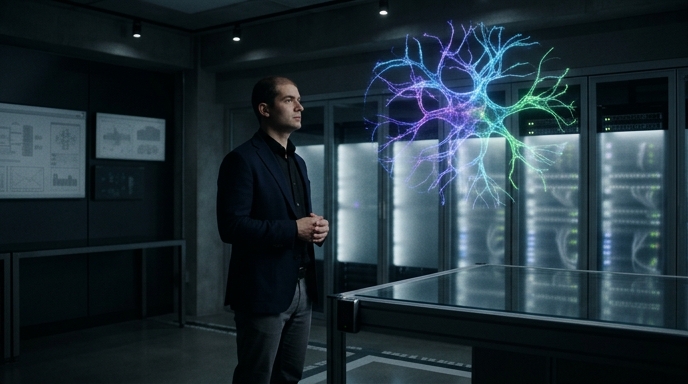
SSI has disclosed almost nothing about the technical approach it intends to scale. That secrecy fuels both excitement and skepticism.
The Financial Times reported that the startup believes it has achieved a research breakthrough and wants to scale it over the coming year. The publication said SSI’s approach differs from the conventional large-language-model path followed by OpenAI, Anthropic and Google.
Exactly how it differs remains unclear.
Perhaps SSI has developed a new training objective, architecture or method for improving reasoning. Perhaps it has found a way to integrate safety more deeply into capability development. Perhaps the breakthrough will look less dramatic once tested at scale. All three possibilities remain open.
Responsible reporting has to stop there. SSI has not released enough evidence for outsiders to judge the claim, and inventing technical details would turn news into fan fiction.
What we can say is that Nvidia saw private research substantial enough to justify a strategic relationship. That does not prove SSI has solved superintelligence. It does indicate that experienced technical and business leaders found the work worth a very expensive closer look.
From $5 Billion Valuation to a $5 Billion Check
SSI’s fundraising history shows how quickly elite AI laboratories can accumulate extraordinary value.
Only three months after its launch, the startup raised $1 billion. Reuters reported in September 2024 that the young company was valued at roughly $5 billion. Investors included Andreessen Horowitz, Sequoia Capital, DST Global and SV Angel.
In April 2025, SSI raised another $2 billion at a reported $32 billion valuation. The jump looked spectacular, especially because the company still had no publicly released product or revenue stream. Capital followed talent and the possibility of a foundational breakthrough.
Nvidia had already participated as an investor before the newly announced partnership, according to TechCrunch. The latest deal therefore deepens an existing relationship rather than creating one from scratch.
If the reported $5 billion is accurate, Nvidia’s new investment alone equals SSI’s entire reported valuation from its first major funding round. That is not normal venture-capital arithmetic. Then again, frontier AI stopped behaving normally several funding rounds ago.
The unresolved question is what valuation and ownership stake accompany Nvidia’s money. The companies have not disclosed those terms.
Why Nvidia Would Make This Bet
Nvidia’s immediate incentive is easy to understand. The company sells the infrastructure that AI developers need, so helping promising laboratories grow can create future demand for its systems.
Yet the strategy runs deeper than selling more GPUs.
By investing in frontier labs, Nvidia gains insight into the workloads that its next chips must handle. It can tune hardware, software and networking around emerging research demands. It also strengthens relationships with the scientists most likely to influence the next phase of AI development.
SSI offers something especially valuable: a possible alternative to the current scaling playbook. If Sutskever’s team has discovered a more powerful path, Nvidia wants its systems at the center of it.
There is also competitive pressure. AMD, Google and custom-chip developers are all trying to loosen Nvidia’s grip on AI computing. AI companies increasingly diversify their hardware to gain capacity and negotiating leverage. A deep partnership with SSI helps Nvidia keep a highly regarded lab inside its ecosystem.
In short, Nvidia is not simply choosing a startup. It is buying exposure to a potential new branch of the AI technology tree.
That branch may flourish. It may also stubbornly refuse to grow.
The Circular-Financing Question
The deal also feeds a growing criticism of the AI economy: chipmakers invest in AI companies, and those companies use vast amounts of capital to acquire computing systems from the same chipmakers.
The arrangement can resemble a very sophisticated financial roundabout.
That does not make it improper. Strategic investors have funded customers and ecosystem partners across the technology sector for decades. Nvidia can reasonably argue that supporting ambitious researchers expands the market for accelerated computing and advances AI science.
But scale changes the risk. When investments reach billions, analysts must ask whether demand reflects sustainable business activity or capital circulating among a tightly connected group of suppliers, laboratories and data-center operators.
SSI makes the debate sharper because it has no public commercial product. Nvidia is betting on research that may take years to generate revenue—assuming revenue is even the near-term goal.
The Financial Times reported that Nvidia’s commitment is milestone-based. If so, the structure may limit some risk by tying capital to progress. Neither company has publicly provided the detailed conditions.
The partnership can therefore be both strategically rational and financially audacious. Those ideas are not mutually exclusive.
Safety Is the Product, Not a Side Department
SSI’s pitch differs from the common model of releasing increasingly capable products while maintaining a separate safety team.
The startup says it will develop capabilities and safety together. Its organizational design supposedly insulates the mission from product cycles and short-term commercial pressures. There is no consumer chatbot demanding weekly features. There is no advertising business tapping its watch.
That sounds clean in theory. In practice, “safe superintelligence” remains an unsolved technical and governance challenge. Researchers disagree about what superintelligence would look like, how soon it might arrive and which methods could reliably control it.
SSI has not published enough for independent experts to evaluate whether its approach makes safety measurable, scalable or meaningfully different from competing alignment programs.
Nvidia’s involvement adds resources but also tension. More compute can accelerate safety research. It can also accelerate capabilities, potentially raising the stakes if safeguards lag. SSI insists that safety will remain ahead, but the public currently has to take that commitment largely on trust.
The company chose secrecy to protect focused research. The cost is limited external scrutiny.
A Bet on the Road Beyond Today’s AI

Nvidia’s partnership with SSI captures the strange economics of the current AI race. A two-year-old laboratory can command billions without releasing a product because investors are not valuing what it sells today. They are pricing the possibility that it has found a route beyond today’s models.
For Nvidia, the wager is elegantly positioned. If the next breakthrough requires enormous computing power, it wants to provide that power. If the breakthrough uses a new architecture, it wants early knowledge of the workload. If SSI succeeds commercially, Nvidia owns equity as well as supplying infrastructure.
For everyone else, patience and skepticism remain appropriate. The official record confirms an investment, a strategic partnership, Vera Rubin access and plans to multiply SSI’s compute tenfold. Credible reporting places the investment at $5 billion. The alleged research breakthrough remains private.
That makes this story genuinely important—but unfinished.
Nvidia has not purchased proof that safe superintelligence is around the corner. It has purchased a very expensive seat near the experiment. Now Sutskever and his team must show that behind the secrecy sits more than a brilliant résumé, a mountain of chips and one of the boldest promises in technology.
Sources
- Inc.: Nvidia just bet $5 billion on an AI startup most people have never heard of
- Nvidia Newsroom: SSI and Nvidia announce a long-term strategic partnership
- Safe Superintelligence Inc.: Official website and mission
- SSI: Official company updates
- Reuters: Nvidia to invest $5 billion in Ilya Sutskever’s startup
- TechCrunch: SSI partners with Nvidia to scale its AI research
- Financial Times: Nvidia bets $5 billion on Ilya Sutskever’s AI breakthrough
- Reuters: SSI raises $1 billion shortly after launching
- CTech: SSI raises $2 billion at a $32 billion valuation
The Kingy Brief
Get the next Kingy Brief.
Source-checked AI changes, original tests and one practical thing to try.
Free · Choose your subjects · Double opt-in · Unsubscribe anytime