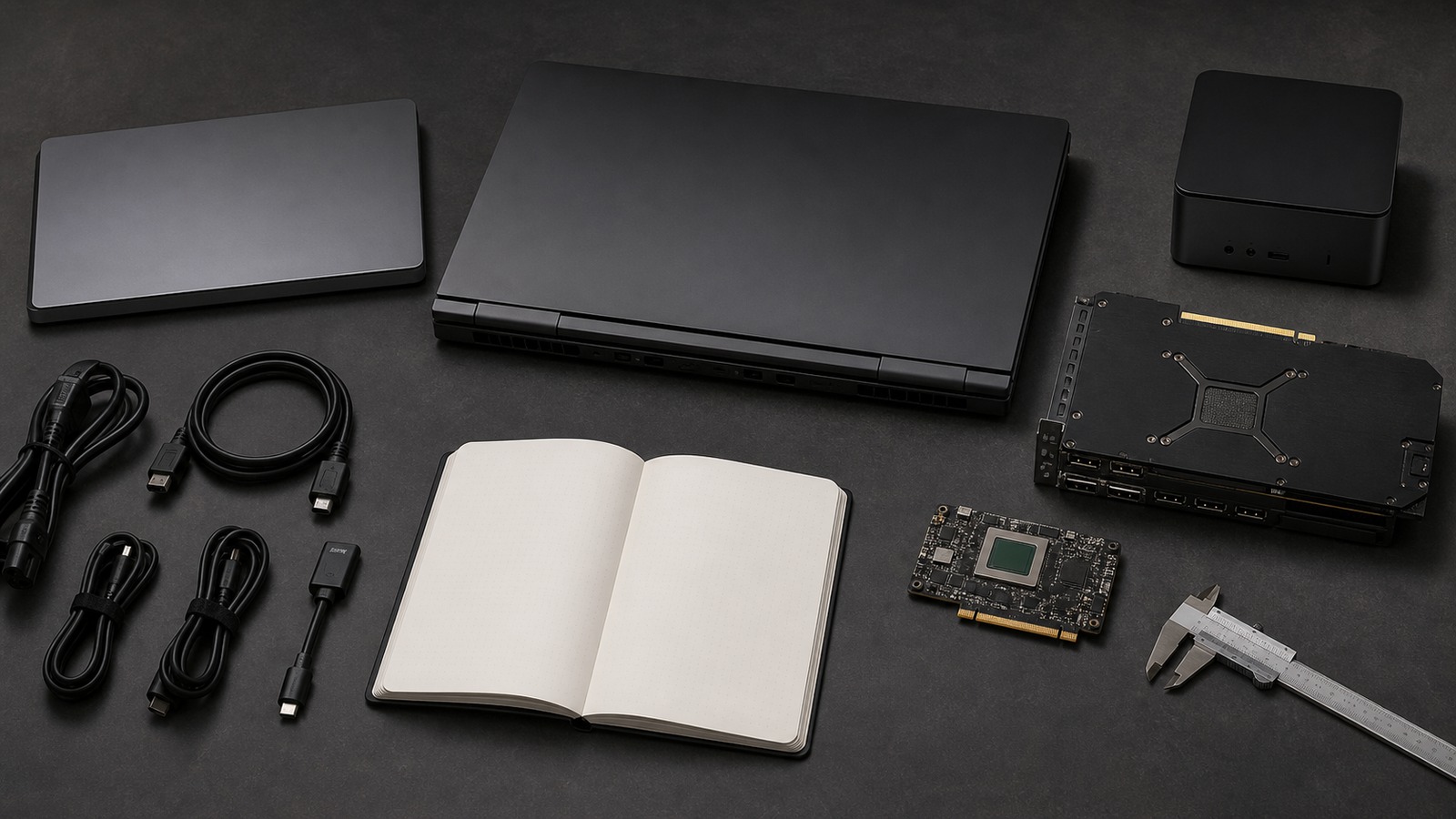
AI hardware comparisons
A comparison method for choosing local-AI hardware by workload, model, runtime, memory placement, and sustained operating constraints—not by badges or a single theoretical number.
Return to Kingy’s AI Hardware hub to connect these comparisons with compatibility checks, buying guidance, tested results, runtimes and current releases.
Start with the job, not the device category
“Which computer is better for AI?” is underspecified. Short private chat, a long-context coding session, image generation, transcription, background inference, model training, and a shared local service put different pressure on compute, memory, storage, cooling, and power.
A valid comparison keeps the software stack fixed. Name the exact model artifact, quantization or precision, context length, runtime version, backend, operating system, and concurrency before comparing hardware. Otherwise a faster result may simply reflect different settings.
The comparison sequence
- Define the workload. Record the task, required quality, acceptable latency, session length, concurrency, data path, and applications that must remain open.
- Lock the model and runtime. Use the same artifact, tokenizer, context, batch or parallel settings, runtime version, and execution backend on every candidate.
- Map memory. Separate model weights, runtime allocations, context or KV cache, system RAM, dedicated VRAM, unified memory, and any CPU/GPU split.
- Confirm actual execution. Verify whether the workload ran on the CPU, GPU, NPU, or a split path. A device label does not prove the selected backend was used.
- Measure the full session. Record warm-up, latency, throughput, power mode, temperature or throttling, and responsiveness over a representative duration—not only the first prompt.
- Include ownership constraints. Compare portability, noise, ports, storage, repairability, upgradeability, driver and runtime support, and the cost of changing the system later.
Do not collapse these results into one score
Compatibility
Can the exact model and required operators run through the intended runtime and backend on this operating system?
Capacity
Can weights, context cache, runtime overhead, the operating system, and other applications coexist without harmful swapping or forced offload?
Latency
How long does the user wait for the first useful output under the intended settings?
Throughput
How much work completes per unit of time, especially with batching or concurrent requests?
Sustained behavior
Does performance, noise, or responsiveness change after heat and power limits settle?
Efficiency and portability
How much energy, battery, desk space, weight, and setup complexity does the useful result require?
Evidence hierarchy
| Evidence | What it can establish | What it cannot establish alone |
|---|---|---|
| Official runtime and backend documentation | Supported operating systems, model formats, execution providers, commands, and documented limits. | Performance for an untested device, model, or configuration. |
| Official device specification | Installed processor, accelerator, memory, storage, ports, power adapter, dimensions, and supported upgrade paths. | That a particular model uses the advertised accelerator. |
| Runtime estimator or placement report | Expected memory for a chosen configuration or where a loaded model actually resides. | Output quality, sustained thermals, or suitability for another workload. |
| Reproducible workload measurement | Latency, throughput, memory, power, and sustained behavior for the recorded stack. | A universal winner after the model, context, runtime, or power mode changes. |
| Marketing TOPS, FLOPS, or “AI” badge | A vendor-defined theoretical capability or product category. | Cross-architecture performance, operator coverage, memory capacity, or software compatibility. |
Comparison guides
AI Laptop vs Gaming Laptop for Local AI
Compare NPU availability, discrete GPU capacity, cooling, battery behavior, portability, and runtime support.
AI Mini PC vs Gaming Laptop for Local AI
Evaluate compact desktops and mobile gaming systems through memory placement, sustained power, ports, and upgradeability.
Mac vs Windows AI PC for Local AI
Match Apple unified memory and Metal/MLX support against Windows execution providers, device choice, and application requirements.
GPU vs NPU for AI
Separate architecture, supported operators, model formats, memory access, fallback, and actual accelerator use.
AI Laptop vs AI Mini PC for Local AI
Compare exact configurations through accelerator support, memory placement, mobility, ports, sustained operation, and serviceability.
Apple Silicon vs NVIDIA GPU for Local AI
Evaluate unified memory and dedicated VRAM alongside MLX, Metal, CUDA, runtime support, model placement, and sustained workloads.
Jetson vs Raspberry Pi AI Kit
Distinguish exact modules, developer kits, Pi boards, Hailo accelerators, software releases, power, cooling, I/O, and deployment paths.
Local AI vs Cloud AI Hardware
Compare the data path, latency, capacity, availability, operations, security responsibilities, and dated cost inputs.
How these comparisons stay maintainable
Recheck the current software path
Runtime, driver, operating-system, and execution-provider support changes. A comparison should name the version and review date rather than presenting support as permanent.
Separate specifications from observations
Specifications are cited to the manufacturer. Measurements must describe the exact hardware, software stack, settings, power mode, and duration. Neither is silently substituted for the other.
Retire volatile claims
Street prices, preview features, product availability, and “best” rankings age quickly. They are omitted unless a dated decision genuinely requires them and a current primary source supports them.
Prepare a compatibility check first
Before comparing form factors, use the Local AI Compatibility Guide to record the exact model, runtime, memory requirements, and intended backend. Its RAM and VRAM guides explain why a model-file size is not the whole memory budget.