Which one for your job?
| Your job | Start with | Why |
|---|---|---|
| Routine coding, drafts, documents, repeated tasks you can check | Sonnet at High or lower | Half the token price, and no Opus setting beat it on both score and cost at these settings in the charts below. |
| Messy debugging, multi-repository changes, conflicting evidence | Opus at Medium or High | Opus scored higher at each model’s default setting in all four benchmarks, for 1.1 to 1.9 times the cost. |
| Work where an error is costly and hard to spot | Opus, plus your own check | In our small quote test, Opus got the totals right in both runs and Sonnet did not. Neither model replaces a check. |
| You have raised Sonnet to Xhigh or Max and it still falls short | Opus at High | This often gets a similar score for less money. Terminal-style agent work is the exception, where Sonnet at Max scored highest. |
| You are on the Free plan | Sonnet | Opus is not included on Free. |
The price gap shrinks once you count effort
Opus costs twice as much per token. But effort changes how many tokens a task uses, so the token price alone doesn’t tell you the cost of finished work. On the Claude API, Sonnet defaults to High effort and Opus defaults to Medium. Here’s how those defaults compare in Anthropic’s launch charts:
| Benchmark | Sonnet 5.5 at High | Opus 5.5 at Medium | Opus cost vs Sonnet |
|---|---|---|---|
| Terminal-Bench 4.0 | 43.0% at $1.94 | 57.6% at $2.94 | 1.5× |
| FrontierCode 1.1 Main | 49.4% at $0.42 | 54.6% at $0.80 | 1.9× |
| CursorBench 4.0 | 47.8% at $1.67 | 52.5% at $2.91 | 1.7× |
| AA-Briefcase v1.1 | 1634 Elo at $3.95 | 1642 Elo at $4.40 | 1.1× |
Every effort setting, side by side
Each dot is one effort setting, from Low on the left to Max on the right. Up and to the left is better: a higher score for less money. Ringed dots are the API defaults. Each step on the cost axis is a multiple, not a fixed amount. Hover over a dot on a computer to see its exact values.
- Low to High: no Opus setting beat Sonnet on both score and cost. If budget comes first, this is Sonnet’s range.
- Xhigh: an Opus setting beat Sonnet on both score and cost in two of four benchmarks. On CursorBench, Opus at High scored 2.9 points higher for $0.09 more.
- Max: Opus beat Sonnet on both score and cost in three of four. The exception was Terminal-Bench, where Sonnet at Max scored the highest of any setting, 70.6%.
- More effort isn’t always better: on FrontierCode, Sonnet at Max scored lower than at Xhigh and cost about 13 times as much. Anthropic says extra review steps caused timeouts or out-of-scope edits in two cases.
See every number in a table
| Benchmark | Effort | Sonnet score | Sonnet cost | Opus score | Opus cost |
|---|---|---|---|---|---|
| Terminal-Bench 4.0 | Low | 20.0% | $0.76 | 38.5% | $1.29 |
| Terminal-Bench 4.0 | Medium | 28.8% | $0.83 | 57.6% | $2.94 |
| Terminal-Bench 4.0 | High | 43.0% | $1.94 | 64.2% | $3.88 |
| Terminal-Bench 4.0 | Xhigh | 61.5% | $5.30 | 66.4% | $7.35 |
| Terminal-Bench 4.0 | Max | 70.6% | $12.54 | 64.8% | $11.24 |
| FrontierCode 1.1 Main | Low | 29.3% | $0.19 | 47.3% | $0.40 |
| FrontierCode 1.1 Main | Medium | 36.5% | $0.24 | 54.6% | $0.80 |
| FrontierCode 1.1 Main | High | 49.4% | $0.42 | 54.0% | $1.09 |
| FrontierCode 1.1 Main | Xhigh | 52.1% | $1.59 | 51.4% | $2.25 |
| FrontierCode 1.1 Main | Max | 46.2% | $20.78 | 54.4% | $6.19 |
| CursorBench 4.0 | Low | 35.8% | $0.50 | 43.7% | $1.17 |
| CursorBench 4.0 | Medium | 39.2% | $0.70 | 52.5% | $2.91 |
| CursorBench 4.0 | High | 47.8% | $1.67 | 56.0% | $3.97 |
| CursorBench 4.0 | Xhigh | 53.1% | $3.88 | 56.0% | $6.98 |
| CursorBench 4.0 | Max | 55.5% | $9.67 | 57.8% | $13.43 |
| AA-Briefcase v1.1 | Low | 1264 Elo | $0.87 | 1285 Elo | $1.15 |
| AA-Briefcase v1.1 | Medium | 1461 Elo | $1.64 | 1642 Elo | $4.40 |
| AA-Briefcase v1.1 | High | 1634 Elo | $3.95 | 1705 Elo | $6.27 |
| AA-Briefcase v1.1 | Xhigh | 1746 Elo | $9.63 | 1780 Elo | $12.27 |
| AA-Briefcase v1.1 | Max | 1811 Elo | $29.19 | 1822 Elo | $21.05 |
What outside testers found
Two independent evaluators tested both models at Max effort, and they don’t agree. That’s why you should test your own work before committing.
| Evaluator | Sonnet 5.5 | Opus 5.5 | What it suggests |
|---|---|---|---|
| Artificial Analysis Intelligence Index v5.0 | 54, $10.02 per task | 58, $10.04 per task | Opus scores higher for about the same cost. Sonnet used 340M output tokens against Opus’s 220M. |
| Vals Index v2.2 | 70.85% ±0.93, $18.70 per test | 70.18% ±1.00, $28.12 per test | The scores are too close to separate, and Sonnet costs about a third less. |
Where this differs from Anthropic’s advice
Anthropic’s guide says “Most workloads start with Claude Opus 5.5.” It lists Sonnet for everyday coding, agent and enterprise work where speed matters. We agree when work is hard to check. We’d start on Sonnet when you have a clear pass or fail test, because a wrong answer then costs you only a retry.
What we tested ourselves
On October 19, 2026, we gave both models the same made-up supplier decision in the Claude web app, at Medium effort, in fresh chats, twice each. The right choice was supplier B at $868. Supplier A came to $904, over the $900 budget.
| Check | Sonnet 5.5 | Opus 5.5 |
|---|---|---|
| Supplier A total ($904) | $880, then $912: wrong both times | $904 both times: correct |
| Supplier B total and final choice | $868 and B: correct both times | $868 and B: correct both times |
| Left the euro quote unknown | Yes, both times | Yes, both times |
| Returned plain JSON as told | Yes, both times | No: added Markdown fences both times |
Sonnet picked the right supplier while getting another total wrong, so checking only the final answer would have missed the mistake. This is four runs of one small task. It doesn’t tell you general accuracy, speed, API cost or coding quality, and we haven’t run a matched coding test of these two models.
Test them on your own work
The kit has our exact prompt, the answer key, our October 19 outputs and an optional scorer.
- Pick one real task and write down what counts as a pass before you start.
- Run it at least twice on each model, in fresh chats, at the same effort you plan to use.
- Count every attempt, including the ones you throw away, and note how long fixes took.
- Divide total cost by accepted results. That number beats any token price.
Show the exact prompt
Do not use tools, files, browsing, or external information. Return the requested JSON only.

You are checking synthetic supplier quotes for a four-seat team buying 12 months of service. Use only these rows. Q1: A costs USD18 per seat per month, paid monthly, plus a one-time USD40 setup fee. Q2: B costs USD16 per seat per month, billed for all 12 months upfront, plus a one-time USD100 setup fee. Q3: C costs EUR15 per seat per month, no setup fee; no EUR/USD exchange rate is supplied. Ignore tax for every quote. Total first-year budget is USD900; upfront cash is not separately constrained. Return only a JSON object with eligible_totals_usd (object keyed A and B), recommendation (supplier letter), excluded (object keyed by supplier with the missing information), and source_rows (object mapping A/B/C to the source row IDs). Calculate first-year totals, recommend the cheapest qualifying USD quote, and do not invent currency conversion.
Price and specs
| Detail | Sonnet 5.5 | Opus 5.5 |
|---|---|---|
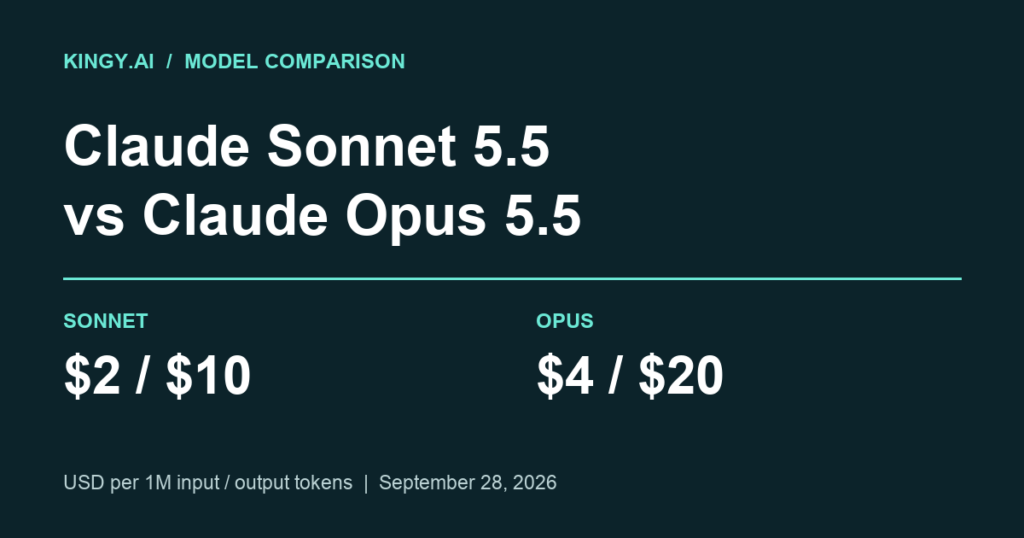
| Input / output, per million tokens | $2 / $10 | $4 / $20 |
| Cache read / 5-minute write / 1-hour write, per million | $0.10 / $2.50 / $4 | $0.20 / $5 / $8 |
| Batch input / output, per million | $1 / $5 | $2 / $10 |
| Default effort on the API | High | Medium |
| Thinking | Adaptive | Adaptive, always on |
| Speed label from Anthropic | Fast | Moderate |
| Context / maximum output | 1M / 128K tokens | 1M / 128K tokens |
| Reliable knowledge cutoff | June 2026 | June 2026 |
| API model ID | claude-sonnet-5-5 |
claude-opus-5-5 |
| Earliest retirement on the Claude API | September 28, 2027 | September 22, 2027 |
A request with 100,000 fresh input tokens and 20,000 output tokens costs $0.40 on Sonnet or $0.80 on Opus. If the two used the same tokens, Sonnet would hit Opus’s cost at two attempts per accepted result. Opus Fast mode costs $8 / $40 per million tokens. Estimate your own workload.
Which plans include which model
| Plan | List price (US) | Sonnet | Opus |
|---|---|---|---|
| Free | $0 | Yes | No |
| Pro | $20 a month, or $17 a month billed annually | Yes | Yes |
| Max | From $100 a month | Yes | Yes |
| Team | From $20 per seat a month, billed annually | Yes | Yes |
Still unknown: Anthropic doesn’t publish how much faster Opus uses a subscription’s limits than Sonnet, only that usage depends on the model and feature. Check Settings > Usage in Claude. See our plan limits tracker.
Before you switch an API app
Changing the model ID isn’t enough. Both models have breaking changes around thinking settings, forced tool use and computer-use tools. Read the Sonnet 5.5 and Opus 5.5 migration guides and run your tests first.
Version history
| Date | What changed in this comparison |
|---|---|
| September 28, 2026 | Sonnet 5.5 launched, six days after Opus 5.5 (September 22). This is the pairing covered above. |
When a new Sonnet or Opus ships, we update this page and keep the old pairing’s key numbers here, clearly dated.
Sources, method and updates
Sources, all read November 1, 2026: Anthropic’s models overview, API pricing, model guide, Sonnet 5.5 launch page and plan pricing; Artificial Analysis on Sonnet and Opus; Vals on Sonnet and Opus.
Method: “Beat on score and cost” means the other setting scored at least as high and cost no more in the same benchmark. Prices are global Standard USD rates on the Claude API. These benchmarks don’t measure your workload.
November 1, 2026: Moved to this version-free address and rebuilt around effort settings. The first-hand test and its outputs are unchanged, and no new model test was run. The earlier address was /blog/claude-sonnet-5-5-vs-opus-5-5/, first published September 28, 2026.
The Kingy Brief
Get the free AI price sheet.
26 AI plans and models on one page, from official pricing pages, updated every month. Free when you join The Kingy Brief: AI changes, original tests and one practical thing to try, Fridays at 09:00 Vancouver time.
Free · Double opt-in · Unsubscribe anytime
Sign up for The Kingy Brief on Beehiiv.
Signup help and newsletter schedule
Signup form provided by Beehiiv. After submitting, check your inbox for "Confirm your subscription to The Kingy Brief" and open its confirmation link. Your price sheet download is on the page that opens. Check Spam or Promotions if you cannot find it.
Fridays at 09:00 Vancouver time: source-checked AI changes, original tests and one practical thing to try. We skip a week when there is not enough verified material. Free. Unsubscribe anytime.