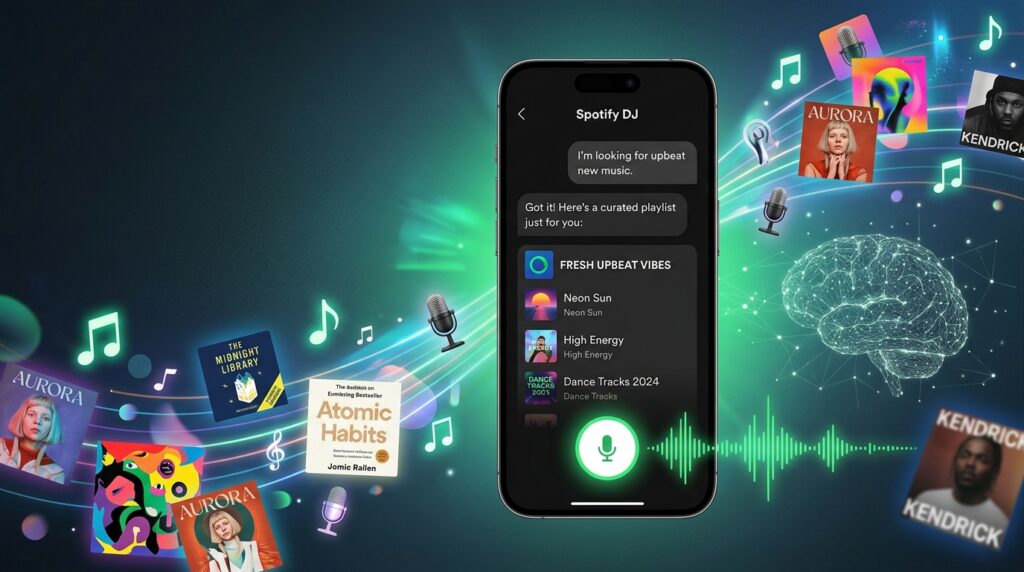
Your Streaming App Just Became a Conversation Partner
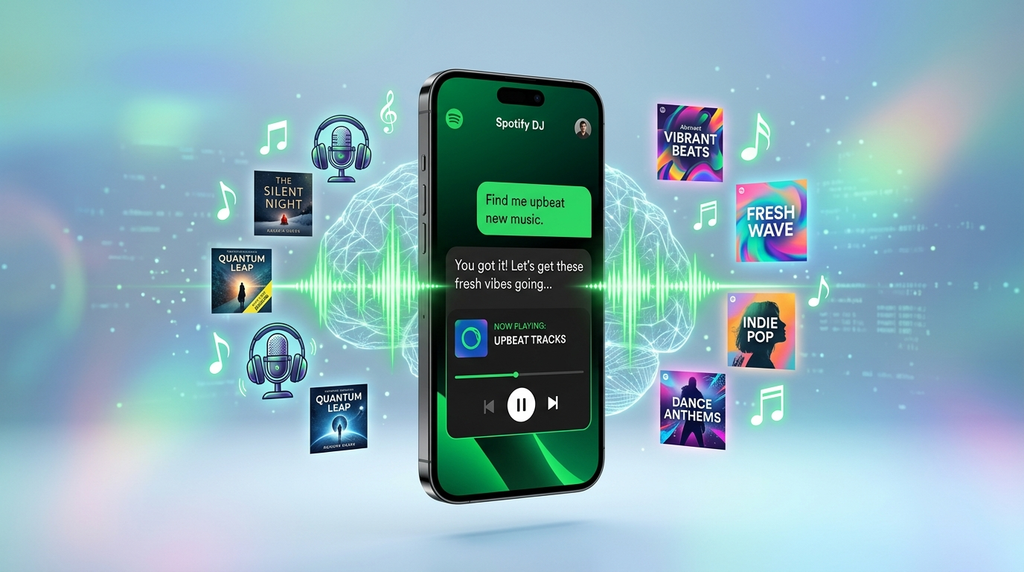
Spotify already knows what you play while working, exercising, driving, cooking, or staring dramatically through a rain-covered window. Now, it wants you to ask what all that listening says about you.
The company is rolling out “Talk to Spotify,” a conversational feature that lets listeners control and explore audio through spoken or typed requests. Instead of hunting through menus or repeatedly rewriting a search, eligible users can have an ongoing exchange with the app.
You might begin with a broad request such as “Play some artists I haven’t heard before.” If the results feel sleepy, you can ask Spotify to make the selection more upbeat. Then you can add an artist, request newer releases, save a song, rearrange the queue, or follow someone you have just discovered.
That progression matters. Traditional search treats every request like a fresh visit to the information desk. Talk to Spotify tries to retain the thread.
The result resembles a chatbot, although its job is refreshingly specific. It will not write your resignation letter or explain quantum mechanics over breakfast. It wants to find something good to play and perhaps reveal that your “brief indie phase” has lasted eleven years.
What Talk to Spotify Actually Does
Talk to Spotify appears within the Home and Now Playing areas of Spotify’s mobile app. Users can enter a message in a text box or tap the microphone and speak.
From there, the feature handles three broad jobs.
First, it can control listening. It can start music, modify the current selection, save tracks, add songs to the queue, and follow artists.
Second, it can answer questions about the material currently playing. A listener could ask when an album arrived, what genre a song belongs to, or what inspired a particular project. During a podcast, the user might ask where else a guest has appeared. During an audiobook, the user could request other titles by the same author.
Third, it can discuss the listener’s own activity. Spotify says the assistant can draw upon playlists, favorite artists, repeat plays, and listening history when answering personal questions.
That could make it useful for prompts such as “When did I first play this song?” or “What genres have I listened to recently?”
It is not merely a voice-operated play button. Spotify is attempting to combine playback control, discovery, contextual information, and personal history inside one conversational interface.
The Rollout Starts Small
Before anyone begins shouting song requests at a phone and wondering why nothing happens, there are several restrictions.
Talk to Spotify is launching gradually as a beta. It is initially available to Premium subscribers aged 18 or older in the United States, Ireland, and Sweden. The experience works in English across Spotify’s iOS and Android apps.
That excludes free-tier listeners, desktop users, younger subscribers, other languages, and most markets at least during the opening phase.
Spotify has not published a timetable for wider availability. It also warns that responses will not always be correct. That familiar beta disclaimer matters because this assistant can answer factual questions, not simply select tracks.
A poor recommendation may be mildly annoying. A confidently incorrect explanation of an album’s history is a different issue.
The limited debut gives Spotify a manageable testing group while it gathers feedback. It can observe which requests people actually make, where conversations break down, and whether users consider the tool more convenient than ordinary browsing.
In other words, this is a public experiment, not the finished form of Spotify’s conversational future.
Search Becomes a Back-and-Forth Exchange
Music searches often begin with an idea that is difficult to translate into keywords.
You may want energetic electronic music that is not too aggressive, works for an afternoon drive, includes unfamiliar artists, and avoids songs you played to death last month. A normal search bar does not love that sentence. A conversational system might.
Talk to Spotify allows listeners to start loosely and refine the result. Spotify’s demonstration begins with a request for unfamiliar artists. The listener then adds Bad Bunny, limits the selection to his recent material, and makes the overall mix more upbeat.
Each instruction builds upon the previous one. You do not need to restate the entire musical equation every time.
That sounds simple, but it changes the interaction. Search traditionally asks the listener to identify the correct artist, album, track, playlist, or genre. Conversation lets the listener describe an intention even if that intention remains slightly fuzzy.
The assistant then translates that language into playable choices.
If it works reliably, the hardest part of discovering music may no longer be knowing what to type. You can begin with a mood, an activity, or a half-formed thought and improve the soundtrack as it plays.
Spotify’s Biggest Advantage Is Context
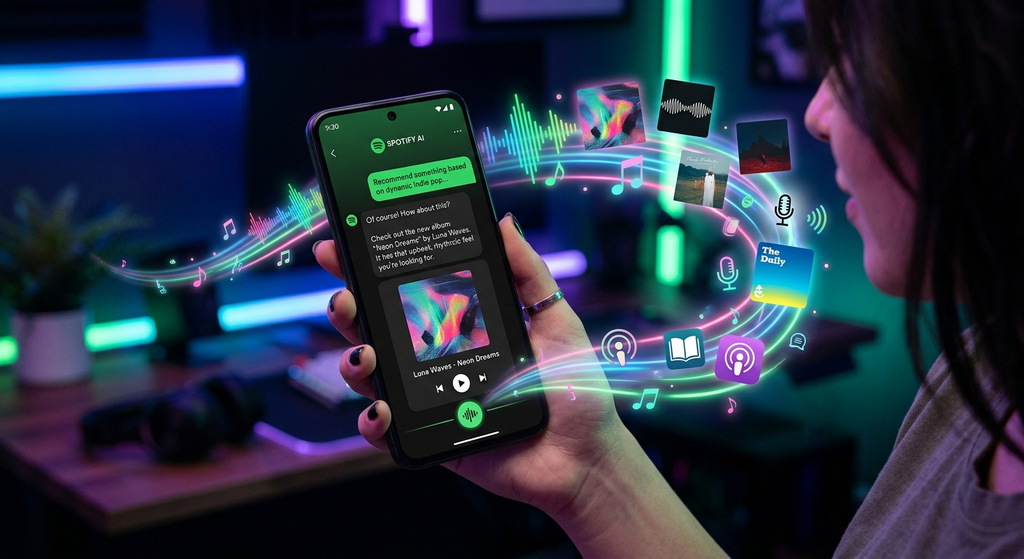
General-purpose chatbots can recommend music. They can list influential albums, suggest artists within a genre, and produce playlists in text form. What they usually lack is a complete view of your actual Spotify behavior.
Talk to Spotify operates closer to the listening data.
The company says it can use information including your playlists, favorite artists, repeat listens, and listening history. That allows it to answer questions and make suggestions around the person holding the phone, rather than around an imaginary average listener.
Context could make a vague prompt surprisingly effective. “Play something by one of my favorite artists” means very little to an assistant that does not know your favorites. Spotify already has the missing half of that sentence.
The same applies to discovery. “Give me artists I haven’t heard before” requires the system to understand what you have heard. A generic chatbot can guess. Spotify can compare the request with account activity.
That is the feature’s real competitive edge. The conversational interface is not particularly novel by itself. The valuable ingredient is the history behind it.
Of course, that advantage also raises questions about transparency and user comfort. A knowledgeable assistant feels magical until it remembers something you had forgotten and suddenly the magic has a tiny surveillance moustache.
Your Listening History Becomes Searchable
Spotify Wrapped turns listening history into an annual spectacle. Talk to Spotify could make portions of that history accessible throughout the year.
Users can ask when they first heard a particular song or which genres have dominated their recent listening. That moves personal analytics away from static cards and toward questions asked in ordinary language.
The appeal is easy to understand. Listening history contains memories.
A song may be connected to a holiday, a relationship, a job, a difficult month, or one heroic week in which you somehow believed sea shanties would become your permanent personality. Finding the first play date could help place that soundtrack on a personal timeline.
The assistant may also expose patterns that listeners never consciously noticed. Perhaps your weekday music differs sharply from your weekend choices. Maybe an artist you consider a favorite has quietly disappeared from rotation.
Spotify has not promised a full analytical dashboard or unlimited access to every historical data point. Users should therefore avoid assuming that the chatbot can retrieve anything imaginable.
Still, conversational access turns listening data into something more than fuel for recommendations. It becomes material that listeners can explore directly.
Now Playing Gets a Curious Sidekick
Talk to Spotify also attempts to keep listeners inside the app when curiosity strikes.
Suppose a song comes on and you want to know when its album was released. Normally, you might open a browser, search for the record, skim several results, and then return to Spotify possibly after wandering into an online argument about whether the artist’s third album was unfairly misunderstood.
The new assistant can answer from the Now Playing screen.
Spotify suggests questions about musical inspiration, album dates, genres, related artists, and creative context. The same system extends to spoken-word material. An audiobook listener can ask what else the author has written. A podcast listener can ask where else a guest has appeared.
This turns the player into an exploration layer rather than a collection of transport controls.
It could be particularly useful on mobile devices, where switching between several apps feels more disruptive than it does on a desktop. The assistant keeps playback, background information, and follow-up discovery in one place.
Accuracy remains the catch. Spotify openly acknowledges that the beta will make mistakes. Curious listeners may still need to verify important details, especially when the answer involves obscure credits, ambiguous titles, or complicated release histories.
This Is More Than AI DJ With a Chat Box
Spotify has already introduced several AI-flavored listening tools. AI DJ provides a personalized stream with spoken commentary. Prompt-based playlist features transform descriptions into collections of songs. Spotify can also connect with outside assistants, including ChatGPT.
Talk to Spotify pulls those ideas toward a shared interface.
AI DJ generally leads the session. It selects material and presents it in a radio-like format. A prompted playlist converts one instruction into a set of tracks. Talk to Spotify instead encourages repeated interaction across the app.
That distinction gives the listener more control. If the first output misses, the user can correct the direction without beginning again.
The feature also moves beyond music selection. It handles questions, playback actions, personal history, podcasts, and audiobooks. Spotify is effectively creating a conversational control layer over several parts of its service.
Calling it “ChatGPT for Spotify” captures the visual idea, but the comparison only goes so far. Talk to Spotify has a narrower mission and privileged access to Spotify-specific context.
It does not need to know everything. It needs to know your audio habits, understand a request, find relevant material, and avoid turning a workout playlist into three hours of medieval lute music. A modest brief, really.
Several Models May Be Working Behind the Curtain
Spotify did not identify one foundation model powering the feature. However, the company confirmed to TechCrunch that Talk to Spotify uses a combination of its own AI technology and models from multiple providers, selecting what best suits a particular task.
That suggests the assistant may function as a coordinated system rather than a single all-purpose chatbot.
One component could interpret a spoken request. Another could manage conversational context. Spotify’s recommendation technology could rank tracks, while other systems retrieve catalog information or perform account actions.
The model arrangement also explains why evaluating the product may prove complicated. A failure could come from speech recognition, language interpretation, recommendation quality, factual retrieval, or the mechanism executing an instruction.
If the assistant correctly understands “more upbeat” but chooses terrible songs, the conversational layer worked while the recommendation layer stumbled. Users will not care which subsystem deserves the blame. They will simply hear the bad playlist.
Spotify’s decision to use multiple technologies gives it flexibility, but it also creates an orchestration challenge. The individual pieces must produce one coherent experience, preferably without the digital equivalent of band members playing in different keys.
The Interface Could Change How People Discover Audio
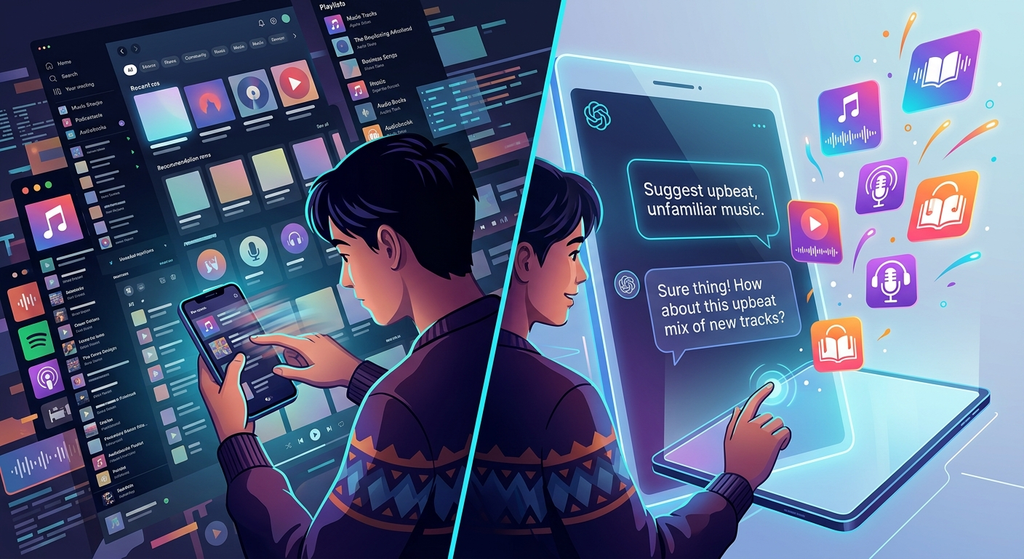
Streaming services have trained listeners to browse rows of recommendations, curated collections, charts, covers, and algorithmically generated mixes. Talk to Spotify introduces a different doorway: asking.
That doorway could benefit listeners who struggle with crowded interfaces. Rather than scrolling through an endless Home feed, they can state what they want.
It may also help users escape overly familiar recommendations. Algorithms often become excellent at serving safe variations of yesterday’s choices. A conversational prompt can explicitly demand novelty, impose constraints, or redirect the mood.
Yet conversation introduces its own friction. Speaking to an app in public can feel awkward. Typing a detailed prompt may take longer than tapping a known playlist. Some listeners simply want to press play and disappear into the music.
Spotify appears to recognize this. The company says people can use the microphone, type, or continue listening as they always have.
The chatbot therefore supplements the existing interface rather than replacing it at least for now.
Its long-term importance will depend on habit. If users begin asking for audio as naturally as they ask a smart speaker for the weather, conversation could become a primary discovery method. If not, it may remain a clever extra parked beside the play button.
Personalization Brings a Privacy Conversation
A system that can discuss repeat listens and first-play dates must draw on personal account activity. That is precisely what makes Talk to Spotify potentially useful. It is also what may make some listeners cautious.
Spotify’s announcement explains which kinds of listening context can inform responses, but it does not present the feature as a new privacy dashboard. Nor does the announcement fully detail matters such as conversation retention, provider-specific data handling, or how individual prompts may contribute to product improvement.
That does not prove anything improper. It simply means users should distinguish confirmed functionality from unanswered implementation questions.
The beta’s 18-and-over limitation may reflect a deliberately cautious launch, although Spotify has not publicly attributed the age restriction to one specific reason.
People who receive access should review the information shown inside the app and Spotify’s privacy controls before sharing anything beyond ordinary listening requests. The sensible rule is the same one that applies to other connected assistants: do not treat a convenient text box like a locked diary.
Personalization always involves a trade. More context can produce better answers. More context also deserves clearer explanation.
Spotify will need to communicate that balance well if it wants the assistant to feel helpful rather than nosy.
The Beta Label Is Doing Important Work
Spotify says responses will not always be perfect. That warning should not be treated as decorative legal parsley.
Conversational AI can misinterpret vague language, lose context, state inaccurate facts, or execute the wrong version of an instruction. Music carries additional ambiguity because artists, songs, albums, and podcasts frequently share similar names.
A request to “play the original version” may require knowledge of remasters, covers, rerecordings, regional editions, and release chronology. “Play something newer” could mean a recent release, a song unfamiliar to the user, or merely the next track in a sequence.
Follow-up conversation can solve some ambiguity. It can also compound an early misunderstanding.
The safest initial uses will probably involve low-stakes actions: changing the mood, adding an artist, saving a song, or exploring unfamiliar material. Users should treat historical or biographical answers as helpful starting points, especially when the topic is niche.
The beta phase gives Spotify time to measure these weak spots. Feedback can show whether users prefer clarification questions or decisive action, how much explanation they want, and when the assistant should admit uncertainty.
A good music assistant should know when to play. A great one should also know when to ask, “Did you mean the album or the song?”
Artists and Creators Face a New Gatekeeper
Conversational discovery could also affect musicians, podcasters, authors, and other creators whose work lives inside Spotify’s catalog.
Today, creators compete for space in playlists, recommendations, search results, editorial collections, and social sharing. A chatbot adds another layer between the audience and the catalog.
If a listener asks for “new dreamy pop from an independent artist” or “a funny technology podcast under 30 minutes,” the assistant must decide which candidates best match. Those decisions could direct meaningful attention toward some creators while leaving others invisible.
Spotify has not announced a special ranking system for conversational results. It is therefore too early to claim that Talk to Spotify will dramatically reshape discovery or promotion.
However, the questions will become important if the feature attracts widespread use. Creators and labels may want to know which metadata influences inclusion, whether popularity overwhelms relevance, how sponsored material would be identified, and whether users can understand why something was recommended.
Conversational interfaces can feel neutral because they return one smooth answer. Underneath that answer sits a stack of ranking choices.
For listeners, the experience may feel like chatting with a knowledgeable friend. For creators, that “friend” may become a powerful new tastemaker whose reasoning remains largely backstage.
Spotify Is Joining a Larger Interface Race
Spotify is not alone in turning entertainment search into conversation. Amazon Music has integrated Alexa Plus capabilities, while general assistants increasingly help users find and control media.
The broader shift is straightforward. Apps have spent years adding tabs, filters, recommendation rows, icons, and menus. AI offers a tempting alternative: let users describe the outcome and allow the software to navigate the complexity.
For Spotify, this strategy has particular appeal. Its catalog spans songs, albums, playlists, podcasts, and audiobooks. A conversational layer can provide one entrance to all of them.
It can also make Spotify’s accumulated knowledge of an individual listener harder for competitors to replicate. Catalogs overlap. Interfaces can be copied. Years of listening behavior are much less portable.
That gives Talk to Spotify strategic importance beyond its visible chat box. The assistant could strengthen the relationship between Spotify and its paying customers by making the service feel increasingly tailored to each account.
Still, novelty will not carry it forever. The assistant must respond quickly, interpret ordinary speech, make genuinely good selections, and recover gracefully when it misunderstands.
Nobody wants to debate an algorithm for six turns just to hear Fleetwood Mac.
A Small Beta With a Much Bigger Ambition
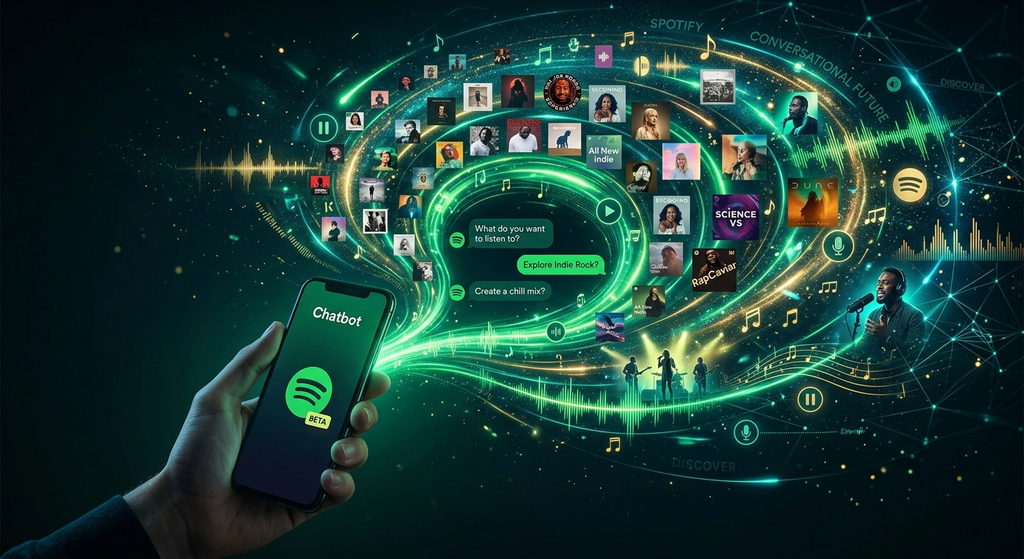
Talk to Spotify begins as a restricted experiment, but its direction is clear. Spotify wants listeners to move from operating the app to expressing intent.
The service already predicts what people may enjoy. Now it wants them to explain what they want, revise the answer, investigate what is playing, and examine their own musical history without breaking the flow.
If the feature succeeds, playlist creation may become less like filing tracks into folders and more like directing a very fast, remarkably well-informed DJ. Podcast and audiobook discovery could follow the same path.
The unanswered questions matter. Spotify must improve accuracy, explain data handling, show how recommendations work, and demonstrate that conversation offers more than a fashionable coat of AI paint.
For now, eligible Premium subscribers can test the proposition themselves. They can speak, type, refine, save, queue, explore, and occasionally correct the machine.
Spotify has spent years learning what you play. With Talk to Spotify, it is finally talking back.
Let us hope it has tact when asked about that one song you streamed 97 times after midnight.
Sources
- Spotify Newsroom — Just Say the Word: A More Personal Way to Ask, Discover, and Listen
- Thurrott — Spotify Is Copying AI Chatbots With New “Talk to Spotify” Feature
- TechCrunch — Spotify Expands Its AI Push With a ChatGPT-Like Music Assistant
- MLXIO — Spotify Premium AI Chatbot
- Windows Report — Spotify’s New AI Feature Lets You Talk to the App and Control Music Naturally
- How-To Geek — Spotify Conversation, Voice Control, Discovery and Playlist Features
- The Verge — Spotify Is Now an AI Chatbot, Too
The Kingy Brief
Get The Kingy Brief.
AI changes, original tests and one practical thing to try. Fridays at 09:00 Vancouver time.
Free · Double opt-in · Unsubscribe anytime
Sign up for The Kingy Brief on Beehiiv.
Signup help and newsletter schedule
Signup form provided by Beehiiv. After submitting, check your inbox for "Confirm your subscription to The Kingy Brief" and open its confirmation link. Check Spam or Promotions if you cannot find it.
Fridays at 09:00 Vancouver time: source-checked AI changes, original tests and one practical thing to try. We skip a week when there is not enough verified material. Free. Unsubscribe anytime.