
ChatGPT Learns the Art of Conversation
Talking to an AI assistant has traditionally felt less like chatting with a person and more like using a walkie-talkie with stage fright.
You speak. It waits. It answers. You attempt to interrupt. Chaos follows.
OpenAI wants to end that awkward rhythm with GPT-Live, a new generation of voice models that can listen and speak simultaneously. The company began rolling out the technology globally on July 8, 2026, introducing two versions: GPT-Live-1 and GPT-Live-1 mini.
The key improvement is not simply a nicer voice or a faster reply. GPT-Live changes the basic structure of the conversation. It can hear users while generating speech, react to interruptions, wait through thoughtful pauses and decide when silence makes more sense than another enthusiastic paragraph.
In other words, ChatGPT may finally stop treating every two-second pause as an invitation to launch a TED Talk.
OpenAI says the models now power an upgraded ChatGPT Voice experience across mobile devices and the web. The company describes GPT-Live as its most natural and intelligent voice system so far, designed to make interaction with AI feel more fluid, responsive and genuinely conversational.
The Big Upgrade Is Full-Duplex Audio
GPT-Live relies on what OpenAI calls a full-duplex architecture. The phrase sounds like something printed on the side of an expensive router, but the concept is simple.
Both sides can communicate at once.
Humans do this constantly. We say “yeah,” “right” or “go on” while another person speaks. We interrupt when something needs clarification. We hesitate. We change direction halfway through a sentence. Sometimes we produce noises that technically contain no words but somehow carry an entire emotional weather report.
Older voice assistants struggled with that messiness because they treated conversations as a series of separate turns. One participant spoke while the other waited.
GPT-Live continuously processes incoming audio while producing its own output. According to OpenAI, the system can make interaction decisions many times per second. It may continue speaking, pause, listen, respond to an interruption or call another tool.
That allows ChatGPT to acknowledge users with brief expressions such as “mhmm” or “got it” without hijacking the conversation. It can also remain quiet when someone needs time to think.
The result should feel less like issuing commands to software and more like talking with an attentive partner—albeit one living inside a glowing circle on your screen.
Why Earlier Voice Modes Felt So Clunky
The original ChatGPT Voice used a pipeline made from three separate systems.
First, one model converted speech into text. A language model then generated a response. Finally, another system converted that response back into audio.
This approach worked, but each handoff introduced delay and created opportunities for information to disappear. Tone, hesitation and other audio cues could get flattened during transcription. The finished response often arrived late and sounded disconnected from the natural flow of the conversation.
Advanced Voice Mode improved matters by processing and generating audio through a single model. It reduced latency and produced more expressive speech. However, the system still depended heavily on turn detection.
That caused another problem.
When a user paused, ChatGPT had to decide whether the person had finished speaking. Background noise, a moment of hesitation or a badly timed car horn could convince it that the floor was suddenly open. The assistant would jump in, often just as the user resumed talking.
PCWorld compared the resulting experience to a conversation conducted over an old-fashioned CB radio: one person speaks, announces that the turn is over and waits for the other side. Functional? Yes. Natural? Only if your daily conversations include the word “over.”
ChatGPT Can Now Be Interrupted Properly
One of GPT-Live’s most practical improvements is its ability to handle interruptions without becoming confused.
Suppose ChatGPT starts explaining how to repair a bicycle chain, but you already understand the first three steps. With a traditional turn-based assistant, interrupting may cause it to stop awkwardly, miss the new instruction or continue talking as though your voice were merely atmospheric noise.
GPT-Live can listen while speaking. That means it should detect the interruption, understand it and adjust more smoothly.
Users can ask ChatGPT to slow down, skip ahead, clarify a point or stop entirely. They can also instruct it to remain silent until addressed again.
TechRadar reported that OpenAI demonstrated this behavior by asking ChatGPT not to respond until it heard a direct wake phrase. The assistant reportedly waited rather than barging into every quiet moment.
That may sound like a small feature, but conversational timing matters enormously. A voice assistant can possess encyclopedic knowledge and still feel unusable if it constantly cuts people off.
Intelligence attracts attention. Manners keep the conversation going.
GPT-Live appears designed around that distinction.
The Voice Model Does Not Work Alone
OpenAI faced a tricky engineering problem while building GPT-Live.
A conversational voice system needs speed. Nobody wants a seven-second pause after asking, “Should I take an umbrella?” Yet difficult questions may require web searches, calculations or deeper reasoning that cannot happen instantly.
OpenAI’s solution is delegation.
GPT-Live manages the live interaction, while more demanding work can be handed to a frontier model operating behind the scenes. At launch, OpenAI says GPT-Live uses GPT-5.5 for tasks involving search, advanced reasoning or more complex execution.
The voice model can continue engaging with the user while the delegated system works. It might explain that it is checking the answer, ask a related question or maintain the flow rather than freezing in digital contemplation.
This separation lets OpenAI optimize different parts of the experience independently. GPT-Live handles timing, speech and continuous listening. GPT-5.5 handles the intellectual heavy lifting when necessary.
It also gives OpenAI room to upgrade the underlying reasoning model later without rebuilding the entire voice interface.
Think of GPT-Live as the charismatic presenter and GPT-5.5 as the researcher frantically checking facts backstage. The audience sees one performance. Behind the curtain, several systems may be juggling the work.
Instant, Medium or High Reasoning

The new voice experience also allows users to choose how much reasoning ChatGPT should apply.
Instant prioritizes speed. It suits casual questions, everyday assistance and conversations where a fast answer matters more than an extended analysis.
Medium and High give the system more time to think. Those modes may prove useful for technical questions, complicated planning or topics where the first answer should not be whatever wandered into the model’s silicon head.
OpenAI says GPT-Live-1 and GPT-Live-1 mini use GPT-5.5 Instant in the background for standard interactions. GPT-Live-1 Medium and High use GPT-5.5 Thinking with corresponding levels of reasoning effort.
This creates a voice interface that can shift between quick conversation and deeper problem-solving.
A user might ask for a simple weather update, then move directly into comparing travel routes, costs and scheduling constraints. The interface remains conversational, but the machinery behind it can scale according to the difficulty of the task.
That is important because voice assistants have often been treated as lightweight conveniences. They set timers, play songs and mishear shopping lists.
GPT-Live points toward something more ambitious: voice as a gateway to the full capabilities of an advanced AI system.
Live Translation Becomes More Natural
Full-duplex processing also enables more fluid live translation.
Earlier translation systems often operated in chunks. One person spoke. The system processed the sentence. A translated version followed. Then the other participant took a turn.
That delay may work during a formal presentation, but it feels stiff in ordinary conversation. People interrupt. They clarify. They laugh before the sentence ends. Real dialogue refuses to obey tidy software rules.
GPT-Live can listen continuously, detect changes in speakers and generate translated speech with less rigid turn-taking. OpenAI says the architecture allows the model to perform live translation while maintaining a better sense of conversational timing.
TechRadar described simultaneous translation as one of the headline additions to the upgraded ChatGPT Voice experience.
Potential uses range from travel and language learning to international meetings and multilingual customer service. A traveller could ask directions without passing a phone back and forth like a tiny diplomatic document. Colleagues could conduct a discussion while ChatGPT interprets between languages.
The experience will not be flawless. OpenAI acknowledges that GPT-Live may retain a non-native accent or show gaps in fluency in certain languages.
Still, smoother translation could turn ChatGPT from a speaking dictionary into something closer to an active interpreter.
Better Listening in Noisy Environments
GPT-Live is also supposed to cope better with the unpredictable soundtrack of daily life.
Traditional voice assistants often lose the plot when background noise enters the conversation. Traffic, television audio, nearby voices and clattering dishes can all confuse turn detection or corrupt the user’s words.
OpenAI says the new system can focus more effectively on the primary speaker. It should also distinguish between a genuine pause and the end of a turn, reducing those irritating moments when ChatGPT begins answering halfway through a thought.
That improvement could make voice mode far more useful outside quiet rooms.
People may use it while commuting, cooking, walking or working with their hands occupied. Those are precisely the situations where voice interaction offers the greatest advantage—and where noisy surroundings have historically made it least reliable.
Better listening also matters for accessibility. Users who find typing difficult may depend on speech for longer, more detailed interactions. A system that repeatedly interrupts or misidentifies pauses does more than annoy them. It creates a genuine barrier.
GPT-Live will still make mistakes. No microphone can defeat every combination of barking dogs, revving motorcycles and relatives shouting from another room.
Nevertheless, OpenAI appears to be tackling voice as a real-world interface rather than a polished laboratory demonstration.
Voice Answers Can Now Include Visuals
Despite the name, the new ChatGPT Voice experience does not rely exclusively on sound.
While users speak, ChatGPT can display visual cards containing information such as weather forecasts, stock data and sports schedules. Voice mode also continues to work with web search, memory, uploaded files and images.
This hybrid approach makes sense because some information is miserable when read aloud.
Nobody wants a voice assistant to recite an entire seven-day forecast one temperature at a time. Stock movements, match schedules, maps and comparison tables usually make more sense on a screen.
GPT-Live can therefore use speech to guide the interaction while presenting dense information visually. A user might ask for nearby restaurants, hear a quick summary and then see a map with several options. They could ask a follow-up without leaving voice mode.
That combination also moves ChatGPT closer to becoming a general interface rather than a standalone chatbot. The user does not need to decide in advance whether the task belongs in a text box, voice conversation, search engine or visual dashboard.
They simply ask.
The system then chooses how to deliver the answer.
That sounds obvious. Good interfaces often do. The complicated part is making all those modes cooperate without turning the experience into a digital variety show.
Free Users Are Included in the Rollout
OpenAI is releasing GPT-Live across its user base rather than reserving the entire experience for its most expensive subscriptions.
GPT-Live-1 is becoming the default voice model for Go, Plus and Pro users. GPT-Live-1 mini is becoming the default for users on the Free plan.
The rollout covers ChatGPT on iOS, Android and the web. OpenAI said availability would expand globally, although individual users might not receive the update at exactly the same moment.
The company also plans to bring GPT-Live models to the API. That will allow developers and businesses to build the technology into customer-service platforms, educational software, productivity tools and other voice-based applications.
At launch, however, GPT-Live does not support video or screen sharing inside ChatGPT. Users who need those capabilities can still access legacy voice modes while OpenAI works on adding support to the new system.
The two-model strategy gives OpenAI a way to serve a huge free audience without assigning the same computational resources to every conversation.
GPT-Live-1 mini may offer fewer capabilities or lower limits, but placing the basic full-duplex experience in the free tier could accelerate adoption quickly.
Voice features improve when people use them in messy, unpredictable situations. Millions of free users can generate plenty of unpredictability.
A More Human Voice Brings Human Problems
The closer an AI sounds to a person, the easier it becomes to forget that it is not one.
GPT-Live’s conversational timing, listening cues and expressive speech may make the system more pleasant to use. They may also increase emotional attachment and encourage users to assign human intentions to the software.
The Decoder highlighted that risk, noting research and concerns surrounding emotional dependency among heavy users of voice-based AI. A system that responds with perfectly timed acknowledgements may feel unusually attentive—sometimes more attentive than the humans around it.
OpenAI says it expanded safety testing for issues including emotional reliance, self-harm, mania, psychosis, violence and sexual content. The company also built safeguards that can intervene while the model speaks.
Those systems may redirect an unsafe response, present additional information or end a voice interaction in higher-risk situations. OpenAI says crisis-support resources can appear during conversations involving self-harm.
The company also trained age-appropriate behavior for teenagers and allows parents to control access to ChatGPT Voice. GPT-Live uses predefined voices and includes protections intended to prevent imitation of real individuals.
Those measures matter. Yet safeguards will face an increasingly difficult challenge as synthetic conversation becomes warmer, smoother and more persuasive.
Making AI sound human is an engineering achievement. Ensuring people remember that it is software may become the harder job.
The Bigger Battle Is Over the Interface
GPT-Live is more than a voice upgrade. It represents a contest over how people will interact with computing.
For decades, keyboards, mice and touchscreens have acted as the main gateways into digital systems. Voice promised to replace them, but most assistants never became capable enough. They handled timers and music requests, then stumbled when users asked anything remotely complicated.
Generative AI changed the intelligence side of that equation. GPT-Live now targets the interface side.
A system that can listen continuously, handle interruptions, search the web, reason through problems and present visual information may become useful in situations where typing feels slow or unnatural.
Drivers could ask for route comparisons. Students could practise an unfamiliar language. Workers could discuss documents while moving around a job site. Older adults could navigate online services without wrestling with layers of menus.
The possibilities sound impressive. They also depend on reliability.
A voice assistant that misunderstands one word in twenty will remain frustrating. A system that gives confident but incorrect answers becomes more dangerous when its voice sounds calm and convincing.
OpenAI’s challenge is not merely to make GPT-Live feel magical during a controlled demonstration. It must make the system trustworthy during ordinary, noisy and unpredictable use.
That is where voice assistants historically go from science fiction to “Sorry, I didn’t catch that.”
Voice AI Finally Finds Its Rhythm
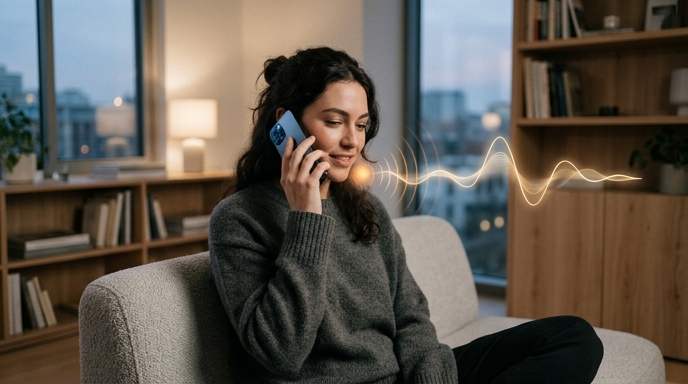
GPT-Live does not turn ChatGPT into a human conversational partner. It does something more practical: it removes several mechanical habits that constantly reminded users they were talking to a machine.
It can listen while speaking. It can wait through a pause. It can accept an interruption. It can delegate difficult work without shutting down the conversation. It can translate speech and show visual answers while the discussion continues.
Those changes may seem subtle beside the enormous benchmark numbers that usually dominate AI announcements. Yet usability often advances through small moments.
The assistant does not interrupt.
It remembers that you are still thinking.
It says “mhmm” rather than delivering six paragraphs.
Suddenly, the technology feels easier.
Early reports from TechRadar, PCWorld, The Decoder, The Hindu and iPhone in Canada broadly agree on the significance of the full-duplex design, although real-world testing will determine how consistently the experience matches OpenAI’s polished examples.
GPT-Live’s greatest achievement may not be that it talks more intelligently. It may be that it finally understands when not to talk.
For voice AI, that counts as personal growth.
Sources
- OpenAI — Introducing GPT-Live
- TechRadar — ChatGPT’s GPT-Live Voice Model Rolls Out
- The Decoder — ChatGPT Can Now Listen and Talk at the Same Time
- PCWorld — ChatGPT Might Actually Be Worth Talking to Now
- The Hindu — OpenAI Launches GPT-Live Voice Models
- iPhone in Canada — OpenAI Launches GPT-Live
The Kingy Brief
Get The Kingy Brief.
AI changes, original tests and one practical thing to try. Fridays at 09:00 Vancouver time.
Free · Double opt-in · Unsubscribe anytime
Sign up for The Kingy Brief on Beehiiv.
Signup help and newsletter schedule
Signup form provided by Beehiiv. After submitting, check your inbox for "Confirm your subscription to The Kingy Brief" and open its confirmation link. Check Spam or Promotions if you cannot find it.
Fridays at 09:00 Vancouver time: source-checked AI changes, original tests and one practical thing to try. The weekly restart begins October 9, 2026. We skip a week when there is not enough verified material. Free. Unsubscribe anytime.