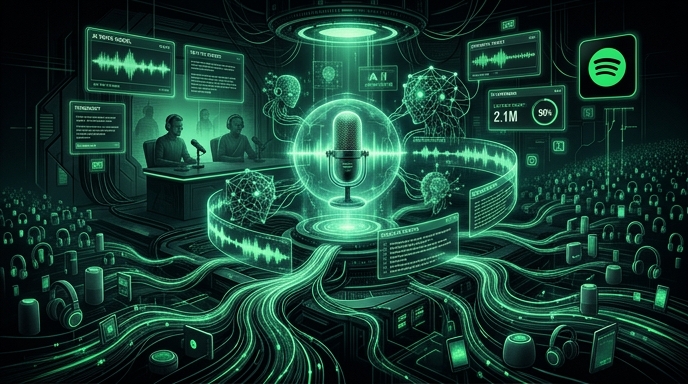
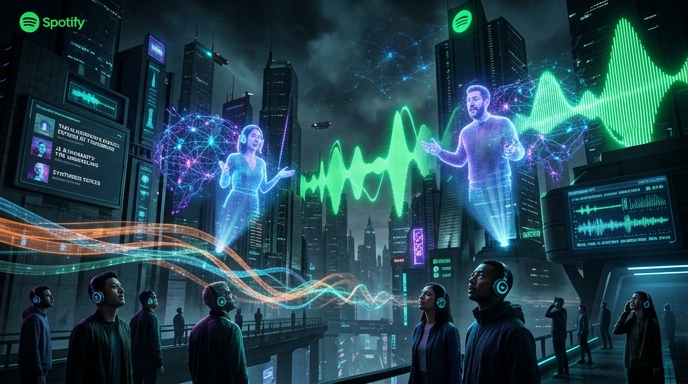
Artificial intelligence has already invaded search engines, customer service, coding, filmmaking, music production, and the sacred wasteland known as LinkedIn thought leadership. Now it has its sights set on something even more intimate: podcasts.
Not podcast recommendations. Not transcription tools. Actual podcast creation.
And this time, the machines aren’t merely helping humans record audio faster. They are becoming the hosts, producers, scriptwriters, editors, and distributors all at once.
In May 2026, Spotify Newsroom announced a new initiative that lets users create personalized AI-generated podcasts through AI agents. The rollout instantly triggered fascination, excitement, dread, skepticism, and a wave of “Wait… are humans still involved at all?”
The answer is: sometimes.
The bigger answer is far more disruptive.
Spotify is quietly transforming itself from a streaming platform into an AI media operating system. And unlike earlier experiments in generative AI, this one lands directly inside an entertainment format people trust deeply. Podcasts feel personal. They feel human. That matters.
Because once listeners become comfortable hearing synthetic voices deliver news, commentary, summaries, and even emotional storytelling, the entire media economy changes shape.
Not eventually. Right now.
The Podcast Was Made By an AI Agent. Seriously.
Spotify’s new feature allows AI agents to build fully customized podcasts for users based on prompts, preferences, topics, or imported information. According to Spotify’s official announcement, users can create “personal podcasts” generated dynamically by AI systems.
That phrase sounds harmless at first. Cute, even.
But unpack it for thirty seconds and the implications become enormous.
Imagine asking an AI agent:
“Create a 15-minute morning podcast summarizing AI news, basketball updates, and the stock market in a sarcastic tone.”
The system can generate it.
Or:
“Turn my unread articles into a daily audio show.”
Done.
Or even:
“Create a podcast that explains world history like a noir detective story narrated by two friends arguing.”
Also possible.
The agent builds scripts, synthesizes voices, structures segments, inserts transitions, and produces a finished audio experience. No studio, no microphone, no editor frantically cleaning up breathing sounds at 2 a.m.
The production chain collapses into software.
This is not the first AI-generated audio experiment on the internet. But Spotify’s involvement changes everything because Spotify already owns distribution. That’s the key difference.
Tech history keeps repeating the same lesson: invention matters less than distribution.
Millions of creators can build tools. Few companies can place those tools instantly in front of hundreds of millions of users.
Spotify can.
And now it is.
The “Save to Spotify” Feature Quietly Revealed the Strategy
The larger vision became clearer after coverage from The Verge highlighted Spotify’s “Save to Spotify” functionality connected to AI-generated podcasts.
At first glance, the feature looks simple. Users can save AI-created podcast experiences directly into Spotify’s ecosystem. Convenient. Frictionless. Smart product design.
But strategically? It reveals Spotify’s long game.
Spotify does not merely want to host podcasts anymore. It wants to generate them, personalize them, and algorithmically adapt them to every individual listener.
That changes the definition of media itself.
Traditional media works like this:
One creator → many consumers.
AI-generated personalized media works differently:
One platform → infinite individualized experiences.
That distinction sounds subtle until you realize it destroys the economics of mass broadcasting.
Why would listeners consume the same generic news recap every morning if an AI can build one tailored specifically to their interests, humor preferences, attention span, and favorite speaking style?
And why tolerate filler?
Lastly why sit through ads for mattresses and meal kits when the AI-generated show itself can adapt sponsorship messaging to your interests in real time?
The old podcast model suddenly looks primitive.
And Spotify knows it.
AI Agents Are Becoming Media Companies
Coverage from Thurrott emphasized a particularly important phrase: podcasts “created with AI agents.”
That wording matters.
Not AI tools.
AI agents.
There’s a huge difference.
An AI tool helps humans perform tasks. An AI agent executes workflows semi-autonomously. Increasingly, these systems can plan, iterate, revise, and publish with minimal intervention.
That means Spotify is positioning itself for a future where AI entities become active media creators.
Not metaphorically. Literally.
A single creator could theoretically deploy dozens of AI podcast agents producing niche content around finance, gaming, fitness, geopolitics, anime, Formula 1, conspiracy theories, ancient Rome, or cat psychology. The marginal cost approaches zero.
That is both thrilling and terrifying.
Thrilling because creativity becomes radically democratized.
Terrifying because content volume could become infinite.
The internet already suffers from a tsunami of low-quality sludge. AI-generated media could multiply that problem by several orders of magnitude.
The barrier to publication disappears.
Historically, creating a podcast required effort. Equipment. Editing skills. Time. Some degree of competence.
Now? A teenager with a prompt box can create an endless network of synthetic podcast personalities before breakfast.
Quantity explodes.
Quality becomes harder to identify.
Authenticity becomes blurry.
And audiences may stop caring.
That last point is critical.
People assume listeners will reject AI-generated voices automatically. Maybe. Maybe not.
Humans adapt astonishingly fast to convenience.
Listeners Already Accept Fake Voices More Than They Admit
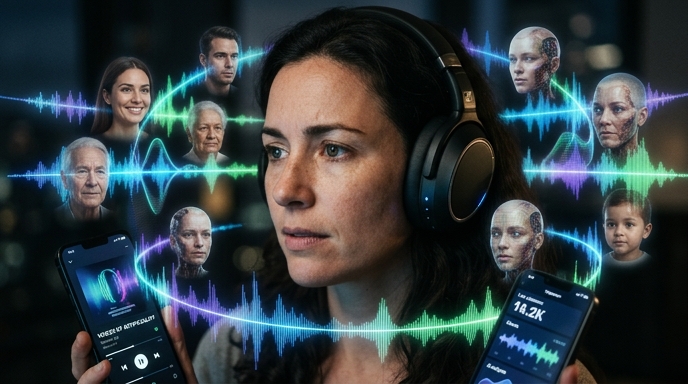
This is where the conversation becomes uncomfortable.
Many people claim they value “human authenticity” in media. They insist they can detect emotional sincerity. They swear they hate synthetic content.
Yet millions already consume algorithmically optimized media every day without objection.
TikTok creators edit their speech patterns around retention metrics. YouTubers optimize thumbnails with machine-tested psychology. Influencers rehearse “spontaneous” moments.
Authenticity online has been heavily manufactured for years.
AI simply accelerates the process.
And modern voice synthesis has improved dramatically. Some AI-generated hosts already sound more articulate, emotionally consistent, and polished than real humans. That sounds absurd until you listen carefully to enough AI-generated audio.
No coughing , No rambling, No filler words, No awkward pacing.
The machine never loses energy.
That consistency matters in podcasting.
Spotify likely understands that many users won’t care whether a host is human if the experience feels entertaining, informative, and emotionally engaging.
Convenience often defeats philosophical objections.
Streaming defeated physical ownership.
Algorithms defeated curated discovery.
Recommendation engines defeated intentional browsing.
AI-generated podcasting may defeat traditional human-hosted formats in many categories simply because it can adapt faster and cheaper.
The Economics Are Brutal
The real disruption here is economic.
Podcasting exploded because production costs were relatively low compared to television or film. A few microphones and editing software could launch a successful show.
AI slashes those costs even further.
A business could produce daily multilingual podcasts without hiring hosts, writers, editors, or translators. Media companies could create hyper-targeted niche content at scale. Brands could generate endless “podcast-style” marketing disguised as entertainment.
Expect corporations to flood Spotify with synthetic audio content almost immediately.
Some of it will be awful.
Some of it will be disturbingly good.
That’s the danger.
People tend to imagine AI media failing in obvious ways. Robotic voices. incoherent scripting. uncanny awkwardness.
But mediocre AI is not the real threat.
Competent AI is.
Once generative systems become “good enough,” economics overpower aesthetics. Companies prioritize scalability. Audiences prioritize convenience. Platforms prioritize engagement.
Human creators suddenly compete against infinite synthetic labor.
That is not a fair fight.
Spotify Is Also Fighting for Survival
There’s another layer to this story that often gets ignored.
Spotify is under pressure.
The company has spent years trying to evolve beyond music streaming because music economics are brutal. Licensing costs are enormous. Margins remain difficult. Podcasts offered a way to own more content directly.
Now AI-generated podcasts offer something even more attractive: scalable proprietary content ecosystems.
Spotify can become the infrastructure layer for AI media creation.
That is vastly more powerful than merely distributing podcasts made by humans.
Think about the shift:
Old Spotify model:
Host human-created content.
Emerging Spotify model:
Generate, personalize, distribute, and optimize content algorithmically.
That transition moves Spotify closer to becoming an AI entertainment engine rather than a streaming service.
And it’s happening while every major tech company races toward AI-native experiences.
Google wants AI search companions.
OpenAI wants conversational assistants.
Meta wants AI personalities.
Spotify wants AI audio ecosystems.
Everyone is fighting for daily user attention.
Audio matters because it occupies otherwise “dead” time — driving, cooking, exercising, commuting, walking.
Spotify wants AI to fill every available second.
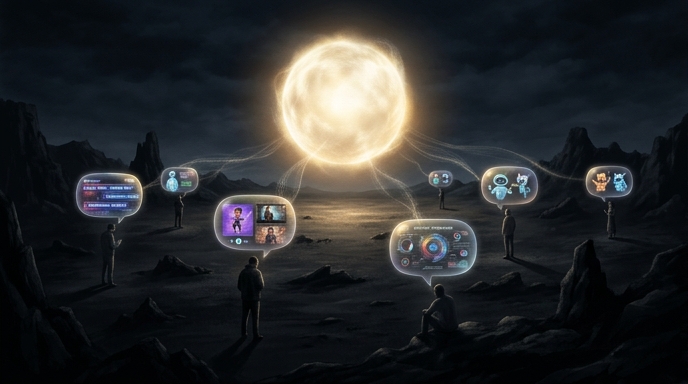
The Strange Rise of Personalized Media Universes
One of the most fascinating implications of AI-generated podcasts is the death of shared listening experiences.
Traditional media creates cultural synchronization. Millions watch the same show. Hear the same hosts. Discuss the same moments.
AI personalization fragments that.
If every listener receives a customized podcast version tailored specifically to them, mass culture weakens further.
Two people may technically listen to the “same” AI podcast but hear different jokes, different pacing, different news emphasis, and different explanations.
Media becomes individualized.
This could create a bizarre future where every person inhabits a slightly different informational reality engineered for maximum engagement.
Frankly, social media already pushed society in that direction. AI-generated personalized audio may accelerate it further.
And because podcasts feel intimate, listeners may form stronger emotional attachments to AI personalities than many expect.
Humans anthropomorphize aggressively. People already name robotic vacuum cleaners and emotionally bond with video game characters.
An AI podcast host that remembers your interests, adapts to your humor, and speaks conversationally could become psychologically sticky very fast.
That has enormous commercial value.
Creators Should Be Nervous — But Not Paralyzed
Human podcasters now face an ugly question:
“What exactly is my moat?”
That’s not cynicism. That’s business reality.
If AI can generate competent summaries, commentary, educational explainers, scripted storytelling, and interview simulations, creators must identify what machines still struggle to replicate.
Right now, several human advantages remain strong:
- Genuine lived experience
- Unpredictable chemistry
- Deep expertise
- Emotional vulnerability
- Investigative reporting
- Physical-world access
- Reputation and trust
Those matter.
But many podcast genres rely heavily on formats AI can imitate effectively: listicles, summaries, reaction commentary, motivational chatter, generic business advice, lightweight news recaps.
That territory looks vulnerable.
The creators most likely to survive long term will probably lean harder into distinctly human strengths rather than polished generic content.
Ironically, AI may push audiences to value imperfection again.
Messiness can signal humanity.
A strange future may emerge where awkward pauses and imperfect speech become authenticity markers.
Imagine that. Humans deliberately sounding less optimized so audiences know they are real.
The machine age creates nostalgia for flaws.
Regulation Is Coming. Probably Too Late.
Spotify’s AI podcast initiative also raises serious legal and ethical questions.
Who owns AI-generated voices?
Can systems imitate celebrities?
What happens when political propaganda gets mass-produced through personalized synthetic podcasts?
How do platforms moderate millions of AI-generated audio streams?
Those problems do not have clean solutions.
And tech companies historically move much faster than regulators.
We already saw how social media platforms struggled to control misinformation at scale. AI-generated personalized media could make that challenge exponentially harder.
A malicious actor could theoretically generate thousands of persuasive synthetic podcasts targeted at specific demographics.
That possibility is not science fiction anymore.
It is infrastructure.
Spotify will likely face increasing scrutiny over moderation policies, disclosure rules, voice cloning safeguards, and content verification systems.
Because eventually listeners will ask an uncomfortable question:
“How do I know this podcast is real?”
The Most Important Shift Isn’t Technical — It’s Psychological
The real breakthrough here is not voice synthesis.
It is normalization.
Spotify’s move signals that AI-generated entertainment is entering mainstream consumer culture. Not as a novelty. Not as an experiment. As a product category.
That changes public psychology.
Once ordinary users become comfortable generating personalized podcasts casually, broader acceptance of AI-created media accelerates across industries.
Movies. Education. Advertising. Journalism. Gaming.
The barriers weaken.
And history shows that once consumers accept convenience, reversals become rare.
People complained about algorithmic recommendations ruining discovery. Then they kept using them.
People criticized infinite scrolling. Then spent six hours per day on apps designed around it.
People mocked AI-generated images. Then companies started replacing illustrators.
The pattern repeats relentlessly.
Technology does not need universal approval to dominate markets.
It only needs enough adoption to reshape incentives.
Spotify appears to understand that better than most media companies.
So What Happens Next?
Expect several developments over the next two years.
First, AI-generated podcast volume will explode. Most of it will be disposable noise. Some will become surprisingly popular.
Second, synthetic hosts will improve rapidly. Emotional realism, conversational flow, humor timing, and adaptive dialogue will get dramatically better.
Third, hybrid podcasting models will emerge. Human creators will increasingly collaborate with AI systems instead of competing directly against them.
Fourth, audiences will split psychologically into two camps:
people who care deeply about human authenticity and people who mostly care about convenience and personalization.
The second group may end up much larger than critics expect.
Finally, entirely new forms of media will appear — formats impossible before AI generation.
Dynamic podcasts that update continuously.
Interactive conversational episodes.
Narratives that adapt in real time.
Personalized educational audio tutors.
AI-generated debate shows tailored to your political interests.
The boundaries between podcast, assistant, companion, and entertainment product will blur.
Spotify’s latest move is not just a feature launch.
It is an early signal that the definition of media itself is mutating.
And unlike previous technological transitions, this one attacks something deeply human: the voice.
That changes the emotional equation entirely.
Because hearing a voice feels personal.
Even when no person exists behind it.
Sources
- The Verge – “Save to Spotify” AI Podcasts Coverage
- Thurrott – Spotify Welcomes AI-Generated Podcasts Created With AI Agents
- Spotify Newsroom – Personal Podcasts Launch
- Rolling Out – Spotify Now Lets AI Agents Build Podcasts
The Kingy Brief
Get future Kingy Brief editions.
Source-checked AI changes, original tests and one practical thing to try.
Free · Choose your subjects · Double opt-in · Unsubscribe anytime
Regular sending is paused; no restart date is set.