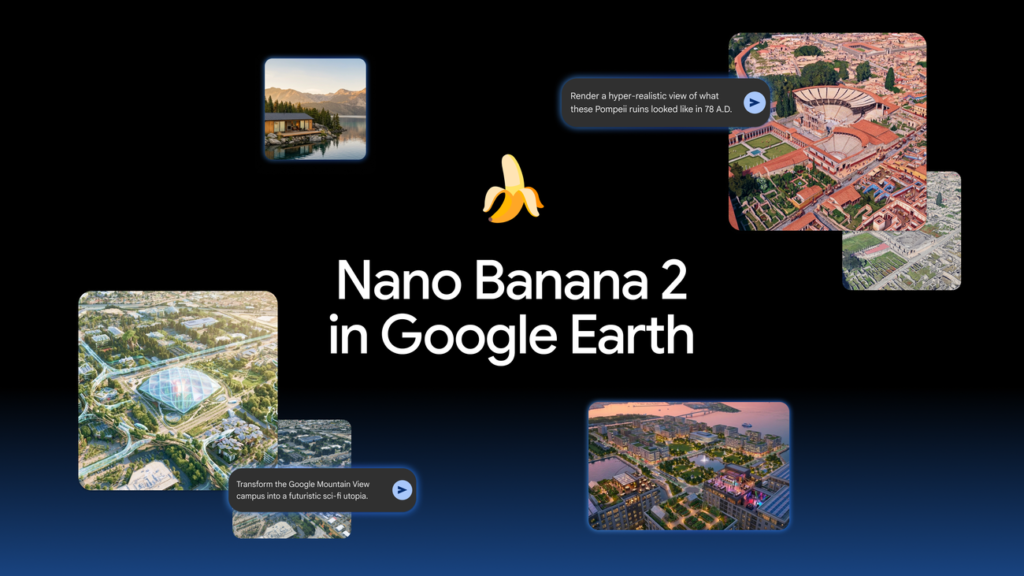
Google gave a small group of Google Earth users a new kind of mapmaking tool on July 30: describe a scene, choose a place and let Nano Banana 2 generate the image. One day later, Google rolled it back.
The reversal was unusually direct. In an update to its announcement, Google said it had seen screenshots that violated its policies and acknowledged that people rely on Google Earth for a dependable view of the world. It is now working on stronger guardrails before deciding whether the feature should return.
This was not simply a content-moderation stumble. It exposed a harder product-design question: what changes when a generative model is placed inside a service that people treat as geographic evidence?
What Google launched—and why it pulled back
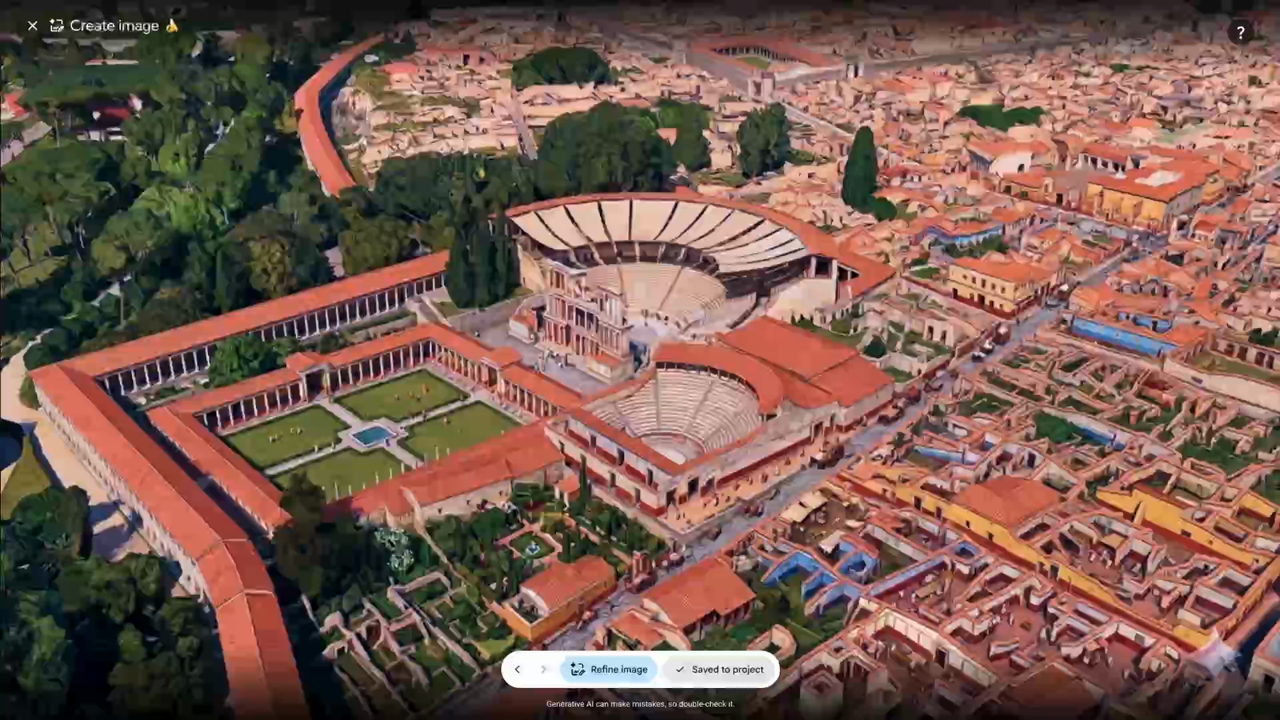
The experiment combined Google Earth’s 3D imagery with Nano Banana 2. Google presented it as a creative canvas for reimagining familiar places: users could transform landmarks, test historical or fantastical scenes and create shareable images from geographic locations.
Google’s original announcement included safeguards. Generated images were visibly marked, contained SynthID—the company’s machine-readable watermark—and could not be published into the main Google Earth experience for other users. The feature was also limited to select Google AI Pro and Ultra subscribers in the United States, initially on Android.
Those controls did not prevent misleading screenshots from leaving the app. TechCrunch reported that critics quickly demonstrated how the tool could create fabricated disaster and conflict scenes. The Atlantic’s testing produced similarly troubling examples. By July 31, Google had disabled the experiment.
A watermark cannot carry the whole trust burden
Google’s first version treated provenance mainly as an attribute of the generated file: label the image, embed a detector-readable signal and keep it out of the shared map. That is useful, but it assumes the image will remain in its original context.
Screenshots break that assumption. They can crop out a visible label, flatten the interface and circulate through social feeds that do not preserve metadata. Even when a watermark remains, viewers may not notice it before reacting. The misleading impression often travels faster than the correction.
This is a recurring weakness in synthetic-media systems. Kingy.ai saw a related problem when Meta’s AI-image detector struggled with cropped images. Provenance helps most when the viewing environment preserves and explains it; it is less reliable when the content is copied into a new frame.
The Google Earth case raises the stakes because the host product already has a strong documentary identity. A fantasy-image generator inside a general creative app starts from one set of expectations. The same generator inside a globe assembled from satellite and aerial imagery inherits a different level of implied credibility.
The real boundary is between a canvas and an evidence surface
Google described the feature as a creative experiment, and that description was accurate. The problem was not necessarily that the generated images appeared realistic. It was that the surrounding interface could make them feel observational.
A map is more than a background. Place names, coordinates, camera angles and recognizable terrain all act as credibility cues. When generative output uses those cues, viewers may infer that the scene corresponds to a real location or event—even if the image carries a label.
That distinction matters for emergency response, journalism, education, insurance and public policy. A false flood image pinned to a real town can mislead without ever entering Google Earth’s shared data layer. A screenshot is enough.
There is a broader lesson here for AI companies: safety depends on the meaning of the surrounding product, not only on what a model can generate. The relevant risk assessment should ask how users interpret the host interface, how outputs travel after export and what damage a plausible misreading could cause.

What stronger guardrails could look like
Google has not promised a relaunch or detailed its next design. Its update says only that the company is working on stronger guardrails and will share more when available. Several approaches would directly address the failure mode revealed by the rollout:
- Persistent visual framing. Instead of a removable corner label, the whole generated view could use a clearly synthetic border, repeating overlay or unmistakable creative-mode treatment.
- Risk-aware prompt limits. Requests involving active conflicts, disasters, public-safety incidents or realistic depictions of identifiable people could receive stricter treatment than benign historical or fantastical transformations.
- Safer sharing. Exported images could include durable provenance, a descriptive caption and a verification link that survives beyond the app.
- Context separation. Google could move creation into a more clearly isolated studio rather than placing it inside the familiar geographic viewing flow.
- Adversarial launch testing. Red-team exercises should test not only policy-breaking prompts, but also misleading screenshots, crops and reposts in the environments where people are likely to encounter them.
None is a complete fix. Persistent overlays can be cropped, prompt filters can be evaded and provenance systems depend on adoption by platforms and viewers. The goal is layered friction: make the synthetic nature difficult to miss, reduce high-risk generations and preserve context when media leaves the product.
Who should care about the rollback
For ordinary Google Earth users, the immediate effect is simple: the experiment is unavailable. There is no indication that generative images replaced public satellite or aerial imagery in the core globe.
For developers and product teams, the more important point is architectural. A generative feature can be technically sandboxed and still borrow trust from the product around it. Teams building AI into browsers, health portals, financial dashboards or other evidence-oriented tools should treat that borrowed credibility as a safety dependency.
For publishers and researchers, the episode is another warning against using interface appearance as proof of origin. Kingy.ai’s coverage of the legal fight around Grok deepfakes showed how quickly generated media can move from product capability to questions of accountability. Google Earth adds location-based authority to the same basic problem.
Kingy AI take
Google deserves credit for moving quickly and explaining the rollback in the same public announcement. But the speed of the reversal also shows that launch gates were focused too heavily on the output and not enough on the product context.
The key design principle is straightforward: creative generation should not be visually interchangeable with an evidence surface. If Google brings the experiment back, the strongest version will make that separation obvious before a user types a prompt—and keep it obvious after the result becomes a screenshot.
This will not be the last collision between generative AI and a trusted interface. Maps, search results, productivity documents and news-like feeds all lend authority to whatever appears inside them. The Google Earth rollback is a useful early case because the failure became visible in 24 hours. Other products may not get such a clear warning.
Official sources and original reporting
- Google: Nano Banana 2 comes to Google Earth, including the July 31 rollback update
- Google Public Policy: determining trustworthiness through provenance and context
- TechCrunch: Google withdraws the feature after criticism
- The Atlantic: independent testing of the Google Earth experiment
The Kingy Brief
Get the next Kingy Brief.
Source-checked AI changes, original tests and one practical thing to try.
Free · Choose your subjects · Double opt-in · Unsubscribe anytime