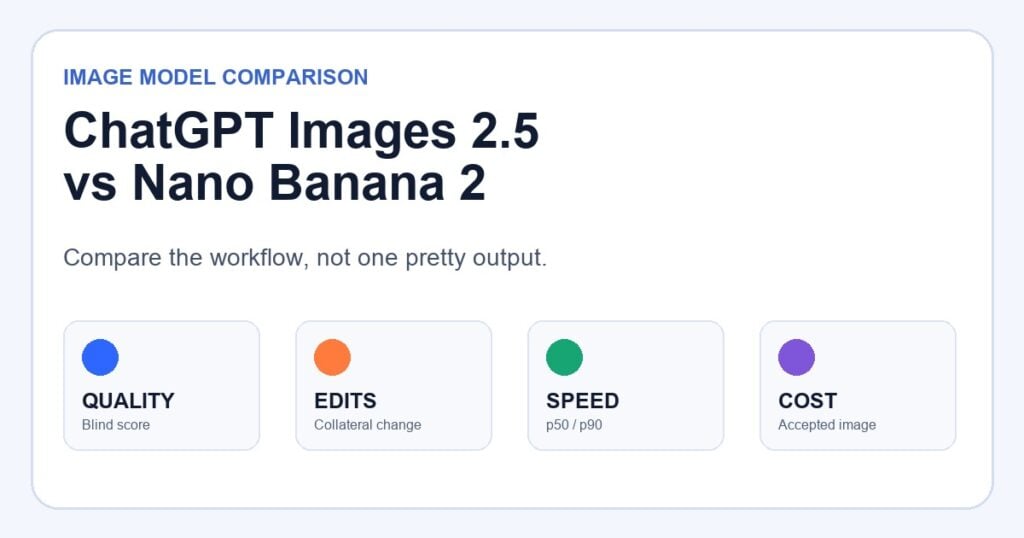
This September 8 article compares published sources for ChatGPT Images 2.5 and Nano Banana 2. Prices, model names and availability retain their dated scope.
Later original test, linked October 22: Kingy’s October 15 comparison of 516 images tested GPT Image 2.5 Flare and Sunburst against Nano Banana 2.1, the later Google model. Flare and Nano Banana 2.1 each passed 31/32 generation outputs on four predefined checks; Sunburst passed 29/32. This small automated evaluation used differing hosted settings and no independent human panel. It does not test the ChatGPT interface or substitute 2.1 results for the Nano Banana 2 model discussed below. See the full method, costs and limitations with the results.
ChatGPT Images 2.5 has arrived with a stronger claim than most image updates: sharper output, more precise edits and up to 50% lower generation latency than Images 2.0. It also adds Sketch, templates, image comments and prompt sharing inside ChatGPT. That makes the obvious comparison with Google’s Nano Banana family useful, but only if you separate product features from API-model claims.
The useful answer
Use ChatGPT Images 2.5 when the work begins in ChatGPT and the person making the image needs to steer a result with a rough drawing, an image comment or a shared prompt. Use an API comparison when you need repeatable settings, metered cost, logs and an automated workflow. A prettier isolated sample is not enough to choose a production image model.
OpenAI says its new API pair is split by job: GPT-Image-2.5 Flare is the faster default, while GPT-Image-2.5 Sunburst trades longer generation time for tighter control on detailed creative work. A fair Nano Banana comparison must hold resolution, reference inputs, retries and acceptance rules steady. Until that happens, there is no honest universal winner.
What OpenAI actually launched
OpenAI announced ChatGPT Images 2.5 on September 8, 2026. The company says it improves natural lighting, texture, reference-subject preservation, targeted editing and consistency over a series of edits. It also says generation latency is reduced by up to 50% against Images 2.0. Those are product claims, not an independent quality benchmark.
The ChatGPT experience now includes Sketch, which lets users supply a drawing as a visual reference; templates for common formats; image comments for more focused edits; and the option to share a prompt with an image. The release notes add an important caveat: templates are not available in Work mode and existing image-generation limits are unchanged.
For developers, OpenAI names two API models: Flare for quality, editing and speed in ordinary application workloads, and Sunburst for higher-precision workflows where longer generation time is acceptable. Keep those API models separate from the ChatGPT interface in reporting. The interface does not necessarily expose the exact serving model for a given image.
ChatGPT Images 2.5 vs Nano Banana 2: what to compare
| Decision | Evidence to collect | Why it matters |
|---|---|---|
| First-pass quality | Blind score from frozen prompts | Stops brand preference from deciding the result. |
| Exact text and data | OCR pass rate and visual review | Poster and infographic work fails on a single wrong word. |
| Reference fidelity | Protected details checklist | Product labels, faces and layout cues must survive transformations. |
| Edit locality | Before/after review outside the requested area | A green-sofa edit is not useful if it changes the room. |
| Speed and reliability | Median and p90 wall-clock time, errors and retries | The fastest single run does not predict a real queue. |
| Cost per accepted image | All billed calls divided by outputs that meet the rule | Cheap requests become expensive when they require repairs. |
The benchmark that would answer the question
A credible comparison should use the same prompt pack across models: exact-text posters, product packaging, transparent assets, hands and tools, exact-count still lifes, data infographics, a sketch-led composition and a two-reference composite. Then run local colour edits, exact text replacement, a wardrobe edit and a five-turn preservation chain.
Freeze prompts, source assets, output size and quality settings before looking at results. Run two independent repeats for ordinary generation tests, rename files before scoring and keep every error, refusal and retry. Grade with a published rubric for brief compliance, reference fidelity, text and data accuracy, technical quality, aesthetics and production usability. Report latency and cost beside the score rather than blending them into one made-up winner number.
For a practical acceptance rule, require a score of at least 75 out of 100 with no critical failure. Critical failures include wrong required text, a missing or duplicated object, a changed identity, changed protected product geometry, missing transparency or a collateral edit. That definition makes “cost per usable image” more useful than a per-request price.
Why a ChatGPT feature can still change the decision
Sketch is not an API spec. It is a control surface. A rough box for a headline, a circle for a product and an arrow for reading order may tell the model what a long prose description leaves ambiguous. Image comments make that control more local: point to the part that needs changing instead of rewriting the whole request.
That makes ChatGPT Images 2.5 attractive for creative exploration, social concepts, room ideas and early product direction. It does not remove the need for a controlled API evaluation when a team needs repeatability, provenance, budget control or a batch pipeline.
Price is only useful with a dated receipt
OpenAI says Flare and Sunburst are available through the API and points developers to its pricing page. Google publishes separate Gemini image model pricing. Both providers can meter by output size, input, model tier or token usage, and each can revise prices. Save the dated pricing page, returned model version, request settings, reported usage and file dimensions with every run.
Do not compare a high-resolution premium output from one provider against a faster lower-resolution default from another and call the difference a model win. Match the closest common output tier, then make a clearly labelled resolution spot check.
Verdict
ChatGPT Images 2.5 is worth trying for the interaction layer alone: Sketch, templates, image comments and shared prompts give non-designers clearer ways to steer an image. OpenAI’s API split also gives developers a plausible speed-versus-precision choice. But GPT-Image-2.5 and Nano Banana 2 need a frozen, paid, apples-to-apples test before anyone should claim a quality or value winner.
Sources
The Kingy Brief
Get The Kingy Brief.
AI changes, original tests and one practical thing to try. Fridays at 09:00 Vancouver time.
Free · Double opt-in · Unsubscribe anytime
Sign up for The Kingy Brief on Beehiiv.
Signup help and newsletter schedule
Signup form provided by Beehiiv. After submitting, check your inbox for "Confirm your subscription to The Kingy Brief" and open its confirmation link. Check Spam or Promotions if you cannot find it.
Fridays at 09:00 Vancouver time: source-checked AI changes, original tests and one practical thing to try. We skip a week when there is not enough verified material. Free. Unsubscribe anytime.