
Published October 6, 2026. Evidence update October 22, 2026. Kingy tested Nano Banana 2.1 in the October 15 comparison below. The Cloud aspect-ratio list and search-pricing wording were corrected November 2, 2026. Other launch reporting and public leaderboard snapshots retain their October 6–7 reporting dates.
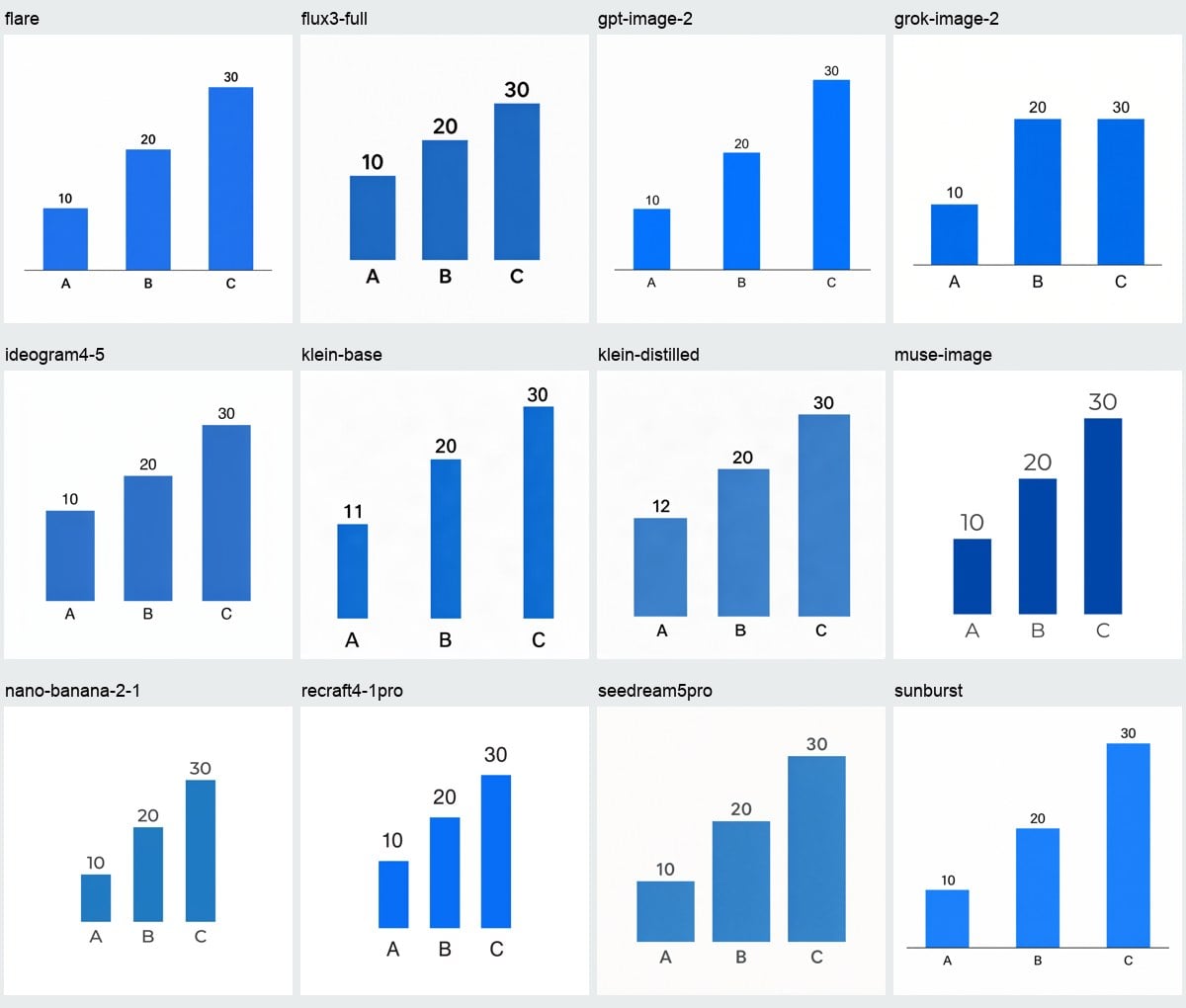
Nano Banana 2.1 passed all four predefined checks on 31 of 32 generated images (96.9%) in Kingy’s 516-image comparison across 12 hosted configurations. GPT Image 2.5 Flare also passed 31/32; full FLUX 3 Image passed 28/32 and Klein distilled passed 24/32. Nano Banana’s 32 generations plus 12 edits cost US$2.0409 in reconciled Fal API credits, excluding evaluation. Flare’s same-size batch cost $9.3854. These are October 15 batch charges at the tested settings.
Testing limits: Nano Banana ran at 1K, medium thinking, with web search disabled. The generation sample was 16 prompts with two draws each; a pass means four rubric checks passed, not that every instruction or production requirement was satisfied. The GPT-6 Luna automated judge used no model labels, but there was no independent human panel, some scored images overlapped evaluator calibration, and the judge shares a vendor with the OpenAI image models. Provider settings differed, including disabled prompt expansion for Klein and full FLUX. A one-image lead is too small to establish a general winner.
Nano Banana also passed all four checks on 12/12 simple edits, as did every other tested editing configuration. Six tasks using just two source images did not separate editing quality. Outside-region pixels still changed; the result does not establish exact preservation, complex retouching or consistency over long revision sequences.
Launch context: October 6–7 reporting
Google released Nano Banana 2.1 on October 6, 2026, with a stable API model, lower image-output pricing than Nano Banana 2, and stronger results on public image-generation and editing leaderboards. For developers already using Google’s image models, it is a serious migration candidate. For anyone choosing across providers, the evidence supports comparing it with GPT Image 2.5 rather than assuming Google now leads every task.
The release is confirmed in Google’s October 6 API release notes. The model ID is gemini-nano-banana-2.1. Google has deprecated gemini-3.1-flash-image, the stable Nano Banana 2 API model, and recommends migrating to 2.1. Its current release notes and deprecation schedule say no shutdown date has been announced; the previously listed October 29 date has been removed.
What changed in Nano Banana 2.1?
Google’s updated product page emphasizes visual design, editing with masks, subject consistency, and more natural images. Those changes target familiar production problems: a character’s face drifting across edits, a product losing its label, or a poster looking attractive while its lettering falls apart.
Our editorial assessment is that preservation deserves as much attention as the first generated image. An advertising team may accept a beautiful draft, then reject the next version because the model changed the packaging. A useful upgrade should survive those revisions. The launch benchmarks give reasons to investigate that possibility; they do not establish the success rate for your own assets.
Nano Banana 2.1 specifications
| Specification | Gemini Developer API documentation |
|---|---|
| Model | gemini-nano-banana-2.1, stable |
| Inputs / outputs | Text, images, video and PDF / images and text |
| Token limits | 131,072 input; 32,768 output |
| Image resolutions | 1K, 2K and 4K; default 1K |
| Reference images | Up to 14; documented resemblance for up to four characters and fidelity for up to ten objects |
| Thinking | Minimal, medium and high; default medium |
| Grounding | Google Web and Image Search |
| Processing | Batch supported; Flex and Priority inference unsupported |
Source: Google’s model specification. Google reports fixes for tiling artifacts in very wide or tall images at 2K and 4K.
There is a launch-day documentation discrepancy. The DeepMind model card describes a one-million-token context and 64K text output, while the API specification above lists smaller limits. For integration planning, use the documented limits of your endpoint and verify actual behavior before relying on larger figures.
The Google Cloud specification also lists a 131,072-token context and 32,768 maximum output tokens. Its current list documents 14 aspect ratios, including 16:9, 9:16, 21:9, 1:8 and 8:1; 9:21 is not listed. A “4K” option is a resolution tier, not a promise that every output is a 4096-pixel square.
Costs: image output is cheaper, but the total bill has several parts
The following are Google’s published USD image-output charges. They exclude prompt inputs, text and thinking output, and chargeable search requests.
| Model / processing | 1K | 2K | 4K |
|---|---|---|---|
| Nano Banana 2.1, Standard | $0.0336 | $0.0504 | $0.113 |
| Nano Banana 2.1, Batch | $0.0168 | $0.0252 | $0.0567 |
| Nano Banana 2, Standard | $0.067 | $0.101 | $0.151 |
| Nano Banana Pro, Standard | $0.134 | $0.134 | $0.24 |
Google’s revised pricing page lists 3,780 output tokens for a 4K image, replacing the launch-day figure of 2,520. The image-token rates remain $30 per million for Standard and $15 for Batch. The table uses Google’s displayed per-image figures; these are image-output charges, not total request costs.
For 2.1, inputs cost $1.50 per million tokens; text and thinking output cost $7.50. Google lists no Developer API free tier. Search includes 5,000 free requests monthly, shared across all Gemini 3 and newer models, then $14 per 1,000 requests, subject to the documented daily cap of 1,500 requests. One generation may cause multiple search queries. See Google’s pricing page.
Calculated from those rates, 1,000 Standard 1K image outputs cost $33.60 before other charges. Treat this as one line of a budget. Track total request cost and the number of usable images you retain. A cheap output that needs three more attempts may be more expensive than a stronger first result.
Google’s benchmarks show better editing and design
The model card reports these vendor-run evaluations. Google uses human side-by-side judgments for preference scores and an automated rater for factuality.
| Evaluation | 2.1 Thinking | 2.1 No Thinking | 2 Thinking | Pro |
|---|---|---|---|---|
| Overall preference | 1050 ± 14 | 1015 ± 13 | 990 ± 7 | 935 ± 8 |
| Infographic factuality | 0.521 | 0.328 | 0.179 | 0.265 |
| General editing | 1026 ± 12 | 980 ± 15 | 938 ± 11 | 939 ± 10 |
| Multi-character consistency | 1106 ± 14 | 1068 ± 14 | 978 ± 10 | 1011 ± 10 |
The direction is encouraging across these tasks. Preference scores are not percentages, and Google’s factuality metric is not a guarantee that an infographic is correct. These scores also use a different evaluation pool from Arena, so comparing their numerical levels would be misleading.
Independent rankings: how it compares with other powerful image models
At our October 7 check, Arena’s overall text-to-image leaderboard showed the following snapshot:
| Rank | Model | Score | Votes |
|---|---|---|---|
| 1 | GPT Image 2.5 Sunburst* | 1425 ± 7 | 17,752 |
| 2 | GPT Image 2.5 Flare* | 1398 ± 7 | 16,889 |
| 3 | GPT Image 2 (medium) | 1383 ± 4 | 93,334 |
| 4 | Grok Imagine Image 2.0 (canvas)* | 1334 ± 12 | 3,113 |
| 5 | MAI-Image-2.6 | 1332 ± 5 | 25,091 |
| 6 | Nano Banana 2.1* | 1328 ± 9 | 5,310 |
| 11 | Nano Banana 2 [web-search] | 1262 ± 4 | 60,515 |
| 16 | Nano Banana Pro, 2K | 1248 ± 3 | 175,734 |
*Arena marks these entries preliminary. Nano Banana 2.1 is now displayed sixth, with its score unchanged at 1328 ± 9. Its rank spread remains 4–6, shared with the nearby Grok canvas and MAI entries, so the ordering deserves caution. Rankings, vote counts and model configurations can change.
The single-image editing leaderboard, still displaying its October 6 snapshot at this check, places 2.1 sixth at 1428 ± 6 from 12,985 votes, with a rank spread of 4–7. Sunburst leads at 1524 ± 5 and Flare follows at 1481 ± 5. Arena marks Nano Banana 2.1, Sunburst and Flare preliminary. Nano Banana Pro’s 2K entry is twelfth at 1390 ± 3; Nano Banana 2’s web-search entry is fourteenth at 1387 ± 3.
That supports a narrower conclusion than a universal winner: 2.1 improves Google’s standing, while OpenAI leads these two overall preference tables. Neither table measures your turnaround time, API reliability, total production cost or tolerance for small text errors. Kingy has not independently reproduced these Arena results. Our October 15 test above uses a separate four-check rubric and cannot be compared numerically with Arena scores.
Which model should you evaluate?
Google recommends Nano Banana 2.1 for new projects in place of Nano Banana 2. Its guide continues to position Pro for demanding visual tasks and Lite for speed and cost. For a Google-based workflow, our assessment is to evaluate 2.1 first, then compare Pro on the specific tasks where you already trust it.
For a cross-provider shortlist, include GPT Image 2.5 Sunburst when editing precision matters, and Flare when speed matters. Both list $30 per million image-output tokens and $15 for Batch. That equal token rate does not imply equal per-image bills: image token consumption, quality settings and input charges must be compared separately. OpenAI explicitly warns that its GPT Image 2 calculator does not estimate 2.5 consumption.
A fair evaluation should use identical prompts, the same reference assets, comparable output dimensions and a defined revision sequence. Record latency, total charges and failed requests. Judge the final images without seeing the model names. We would prioritize a product label that must remain unchanged, a four-character scene, a multilingual poster, a targeted masked edit and an infographic with separately checked facts.
Availability and limitations
Google’s distribution list includes Gemini, AI Studio, the Gemini API, Search AI Mode, Ads, Flow and Stitch. The Cloud endpoint is documented separately. These listings do not establish access for every account or region, or identical credits and quotas across products. We have verified documentation, not every product’s account-level rollout.
Google acknowledges small-text blur, imperfect character preservation and errors in masked edits. Review letters, identities and factual labels before using an output. The image-generation guide says generated images include SynthID. Watermarking does not validate the contents of a diagram.
For teams migrating from Nano Banana 2, check hard-coded model IDs, output parsing, resolution settings and retry behavior. Run a small representative evaluation before routing production traffic to 2.1, and use the official deprecation schedule to watch for a future shutdown announcement. There is currently no published shutdown date for the stable Nano Banana 2 model.
Living update history
October 22, 2026 — Original test added. Added the October 15 Nano Banana 2.1 results, measured batch cost and existing comparison graphic, with the evaluation and editing limits beside the findings. The launch specifications, list prices and Arena snapshots below the new results were not rechecked for this update.
October 7, 2026, 5:25 p.m. PDT — Arena comparison refresh. Updated the October 7 text-to-image snapshot: Nano Banana 2.1 is displayed sixth with an unchanged 1328 ± 9 score and 4–6 rank spread. Refreshed comparison scores and vote counts, including Grok canvas in fourth place. The single-image editing snapshot remains unchanged.
October 6, 2026, 9:25 p.m. PDT — Pricing and migration correction. Google’s pricing page now lists 4K image-output charges of $0.113 Standard and $0.0567 Batch, with 3,780 output tokens. Updated the table; 1K and 2K prices are unchanged. The release notes and deprecation schedule now say no shutdown date is announced for Nano Banana 2. Removed the October 29 deadline from migration guidance.
October 6, 2026, 5:21 p.m. PDT — Benchmark qualification. Added Arena’s preliminary designation to Nano Banana 2.1’s text-to-image and single-image editing results. The displayed scores and ranks are unchanged.
October 6, 2026 — Initial publication. Added confirmed release status, API specifications, Standard and Batch pricing, vendor evaluations, independent Arena snapshots, availability and migration guidance. Flagged the context-limit discrepancy. At initial publication, this was source-based reporting with no Kingy hands-on Nano Banana 2.1 tests. The October 15 run is summarized above.