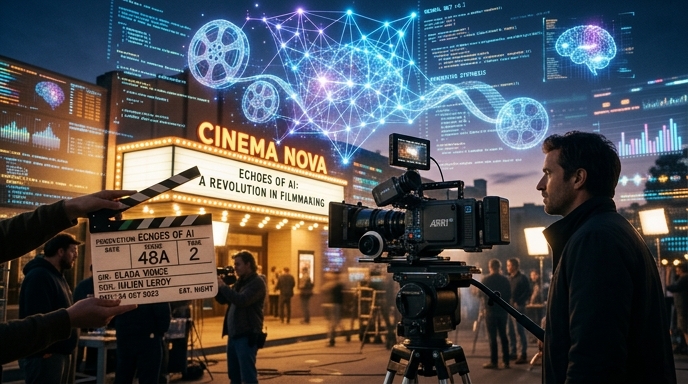
A Strange, Shiny New Plot Twist
Hollywood loves a dramatic entrance. A mysterious briefcase. A door opening in slow motion. A character saying, “You’re going to want to sit down for this.”
Well, here it is.
Google DeepMind and A24 have announced a first-of-its-kind research partnership aimed at exploring how artificial intelligence can shape the future of filmmaking. Google says the partnership will connect DeepMind’s research muscle with A24’s filmmaker-first creative culture. That means researchers and artists will work side by side to test new workflows, build new tools, and find out what AI can actually do when it leaves the demo stage and enters a real production environment.
That last part matters.
AI in entertainment has produced plenty of noise. Some of it has been useful. Some of it has been embarrassing. Some of it has looked like a fever dream rendered by a toaster. This deal is different because it pairs one of the world’s most advanced AI research labs with one of the most distinctive studios in modern film.
A24 is not a generic content factory. It built its reputation on sharp taste, weird risks, and films that do not feel like they were assembled by committee in a windowless conference room. Google DeepMind, meanwhile, wants real creative use cases for its technology.
So now the lab meets the art house. Popcorn, meet neural nets.
What Google Actually Announced
Google’s official announcement keeps things broad. Very broad. Broad enough to park a spaceship in it.
According to Google’s blog post, the partnership is focused on research. The company says it will help artists develop new workflows and techniques, with creators shaping the tools they may eventually use.
That wording is important. Google is not saying, “Here is a finished product.” It is not announcing a consumer app, a production suite, or a magic movie button that turns a half-baked prompt into the next Best Picture winner. Instead, Google frames the deal as a long-term collaboration across multiple projects.
The partnership also includes an investment in A24. Google confirms that part, but it does not name the exact amount in its own announcement.
The key phrase is “research and development.” This suggests experiments, prototypes, feedback loops, and probably a lot of uncomfortable meetings where engineers and directors argue about whether a tool is useful or just technically impressive.
That is a healthy thing.
Creative tools do not become valuable because they look dazzling in a keynote. They become valuable when tired professionals use them under deadline pressure and still want to use them again the next day. That is the real test.
The Reported $75 Million Number
The number getting attention is $75 million.
Several outlets reported that Google is investing roughly $75 million in A24, citing The Wall Street Journal. The Decoder describes the deal as a long-term research partnership and says Google is investing about $75 million in the studio, according to the Journal. GameSpot reports the same figure and adds that this would be Google’s first investment in a movie studio. FourWeekMBA also frames the move as a $75 million investment tied to AI tools for film production.
That distinction matters. Google confirmed the partnership and an investment. The $75 million figure comes from reporting, not from Google’s official post.
Still, even as a reported figure, $75 million is not pocket lint. It is not “let’s buy better coffee for the writers’ room” money. It is a serious bet that AI will matter inside the creative process, not just around it.
For Google, this looks like a strategic toe-hold in premium entertainment. For A24, it could mean access to frontier AI research without turning itself into a Silicon Valley mascot wearing a director’s beret.
The deal is not just about money. It is about proximity. DeepMind gets close to filmmakers. A24 gets close to tools before everyone else does.
That is the real currency here.
Why A24 Makes Sense
A24 is an odd choice only if you think Hollywood innovation starts with the biggest studios. It often does not.
Big studios have enormous resources, but they also have enormous machinery. Franchises. Legacy processes. Risk committees. Brand guardians. Sixteen people giving notes on whether a cape looks “emotionally consistent.”
A24 has a different profile. It is smaller, cooler, stranger, and more willing to experiment. It has built a brand around taste and creative risk. The studio is associated with films such as Everything Everywhere All at Once, Moonlight, Hereditary, and Ex Machina, all of which FourWeekMBA mentions in its coverage. GameSpot also notes A24’s involvement in upcoming adaptations tied to Elden Ring and Death Stranding.
That makes A24 a tempting partner for AI research.
If you want to test AI tools in storytelling, you need filmmakers who will push back. You need people who will say, “This is useful,” “This is garbage,” or “This accidentally made something interesting, but not for the reason you think.”
That kind of feedback is gold.
A buttoned-up studio might use AI to make existing workflows cheaper. A24 might use it to make workflows weirder, faster, leaner, or more visually adventurous. That is a much more interesting laboratory.
DeepMind does not need polite applause. It needs bruising, specific feedback from artists who care about the frame, the rhythm, the mood, and the strange little choices that make a film feel alive.
What the Partnership Might Actually Do
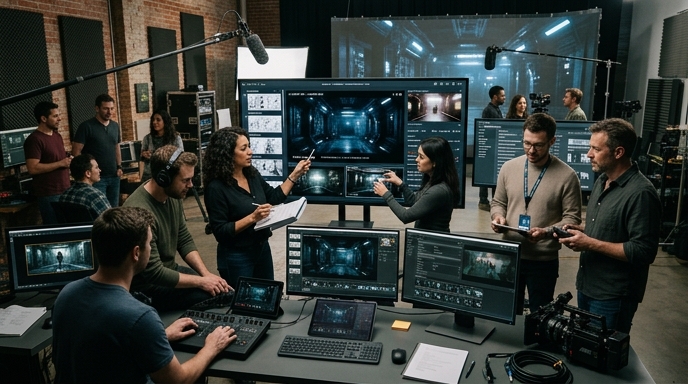
Nobody outside the partnership can honestly say exactly what tools will come out of it. The Decoder makes that point clearly: the concrete products and results remain unclear.
But we can map the obvious territory.
AI could help with previsualization. A director might explore scenes before expensive production begins. A cinematographer might test lighting ideas. A production designer might generate rough environments. Editors might search footage faster. Marketing teams might experiment with trailer cuts, audience segments, or campaign materials.
Some of that sounds glamorous. Some of it sounds boring. The boring parts may matter more.
Hollywood production is full of friction. Scheduling, versioning, localization, asset management, compliance, budget pressure, and endless iteration can drain time and money. AI tools that reduce grunt work without damaging creative control could become valuable quickly.
That is where the Twarx angle is useful. Twarx describes itself as an applied AI studio focused on what models can actually do in production, not just flashy demos. That framing fits this deal perfectly. The question is not whether AI can produce a cool clip. We already know it can. The question is whether it can earn a place in real creative workflows.
That is a much harder test.
A film set is not a lab demo. It is chaos with snacks. The tool either helps, or it gets ignored.
The Backlash Is Practically Baked In
This deal will annoy people. That is not a prediction so much as a weather report.
AI remains a hot-button issue in entertainment. GameSpot notes that SAG-AFTRA’s strike involved concerns about AI, and video game actors also pushed for AI protections. The fear is obvious: performers, writers, artists, editors, designers, and crew members do not want their work scraped, simulated, cheapened, or replaced by software controlled by companies with bottomless servers and suspiciously cheerful press releases.
A24’s reputation makes the reaction even sharper.
The studio is seen as auteur-friendly. It has cultural cachet. It is the brand people invoke when they want to say, “No, not that plastic franchise sludge. I mean real movies.” So when A24 partners with Google DeepMind, some fans will hear a record scratch.
The criticism will be simple: Why is the cool indie studio getting into bed with Big Tech?
That criticism is not irrational. AI tools can shift leverage away from workers and toward capital. They can also flatten style, create legal messes, and flood markets with synthetic mediocrity. Anyone pretending otherwise is selling something.
But the opposite argument is also serious. If AI tools are coming anyway, artists should shape them early. Waiting until tech companies build everything in isolation would be worse. Creative professionals need a hand on the steering wheel before the car becomes a bus.
Google Wants More Than Movie Magic
Google already dominates online video through YouTube. But YouTube is not the same as owning a role in prestige film production.
This partnership gives Google something different: a direct research pipeline into premium storytelling.
FourWeekMBA argues that the move reflects a broader shift in which AI companies push closer to the industries that will use their models. That reading makes sense. AI labs do not just want to sell general-purpose models. They want domain-specific proof. They want examples that show their systems can help make real things in real markets.
Film is perfect for that.
It is visual. It is emotional. It is expensive. It uses huge teams. It generates massive amounts of media. It also lives at the center of public culture. If DeepMind can help filmmakers without making the final product feel soulless, Google gets a powerful story to tell.
And yes, distribution may matter too. FourWeekMBA emphasizes that the deal could touch both production and distribution. That opens the door to AI-assisted marketing, audience matching, localization, trailers, and campaign testing.
The future may not be “AI makes the movie.” It may be “AI helps package, adapt, version, market, and route the movie.”
Less sexy? Sure. More commercially important? Very possibly.
Hollywood has always been half dream factory, half logistics nightmare.
The Missing Details Are the Story
The most honest thing to say is this: the announcement is exciting, but vague.
Google says the goals, technical outputs, and creative milestones will evolve over time. The Decoder says there are no concrete products yet. GameSpot says there is no reason to believe these tools will be used in the upcoming Elden Ring or Death Stranding films, and it also reports that Google will not get access to A24’s content library or data.
Those details cool down some of the hotter speculation.
This is not, based on the available sources, a deal where Google gets to swallow A24’s archive and train on everything in sight. It is not a public announcement that future A24 movies will be AI-generated. It is not proof that actors are being replaced next Tuesday at 3 p.m.
It is a research partnership with an investment attached.
That is still meaningful. Maybe very meaningful. But the careful version beats the hysterical version.
The real story is not that AI has conquered Hollywood. It has not. The real story is that one of the world’s most important AI labs wants to learn from a studio known for creative risk. That suggests AI companies now understand something obvious: entertainment tools cannot be built only by engineers.
They need artists in the room.
Preferably artists with opinions. Strong ones. Maybe with coffee.
Why This Could Matter for Filmmakers
For filmmakers, the best version of this future is not replacement. It is leverage.
Imagine smaller teams doing more ambitious visual development. Imagine independent directors testing complex sequences before spending money they do not have. Imagine editors finding buried moments in mountains of footage. Imagine international releases with better localization. Imagine production teams reducing repetitive work so humans can spend more time on taste, judgment, and performance.
That is the optimistic case.
The pessimistic case is grimier. Studios use AI to cut jobs. Executives chase cheaper output. Synthetic images create legal disputes. Tools trained on murky data produce lawsuits, backlash, and blandness. Creative workers become prompt supervisors for machines that imitate the very artists they displaced.
Both futures are plausible. The outcome depends on contracts, consent, compensation, tool design, and who controls the workflow.
That is why this partnership deserves scrutiny. Not panic. Scrutiny.
A24’s involvement gives the project cultural credibility. Google’s involvement gives it technical power and corporate scale. That combination can create useful tools. It can also create pressure. The line between “helping artists” and “automating artists” is not a line you find once. It has to be fought over constantly.
The fun part is the creative possibility.
The serious part is the power shift.
Hollywood, naturally, contains both. Usually in the same lunch meeting.
The Bigger AI Reality Check
The Twarx homepage uses a phrase that cuts through the fog: what models can actually do in production. That is the right lens for this deal.
AI has spent years dazzling people in controlled environments. Film production will not be so gentle. A tool must survive taste, deadlines, budgets, unions, legal review, creative disagreements, and the brutal final question: Did it make the movie better?
If the answer is no, nobody cares how advanced the model is.
This is why the Google DeepMind-A24 partnership is more interesting than another model announcement. It moves the conversation from capability to utility. Not “Can AI generate video?” but “Can AI help real filmmakers make better work?”
Those are different questions.
The first one belongs in a demo. The second one belongs on a set, in an edit bay, inside a production office, or during a late-night creative panic when the schedule is on fire and the solution must work now.
That is where tools prove themselves.
If DeepMind and A24 can build systems that artists genuinely want, the partnership could influence how the whole industry thinks about AI. If they produce overhyped toys, Hollywood will shrug and go back to arguing about budgets.
Either way, the experiment is worth watching.
Final Cut
Google DeepMind and A24 have not announced the future of cinema. Not yet.
They have announced a serious experiment. Google brings frontier AI research. A24 brings taste, credibility, and a filmmaker-centered culture. Reporters say Google’s investment is about $75 million. Google confirms an investment but leaves the amount unnamed. The partnership will span multiple projects over time, and the specific outputs remain open-ended.
That openness is both thrilling and suspicious. Delicious combo.
The deal could produce tools that help artists move faster, test ideas earlier, and make ambitious work with fewer bottlenecks. It could also intensify fears that AI will be used to squeeze creative labor and sanitize art into algorithmic goo.
The truth will not come from the press release. It will come from the work.
Do filmmakers use the tools? Do the tools respect creative control? Do audiences notice anything better on screen? Do workers get protected, paid, and credited? Does A24 stay weird?
That last question may be the big one.
Because if this partnership gives us richer, stranger, bolder films, then Hollywood may have found a useful new instrument. If it gives us cheaper sludge with a tasteful logo, then congratulations: the robots learned how to wear a tote bag.
For now, the camera is rolling.
Sources
- Google: “Google DeepMind and A24 announce first-of-its-kind research partnership”
- The Decoder: “Google DeepMind and A24 team up on AI filmmaking research”
- GameSpot: “Elden Ring, Death Stranding Movie Studio Signs Deal With Google For AI-Training”
- FourWeekMBA: “Google Invests $75 Million in A24 — DeepMind Will Build AI Tools for Film Production”
- Twarx: “An AI innovation chamber”
Continue Reading
Related Companies
Latest News
Related Guides
Calculators
The Kingy Brief
Get the next Kingy Brief.
Source-checked AI changes, original tests and one practical thing to try.
Free · Choose your subjects · Double opt-in · Unsubscribe anytime