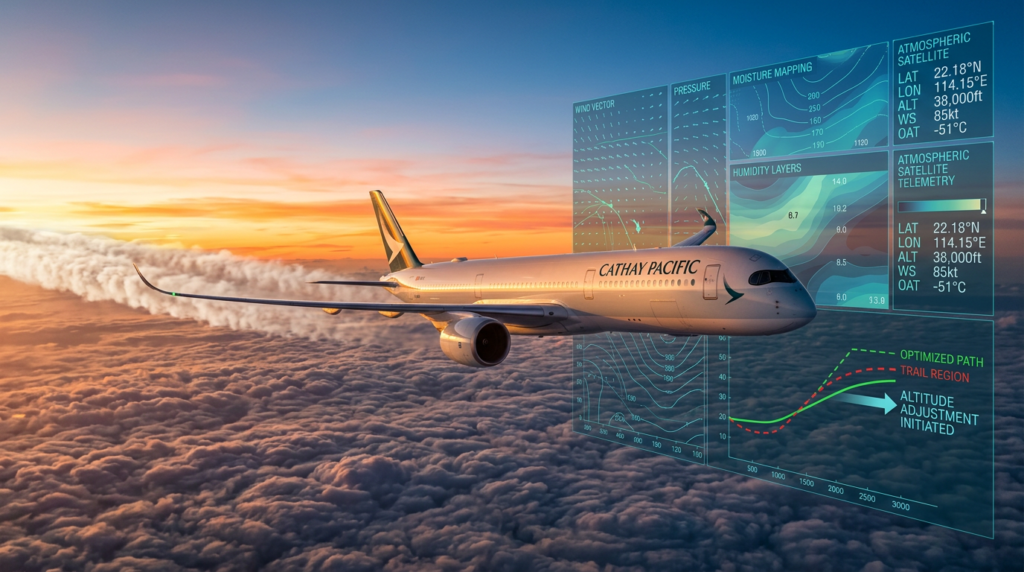
Those white streaks trailing behind airplanes may look harmless. Sometimes, they even make the sky appear more dramatic. But certain aircraft contrails can linger, spread, and trap heat inside Earth’s atmosphere.
Google and Cathay Pacific believe artificial intelligence can help pilots avoid creating some of them.
The two companies are expanding an AI-powered contrail-avoidance trial across Cathay Pacific’s Asian and trans-Pacific network. The project uses predictive models, satellite imagery, weather intelligence, and live flight data to identify atmospheric zones where warming contrails are likely to form.
Pilots can then make small altitude adjustments to steer around those areas—provided airspace, safety, payload, and operational conditions permit.
Early results look encouraging. The first phase targeted more than 100 Cathay Pacific flights, with over 80 following contrail-avoidance routes. Google estimates those flights reduced the warming impact associated with their contrails by roughly 40%.
Now comes the bigger test.
Cathay Pacific has become Google’s first commercial airline partner in Asia-Pacific for the technology. It is also the first airline globally to test contrail avoidance on ultra-long-haul flights.
The expanded study will examine whether the approach works reliably across different routes, weather systems, and operational environments. It will also generate much-needed data from Asia-Pacific, a region that earlier contrail trials have not studied as extensively.
It is a clever idea. Instead of waiting for revolutionary aircraft, exotic fuels, or teleportation—still annoyingly behind schedule—the project tries to reduce aviation’s climate impact using planes already flying today.
Those White Lines Are More Complicated Than They Look
Contrails, short for condensation trails, form when aircraft fly through cold and humid air at high altitude.
Jet engines release hot exhaust containing water vapor and particles such as soot. Under the right atmospheric conditions, the vapor condenses and freezes around those particles, creating lines of tiny ice crystals behind the aircraft.
Many contrails disappear quickly. Those generally cause little concern.
Persistent contrails behave differently. They can remain in the sky for minutes or hours, gradually spreading into thin, cirrus-like cloud formations. These clouds interact with incoming sunlight and heat escaping from Earth.
During daylight, contrails can reflect some sunlight back into space, producing a cooling effect. However, they also trap outgoing heat. At night, there is no incoming sunlight to reflect, so the heat-trapping effect dominates.
Scientists therefore consider persistent contrails a significant non-carbon-dioxide component of aviation’s climate impact.
Google and Cathay Pacific cite previous research indicating that contrails may account for approximately one-third of aviation’s total warming effect. Google’s Project Contrails research page points to an estimate of roughly 35%.
That does not mean every white line has the same effect. Timing, location, atmospheric conditions, duration, and the contrail’s eventual size all matter.
The challenge is finding the small number of flights that could create particularly damaging contrails—and intervening before those icy clouds appear.
Google’s AI Works Like a Weather Scout
Pilots cannot simply look out the window and spot every invisible pocket of contrail-friendly air waiting ahead. They need forecasts.
Google’s system combines large quantities of weather information, satellite imagery, and flight data. Its AI models analyze those inputs to predict where persistent contrails are likely to form.
The platform then turns those predictions into practical information for airline dispatchers and pilots. Flight teams can use it while preparing a route and continue receiving updated forecasts after departure.
Cathay Pacific feeds the information into its internally developed Electronic Flight Folder. The system displays Google’s dynamic contrail forecasts alongside the normal operational data pilots already use.
In-flight Wi-Fi delivers new information to the cockpit as conditions change.
According to Google’s announcement, the system lets crews consider modest altitude changes before an aircraft enters a cold, humid zone associated with persistent contrail formation.
The basic maneuver is not exotic. Pilots already adjust altitude to avoid turbulence, manage weather, improve efficiency, and respond to air-traffic instructions.
AI’s job is to identify a climate-related hazard that crews cannot easily see.
However, the software does not take control of the aircraft or command pilots to change altitude. Flight teams evaluate the recommendation alongside safety requirements, fuel considerations, payload restrictions, traffic, and available airspace.
The AI supplies an informed suggestion. Humans—and aviation rules—remain firmly in charge.
The First Phase Delivered a Promising Result
The operational trial began in late 2025 and targeted more than 100 flights across Cathay Pacific’s network.
More than 80 of those flights ultimately followed contrail-avoidance routes. Not every targeted flight could participate. Cathay identified airspace and payload restrictions among the factors that prevented some crews from making the proposed changes.
Google later examined satellite imagery to determine whether the participating aircraft produced persistent contrails.
Its analysis estimated that the avoidance routes reduced the warming impact of contrails by approximately 40%.
That is an encouraging number, but it deserves careful wording. Google produced the estimate using its own satellite-based analysis. It is not equivalent to a verified 40% reduction in each flight’s total climate impact, fuel consumption, or carbon-dioxide emissions.
The project addresses contrail-related warming specifically.
One route proved particularly influential. Flights between Hong Kong and Singapore frequently pass through atmospheric conditions that favor persistent contrails. Google reported that interventions along this corridor accounted for more than half of the first phase’s estimated climate benefit.
That concentration illustrates why predictive targeting matters. Some flights and atmospheric zones create far more warming than others.
Airlines may not need to alter every route. They could focus on flights most likely to produce long-lived, strongly warming contrails.
Think of it as climate whack-a-mole, except AI tries to predict where the mole will appear before the mallet—or airplane—arrives.
Cathay Is Taking the Technology Into New Territory
Earlier contrail-avoidance studies concentrated heavily on North American and European operations. Asia-Pacific has received less real-world testing, despite becoming the world’s fastest-growing aviation market.
Cathay Pacific changes that equation.
The Hong Kong-based carrier operates an extensive network across Asia and long-distance routes linking the region with North America and other global markets. That gives researchers access to different climates, weather patterns, air-traffic systems, and flight lengths.
Cathay is Google’s first commercial airline partner in Asia-Pacific to test the technology during live operations. More significantly, it is the first carrier anywhere to test AI-assisted contrail avoidance on ultra-long-haul flights.
Those routes create new operational questions.
A small altitude adjustment may affect fuel planning differently during a lengthy trans-Pacific journey than on a short regional flight. Aircraft weight changes substantially as fuel burns. Crews may cross several controlled airspaces, each with its own traffic conditions and procedures.
Forecast accuracy also matters across long distances. Weather can evolve dramatically between departure and the point where a flight encounters a predicted contrail zone.
The expanded trial will help researchers understand those constraints. It will not merely ask whether avoiding contrails is scientifically possible. Previous studies suggest that it is.
Instead, it asks whether airlines can make avoidance routine, scalable, and practical without disrupting safe and efficient operations.
That is a harder question—and a much more useful one.
The Second Phase Will Raise the Difficulty Level
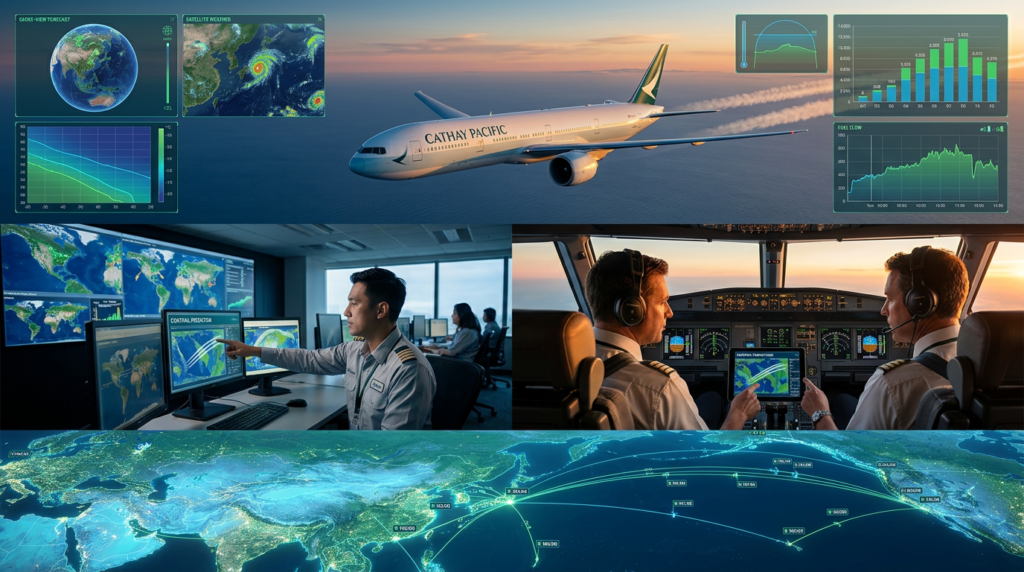
Google and Cathay Pacific are now launching a larger second phase covering routes across Asia and the Pacific.
Reuters reported that the expansion will examine more flights and operating environments. The South China Morning Post said the partners plan to conduct a randomized controlled trial on ultra-long-haul Asian and trans-Pacific services.
The companies have not announced the number of flights, the trial’s complete route list, or a timetable for publishing final results.
Contrails.org will participate as a research partner. The nonprofit initiative works on the science, measurement, and practical implementation of contrail mitigation.
The expanded phase should generate a broader and more rigorous dataset. Researchers need to compare flights receiving avoidance recommendations with suitable control flights operating under similar conditions.
They must also track how often dispatchers and pilots can act on a forecast. A recommendation may look brilliant inside a computer model but become unusable because of air traffic, aircraft performance, turbulence, restricted airspace, or fuel limitations.
That gap between theoretical opportunity and operational reality has appeared in previous research.
A larger trial can reveal whether Google’s forecasts remain useful when exposed to the glorious chaos of commercial aviation: changing winds, busy skies, tight schedules, heavy aircraft, and weather that clearly did not read the itinerary.
Previous Google Trials Built the Foundation
Google did not begin experimenting with contrails when Cathay Pacific entered the picture.
In 2023, Google Research, American Airlines, and Breakthrough Energy tested AI-generated contrail forecasts on 70 flights. Satellite analysis found that participating flights created 54% fewer contrails by distance than comparable flights that ignored the predictions.
Those avoidance maneuvers used approximately 2% more fuel on affected flights. Because only a small share of an airline’s flights would need adjustment, Google estimated the fleet-wide penalty could fall to around 0.3%.
A much larger study followed.
Researchers integrated Google’s predictions into American Airlines’ regular flight-planning workflow and examined roughly 2,400 transatlantic flights. According to an Associated Press report, 112 flights that followed the suggested avoidance routes produced 62% fewer contrails than the control group.
Researchers estimated a 69% reduction in contrail-related warming for those participating flights. The underlying study found no statistically significant difference in fuel consumption between its groups.
Yet the results also exposed an important limitation. Only a fraction of the flights offered an avoidance option actually flew it as planned.
The Cathay project can help investigators understand that implementation gap in another region and under different conditions.
Google has also expanded its work through Operation Blue Skies, a state-supported North Atlantic trial involving the United Kingdom and several aviation and research organizations.
The goal is shifting from isolated demonstrations to repeatable operations across busy airspace.
Why Contrail Avoidance Could Be a Rare Quick Win
Aviation remains one of the most difficult industries to decarbonize.
Electric cars can replace combustion vehicles for many journeys. Power companies can substitute wind or solar generation for fossil fuels. Long-haul aircraft present a nastier engineering puzzle because batteries remain too heavy for many large commercial routes.
Sustainable aviation fuel could reduce lifecycle carbon emissions, but supply remains limited and costs remain high. Hydrogen and electric aircraft may eventually serve parts of the market, although widespread long-distance deployment remains years away.
Contrail avoidance offers a different proposition.
Airlines could potentially reduce part of their climate impact without replacing their fleets or inventing a new fuel. They would use better forecasts and small operational adjustments on selected flights.
That does not make the strategy effortless. It requires accurate models, airline software integration, pilot training, cooperation from air-traffic authorities, and reliable measurement.
But the physical intervention is relatively modest.
Research also suggests that a small proportion of flights causes a large share of contrail warming. If forecasts can identify those high-impact opportunities, airlines may achieve meaningful benefits without rerouting thousands of aircraft unnecessarily.
This makes AI particularly useful. The system must process complex weather and satellite data, predict a narrow atmospheric target, and update that prediction quickly enough for real operations.
It is less “AI writes a poem about clouds” and more “AI helps stop airplanes from accidentally making extra clouds.” Frankly, the second one has a better business case.
There Are Still Plenty of Caveats
The 40% figure from Cathay’s first phase sounds impressive. It should not become a victory banner just yet.
Google estimated the result through satellite analysis. The companies themselves say more trials and research are necessary before anyone can assess system-wide benefits.
Forecasts can be wrong. Contrail-forming zones can move or develop differently than expected. A changed altitude may also increase fuel use, producing additional carbon dioxide that remains in the atmosphere far longer than a contrail.
Researchers must therefore compare the short-term warming avoided with any extra long-lived emissions created by the maneuver.
Then comes air-traffic coordination.
A few experimental flights can change altitude relatively easily. Scaling the system across multiple airlines in congested airspace would require dispatchers and controllers to coordinate many requests without creating conflicts or inefficiencies.
Measurement poses another challenge. Researchers must connect a particular aircraft with a particular streak seen in satellite imagery, determine how long the contrail persisted, and estimate its warming effect.
Not all contrails warm the planet equally. Some daytime contrails reflect enough sunlight to offset part of the heat they trap. Avoiding the wrong one could deliver little benefit.
This is why the expanded trial matters. It will test not only whether AI can make a convincing prediction, but whether the entire process produces reliable climate gains in real operations.
Promising? Yes.
Finished science? Not remotely.
Contrails Are Only One Piece of Aviation’s Climate Problem
Contrail mitigation cannot replace the aviation industry’s work on carbon dioxide.
CO₂ accumulates in the atmosphere and can influence the climate for centuries. Contrails generally last for hours, meaning their effects operate on a much shorter timescale.
Avoiding persistent contrails could reduce warming quickly, but it would not cancel the carbon released when aircraft burn fuel.
Cathay acknowledges this distinction. In its official partnership announcement, the airline described contrail research as one element of a broader climate strategy.
Cathay says reducing carbon emissions remains its main priority through fleet modernization, operational improvements, and greater adoption of sustainable aviation fuel.
Contrail avoidance could complement those measures.
That combination matters because aviation’s climate footprint includes more than one mechanism. Jet engines release carbon dioxide, nitrogen oxides, water vapor, soot, and other substances. Aircraft also influence cloud formation.
Focusing only on CO₂ can leave a significant portion of aviation-induced warming unaddressed. Focusing only on contrails would ignore the industry’s most persistent source of climate damage.
The sensible approach tackles both.
AI-based avoidance could provide a near-term tool while manufacturers, fuel producers, airlines, and governments work on slower technological changes.
It will not make flying climate-neutral. It may, however, help the same aircraft cause less warming on the same journey.
In a sector where major improvements often require decades, “helpful right now” carries considerable value.
AI Steps Out of the Chat Window
Much of the public conversation around artificial intelligence focuses on chatbots, image generators, coding tools, and digital assistants.
The Cathay Pacific trial highlights another side of the technology.
Google’s AI does not need to speak charmingly, write a screenplay, or generate a suspiciously muscular picture of someone’s cat. It needs to recognize patterns inside weather forecasts, flight paths, and satellite images.
Then it must turn those patterns into useful decisions.
That is where AI can shine. Atmospheric systems generate enormous volumes of data. Human experts understand the science, but machines can help them process information at a speed and scale that manual analysis cannot match.
Cathay contributes the operational layer. The airline knows how flight planning works, what crews need, and which recommendations remain realistic inside a commercial cockpit.
Neither capability would accomplish much alone.
A perfect forecast that pilots cannot use becomes an academic curiosity. An airline willing to change altitude without accurate predictions could waste fuel while avoiding nothing.
The partnership combines Google’s predictive technology with Cathay’s aircraft, pilots, systems, and global network.
If the expanded trial succeeds, the resulting data could help other airlines, researchers, and regulators design their own contrail-mitigation programs.
That broader value may prove more important than the performance of any single flight. Commercial aviation operates as an interconnected global system. Climate solutions must eventually travel beyond one company’s cockpit.
A Small Change in Altitude Could Create a Big Opportunity
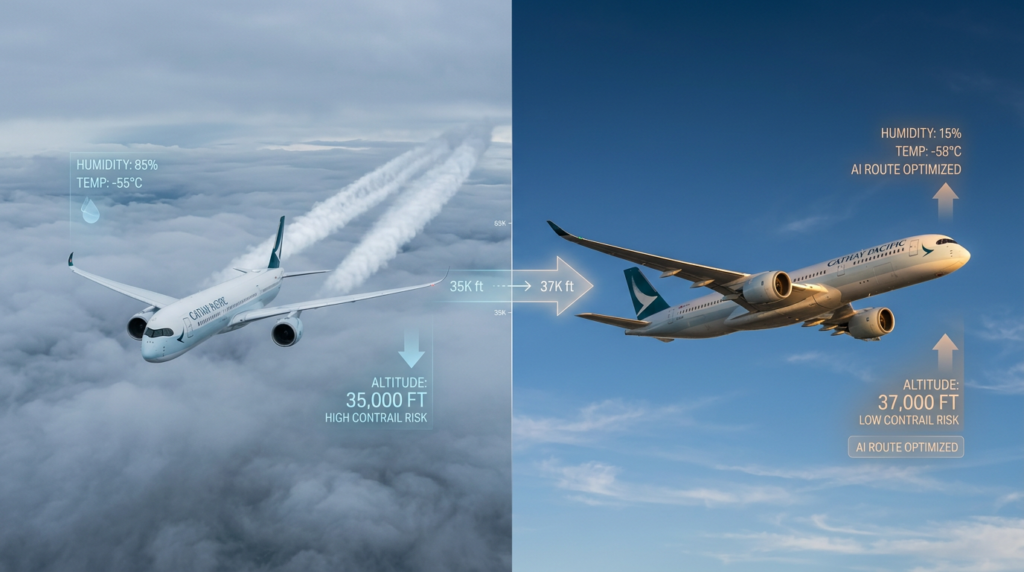
Google and Cathay Pacific have produced a rare kind of climate story: one with an encouraging early result, existing technology, and a clear next experiment.
More than 80 flights followed AI-informed avoidance routes during the first phase. Google estimated a roughly 40% reduction in their contrail-related warming. One heavily affected corridor delivered over half the trial’s estimated benefit.
Now the companies will test the system across more Asian and trans-Pacific operations, including ultra-long-haul services. Contrails.org will help strengthen the research, while real-world flight data will reveal whether the approach can scale.
There is no guarantee it will.
Airspace limitations, forecast errors, fuel trade-offs, and operational complexity could reduce the benefits. The industry will also need independent analysis, common measurement standards, and cooperation between airlines and aviation authorities.
Still, the project has a valuable advantage: it does not demand an entirely new generation of aircraft.
It works with today’s jets and today’s fuel. The main ingredients are better atmospheric predictions, connected cockpits, informed pilots, and carefully selected altitude changes.
That makes contrail avoidance a potentially practical bridge between aviation’s current climate footprint and its cleaner long-term future.
The white lines behind aircraft will not disappear overnight. But Google and Cathay Pacific are testing whether AI can help pilots decide which ones never need to appear.
Sometimes, a major technological breakthrough looks like a futuristic machine.
Sometimes, it looks like moving an airplane up or down by a few thousand feet.
Sources
- Cathay Pacific: AI-powered contrail-avoidance partnership with Google
- Google: New contrail-avoidance trial in Asia-Pacific
- Reuters: Cathay Pacific and Google expand AI contrail trials
- South China Morning Post: Second-phase testing across Asian and trans-Pacific routes
- Google Research: Project Contrails
- American Airlines: Initial Google AI contrail-avoidance research
- Associated Press: Results from Google and American Airlines’ larger trial
- Research paper: Efficacy of Scalable Airline-led Contrail Avoidance
The Kingy Brief
Get The Kingy Brief.
AI changes, original tests and one practical thing to try. Fridays at 09:00 Vancouver time.
Free · Double opt-in · Unsubscribe anytime
Sign up for The Kingy Brief on Beehiiv.
Signup help and newsletter schedule
Signup form provided by Beehiiv. After submitting, check your inbox for "Confirm your subscription to The Kingy Brief" and open its confirmation link. Check Spam or Promotions if you cannot find it.
Fridays at 09:00 Vancouver time: source-checked AI changes, original tests and one practical thing to try. We skip a week when there is not enough verified material. Free. Unsubscribe anytime.