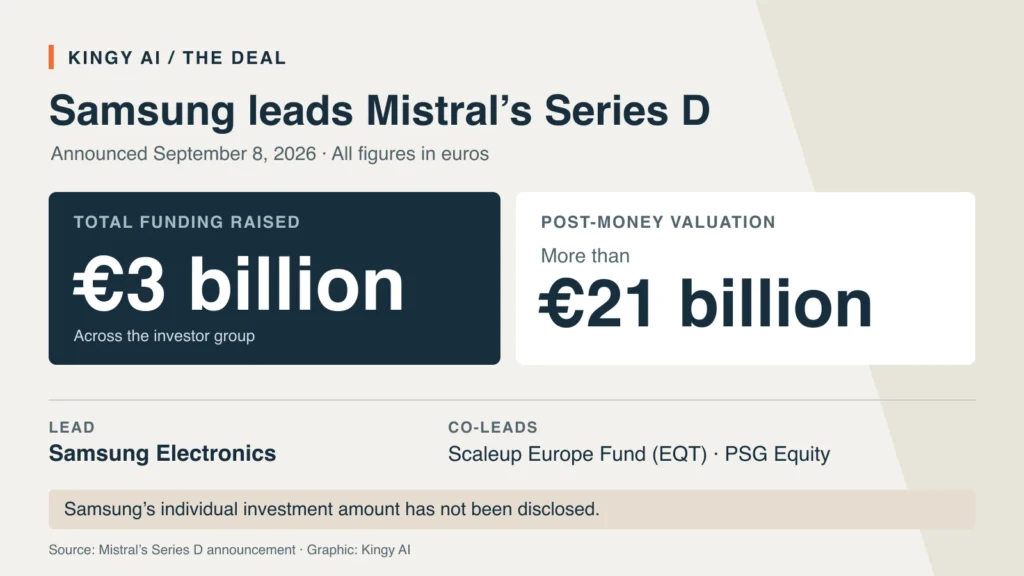
Samsung Electronics has led Mistral AI’s €3 billion Series D, valuing the French company at more than €21 billion after the investment. Announced on September 8, 2026, the financing will support research, computing capacity and international expansion. Mistral’s funding announcement
The industrial purpose is now clearer, too. In a separate statement dated September 9 in Korea, Samsung announced plans to deploy Mistral technology within its semiconductor operations. That gives the deal a concrete focus: applying AI to chip engineering and manufacturing while keeping sensitive operational data inside Samsung’s infrastructure. Samsung’s partnership announcement
For Mistral, the investment strengthens a demanding strategy: develop competitive models, supply the infrastructure to run them, and sell businesses greater control over their AI systems. The funding improves its ability to execute. Whether that combination produces a durable business depends on the quality of the models, the cost of operating them and the results customers can measure.
Reporting updated September 8, 2026, Pacific time. Includes Samsung’s announcement dated September 9 in Korea.
The deal at a glance
| Detail | What is confirmed |
|---|---|
| Financing | €3 billion Series D |
| Post-money valuation | More than €21 billion |
| Lead investor | Samsung Electronics |
| Co-leads | Scaleup Europe Fund, managed by EQT; PSG Equity |
| Samsung’s individual contribution | Not disclosed in the companies’ announcements |
| Record claim | Mistral describes it as Europe’s largest technology-company equity fundraising |
Source: Mistral. The record is a company claim; it should not be stretched to include debt financing, acquisitions or public-market offerings.
The euro denomination matters. The round is approximately $3.5 billion, with a valuation of roughly $24 billion, using the contemporary conversions reported by The Wall Street Journal. Headlines using euros and dollars describe the same financing.
Nor is €3 billion Samsung’s disclosed cheque. It is the total raised from the investor group.
What Samsung plans to do with Mistral
Samsung says it will use Mistral services, including Mistral Large, to develop customized models for deployment on its own premises. Its stated priorities include defect detection and equipment optimization, with the aim of improving development cycles, manufacturing precision and yield stabilization across memory and logic chips. Samsung
These are announced objectives. Samsung has not supplied quantified results in the release, such as a measured increase in yield or a reduction in manufacturing costs. It also does not announce a Galaxy phone integration or identify a new consumer product powered by Mistral.
That distinction gives readers a better way to judge the partnership. Useful evidence would include a defined production deployment, results against the previous process, and a clear account of where engineers retain control. A manufacturing claim becomes much more meaningful when the company can specify the defect type, operating conditions and improvement it achieved.
How the round compares with ASML’s investment
Mistral’s previous major equity financing already connected the company to semiconductor manufacturing. Its September 2025 Series C raised €1.7 billion at an €11.7 billion post-money valuation. Mistral’s Series C announcement
| Metric | September 2025 Series C | September 2026 Series D |
|---|---|---|
| Lead investor | ASML | Samsung Electronics |
| Total raised | €1.7 billion | €3 billion |
| Post-money valuation | €11.7 billion | More than €21 billion |
| Lead investor’s disclosed contribution | ASML: €1.3 billion | Samsung: undisclosed |
Sources: Mistral, Series C, Mistral, Series D, ASML.
The new round is about 76% larger, and the reported valuation has risen by more than 79%. Those are calculations from the announced euro figures, rather than measures of revenue growth or model performance.
Post-money valuation includes the new investment. Under a simple all-primary financing assumption, subtracting €3 billion implies a pre-money valuation above €18 billion. The announcements do not provide the detailed capitalization table or share terms needed to calculate Samsung’s ownership. Dividing the entire round by the headline valuation would not establish Samsung’s stake.
ASML’s earlier €1.3 billion investment produced approximately 11% ownership on a fully diluted basis at that time. Its partnership covered potential applications across products, research, development and operations. That historical percentage should not be presented as ASML’s ownership after the new round. ASML’s September 2025 announcement
The pattern is commercially significant. Mistral is attracting industrial partners with difficult engineering problems and sensitive technical information. Their investment creates an opportunity to sell specialized AI deployments; it does not establish an exclusive alliance among chip companies.
Who else invested, and why Europe’s fund matters
New backers include Advent, BlackRock-managed funds and accounts, and Luxembourg. Returning investors include ASML, Nvidia, a16z, Bpifrance, General Catalyst, Index Ventures, Lightspeed and Salesforce Ventures. Mistral’s investor list
The Scaleup Europe Fund adds a public-policy dimension. The European Commission describes the fund as a way to supply growth capital to strategic European technology companies, including businesses in AI, semiconductors and robotics. Its structure combines public and private investment with commercial fund management. European Innovation Council
That helps explain why a European fund and a South Korean industrial company can support the same transaction. Europe wants more capacity to develop and operate AI; Samsung wants useful technology for its own business. Neither motive, by itself, tells us who controls Mistral’s board or how its commercial agreements are structured.
The infrastructure strategy behind the funding
Mistral says it operates across 20 countries and supports more than 125 enterprises. The financing is intended to expand frontier research, compute and commercial reach. Mistral
Its infrastructure ambitions predate this round. On August 11, the company outlined plans for up to 1 gigawatt of European capacity by 2030 and an approach that pools customers’ long-term commitments to support that buildout. This is planned capacity, not a statement that 1 gigawatt is already operating. Mistral’s infrastructure announcement
Microsoft is part of that commercial picture. In July, it announced a multibillion-dollar commitment to use Mistral’s expanded European GPU infrastructure. The agreement also broadened access to Mistral models through Microsoft’s enterprise products. Microsoft’s July 21 announcement
Microsoft did not participate in the Series D, CFO Johan Bergqvist told Reuters. A compute-purchasing commitment and an equity investment are different transactions; they should not be combined into one funding total. Reuters, republished by CNA
The business logic is understandable: enterprise demand can help pay for infrastructure, and infrastructure can support both customer workloads and research. The execution risk is equally concrete. Mistral must coordinate equipment, power, facilities and paying demand while continuing to improve its models. Announced capacity does not establish utilization, and large contracts do not reveal the margin earned on them.
What “sovereign AI” means for a customer
The useful question is how much control a customer has over a particular deployment. An open-weight model makes trained parameters available, subject to its licence. That can support customization and local operation. Open-weight does not automatically mean fully open-source: the Open Source Initiative’s definition also addresses code, training-data information and the freedoms to use, study, modify and share the system. Open Source Initiative
There is also a practical difference between running a model inside an organization and choosing a regional cloud endpoint. Mistral’s August announcement says its regional endpoints keep inference and associated processing in the selected region, while allowing limited, safeguarded transfers to subprocessors outside it. A blanket promise that every Mistral deployment keeps all information inside the customer’s walls would therefore be misleading. Mistral’s regional-processing terms
For buyers, this suggests four concrete checks:
- Data: Where do prompts, documents, logs, backups and support data go?
- Model: Does the exact model’s licence permit the intended use, customization and continued operation?
- Operations: Who controls updates, access, audit logs and incident response?
- Exit: Can the organization keep running or migrate its system if pricing, availability or the supplier relationship changes?
Those checks make sovereignty a property of the deployment that can be examined. The provider’s nationality and the presence of downloadable weights answer only part of the question.
Revenue reports leave an important question unresolved
Reuters reported that Bergqvist expected Mistral to reach $1 billion in annual recurring revenue by the end of 2026. The Wall Street Journal reported ARR already slightly above $1 billion. The published accounts differ on timing; the funding announcement does not supply a revenue figure that reconciles them. Reuters via CNA, The Wall Street Journal
ARR is an annualized measure of recurring business. It is not the same as revenue recognized over a completed financial year, cash collected or profit. Without the company’s metric definition, reporting date and revenue mix, a precise valuation-to-revenue multiple would imply more certainty than the evidence supports.
The strategy is also under scrutiny. Le Monde reported concerns that expansion into infrastructure and third-party model hosting could dilute Mistral’s original ambition to lead in model research. Mistral’s response is that an integrated business can finance further research. Le Monde’s reporting
That tension deserves attention. Strong infrastructure sales could coexist with weaker progress in general-purpose models. Conversely, useful specialist models could win industrial customers without topping every broad benchmark. Assessing the company requires separating those businesses and testing the claims each makes.
What would demonstrate that the investment is working?
Four developments would provide stronger evidence than another valuation headline:
- Measured industrial results. Samsung or other customers publish deployment outcomes against a defined baseline, including costs and failure cases.
- Competitive model releases. Independent evaluations show progress on relevant workloads, with enough detail to compare quality, latency and operating cost.
- Delivered infrastructure. Planned facilities and GPU capacity enter service, with credible evidence of utilization and reliability.
- Clearer financial reporting. Mistral identifies the date and definition of its revenue metrics and supplies enough information to assess margins, customer concentration and cash consumption.
An IPO remains an option, but Bergqvist told Reuters that no discussions were underway and the timing was undecided. There is no announced listing schedule in that account. Reuters via CNA
For a business choosing an AI supplier today, the useful next step is a trial on its own workload, under the deployment conditions it actually needs. Measure task quality, total operating cost and the ability to retain control. The funding improves Mistral’s capacity to compete; those results determine whether its offer fits.
Related: Kingy AI’s funding tracker and Mistral Medium 3.5 model record.
The Kingy Brief
Get The Kingy Brief.
AI changes, original tests and one practical thing to try. Fridays at 09:00 Vancouver time.
Free · Double opt-in · Unsubscribe anytime
Sign up for The Kingy Brief on Beehiiv.
Signup help and newsletter schedule
Signup form provided by Beehiiv. After submitting, check your inbox for "Confirm your subscription to The Kingy Brief" and open its confirmation link. Check Spam or Promotions if you cannot find it.
Fridays at 09:00 Vancouver time: source-checked AI changes, original tests and one practical thing to try. We skip a week when there is not enough verified material. Free. Unsubscribe anytime.