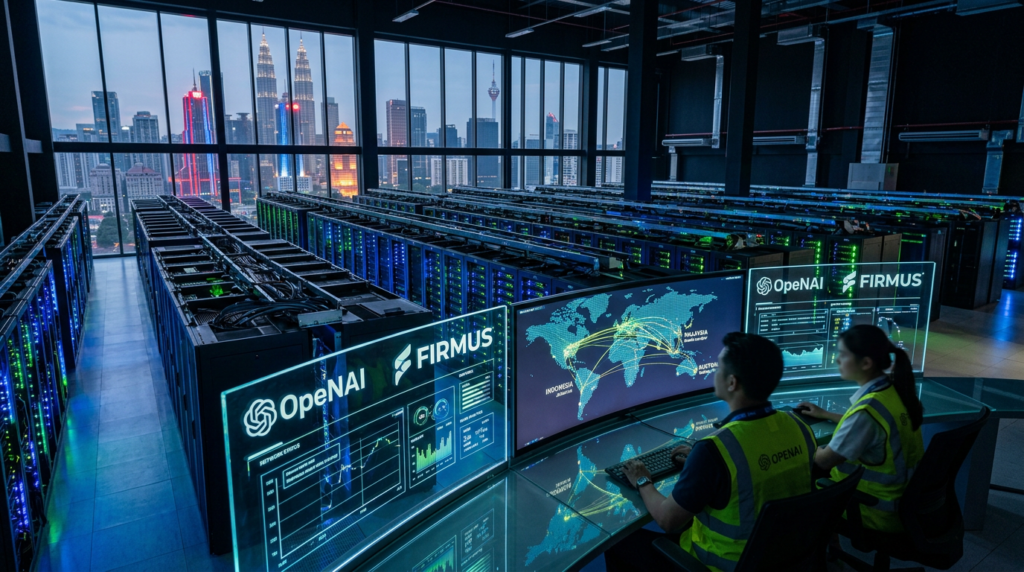
OpenAI has found another place to park a serious amount of computing power and this time, Malaysia sits at the center of the map.
The ChatGPT developer has signed a multi-year strategic agreement with Australian AI infrastructure company Firmus Technologies. Under the partnership, OpenAI will obtain dedicated computing capacity from two new Firmus “AI Factory” sites in Malaysia.
The agreement makes OpenAI an anchor customer for Firmus. It also pushes the infrastructure company’s total contracted capacity beyond 900 megawatts.
That is quite a leap. Firmus currently operates two AI facilities but has five more under development across the Asia-Pacific region. The Malaysian expansion will add OpenAI to a platform stretching across Australia, Singapore, Indonesia, and Malaysia.
Meanwhile, Nvidia plays a substantial supporting role. The chipmaker backs Firmus financially, and Firmus plans to equip its regional facilities with Nvidia’s next-generation Vera Rubin systems.
In other words, this is not simply another cloud-services contract. It connects one of the world’s most influential AI developers, the dominant supplier of AI accelerators, and Southeast Asia’s fastest-growing data-center market.
There are still unanswered questions, including the deal’s financial value and the exact locations of the two Malaysian sites. Nevertheless, the agreement sends a clear signal: Malaysia has moved from aspiring AI hub to serious contender.
OpenAI Goes Shopping for More Computing Power
Modern AI models require a staggering amount of infrastructure. Training is computationally expensive. Serving millions of users is not exactly light work either.
Every time someone asks ChatGPT to analyze a document, generate software, create an image, or solve a complicated problem, physical machines perform the calculations somewhere. Those machines need processors, electricity, cooling systems, storage, and high-speed networking.
OpenAI’s agreement with Firmus addresses that appetite directly.
According to the official announcement from Firmus, OpenAI will contract dedicated AI computing capacity from two Malaysian facilities under a multi-year arrangement. Neither company disclosed how much capacity OpenAI reserved at each site.
OpenAI Vice President of Compute Strategy Sachin Katti said the Malaysian facilities would help the company meet growing demand for its products “across the region and around the world.”
That wording matters. Although the infrastructure sits in Malaysia, its usefulness will not necessarily stop at the border. Large AI facilities can support workloads from multiple markets, depending on connectivity, regulations, latency requirements, and OpenAI’s deployment strategy.
Essentially, OpenAI is expanding the engine room while its audience keeps getting larger. The chatbot may live inside a browser, but its appetite belongs in an industrial kitchen.
What Being an Anchor Customer Actually Means
The term “anchor customer” sounds like something involving ships, loyalty points, or an unusually ambitious marina. In infrastructure, it carries a more practical meaning.
An anchor customer commits to buying a meaningful portion of a new project’s future capacity. That commitment gives the developer predictable demand before the facility is fully completed.
For Firmus, landing OpenAI provides more than an impressive logo for a presentation. It can strengthen the business case for investing in hardware, construction, power connections, cooling equipment, and network infrastructure.
OpenAI also benefits. Instead of waiting for spare computing capacity to appear, the company secures dedicated resources as part of a planned buildout.
The arrangement raises Firmus’ contracted portfolio to more than 900 MW, according to both the company and Reuters. That figure covers commitments from all Firmus customers, not OpenAI alone.
Firmus has not revealed the contract’s monetary value. Reuters reported that the company declined to provide one, while OpenAI did not immediately answer the news agency’s request for additional comment.
That leaves plenty of room for speculation but speculation is not a substitute for an invoice. The confirmed facts remain substantial enough: two Malaysian sites, a multi-year agreement, dedicated AI capacity, and OpenAI as an anchor customer.
No financial guesswork required.
Firmus Is Building “AI Factories,” Not Ordinary Data Centers
Firmus prefers the term “AI Factory” for its facilities. Yes, the phrase carries a generous helping of industrial drama. It also describes a genuine shift in data-center design.
A traditional data center might host websites, databases, business applications, and general cloud services. An AI factory focuses heavily on accelerated computing. It combines large clusters of GPUs with specialized networking, storage, power distribution, and cooling.
Firmus says its platform vertically integrates these components to improve efficiency. The goal sounds deceptively simple: consume energy and produce AI tokens at the lowest practical cost.
The company plans to combine its modular HyperCube infrastructure with Nvidia’s DSX AI Factory Platform. The facilities will use liquid cooling and prefabricated mechanical and electrical systems designed to support high-density computing equipment.
Firmus says it manufactures parts of the HyperCube system in regional New South Wales. Prefabrication could help the company reproduce facilities faster across different locations instead of treating every data center as an entirely new engineering puzzle.
That repeatable design will become important as Firmus expands. Its wider portfolio now includes seven AI factories across four countries. Two facilities in Australia and Singapore are already operating. Five others remain under development and are targeting readiness within the next 24 months.
It is an ambitious schedule. GPUs, unfortunately, do not run on ambition. Firmus must still deliver buildings, power, cooling, connectivity, and machines on time.
Nvidia Supplies the Muscle Behind the Expansion
Nvidia sits one step behind the OpenAI–Firmus handshake, but its fingerprints appear throughout the project.
The chipmaker is an investor in Firmus. Other reported backers include Jane Street, funds managed by Blackstone, and Coatue Management. Business Today Malaysia reported that Firmus received a valuation exceeding US$10.5 billion during its latest fundraising round.
More importantly, Firmus intends to deploy Nvidia’s Vera Rubin platform across its Asia-Pacific infrastructure.
Vera Rubin represents Nvidia’s next generation of accelerated computing systems. The Malaysian AI factories will integrate Vera Rubin NVL72 rack-scale systems through Nvidia’s DSX platform and Firmus’ HyperCube design.
That setup brings processors, networking, cooling, software, and facility engineering into one coordinated system. For OpenAI, this can provide the tightly integrated infrastructure needed to train models or operate them at enormous scale.
For Nvidia, the partnership extends its influence beyond selling individual chips. Its technology becomes part of an entire regional computing platform.
For Firmus, Nvidia supplies both technological credibility and access to highly sought-after hardware.
The relationship forms a neat triangle: OpenAI brings demand, Firmus builds and operates the facilities, and Nvidia supplies much of the computing machinery. Everyone brings something expensive to the picnic.
Why Malaysia Has Become an AI Infrastructure Magnet
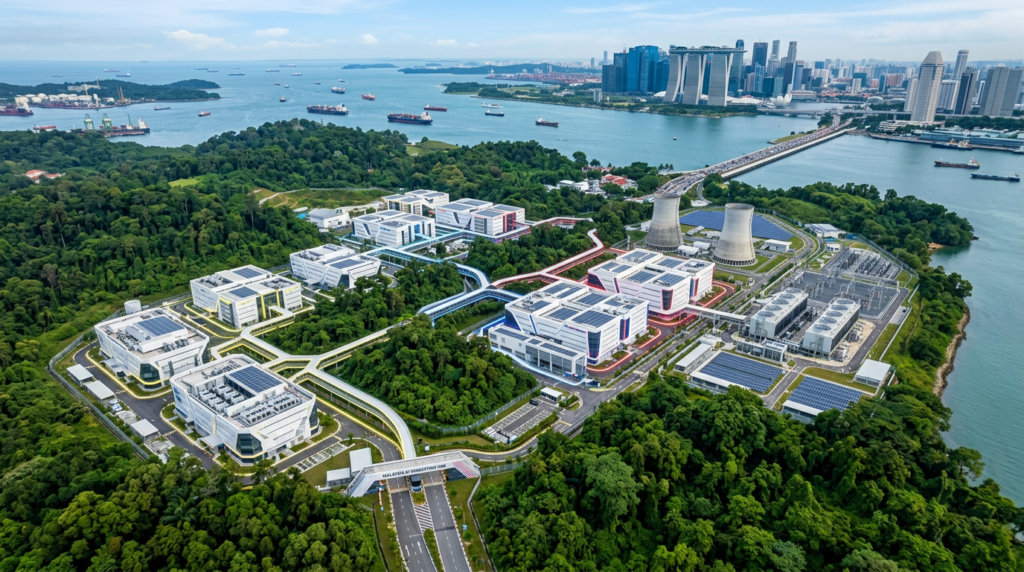
Malaysia did not suddenly wake up and discover two hyperscale facilities sitting beside the morning coffee. Its data-center rise has been building for years.
The country offers several advantages: comparatively affordable land, access to power, improving network connectivity, and proximity to Singapore. When Singapore restricted new data-center development between 2019 and 2022, some demand spilled into neighboring Malaysia especially Johor.
Major technology companies followed.
Microsoft announced a multibillion-dollar cloud and AI investment in the country. Google committed US$2 billion to establish its first Malaysian data center and cloud region. Amazon, Alibaba, Tencent, Nvidia-linked ventures, and other infrastructure operators have also expanded their presence.
By 2026, Malaysia had become one of the fastest-growing data-center markets in Asia. A Reuters investigation into the country’s infrastructure boom identified Johor and Selangor as major areas of activity.
Firmus has not publicly identified where its two Malaysian sites will be located. Johor would be an obvious candidate based on existing industry development, but calling it confirmed would run faster than the evidence.
Wherever the sites land, OpenAI’s involvement raises Malaysia’s status. The country is no longer attracting only conventional cloud storage and enterprise services. It is gaining facilities designed specifically for cutting-edge AI workloads.
That is a different weight class.
A Bigger Role for Southeast Asia
The agreement also reflects a broader geographical shift.
For much of the generative-AI boom, attention concentrated on enormous American campuses. Virginia, Texas, Ohio, and other states became familiar locations in increasingly colossal infrastructure announcements.
Asia-Pacific demand, however, is growing quickly. The region has hundreds of millions of internet users, expanding digital economies, active developer communities, and governments eager to establish domestic AI capabilities.
Putting more infrastructure inside the region could improve resilience and reduce dependence on distant computing hubs. It may also help companies serve Asian customers with lower latency, although OpenAI and Firmus have not specified which services or markets the Malaysian capacity will support.
Firmus co-founder and co-CEO Tim Rosenfield described the partnership as a moment when Asia-Pacific becomes “a producer of intelligence, not just a consumer of it.”
That statement is corporate messaging, but it captures the strategic ambition. Countries want more than access to foreign AI products. They want infrastructure, investment, engineering knowledge, and economic participation.
Malaysia’s existing semiconductor and electronics industries give it another advantage. Data centers do not automatically create a complete AI ecosystem, of course. Servers alone will not produce thousands of researchers or software companies by magic.
Still, computing infrastructure forms part of the foundation. Without it, ambitious AI plans can quickly become very polished PowerPoint presentations waiting for a GPU.
Firmus Is Scaling at Remarkable Speed
The OpenAI agreement arrives during an aggressive expansion period for Firmus.
The Sydney-headquartered company says its platform now covers seven facilities. Beyond Malaysia, it has projects in Australia, Singapore, and Indonesia, including a major Nvidia-powered campus planned for Batam.
In June, Firmus announced plans to develop infrastructure supporting as many as 170,000 Nvidia accelerators across several Nvidia hardware generations through 2027 and 2028. The company has also secured a long-term agreement for trans-Pacific subsea-cable capacity.
Those projects show that Firmus is thinking about more than buildings. An AI facility needs reliable communication links to move massive quantities of data between regions and customers.
The OpenAI contract could also strengthen Firmus ahead of a possible stock-market listing. Reuters reported that the company has been considering an initial public offering that could rank among Australia’s largest recent floats.
However, that IPO remains reported rather than formally confirmed in the OpenAI announcement. The partnership does not guarantee that a listing will happen, nor does it establish a public valuation for the contract.
What it does provide is commercial validation. OpenAI has plenty of reasons to scrutinize infrastructure partners carefully. Securing it as an anchor customer suggests Firmus has convinced one of the industry’s hungriest computing buyers that it can deliver.
Now comes the tricky part: actually delivering.
The Electricity and Water Question Is Not Going Away
Malaysia’s data-center boom brings opportunity, but it also comes with a power cable attached and that cable is getting thick.
Advanced AI facilities consume enormous quantities of electricity. Cooling systems can also require substantial water, depending on their design and local climate. As developments multiply, communities and regulators increasingly want to know who pays for new infrastructure and whether projects will strain public resources.
Reuters reported that Malaysia’s rapid expansion has already triggered greater scrutiny over electricity and water consumption. Authorities in major development areas have introduced tighter requirements involving efficiency, renewable energy, water use, and local participation.
Firmus promotes liquid cooling, modular construction, and energy-efficient engineering as central features of its platform. It says integrating facility and computing systems can reduce waste and lower the cost of producing AI tokens.
Those claims will matter most when operating data becomes available.
Efficiency does not necessarily mean low consumption. A highly efficient 100-MW facility still uses a large amount of electricity. If companies make AI computation cheaper, customers may simply consume more of it.
Malaysia therefore faces a balancing act. It wants the investment, technology, and economic activity associated with becoming an AI hub. It must also protect water supplies, manage the electrical grid, and ensure local communities receive meaningful benefits.
The shiny server racks are only half the story. Someone still has to keep the lights and the cooling pumps on.
What the Agreement Could Mean for OpenAI Users
The deal does not mean Malaysian ChatGPT users will immediately notice faster answers or receive a magical new button. OpenAI has not announced any consumer-facing feature tied directly to the facilities.
Infrastructure agreements work behind the curtain.
Over time, additional capacity can help OpenAI serve more users, support demanding models, and reduce bottlenecks during periods of heavy activity. Dedicated regional infrastructure might also give the company more flexibility when allocating workloads across its global network.
The facilities could support training, inference, or a mixture of both. Training creates or improves models by processing vast datasets. Inference occurs when a trained model responds to users. OpenAI and Firmus have not disclosed the intended workload mix, so declaring one would be premature.
The company announcement instead emphasizes growing worldwide demand for OpenAI products.
That demand has transformed computing capacity into a strategic resource. AI developers can create brilliant models, but those models have limited commercial value if customers cannot access them reliably or if every popular launch produces a digital traffic jam.
OpenAI has pursued infrastructure relationships across multiple markets and suppliers. The Firmus agreement adds another regional piece to that expanding puzzle.
For users, the eventual result should feel boring in the best possible way: more availability, enough capacity, and fewer moments when an overloaded service politely asks everyone to come back later.
A Major Win, With Important Blanks Still Unfilled

The OpenAI–Firmus partnership represents a significant vote of confidence in Malaysia’s emerging AI infrastructure sector.
It gives OpenAI dedicated capacity from two new facilities. It pushes Firmus beyond 900 MW in total contracted customer commitments. It expands the company’s footprint to a fourth country. And it creates another major destination for Nvidia’s upcoming Vera Rubin systems.
Several important details remain undisclosed.
The companies have not revealed the contract value, the capacity assigned specifically to OpenAI, the precise locations of the facilities, or their individual completion dates. Firmus only says its five developing sites target readiness within the next 24 months.
Those omissions prevent a complete financial or operational assessment. They do not erase the larger direction.
AI companies are searching globally for power, land, cooling, processors, and connectivity. OpenAI’s Malaysian agreement shows that Southeast Asia will play a larger role in supplying them.
The opportunity could extend beyond data-center construction. If Malaysia connects new infrastructure with education, research, renewable power, and local technology companies, it could capture more of the AI economy’s value.
Firmus has separately proposed an Australian AI Access Program for researchers and organizations working in science, education, agriculture, energy efficiency, and climate resilience. It has not announced an equivalent Malaysian program.
For now, the machines are the headline. What Malaysia builds around them will determine whether this becomes merely a large infrastructure deal or the foundation of something much bigger.
Sources
- Firmus: OpenAI becomes an anchor customer as contracted capacity surpasses 900 MW
- Reuters: Nvidia-backed Firmus signs OpenAI agreement for Malaysian capacity
- Business Today Malaysia: OpenAI secures capacity from Nvidia-backed Firmus
- Capital Brief: Firmus adds OpenAI as anchor customer
- Reuters: Malaysia’s data-center boom faces scrutiny over resources
- Microsoft: Why Malaysia needs data centers for an AI-powered future
- Associated Press: Microsoft’s US$2.2 billion Malaysian cloud and AI investment
- Reuters: Google’s Malaysian data-center and cloud-region investment
The Kingy Brief
Get The Kingy Brief.
AI changes, original tests and one practical thing to try. Fridays at 09:00 Vancouver time.
Free · Double opt-in · Unsubscribe anytime
Sign up for The Kingy Brief on Beehiiv.
Signup help and newsletter schedule
Signup form provided by Beehiiv. After submitting, check your inbox for "Confirm your subscription to The Kingy Brief" and open its confirmation link. Check Spam or Promotions if you cannot find it.
Fridays at 09:00 Vancouver time: source-checked AI changes, original tests and one practical thing to try. We skip a week when there is not enough verified material. Free. Unsubscribe anytime.