Meet the Humanoid Built for Dangerous Work
The phrase “robot soldier” sounds like something lifted from a film trailer the kind featuring metallic footsteps, a nervous general and at least one scientist shouting, “We’ve lost control!”
Yet in San Francisco, a startup called Foundation Future Industries is turning that cinematic premise into actual hardware.
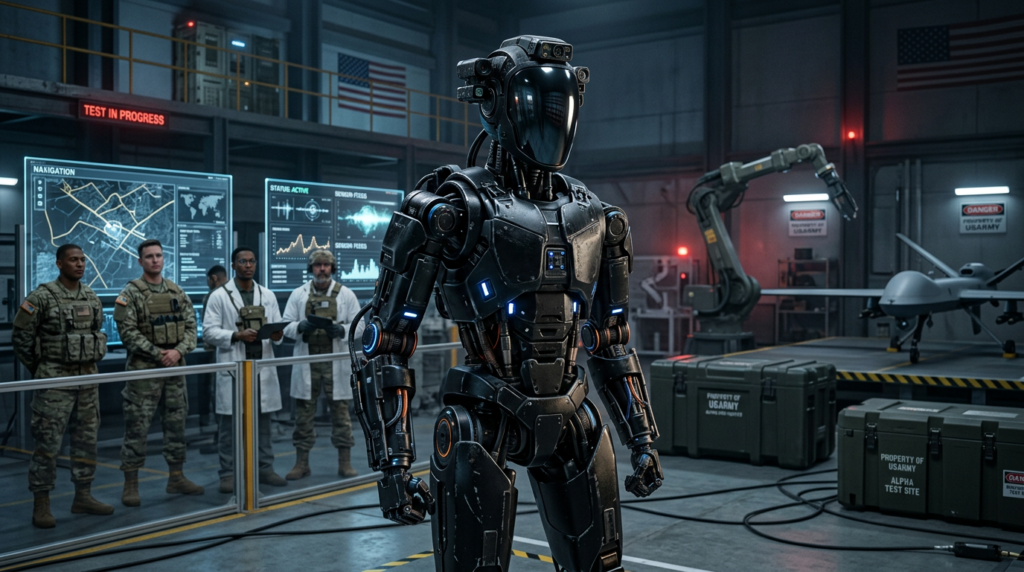
Founded in 2024, Foundation develops humanoid robots for industrial and military assignments. Its flagship machine, Phantom, resembles a futuristic armored worker: tall, black, human-shaped and equipped with a smooth face shield rather than anything resembling a friendly smile.
That appearance is no accident. Phantom must operate in environments designed for people, from warehouses and factories to military facilities. A humanoid body can theoretically use existing doors, stairs, tools and vehicles without forcing customers to rebuild everything around it.
Foundation’s immediate goals sound practical. The company wants its robots to move heavy materials, inspect dangerous locations and carry out repetitive industrial jobs. However, its ambitions extend well beyond warehouse duty.
Co-founder and CEO Sankaet Pathak believes humanoid machines could eventually enter combat zones alongside or ahead of human troops. If the US military requested armed versions, he told The Independent, Foundation would be willing to develop them.
Nobody has reportedly made that request yet. Still, the answer has ignited a much larger argument.
The technology may begin with cargo. It could end with a machine carrying a rifle.
That is quite the software update.
What Phantom Can Actually Do
Phantom is not being presented as an unstoppable mechanical super-soldier. At least, not yet.
According to The Independent, the current robot stands roughly six feet tall and can carry nearly 90 pounds. Cameras positioned around its head give it a 360-degree view, while onboard artificial intelligence helps it perceive and navigate its surroundings.
The machine can operate autonomously for certain tasks or under remote human control. That distinction matters. A remotely piloted robot functions more like a sophisticated vehicle, while an autonomous system can interpret conditions and act without continuous instructions.
Foundation says its present work concentrates on autonomous navigation and materials handling. That includes moving cargo and working around people without treating them as obstacles or, more ominously, as targets.
The company is also developing reconnaissance capabilities. A Phantom could enter an unfamiliar building, inspect rooms and map the interior before soldiers go inside. That would place hardware, rather than a person, in the most vulnerable position.
Foundation claims Phantom robots contributed to the production of more than 24,000 cars in 2025. Reuters reported that the machines have already participated in industrial deployments and that Foundation leases industrial units for approximately $100,000 per year.
For defense customers, the price reportedly reaches around $300,000 per robot.
That is expensive compared with a commercial drone. Compared with training, equipping and protecting a soldier, however, the calculation becomes more complicated and far more consequential.
The Difference Between Military and Lethal
Military robotics already exists. Bomb-disposal robots have saved lives for decades. Drones conduct surveillance, deliver supplies and evacuate wounded personnel. Automated systems inspect vehicles, patrol facilities and operate in environments filled with fire, radiation or toxic chemicals.
A humanoid carrying ammunition or mapping a hostile building does not automatically qualify as an autonomous weapon.
The controversy begins when the same robot receives a weapon and the ability to select, track or engage a target.
Pathak told The Independent that no customer has asked Foundation to weaponize Phantom. Nevertheless, he argued that if the military requested armed humanoids, the request would likely reflect a desire for more precise operations. Foundation would want to participate, he said.
That position separates the company from several major robotics developers. In 2022, a group that included Boston Dynamics, Agility Robotics, ANYbotics, Clearpath Robotics, Open Robotics and Unitree pledged not to support the weaponization of their advanced general-purpose robots.
Foundation takes a different view. Pathak argues that refusing to build defense robots will not stop rival nations from developing similar technology. China and Russia, he says, are already exploring military humanoids and weapon-carrying quadrupeds.
His argument is blunt: if an arms race has already started, sitting politely beside the track will not cancel it.
Critics respond with an equally blunt question. What happens when everyone starts running faster but nobody agrees where the brakes should be?
Foundation’s Case for the Robot Soldier
Foundation’s central pitch rests on a difficult-to-dismiss principle: send machines into danger before sending people.
A robot could scout a booby-trapped structure, carry supplies through incoming fire or enter an area contaminated by chemical agents. It could also handle explosives, recover wounded soldiers or perform tedious jobs that exhaust human operators.
If the machine gets destroyed, nobody must write a condolence letter.
Pathak also argues that humanoid robots could make some military missions more precise. Instead of destroying an entire building from the air, troops might send a remotely operated Phantom inside to locate a particular threat. In theory, that could reduce civilian casualties and structural damage.
The key phrase is “in theory.”
Precision depends on more than the shape of the machine. It depends on reliable sensors, accurate intelligence, resilient communications, good software and human judgment. If one layer fails, the supposedly surgical operation can become chaotic very quickly.
Still, Foundation’s argument deserves serious consideration. A robot performing reconnaissance is not inherently more dangerous than a missile. In many situations, it could offer soldiers more information and more time before they use force.
The machine itself is neither ethical nor unethical. Everything turns on its design, deployment and command structure.
A shovel can dig a garden or a grave. Phantom simply arrives with considerably more processing power.
From Factory Floors to Military Contracts
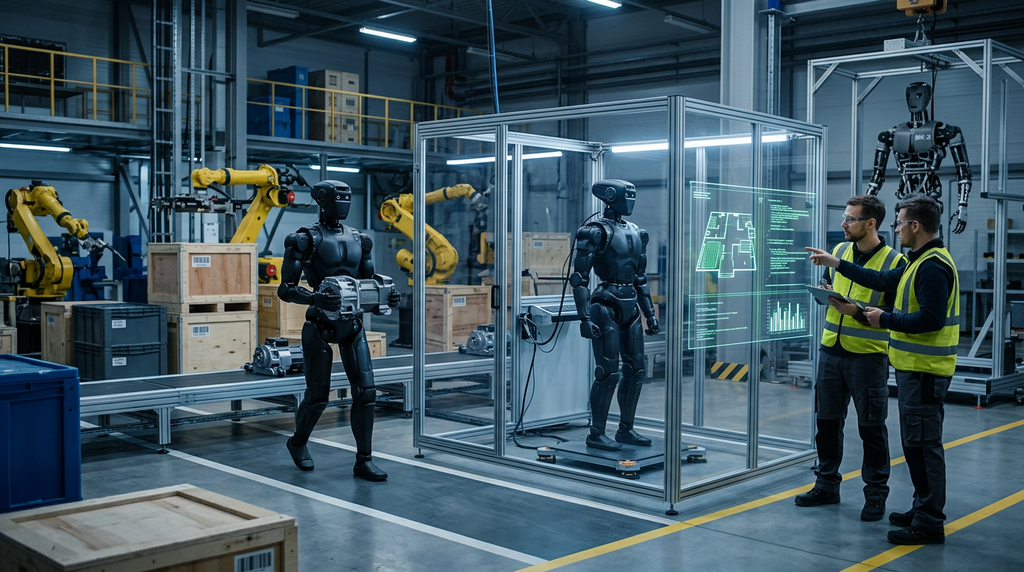
Foundation insists defense represents only a small portion of its broader operation. The company’s commercial vision includes industrial labor, logistics, construction and eventually robot-built cities.
Its military relationships, however, have attracted most of the headlines.
Reports cited by The Independent place Foundation’s defense-related research agreements at approximately $24 million, although the company declined to confirm their exact value. The programs reportedly involve testing robots across several US military branches.
The company is also discussing possible border-patrol applications with the Department of Homeland Security. No deployment has been announced, and DHS had not publicly confirmed such plans in The Independent’s report.
Meanwhile, Foundation is preparing to scale production dramatically. Pathak told Reuters that the company plans to open a factory in October 2026 with capacity for 5,000 robots per year. A second facility, scheduled to begin development in 2027, could eventually produce 50,000 annually.
Those numbers remain plans, not completed output. Manufacturing a few impressive prototypes is one challenge. Producing tens of thousands of dependable machines each capable of surviving dust, rain, impacts, electronic interference and unpredictable human environments is another beast entirely.
Foundation has also partnered with AMD to develop Phantom MK-2. The next-generation robot will use AMD’s Ryzen AI Embedded X100 Series processors for onboard computing.
In other words, Phantom is moving from startup spectacle toward a serious production program. The robot still has plenty to prove, but this is no longer merely a cool demo wandering around a laboratory.
The Eric Trump Connection
Foundation’s political connections add another layer to the story.
Eric Trump, the son of US President Donald Trump, invested in the company in early 2026 and serves as its chief strategy adviser. Foundation has not disclosed the size of his investment. It also told The Independent that he receives no pay from the company.
A spokesperson for Eric Trump said he plays no role in daily management or corporate decision-making. Foundation and the White House have also denied that his involvement gives the startup preferential treatment.
Even so, the arrangement invites scrutiny. Foundation seeks government defense business while a sitting president’s son owns a financial interest in the company. That does not, by itself, prove wrongdoing. It does create an obvious conflict-of-interest concern that demands transparency.
Reuters noted that the Trump family’s investments in several companies pursuing government contracts have drawn wider criticism. Eric Trump and Donald Trump Jr. have also backed businesses involved in drones and defense technology.
The timing makes the relationship particularly sensitive. Washington is pouring money into autonomous systems as drones, artificial intelligence and robotic platforms reshape military planning. A startup with strong technology and powerful connections could benefit enormously.
The appropriate response is neither to assume corruption nor to wave the issue away. Contract awards, testing requirements and procurement decisions should remain open to meaningful oversight.
When public money meets private investment and presidential relatives, “trust us” is not a sufficient accounting system.
Why Human-Rights Experts Are Alarmed
Human-rights groups do not generally oppose robots carrying boxes, clearing mines or rescuing injured people. Their concern centers on machines that can influence or independently make life-and-death decisions.
Verity Coyle of Human Rights Watch told The Independent that military humanoids could support humanitarian operations. However, she warned that a Silicon Valley-style “move fast” philosophy could produce catastrophic consequences without effective legal protections.
AI systems make mistakes. Cameras misread shadows. Sensors fail. Data contains gaps and biases. Communications links get jammed. Software behaves differently in unfamiliar conditions.
A warehouse error might send the wrong package down a conveyor belt. A battlefield error might identify the wrong person as a threat.
Accountability creates another problem. If an autonomous robot unlawfully kills a civilian, who carries responsibility? The commanding officer? The remote operator? The software developer? The manufacturer? The official who approved the system?
Existing international humanitarian law still applies. Armed forces must distinguish combatants from civilians, use proportionate force and take precautions to reduce civilian harm. Yet translating those duties into software remains unsettled.
The News Minimalist summary highlights growing concern among rights experts and international organizations, including the United Nations. UN Secretary-General António Guterres has supported a legally binding prohibition on lethal autonomous weapons that operate without human control.
The debate, therefore, is not simply about robots with guns. It is about whether meaningful human judgment remains attached to every trigger.
Human Control Is Not a Magic Phrase
Military developers often promise to keep a human “in the loop.” That sounds reassuring. Unfortunately, the phrase can describe wildly different arrangements.
A human operator might directly control every movement and approve every shot. Alternatively, one person might supervise dozens of robots, receiving only seconds to accept or reject machine-generated recommendations.
Technically, both systems involve human authorization. Practically, they are worlds apart.
Automation bias compounds the danger. People frequently trust computer recommendations, especially under pressure. When an AI system presents a target with a bright red box and a confidence score, an exhausted operator may approve the action without conducting a meaningful review.
Battlefield communications can also disappear. Electronic warfare already disrupts drone links in Ukraine. A humanoid operating inside a concrete building, underground tunnel or heavily jammed area might lose contact with its controller.
What happens next must be decided before deployment. Does the robot freeze? Retreat? Continue its mission? Defend itself? Fire at anything classified as hostile?
Those are policy choices disguised as engineering settings.
Phandroid reports that Foundation remains willing to produce an armed Phantom if requested, while emphasizing that the company has not yet received such an order. That caveat is essential. The current story concerns a stated willingness and a developing capability not confirmed armies of autonomous gunmen roaming battlefields.
The Terminator has not arrived. The procurement paperwork, however, may already be warming up.
Would Robot Armies Make War Easier?
Robotic warfare presents a nasty paradox.
Replacing soldiers with machines could reduce military casualties. It could also lower the political cost of starting or extending a conflict.
Joe Costa, a former Pentagon official now at the Atlantic Council, warned that leaders might find military action easier to authorize if they no longer need to place their own troops directly at risk.
That possibility changes deterrence. Voters react strongly when soldiers die. Destroyed machines do not return home in flag-draped coffins. A government equipped with thousands of relatively replaceable robots might tolerate longer, more frequent or more aggressive operations.
The economics could accelerate that shift. Once manufacturers achieve mass production, robotic forces may become cheaper to expand than conventional armies. Software improvements can also spread rapidly across an entire fleet.
One update. Ten thousand newly capable machines.
Robots could likewise fight at speeds humans struggle to understand. Automated systems might detect, classify and respond to threats in milliseconds. Rival forces would feel pressure to grant their machines greater autonomy simply to keep up.
That dynamic risks producing conflicts in which humans formally remain in command but cannot realistically follow every decision.
The result may not resemble a science-fiction rebellion. There need be no evil supercomputer announcing the end of humanity.
A far more plausible danger is mundane: flawed systems, hurried officers, jammed networks, murky accountability and thousands of machines acting faster than diplomats can reach the phone.
Less Hollywood. More systems failure. Somehow, that is scarier.
The Future Foundation Wants to Build
Foundation’s ambitions do not stop at factories or battlefields.
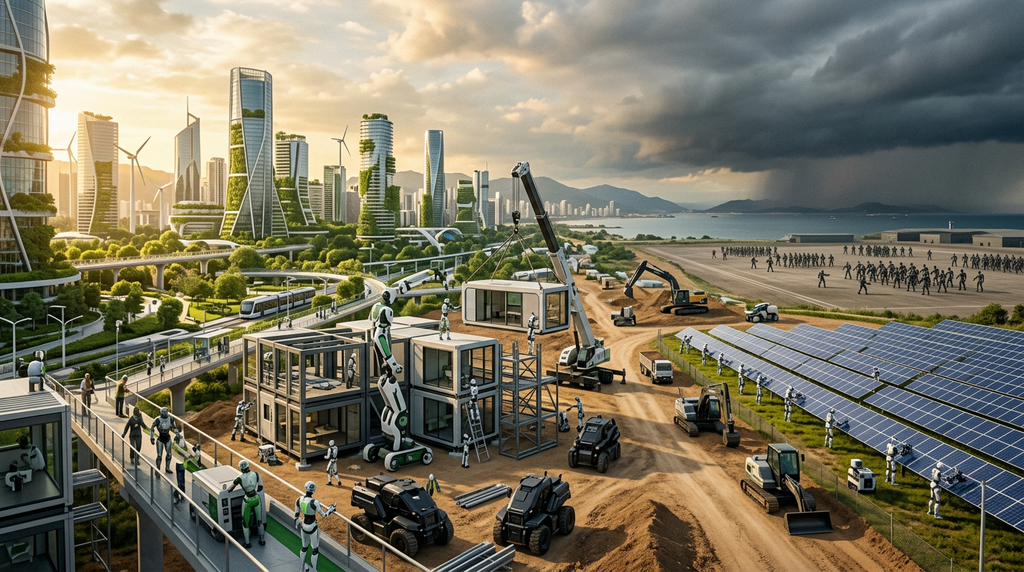
Pathak imagines robotics creating enormous gains in productivity. Machines would perform dangerous and repetitive work, while company profits would help finance environmentally sustainable cities with abundant, inexpensive housing.
The vision mixes industrial automation, libertarian politics and a healthy scoop of science fiction. Foundation even takes its name from Isaac Asimov’s famous novels about preserving civilization through a predicted collapse.
Company executives have discussed future “droid battles,” in which robotic forces clash instead of human armies. Pathak also envisions green, robot-built cities where people can focus on art, exploration and other pursuits while machines handle society’s dull and hazardous labor.
It is an audacious package: automated factories, robotic armies and near-free housing, all tied together by the same humanoid platform.
The optimistic version offers abundance and fewer dangerous jobs. The darker version concentrates wealth, physical power and military capability inside a small group of technology companies.
Both outcomes could emerge from the same machinery.
That is why the debate cannot wait until an armed Phantom walks onto a battlefield. Governments need clear rules for testing, human control, targeting, audit logs, cybersecurity and legal accountability now.
Foundation may be correct that military humanoids are coming regardless of Western discomfort. But inevitability is not a permission slip.
Robot soldiers could save lives. They could also make violence faster, cheaper and politically easier.
The hardware is impressive. The hardest engineering challenge remains the human one: deciding what these machines must never be allowed to do.
Sources
- The Independent — Robot soldiers are being built in America to fight tomorrow’s wars
- Phandroid — U.S. startup says it would arm robot soldiers if the Army asks
- News Minimalist — US startup builds robot soldiers, sparking rights concerns
- Reuters — Eric Trump-backed Foundation partners with AMD
The Kingy Brief
Get the next Kingy Brief.
Source-checked AI changes, original tests and one practical thing to try.
Free · Choose your subjects · Double opt-in · Unsubscribe anytime